Budget guide for exterior and garden lighting installation
By Housey · Last reviewed 9th of May 2026
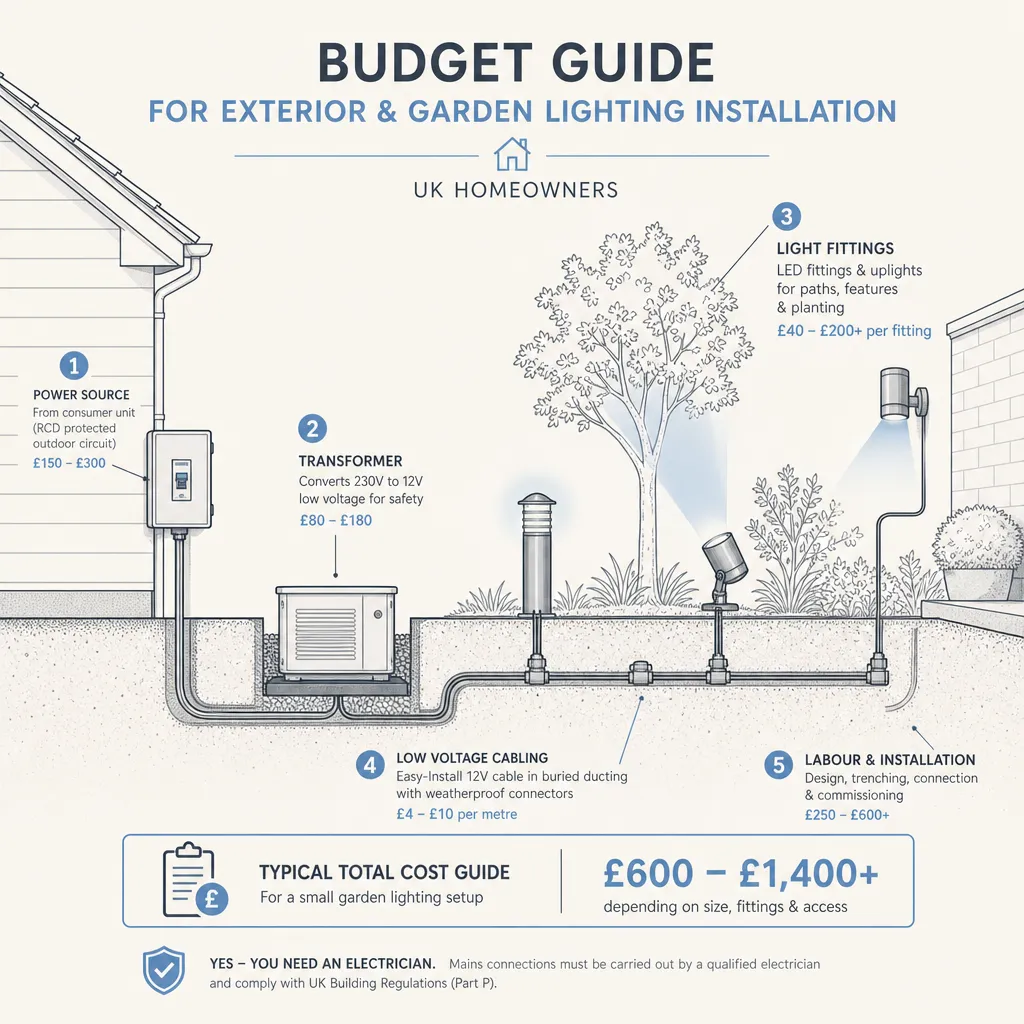
Budget guide for exterior and garden lighting installation
Exterior and garden lighting questions typically arise when homeowners are landscaping, extending, or improving kerb appeal — or after moving into a property where the outside spaces feel underlit after dark. The right choice of system affects both the upfront cost and whether you need a qualified electrician at all. Getting this wrong can mean costly rewiring later or, in some cases, unsafe installations that create problems when selling.
Key points
- New permanent mains electrical circuits outdoors fall under Building Regulations Part P (Electrical Safety — Dwellings) and must be installed by a registered electrician (NICEIC, NAPIT, or another Part P competent person scheme) in England and Wales.
- LED fittings intended for garden use must carry an IP65 rating or higher — the first digit (6) means fully dust-tight; the second (5) means protected against water jets from any direction.
- Solar and self-contained low-voltage 12 V battery systems do not trigger Part P, so confident DIYers can install these without notifying building control.
- Indicative UK costs range from around £150 for a quality solar kit to £1,500 or more for a hardwired scheme with multiple zones — Indicative UK costs, last reviewed 2026-05-09.
- Properties in conservation areas or with listed building status may require consent before fixing permanent external light fittings to walls or structures.
Types of exterior lighting and what they typically cost
Garden lighting broadly falls into three categories, each with different cost profiles and installation requirements.
Solar lighting requires no wiring or electrician. Individual solar spike lights cost £10–£40 each, while quality branded solar path kits run £80–£300 for six to ten units. Performance varies considerably — cheaper units may only light reliably for three to four hours after a cloudy UK day.
Low-voltage (12 V) cable systems are transformer-based: a plug-in or hard-wired transformer steps mains power down to 12 V, with cable runs out to garden fittings. Transformer and cable kits typically start around £120–£350. Running the low-voltage cable yourself is usually straightforward; only the mains side of the transformer requires Part P compliance if a new circuit is needed.
Mains hardwired systems offer the most reliable output and allow higher-specification fittings — wall lanterns, floodlights, and uplighters with meaningful output. A qualified electrician will install a new outdoor circuit from the consumer unit or an existing junction, lay Steel Wire Armoured (SWA) cable or run conduit, and fit weatherproof back boxes and fittings. Expect to pay £400–£1,500 for a modest residential scheme, including materials and labour — Indicative UK costs, last reviewed 2026-05-09. Costs rise with cable run length, multiple zones, smart controls, and the complexity of any groundwork.
What drives the price up or down
Several factors move the final quote materially:
- Number of fittings and zones. Each additional circuit zone — patio, path, driveway, pond feature — adds both labour and materials.
- Cable route. Surface conduit is faster and cheaper than trenching. Digging through clay soils or under block paving adds significant groundwork cost.
- Armoured cable vs conduit. SWA cable buried directly is common for garden runs; surface-mounted or under-path conduit may cost less in labour but more in materials depending on the run.
- Smart or sensor controls. PIR motion sensors, dusk-to-dawn photocells, and smart home integration (Zigbee, Z-Wave, or Wi-Fi) typically add £50–£200 per zone.
- Fitting quality and material. IP65 brass or stainless-steel uplighters cost substantially more than plastic equivalents but hold up better in UK weather over time.
- Access and groundwork. Lifting and relaying paving slabs or reinstating turf adds cost — some electricians subcontract this element to a separate groundworker.
Do you need an electrician — and what about planning permission?
Electrician: Under Building Regulations Part P, any new electrical circuit installed outdoors is a notifiable installation in England and Wales. This must be carried out by a Part P registered electrician or self-certified through a competent person scheme such as NICEIC or NAPIT. Extending an existing outdoor socket circuit is also notifiable if it creates a new outdoor circuit. Failure to use a registered electrician can create problems when selling — you may need a retrospective building control sign-off or a remedial electrical certificate.
Planning permission: Most exterior lighting on a dwelling is permitted development and does not require a planning application. However, excessively bright or poorly aimed fittings can attract complaints, and some local planning authorities publish guidance on light pollution. Properties in conservation areas may need conservation area consent for permanent external fixtures that could affect the character of the area. Listed buildings may require listed building consent. Check with your local planning authority if in any doubt — the Planning Portal provides a useful starting point for permitted development eligibility.
Comparison: solar vs low-voltage vs mains hardwired
Feature | Solar | Low-voltage (12 V) | Mains hardwired |
|---|---|---|---|
Electrician required? | No | Not for cable runs; yes for mains transformer circuit | Yes (Part P) |
Typical upfront cost | £150–£300 for a kit | £200–£600 installed | £400–£1,500+ |
Reliability | Weather-dependent | Good | Excellent |
Maximum brightness | Low to moderate | Moderate | Low to high (fitting-dependent) |
Running cost | Zero | Very low | Low (LED) |
Suitable for security lighting? | Rarely | Occasionally | Yes |
DIY-friendly? | Yes | Partly | No |
Worked scenario: 1930s semi in Nottingham
A homeowner with a 1930s semi-detached in Nottingham wanted six path lights along a 10-metre front path, two wall lanterns at the front door, and two uplighters in the rear garden. They requested three options from local contractors:
- Solar path lights only (DIY): £240 for quality solar spike sets — no electrician needed, fitted in an afternoon.
- Low-voltage kit plus electrician for transformer circuit: £580 including a NICEIC-registered electrician to install the transformer spur, with the homeowner running the low-voltage cable between fittings. Reliable year-round lighting without a full rewire.
- Fully hardwired scheme across all zones: £1,150 from a local NICEIC contractor, including trenching for armoured cable to the rear garden, three timer-controlled zones, and a PIR sensor at the front door lanterns.
The homeowner chose option two for the path lights and front door, and added solar uplighters in the rear garden — total spend approximately £680. The key decision factor was avoiding unnecessary groundwork while still getting year-round reliable lighting at the front.
What to ask before accepting a quote
Before instructing an electrician or lighting installer, confirm the following:
- Are you registered with NICEIC, NAPIT, or another Part P competent person scheme?
- Will you provide a Part P completion certificate for building control notification?
- What cable type will you use (SWA armoured, conduit, or flex) and why is it appropriate for this run?
- Is groundwork — trenching, paving or turf reinstatement — included in the quote, or priced separately?
- Are IP-rated back boxes and weatherproof fittings included in the price?
- Is VAT included in the total figure?
- What warranty do you offer on labour, and what is the manufacturer warranty on the fittings?
When to get professional help
Always use a Part P registered electrician for any new mains outdoor circuit. Additionally, seek professional advice if:
- You are in a listed building or conservation area and want permanent external fittings affixed to the structure.
- The cable run must pass under driveways, paths, or close to buried services such as gas pipes, water mains, or drainage.
- You want security lighting integrated with an alarm or CCTV system.
- An existing outdoor circuit is tripping the consumer unit, showing visible corrosion, or has exposed or damaged cable.
For any suspected fault with an existing outdoor electrical installation, do not attempt repairs yourself — contact a Part P registered electrician.
How Housey can help
Housey connects homeowners across the UK with vetted local tradespeople. Whether you need a Part P registered electrician for a garden lighting circuit, a landscaper to advise on placement and aesthetics, or a groundworker to handle trenching alongside the installation, Housey makes it straightforward to request and compare quotes before you commit to a contractor.
Frequently asked questions
Do I need building regulations approval for garden lights?
New outdoor mains circuits require notification under Building Regulations Part P in England and Wales. Using a Part P registered electrician (NICEIC or NAPIT) means they self-certify and notify building control on your behalf. Solar and 12 V low-voltage systems that do not involve a new mains circuit do not require Part P notification.
How long does garden lighting installation take?
A simple mains outdoor lighting scheme with two to four fittings typically takes a qualified electrician four to eight hours. Larger schemes involving trenching and multiple zones may take a full day or more, particularly if groundwork to reinstate turf or paving slabs is included in the scope.
Can I install garden lights myself?
Solar and low-voltage 12 V systems are generally safe for a confident DIYer. Any work involving a new mains circuit outdoors must be carried out by a Part P registered electrician. Do not attempt to extend or modify mains outdoor wiring yourself unless you hold the appropriate qualification.
What IP rating do I need for outdoor lights?
The minimum recommended for garden use is IP44 (splash-protected), but IP65 is the standard for exposed fittings such as path lights, uplighters, or wall lanterns in full weather. IP65 means fully dust-tight and protected against water jets. Always check the fitting datasheet before purchasing.
Will garden lighting noticeably increase my electricity bill?
LED garden lights use very little energy — a 5 W LED path light running six hours nightly uses roughly 11 kWh per year. A scheme of ten such fittings might add approximately £3–£5 per year at typical UK electricity rates. Smart timers and PIR sensors reduce consumption further.
Sources and further reading
- Building Regulations Approved Document P: Electrical Safety — GOV.UK
- Find a Registered Electrician — NICEIC
- Find a Member — NAPIT
- Permitted Development Rights Guidance — Planning Portal
- Energy-Efficient Lighting — Energy Saving Trust
Useful next reads
 General property advice
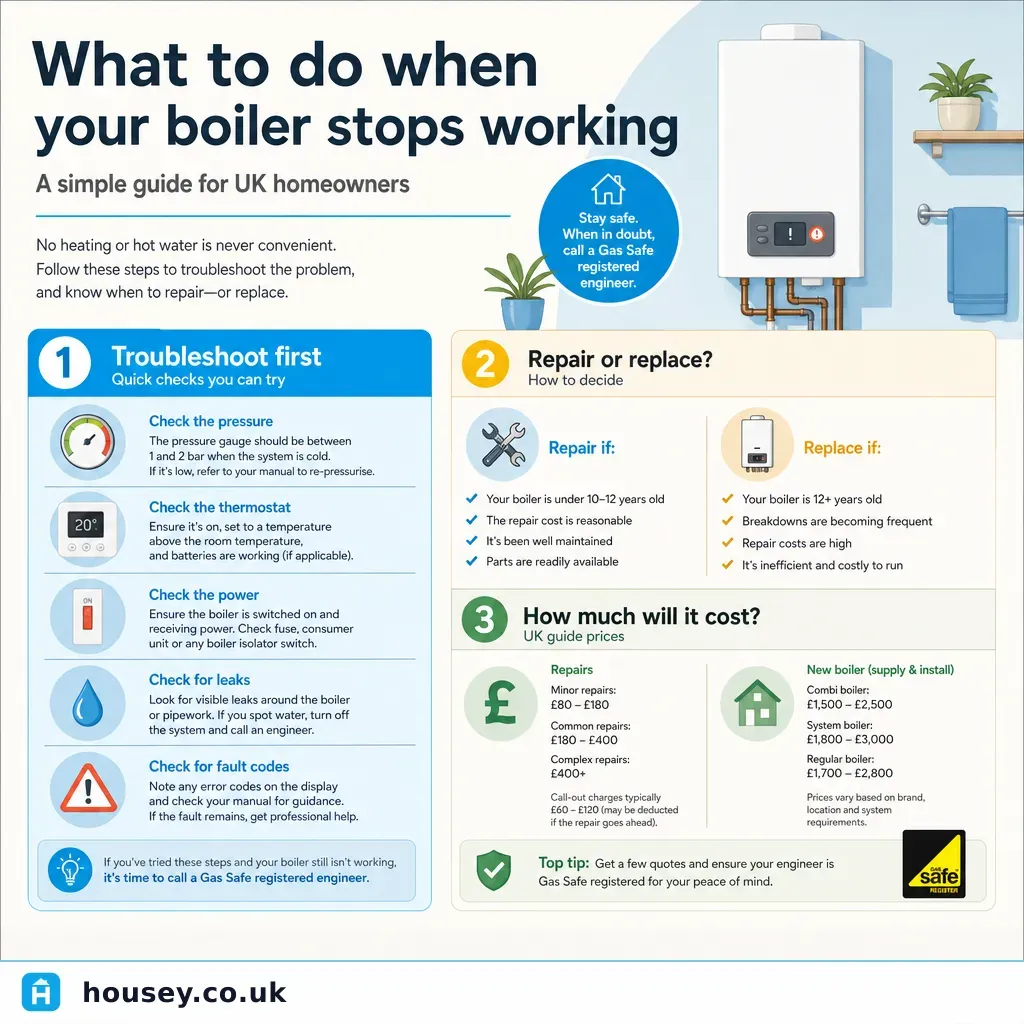
What to do when your boiler stops working
When your boiler stops working, check the pressure gauge (should read 1–1.
 General property advice
Property Market Trends: Activity Growth and Price Movements
UK property market activity is measured through completed sale registrations (HM Land Registry), lender mortgage data, and transaction volumes from HMRC.
 General property advice
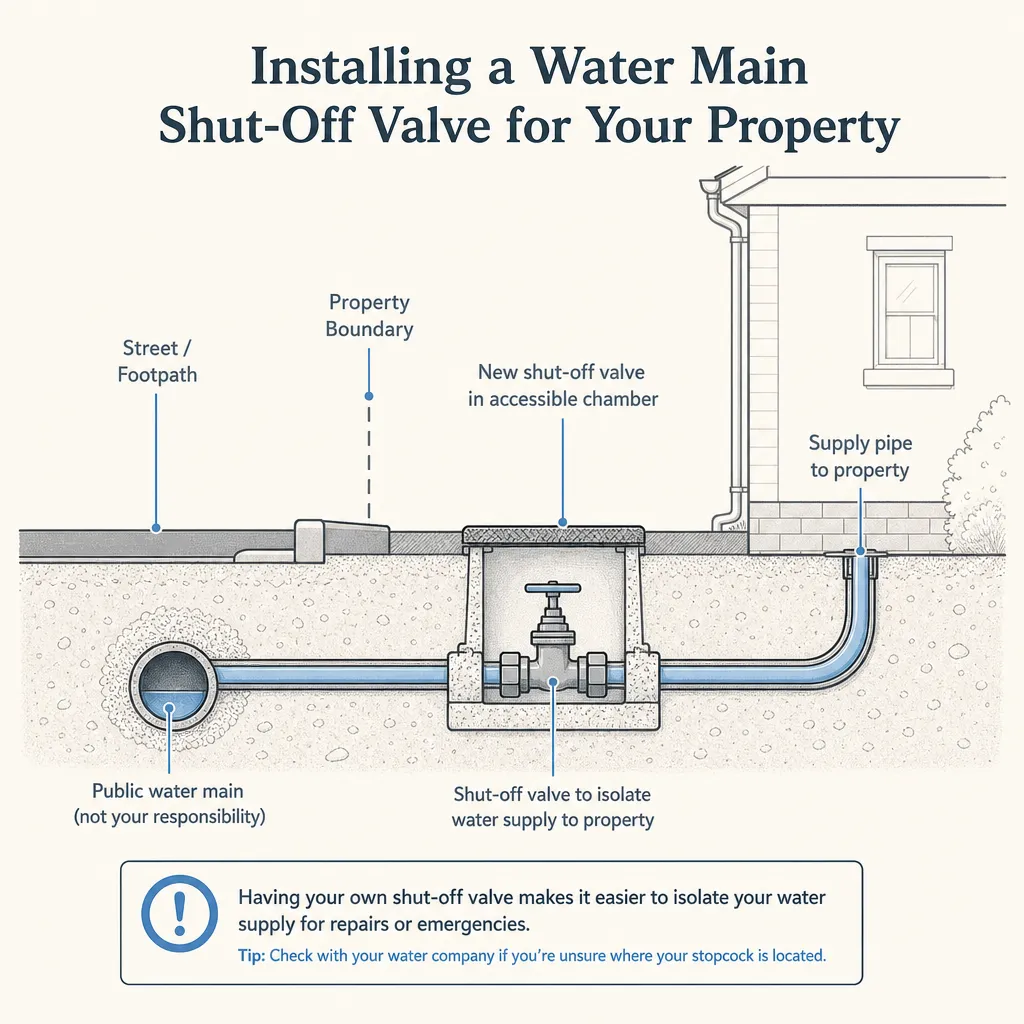
Installing a water main shut-off valve for your property
A water main shut-off valve — commonly called a stopcock — controls all water entering your home from the mains.
 General property advice
Monthly House Price Index: August Market Report and Analysis
The UK House Price Index is published monthly using completed Land Registry transaction data, meaning August figures typically reflect sales agreed months earlier.
 General property advice
Scottish Property Market: Activity and Regional Trends
Scotland's property market operates under distinct legal rules: sellers must provide a Home Report before marketing, transactions become legally binding at conclusion of missives rather than exchange of contracts, and Land and Buildings Transaction Tax replaces Stamp Duty.