What to Know About Removing Structural Walls
By Housey · Last reviewed 19th of May 2026
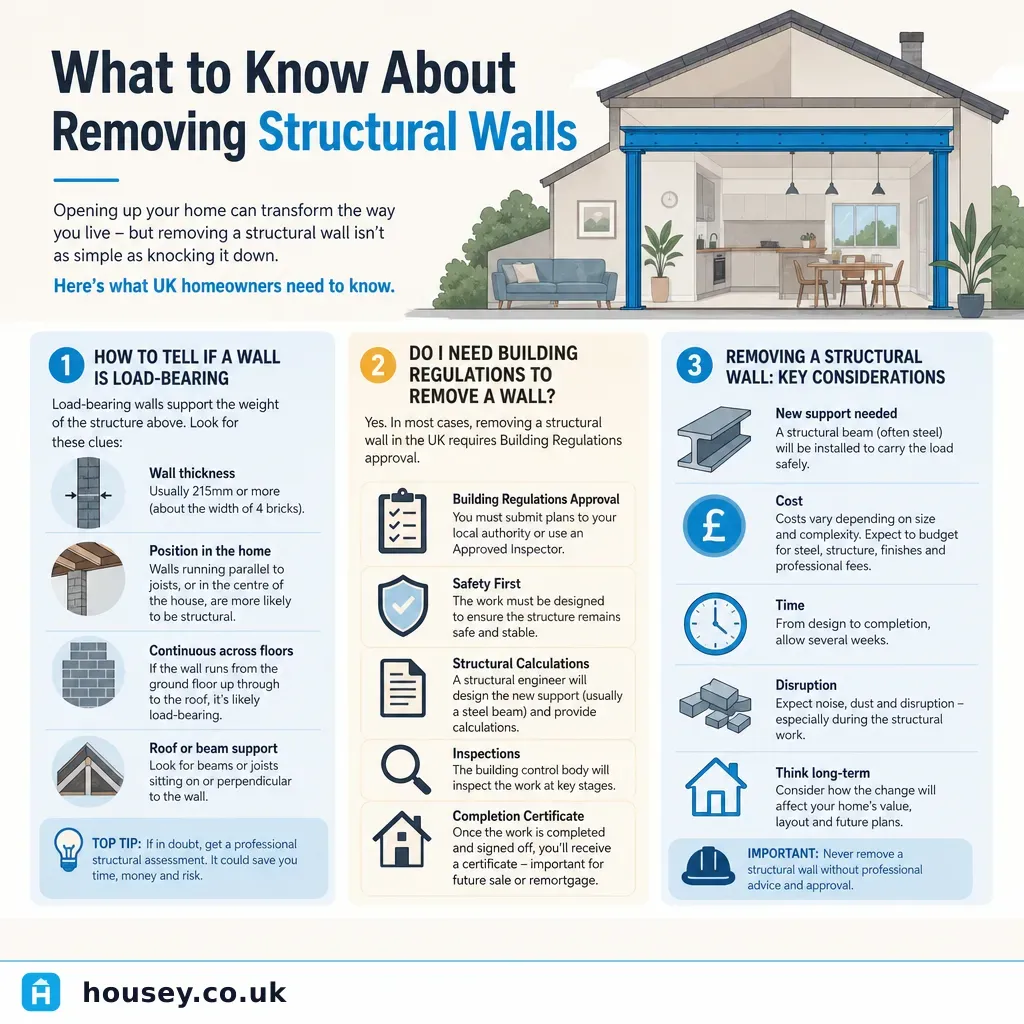
What to Know About Removing Structural Walls
Opening up the ground floor of a UK home — knocking through a kitchen and dining room, removing a chimney breast, or creating an open-plan living space — is one of the most transformative internal renovation projects you can undertake. It is also one of the most technically and legally demanding. Every year, UK homeowners encounter structural movement, building control complications, or difficulties at the point of sale because the load-bearing implications of wall removal were not properly addressed before work began.
Key points
- Any wall that supports a floor, roof, or another wall above it is load-bearing; removing it without a correctly specified beam creates an unacceptable risk of structural failure.
- Building Regulations approval is required in England and Wales for structural alterations under the Building Regulations 2010 — this applies even to internal work that does not require planning permission.
- A structural engineer must calculate the beam size (typically a rolled steel joist, or RSJ), specify the padstones, temporary propping, and connection details before any physical work begins.
- A building control inspector will check the temporary propping, beam installation, and fire protection at key stages; a Completion Certificate is issued once the work is deemed compliant.
- Missing building control documentation is routinely raised in solicitors' enquiries during conveyancing and can delay or prevent a sale; retrospective regularisation applications are possible but add cost and uncertainty.
How to tell if a wall is load-bearing
No visual inspection alone can confirm whether a wall carries structural load. These indicators raise the likelihood that a wall is load-bearing:
- The wall runs perpendicular to the floor joists above (you can check joist direction in the loft or by noting the direction of the floorboards).
- The wall sits directly above or below another wall on a different floor.
- The wall is positioned centrally through the plan, which is common in Victorian and Edwardian terraces and semi-detached houses.
- The wall supports a chimney breast or hearth.
- Padstones — flat stone or engineering-brick bearing pads — are visible where the wall meets the ceiling or floor structure.
These are indicators only, not confirmation. A structural engineer must assess the wall in the context of the whole building before you proceed.
Wall type | Likely load-bearing? | Risk if removed without proper support |
|---|---|---|
Spine wall running perpendicular to floor joists | Usually yes | Floor or roof above may deflect or collapse |
Party wall shared with a neighbour | Structural considerations apply; Party Wall etc. Act 1996 implications also arise | Significant structural and legal risk |
Timber stud partition running parallel to joists | Usually no | Lower structural risk, but always verify with an engineer |
Chimney breast (ground or upper floor) | Yes — chimney stack above requires support | Stack may drop through ceiling if breast is removed without a cathead beam |
Any section of external wall | Always yes | Serious structural and weathertightness risk |
The correct sequence for removing a structural wall
Following the correct order avoids unsafe conditions and building control rejection:
- Appoint a structural engineer to assess the wall, calculate the required beam, and produce a written specification.
- Apply for building regulations approval — a Full Plans application (drawings checked before work starts, and the preferred route for structural alterations) or a Building Notice (faster but with no pre-approval of drawings).
- Appoint a builder experienced in structural alterations to carry out the temporary propping and beam installation, following the structural engineer's specification exactly.
- Notify building control before propping is installed and before the beam is boxed in, so an inspector can check compliance at each stage.
- Complete the works including any required fire protection to exposed steelwork.
- Obtain the Completion Certificate from building control — this is the document that evidences the work was inspected and found compliant.
Important limitations
This article provides general information only. The structural implications of wall removal depend on your specific property's construction, age, condition, and history of previous alterations. Nothing here replaces a structural engineer's professional assessment of your building. The Building Regulations 2010 and the Party Wall etc. Act 1996 apply differently depending on property type, tenure, and local authority. Always engage a qualified professional before starting any structural work.
When this becomes urgent
Stop work immediately and call a structural engineer or your building control officer if:
- Cracks appear in walls, ceilings, or floors following any propping or alteration works.
- Temporary props begin to tilt, sink, or show any sign of movement.
- Floorboards or ceiling plasterwork above the affected area show deflection or sagging.
- You find that a wall you believed to be non-load-bearing appears to carry additional load — for example, a hidden timber or steel element discovered within the wall structure.
What to ask a qualified professional
Before instructing a structural engineer or builder for wall removal:
- Are you a Chartered Member of the Institution of Structural Engineers (MIStructE) or Institution of Civil Engineers (MICE)?
- Will you produce a full written specification including beam size, bearing length, padstone dimensions, and temporary propping requirements?
- What building regulations route do you recommend for this project — Full Plans or Building Notice?
- Does your specification address fire protection requirements for any exposed steelwork?
- Do you have experience with this property type and era — for example, a Victorian terrace or 1930s semi-detached?
- Does the Party Wall etc. Act 1996 apply to this wall, and if so, do I need to serve a Party Structure Notice before work begins?
Red flags to watch for
- A builder who claims the wall is probably not load-bearing without a structural engineer's written assessment.
- A quote that does not include building control fees or reference to a structural engineer's specification.
- Any suggestion that building regulations approval is not required for internal structural work.
- A contractor who wants to start demolition immediately without seeing drawings or a written specification.
- No mention of temporary propping or a propping sequence in the proposed scope of works.
When to get professional help
Removing a structural wall is not a suitable DIY project at any stage. You need a structural engineer for specification and a competent builder for temporary works and beam installation. If the wall is shared with a neighbour — a party structure — you must also follow the Party Wall etc. Act 1996 and may need a party wall surveyor. A building control consultant can guide you through the approvals process from the outset.
How Housey can help
Housey connects you with qualified professionals at every stage of a structural alteration project. Find architectural technologists to produce drawings for building regulations submission, building control consultants to manage the approvals process, and experienced extension builders with a track record in structural alterations. Submit your project brief to receive quotes from vetted local professionals.
Frequently asked questions
Do I always need building regulations approval to remove an internal wall?
Yes, if the wall is load-bearing. Building Regulations approval is required in England and Wales for any structural alteration under the Building Regulations 2010, regardless of whether the work also needs planning permission. Even for apparently non-load-bearing walls, if the work affects fire compartmentation — for instance, a wall between an integral garage and the living space — building regulations may still apply.
Can I remove a load-bearing wall myself?
The structural design and specification must be carried out by a qualified structural engineer. The physical installation of a steel beam, temporary propping, and related construction involves significant safety risk and must be done by an experienced builder. Building control will inspect the work at key stages — an inspector must be notified before propping is installed and before the beam is concealed by plasterwork or boxing.
What is the difference between a Full Plans application and a Building Notice?
A Full Plans application submits detailed drawings to building control in advance for checking and approval before work begins. A Building Notice involves less upfront paperwork but no pre-approval — if work is found non-compliant during inspection, you may need to expose or redo elements. For structural alterations, a Full Plans application is generally the safer and recommended route.
How long does building regulations approval take for wall removal?
A Full Plans application typically takes 5–8 weeks for a decision. Work can begin once the plans are approved. Inspections occur during the works at agreed stages. The Completion Certificate is issued once the inspector is satisfied all work is compliant. Timescales vary by local authority and their current workload.
Sources and further reading
- Building Regulations: overview — GOV.UK
- The Building Regulations 2010 — legislation.gov.uk
- Party Wall etc. Act 1996 — legislation.gov.uk
- Approved Document A: Structure — GOV.UK / MHCLG
- Find a structural engineer — Institution of Structural Engineers
Useful next reads
 Planning & Pre-Build
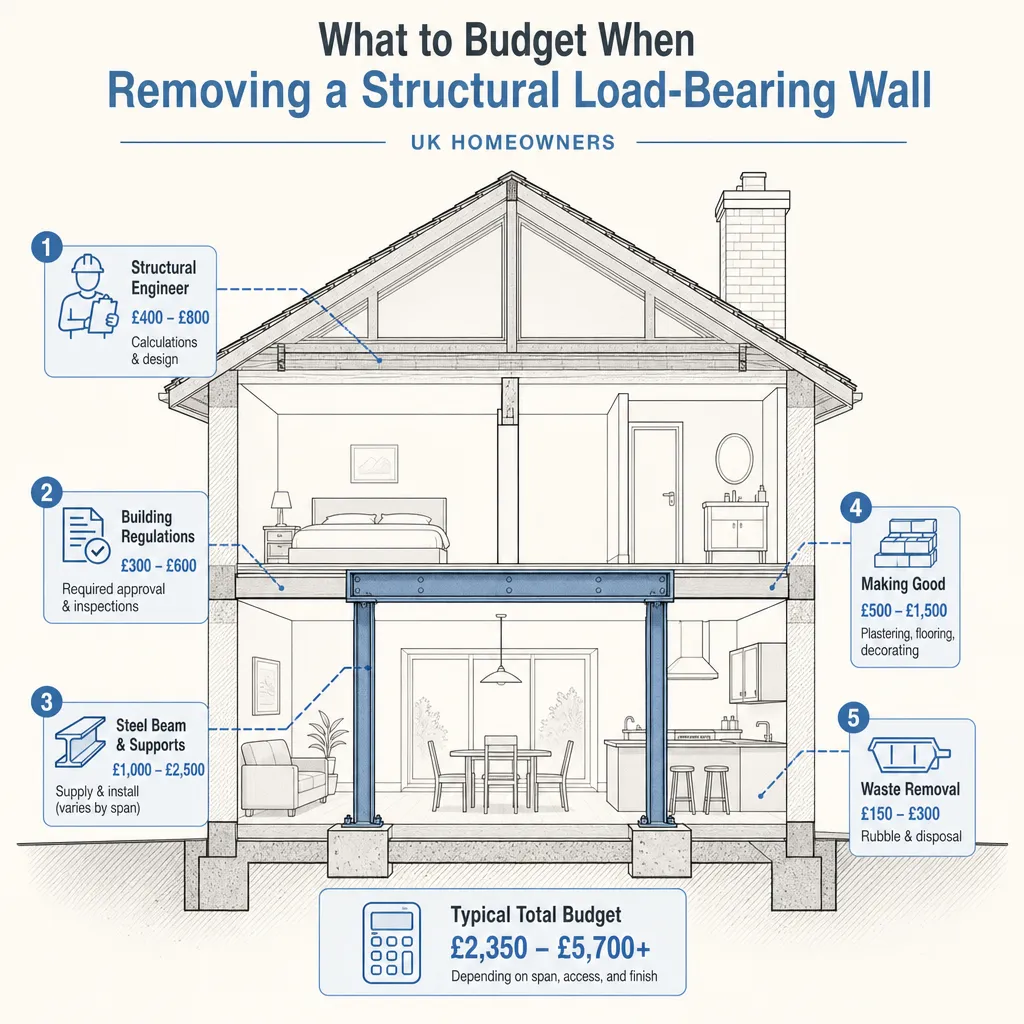
What to Budget When Removing a Structural Load-Bearing Wall
Removing a load-bearing wall in a typical UK home costs £2,500–£8,000 or more in total, covering a structural engineer's calculations, Building Regulations approval, the steel beam, builder's labour, and replastering.
 Planning & Pre-Build
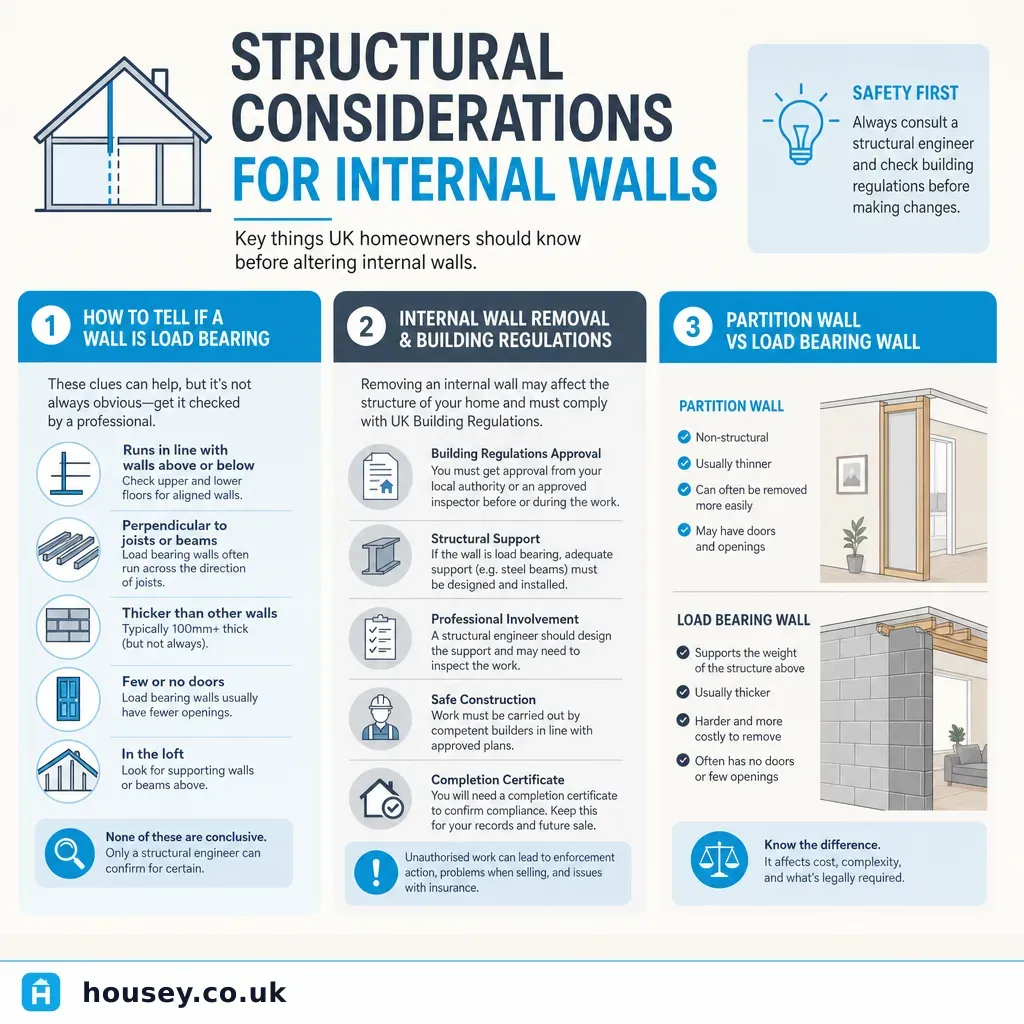
Structural considerations for internal walls
Whether a wall is load-bearing depends on its position, orientation relative to floor joists, and the property's construction.
 Planning & Pre-Build
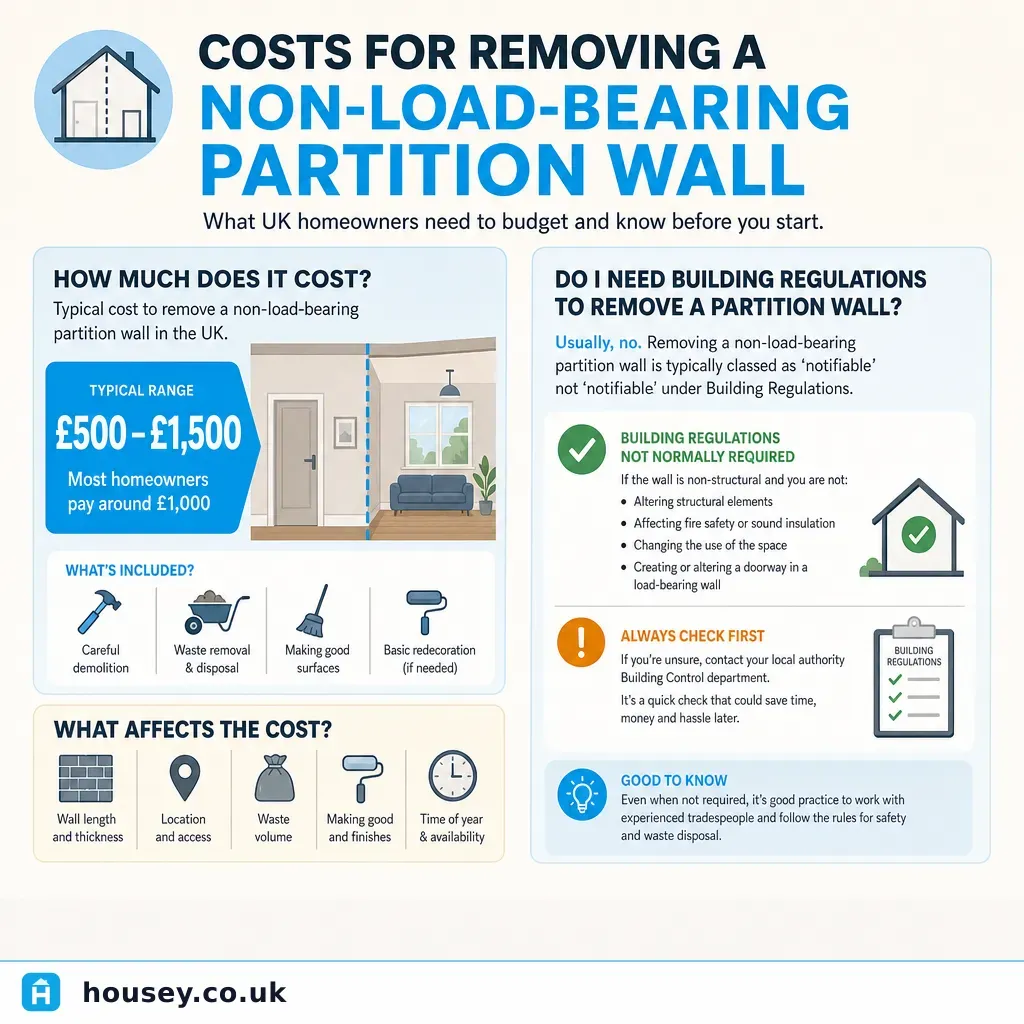
Costs for removing a non-load-bearing partition wall
Removing a non-load-bearing partition wall in a UK home typically costs £300–£1,500 in labour, plus £200–£600 or more for replastering and making good.
 Planning & Pre-Build
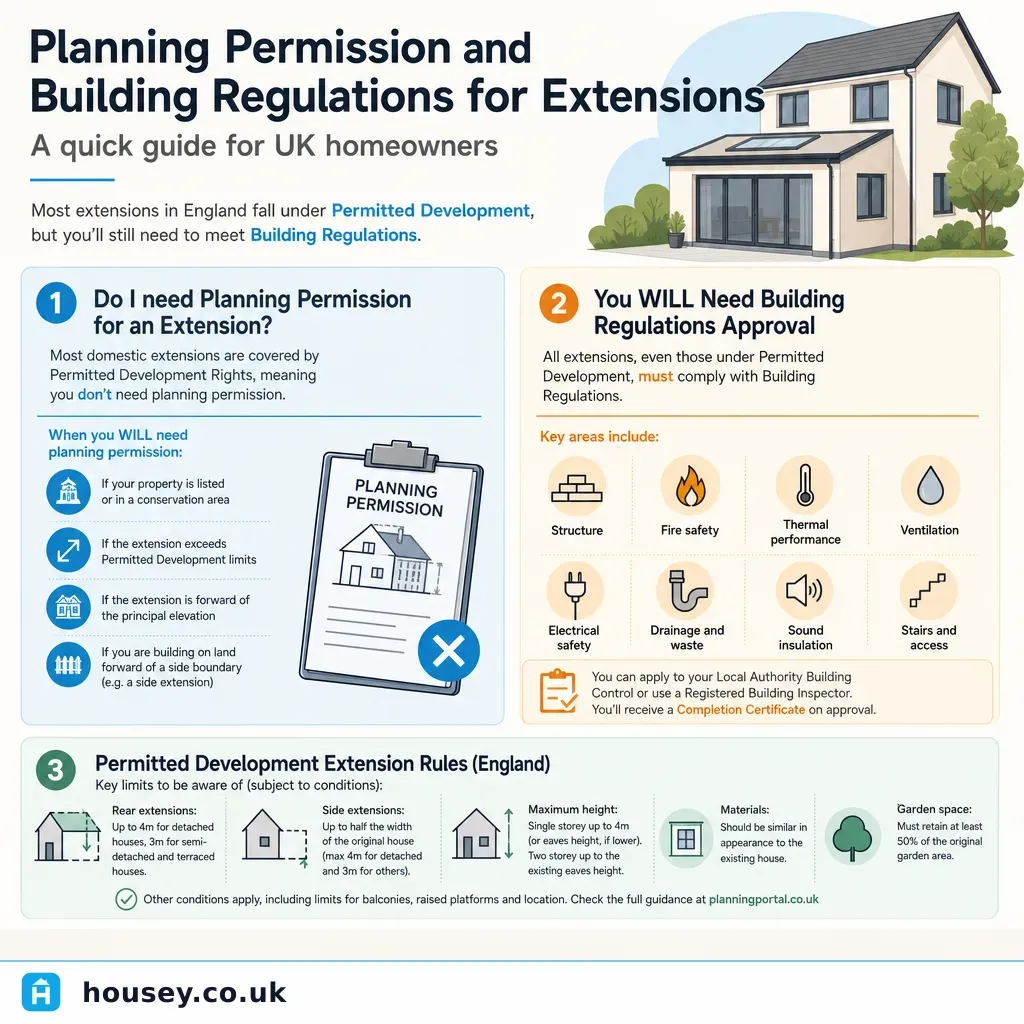
Planning Permission and Building Regulations for Extensions
UK home extensions usually require both planning permission and Building Regulations approval, though most smaller rear extensions qualify as Permitted Development under the GPDO 2015 and need no planning application.
 Planning & Pre-Build
Building a Summer House: Planning and Regulatory Requirements
Most garden summer houses in England fall under Class E permitted development and need no planning permission, provided they are single-storey, within height limits, and not used for sleeping.