Costs for removing a non-load-bearing partition wall
By Housey · Last reviewed 6th of May 2026
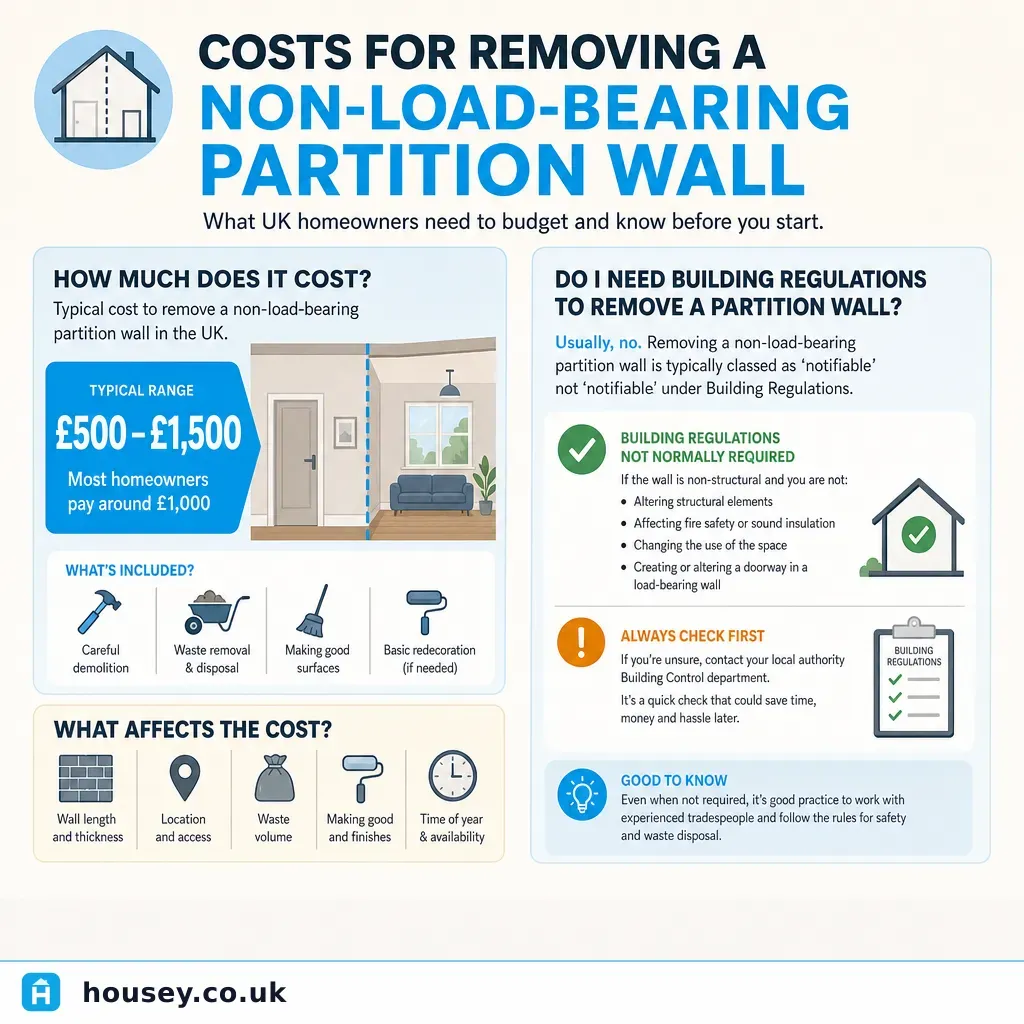
Costs for removing a non-load-bearing partition wall
Many homeowners consider removing an internal partition wall to create a more open-plan living space, improve light flow, or combine two smaller rooms. Knowing the likely costs upfront — and understanding the steps involved — helps you plan the project and avoid surprises once a builder is on site. The question most often arises during a kitchen redesign, a loft conversion, or when reconfiguring bedroom layouts in a growing family home.
Key points
- Removing a timber stud partition wall in a standard UK home typically costs £300–£1,500 in labour, depending on size, access, and the extent of making good required.
- Before any work starts, confirm the wall is genuinely non-load-bearing — ideally with a structural engineer or experienced builder who can check joist direction and the structure above.
- In most cases, removing a simple non-structural partition in a house does not require Building Regulations approval, but there are exceptions: walls forming fire compartments (such as between a garage and a habitable room) usually do.
- Replastering and making good after removal often adds £200–£600 or more to the final bill — budget for finishing, not just demolition.
- If the wall contains electrical sockets, lighting circuits, or data cables, a Part P-registered electrician must reroute them, adding £150–£400 to the total cost.
What is a non-load-bearing partition wall?
A non-load-bearing (or non-structural) partition wall is an internal wall that divides space but does not carry the weight of the floors or roof above it. In UK homes, these are most commonly lightweight timber stud partitions with plasterboard on each face, though older properties may also have block or brick partitions that are non-structural.
The key point is that a partition wall can, in theory, be removed without affecting structural integrity — provided it has been correctly identified as non-structural. That identification matters: a wall can look like a simple partition but still carry loads depending on joist direction and what was built above it. Always confirm before proceeding.
Typical costs for non-load-bearing partition wall removal
The table below gives indicative UK costs for different scenarios. All figures are Indicative UK costs, last reviewed 2026-05-06, and will vary by region, contractor, and site conditions. Obtain at least three quotes.
Scenario | Indicative cost range |
|---|---|
Small timber stud partition (up to 8 m²) | £300–£700 |
Larger timber stud partition (8–20 m²) | £600–£1,500 |
Block or brick partition (any size) | £700–£2,000 |
Replastering and skimming affected surfaces | £200–£600 extra |
Rerouting electrical circuits (Part P electrician) | £150–£400 extra |
Skip hire or waste removal (if not included) | £150–£350 extra |
Indicative ranges based on trade pricing guides; costs vary by region and project. Obtain at least three quotes.
Why costs vary
Several factors push the price up or down:
- Wall size and height — a full-height partition in a Victorian terrace with high ceilings takes longer to strip and dispose of than a short modern stud wall.
- Construction material — plasterboard stud partitions are quicker to remove than solid block or brick; the latter also produces more rubble.
- Services in the wall — electrical cables, sockets, switches, or pipework must be safely isolated, rerouted, and tested before demolition.
- Access — restricted access in a terraced house or flat can increase skip-hire and labour costs.
- Making good required — the floor, ceiling, and adjoining walls will almost always need some degree of remedial plastering.
- Regional labour rates — London and south-east contractors typically charge 20–40% more than the national average.
Do you need building regulations for a non-load-bearing wall?
In most straightforward cases — removing a timber stud partition inside a standard UK dwelling — Building Regulations approval is not required. However, there are important exceptions:
- Fire compartmentation: If the wall separates a habitable room from a garage, or forms part of the fire separation between flats in a converted building, removing it affects fire safety and requires building control sign-off under Approved Document B.
- Flats and converted properties: Fire safety rules under Approved Document B are stricter in flats and HMOs, and many lease agreements require landlord or management company consent before alterations.
- Walls containing a chimney breast or live flue: Any section housing a live flue affects combustion safety and must comply with Approved Document J, regardless of whether the main wall is structural.
- Listed buildings: Any internal alteration in a listed building requires Listed Building Consent.
If you are unsure, contact your local authority building control department or speak to a structural engineer before starting.
Before you start: homeowner checklist
Use this checklist before instructing a builder or undertaking any work.
Red flags that the wall may be load-bearing
Before assuming a wall is non-structural, watch for these warning signs:
- The wall runs perpendicular to the floor joists (check from the loft or basement)
- The wall sits directly above another wall on the floor below — stacked walls often carry load
- There is a wall, post, or column directly above the partition
- The wall is in the centre of the house — central walls in many UK homes carry ridge or floor loads
- The property is pre-1919 or timber-framed — construction methods vary widely and visual assumptions can be wrong
- A previous survey flagged concerns about movement or cracking near this wall
If any of these apply, instruct a structural engineer before proceeding.
When to get professional help
For a simple non-load-bearing stud partition in a modern or post-war house, an experienced builder can usually manage the removal. However, you should involve a structural engineer for your wall removal project when:
- You are not certain the wall is non-structural
- The property is pre-1900, of unusual construction, or has a history of structural movement
- The wall is on an upper floor or runs between floors
- There is visible cracking in plaster, brickwork, or ceilings near the wall
- The property is a flat or converted building where fire compartmentation is a concern
A structural engineer's assessment for a straightforward query typically costs £200–£500 and is a sensible investment before committing to demolition.
How Housey can help
If you need a structural assessment before removing a partition wall, or want to compare quotes from qualified engineers, Housey can connect you with vetted professionals. Find a structural engineer for your wall removal project and request quotes in minutes.
Frequently asked questions
Do I need planning permission to remove a non-load-bearing partition wall?
In most cases, no. Internal alterations to a dwelling do not generally require planning permission. Listed buildings are a significant exception — you will need Listed Building Consent for any internal alteration, regardless of whether the wall is structural. Always check if your property is listed before starting work.
How long does it take to remove a non-load-bearing partition wall?
A straightforward timber stud partition can usually be removed in half a day to a full day by one or two tradespeople. Solid block or brick partitions take longer, typically one to two days. Plastering and drying time will add several more days before the space is ready for decoration.
Can I remove a non-load-bearing partition wall myself?
Physical demolition of a lightweight stud partition is within reach of a competent DIYer, but you must first confirm the wall is non-structural, isolate all electrical circuits, and ensure no pipework is affected. Any electrical rerouting must be carried out by a Part P-registered electrician. For solid block walls, professional help is usually safer and more cost-effective.
Will removing a partition wall add value to my home?
Creating more open-plan living spaces can improve saleability and buyer appeal, particularly in smaller UK homes. The impact on value depends on the property type, local market, and quality of finish. A poorly finished removal or one that creates an awkward layout can reduce appeal. Consult a local valuer if you are uncertain of the impact.
What happens to the floor and ceiling where the wall was?
The floor will have a gap where the wall's bottom plate was fixed, which usually needs filling and either matching the existing floor covering or relaying flooring across the whole room. The ceiling will need replastering or patching at the junction. Budget for both remedial tasks when requesting quotes — they are often underestimated.
Sources and further reading
- Building Regulations Approved Document A (Structure) — GOV.UK / MHCLG
- Building Regulations Approved Document B (Fire Safety) — GOV.UK / MHCLG
- When you need building regulations approval — GOV.UK
- Listed buildings — GOV.UK
- Approved Document J: Combustion appliances and fuel storage systems — GOV.UK / MHCLG
Useful next reads
 Planning & Pre-Build
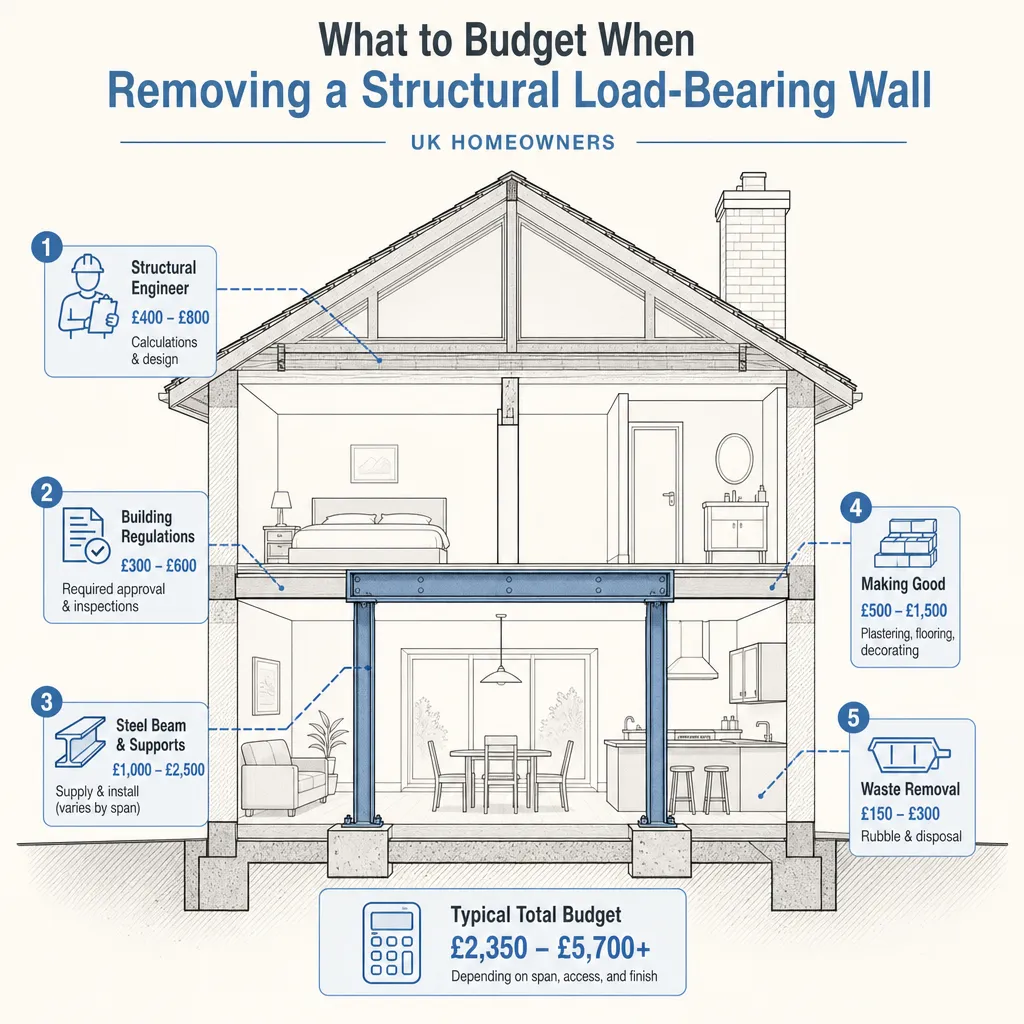
What to Budget When Removing a Structural Load-Bearing Wall
Removing a load-bearing wall in a typical UK home costs £2,500–£8,000 or more in total, covering a structural engineer's calculations, Building Regulations approval, the steel beam, builder's labour, and replastering.
 Planning & Pre-Build
Electrical Panel Replacement: When and Why Your Home Needs an Upgrade
Most UK homes need a consumer unit replacement when they have rewirable fuse wire, lack residual current devices (RCDs), or experience frequent circuit tripping.
 Planning & Pre-Build
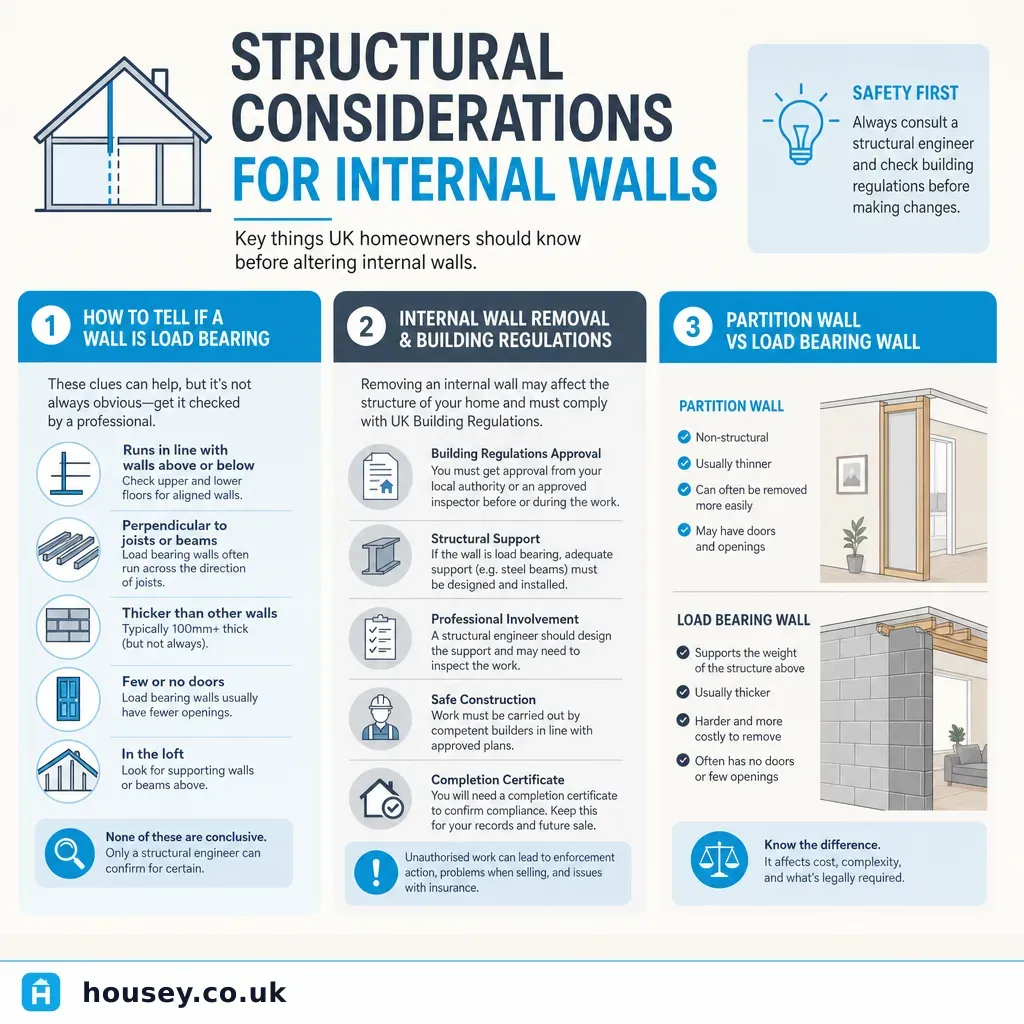
Structural considerations for internal walls
Whether a wall is load-bearing depends on its position, orientation relative to floor joists, and the property's construction.
 Planning & Pre-Build
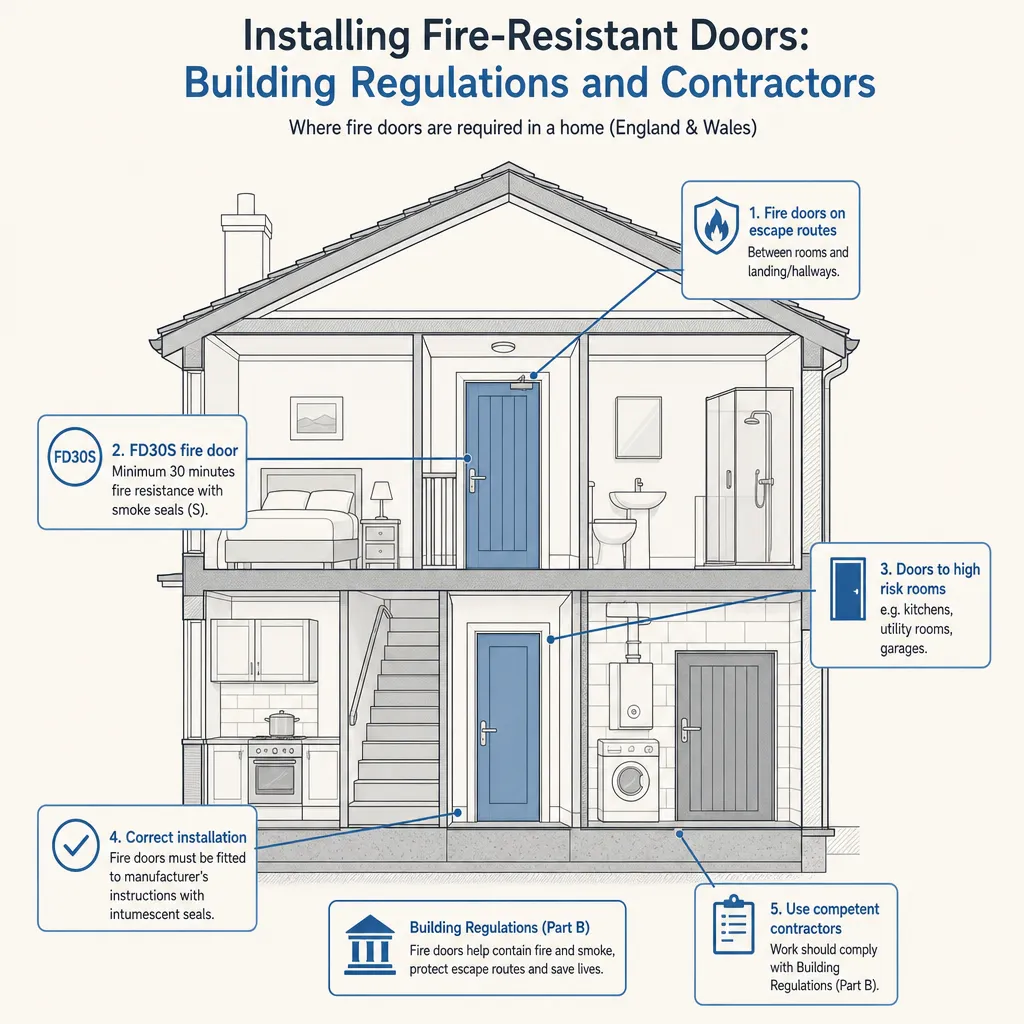
Installing Fire-Resistant Doors: Building Regulations and Contractors
Fire doors are required by Building Regulations in specific locations — including integral garages, properties of three or more storeys, loft conversions, and HMOs.
 Planning & Pre-Build
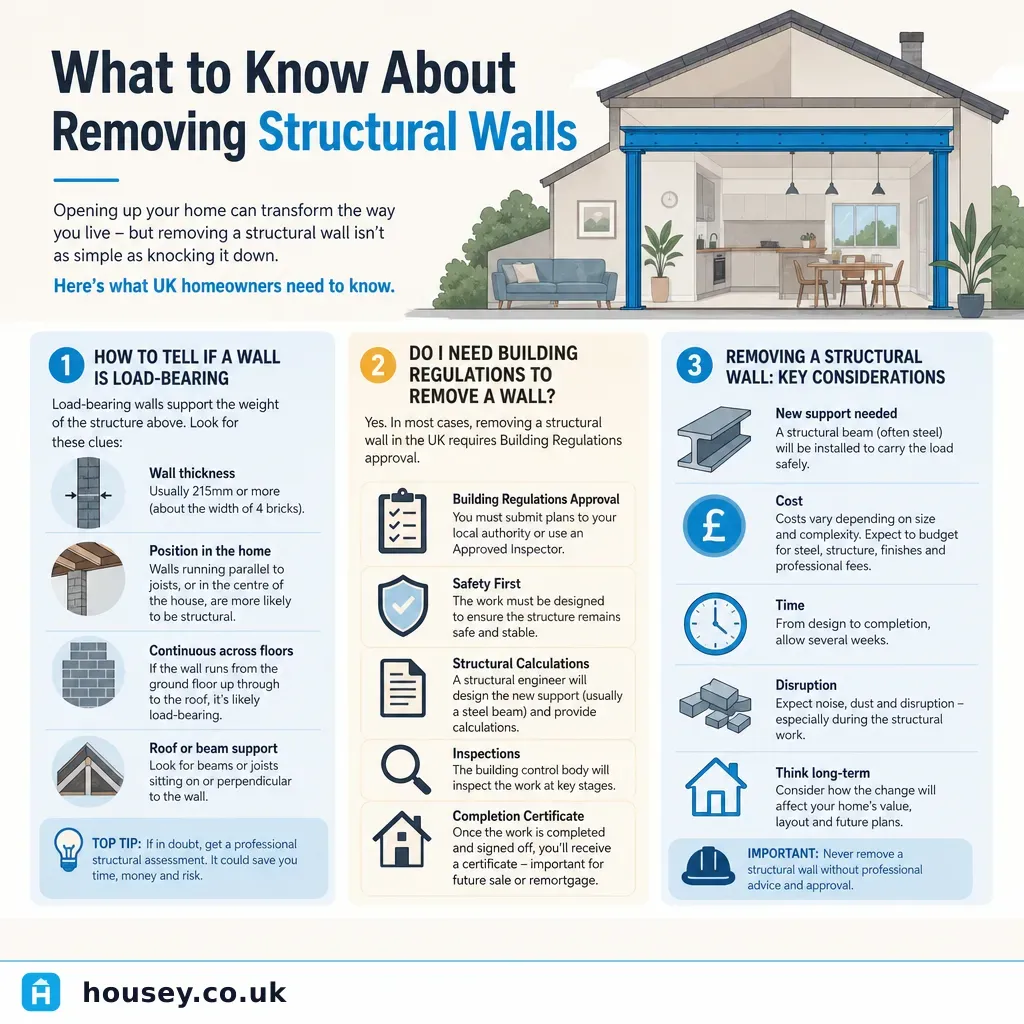
What to Know About Removing Structural Walls
Removing a structural or load-bearing wall in a UK home requires a structural engineer's assessment, a correctly specified steel beam (RSJ), and Building Regulations approval.