Budgeting For Property Extension And Building Projects
By Housey · Last reviewed 10th of May 2026
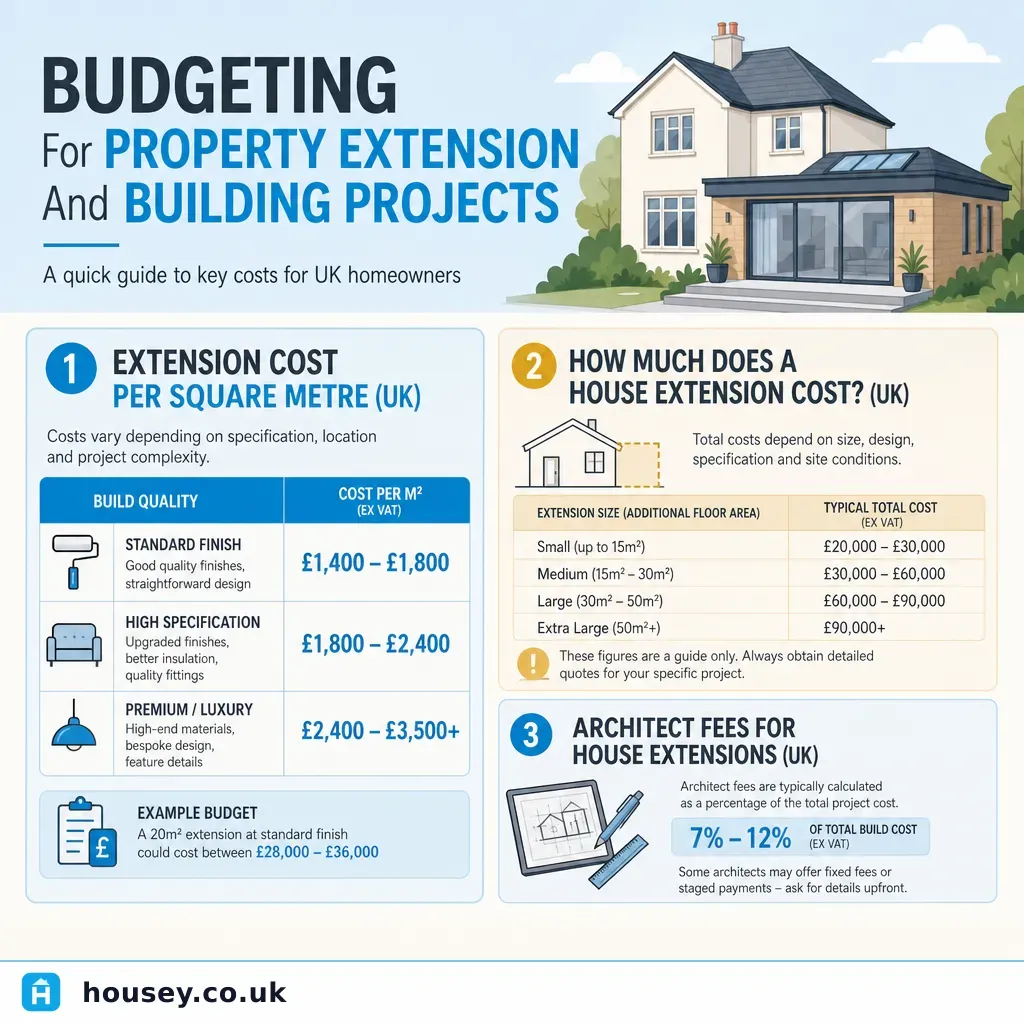
Budgeting For Property Extension And Building Projects
Deciding to extend or significantly improve your home is one of the largest financial commitments most UK homeowners ever make. Costs can escalate quickly when unexpected groundworks, structural requirements, or supply delays arise — yet many projects begin without a full picture of what is actually included in a builder's quote, let alone what sits outside it. Whether you are planning a single-storey rear extension on a 1930s semi or a two-storey addition to a Victorian terrace, building a realistic budget from the outset is the difference between a smooth project and a painful overrun.
Key points
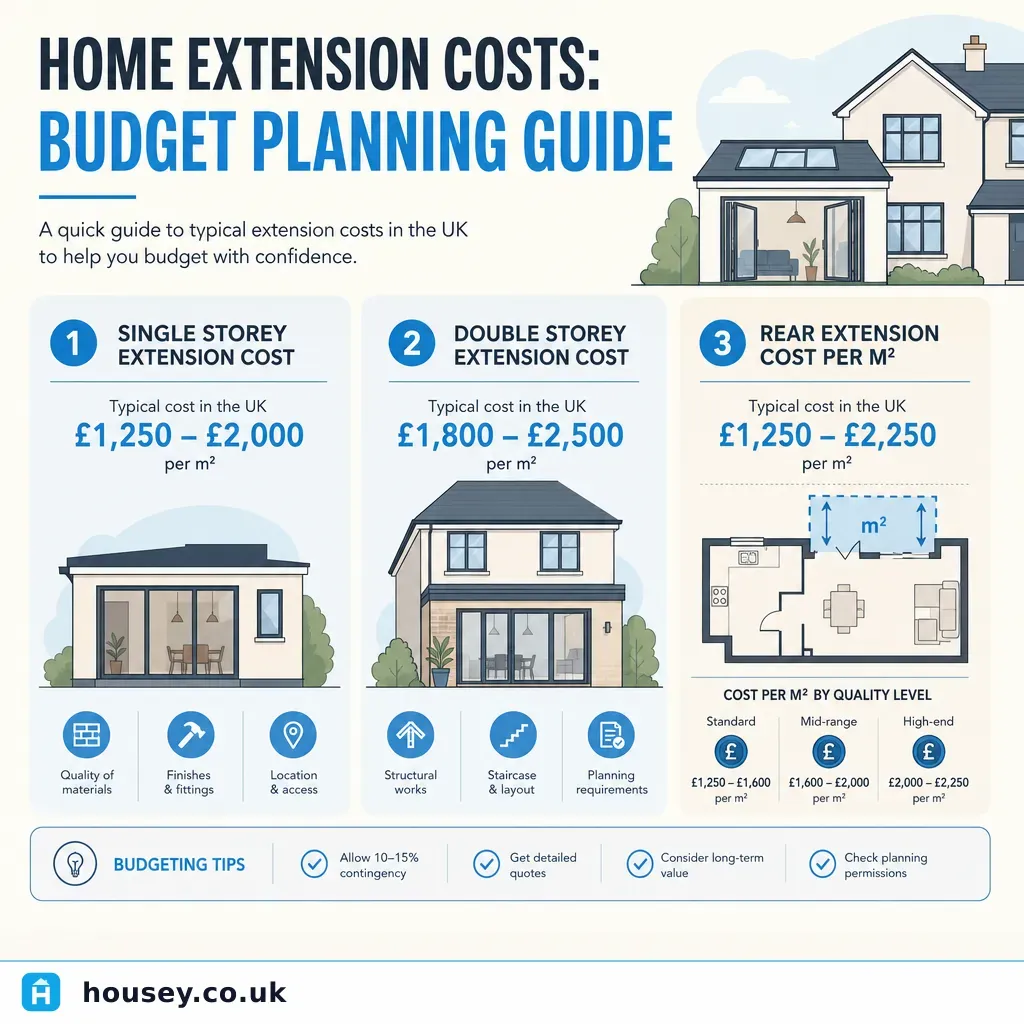
- Build costs for a standard single-storey rear extension typically range from £1,500 to £2,500 per square metre in the UK, before professional fees, planning, and VAT.
- A contingency of 10–15% of the total build cost is widely recommended by RICS and industry guidance; 20% is more prudent for older or structurally complex properties.
- Planning application fees in England are currently £258 for a householder application (following the December 2023 fee uplift — verify on Planning Portal before submitting, as fees differ in Wales, Scotland, and Northern Ireland).
- New residential extensions and construction generally attract VAT at 20%; some conversion and renovation works may qualify for a reduced 5% rate — confirm with your contractor and HMRC before budgeting.
- Professional fees — architect, structural engineer, and party wall surveyor where applicable — typically add 10–20% to the build cost, depending on the scope of service and project complexity.
What affects the cost of an extension or building project?
Extension costs in the UK are not uniform. A wide range of factors influence where your project falls within any given indicative range:
- Gross internal area: The single biggest cost driver. Groundworks, service connections, and scaffolding carry fixed cost elements regardless of floor area, so smaller extensions often cost more per square metre than larger ones.
- Storey count: Double-storey extensions cost less per square metre than single-storey because foundations and roof are shared across more usable floor area, but overall spend is higher.
- Structural complexity: Removing load-bearing walls, underpinning foundations, or building over drainage requires specialist input and can significantly increase costs.
- Specification: Standard render and uPVC versus bespoke timber joinery, underfloor heating, and frameless glazing can double the fit-out cost for the same footprint.
- Access and site conditions: Restricted rear access, sloped ground, or a dense urban plot add to groundwork complexity and site logistics.
- Location: London and the South East typically command a 20–40% premium over comparable work in the Midlands or North of England.
Comparing common UK extension and conversion types
Project type | Typical indicative range | Planning usually required? | Typical build duration |
|---|---|---|---|
Single-storey rear extension (20–25m²) | £35,000–£62,000 | Permitted development often applies | 10–14 weeks |
Double-storey rear extension (40–50m²) | £60,000–£110,000 | Planning permission usually needed | 16–24 weeks |
Side return extension (terrace or semi) | £30,000–£60,000 | Permitted development may apply — check with LPA | 10–16 weeks |
Loft conversion with dormer | £40,000–£75,000 | Permitted development often applies — check ridge height | 8–12 weeks |
Integral garage conversion | £15,000–£30,000 | Permitted development in most cases | 4–8 weeks |
Wrap-around extension | £80,000–£150,000+ | Planning permission usually needed | 20–30 weeks |
Indicative UK costs, last reviewed 2026-05-10. Figures include build cost only — add professional fees, planning fees, building regulations fees, and VAT separately. Always obtain at least three detailed quotes.
Professional fees and other budget lines to include
A build cost per square metre only tells part of the story. Prepare separate budget lines for:
- Architect or architectural technologist: 8–15% of build cost for full design and contract administration. Fixed-fee arrangements are common for smaller, straightforward projects.
- Structural engineer: £500–£1,500 for beam calculations, foundation design, or structural assessments — usually essential even for modest single-storey extensions.
- Planning application fee: £258 in England for a householder application (2023 rate). Different rates apply in Wales, Scotland, and Northern Ireland.
- Building regulations fees: Set by your local authority or an approved inspector; typically £200–£1,000 depending on the scope and value of works. Request a fee estimate at plan-check stage.
- Party wall surveyor: Required if works affect a shared wall with a neighbour under the Party Wall etc. Act 1996. Fees of £700–£1,500 per surveyor are typical, and costs may double if the neighbour appoints their own surveyor separately.
- Measured building survey: £500–£1,500 if detailed drawings of the existing property are needed before design work can begin.
- VAT: 20% on most new extension build contracts. Some conversion works attract the reduced 5% rate — confirm with your contractor and HMRC before budgeting.
Worked example: budgeting a 25m² single-storey rear extension
To illustrate how a project budget builds up, consider a homeowner in the East Midlands extending a 1960s detached house with a 25m² single-storey kitchen-dining extension. Standard specification, no major structural complications.
Budget line | Indicative amount |
|---|---|
Build cost (25m² × £1,800/m²) | £45,000 |
Architect fees (full service, ~10% of build) | £4,500 |
Structural engineer | £900 |
Planning application fee (England) | £258 |
Building regulations fee (estimated) | £500 |
VAT at 20% on build and professional services | £10,080 |
Contingency (15% of build cost) | £6,750 |
Total indicative budget | ~£68,000 |
This example is illustrative only. Actual costs depend on specification, contractor, ground conditions, and location. Indicative UK costs, last reviewed 2026-05-10.
Homeowner extension budget checklist
Before finalising your budget and choosing a builder, work through this checklist:
What to ask before accepting a builder's quote
- What exactly is included and excluded in this price?
- Who will carry out the structural and specialist elements — groundworks, steelwork, roofing?
- What qualifications or trade body accreditations does the main contractor hold?
- What building regulations approval route are you using — local authority or approved inspector?
- What warranty or guarantee will be provided on workmanship?
- How are variation costs handled if unforeseen issues arise during the build?
- What is the payment schedule, and what triggers each stage payment?
- Is VAT included in the quoted price, and at what rate?
- What is the realistic start date and programme length?
- Can you provide references or examples of similar local projects I can view or verify?
When to get professional help
An extension or building project involves planning law, Building Regulations, structural engineering, and contract management — often simultaneously. Consider engaging professionals before you commit to a contractor if:
- You are unsure whether your project needs planning permission or qualifies as permitted development.
- Your property is listed, within a conservation area, or subject to Article 4 directions that restrict permitted development.
- The works will affect a shared wall, boundary, or neighbouring structure, triggering obligations under the Party Wall etc. Act 1996.
- You want independent help reviewing contractor quotes, interpreting drawings, or administering a building contract.
- Your project budget exceeds £50,000 — the risk of unmanaged overruns at this scale justifies early professional oversight.
How Housey can help
Housey connects you with extension builders, design-and-build firms, and build cost estimating specialists who can help you plan and price your project accurately. For larger or more complex builds, a project manager can take on day-to-day oversight and protect your interests throughout the build.
Frequently asked questions
Do I need planning permission for a house extension?
Many single-storey rear extensions fall under permitted development rights and do not need a planning application — but limits apply on size, height, and proximity to boundaries. Permitted development rights can be removed by local authorities through Article 4 directions, so always check with your local planning authority before starting work. Listed buildings require listed building consent for any extension, regardless of size.
How much contingency should I allow for a building project?
A contingency of 10–15% of the total build cost is the standard recommendation from RICS and industry guidance. For older properties, sites with unknown ground conditions, or structurally complex projects, 20% is more prudent. Contingency is not a budget for upgrades or changes in specification — it exists to absorb unforeseen costs that arise during construction.
Should I use a design-and-build firm or appoint an architect and builder separately?
Design-and-build offers a single point of contractual responsibility and can be faster to procure. Appointing an architect separately gives you independent design advice and contract administration, which can offer stronger protection if disputes arise. For projects over approximately £100,000, independent contract administration is generally advisable. The right approach depends on project complexity, your time availability, and how much design control you want to retain.
Can I save money by managing the project myself?
Self-managing reduces professional fees but demands significant time, construction knowledge, and the ability to co-ordinate subcontractors effectively. Mistakes in sequencing, procurement, or contract management can cost more than the fees saved. For projects over £50,000, consider engaging a professional project manager to oversee the build on your behalf.
Sources and further reading
- Planning Portal: householder applications and fees — Planning Portal / MHCLG
- RICS guidance on building costs and project management — RICS
- GOV.UK: permitted development rights for householders — GOV.UK
- Party Wall etc. Act 1996 — legislation.gov.uk
- HMRC: VAT on buildings and construction (Notice 708) — HMRC / GOV.UK
Useful next reads
 Improvement & Build
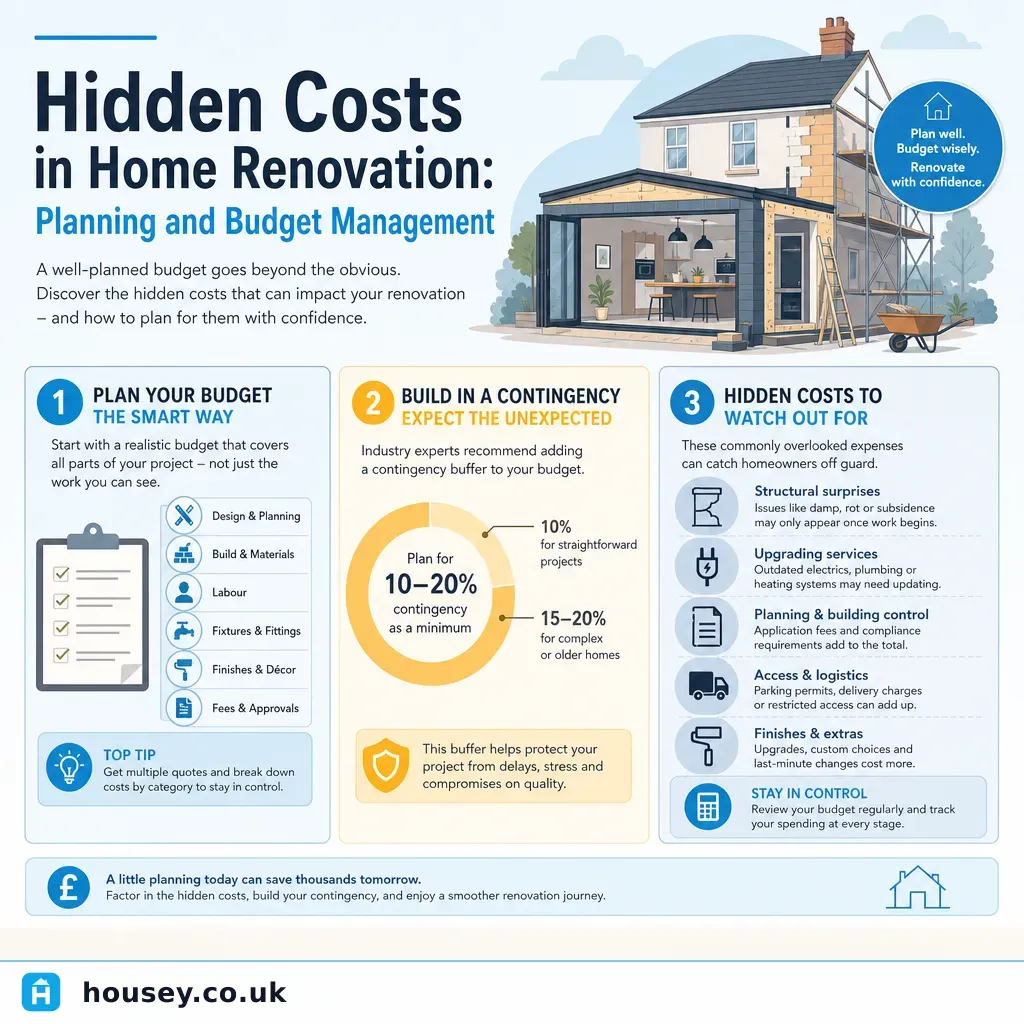
Hidden Costs in Home Renovation: Planning and Budget Management
Most UK renovation projects run 10–20% over the initial builder quote because professional fees, VAT, statutory fees, and party wall costs are routinely excluded from early estimates.
 Improvement & Build
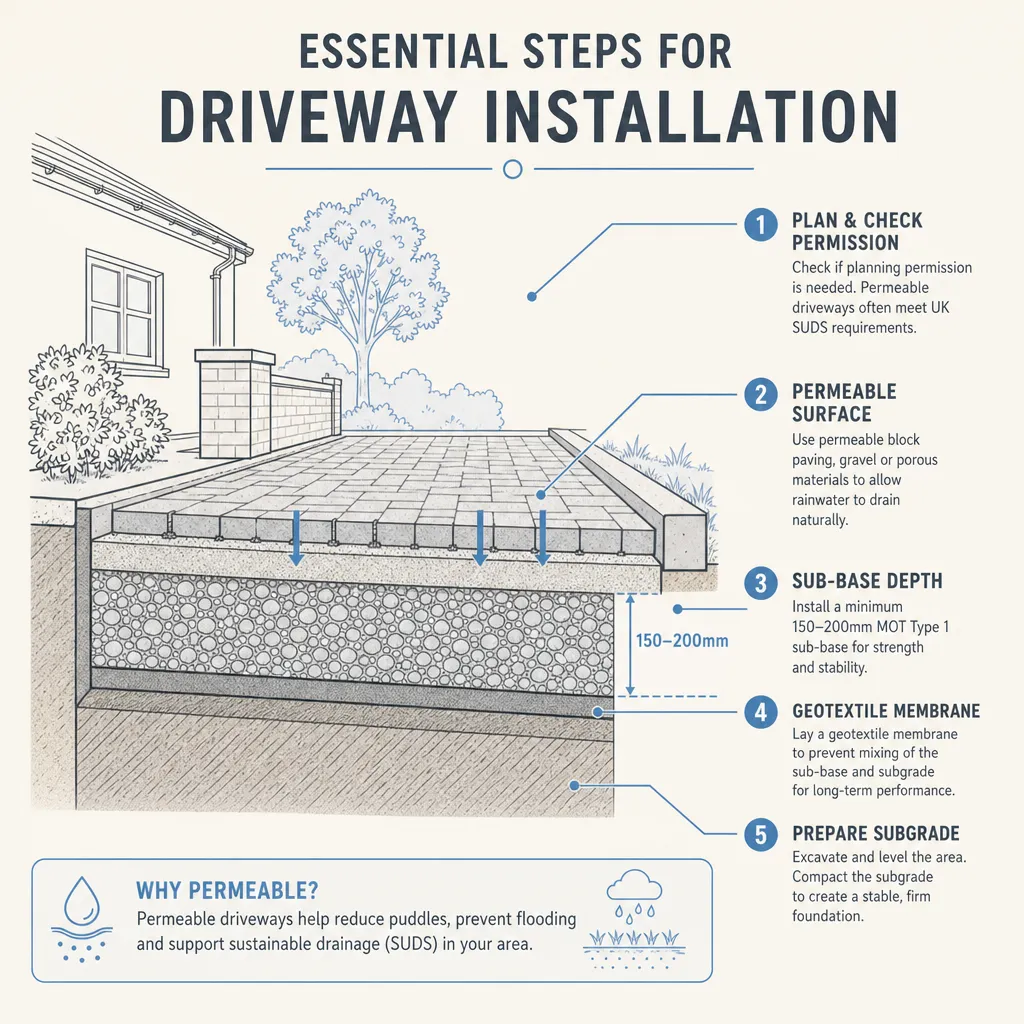
Essential Steps for Driveway Installation
Installing a driveway in England requires planning permission only when using an impermeable surface (standard tarmac, concrete, or block paving) on a front garden area over 5 m².
 Improvement & Build
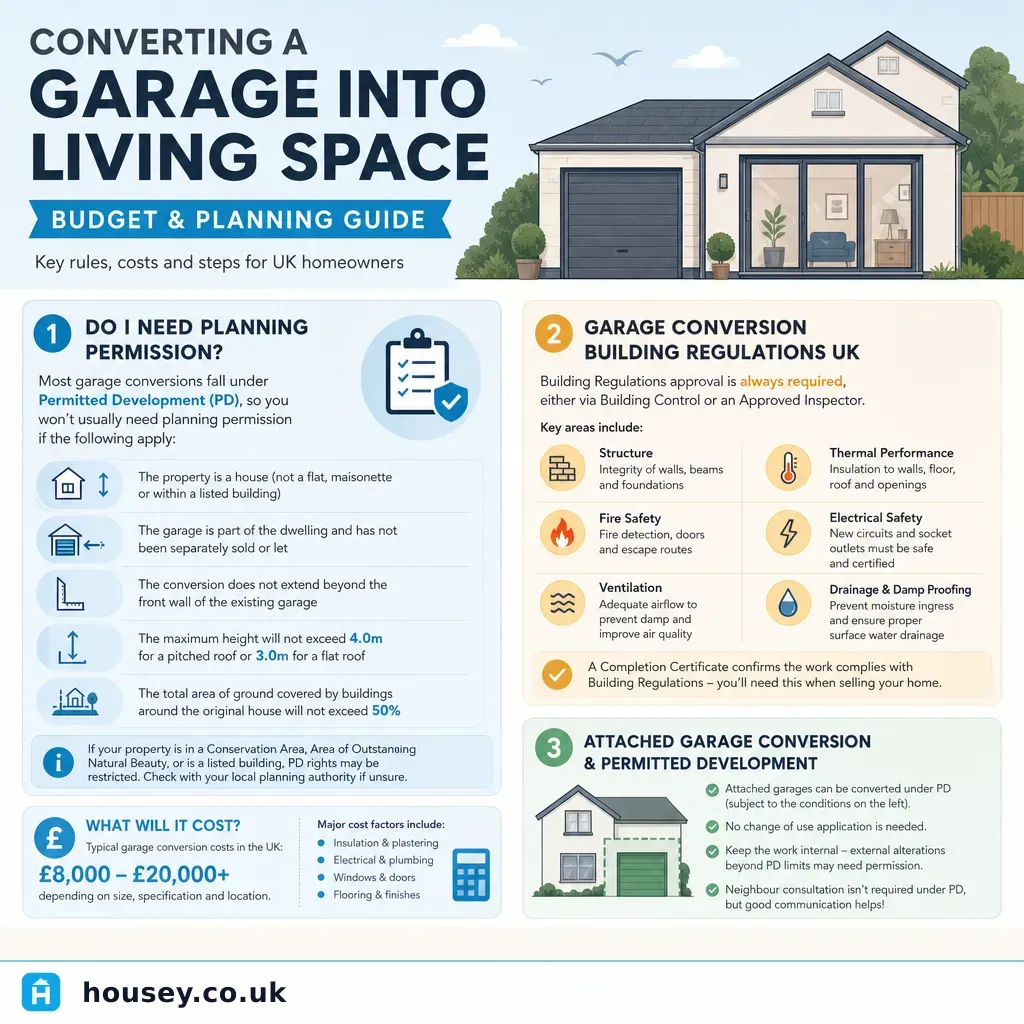
Converting a Garage into Living Space: Budget and Planning Guide
A single-garage conversion typically costs £8,000–£20,000 in the UK.
 Improvement & Build
Home Extension Costs: Budget Planning Guide
A single-storey rear extension in the UK typically costs £1,500–£2,500 per square metre to build.
 Improvement & Build
Planning a Roof Replacement Project
A roof replacement project involves stripping the existing covering, renewing the sarking felt and battens, and laying new tiles, slates, or a flat-roof membrane.