Home Extension Costs: Budget Planning Guide
By Housey · Last reviewed 7th of May 2026
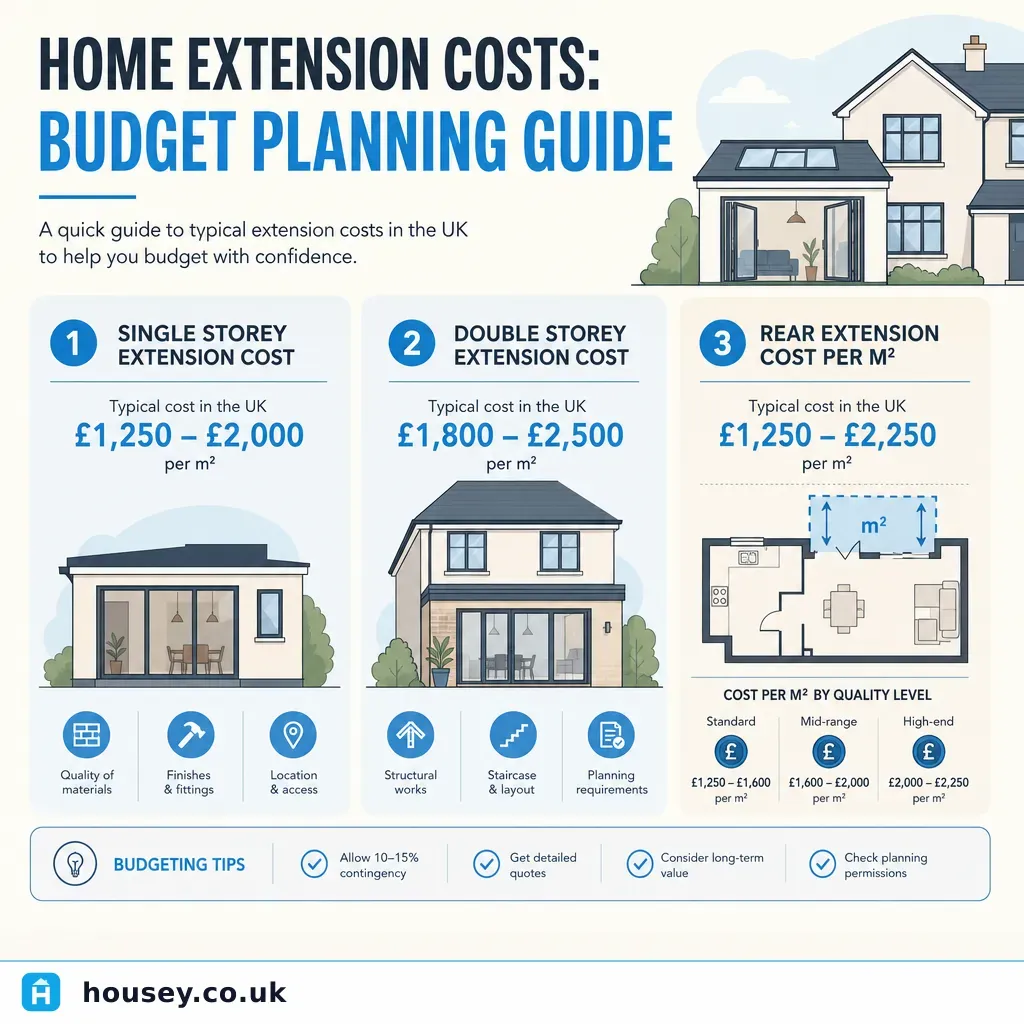
Home Extension Costs: Budget Planning Guide
A home extension spans multiple professionals, regulatory approvals, and trade contractors — and costs can differ significantly from early estimates if the full scope is not accounted for at the outset. Whether you are planning a rear kitchen extension, a double-storey addition, or a side infill, understanding where the money goes before approaching builders makes it far easier to compare quotes on a like-for-like basis and avoid mid-project surprises.
Key points
- Single-storey extensions typically cost £1,500–£2,500 per m² to build; double-storey extensions range from £1,800–£3,000 per m² (Indicative UK costs, last reviewed 2026-05-07).
- Professional fees — architect or architectural technologist, structural engineer, and Building Control — typically add 15–25% on top of construction costs and must be budgeted separately from the builder's quote.
- Most single-storey rear extensions on houses may qualify for Permitted Development in England under the Town and Country Planning (General Permitted Development) (England) Order 2015, but PD rights are removed for listed buildings, many conservation areas, and all flats and maisonettes.
- Building Regulations approval is required for virtually all extensions regardless of planning status, covering structural integrity, thermal performance (Approved Document L), fire safety, ventilation, and drainage connections.
- The Party Wall etc. Act 1996 requires formal notices to be served on adjoining owners if the extension is within 3m of a neighbouring structure or involves excavation near the boundary.
How much does a home extension cost?
Build costs vary by extension type, size, specification, location, and site conditions. The table below gives indicative construction cost ranges for common extension types in the UK, excluding professional fees and internal fit-out.
Extension type | Typical size | Indicative build cost range | Notes |
|---|---|---|---|
Single-storey rear extension | 10–25 m² | £18,000–£55,000 | Most common type; standard finishes |
Single-storey side extension | 10–20 m² | £17,000–£50,000 | May require Party Wall Agreement |
Double-storey rear extension | 20–40 m² total | £35,000–£90,000 | Greater structural complexity |
Wraparound (L-shape) extension | 25–40 m² | £45,000–£100,000+ | Higher design and structural cost |
Kitchen extension (single storey) | 12–20 m² | £25,000–£60,000 | Includes plumbing and electrical connections |
Over-garage extension | 15–25 m² | £30,000–£70,000 | Subject to existing garage structure |
Indicative UK costs, last reviewed 2026-05-07. Costs in London and the South East are typically 20–40% higher. Figures exclude professional fees, planning fees, and internal fit-out.
What drives costs toward the higher end?
- Specification: Bifold or sliding doors, underfloor heating, bespoke joinery, and premium materials add significantly to m² costs.
- Ground conditions: Poor bearing capacity, a high water table, or existing drainage running through the footprint increases foundation and groundwork costs.
- Access: Restricted rear access, terraced plots, or urban sites make deliveries and scaffolding more expensive.
- Structural complexity: Large steel beams, load-bearing wall removal, or underpinning requirements add cost and programme time.
- Location: Labour and materials are materially more expensive in London and the South East.
Professional fees: what to budget separately
Professional fees are frequently underestimated at the early budgeting stage. For a typical single-storey extension, the following gives a guide to expected fees.
Professional | Indicative fee range | When required |
|---|---|---|
Architect or architectural technologist | £2,000–£6,000+ | Design, planning drawings, specification |
Structural engineer | £800–£2,500 | All extensions involving structural elements |
Building regulations drawings | £500–£1,500 | Required for Building Control submission |
Building Control (local authority fee) | £200–£900 | Full Plans application |
Planning application (householder, England) | £258 | When Permitted Development is not available |
Party wall surveyor | £700–£2,000 per adjoining owner | If within 3m of neighbouring structure |
Fee ranges are indicative. Listed buildings, conservation areas, and complex structural situations attract higher fees.
A structural engineering assessment is needed on virtually all extension projects to size foundations, specify beams for load-bearing wall openings, and confirm the adequacy of any retained structural elements.
Producing building regulations drawings to a standard accepted by Building Control is a requirement for the Full Plans submission — this document set allows builders to price accurately and ensures inspections proceed without delay.
What builder quotes typically include — and exclude
When comparing quotes from extension builders, mismatches in scope are one of the most common causes of budget overruns. Check each quote against the following.
Typically included in a construction-only quote:
- Foundations and groundworks
- Masonry, blockwork, or structural frame
- Roof structure and weatherproof covering
- External walls to the outer leaf (brick, render, or cladding)
- Windows and external doors (supply and fit)
- First-fix carpentry — floor structure and stud partitions
Typically not included:
- Architect, structural engineer, and Building Control fees
- Internal plastering and decoration
- Kitchen, bathroom, or other fit-out and appliances
- Underfloor heating or radiator system extensions
- Electrical work beyond first-fix connections
- Landscaping and garden reinstatement after works
Always request an itemised quote and confirm what each line covers before signing any contract.
Worked UK property scenario: 20 m² rear kitchen extension
To illustrate the full cost picture, consider a 1970s three-bedroom semi-detached house in the Midlands, adding a 20 m² single-storey rear kitchen extension with bifold doors onto the garden.
Item | Indicative cost |
|---|---|
Architect/architectural technologist | £2,500 |
Structural engineer | £1,200 |
Building regulations drawings | £800 |
Building Control (local authority fee) | £550 |
Party wall surveyor (one adjoining owner) | £1,000 |
Construction — 20 m² at £1,900/m² | £38,000 |
Kitchen fit-out and appliances | £12,000 |
Flooring, plastering, and decoration | £3,500 |
Garden reinstatement | £1,500 |
Contingency (10%) | £6,100 |
Estimated total | ~£67,150 |
This is a worked example only, not an estimate for any specific project. Indicative UK costs, last reviewed 2026-05-07.
A project manager can coordinate the above professionals and trades — particularly valuable on complex builds or where the homeowner cannot be on-site regularly.
Planning permission and Permitted Development
Many single-storey rear extensions on houses can be built under Permitted Development (PD) rights in England without a full planning application, under the Town and Country Planning (General Permitted Development) (England) Order 2015. Key limits for houses are:
- Detached houses: Up to 4m rear extension depth within standard PD.
- Semi-detached and terraced houses: Up to 3m rear extension depth within standard PD.
- Under the Prior Approval (Larger Home Extension) route, up to 8m (detached) or 6m (other) may be possible, subject to neighbour consultation.
PD rights are removed or restricted for:
- Listed buildings (full Listed Building Consent required).
- Properties in conservation areas, National Parks, or Areas of Outstanding Natural Beauty.
- Homes where PD rights have been removed by a planning condition or Article 4 Direction.
- Flats and maisonettes (PD rights do not apply).
Even where PD is likely to apply, many solicitors and mortgage lenders recommend obtaining a Lawful Development Certificate (LDC) from the Local Planning Authority — this confirms PD status in writing and protects the position on future sale.
Homeowner checklist: before appointing a builder
When to get professional help
Appointing an architect or architectural technologist before approaching builders is almost always worthwhile — it ensures the design is feasible, compliant with Building Regulations, and priced against a consistent specification. Seek professional advice as a priority if:
- You are unsure whether planning permission is needed for your specific property and proposal.
- The extension will be close to a neighbouring boundary or existing structure.
- The property has a history of subsidence, structural movement, or non-standard construction.
- You are adding a bathroom, relocating soil drainage, or making changes affecting the consumer unit.
- The property is listed or in a conservation area — non-compliance in these cases can result in enforcement action and compulsory reinstatement.
How Housey can help
Housey connects homeowners with verified extension builders, structural engineers, and project managers across the UK. You can also find professionals for building regulations drawings to ensure your project meets current requirements from the outset. Request quotes from local specialists and compare them on a like-for-like basis.
Frequently asked questions
Do I always need planning permission for a home extension?
Not always. Many single-storey rear extensions on houses qualify for Permitted Development in England, so no formal planning application is needed. However, PD rights are removed for listed buildings, many conservation areas, and all flats and maisonettes. Always confirm your position with the Local Planning Authority or obtain a Lawful Development Certificate before work begins.
How long does it take to build a typical home extension?
A single-storey extension of 15–25 m² typically takes 10–16 weeks to build once work starts on site. Add design, planning or prior approval, and Building Regulations lead times — often 8–20 weeks before a spade goes in — to arrive at a full project timeline. Larger or more complex extensions will take longer.
What is the Party Wall Act and does it apply to my extension?
The Party Wall etc. Act 1996 applies if your works are within 3m of a neighbouring structure, along a shared boundary wall, or involve excavation near an adjoining property. If it applies, you must serve a formal Party Wall Notice before work begins. Failure to do so can result in injunctions and significant delays to your project.
Can a builder manage the whole process without an architect?
Some experienced builders handle simpler standard extensions without a separate designer. However, Building Control requires professionally produced drawings and structural calculations. An architect or architectural technologist ensures compliance with Part L energy efficiency requirements, ventilation, and drainage standards, and produces the documentation needed for Building Control sign-off and future property sales.
Will a home extension add value to my property?
A well-designed extension adding usable living space — particularly a kitchen-diner or an additional bedroom — often adds value, but the extent depends on location, quality of work, and prevailing market conditions. The Royal Institution of Chartered Surveyors (RICS) notes that value added is not always a 1:1 return on build cost in every market.
Sources and further reading
- Planning permission for a house — GOV.UK
- Permitted development rights for householders: technical guidance — GOV.UK
- Approved Documents (Building Regulations) — GOV.UK
- Party Wall etc. Act 1996 — legislation.gov.uk
- Approved Document L: Conservation of fuel and power — GOV.UK
- RICS guidance for homeowners — RICS
Useful next reads
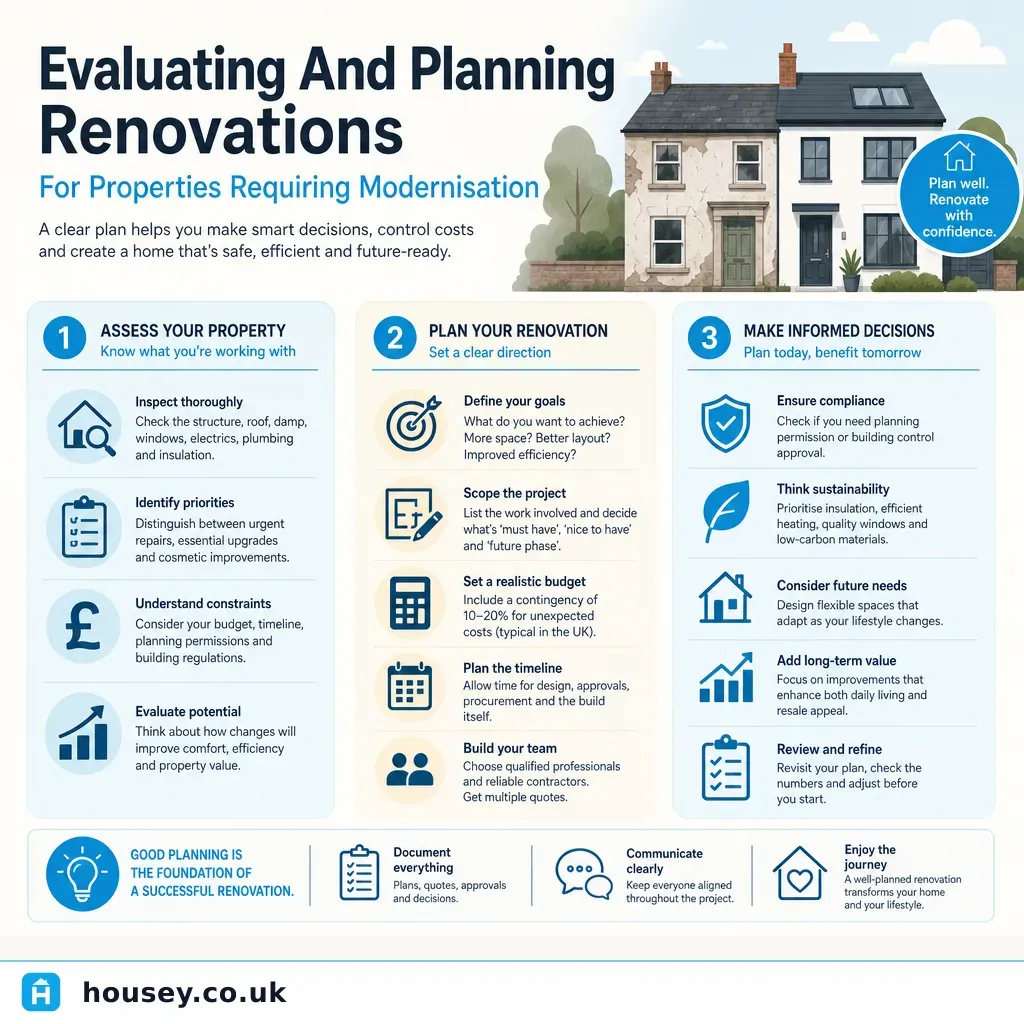 Improvement & Build
Evaluating And Planning Renovations For Properties Requiring Modernisation
Start by commissioning a condition survey — RICS Level 3 for pre-1919 properties — to identify structural defects, damp, and services issues before finalising a budget.
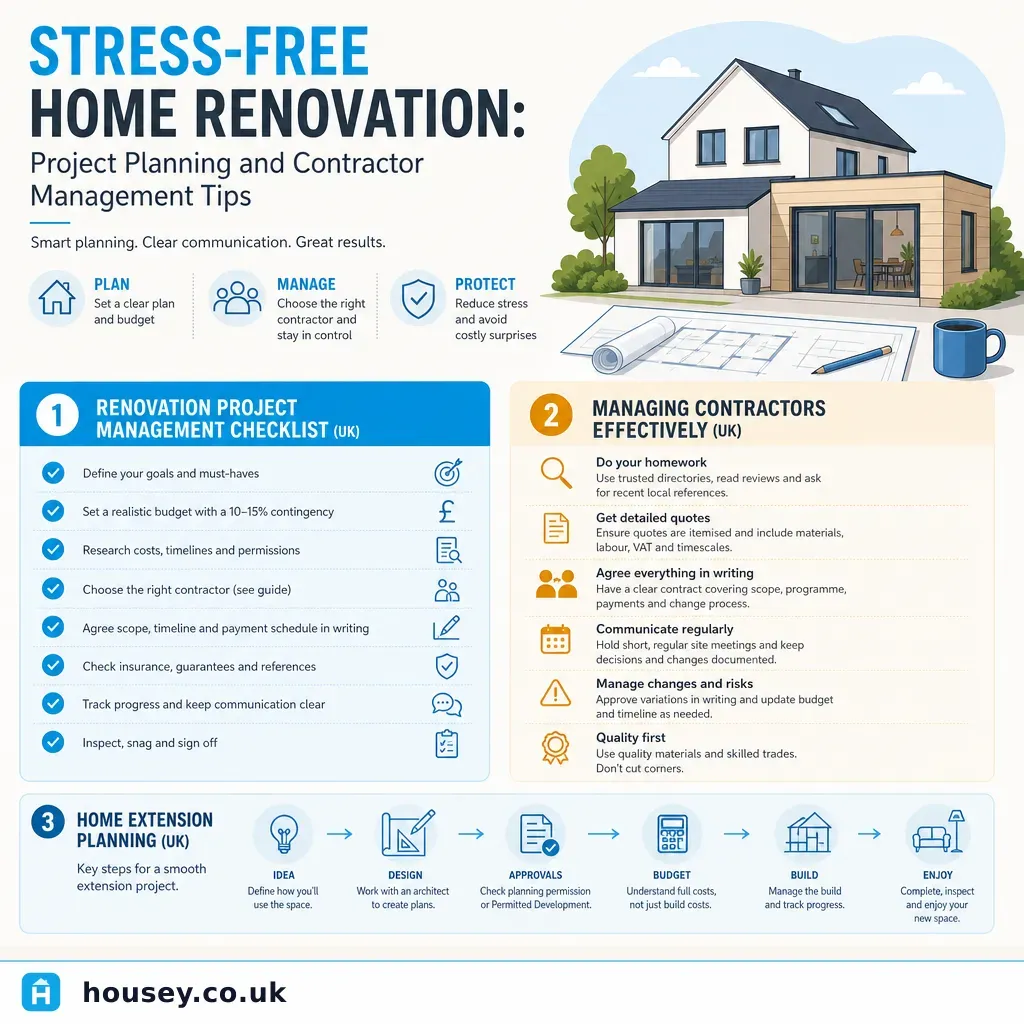 Improvement & Build
Stress-Free Home Renovation: Project Planning and Contractor Management Tips
The home renovations that stay on budget and on time share one characteristic: clear upfront planning.
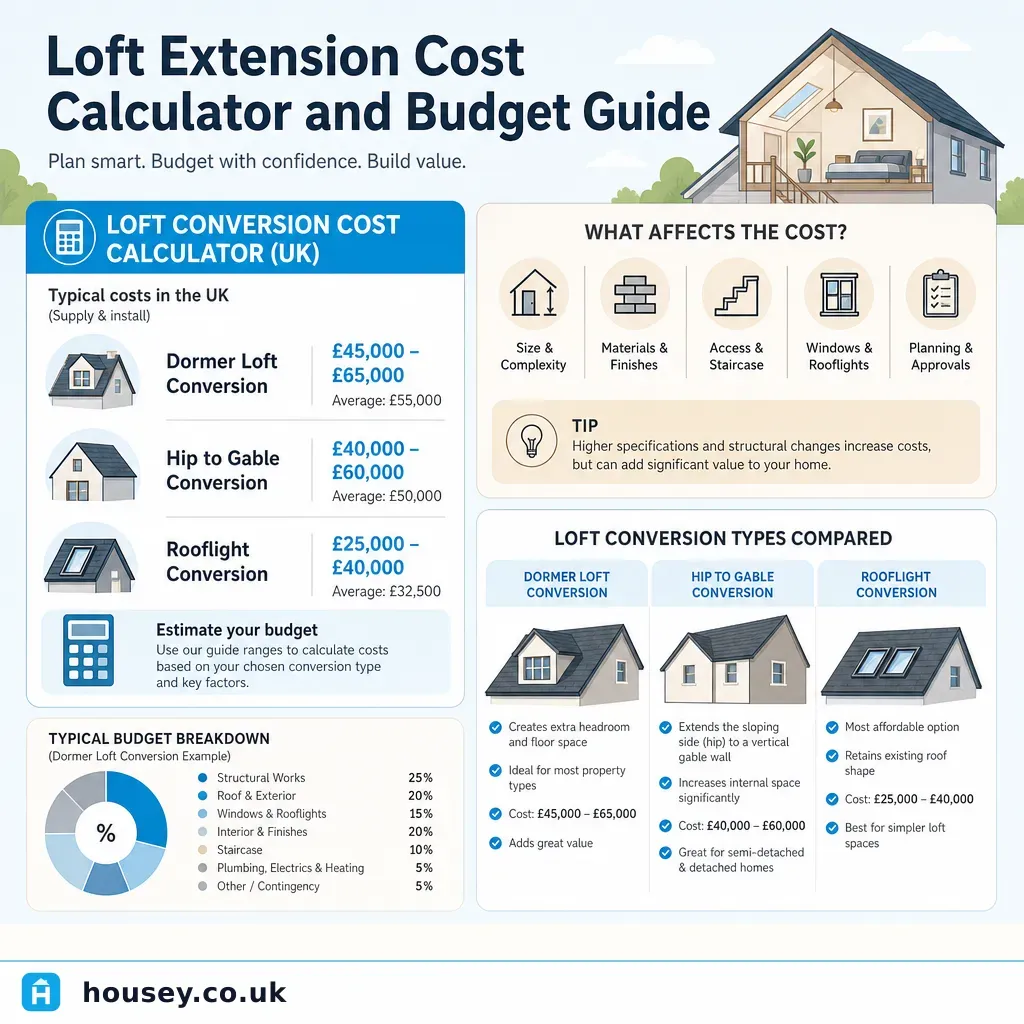 Improvement & Build
Loft Extension Cost Calculator and Budget Guide
Loft extension costs in the UK typically range from £15,000 for a basic Velux conversion to £75,000 or more for a mansard or L-shaped dormer.
 Improvement & Build
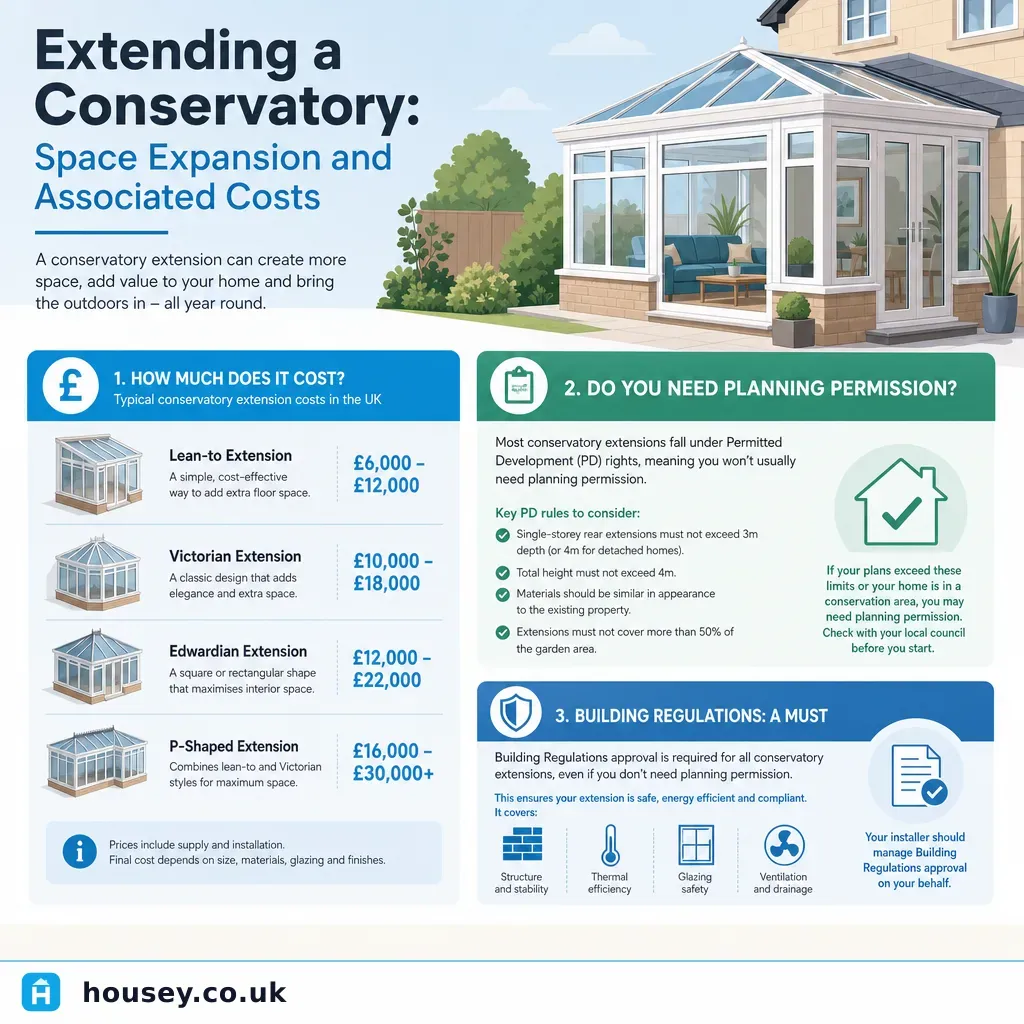
Extending a Conservatory: Space Expansion and Associated Costs
Extending a conservatory usually falls under permitted development rights if the enlarged footprint stays within depth limits — 4m for detached houses, 3m for others.
 Improvement & Build
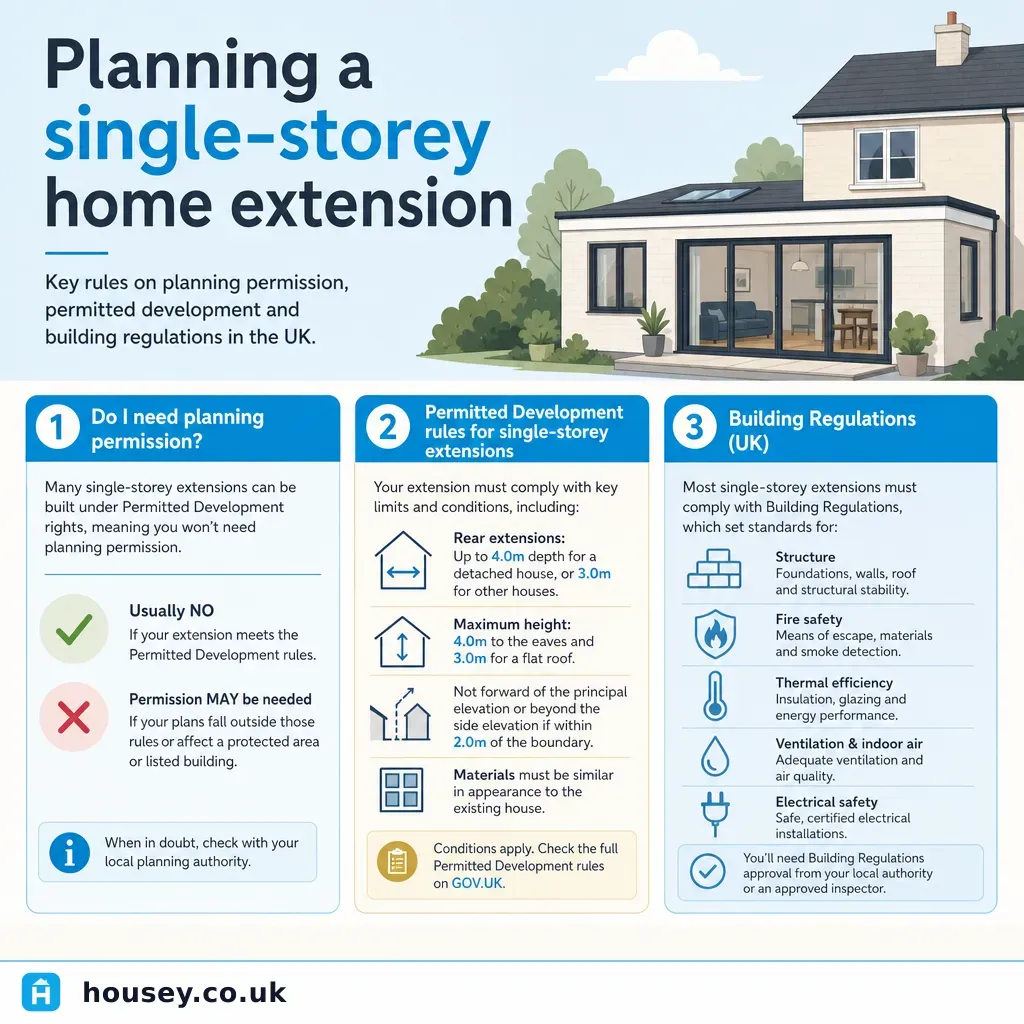
Planning a single-storey home extension
A single-storey extension may fall under permitted development rights, avoiding full planning permission, but only if it meets size, height, and boundary conditions simultaneously.