When to Engage a Builder Versus a Roofing Specialist: Role Definition and Expertise
By Housey · Last reviewed 3rd of May 2026
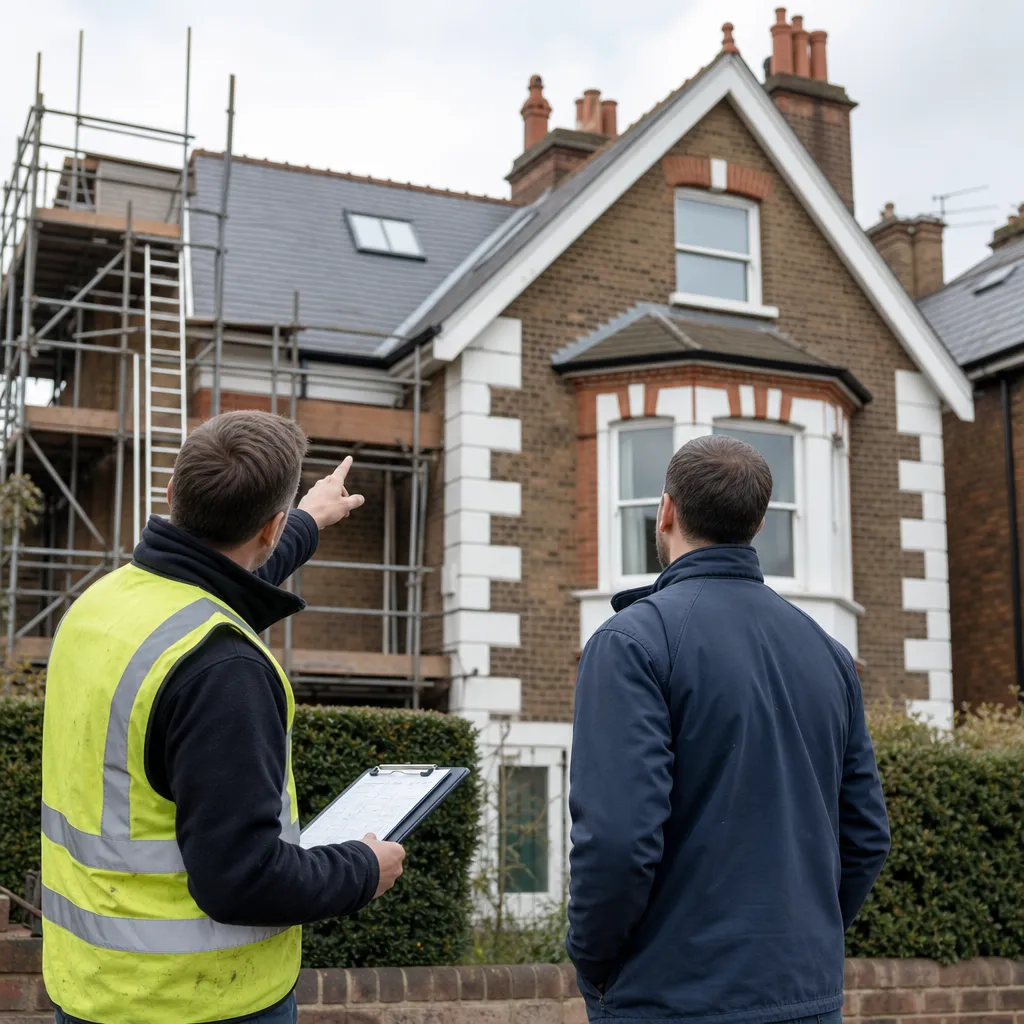
When to Engage a Builder Versus a Roofing Specialist: Role Definition and Expertise
Choosing between a general builder and a specialist roofing contractor is a decision UK homeowners face more often than they might expect — particularly after a property inspection flags roof defects, or when planning a project that touches the roof structure. Getting the professional roles right from the outset can affect workmanship quality, warranty eligibility, building control sign-off, and the ease of making insurance claims if something goes wrong later.
Key points
- Roofing contractors who are members of the National Federation of Roofing Contractors (NFRC) or Confederation of Roofing Contractors (CORC) carry trade-specific accreditation that general builders typically do not hold.
- Under Building Regulations Approved Document L (2021 edition), replacing more than 25% of a roof covering triggers a building control notification requirement and a minimum thermal performance standard.
- Structural roof timbers — rafters, purlins, ridge boards — should be assessed by a structural engineer when defects or alterations are suspected, not a builder or roofer alone.
- A specialist roof survey before instructing any contractor can identify the full scope of work and prevent under-specification at the quoting stage.
- General builders are often better placed than specialist roofers to lead projects where roof work is one element of a wider build — an extension, loft conversion, or major refurbishment.
What each professional does
Understanding the scope of each role prevents assumptions about who is responsible for what — and who should be held accountable if the work fails.
A general builder organises and carries out a wide range of construction tasks — groundworks, brickwork, carpentry, plastering — and may also carry out basic roofing as part of a broader package. On a loft conversion, for example, a builder will typically manage structural alterations, dormer construction, and may either subcontract the roofing element or carry it out directly.
A specialist roofing contractor focuses exclusively or primarily on roof coverings, flashings, guttering, roof drainage, and flat roofing systems. Specialists are more likely to hold product-specific accreditations — from Velux for roof windows, or from manufacturers for flat roofing systems such as GRP, EPDM, or liquid applied products — and are better placed to guarantee manufacturer-backed warranties.
A structural engineer is a separate appointment needed when there is any question about the integrity of the roof's structural members — sagging ridges, spreading rafters, evidence of movement, or proposed structural alterations. Neither a general builder nor a roofing contractor is qualified to provide a structural assessment.
Which professional do you need? A decision tree
- Is the work limited to the roof covering — replacing tiles or slates, repointing ridge tiles, repairing or replacing flashings, clearing or relining gutters? → Engage a specialist roofing contractor.
- Is the roof work part of a larger project such as an extension or loft conversion? → Engage a general extension builder as lead contractor; they will typically subcontract roofing if they cannot carry it out themselves.
- Are there signs of structural roof defects — sagging, spreading, cracking at the ridge, or visibly damaged rafters? → Instruct a structural engineer before any roofing or building work begins.
- Are you unsure of the scope or condition of the roof? → Commission a specialist roof survey first to define the work before inviting tenders.
- Is the project a flat roof replacement on an extension or garage? → Either a specialist roofing contractor with flat roofing system accreditation or an experienced extension builder may be appropriate; confirm which system is proposed and what warranty applies.
- Does the project involve a listed building or conservation area? → Check with your local planning authority before changing any roof materials; permitted development rights may not apply and some materials may be restricted.
Comparison: roofing specialist vs general builder for common projects
Project type | Roofing specialist | General builder | Notes |
|---|---|---|---|
Re-tiling or re-slating a pitched roof | Preferred | May be capable | Specialist more likely to carry trade warranty and NFRC accreditation |
Repairing or replacing lead flashings | Preferred | May be capable | Lead work is a specialist skill; check for Lead Contractors Association membership |
Flat roof replacement (GRP/EPDM) | Preferred | May be capable | System-specific accreditation affects manufacturer warranty |
Loft conversion | Not lead contractor | Preferred as lead | Structural and dormer work needs a builder; roofer may be subcontracted |
Single-storey extension including new roof | Not lead contractor | Preferred as lead | Builder manages the full build scope including the roof element |
Structural rafter or purlin repair or alteration | Neither alone | Neither alone | Structural engineer assessment required first |
Guttering and fascia replacement | Common | Common | Either usually capable; confirm scaffold or access arrangements are included |
What a roof survey adds before you instruct anyone
A roof survey carried out before you invite contractor quotes gives you a clear, written scope of works. Without one, contractors may price only the visible elements and present additional costs once they strip back the covering. A survey report lets you:
- Invite like-for-like quotes from multiple contractors on an equivalent scope.
- Identify whether structural repairs are needed before roofing work can proceed.
- Have documented evidence of roof condition at a point in time — useful for insurance, dispute resolution, or property sale.
- Establish whether the scale of work triggers a building control notification under Approved Document L.
Building Regulations considerations
Replacing more than 25% of the total roof covering of a dwelling triggers a requirement under Building Regulations Approved Document L (2021 edition) to notify building control and to demonstrate that the thermal performance of the roof meets current standards. A general builder acting as principal contractor should be familiar with this threshold; a roofing-only contractor may not manage the building control process.
For structural alterations to roof timbers — removing a wall that supports a purlin, adding a dormer, or similar — building regulations consent and structural calculations from a structural engineering practice will be required, regardless of which contractor carries out the physical work.
Confirm in writing before work starts who is responsible for submitting the building control notification and obtaining the completion certificate. The certificate is required for property sales and mortgage lender sign-off.
What to ask before accepting a quote
- Is the quote for a complete scope, and what is specifically excluded?
- What qualifications or accreditations do you hold — NFRC, CORC, Lead Contractors Association, or manufacturer system accreditation?
- What workmanship warranty do you provide, and separately, what manufacturer warranty applies to the materials?
- Who is responsible for building control notification and sign-off if required?
- Will you provide a written specification covering tile type, weight, fixing method, and underlay standard?
- What scaffold or access arrangements are included, and is edge protection provided throughout the works?
- What happens if additional defects are found once the covering is stripped back?
- Is VAT included in the quoted price?
When to get professional help
If you are uncertain which professional to engage, or if a property inspection has flagged roof concerns, consider:
- Commissioning a roof survey to define the scope and condition before inviting any quotes.
- Instructing a structural engineer if there are any signs of movement, sagging, or spreading in the roof structure.
- Engaging an extension builder as lead contractor when roof work is one part of a larger project, ensuring they co-ordinate specialist subcontractors and manage building control.
How Housey can help
Housey can connect you with the right professional for your project. Whether you need a specialist roofing contractor for roof covering work, a roof survey to define scope before work begins, or a structural engineer to assess the roof structure, Housey lets you compare quotes from qualified UK providers.
Frequently asked questions
Can a general builder replace roof tiles?
Many general builders can carry out basic tile or slate replacement, particularly as part of a larger project. However, for a full re-roofing or significant repair, a specialist roofing contractor is usually preferable — they are more likely to hold relevant trade accreditation, understand system warranties, and be familiar with the building control notification thresholds that apply to roof covering work.
Do I need an architect if I'm just having my roof repaired?
Not for a straightforward repair or re-cover. Architectural drawings are not required for most roofing work unless the project involves extending the roof, adding a dormer, or altering the building's external appearance in a way that requires planning permission. Where planning is needed — for example, on a listed building — a planning consultant or architect may be useful.
When does a structural engineer need to be involved in roof work?
If there are visible signs of structural defect — sagging, spreading walls, cracked ridge, or visibly damaged or rotted rafters — a structural engineer should assess the roof structure before any work proceeds. Structural engineers are also needed when alterations affect load-bearing elements, such as removing a wall that supports a purlin or adding a heavy covering to a structure originally designed for lighter materials.
What accreditations should I look for in a roofing contractor?
Look for membership of the National Federation of Roofing Contractors (NFRC), which requires contractors to meet quality and insurance standards. For flat roofing, confirm the contractor holds manufacturer system accreditation relevant to the product being installed — such as GRP, EPDM, or liquid applied. For lead work, the Lead Contractors Association (LCA) provides specialist accreditation that is worth requesting.
Sources and further reading
- Approved Document L: Conservation of fuel and power (2021) — GOV.UK
- Building regulations approval: when you need it — GOV.UK
- National Federation of Roofing Contractors — NFRC
- Lead Contractors Association — Lead Contractors Association
- RICS guidance on building surveys and defects — RICS
Useful next reads
 Planning & Pre-Build
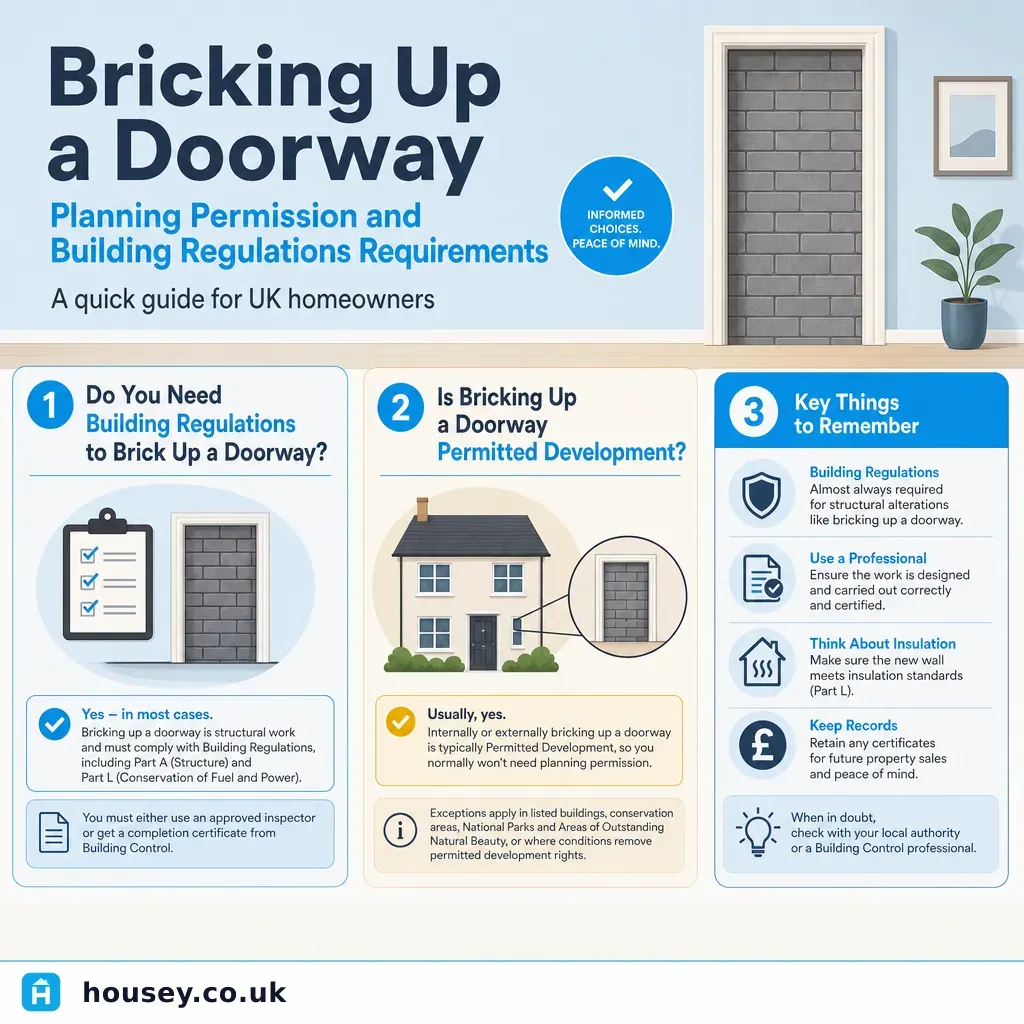
Bricking Up a Doorway: Planning Permission and Building Regulations Requirements
Bricking up a doorway usually does not require planning permission — internal alterations are permitted development and external closures on standard properties are also generally allowed.
 Planning & Pre-Build
Choosing Between an Architect and Structural Engineer
Most UK extension and loft conversion projects need both professionals: an architect or architectural technologist for design, planning, and building regulations drawings, and a structural engineer for beam calculations and foundation design.
 Planning & Pre-Build
Architect or Builder: Determining the Right Professional for Your Project
An architect designs, plans, and often manages projects; a builder carries out the physical construction work.
 Planning & Pre-Build
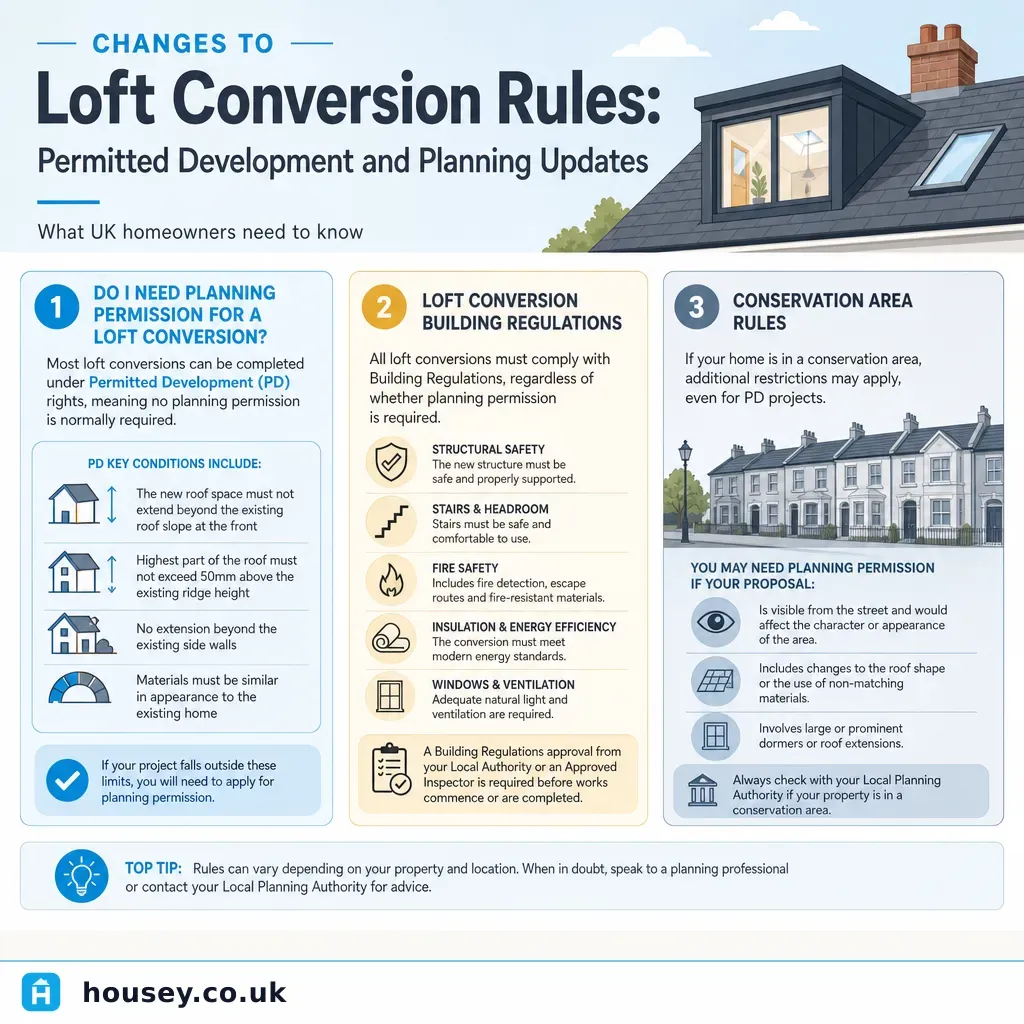
Changes to Loft Conversion Rules: Permitted Development and Planning Updates
In England, most loft conversions on standard houses qualify as Permitted Development under Class B of the GPDO 2015, allowing up to 40 cubic metres (terraced) or 50 cubic metres (detached or semi-detached) without a planning application — if conditions are met.
 Planning & Pre-Build
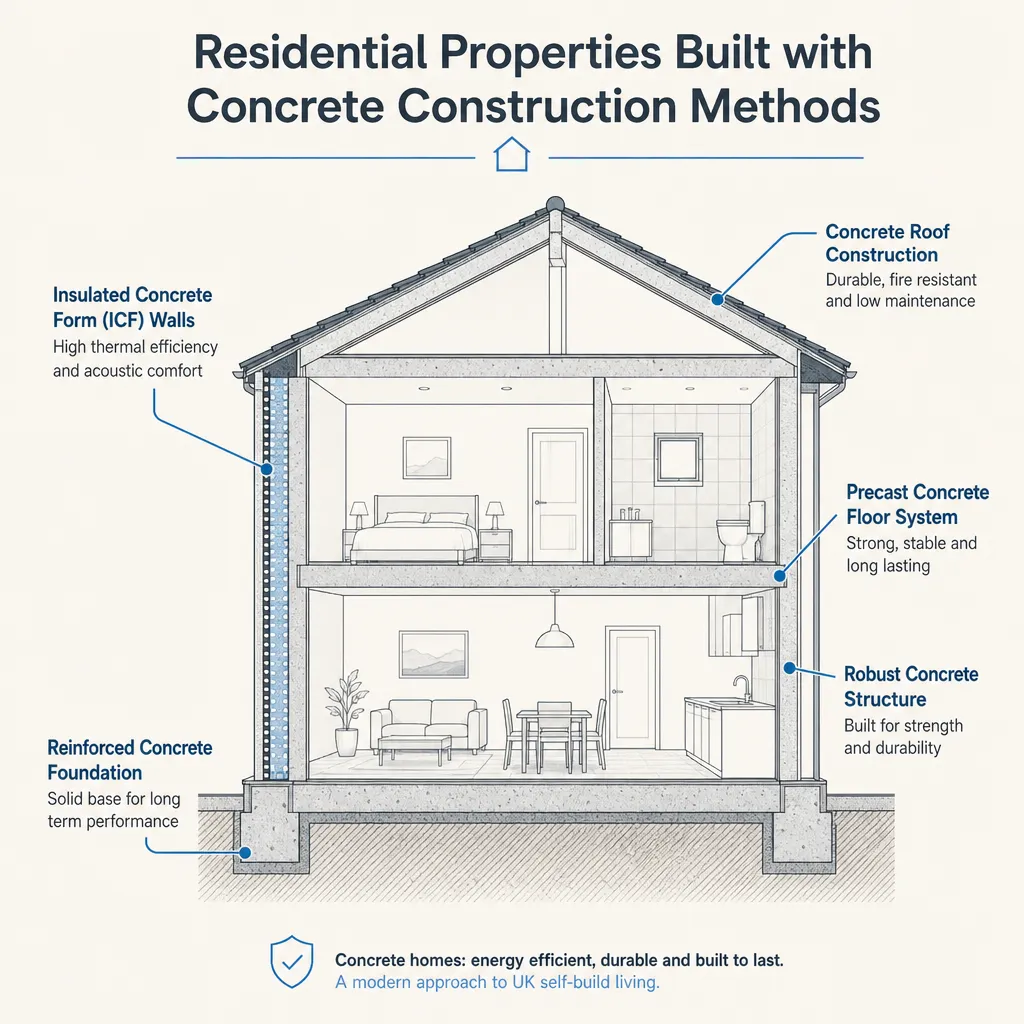
Residential Properties Built with Concrete Construction Methods
UK homes are built using several concrete methods: in-situ cast concrete, precast panel systems, insulating concrete formwork (ICF), and older non-traditional types such as Wimpey No-Fines and Laing Easiform.