Choosing Between an Architect and Structural Engineer
By Housey · Last reviewed 12th of May 2026

Choosing Between an Architect and Structural Engineer
When planning a home extension, loft conversion, or significant internal alteration, one of the first questions UK homeowners face is whether they need an architect, a structural engineer, or both. The answer depends on the nature of the project, the regulatory requirements it triggers, and what stage of the process you are at — and getting it wrong can lead to delays, abortive fees, or building control rejections.
Key points
- Architects are regulated by the Architects Registration Board (ARB); only ARB-registered individuals may legally use the title of architect in the UK under the Architects Act 1997.
- Structural engineers are typically chartered through the Institution of Structural Engineers (IStructE, designation MIStructE or CEng) or the Institution of Civil Engineers (ICE).
- Most extension and loft conversion projects require both professionals: an architect or architectural technologist for design and building regulations drawings, and a structural engineer for beam calculations and foundation design.
- A structural engineer is always required when removing load-bearing walls, installing steel beams (RSJs), underpinning foundations, or making any change affecting a building's structural integrity.
- Indicative fees differ: architects typically charge 5–15% of build cost or a fixed package fee; structural engineers usually charge per calculation package, often £500–£2,000+ for residential projects. (Indicative UK costs, last reviewed 2026-05-12.)
What does an architect do?
An architect takes your brief and translates it into a buildable, compliant design. Their role typically includes:
- Feasibility and design: Assessing what is achievable within your budget, planning constraints, and the physical limits of the property — including permitted development rights and local authority policies.
- Planning applications: Preparing and submitting planning permission applications to your local planning authority (LPA), including drawings, design and access statements, and supporting documents.
- Building regulations drawings: Producing detailed technical drawings demonstrating compliance with the Building Regulations Approved Documents (Parts A through S).
- Contract administration: Managing the tender process with builders, reviewing quotes, and overseeing works on site if you appoint them to that role.
Not every project demands full architectural services. For a straightforward permitted development extension, many homeowners instruct an architectural technologist (MCIAT designation) instead — often at a lower fee, with equivalent technical output for standard residential work.
What does a structural engineer do?
A structural engineer's job is to ensure the building stands up safely under all expected loads. Their work typically includes:
- Structural calculations: Determining load paths, sizing steel beams (RSJs), and specifying foundation depths for new or altered structures.
- Beam and opening specifications: If you are removing a load-bearing wall or creating a large opening, the structural engineer produces the calculation package that building control requires before work can proceed.
- Movement and subsidence assessments: Investigating crack patterns, differential movement, or foundation failures and advising on the appropriate remediation.
- Retaining wall and party wall design: Calculations for structures close to or at boundaries where loading on neighbouring land must be considered.
Structural engineers do not typically produce planning drawings or full building regulations documentation — that is the architect's or technologist's domain.
Architect vs structural engineer: at a glance
Factor | Architect | Structural engineer |
|---|---|---|
Core expertise | Design, planning compliance, building regulations | Load paths, structural calculations, foundation design |
Qualification body | ARB (Architects Registration Board) | IStructE (MIStructE/CEng) or ICE |
When you need them | Design stage, planning applications, building regs, contract admin | Removing walls, beams, underpinning, structural defects |
Key output | Drawings, design statements, planning applications | Calculation packages, structural drawings, specifications |
Typical residential fee | 5–15% of build cost, or fixed package | £500–£2,000+ per calculation package |
Advises on aesthetics? | Yes — central to their role | No — structural adequacy only |
Required for planning? | Usually (or technologist equivalent) | Only if structural drawings required by condition |
Indicative UK costs, last reviewed 2026-05-12. Fees vary significantly by project scale, location, and professional.
Which professional do I need?
Use this decision tree to identify the right professional for your project:
- Choose an architect or architectural technologist if you are designing an extension, loft conversion, or significant alteration; applying for planning permission; or need Building Regulations compliance drawings.
- Choose a structural engineer if you are removing a load-bearing wall, installing a steel beam, experiencing cracks or subsidence, or if your building control body has requested structural calculations.
- Instruct both if your project involves design and structural changes together — an extension with a knocked-through ground floor, a loft conversion with structural roof alterations, or a large rear extension requiring both planning drawings and beam calculations. This is the most common residential scenario.
- Instruct a structural engineer specifically if you suspect foundation failure, significant structural cracking, or want a standalone structural assessment without commissioning design work.
- Check with your local planning authority (LPA) before engaging any professional if you are unsure whether your project qualifies as permitted development or requires full planning permission — the answer can depend on property history, location, and prior extensions.
Which professional for common project types
Project type | Architect or technologist? | Structural engineer? |
|---|---|---|
Single-storey rear extension | Usually (planning or building regs drawings) | Often (beam over new opening, foundation design) |
Loft conversion | Usually (building regs drawings) | Yes (structural roof alterations, ridge beam, floor beams) |
Remove a load-bearing wall | Optional (design only) | Yes — always required |
New-build house | Yes | Yes |
Internal reconfiguration, no structural changes | Sometimes (building regs) | Not usually |
Crack investigation or movement assessment | Not usually | Yes — specialist structural inspection |
Garage conversion | Sometimes (building regs) | Sometimes (depends on existing structure) |
Listed building alterations | Usually (heritage experience important) | Sometimes |
Can I use one professional without the other?
On projects with no structural changes — such as a straightforward garage conversion with no structural alterations, or a simple internal reconfiguration — you may only need an architectural technologist for building regulations drawings without engaging a structural engineer at all.
Conversely, if you need only structural calculations for building control (for example, beam sizes for a wall removal your builder has already planned), you can instruct a structural engineer directly without commissioning full architectural services.
On extension, loft conversion, and wall-removal projects, most building control surveyors expect both sets of documentation. It is common — and efficient — for the architect and structural engineer to work together, with the architect coordinating the complete package submitted to building control.
Important limitations
This article provides general information about the typical roles of architects and structural engineers in UK residential projects. The appropriate professional — and whether both are needed — depends on your specific project, the property's construction and history, your local planning authority's requirements, the views of your building control body, and any lease, party wall, or listed building constraints. Nothing in this article constitutes structural, architectural, planning, or legal advice. Always verify professional credentials on the relevant register before instructing, and seek independent advice on your specific situation.
When this becomes urgent
Seek professional advice promptly if:
- You have started structural work without building control approval — stop the work and contact your local authority building control or an approved inspector immediately.
- You are approaching exchange of contracts on a property where a surveyor's report has flagged significant movement, subsidence, or unexplained cracking — a structural engineer's assessment may be needed before you proceed.
- You have received a planning enforcement notice from your local planning authority regarding unauthorised works.
- Your building insurer requires a structural assessment following subsidence, flooding, or storm damage before reinstating cover.
What to ask a qualified professional
Before instructing an architect or structural engineer, ask:
- Are you ARB-registered (architect) or IStructE/ICE-chartered (structural engineer), and can I verify this on the relevant public register?
- Have you worked on projects of this type and scale before, and are references or examples available?
- What is included in your fee — drawings, calculations, planning submission, building control liaison?
- What is excluded, and what additional costs might arise during the project?
- Will your documentation be accepted by the local building control body or an approved inspector?
- Do you hold professional indemnity insurance, and what is the level of cover?
- Who will carry out and sign off the work — a senior chartered professional or a junior team member?
- What is the expected timeline, and what information do you need from me to begin?
When to get professional help
If your project involves any of the following, instruct a qualified professional before starting work:
- Any structural alteration, including removing internal walls, installing steel beams, or modifying a roof structure.
- A planning application to your local planning authority, particularly for extensions or changes of use.
- Work near or on the party wall under the Party Wall etc. Act 1996.
- Signs of structural movement — stepped cracking in brickwork, doors or windows that have recently started sticking, or visible deflection in floors or ceilings.
- Any work on a listed building, which requires listed building consent in addition to any planning permission or building regulations approval.
An unapproved structural alteration can make a property difficult or impossible to sell, may invalidate building insurance, and presents genuine safety risks to occupants.
How Housey can help
Housey connects UK homeowners with verified professionals across design and structural disciplines. Whether you need a qualified architect for your extension or loft conversion design, or a chartered structural engineer for beam specifications and structural calculations, Housey can help you compare quotes from vetted local professionals.
Frequently asked questions
Do I always need an architect for an extension in the UK?
Not necessarily. For straightforward extensions, an architectural technologist (MCIAT designation) can often prepare the required planning and building regulations drawings at a lower cost. An architect is particularly valuable for complex design briefs, listed buildings, conservation area properties, or projects where design quality and planning negotiation are priorities.
Can a structural engineer replace an architect?
No. A structural engineer's expertise covers load paths, calculations, and structural safety — not design, planning applications, or building regulations compliance documentation. On projects involving extensions, loft conversions, or wall removals, you will typically need both. The roles are complementary, not interchangeable.
What is the difference between building regulations approval and planning permission?
Planning permission is required when you want to change the use, size, or appearance of a property beyond permitted development limits — your local planning authority decides. Building regulations approval is a separate process ensuring the technical construction meets minimum safety standards; it is required for most structural work regardless of whether planning permission is needed.
How much does a structural engineer cost for a typical residential project?
For a standard residential calculation package — such as specifying a steel beam for a load-bearing wall removal — fees typically range from around £500 to £2,000 depending on complexity, location, and firm size. Multi-storey extensions or underpinning projects will cost more. Always request an itemised quote. Indicative UK costs, last reviewed 2026-05-12.
Sources and further reading
- Architects Registration Board – Architects Register — Architects Registration Board (ARB)
- Institution of Structural Engineers – Find a structural engineer — IStructE
- GOV.UK – Planning permission overview — GOV.UK
- GOV.UK – Building regulations approval — GOV.UK
- RICS – Find a member — RICS
Useful next reads
 Planning & Pre-Build
Architect or Builder: Determining the Right Professional for Your Project
An architect designs, plans, and often manages projects; a builder carries out the physical construction work.
 Planning & Pre-Build
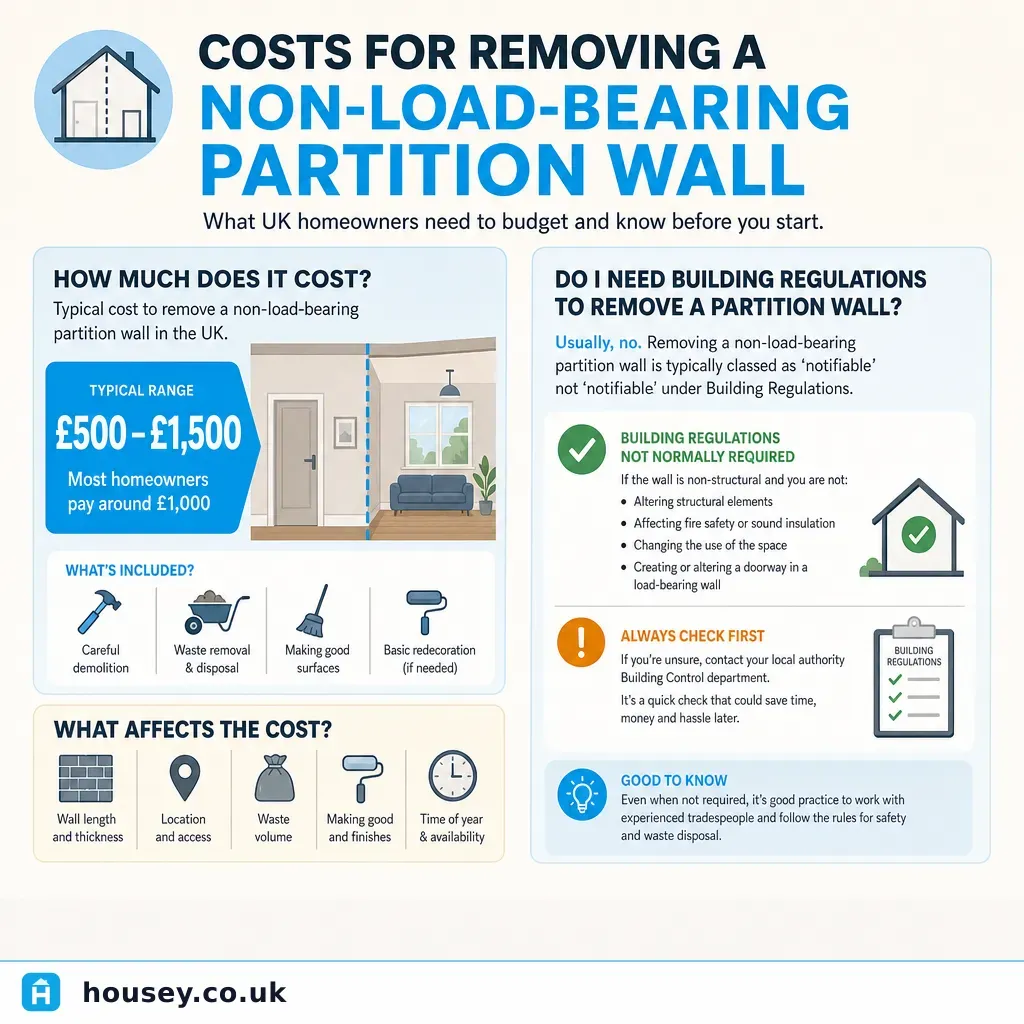
Costs for removing a non-load-bearing partition wall
Removing a non-load-bearing partition wall in a UK home typically costs £300–£1,500 in labour, plus £200–£600 or more for replastering and making good.
 Planning & Pre-Build
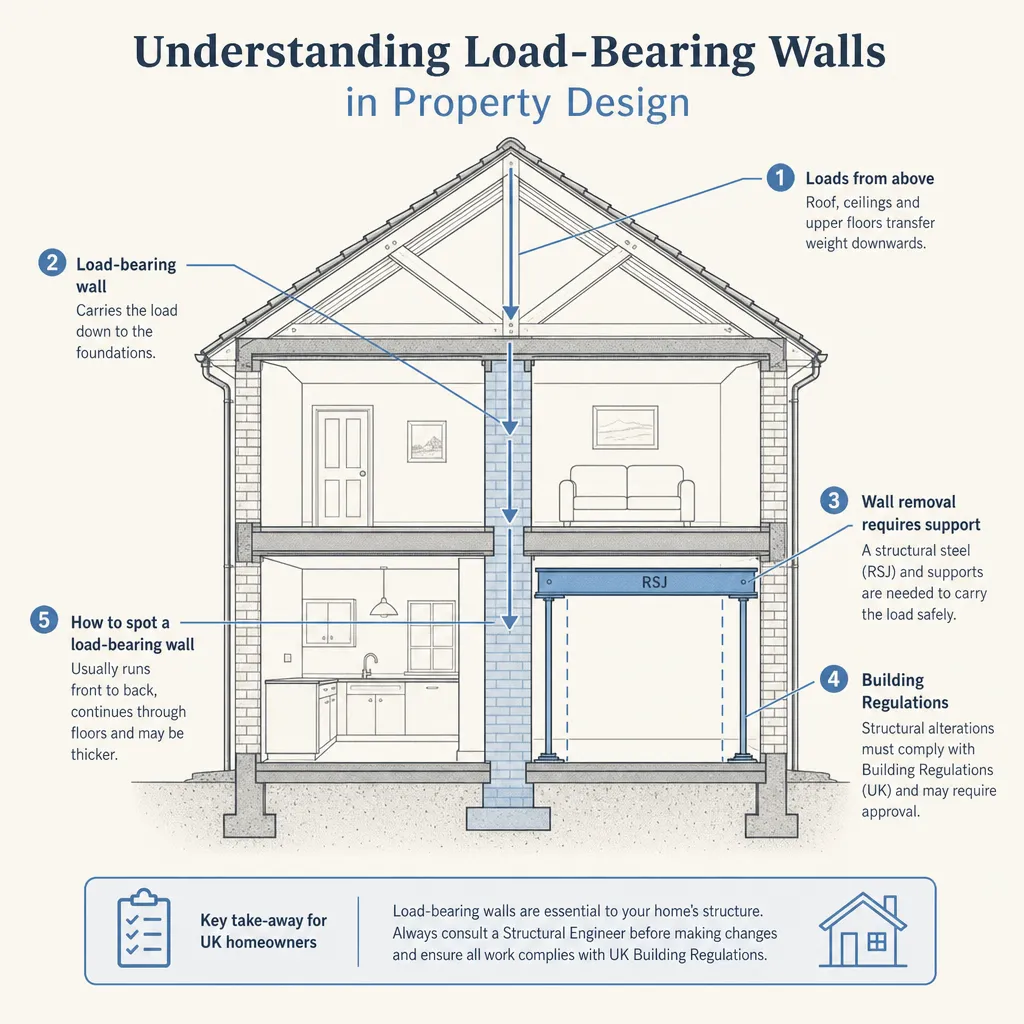
Understanding Load-Bearing Walls in Property Design
A load-bearing wall carries the weight of floors, roofs, or other walls above it down to the foundations.
 Planning & Pre-Build
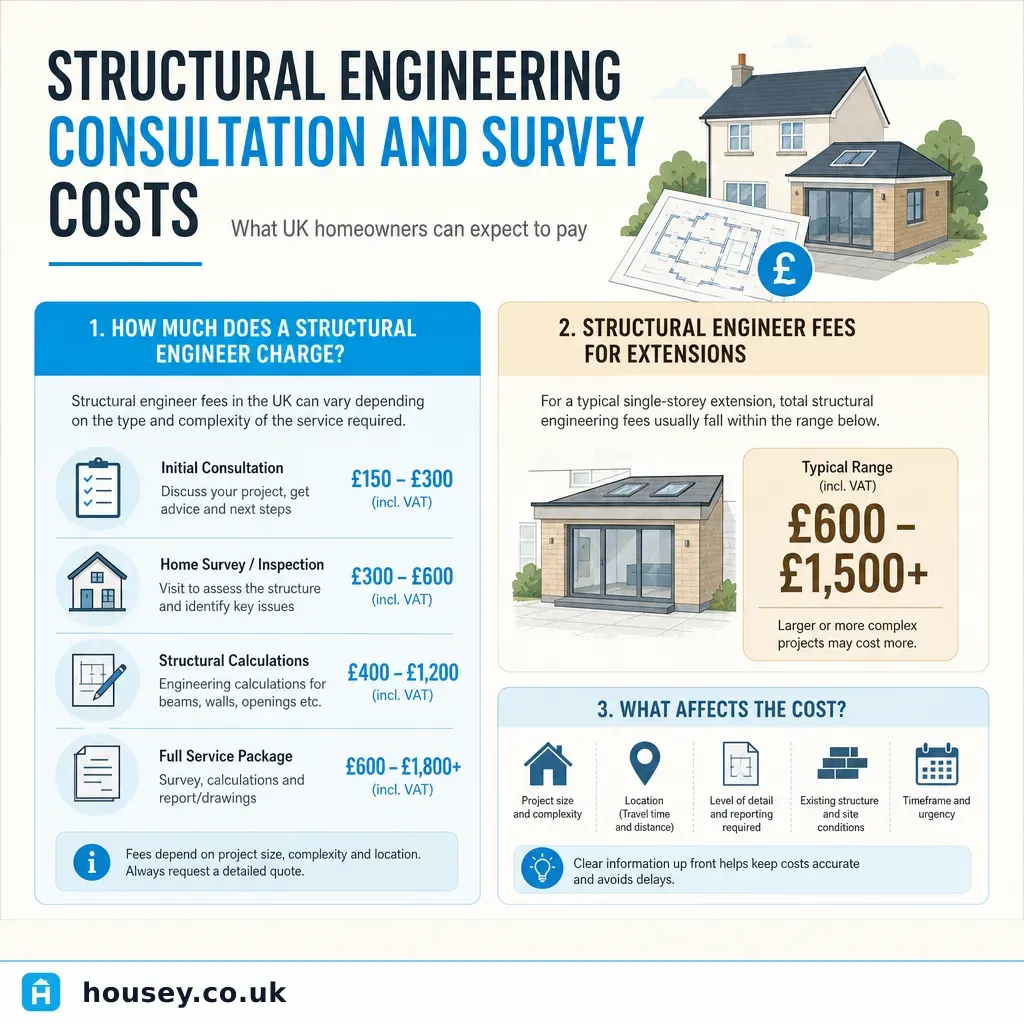
Structural Engineering Consultation and Survey Costs
A structural engineer consultation in the UK typically costs £300–£800 for a specific defect report or pre-purchase assessment.
 Planning & Pre-Build
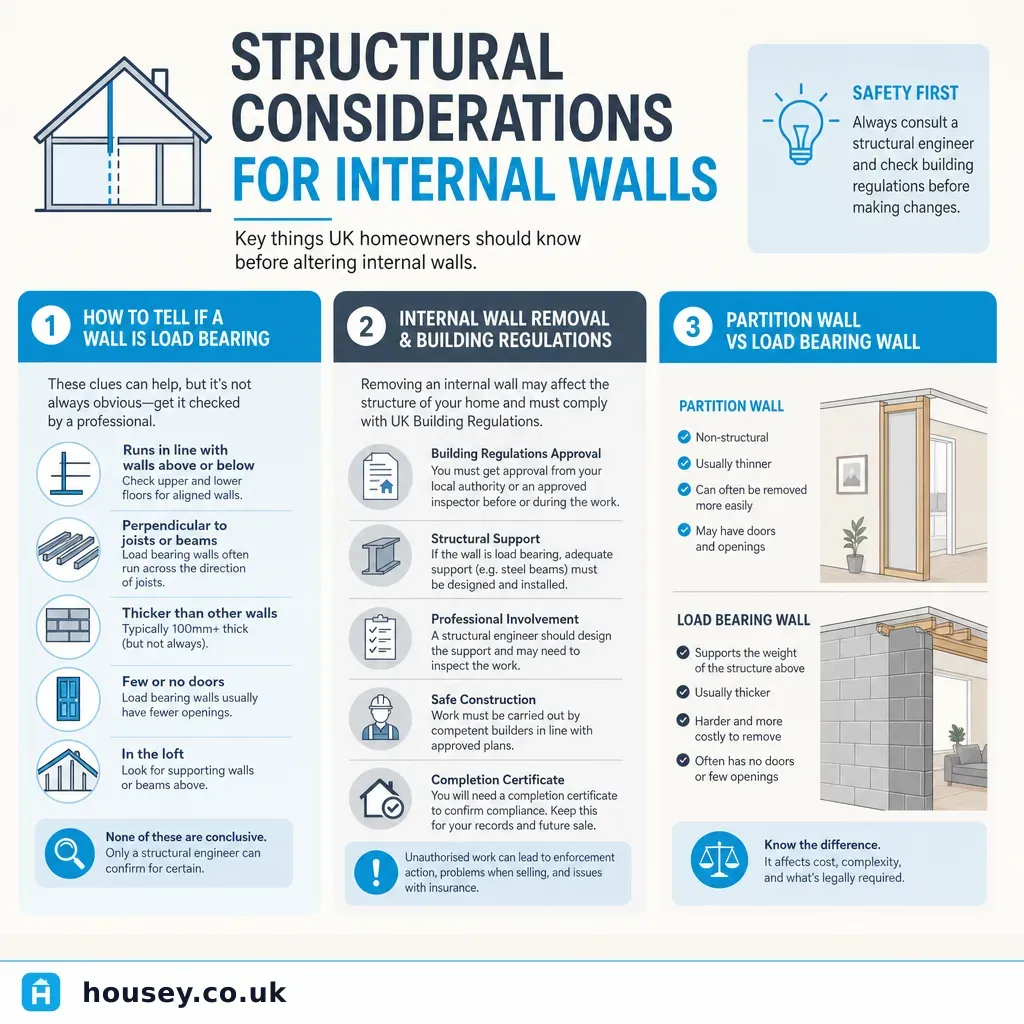
Structural considerations for internal walls
Whether a wall is load-bearing depends on its position, orientation relative to floor joists, and the property's construction.