Building a Bedroom Extension: Planning, Building Regulations, and Costs
By Housey · Last reviewed 5th of May 2026
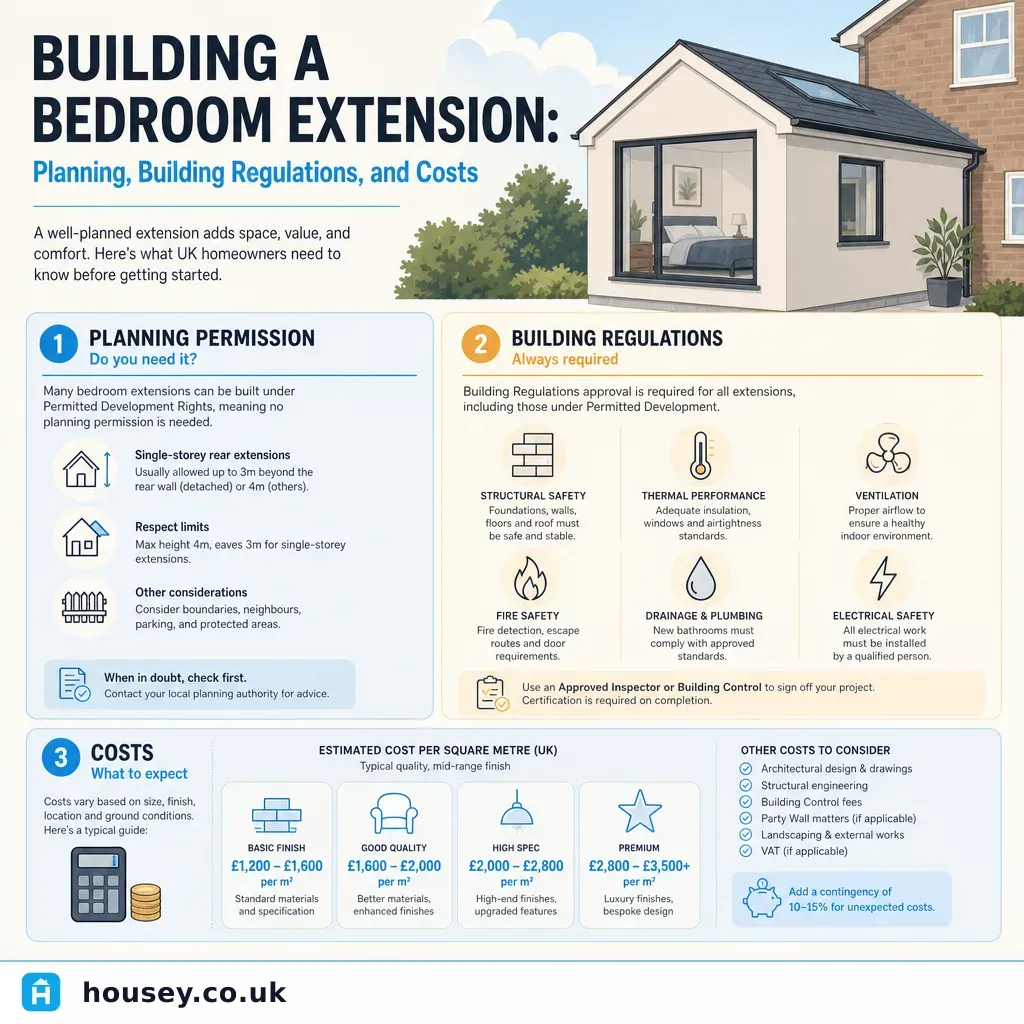
Building a Bedroom Extension: Planning, Building Regulations, and Costs
Adding a bedroom extension is one of the most popular ways UK homeowners increase living space and property value — and one of the most process-intensive projects you can undertake on a residential property. Whether you are creating a ground-floor room for a relative, adding a master suite above an existing extension, or extending into the garden, the project involves navigating planning rules, building regulations, structural design, and a construction contract. Getting each stage right protects your investment and ensures the finished space is legal, structurally sound, and mortgageable.
Key points
- Single-storey rear extensions may qualify as permitted development (PD) without a full planning application: 4 m depth for detached houses, 3 m for semi-detached and terraced properties — extendable under the larger home extension prior approval scheme to 8 m and 6 m respectively.
- All extensions — regardless of PD status — require Building Regulations approval covering structure (Part A), fire safety (Part B), energy efficiency (Part L), and ventilation (Part F).
- The Party Wall etc. Act 1996 applies if your extension is within 3 m of a neighbour's foundation or built on or near a boundary; formal notices must be served before work starts.
- Indicative UK single-storey extension costs range from £1,500 to £2,500 per square metre, with professional fees typically adding a further 10–15% (Indicative UK costs, last reviewed 2026-05-05).
- Conservation areas, Article 4 directions, and listed building status can remove permitted development rights entirely, requiring a full planning application even for modest extensions.
Does a bedroom extension need planning permission?
The answer depends on the size, position, and planning designation of your property.
Permitted development — no planning application required
Under Schedule 2, Part 1, Class A of the Town and Country Planning (General Permitted Development) (England) Order 2015, a single-storey rear extension may be built under permitted development if:
- It does not exceed 4 m in depth for a detached house, or 3 m for any other house type.
- Under the larger home extension scheme (prior approval route), these limits extend to 8 m (detached) and 6 m (semi-detached or terraced), subject to neighbour consultation and local authority prior approval.
- The eaves and ridge height do not exceed those of the existing roof.
- No more than half the original curtilage area is covered by extensions and outbuildings in total.
- External materials are similar in appearance to those of the existing house.
Permitted development rights are removed for properties in conservation areas, World Heritage Sites, Areas of Outstanding Natural Beauty, or where an Article 4 direction applies. Always confirm your position with your local planning authority before starting.
When full planning permission is needed
A householder planning application is required if the extension exceeds PD size limits, you are adding a second storey, the property is listed, PD rights have been removed, or the extension is on a side elevation beyond certain proportions. A householder application in England currently costs £258 (fee as revised April 2025 — check current fees on GOV.UK) and the council has 8 weeks to decide.
Decision tree: which planning route applies?
- Use permitted development if: single-storey rear, depth within 4 m (detached) or 3 m (semi/terrace), matching materials, no planning restrictions on the property.
- Use the larger home extension prior approval route if: single-storey rear, depth between 4–8 m (detached) or 3–6 m (semi/terrace), not in a restricted zone — formal neighbour consultation is required.
- Submit a full planning application if: two-storey or above, exceeds PD depth limits, listed property, conservation area, or side extension beyond PD proportions.
- Take specialist advice if: an Article 4 direction may apply, previous extensions already exist on site, or there is any uncertainty about the property's planning history.
What building regulations must the extension meet?
Building Regulations approval is required for all extensions — separate from and in addition to any planning requirement.
Approved Document | What it covers for your extension |
|---|---|
Part A (Structure) | Foundations, loadbearing walls, floors, roof stability |
Part B (Fire safety) | Escape routes, fire spread, interlinked smoke alarms |
Part C (Moisture) | Damp-proof courses, ground conditions |
Part F (Ventilation) | Background and extract ventilation in new habitable rooms |
Part L (Energy efficiency) | Minimum U-values for walls, roof, floor, windows, doors |
Part M (Accessibility) | Reasonable access provision |
Part P (Electrical safety) | Notifiable electrical work within the extension |
A building control body — either your local authority's building control service or a registered building control approver (following the Building Safety Act 2022) — must inspect at key stages and issue a completion certificate. This certificate is required when you sell the property.
What does a bedroom extension cost?
Indicative UK costs, last reviewed 2026-05-05. Costs vary significantly by size, specification, location, and ground conditions.
Item | Indicative cost range |
|---|---|
Single-storey extension (per m²) | £1,500–£2,500 |
Two-storey extension (per m²) | £1,800–£3,000 |
Architect or architectural technologist fees | 8–15% of build cost |
Structural engineer | £500–£1,500 |
Householder planning application fee (England) | £258 (2025 revision) |
Building control fees | £500–£1,000+ depending on size |
Party wall surveyor (where required) | £700–£1,500+ per affected neighbour |
Sources: RICS, BCIS; figures are indicative ranges — quotes will vary by region and contractor.
Total elapsed time from initial decision to moving into the new room is typically 9–18 months where planning permission is required, including 3–6 months of construction on site.
Homeowner checklist: before you appoint a builder
Important limitations
This article provides general information about bedroom extensions in England. Planning policy, permitted development rights, and building regulations requirements vary depending on your local planning authority, property history, and any historic or environmental designations. Rules in Wales, Scotland, and Northern Ireland differ from England. Leasehold properties may require freeholder consent before any structural work begins. Nothing in this article constitutes professional planning, structural, legal, or construction advice. Always verify your specific position with the relevant authority or a qualified professional before committing to any work or expenditure.
What to ask a qualified professional
Before appointing an architect, designer, or builder:
- Do I need full planning permission, or can this extension be built under permitted development or prior approval?
- Will you carry out a planning history search to confirm permitted development rights have not been removed?
- Does the Party Wall etc. Act apply, and will you advise on serving notices?
- Which building control route do you recommend — local authority or registered building control approver?
- What structural information will the engineer need before drawings can be produced?
- Are you RIBA-chartered, CIAT-registered, or otherwise professionally accredited?
- What is included in your fee, and at what stage does it become payable if the project does not proceed?
When to get professional help
Engage a qualified professional before committing to a builder or budget. An architect or architectural technologist can assess the planning position, identify constraints such as conservation area status or Article 4 directions, and produce the drawings required for both planning and building regulations. Attempting to manage planning applications or building regulations submissions without professional support significantly increases the risk of refusal, non-compliance, or costly remedial work. If you receive a planning refusal, a planning consultant can advise on whether an appeal or a revised scheme is the better route.
How Housey can help
Housey can connect you with vetted extension builders and building control consultants who can guide your bedroom extension from initial design through to a signed-off completion certificate.
Frequently asked questions
Can I build a bedroom extension under permitted development?
Yes, in many cases a single-storey rear bedroom extension can be built under permitted development without a full planning application, provided it meets the size limits and other conditions in Schedule 2, Part 1 of the GPDO 2015. However, permitted development rights may be restricted by conservation area designation, Article 4 directions, or the property's planning history. Always confirm your position with your local planning authority before starting.
Do I need an architect for a bedroom extension?
You are not legally required to use a RIBA-chartered architect, but a qualified designer such as a CIAT-registered architectural technologist is strongly advisable. They will prepare planning and building regulations drawings, coordinate structural engineer input, and liaise with building control, significantly reducing the risk of errors, delays, or enforcement action.
How long does it take to build a bedroom extension?
Construction of a single-storey bedroom extension typically takes 3–6 months once work starts on site. Including design, planning determination, and building regulations approval, total elapsed time from initial decision to completion is usually 9–18 months where a planning application is required.
Will a bedroom extension add value to my home?
Adding a bedroom generally increases saleable value and can move a property into a higher price bracket, particularly where an extra bedroom commands a meaningful premium. The return on investment varies by location, property type, and build quality. A RICS-registered valuer or local estate agent can give a more specific view for your property and area.
What if my neighbour objects to my extension?
For larger home extension prior approval applications, neighbours are formally consulted and can raise objections the council considers. For full planning applications, neighbouring properties are notified. Objections do not automatically lead to refusal — the council weighs material planning considerations such as loss of light, overlooking, and design. Your designer can help minimise the risk of objections through careful siting and massing.
Sources and further reading
- Planning permission for extensions — GOV.UK — GOV.UK
- Town and Country Planning (GPDO) 2015, Schedule 2, Part 1 — legislation.gov.uk
- Permitted development for householders — Planning Portal — Planning Portal
- Building regulations approval — GOV.UK — GOV.UK
- Party Wall etc. Act 1996 guidance — GOV.UK — GOV.UK
- RICS cost information — Royal Institution of Chartered Surveyors
Useful next reads
 Improvement & Build
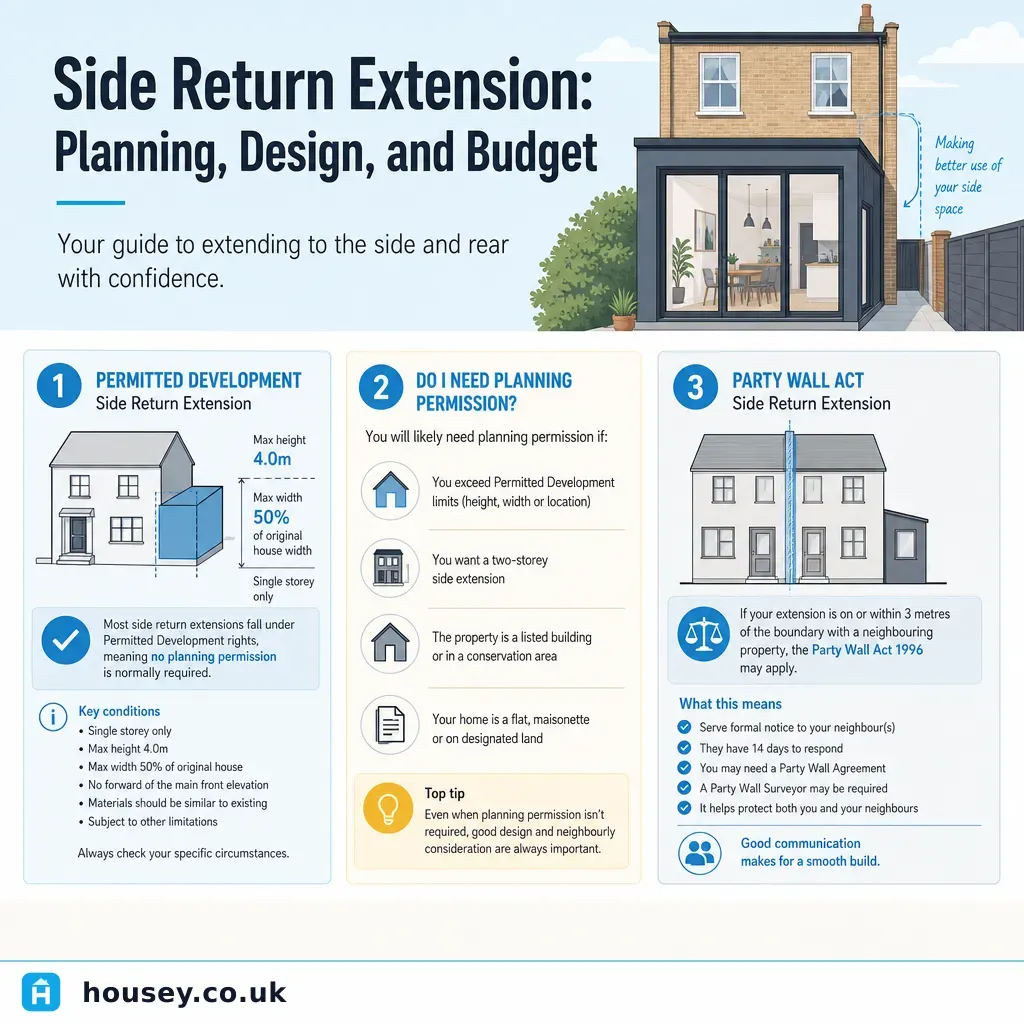
Side Return Extension: Planning, Design, and Budget
A side return extension fills the narrow alley alongside a Victorian or Edwardian terrace to create a larger kitchen or living space.
 Improvement & Build
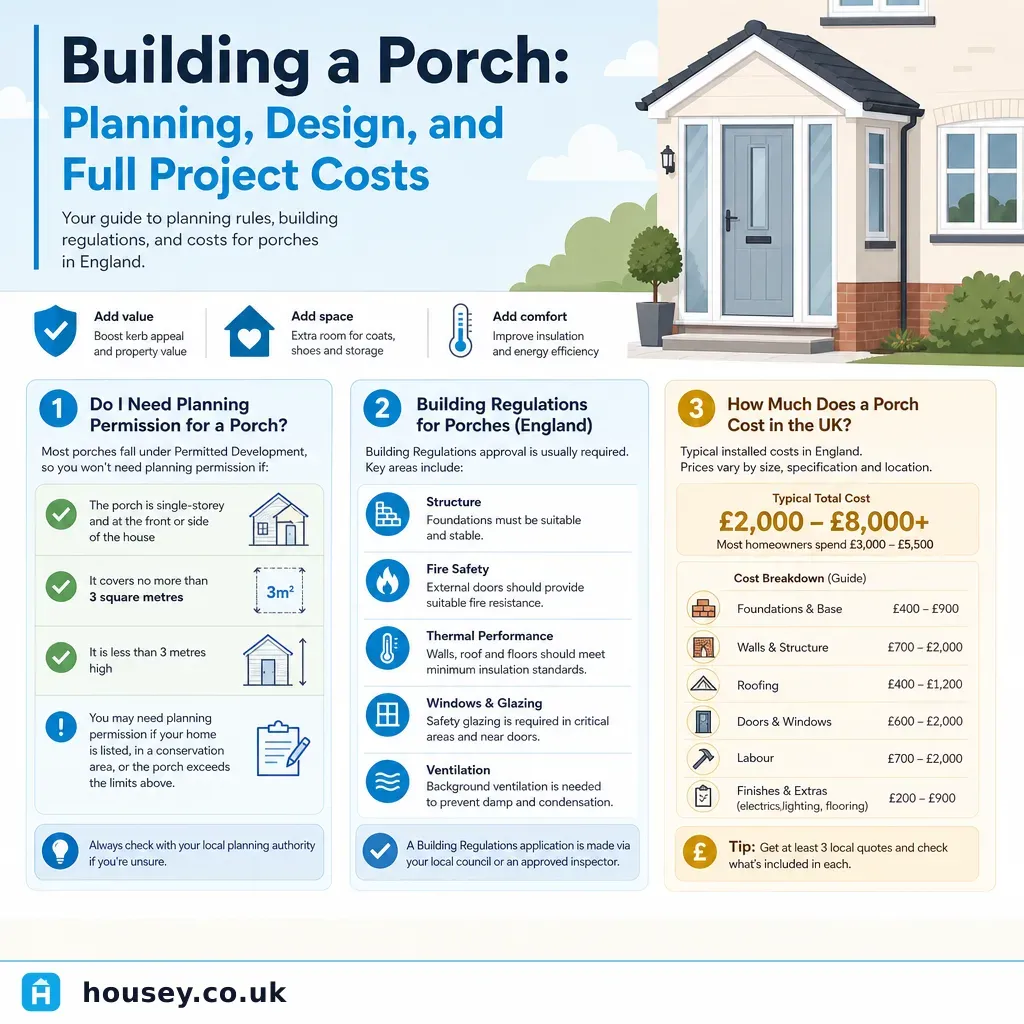
Building a Porch: Planning, Design, and Full Project Costs
Most porches with an external floor area of 3m² or less can be built without planning permission in England under permitted development rights, but building regulations approval is almost always required.
 Improvement & Build
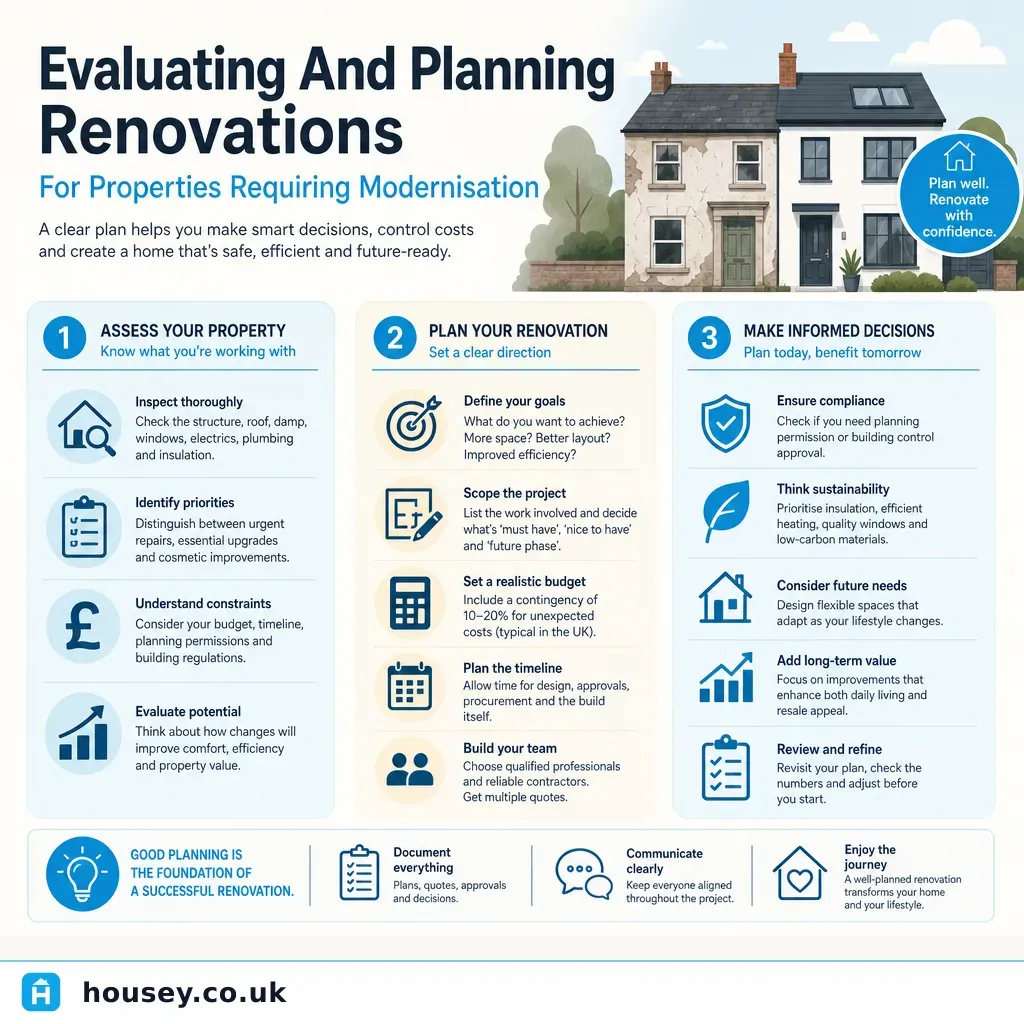
Evaluating And Planning Renovations For Properties Requiring Modernisation
Start by commissioning a condition survey — RICS Level 3 for pre-1919 properties — to identify structural defects, damp, and services issues before finalising a budget.
 Improvement & Build
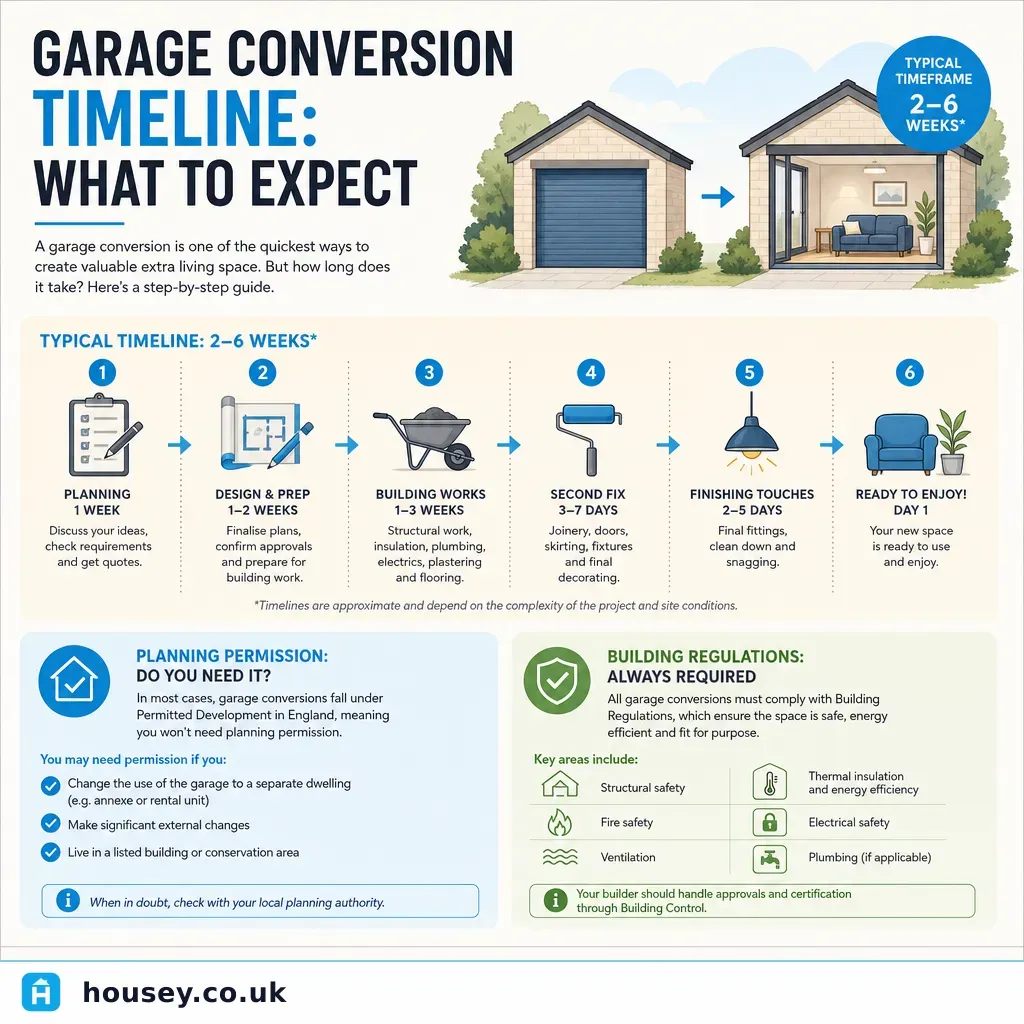
Garage Conversion Timeline: What to Expect
A straightforward attached garage conversion in England usually takes 4–8 weeks of construction, plus pre-start time for building control approval (5 working days for Full Plans).
 Improvement & Build
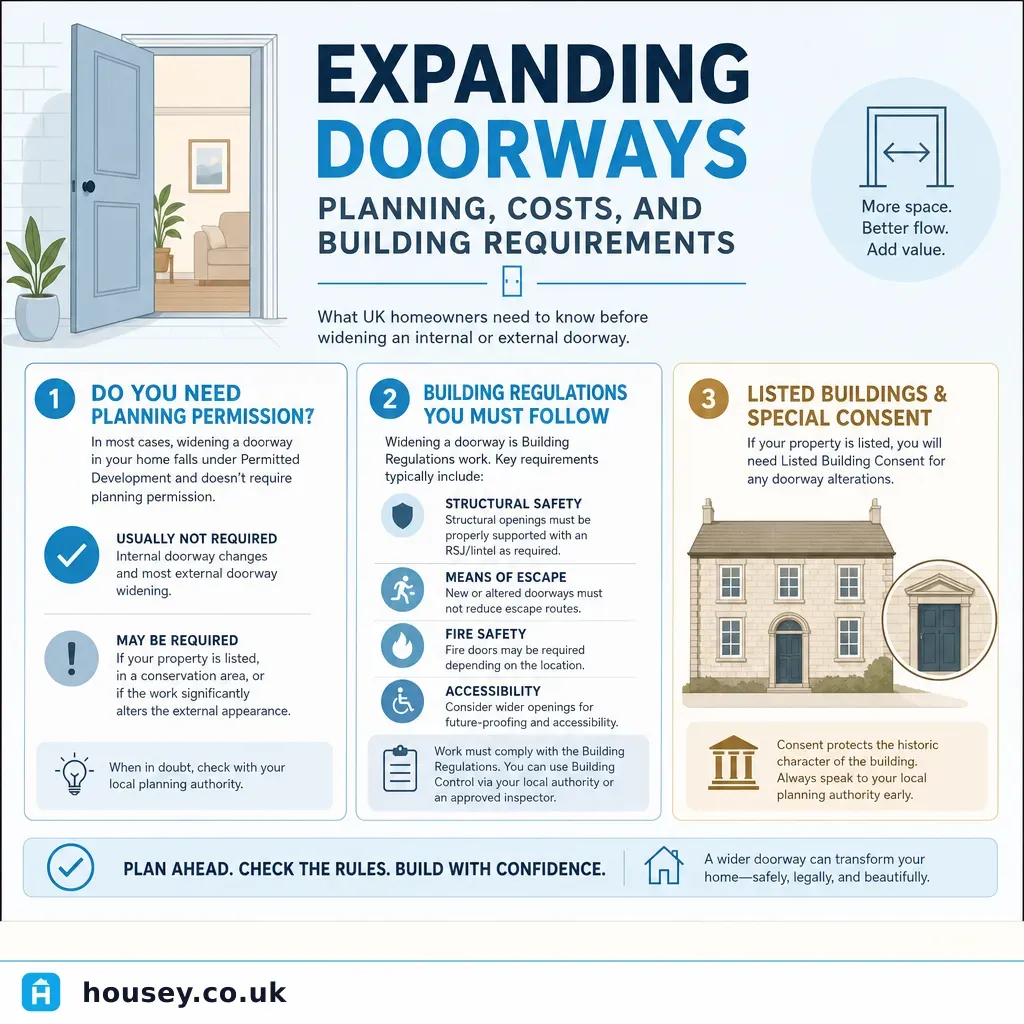
Expanding Doorways: Planning, Costs, and Building Requirements
Expanding a doorway in a load-bearing wall requires Building Regulations Part A approval and a structural engineer's lintel design.