Building a House in the UK: Complete Guide to Costs and Process
By Housey · Last reviewed 5th of May 2026
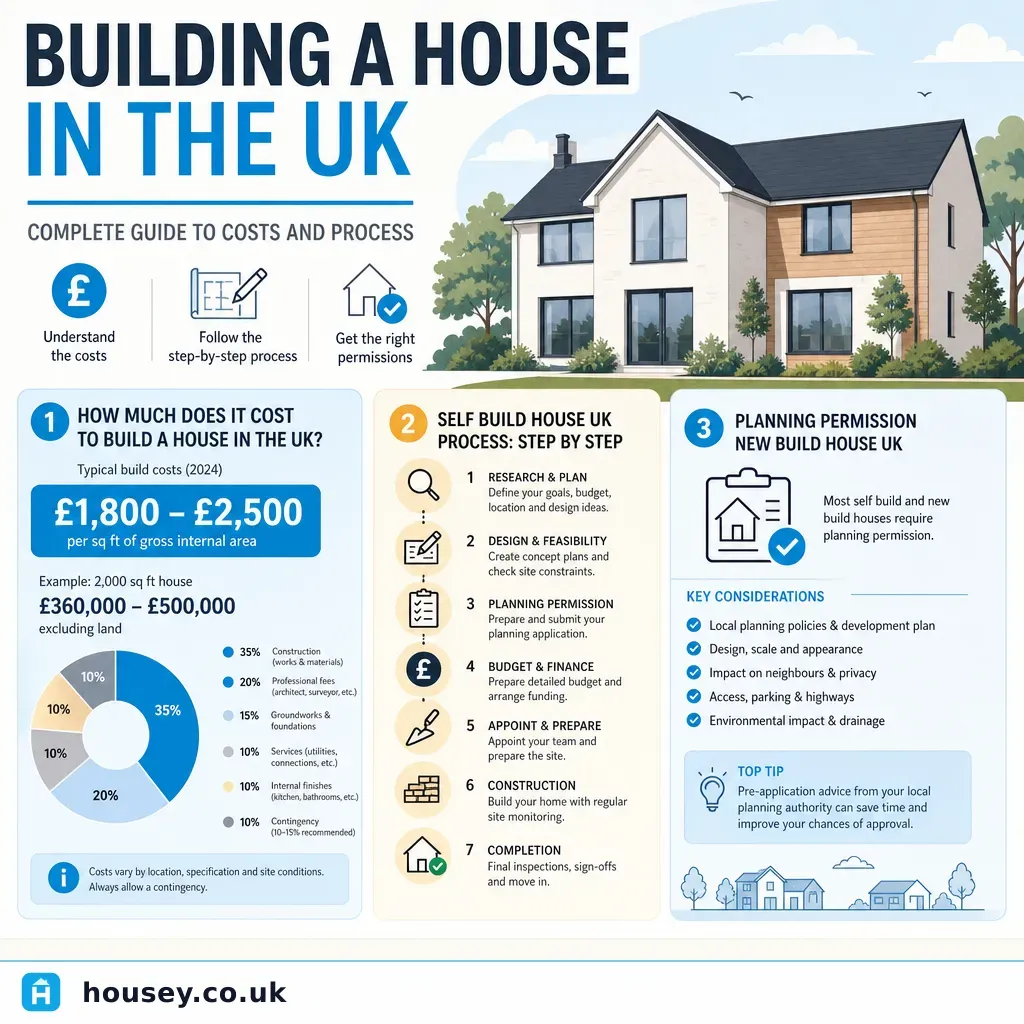
Building a House in the UK: Complete Guide to Costs and Process
Building your own home in the UK is a significant undertaking that typically spans two to four years from initial land search to completion. The question usually arises when someone has acquired a plot, inherited land, or is weighing whether to build rather than buy — and the answer depends heavily on procurement route, local planning context, and budget. Getting the process right from the outset can save tens of thousands of pounds and months of delay.
Key points
- A typical self-build costs £1,500–£3,000 per sq m for construction works alone (excluding land), depending on specification, region, and procurement route — indicative UK costs, last reviewed 2026-05-05.
- Planning permission and Building Regulations approval are both legally required before construction begins on any new dwelling.
- The VAT zero-rating for new residential construction (HMRC Notice 708) and the CIL self-build exemption can materially reduce overall project costs — both require advance registration before work starts.
- NHBC Buildmark or an equivalent 10-year structural warranty is usually required by mortgage lenders for newly built homes.
- Most self-builds follow the RIBA Plan of Work stages 0–7, from strategic brief through to post-occupancy evaluation.
What does building a house in the UK involve?
Building a new home involves five broad phases: securing land, obtaining design and planning approval, securing Building Regulations sign-off, managing construction, and completing the handover. Each phase involves distinct professionals, timescales, and costs. Skipping or compressing a phase — particularly the design and planning stage — is one of the most common reasons projects run over budget or stall before breaking ground.
The process is largely the same whether you are building a single dwelling for your own occupation or undertaking a small residential development. The main variable is who manages the work: you directly, a main contractor, or a package house company.
How much does it cost to build a house in the UK?
Build costs vary widely depending on location, size, specification, and how much you manage yourself.
Indicative UK build costs (construction only, excluding land), last reviewed 2026-05-05:
Specification | Indicative cost per sq m |
|---|---|
Basic/budget (simple form, standard finishes) | £1,500–£1,900 |
Mid-range (brick and block, good specification) | £1,900–£2,500 |
High specification (contemporary design, complex form) | £2,500–£3,500+ |
Source: Homebuilding & Renovating magazine cost data; figures are indicative and vary by region, contractor, and market conditions.
Additional costs to budget for:
- Land purchase (varies significantly by region and plot size)
- Professional fees (architect, structural engineer, planning consultant): typically 10–15% of build cost
- Planning application fees: £578 for a new dwelling in England (April 2026)
- Building Regulations fees: varies by local authority or registered building inspector
- Site infrastructure — utilities connections, drainage, access — can add £20,000–£80,000 or more
- Contingency: a 10–15% contingency is recommended for unexpected ground conditions, design changes, or material price movements
Which procurement route is right for you?
The procurement route determines how much control, risk, and personal time you take on.
Route | Best for | Main advantage | Main risk |
|---|---|---|---|
Self-managed (direct labour) | Experienced project managers; those with strong trade contacts | Lower build cost — potential saving of 20–30%+ on contractor margin | High personal time commitment; programme risk; harder to obtain a self-build mortgage |
Main contractor | Most self-builders; those prioritising cost and programme certainty | Fixed price possible; single point of contractual responsibility | Higher cost; contractor quality varies; a strong written contract is essential |
Package house company | First-time self-builders; tighter timescales | Turnkey design and supply; often includes structural warranty; faster programme | Less design flexibility; premium for convenience; groundworks and fit-out often excluded |
What planning and regulatory approvals do you need?
Planning permission is required for any new dwelling. Permitted development rights do not apply to new build houses. You must submit a full planning application to your Local Planning Authority (LPA) via the Planning Portal in England. Planning conditions often cover materials, landscaping, drainage, and ecology — all conditions must be formally discharged, and pre-commencement conditions must be cleared before work starts.
Building Regulations approval covers the technical standards for construction and is entirely separate from planning permission. You must notify either a local authority building control (LABC) team or a Registered Building Inspector before work begins. Key Approved Documents for new dwellings include:
- Part A (Structure)
- Part B (Fire safety)
- Part F (Ventilation)
- Part L (Conservation of fuel and power) — the 2021 uplift significantly raised energy-efficiency standards for new homes in England
- Part O (Overheating) — applies to new dwellings in England
Community Infrastructure Levy (CIL): Many local authorities charge CIL on new dwellings. Self-builders may claim a CIL exemption, but this must be applied for before commencement. Failing to register in advance can result in the exemption being refused and the full levy becoming payable.
A worked UK scenario: four-bedroom self-build in the East Midlands
A family purchases a 0.1-hectare infill plot with outline planning permission for a single dwelling in Northamptonshire. They appoint an architect to develop the scheme to RIBA Stage 3, then a structural engineer to design foundations and produce structural drawings. A full planning application is submitted (13-week determination period), approved with five conditions. A local authority building control surveyor is appointed as the registered building inspector.
The family uses a main contractor on a JCT Minor Works contract for a 200 sq m house at an agreed price of £420,000 (£2,100/sq m). Professional fees total £52,000. The family manages the kitchen fit-out and landscaping directly. Total project spend excluding land: approximately £490,000. Build programme: 14 months.
This scenario is illustrative. Costs and timescales will differ based on your specific site, design, and market conditions.
Key professionals you will need
- Architect or architectural technologist: Design, planning drawings, and specification
- Structural engineer: Foundations, structural frame, and load-bearing details — structural engineering
- Planning consultant: Pre-application advice, complex sites, and planning appeals — planning consultancy services
- Building control body: Statutory sign-off on construction standards — building control consultants
- Project manager: Programme, cost, and quality oversight if you are not managing the build yourself — project management services
- Quantity surveyor: Cost plan, procurement support, and interim valuations
Self-build checklist: key stages
Important limitations
This article provides general information about the process of building a house in the UK. Regulations, fees, planning policies, and construction costs change frequently and vary significantly by local planning authority, property type, and site conditions. Nothing in this article constitutes legal, structural, financial, or planning advice. Always consult a qualified professional before committing to a site purchase, design, or construction contract.
What to ask a qualified professional
When appointing an architect:
- What RIBA stages does your fee cover, and what is excluded?
- Do you have experience of similar new-build projects with this LPA?
- How do you manage planning risk on this type of site?
When appointing a structural engineer:
- What ground investigation do you recommend before designing the foundations?
- Will your drawings be sufficient for building control submission without further input?
When appointing a planning consultant:
- What are the main planning risks on this site, and how would you mitigate them?
- Is pre-application advice from the LPA worth pursuing before a full submission?
When appointing a main contractor:
- What form of contract are you using — JCT, NEC, or bespoke?
- How do you handle variations and unforeseen ground conditions?
- Can you provide references from similar self-build or new-build projects?
When to get professional help
You will need qualified professional input at virtually every stage of a self-build. Seek advice particularly early if:
- You are considering purchasing a plot and want to understand its planning potential before exchange
- The LPA raises concerns during pre-application discussions
- Unusual ground conditions (filled land, shrinkable clay, high water table) are suspected
- The design involves complex structural elements, basements, or unusual construction materials
- CIL, Section 106 obligations, or ecological constraints may apply to the site
How Housey can help
Housey connects you with qualified professionals at every stage of a self-build project. Whether you need planning consultancy services for a complex or sensitive site, a structural engineering team for foundation and frame design, building control consultants for statutory sign-off, or project management services to oversee the build programme, you can request quotes from relevant UK providers through the platform.
Frequently asked questions
How long does it take to build a house in the UK?
A typical self-build takes 18 months to 3 years from land purchase to moving in. The planning stage alone can take 3–6 months, or longer for complex sites or appeals. Construction of a 3–4 bedroom house typically takes 10–18 months depending on procurement route, weather, and contractor availability.
Do I need an architect to build a house in the UK?
There is no legal requirement to use an architect, but most self-builds benefit from one, particularly for planning drawings and specification. An architectural technologist can provide equivalent technical design services for straightforward schemes. Whoever you appoint should hold professional indemnity insurance.
Can I build a house on agricultural land?
Agricultural land does not carry automatic planning permission for residential use. You would need to apply for a change of use and full planning permission. Class Q permitted development may offer a route for converting certain existing agricultural buildings, but each case is assessed individually by the Local Planning Authority.
Is VAT charged when building a new house?
New residential construction is zero-rated for VAT under HMRC Notice 708. If you are not VAT-registered, you can reclaim VAT paid on qualifying materials and services via the HMRC DIY Housebuilders Scheme. Applications must be submitted within 3 months of completion of the building.
What structural warranty do I need for a self-build?
Most mortgage lenders require a 10-year structural warranty such as NHBC Buildmark, LABC Warranty, or a similar product from an approved provider. The warranty must be in place at the point of mortgage application for the completed property. Some lenders also accept a professional consultant's certificate from a suitably qualified architect or chartered surveyor.
Sources and further reading
- Planning Portal — Planning applications — Planning Portal / MHCLG
- HMRC Notice 708: Buildings and construction — HM Revenue & Customs
- Building Regulations Approved Documents — GOV.UK / MHCLG
- Community Infrastructure Levy: self-build exemption — GOV.UK
- NHBC Buildmark warranty — NHBC
- RIBA Plan of Work 2020 — Royal Institute of British Architects
Useful next reads
 Planning & Pre-Build
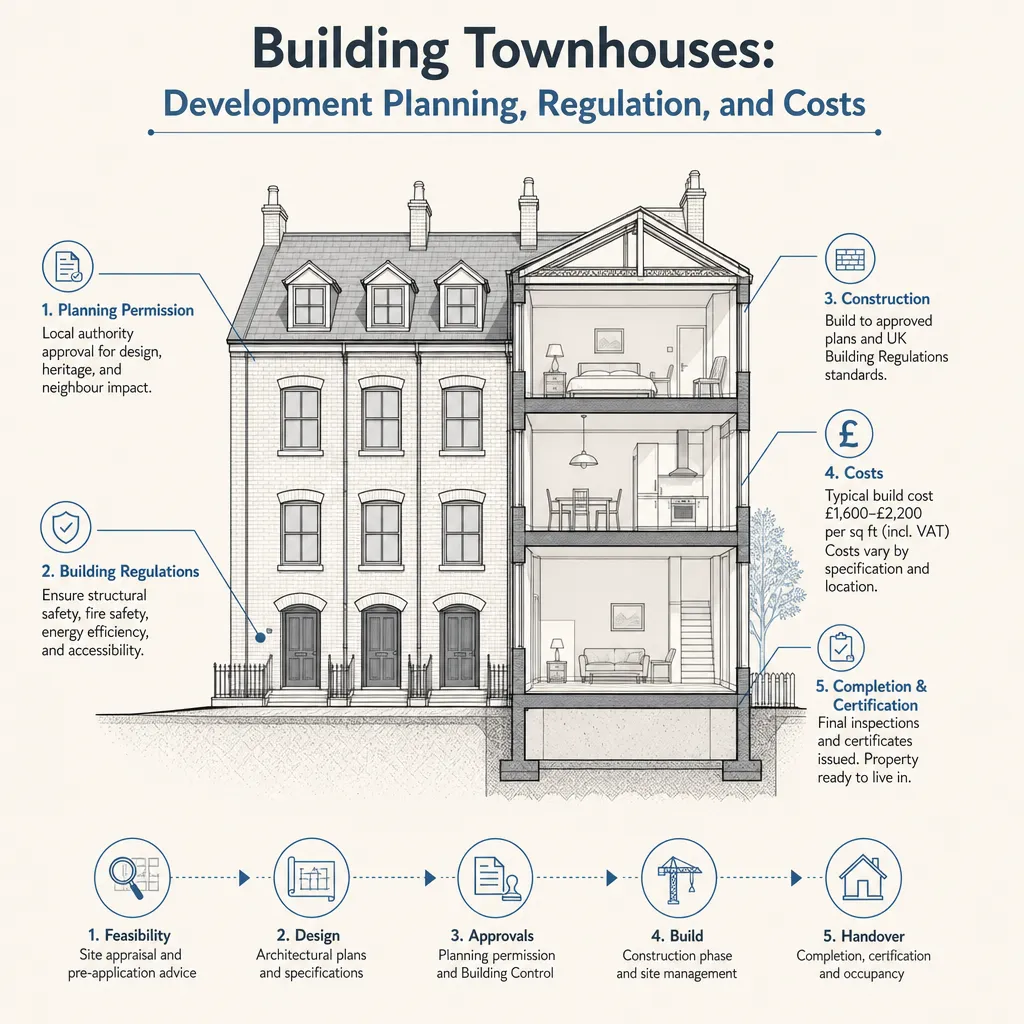
Building Townhouses: Development Planning, Regulation, and Costs
Building townhouses in the UK requires full planning permission for all new dwellings — permitted development rights do not apply to new residential construction.
 Planning & Pre-Build
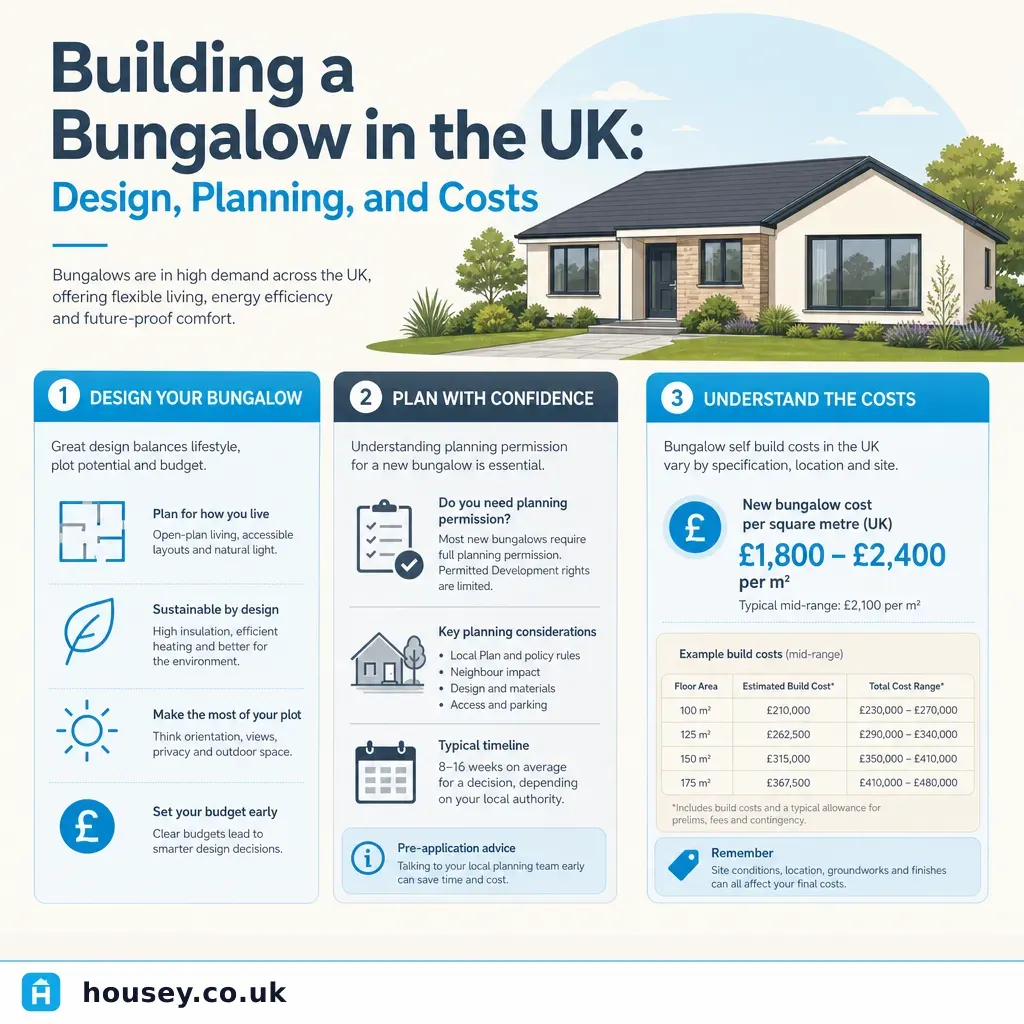
Building a Bungalow in the UK: Design, Planning, and Costs
Building a bungalow in the UK typically costs £1,500–£3,000 per square metre, putting a 100m² bungalow at roughly £150,000–£300,000 in build costs before land, professional fees, and VAT.
 Planning & Pre-Build
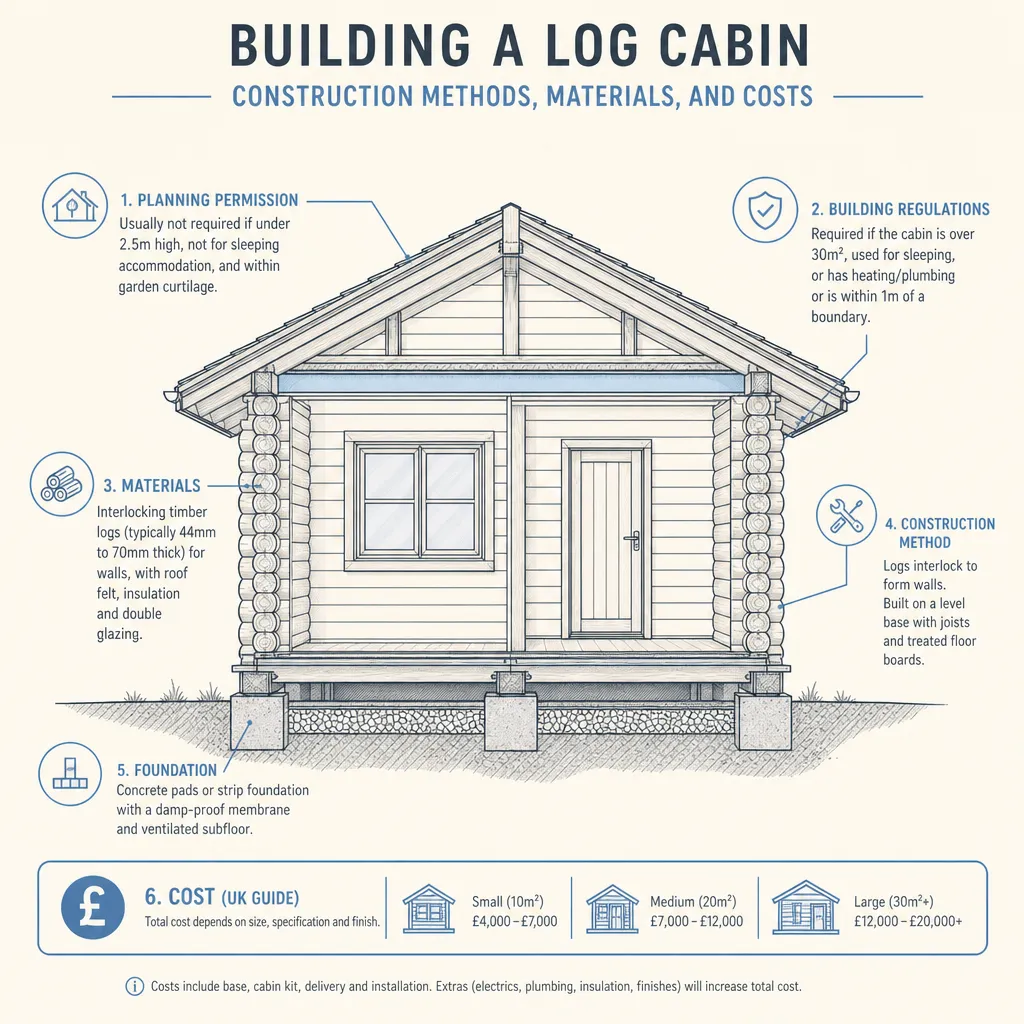
Building a Log Cabin: Construction Methods, Materials, and Costs
Building a habitable log cabin in the UK requires full planning permission and Building Regulations approval, the same as any new house.
 Planning & Pre-Build
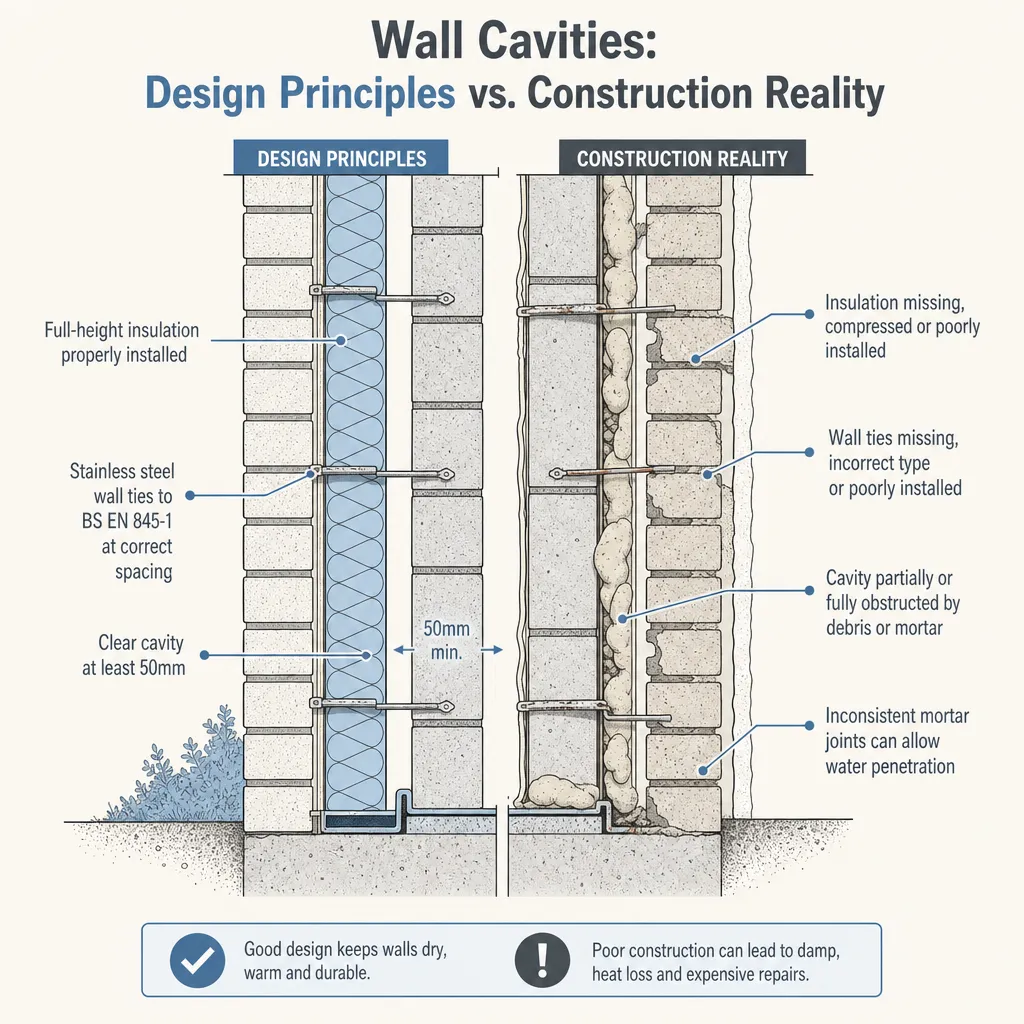
Wall Cavities: Design Principles vs. Construction Reality
A UK cavity wall is designed to resist weather, control heat loss, and structurally link two masonry leaves.
 Planning & Pre-Build
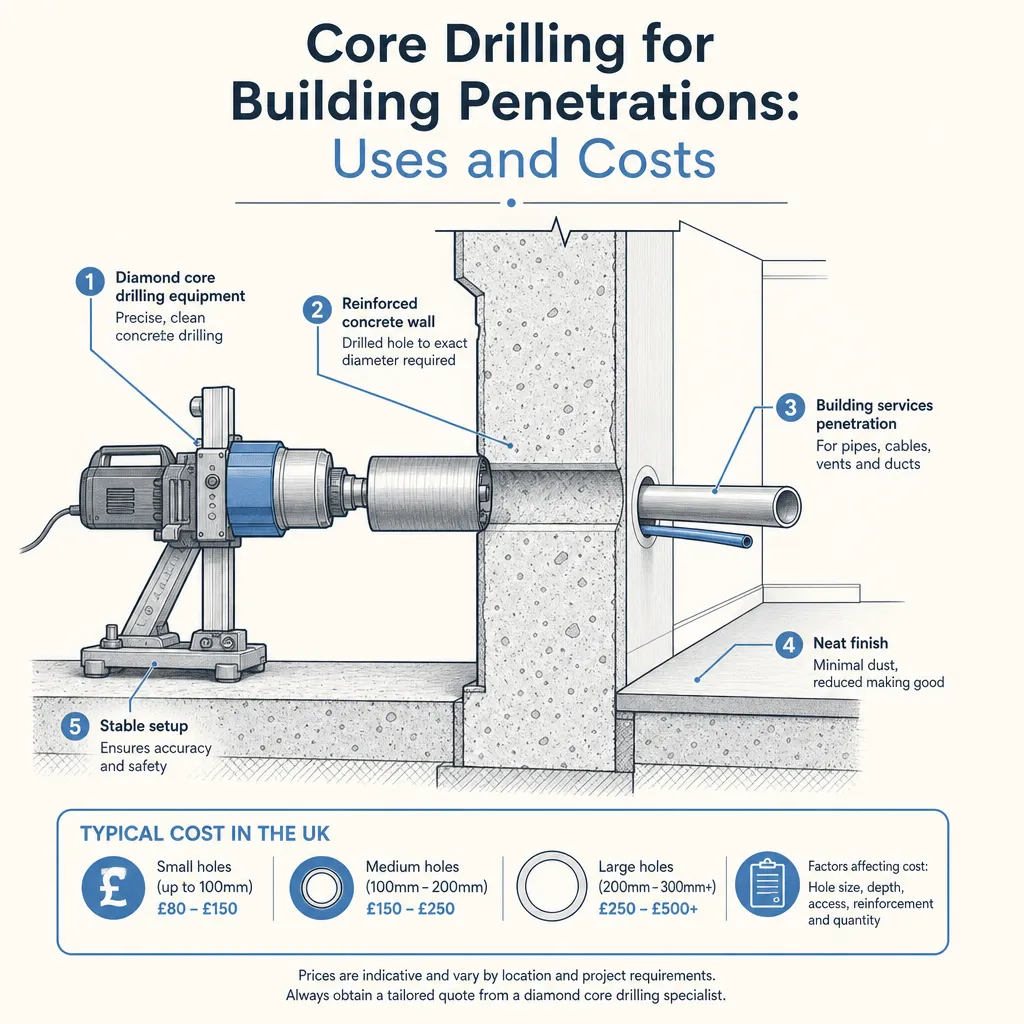
Core Drilling for Building Penetrations: Uses and Costs
Core drilling uses diamond-tipped equipment to cut clean holes through concrete, masonry, or block for pipes, ducts, cables, and building services.