Building a Chicken Coop: Design, Materials, and Installation
By Housey · Last reviewed 5th of May 2026
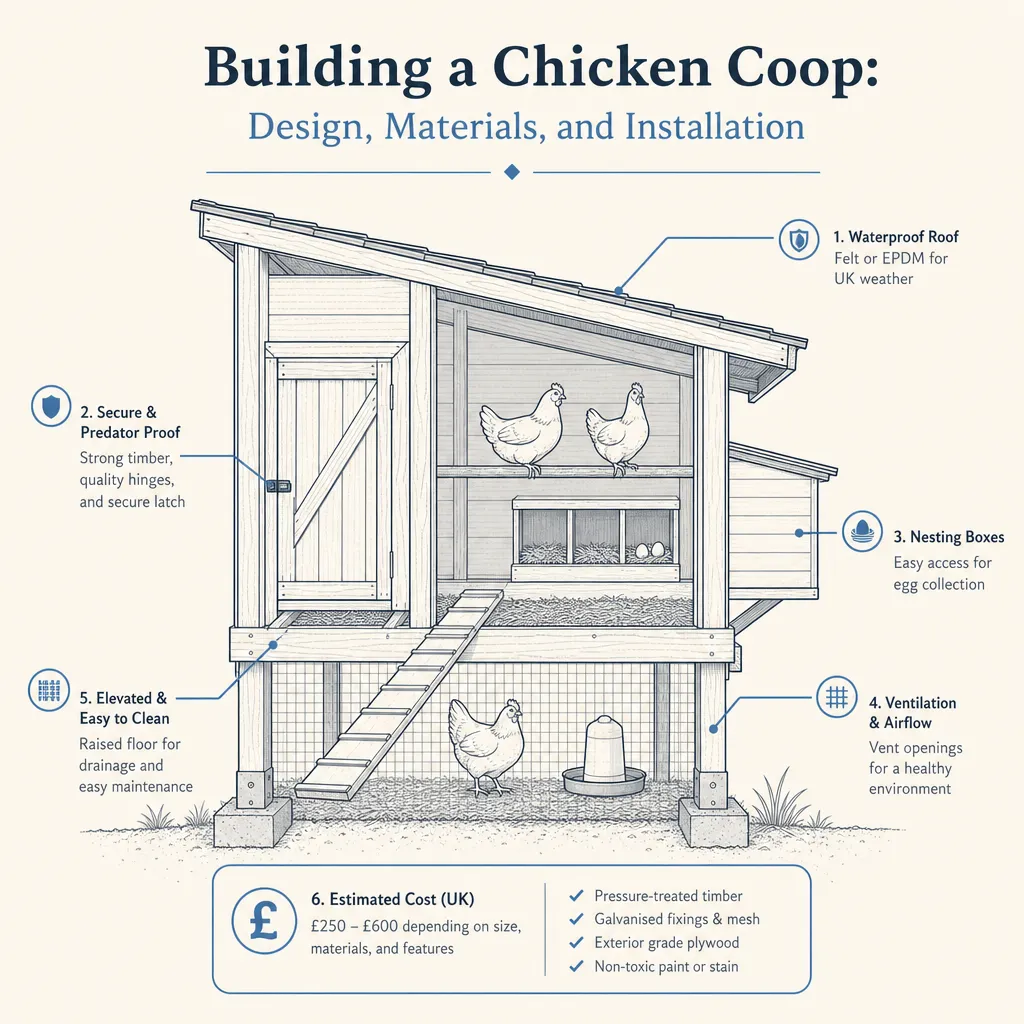
Building a Chicken Coop: Design, Materials, and Installation
Keeping backyard chickens has grown steadily in popularity across the UK, from suburban gardens to rural smallholdings. Whether you are housing two rescue hens or building a flock of twelve, the coop design you choose will directly affect bird welfare, your maintenance burden, and the longevity of the structure. Getting the basics right from the start saves costly rebuilds and unhappy hens later.
Key points
- A chicken coop in a domestic garden is usually permitted development under Class E of the Town and Country Planning (General Permitted Development) (England) Order 2015, provided it does not exceed 2.5m in height if positioned within 2m of a boundary and covers no more than 50% of the total garden area.
- The Animal Welfare Act 2006 requires that all kept animals, including poultry, have appropriate shelter; the RSPCA recommends a minimum of 0.25m² of floor space inside the coop per bird.
- Fox-proof runs require 19mm galvanised weld mesh rather than standard chicken wire, which foxes can tear through; burying the mesh 30cm underground or laying it flat as an apron deters digging.
- Pressure-treated (tanalised) timber is the most durable common material, with a typical working life of 15–25 years if maintained; untreated softwood may last as little as 5–8 years outdoors in UK conditions.
- Ventilation, not insulation, is the priority for a UK chicken coop; damp air causes respiratory illness, so ridge or high-wall vents should remain open year-round.
Planning permission and legal considerations
A domestic chicken coop is almost always permitted development in England under Class E of the Town and Country Planning (General Permitted Development) (England) Order 2015. The structure is treated as a garden outbuilding incidental to the main dwelling, provided it meets these conditions:
- Positioned behind the principal elevation of the house (not in the front garden facing a public highway).
- Does not cover more than 50% of the garden area in combination with any other outbuildings.
- Maximum eaves height of 2.5m; maximum overall height of 4m (or 2.5m if within 2m of a boundary).
- Not on designated land — National Parks, AONBs, conservation areas, or World Heritage Sites — without first checking with the local planning authority.
Scotland, Wales, and Northern Ireland each have separate permitted development rules, so confirm locally if you are outside England.
A domestic flock kept for personal egg production or as pets does not require a licence. However, if you keep 50 or more birds of any species, you must register with the Animal and Plant Health Agency (APHA) under the Poultry Register.
Coop design: space, layout, and essential features
Good coop design starts with the birds, not the budget. The RSPCA recommends at minimum 0.25m² of floor space per bird inside the coop and at least 1m² of covered run space per bird, with as much additional free-range space as your garden allows.
Essential features every coop needs
- Roosting bars: Chickens sleep on perches, not the floor. Allow at least 20–25cm of bar length per bird, set at the same height to reduce pecking-order squabbles.
- Nest boxes: One box per 3–4 hens, positioned lower than the roosting bars so birds are not tempted to sleep in them.
- Pop hole: A small exit (approximately 30cm × 30cm) that closes at night — ideally fitted with an automatic opener on a light or timer.
- Ventilation: High-level, draught-free vents or a raised roof ridge providing cross-ventilation to reduce moisture and ammonia build-up.
- Easy-clean floor: A removable droppings board beneath the roost simplifies daily maintenance considerably.
- Predator-proofing: Secondary catches on all doors; no gaps larger than 2.5cm that a weasel or rat could squeeze through.
Recommended coop floor area by flock size
Flock size | Minimum coop floor area | Minimum run area |
|---|---|---|
2–3 hens | 0.75m² | 3m² |
4–6 hens | 1.5m² | 6m² |
7–10 hens | 2.5m² | 10m² |
10–12 hens | 3m² | 12m² |
Based on RSPCA minimum recommendations. More space improves feather condition and reduces stress behaviours.
Materials comparison
Choosing the right material affects durability, cost, and how much maintenance you will do in five years' time.
Material | Pros | Cons | Typical lifespan |
|---|---|---|---|
Pressure-treated (tanalised) timber | Durable, workable, natural appearance | Heavier; check preservative is poultry-safe once cured | 15–25 years |
Untreated softwood | Cheap, easy to work with | Rots quickly outdoors in UK climate | 5–8 years |
Cedar or hardwood | Naturally rot-resistant, low maintenance | Higher material cost | 20–30 years |
Recycled plastic or composite | Very low maintenance, no rot | Less insulating; can heat up in direct sun | 25+ years |
Metal (galvanised steel) | Very secure, straightforward to disinfect | Poor insulation; overheats in summer | 20+ years |
For most UK homeowners, tanalised timber offers the best balance of cost and durability. Confirm any preservative used is rated safe for poultry contact once fully cured — most modern tanalised products are, but check the product datasheet.
Costs: DIY, kit, and custom-built
Indicative UK costs, last reviewed 2026-05-05. Costs vary by supplier, region, and specification.
Route | Typical cost range | Notes |
|---|---|---|
DIY build from timber | £200–£600 | Materials only; requires basic carpentry skills and tools |
Flat-pack or kit coop | £100–£800 | Widely available online; quality varies significantly |
Professional custom build | £800–£3,000+ | Bespoke sizing, higher specification, usually installed |
Additional pre-made run | £100–£500 | Custom runs add to the above |
Budget-priced flat-pack coops often use very thin timber (sometimes 9mm) that may not survive more than one or two UK winters. If buying a kit, check the stated timber thickness — at least 18mm for main panels — and confirm whether the mesh supplied is weld mesh or standard chicken wire.
Siting and ground preparation
Position the coop on well-drained, level ground, ideally elevated on legs or on a concrete or paving slab base to prevent damp rising from below. Avoid low-lying areas that collect standing water.
Orient the pop hole away from the prevailing wind — usually south or south-east facing in most of England — to keep the interior dry. A concrete or paving apron around the entrance reduces mud build-up. Mobile coops, often called arks, can be moved weekly to break the worm lifecycle and keep grass in better condition.
Homeowner checklist before you build or buy
When to get professional help
Most domestic chicken coops are well within the scope of a confident DIY builder or can be ordered as a quality kit. Consider professional input when:
- The structure is large (over 15m²) or unusually complex, at which point building regulations may become relevant.
- You are on designated land or within a conservation area and are uncertain whether planning permission is required.
- You want the coop integrated into a formal garden scheme — a garden designer can incorporate poultry housing into a wider layout, or a landscaper can handle associated groundworks and hard surfaces.
- Significant ground preparation is needed — substantial levelling, drainage work, or a concrete base — that goes beyond standard DIY confidence.
How Housey can help
If you would like professional support siting, designing, or integrating a chicken coop into your wider garden, Housey can connect you with local garden designers and landscapers who can provide quotes for associated design and groundwork. Use Housey to compare quotes from relevant local professionals.
Frequently asked questions
Do I need planning permission to build a chicken coop in my garden?
In most cases, no. A domestic chicken coop in England is usually permitted development under Class E, provided it sits behind the principal elevation, is under 2.5m tall if within 2m of a boundary, and covers no more than 50% of the garden. Conservation areas, National Parks, or Article 4 Directions may impose additional restrictions — check with your local planning authority if unsure.
How many hens can I keep in a domestic garden?
There is no national legal limit on the number of hens in a domestic garden, though some lease agreements or local covenants may restrict this. If you keep 50 or more birds of any species, you must register with the Animal and Plant Health Agency (APHA). Practically, welfare, space, and neighbour relations are the key constraints for most homeowners.
Is chicken wire sufficient for a fox-proof run?
No. Standard chicken wire (hexagonal netting) can be torn or bitten through by a determined fox. Use 19mm galvanised weld mesh for run sides and roof. Bury the mesh at least 30cm underground or lay it flat on the ground as an apron pegged into the soil to deter digging foxes and badgers.
How much does a decent chicken coop cost in the UK?
Flat-pack kits start from around £100–£150 but quality at this price is often poor, with thin timber that may not last more than a couple of seasons outdoors. A good-quality kit for 4–6 hens costs £250–£500. A professionally built custom coop with a run can cost £1,000–£3,000 or more depending on size and specification. Indicative UK costs, last reviewed 2026-05-05.
Do I need to insulate a chicken coop in the UK?
Insulation is less important than ventilation for UK chickens. Hens tolerate cold well when dry and draught-free; damp air causes respiratory illness far more commonly than cold temperatures. Prioritise high-level ventilation to remove moisture and ammonia. If you do add insulation, ensure any foam or board is fully enclosed so birds cannot peck and ingest it.
Sources and further reading
- Animal Welfare Act 2006 — legislation.gov.uk
- Poultry on small premises: guidance and legislation — GOV.UK
- Register your poultry (50 or more birds) — GOV.UK / APHA
- Town and Country Planning (General Permitted Development) (England) Order 2015, Schedule 2 Part 1 Class E — legislation.gov.uk
- RSPCA advice on keeping chickens — RSPCA
Useful next reads
 Improvement & Build
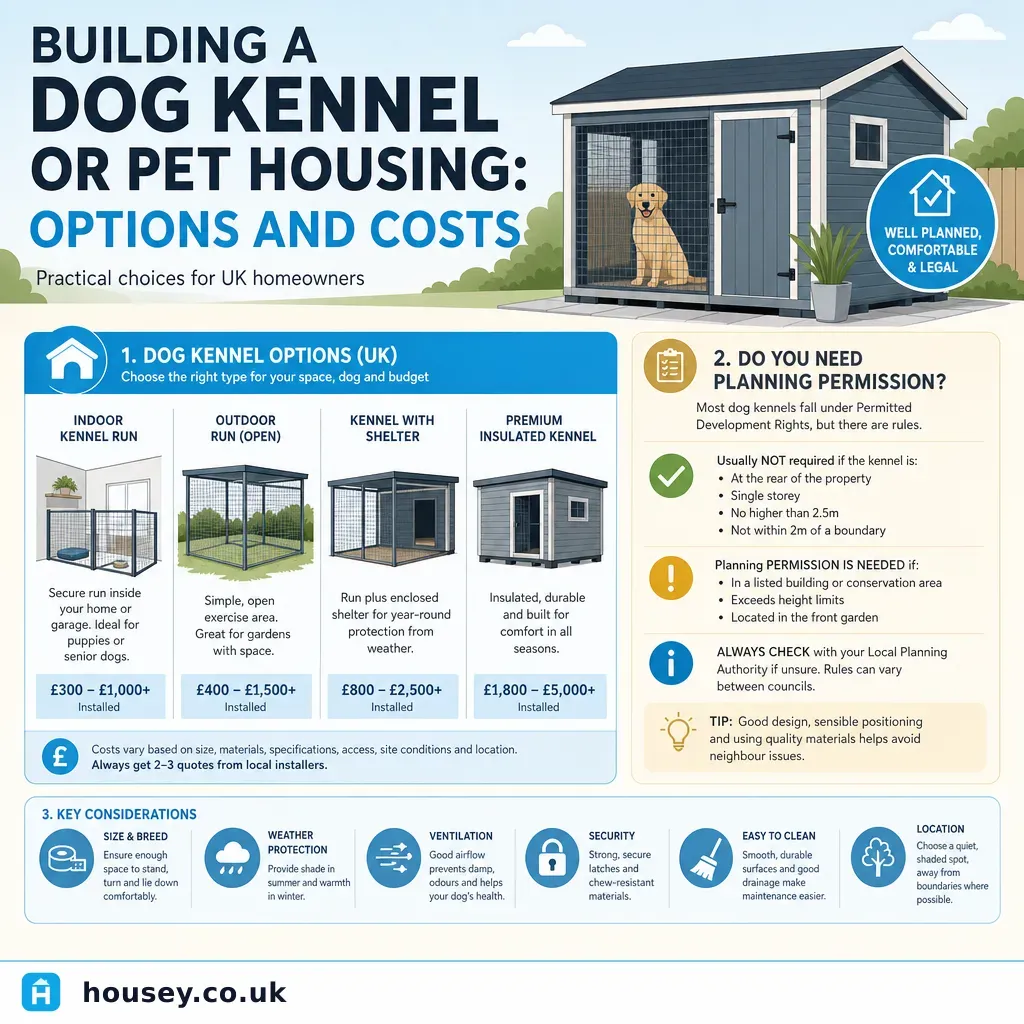
Building a Dog Kennel or Pet Housing: Options and Costs
A domestic dog kennel or pet housing structure is almost always permitted development in England and does not need planning permission if sited behind the house, below 2.
 Improvement & Build
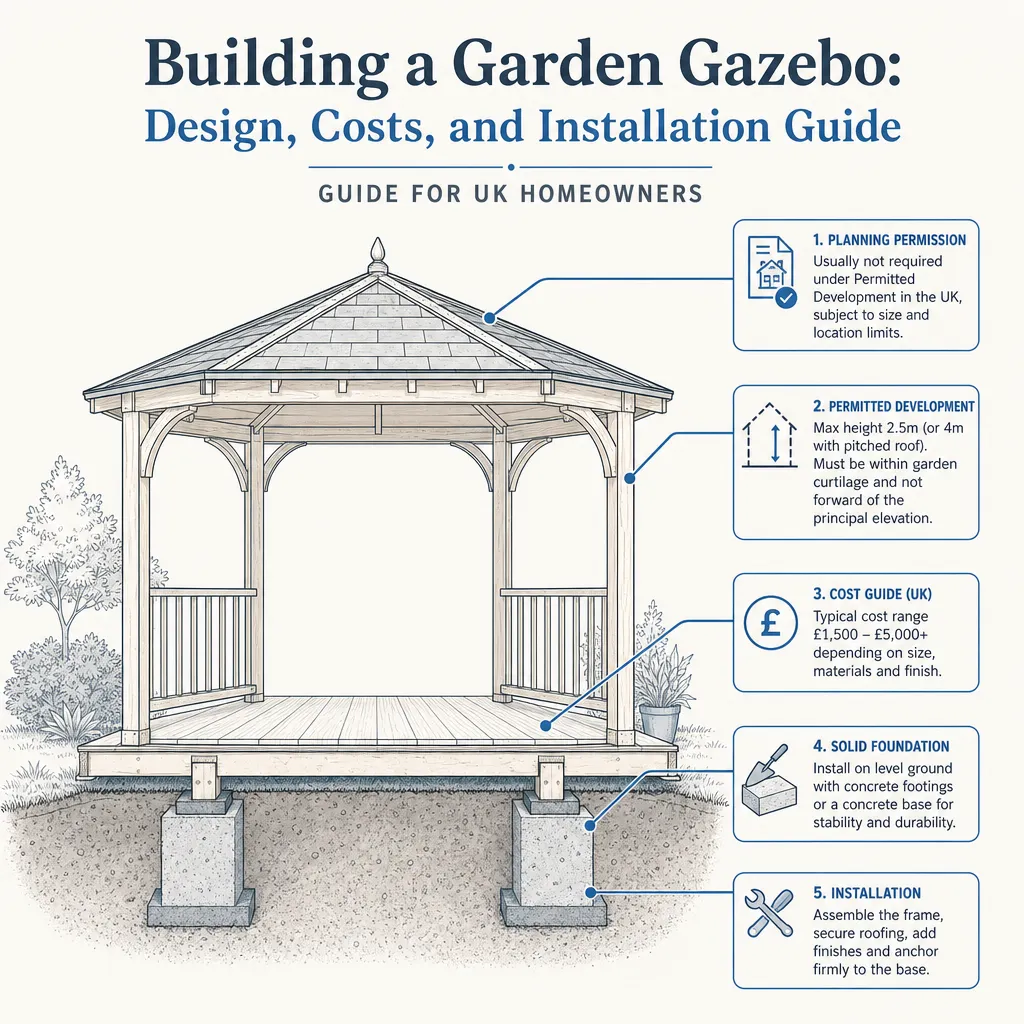
Building a Garden Gazebo: Design, Costs, and Installation Guide
A garden gazebo usually falls under permitted development in England, provided it is single storey, stays within height limits, and covers less than 50% of the garden.
 Improvement & Build
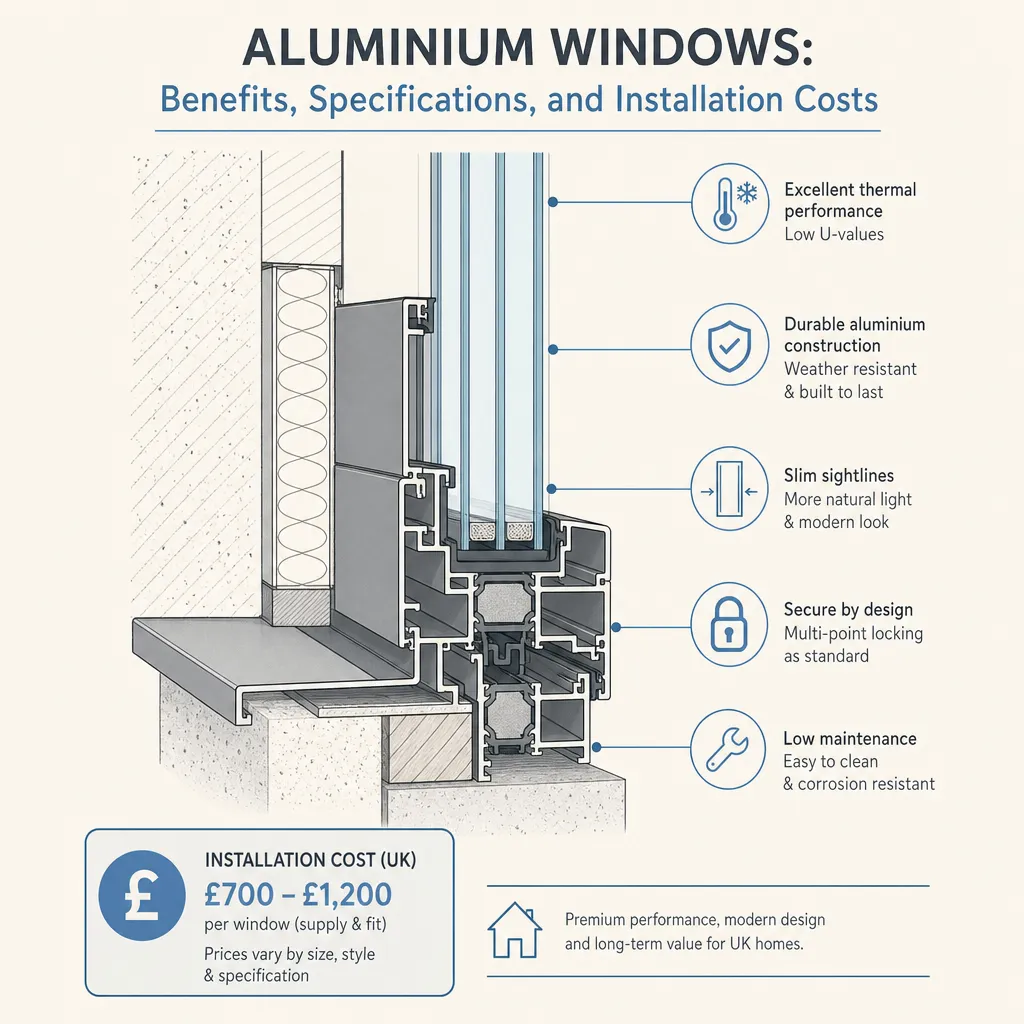
Aluminium Windows: Benefits, Specifications, and Installation Costs
Aluminium windows typically cost £600–£1,800 per window installed in the UK, depending on size and specification.
 Improvement & Build
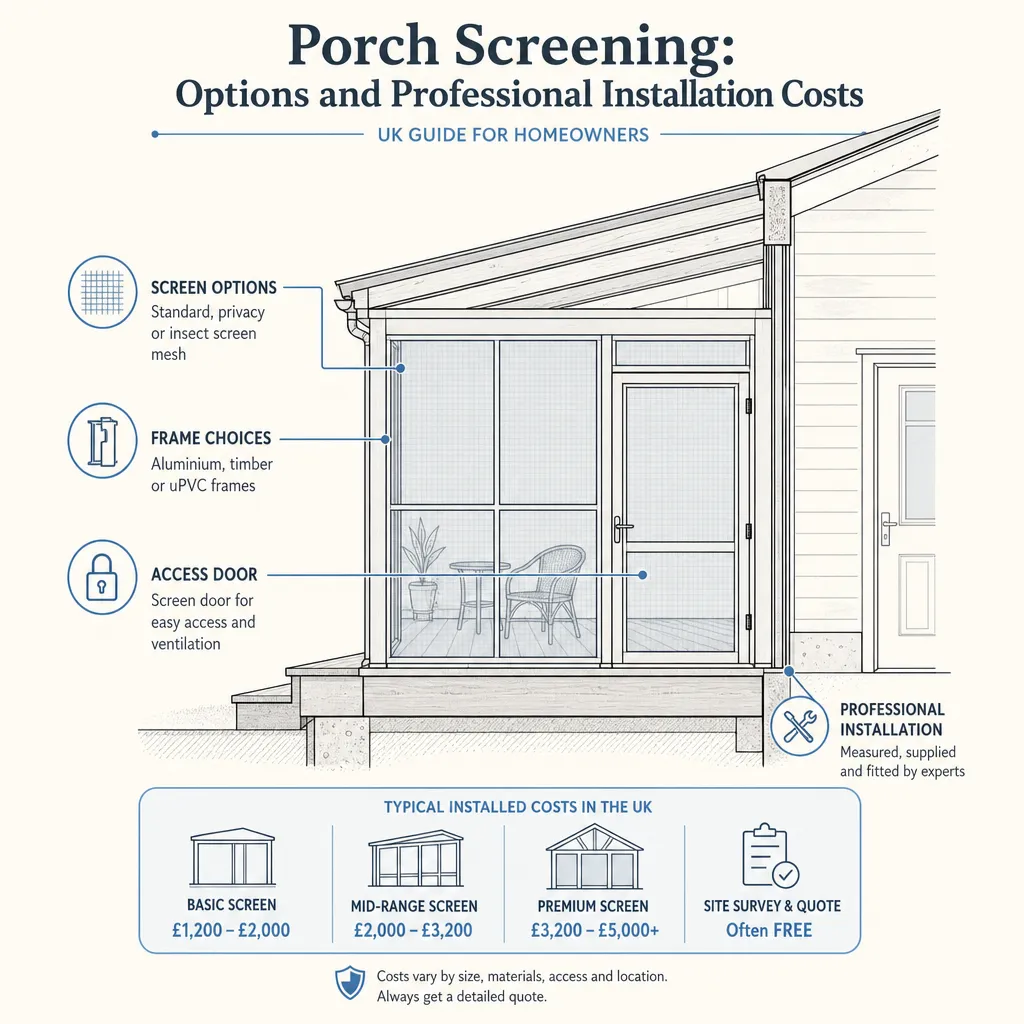
Porch Screening: Options and Professional Installation Costs
Porch screening ranges from simple insect mesh on a timber frame to bespoke aluminium-framed glazed enclosures.
 Improvement & Build
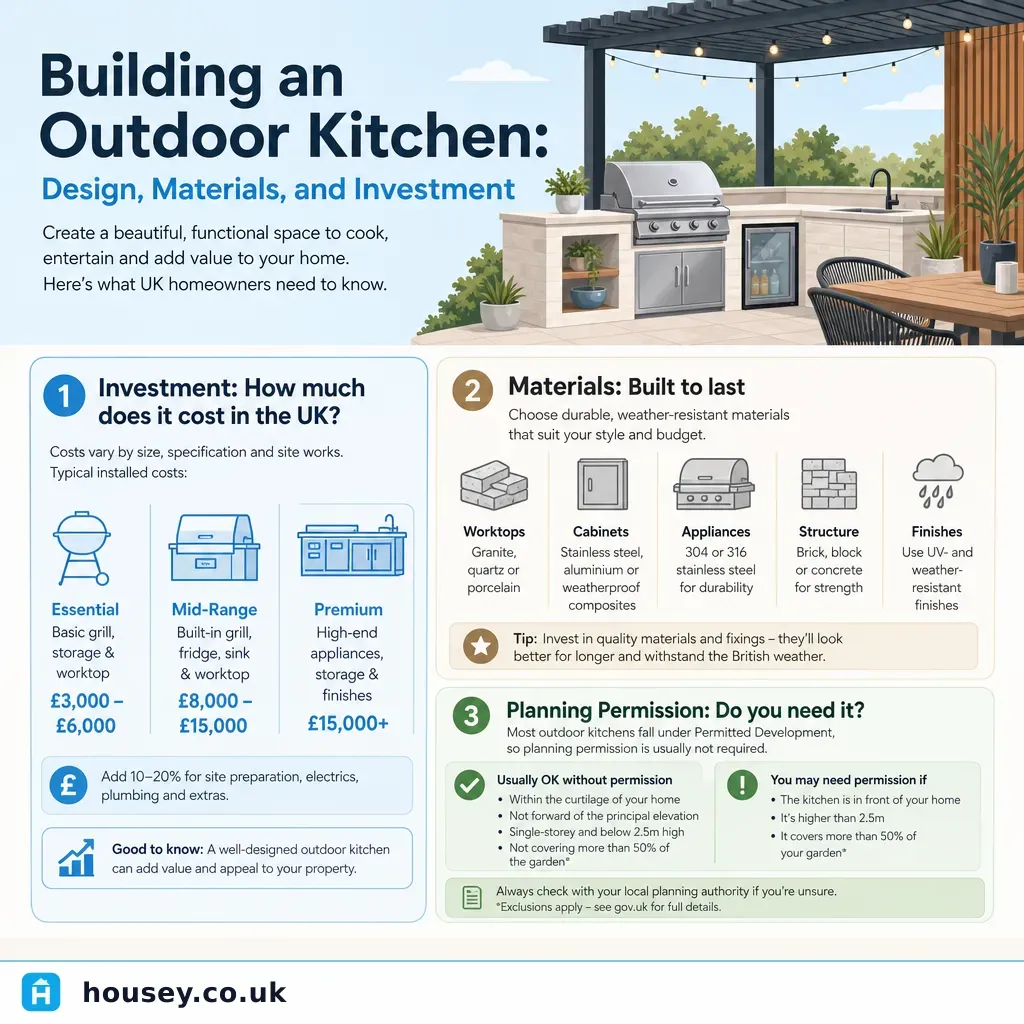
Building an Outdoor Kitchen: Design, Materials, and Investment
Building an outdoor kitchen in the UK costs roughly £3,000–£25,000 depending on size and materials.