Building a Dog Kennel or Pet Housing: Options and Costs
By Housey · Last reviewed 5th of May 2026
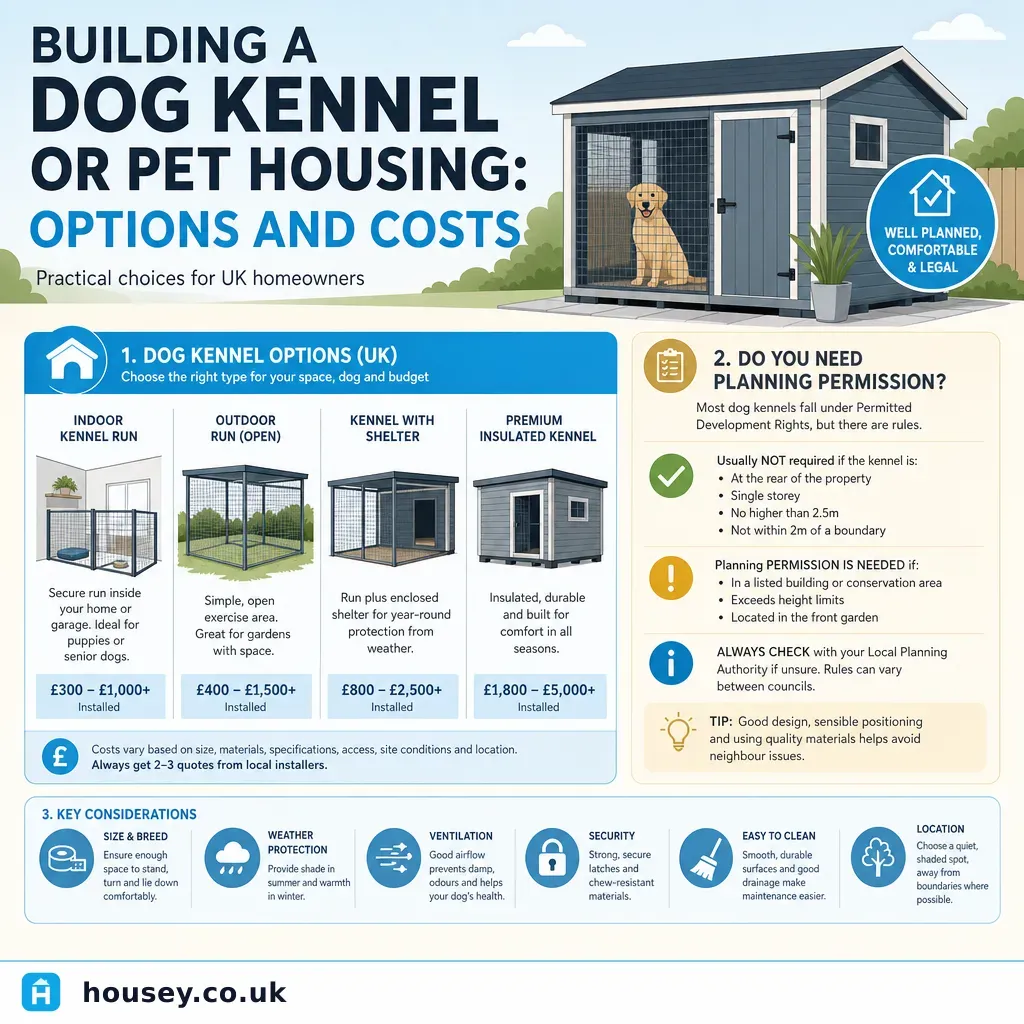
Building a Dog Kennel or Pet Housing: Options and Costs
Outdoor pet housing in UK gardens ranges from a simple timber box to an insulated kennel-and-run complex, and the right solution depends on your dog's breed, size, and how much time they actually spend outside. Many homeowners underestimate the importance of weatherproofing, correct sizing, and predator security — particularly for smaller pets — until their first wet autumn highlights the shortcomings of a budget purchase.
Key points
- A residential dog kennel or small pet housing structure is almost always permitted development in England under Class E of the Town and Country Planning (General Permitted Development) (England) Order 2015, subject to height, coverage, and position rules.
- The Animal Welfare Act 2006 requires that all kept animals have a suitable environment, including appropriate shelter; any kennel used as a primary sleeping space must be weatherproof and adequately insulated.
- Boarding or commercial kennels — taking in other people's animals for payment — require a licence under the Animal Welfare (Licensing of Activities Involving Animals) (England) Regulations 2018; this does not apply to housing your own pets.
- Kennel interior height should be at least the dog's shoulder height plus 30cm; floor area must allow the dog to stand fully upright, turn around, and lie stretched out in any direction.
- Pressure-treated (tanalised) timber is the most widely used durable material; confirm the preservative is rated safe for animal contact once cured before installation.
Planning permission: what the rules say
For a domestic dog kennel or pet housing structure in an English garden, permitted development under Class E of the Town and Country Planning (General Permitted Development) (England) Order 2015 almost always applies. The key conditions are:
- Not positioned in front of the principal elevation — i.e., not in the front garden facing a public highway.
- Covers no more than 50% of the total garden area in combination with any other outbuildings.
- Maximum eaves height of 2.5m; overall height no more than 4m (or 2.5m if the structure is within 2m of the boundary).
- On designated land — National Parks, AONBs, conservation areas, or World Heritage Sites — additional restrictions may apply; check with the local planning authority before starting.
Flat-roofed kennels are common and typically fall comfortably within the 2.5m overall height limit. If a large combined kennel-and-run enclosure covers a significant proportion of the garden, it is worth confirming permitted development applies with your local authority before construction.
Scotland, Wales, and Northern Ireland each have their own planning rules, so check locally if you are outside England.
Which type of pet housing do you need?
Decision tree: matching housing type to your situation
- Small dog, occasional outdoor time, mild climate: A standard timber or plastic kennel, well positioned and insulated, under 1m² floor area — usually sufficient.
- Medium to large dog spending significant time outdoors: An insulated timber kennel with a covered run; a raised floor protects against ground damp.
- Dog left outside for extended periods in all weathers: An insulated, weatherproof kennel-and-run combination with secure latches — take veterinary advice first on breed suitability for outdoor living in the UK.
- Multiple dogs or working dogs: A modular kennel block or purpose-built kennel unit; larger structures may warrant a professional build to ensure structural integrity and welfare compliance.
- Small pets — rabbits, guinea pigs, ferrets: A purpose-designed hutch or housing unit with strong predator security; focus on mesh gauge and latch design rather than insulation alone.
- Cats with an outdoor run (catio): A wire mesh enclosure attached to the house or freestanding; usually straightforward permitted development and well-suited to DIY construction.
Comparison table: kennel types at a glance
Option | Best for | Not ideal for | Typical lifespan | Approximate cost |
|---|---|---|---|---|
Pre-made plastic or resin kennel | Small breeds, easy cleaning, occasional use | Large dogs; cold climates without additional insulation | 10–20 years | £50–£300 |
Flat-pack timber kennel kit | Small to medium breeds, budget-conscious owners | Long-term weathering without ongoing maintenance | 5–15 years (varies by quality) | £100–£600 |
Insulated timber kennel — custom or premium kit | Year-round use, most breeds | Very tight budgets | 15–25 years | £300–£1,000 |
Kennel-and-run combination | Dogs spending significant daily time outdoors | Very small gardens | 10–20 years | £300–£1,500 |
Professionally custom-built kennel | Large breeds, multiple dogs, working dogs, specific welfare requirements | Short-term or temporary needs | 20–30+ years | £800–£3,000+ |
Indicative UK costs, last reviewed 2026-05-05. Costs vary by supplier, region, and specification.
Materials: what to use and why
Material | Pros | Cons |
|---|---|---|
Pressure-treated (tanalised) timber | Durable, rot-resistant, widely available, workable | Check preservative is animal-safe once cured |
Untreated softwood | Low upfront cost | Rots quickly outdoors; poor long-term value |
Cedar | Naturally rot-resistant, low maintenance, pleasant appearance | Higher material cost than standard timber |
Recycled plastic or composite | Very low maintenance, no rot or splinters, easy to disinfect | Less insulating; can overheat in direct summer sun |
Metal (galvanised steel) | Highly secure, easy to disinfect, very durable | Poor insulation; can overheat in summer and chill rapidly in winter |
For most domestic kennels, tanalised timber is the practical default. The floor is particularly vulnerable to rot — consider a raised timber floor, composite floor panel, or a plastic base even if the walls are standard treated timber.
Sizing: getting the dimensions right
A kennel that is too small is both a welfare concern and a waste of money if you have to replace it when your dog grows or a second dog joins the household. Use these as working minimums:
- Height: Dog's shoulder height plus at least 30cm of headroom.
- Width and depth: The dog must be able to stand fully upright, turn in a full circle, and lie stretched in any direction without touching the walls.
- For a Labrador-sized dog (shoulder approximately 57cm): An interior of at least 90cm height, 100cm wide, and 90cm deep is a practical minimum; larger is consistently better.
- Run length: At least three times the dog's body length; more space is needed if the dog will spend extended periods confined to the run.
Always err on the side of larger — a kennel that becomes too small as a puppy grows, or that cannot accommodate a second dog, will need replacing sooner than expected.
Installation and ground preparation
- Orientation: Face the entrance south or south-east to reduce exposure to the prevailing westerly wind and driving rain; position to receive some shade from afternoon sun in summer.
- Base: A concrete or paving slab base prevents damp rising from below and deters digging under the kennel. A raised composite or timber floor achieves a similar result with less groundwork.
- Insulation: For year-round use, line interior walls and roof with rigid foam board, fully enclosed in timber so it cannot be chewed. Double-walled kennel construction eliminates this concern.
- Bedding: A raised internal sleeping platform keeps the dog off a cold floor; replace bedding frequently in damp conditions to prevent mildew.
- Security for runs: Use weld mesh rather than chicken wire, with posts set in concrete; all gate latches should require a two-step action that a dog cannot work open from inside.
What to ask before buying or commissioning
- What are the internal floor area and ceiling height — and is this appropriate for my dog's breed and weight?
- What is the timber thickness specified, and what preservative treatment has been applied?
- Is the floor raised or removable for cleaning and replacement?
- How is ventilation provided without creating draughts at dog level?
- Is the roof overhang sufficient to keep driving rain out of the entrance in UK weather?
- What fixings and latches are fitted, and can a dog open them from inside?
- Does a custom builder have documented examples of similar previous work?
- Is VAT included in the quoted price, and what happens if ground conditions require additional base preparation?
When to get professional help
Most domestic dog kennels are within DIY capability or can be purchased as a quality prefabricated unit. Consider professional input when:
- The structure is large or complex — over 15m², or incorporating electrical or plumbing connections — where building regulations may be relevant.
- You are on designated land or in a conservation area and uncertain about planning requirements.
- You want the kennel integrated seamlessly into a formal garden layout — a garden designer can ensure it is screened, positioned, and surrounded by surfaces that complement the wider scheme.
- Ground preparation is substantial — significant levelling, drainage installation, or a concrete base — and beyond standard DIY confidence.
A vet should always be consulted before housing a dog outside for extended periods. Some breeds, sizes, and ages are not suited to outdoor kennelling in UK winters regardless of how well the structure is insulated.
How Housey can help
If you would like to incorporate a kennel or pet housing into a wider garden project, a garden designer can plan screening, planting, and hard surfaces to make the area both practical and attractive year-round. Use Housey to request quotes from local professionals.
Frequently asked questions
Do I need planning permission for a dog kennel in my garden?
Almost always no, for a domestic kennel in England. Permitted development (Class E) covers garden buildings incidental to the dwelling, provided the structure sits behind the principal elevation, stays below 2.5m in height if within 2m of the boundary, and covers no more than 50% of the garden area. Conservation areas and National Parks may have tighter rules — check with your local planning authority if in doubt.
Do I need a licence to keep dogs in an outdoor kennel?
Not for your own pets. A licence under the Animal Welfare (Licensing of Activities Involving Animals) (England) Regulations 2018 is required only if you board other people's animals for payment, breed dogs for sale above a set threshold, or sell animals commercially. A domestic kennel for your own dog does not require a licence.
What is the best material for an outdoor dog kennel in the UK?
Pressure-treated (tanalised) timber is the most practical choice for most UK homeowners — durable, workable, and widely available. Confirm the preservative is rated safe for animal contact once fully cured. Recycled plastic or composite materials are very low maintenance but offer less natural insulation. Avoid untreated softwood, which deteriorates quickly in wet UK conditions.
How much does a dog kennel cost in the UK?
A basic plastic kennel for a small dog costs £50–£150. A good-quality timber kennel kit for a medium breed costs £200–£600. A professionally built custom kennel with an insulated run can cost £800–£3,000 or more. Kennel-and-run combination units typically range from £300–£1,500. Indicative UK costs, last reviewed 2026-05-05. Costs vary by size, specification, and region.
Should I insulate a dog kennel for UK winters?
Yes, for any dog using the kennel overnight or for extended periods in autumn and winter. Line interior walls and the roof with rigid foam board, fully enclosed to prevent chewing. A raised internal platform or floor significantly reduces cold from the ground. Short-coated, small, or elderly dogs may not be suitable for outdoor kennelling in UK winters even with insulation — take veterinary advice before deciding.
Sources and further reading
- Animal Welfare Act 2006 — legislation.gov.uk
- Animal Welfare (Licensing of Activities Involving Animals) (England) Regulations 2018 — legislation.gov.uk
- Town and Country Planning (General Permitted Development) (England) Order 2015, Schedule 2 Part 1 Class E — legislation.gov.uk
- RSPCA advice on dogs and outdoor living — RSPCA
- Cold weather advice for pets — PDSA
Useful next reads
 Improvement & Build
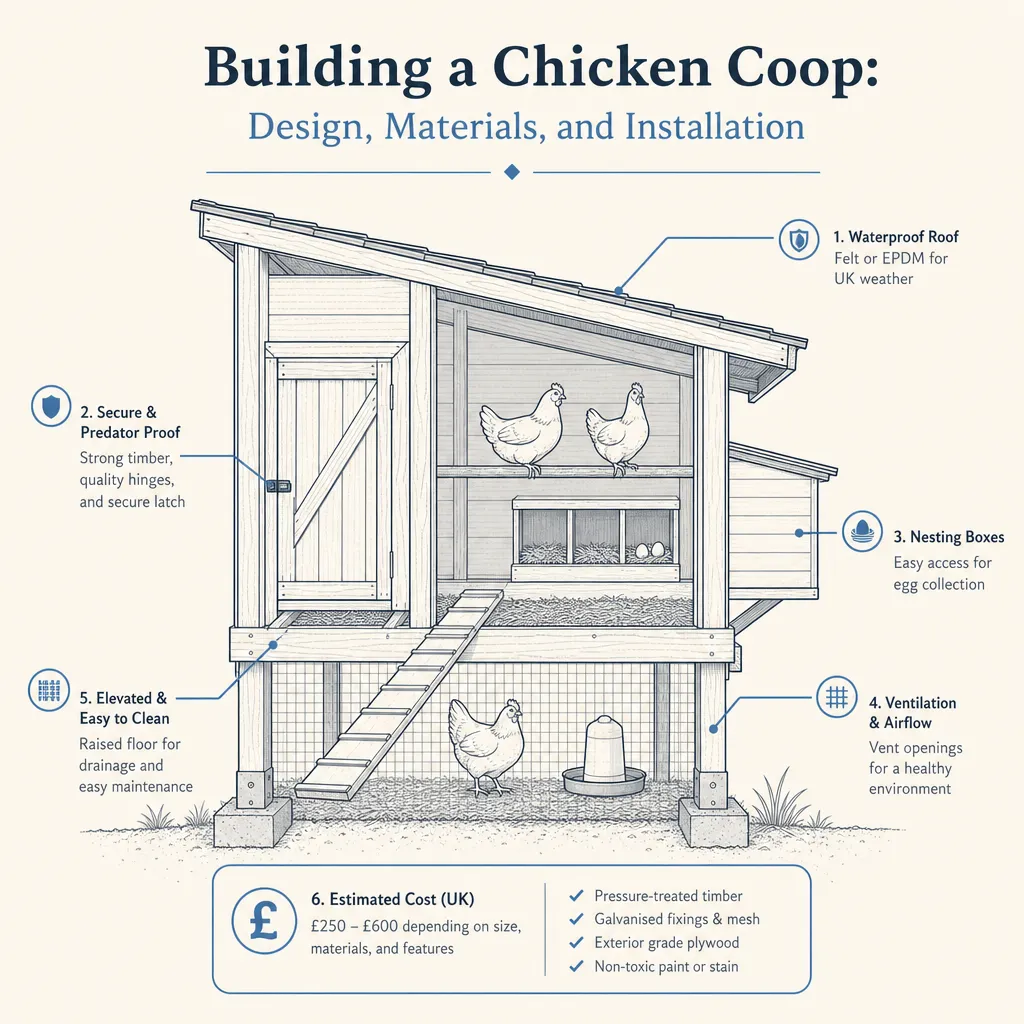
Building a Chicken Coop: Design, Materials, and Installation
A domestic chicken coop is usually permitted development in England and does not need planning permission, provided it meets height and coverage limits.
 Improvement & Build
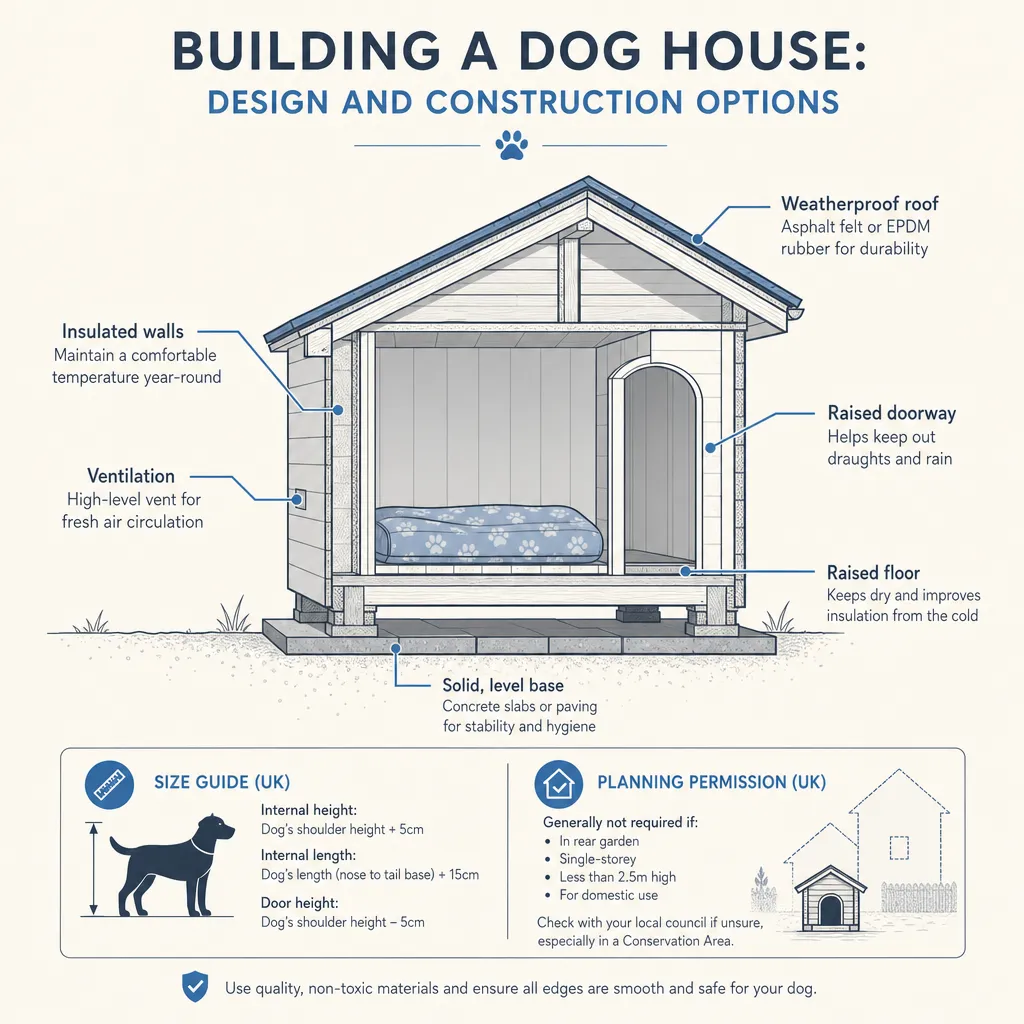
Building a Dog House: Design and Construction Options
Building a dog house in the UK means designing for the British climate — wet winters, variable summers, and occasional cold snaps.
 Improvement & Build
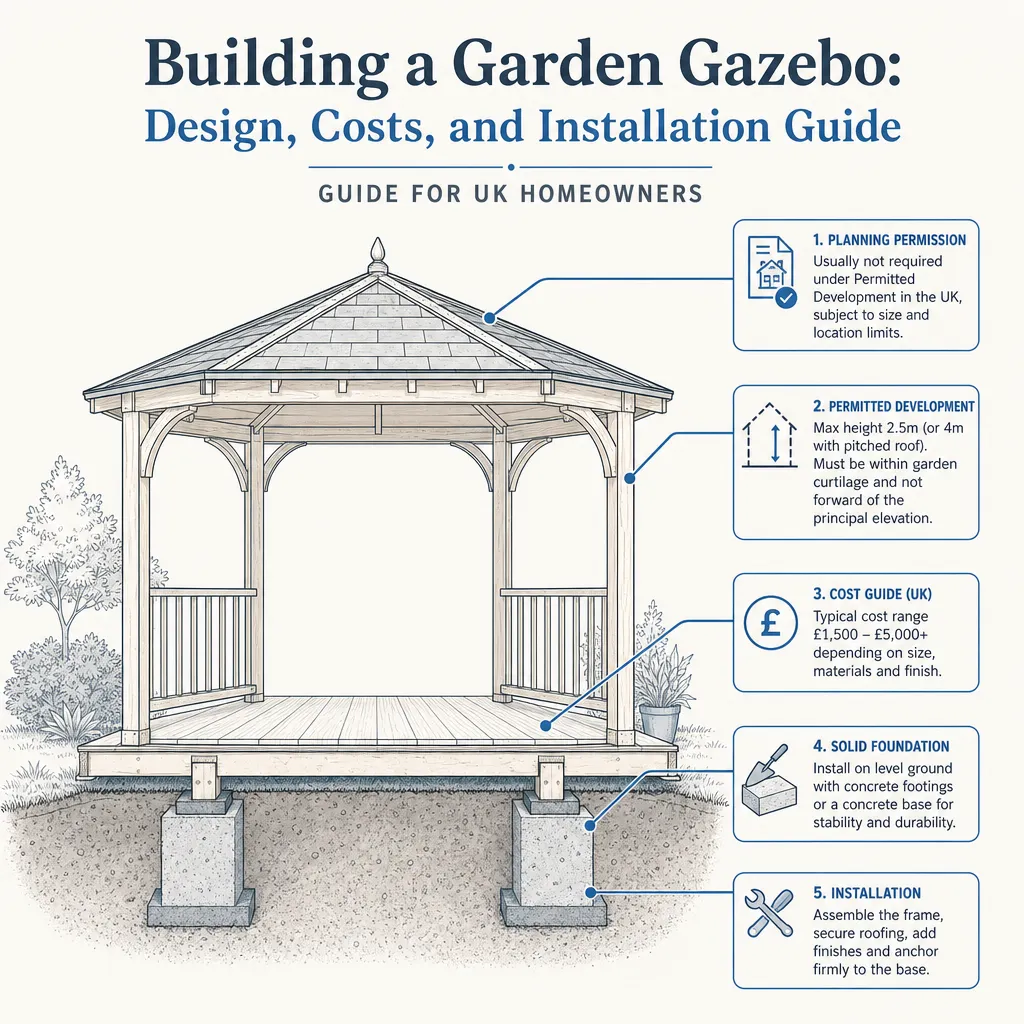
Building a Garden Gazebo: Design, Costs, and Installation Guide
A garden gazebo usually falls under permitted development in England, provided it is single storey, stays within height limits, and covers less than 50% of the garden.
 Improvement & Build
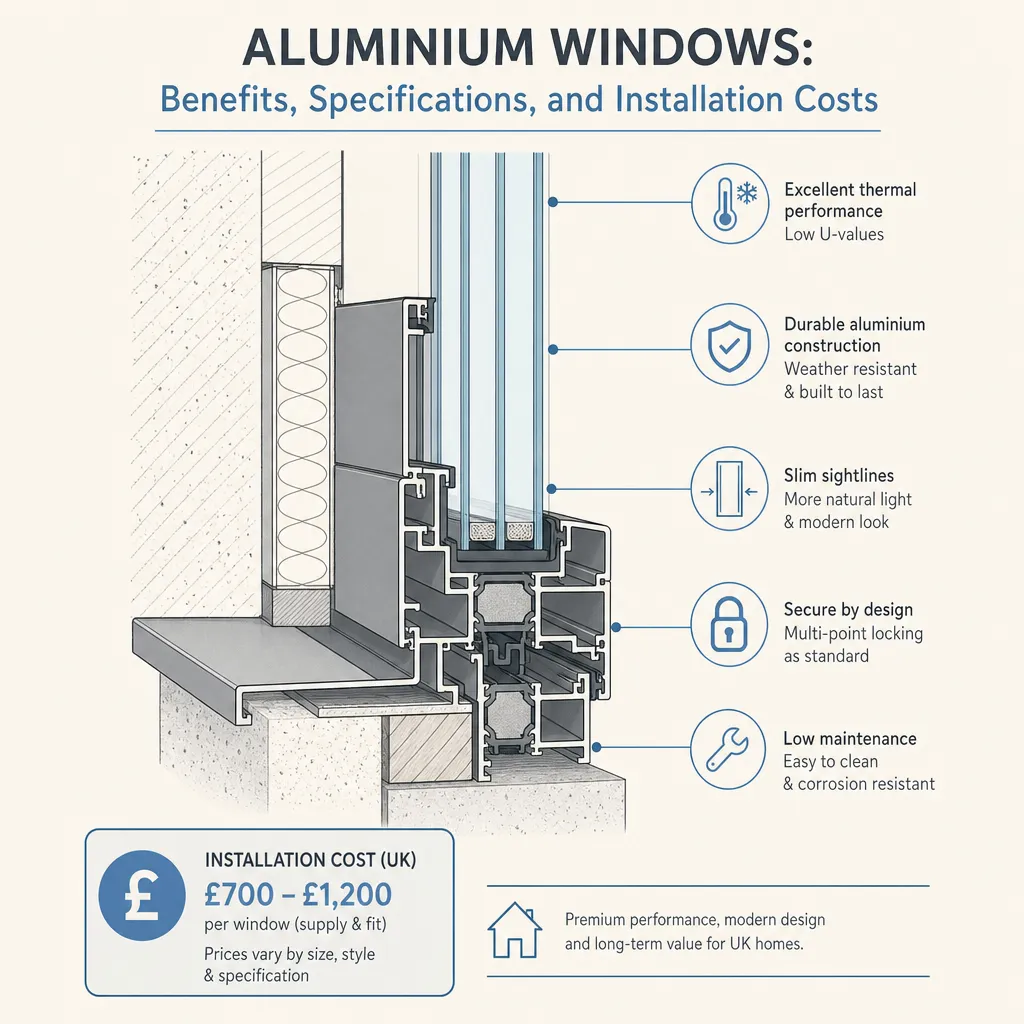
Aluminium Windows: Benefits, Specifications, and Installation Costs
Aluminium windows typically cost £600–£1,800 per window installed in the UK, depending on size and specification.
 Improvement & Build
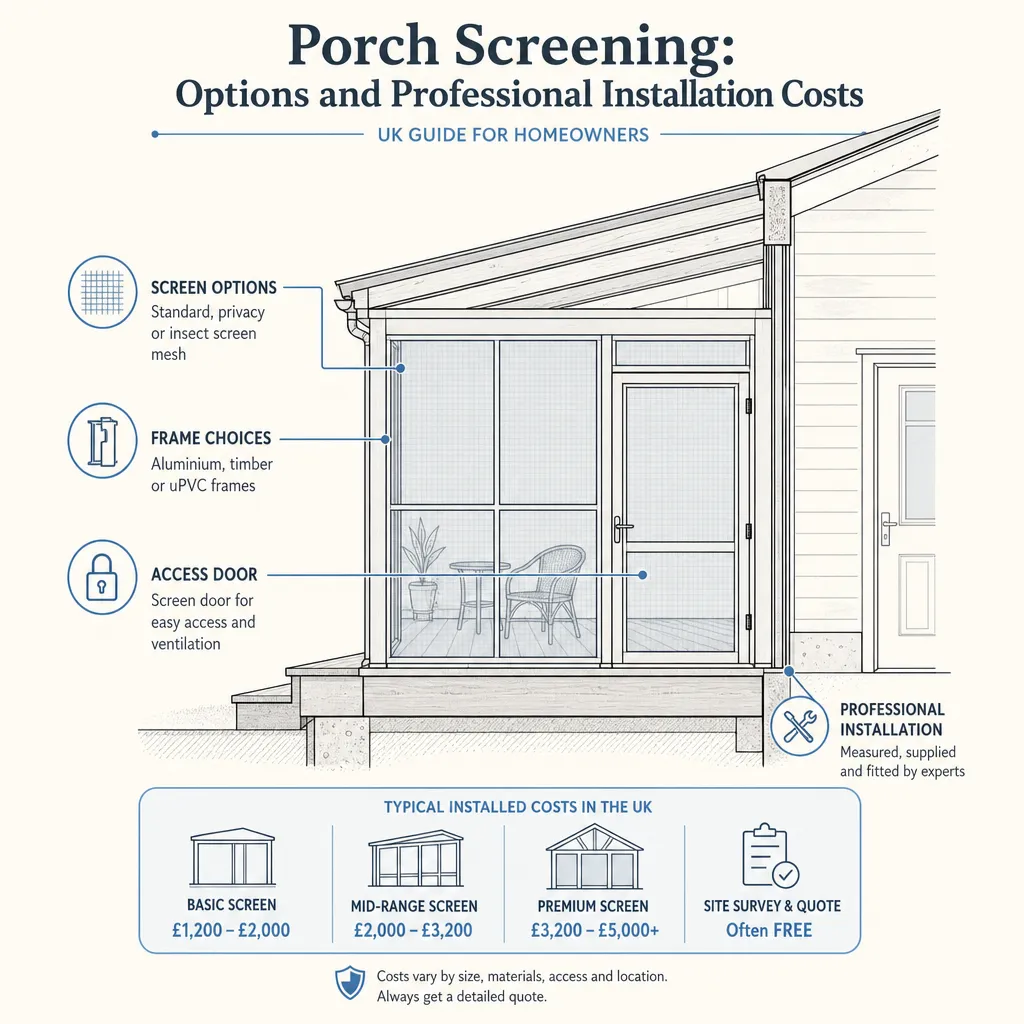
Porch Screening: Options and Professional Installation Costs
Porch screening ranges from simple insect mesh on a timber frame to bespoke aluminium-framed glazed enclosures.