Building a Garden Gazebo: Design, Costs, and Installation Guide
By Housey · Last reviewed 5th of May 2026
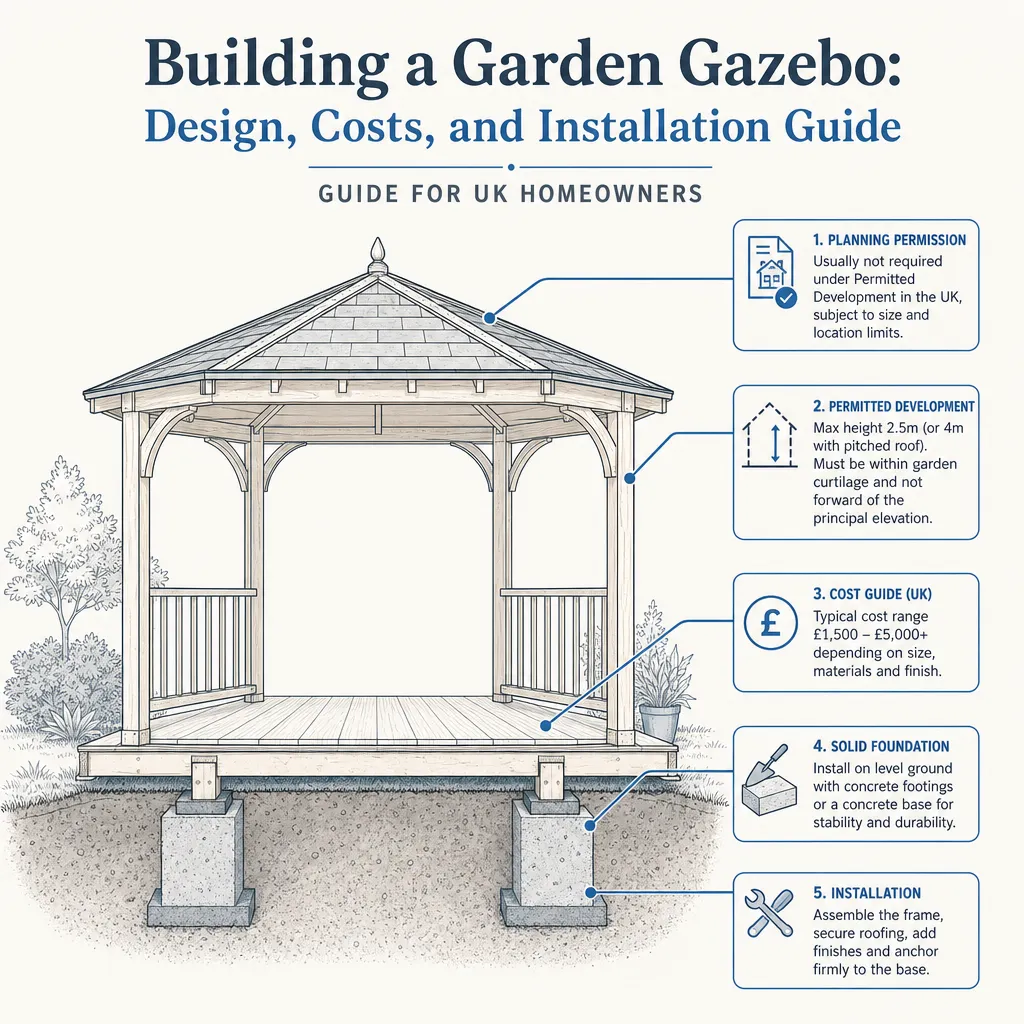
Building a Garden Gazebo: Design, Costs, and Installation Guide
A garden gazebo adds a defined outdoor living space — somewhere to eat, entertain, or sit sheltered from the sun or light rain. Most UK homeowners consider one when looking to extend the usable life of their garden beyond the main house, whether for summer dining or a permanent seating area that serves across more of the year. The key decisions come early: structure type, materials, size, and whether any permissions are needed before work starts.
Key points
- Most garden gazebos in England qualify as permitted development under Class E (Schedule 2, Part 1 of the Town and Country Planning (General Permitted Development) (England) Order 2015), provided the structure is single storey, does not exceed 2.5m eaves height, covers less than 50% of the garden, and sits behind the principal elevation of the house.
- Gazebos placed within 2m of a boundary must not exceed 2.5m in total height under permitted development rules.
- Listed buildings and conservation areas are subject to stricter controls — planning permission may be required for any new garden structure, including a gazebo.
- Timber is the most common material for UK residential gazebos; hardwood species such as oak or iroko last significantly longer than pressure-treated softwood but cost considerably more.
- Any electrical installation inside a gazebo — lighting, sockets, or appliance supplies — must comply with Part P of the Building Regulations and should be carried out by a qualified, registered electrician.
What types of gazebo are available?
UK garden gazebos range from flat-pack metal and softwood kits to fully bespoke hardwood or steel-framed structures. The right choice depends on your garden size, how long you want the structure to last, and your budget.
Type | Best for | Not ideal for | Typical lifespan | Approximate cost range |
|---|---|---|---|---|
Flat-pack metal or softwood kit | Smaller gardens, limited budget, shorter-term use | Long-term permanence, exposed or consistently wet sites | 5–12 years | £300–£1,500 |
Treated softwood, professionally installed | Mid-range budgets, most UK garden sizes | Very exposed coastal or high-rainfall sites | 15–20 years | £2,000–£6,000 |
Hardwood (oak, iroko), bespoke | Long-term investment, larger gardens, period properties | Tight budgets | 30+ years | £6,000–£20,000+ |
Steel or aluminium frame with glazed panels | Contemporary homes, year-round use | Traditional or heritage garden settings | 25+ years | £5,000–£15,000 |
Indicative UK costs, last reviewed 2026-05-05. Prices vary significantly by size, specification, location, and installer. Obtain at least three quotes before committing.
Do you need planning permission for a garden gazebo?
In England, most garden gazebos qualify as permitted development under Class E (buildings incidental to the enjoyment of a dwellinghouse). You generally do not need to apply for planning permission if all of the following apply:
- The gazebo is single storey and for domestic use.
- Maximum eaves height does not exceed 2.5m.
- Maximum overall height does not exceed 4m (dual-pitched roof) or 3m (any other roof form).
- The footprint, combined with all other outbuildings, does not cover more than 50% of the curtilage (garden area, excluding the house footprint).
- It sits behind the principal elevation — usually the front face of the house towards the road.
- It is not within 2m of a boundary, unless it is under 2.5m in total height.
Situations where planning permission is usually required:
- Listed buildings — any outbuilding in the curtilage of a listed building requires Listed Building Consent.
- Conservation areas, AONBs, and National Parks — permitted development rights may be restricted or removed by the local planning authority.
- Article 4 Directions — councils can remove permitted development rights in specific areas; check with your local planning authority.
- Flats and maisonettes — Class E permitted development applies only to dwellinghouses, not flats.
If you are uncertain, check with your local planning authority (LPA) before starting work. Many councils offer a householder pre-application advice service for a small fee. Rules in Wales, Scotland, and Northern Ireland differ — consult the relevant national planning portal.
Design and sizing considerations
Before approaching installers or selecting a kit, work through these design factors:
- Proportionality: a large gazebo in a small garden can feel imposing and reduce the sense of space rather than enhance it.
- Base: most installers require a level, well-drained base — concrete slab, paving, or decking. Base preparation is frequently excluded from gazebo quotes; clarify this before agreeing a price.
- Orientation: south or south-west facing positions in the UK maximise sunlight; consider shade cast by existing trees, fences, or the house at different times of day.
- Roof style: open-slatted roofs suit summer use but offer little shelter from rain; solid or polycarbonate-panel roofs extend usability into wetter months.
- Power and lighting: plan for any electrical supply before the base is laid so conduit can be installed underneath. This is far easier to do at groundwork stage than retrospectively.
Homeowner installation checklist
Use this checklist before and during your gazebo project:
What to ask before accepting a quote
- What is the exact footprint and finished height of the structure as quoted?
- Is the timber pressure-treated (tanalised), and what is the manufacturer's treatment guarantee?
- Who prepares the base, and is that cost included in the quote?
- Does the price include delivery, installation, and removal of waste?
- Will the quoting company carry out the work directly, or will it be subcontracted?
- What workmanship warranty does the installer offer, and in what form?
- Is VAT included in the quoted price?
- What are the payment terms and any stage payment schedule?
When to get professional help
Many flat-pack gazebo kits are designed for competent DIY assembly, but larger or bespoke structures should be installed by a professional. Consider professional involvement when:
- The structure is over 3m tall or has a complex roof requiring precise carpentry or joinery.
- Installation is on a sloping site requiring groundwork, levelling, or retaining.
- Any electrical installation is planned — this must be carried out by a Part P-registered electrician.
- The gazebo is near a boundary where legal boundaries or neighbour relations are a consideration.
- The property is listed, in a conservation area, or planning permission may be required.
A professional garden designer can help plan the gazebo's position, choose materials suited to your garden's character, and coordinate planting, paving, and lighting around the structure so the result reads as a coherent space rather than an isolated addition.
How Housey can help
Housey can connect you with qualified garden designers who work with UK homeowners on garden structures, planting, and outdoor living projects. Use Housey to request and compare quotes from experienced providers in your area.
Frequently asked questions
Does a garden gazebo add value to a house?
A well-designed, high-quality gazebo in good condition can contribute positively to a property's appeal, particularly if it extends usable outdoor space. However, estate agents and valuers generally treat garden structures as an enhancement rather than a significant driver of value. Quality, condition, and proportionality to the garden matter most. A poorly built or maintained structure can detract from a property's presentation.
Can I put electricity in a garden gazebo?
Yes, but any electrical work in an outdoor structure must comply with Part P of the Building Regulations in England and Wales. The installation should be carried out by a qualified electrician registered with a competent person scheme such as NICEIC or NAPIT. Underground cable runs must be installed at the correct depth and protected with appropriate conduit or ducting to meet current standards.
How long does it take to install a garden gazebo?
A flat-pack kit can typically be assembled in one to two days by two people. Professionally installed timber gazebos usually take two to five days on site, depending on size and complexity. Bespoke structures with electrical work or complex bases may take one to two weeks in total. Base preparation is often completed in a separate visit before the main installation begins.
Does a garden gazebo need building regulations approval?
A standard garden gazebo that is not habitable and has no fixed electrical circuits does not usually require Building Regulations approval in England. If electrical work is added, a competent person scheme-registered electrician will self-certify the installation. Any structural concerns about the base or anchoring should be assessed by a qualified professional before work starts.
Can I put a gazebo in my front garden?
Permitted development rights for outbuildings (Class E) apply only to structures behind the principal elevation of the house — typically the street-facing front wall. A gazebo positioned in the front garden would not satisfy this condition and would normally require planning permission. Check with your local planning authority before proceeding, as rules can vary by area and property type.
Sources and further reading
- Outbuildings — Permitted Development — Planning Portal
- Town and Country Planning (General Permitted Development) (England) Order 2015 — legislation.gov.uk
- Approved Document P: Electrical safety in dwellings — GOV.UK
- Find a registered electrician — NICEIC
- Listed buildings and planning — Historic England
Useful next reads
 Improvement & Build
Aluminium Windows: Benefits, Specifications, and Installation Costs
Aluminium windows typically cost £600–£1,800 per window installed in the UK, depending on size and specification.
 Improvement & Build
Porch Screening: Options and Professional Installation Costs
Porch screening ranges from simple insect mesh on a timber frame to bespoke aluminium-framed glazed enclosures.
 Improvement & Build
Building an Outdoor Kitchen: Design, Materials, and Investment
Building an outdoor kitchen in the UK costs roughly £3,000–£25,000 depending on size and materials.
 Improvement & Build
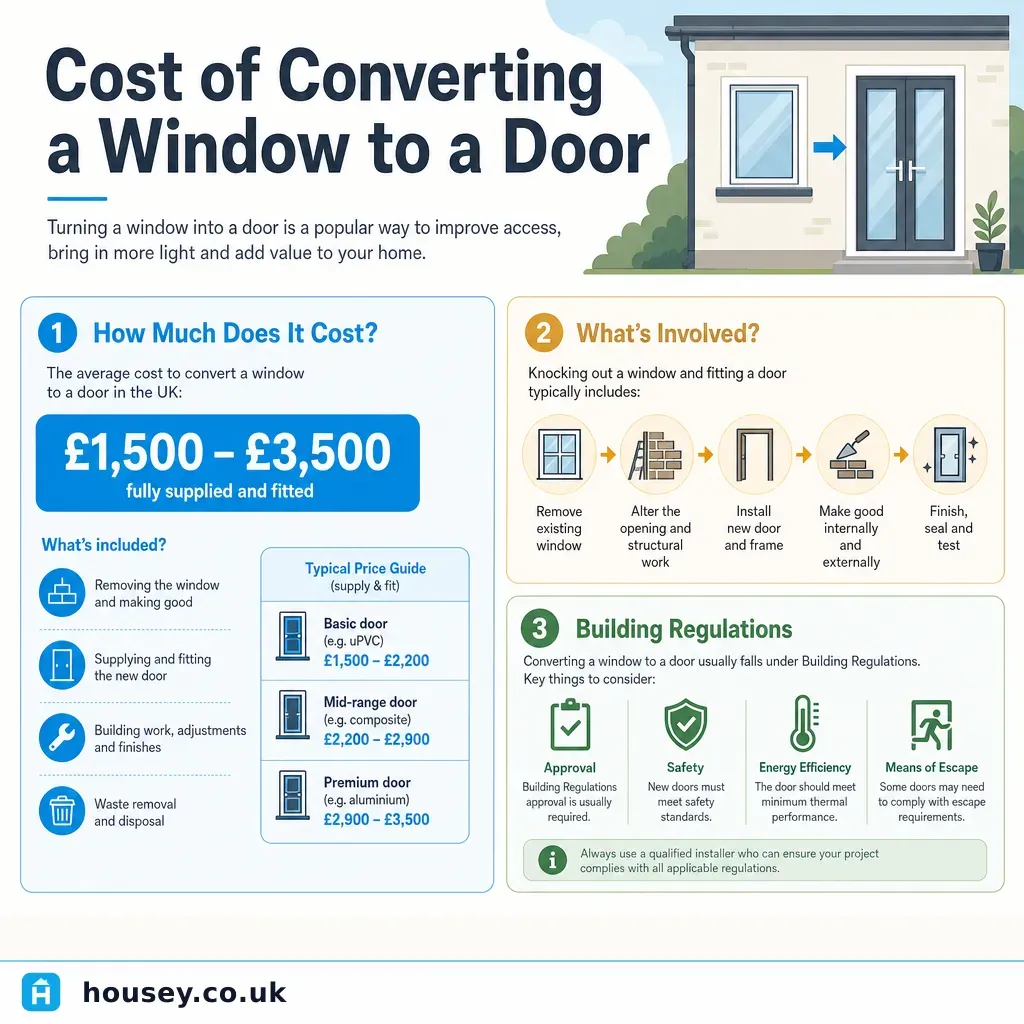
Cost of converting a window to a door
Converting a window to a door in the UK typically costs £1,500–£5,000 or more, depending on wall construction (cavity, solid, or timber frame), the type of door fitted, and whether a new or enlarged lintel is required.
 Improvement & Build
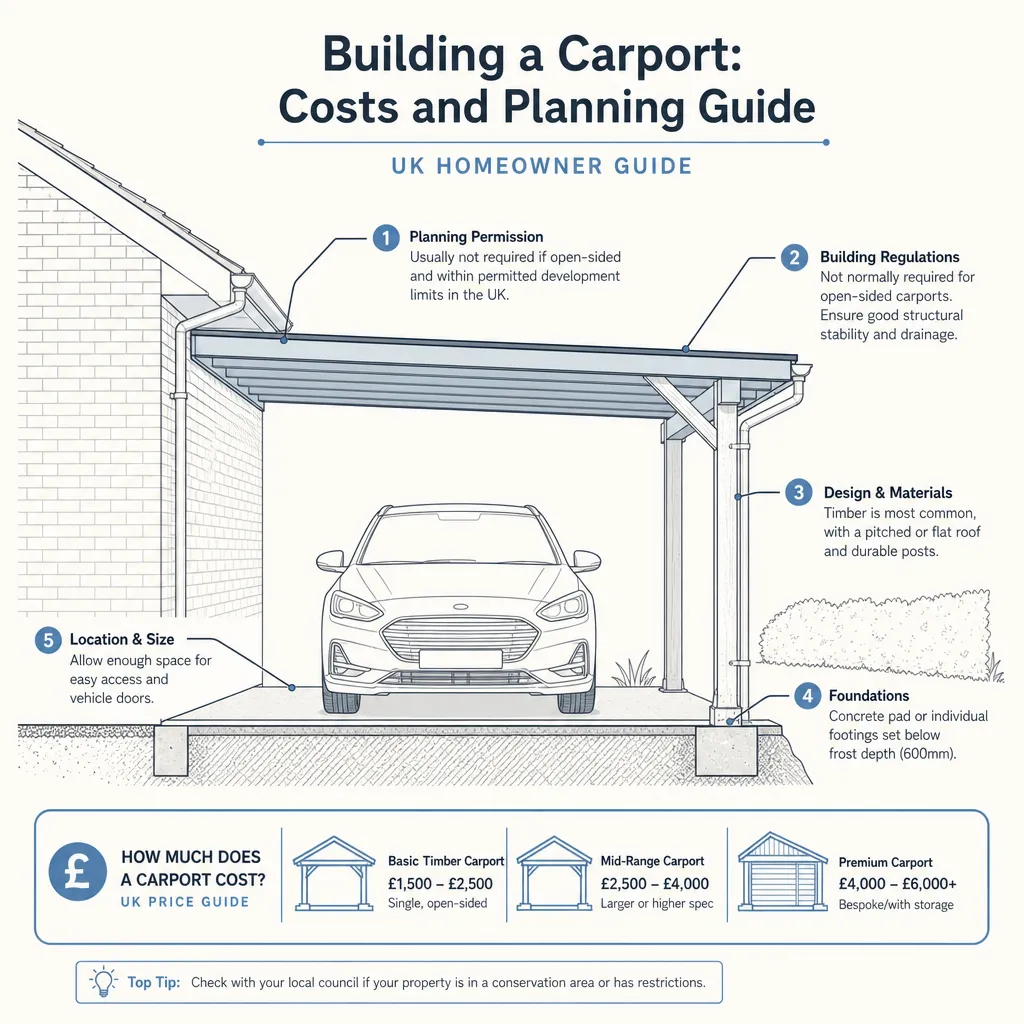
Building a Carport: Costs and Planning Guide
A single-bay carport in the UK typically costs £3,000–£12,000 installed, depending on material and groundworks.