Building a Dog House: Design and Construction Options
By Housey · Last reviewed 11th of May 2026
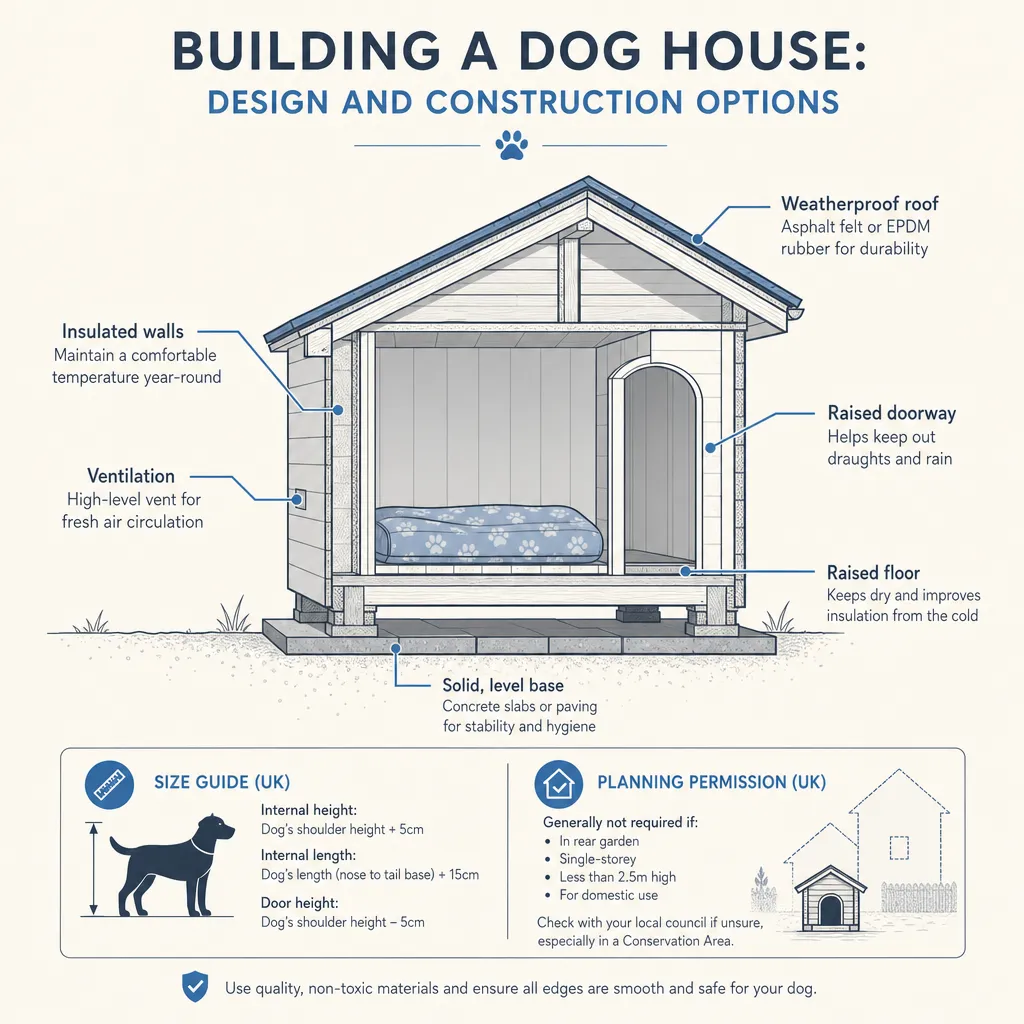
Building a Dog House: Design and Construction Options
Dog owners planning an outdoor kennel in the UK often start with a simple internet search and find themselves confronted with American product dimensions, conflicting breed-size charts, and DIY plans designed for warmer, drier climates. A well-built dog house in Britain needs to handle driving rain, cold winters, and variable summers — challenges that demand attention to weatherproofing, insulation, and drainage from the outset. Getting the size, material, and siting right makes the difference between a kennel your dog uses willingly and one that sits empty at the bottom of the garden.
Key points
- The Animal Welfare Act 2006 requires that dogs have access to adequate shelter; an outdoor kennel used regularly must provide protection from the elements — including wind, rain, and cold — under the Act's welfare standards.
- Most garden dog kennels under 2.5 m in height qualify as permitted development in England and require no planning permission, though conservation areas, listed buildings, and Article 4 Direction areas have additional restrictions.
- The kennel's internal length should be at least 1.5 times the dog's body length; width should allow it to turn in a full circle; height should allow it to stand upright with at least 5 cm clearance.
- Pressure-treated (tanalised) timber is the standard external construction material for UK dog kennels; the copper-based preservative treatment resists rot and fungal decay in damp conditions without requiring annual retreatment.
- A raised floor on timber bearers (at least 5–10 cm off the ground) is essential to prevent moisture from wicking up from the ground and to allow air circulation beneath the structure.
Choosing the right size for your dog
Getting the internal dimensions wrong is the most common dog kennel mistake. A kennel that is too small prevents comfortable movement and can cause stress; one that is excessively large cannot retain enough body heat in cold weather.
As a practical guide, the kennel should be long enough for the dog to lie fully stretched out, wide enough to turn in a full circle, and tall enough to stand upright with at least 5 cm headroom.
Approximate internal dimensions by breed size
Breed category | Typical examples | Minimum internal dimensions (L × W × H) |
|---|---|---|
Small (up to 10 kg) | Jack Russell, Miniature Schnauzer, Pug | 60 × 50 × 55 cm |
Medium (10–25 kg) | Cocker Spaniel, Border Collie, Whippet | 90 × 70 × 75 cm |
Large (25–45 kg) | Labrador, German Shepherd, Boxer | 110 × 85 × 90 cm |
Extra-large (45 kg+) | Great Dane, Newfoundland, St Bernard | 140 × 100 × 110 cm |
These are minimum figures for a dog spending limited outdoor time. For dogs that sleep or spend extended periods in the kennel, increase all dimensions by 20–30%.
Design and construction options
There are three main routes to a dog house in the UK: buying a pre-built kennel, purchasing a flat-pack kit, or building from scratch.
Which option should you choose?
- Choose a pre-built kennel if you need a weatherproof structure quickly and the cost fits your budget; pre-built products from reputable UK suppliers typically range from £80 to £600+ depending on size.
- Choose a flat-pack kit if you want a balance of convenience and customisation; most UK garden centre kits use pre-cut pressure-treated timber and can be assembled in a few hours.
- Build from scratch if you need precise dimensions, specific materials, or a design that integrates with an existing garden structure or run.
- Contact a garden designer or joiner if the kennel is part of a wider outdoor project, needs to match a specific aesthetic, or forms part of a larger kennelling complex.
Construction route | Indicative cost | Customisation | Typical weather performance | Time to use |
|---|---|---|---|---|
Pre-built kennel (small) | £80–£200 | Low | Variable by product | Immediate |
Pre-built kennel (large) | £250–£600+ | Low | Good from reputable supplier | Immediate |
Flat-pack kit | £100–£350 | Medium | Good if joints sealed properly | 2–4 hours assembly |
Custom timber build | £200–£800+ materials | High | Excellent if designed well | 1–3 days |
Indicative UK costs, last reviewed 2026-05-11. Prices vary by supplier, size, and region.
Materials for the UK climate
The UK's damp, variable climate demands materials that resist moisture without requiring constant maintenance.
Pressure-treated (tanalised) timber is the standard choice for outdoor dog kennels. Modern copper-based preservative treatments fix into the wood and are considered safe for pets once the timber has dried fully. Avoid creosote-treated timber, which is toxic to dogs.
Tongue-and-groove cladding for the walls provides better weather resistance than butt-jointed boards, as the interlocking profile prevents water ingress at the joints.
Roofing: mineral felt is the most common low-cost material and is adequate for most uses, with a lifespan of around 10–15 years. Cedar shingles or EPDM rubber membrane offer better longevity if budget allows.
Flooring: exterior-grade plywood (minimum 18 mm thick, WBP bonded) sealed with a non-toxic finish is durable and easy to clean. The floor must be raised off the ground on timber bearers to prevent moisture contact.
Insulation, ventilation, and positioning
A timber kennel without insulation will be cold in a UK winter and potentially hot in summer. Adding 25 mm rigid foam insulation board (PIR) to the inside of the walls and roof — sandwiched between the outer cladding and an inner timber lining — significantly improves year-round comfort. All insulation must be fully enclosed within the structure; dogs will chew exposed foam boards.
A small louvre vent or gap near the roofline prevents condensation and overheating in summer without creating a draught at floor level where the dog sleeps.
Positioning checklist
Planning permission and permitted development in England
Most garden structures — including dog kennels — are permitted development in England provided they:
- Are no more than 2.5 m in height (or up to 3 m with a dual-pitched roof if situated more than 2 m from any boundary).
- Do not cover more than 50% of the total garden area in aggregate with other outbuildings.
- Are not used for residential sleeping accommodation for people.
- Are situated to the rear or side of the principal elevation of the house.
Conservation areas, listed buildings, and Article 4 Direction areas may impose additional restrictions that require full planning permission. Scotland and Wales have similar but not identical permitted development provisions. Always check with your local planning authority before starting work if you are in any doubt.
When to get professional help
For most dog kennels, no professional help is required. Consider getting advice when:
- The kennel is part of a larger garden project — a run, shelter complex, or landscaped scheme — where a garden designer or experienced joiner can ensure structural integrity and aesthetic coherence.
- The property is listed or in a conservation area, where a planning officer should be consulted before any permanent structure is installed.
- The kennel requires fixed electrical wiring for a heater or lighting — this must be carried out by a Part P–compliant electrician registered with NAPIT or NICEIC to comply with Building Regulations.
How Housey can help
If a dog kennel or kennel run is part of a wider garden redesign, Housey can connect you with garden designers who can incorporate the structure into a considered outdoor scheme — advising on positioning, materials, planting, and how the kennel integrates with the wider garden layout.
Frequently asked questions
Does a dog kennel need planning permission in the UK?
In most cases in England, a small garden kennel is permitted development provided it meets height and footprint limits. Conservation areas, listed buildings, and some new-build estates with restrictive covenants may impose additional requirements. Always verify with your local planning authority if you are in any doubt before starting work.
What wood is safe to use for a dog kennel?
Pressure-treated (tanalised) timber is generally safe once dried; modern copper-based preservatives are considered safe for pets after curing. Avoid creosote-treated timber, which is toxic to dogs. Sand smooth any rough or splintered surfaces before the dog is introduced, and allow freshly treated timber to dry fully before use.
How do I stop a dog kennel getting damp inside?
Raise the floor on timber bearers at least 5–10 cm off the ground, use exterior-grade plywood for the base, ensure the roof overhang extends beyond the walls, seal all external timber joints with weatherproof mastic, and apply a pet-safe wood preservative annually to maintain weather resistance.
Can I insulate an existing flat-pack dog kennel?
Yes. Fix rigid foam insulation boards to the inside of the walls and roof, then cover with a smooth inner lining of hardboard or thin plywood to prevent chewing. Ensure the entrance remains unobstructed and that at least one small vent is maintained near the roofline to prevent condensation build-up.
Sources and further reading
- Animal Welfare Act 2006 — legislation.gov.uk
- RSPCA — keeping dogs outside — RSPCA
- Permitted development rights for householders — technical guidance — GOV.UK / MHCLG
- Building Regulations Part P — electrical safety in dwellings — GOV.UK
Useful next reads
 Improvement & Build
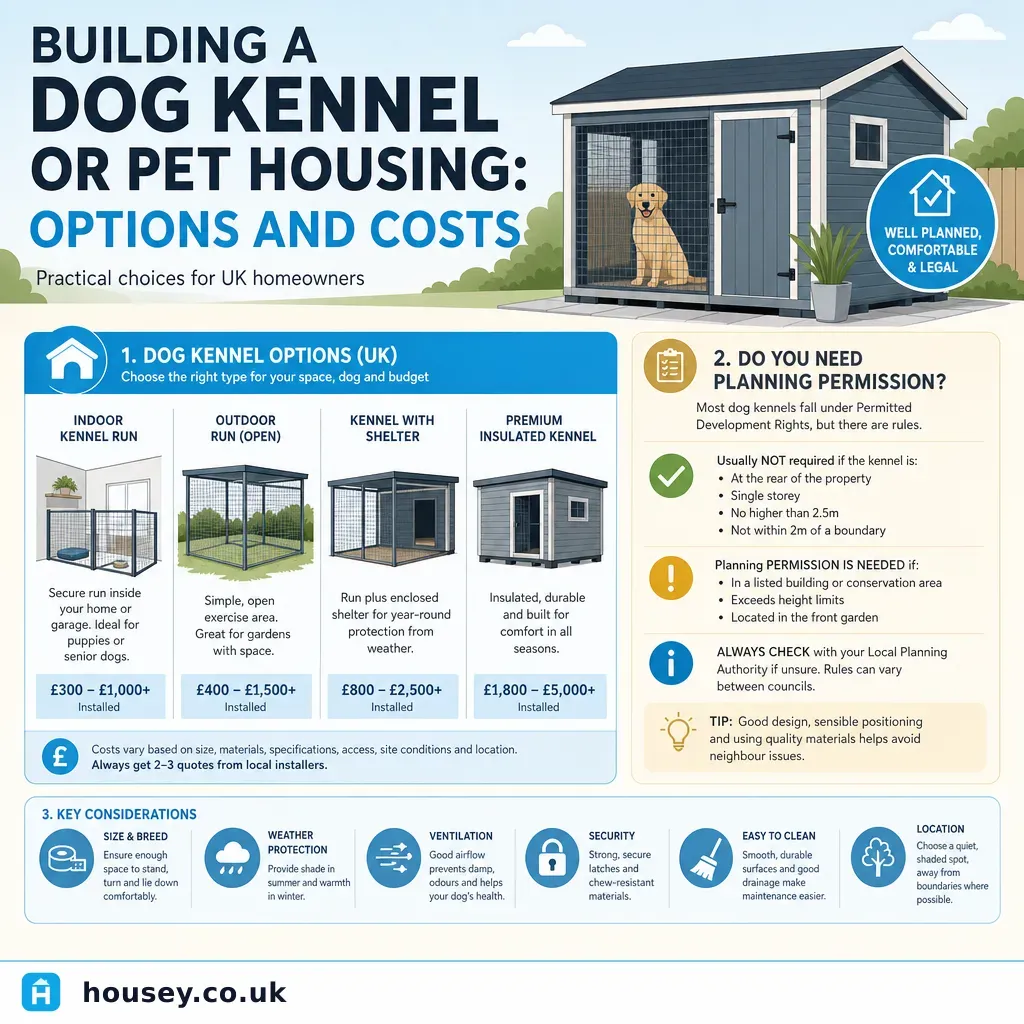
Building a Dog Kennel or Pet Housing: Options and Costs
A domestic dog kennel or pet housing structure is almost always permitted development in England and does not need planning permission if sited behind the house, below 2.
 Improvement & Build
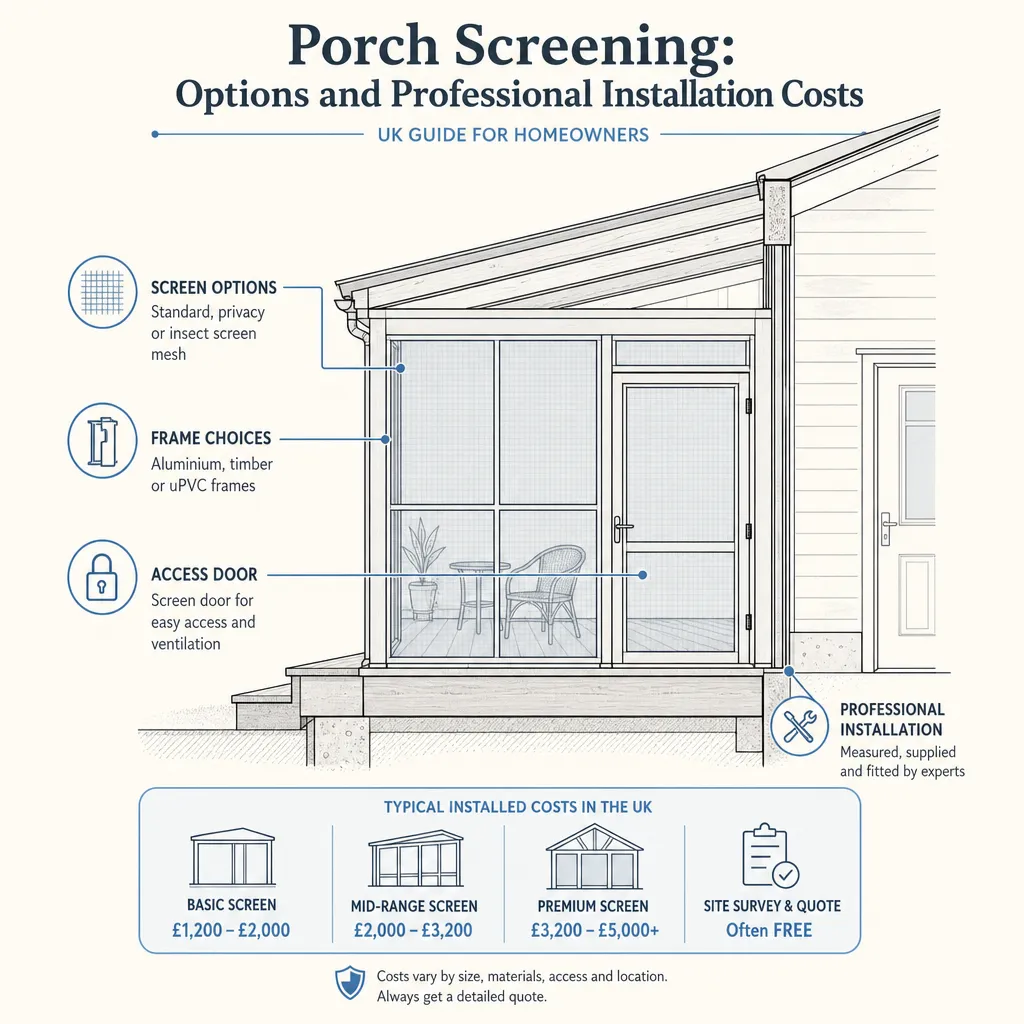
Porch Screening: Options and Professional Installation Costs
Porch screening ranges from simple insect mesh on a timber frame to bespoke aluminium-framed glazed enclosures.
 Improvement & Build
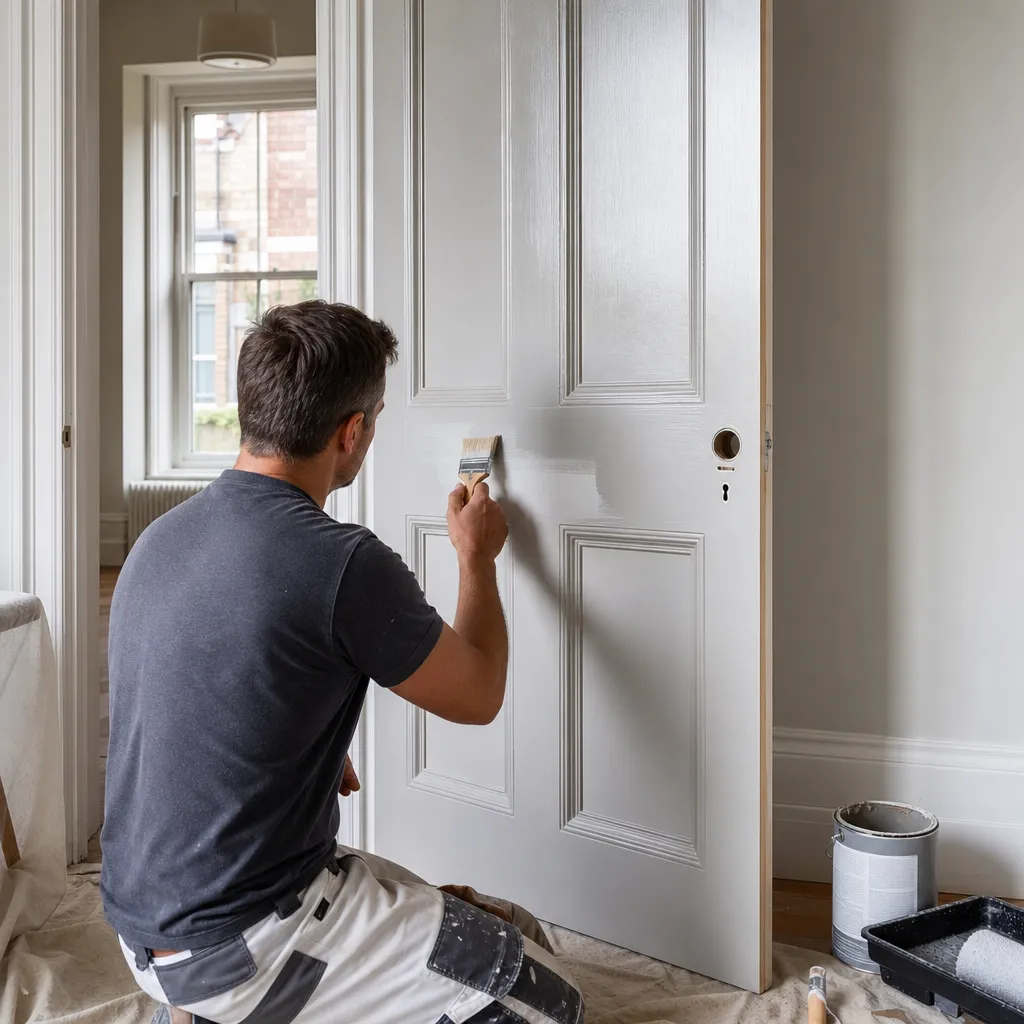
Painting Interior Doors: Preparation and Technique
Painting interior doors well depends on preparation rather than paint choice.
 Improvement & Build
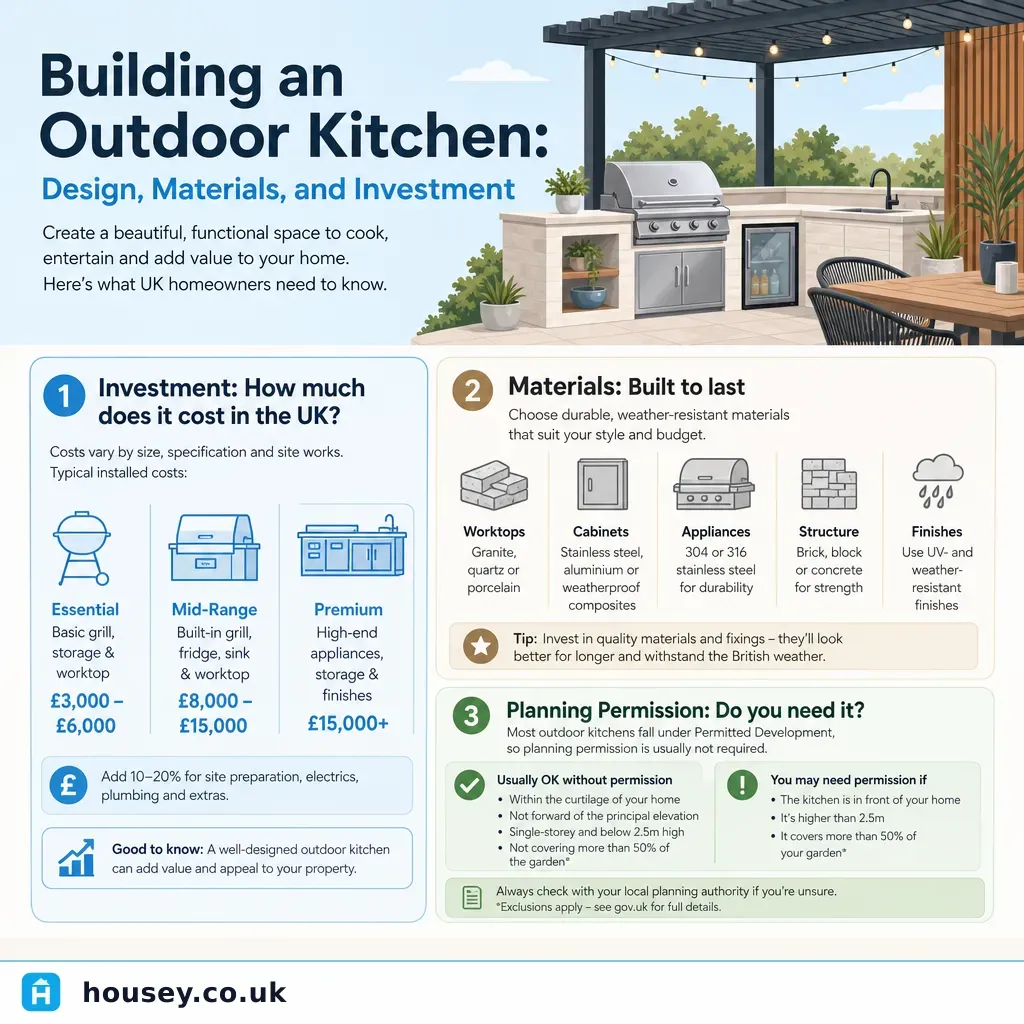
Building an Outdoor Kitchen: Design, Materials, and Investment
Building an outdoor kitchen in the UK costs roughly £3,000–£25,000 depending on size and materials.
 Improvement & Build
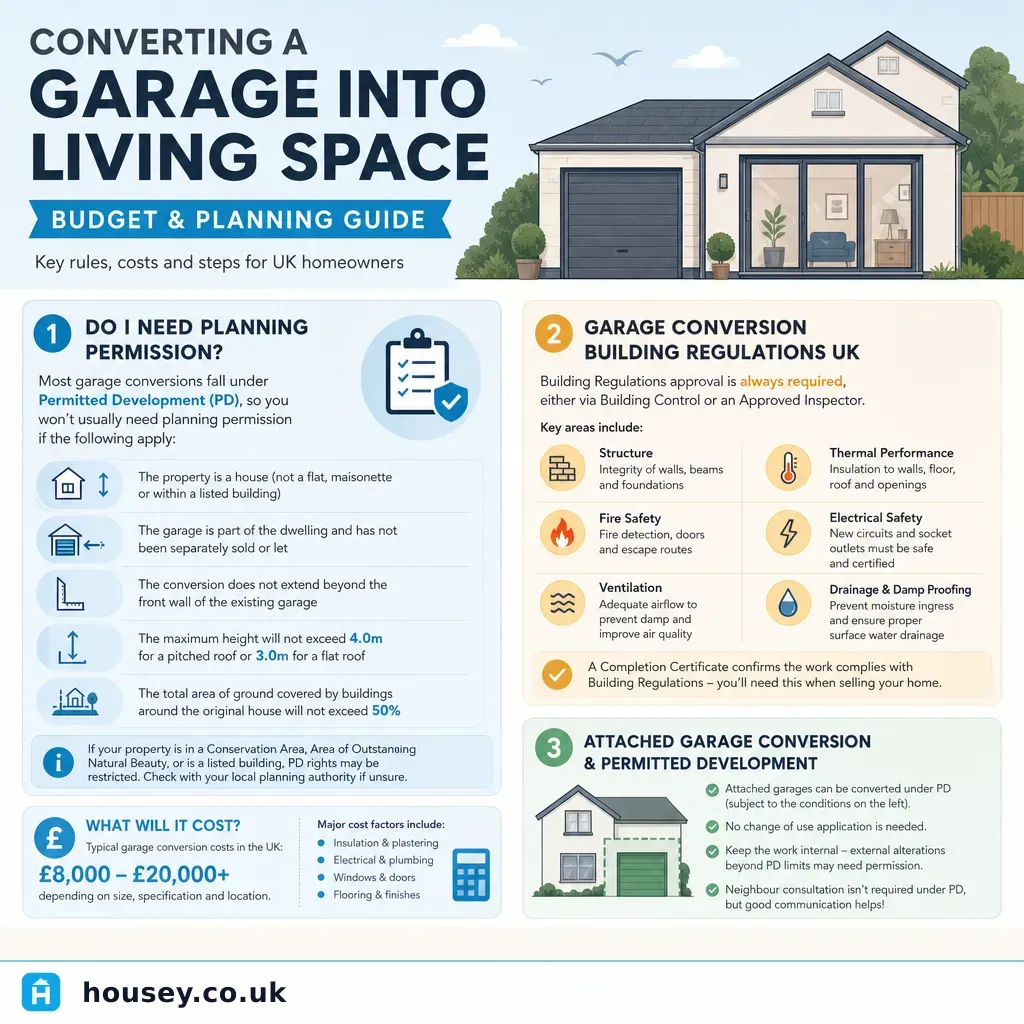
Converting a Garage into Living Space: Budget and Planning Guide
A single-garage conversion typically costs £8,000–£20,000 in the UK.