Building a Garage: Costs, Planning, and Construction
By Housey · Last reviewed 30th of May 2026
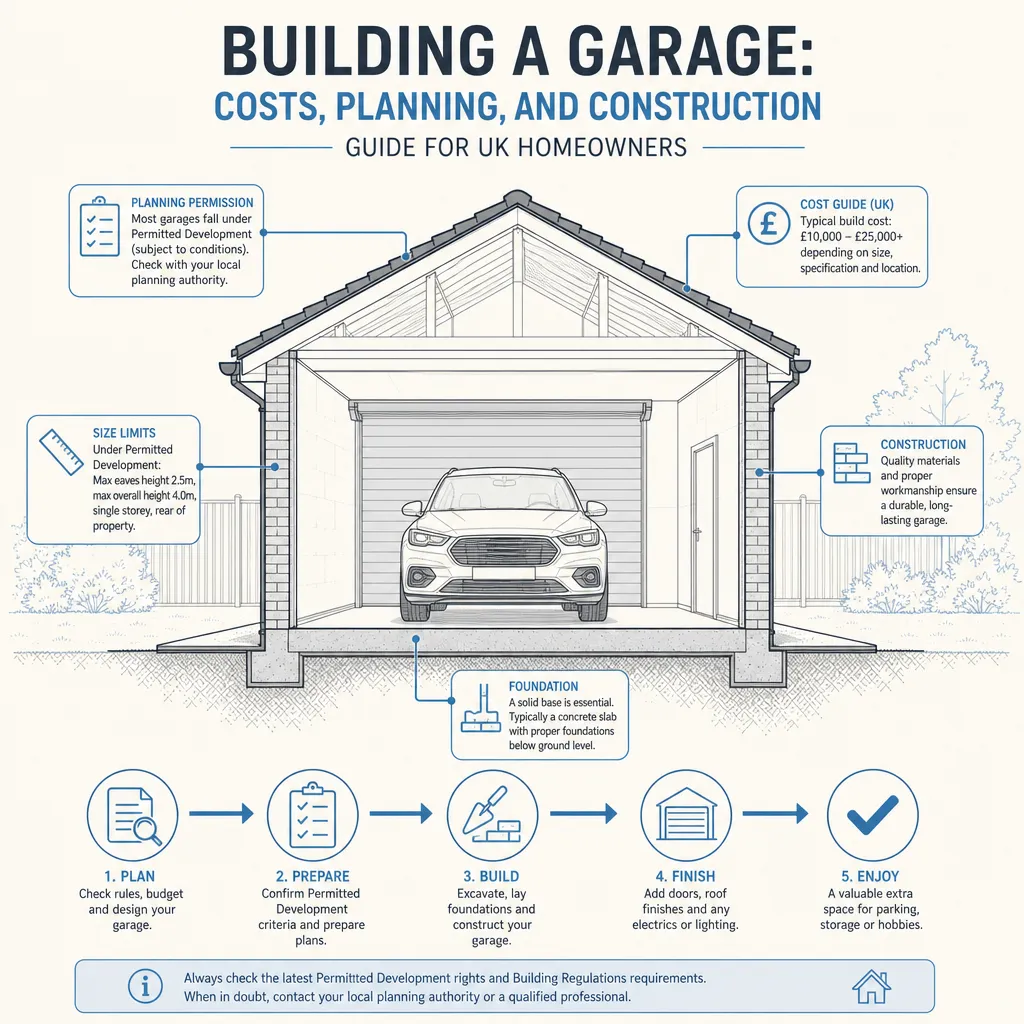
Building a Garage: Costs, Planning, and Construction
Building a new garage is one of the larger single-structure projects a UK homeowner might undertake — typically costing tens of thousands of pounds and requiring decisions about materials, planning status, and building regulations compliance well before a builder sets foot on site. The question usually arises when a property lacks covered parking, when a loft conversion or extension has removed an existing garage, or when a growing household needs additional storage and workshop space. Getting the planning and specification right from the outset avoids costly alterations during or after construction.
Key points
- New detached garages up to 15 m² total floor area are generally exempt from building regulations in England, but larger structures, attached garages, and any garage with sleeping accommodation require formal building regulations approval.
- Permitted development rights allow many homeowners to build a garage without a full planning application, but conditions apply: the structure must not exceed 4 m in height (5 m with a dual-pitched roof), must not exceed 50% of the total original curtilage, and must not project forward of the principal elevation facing a highway.
- In Wales, Scotland, and Northern Ireland, permitted development rules differ from those in England — verify with the relevant authority before relying on PD rights.
- Properties in conservation areas, on designated land (National Parks, Areas of Outstanding Natural Beauty), or listed buildings usually have permitted development rights removed or restricted, requiring a full planning application.
- An attached or integral garage that shares a wall with the main dwelling typically needs building regulations approval regardless of size, as it affects the thermal envelope and fire compartmentation of the house.
Do you need planning permission?
Whether planning permission is required depends on the structure's size, position, and the property's planning history.
Permitted development decision tree
- Choose permitted development if the garage is within the curtilage of a dwellinghouse; does not bring total outbuildings to more than 50% of the original curtilage; is at least 2 m from any boundary if the eaves height exceeds 2.5 m; is not forward of the principal elevation facing a highway; does not exceed 4 m in height (mono-pitch) or 5 m (dual-pitched roof); and no Article 4 Direction, planning condition, or prior restriction on PD rights applies to the property.
- Apply for full planning permission if any of the above conditions cannot be met, or if the property is in a conservation area, on designated land, or is a listed building.
- Check with your local planning authority (LPA) if you are unsure about prior planning conditions, whether PD rights have been removed, or whether an Article 4 Direction applies to the area.
- Ask a planning consultant or architect if the site is constrained, in a sensitive location, or before spending money on design and groundworks.
A Lawful Development Certificate (LDC) from your LPA confirms in writing that a proposed structure falls within permitted development. It is not legally required but provides certainty and is useful during a future sale.
Do you need building regulations approval?
Building regulations approval is entirely separate from planning permission. For a new garage in England and Wales:
Garage type | Building regulations required? |
|---|---|
Detached, under 15 m² total floor area | Generally not required |
Detached, 15 m²–30 m², not within 1 m of boundary, non-combustible materials | Not required |
Detached, over 30 m², or within 1 m of any boundary | Usually required |
Attached or integral (shares a wall with the dwelling) | Required — affects fire compartmentation and thermal envelope |
Any garage with sleeping accommodation or sanitary facilities | Always required |
Garage with new electrical installation | May trigger Part P compliance requirements |
Even where a full application is not required, the work must be structurally sound and safe. A building control officer can inspect on request.
Typical construction costs
Indicative UK costs, last reviewed 2026-05-30. Costs vary significantly by region, ground conditions, specification, and contractor. Obtain at least three itemised quotes before committing to a build.
Garage type | Indicative cost range |
|---|---|
Single detached brick garage, basic spec (approx. 3×6 m) | £15,000–£25,000 |
Single detached brick garage, mid-spec with electrics | £20,000–£30,000 |
Double detached brick garage (approx. 6×6 m), mid-spec | £30,000–£50,000 |
Attached single garage, brick construction | £18,000–£35,000 |
Timber-frame (prefabricated) single garage | £10,000–£20,000 |
Steel portal frame single garage | £12,000–£22,000 |
These indicative figures typically cover groundworks, foundations, structural shell, roof, garage doors, and basic electrical first fix. They do not include planning fees (approximately £258 for a householder application in England at time of writing), building regulations fees (typically £200–£600), architect or structural engineer fees, landscaping, or specialist finishes.
Key cost drivers
The largest variables are ground conditions, access, materials, roof type, and specification:
- Ground conditions — poor bearing capacity, fill material, or a high water table require deeper or engineered foundations, potentially adding £2,000–£8,000 or more to the build cost.
- Access — restricted site access for plant and material deliveries increases manual handling costs.
- Materials — brick-built garages cost more than timber-frame or steel but typically add more resale value and durability.
- Roof type — a pitched tiled roof costs more than a flat or mono-pitch felt roof but generally lasts longer.
- Specification — insulation, power, lighting, drainage, and security features all increase cost but improve long-term usability.
Construction stages overview
A typical new garage build follows this sequence:
- Design and consents — confirm planning status, obtain drawings, and submit a building regulations application if required.
- Groundworks — site clearance, excavation, and formation of strip or raft foundations.
- Substructure — oversite slab or suspended floor construction.
- Superstructure — walls (brick, block, timber frame, or steel portal frame).
- Roof — structure, covering (tiles, felt, or EPDM), fascias, soffits, and rainwater goods.
- Openings — garage doors, windows, and any personnel door.
- First fix — electrical conduit and any below-slab drainage.
- Finishes — render or pointing, floor screed or hardened concrete, decoration.
- Inspections and sign-off — building control inspections at foundation, superstructure, and completion stages if building regulations apply.
Homeowner checklist before starting
Important limitations
This article provides general guidance on the planning and construction of residential garages in England. Rules in Wales, Scotland, and Northern Ireland differ, and planning policy can vary significantly between local authorities. Cost figures are indicative and will vary depending on ground conditions, specification, contractor, and region. This article is not a substitute for advice from a qualified architect, planning consultant, structural engineer, or building control officer. Verify planning and building regulations status with your LPA or a qualified professional before committing to construction.
When this becomes urgent
Seek professional advice before starting work if:
- You are uncertain whether your property has permitted development rights — confirming this before groundworks avoids costly enforcement action.
- Ground conditions appear problematic: soft or waterlogged ground, a sloping site, made ground, or large trees within root-spread distance.
- The proposed structure is within 2 m of a boundary, shares a wall with the house, or may trigger a Party Wall Act obligation.
- The property is in a conservation area, on designated land, or is listed.
- The structure will include sleeping accommodation, sanitary facilities, or any habitable use.
What to ask a qualified professional
Before instructing an architect, planning consultant, structural engineer, or builder, ask:
- Can you confirm whether this project falls within permitted development or requires a planning application?
- Should I apply for a Lawful Development Certificate?
- What building regulations applications are needed, and who will manage the building control process?
- What structural information — soil investigation, structural drawings — is required before foundations can be designed?
- Who will carry out the electrical installation, and will they hold Part P registration?
- What is the programme of works and how many site visits will building control require?
- What drawings, certificates, and warranty documents will I receive on completion?
When to get professional help
Building a garage is a significant construction project. Even where permitted development rights apply and building regulations are not formally required, involving a qualified contractor reduces the risk of structural failure, planning enforcement, or problems on resale. For garages over 30 m², attached structures, or any build involving uncertain ground conditions, submitting a building regulations application provides a formal safety check and a completion certificate that protects your investment.
How Housey can help
Housey connects homeowners with experienced groundworkers for site preparation and foundations, project managers to coordinate and oversee the full build programme, and garage conversion specialists if you are also considering changing the use of an existing structure on the property.
Frequently asked questions
Do I need planning permission for a garage on my driveway?
Usually not, provided the garage meets permitted development conditions: it does not exceed 50% of the curtilage, is not forward of the principal elevation facing a highway, and stays within the permitted height limits. However, permitted development rights may have been removed on your specific property by a planning condition or Article 4 Direction. Check with your local planning authority before ordering materials or starting groundworks.
How long does it take to build a single garage?
A single brick-built detached garage typically takes 6–10 weeks from groundworks to completion in normal conditions. Larger structures, adverse weather, complex ground conditions, or supply delays can extend the programme. The design and consents stage — drawings, planning confirmation, and building regulations approval if required — may add several further weeks before construction can begin.
Can I build a garage right up to my boundary?
A garage over 2.5 m in height must generally be at least 2 m from the boundary to fall within permitted development in England. Structures under 2.5 m measured at the eaves may sometimes be positioned closer. Building regulations also require non-combustible materials where the wall is within 1 m of a boundary. Check both the planning and building regulations positions before finalising the layout, and consider Party Wall Act implications where relevant.
Will a new garage add value to my property?
A well-built, properly consented garage typically adds value, particularly in areas with limited off-street parking. The increase varies by location, property type, and specification. An integral or attached garage generally adds more value per square metre than a detached structure, though it is also more expensive to build. An estate agent familiar with your local market can offer the most practical guidance on likely value uplift.
What is the difference between building a new garage and converting an existing one?
Building a new garage involves groundworks, foundations, and new structural construction from scratch. Converting an existing garage typically involves insulation, damp-proofing, internal partitions, heating, and sometimes structural alterations. Both can require planning permission and building regulations approval depending on scope and property history. Conversion is generally lower cost but constrained by the existing structure; a new build allows full specification from the outset.
Sources and further reading
- Permitted development rights for householders: technical guidance — GOV.UK
- Planning Portal — outbuildings: do you need planning permission? — Planning Portal
- Building regulations approval: when you need it — GOV.UK
- Apply for a Lawful Development Certificate — GOV.UK
- HSE — construction work: managing health and safety — Health and Safety Executive
Useful next reads
 Improvement & Build
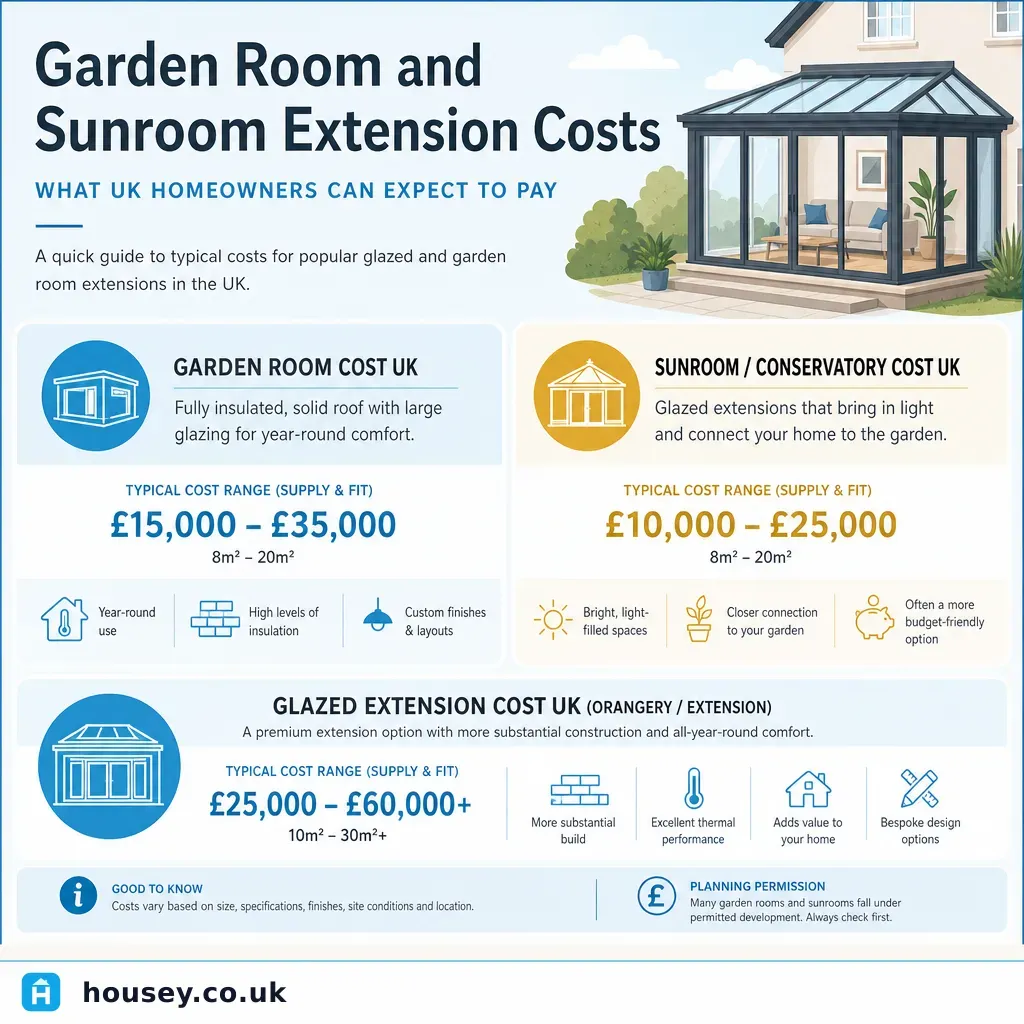
Garden Room and Sunroom Extension Costs
Garden rooms and sunroom extensions cost roughly £10,000–£80,000 installed in the UK depending on type, size, and glazing specification.
 Improvement & Build
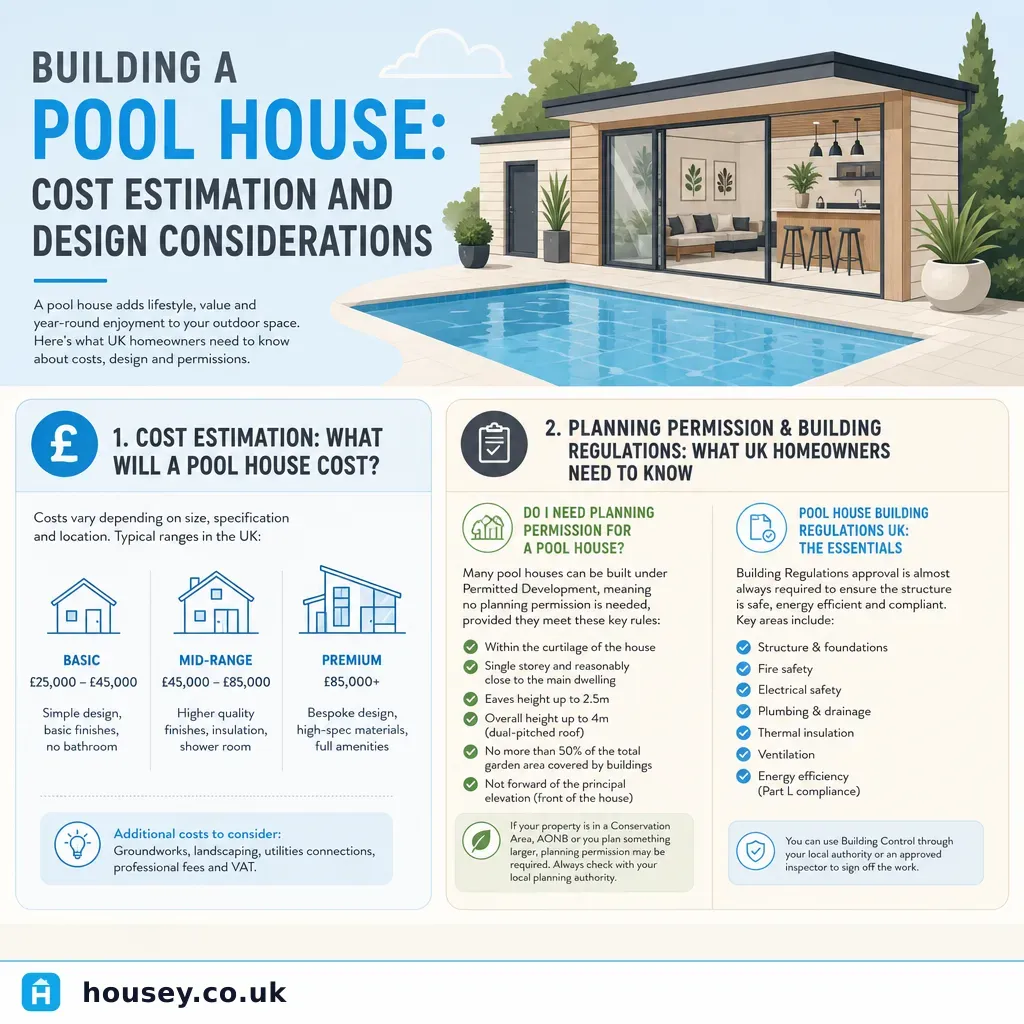
Building a Pool House: Cost Estimation and Design Considerations
A pool house in the UK typically costs between £20,000 and £180,000 depending on size, construction method, and specification.
 Improvement & Build
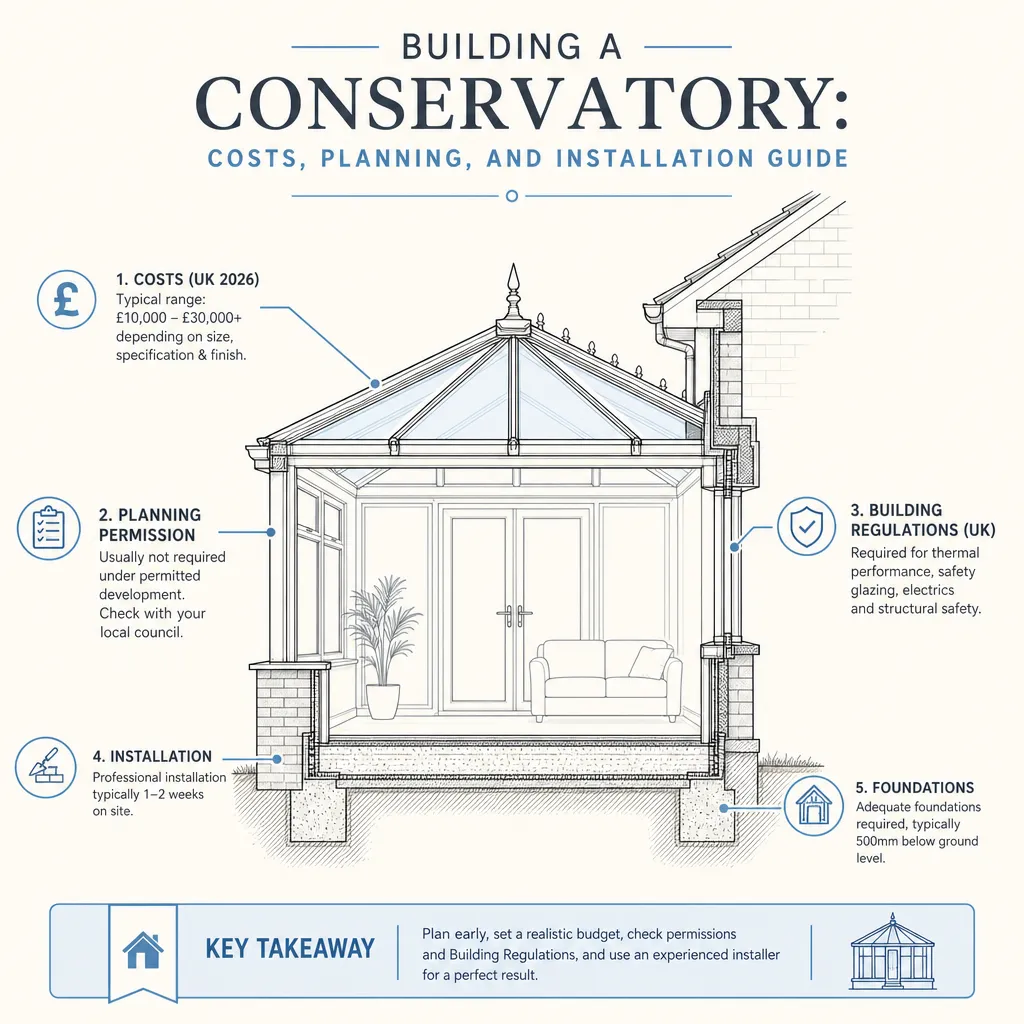
Building a Conservatory: Costs, Planning, and Installation Guide
Most UK conservatories qualify as permitted development and do not need a planning application, provided they meet the size, height, and location conditions in the Town and Country Planning (General Permitted Development) (England) Order 2015.
 Improvement & Build
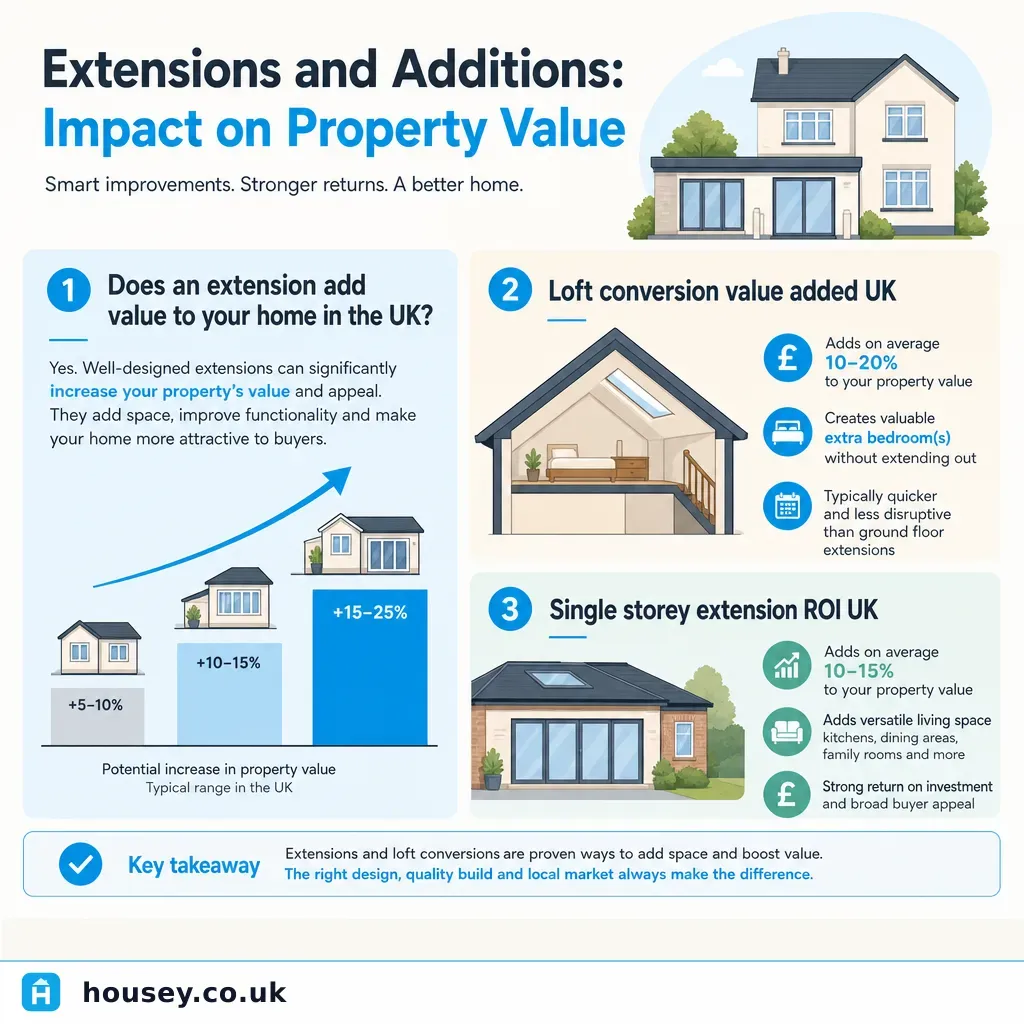
Extensions and Additions: Impact on Property Value
Extensions typically add 5–20% to UK property values depending on type, quality, and local market conditions.
 Improvement & Build
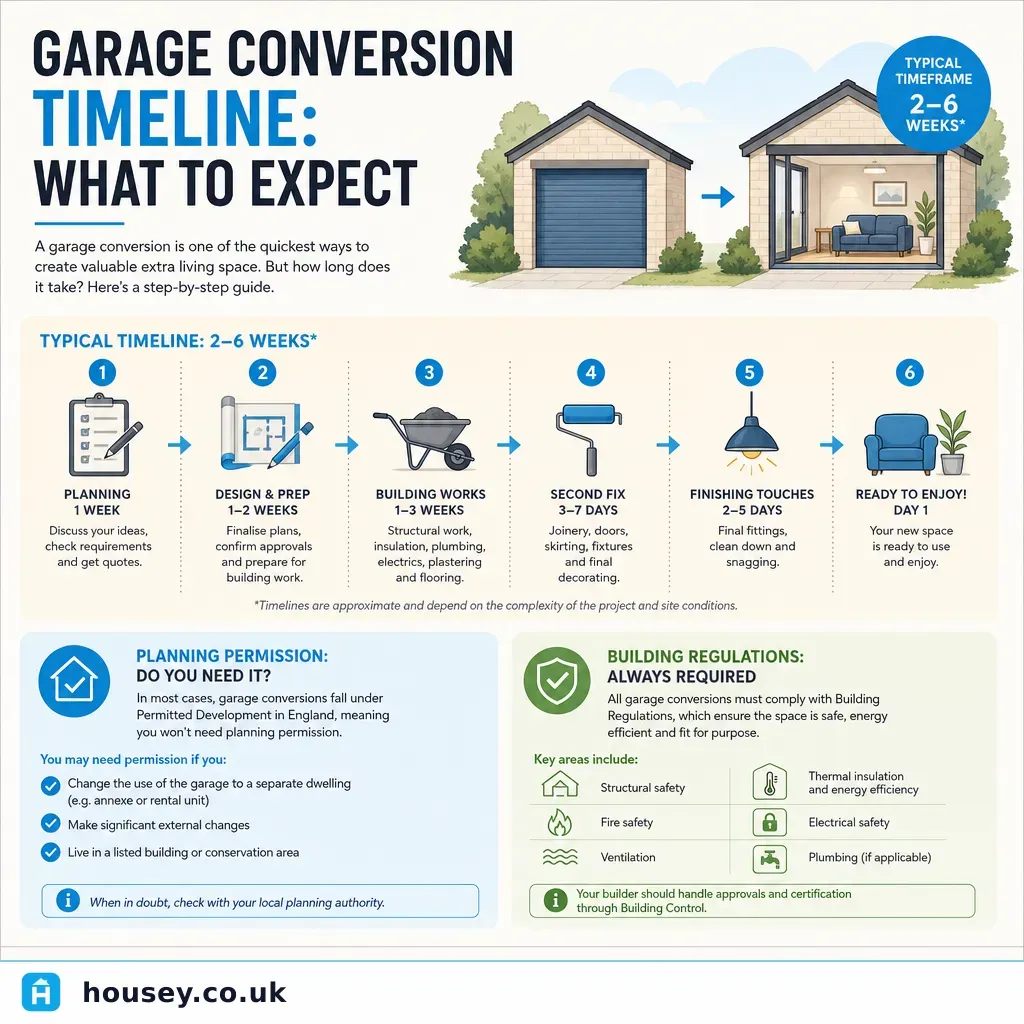
Garage Conversion Timeline: What to Expect
A straightforward attached garage conversion in England usually takes 4–8 weeks of construction, plus pre-start time for building control approval (5 working days for Full Plans).