Extensions and Additions: Impact on Property Value
By Housey · Last reviewed 11th of May 2026
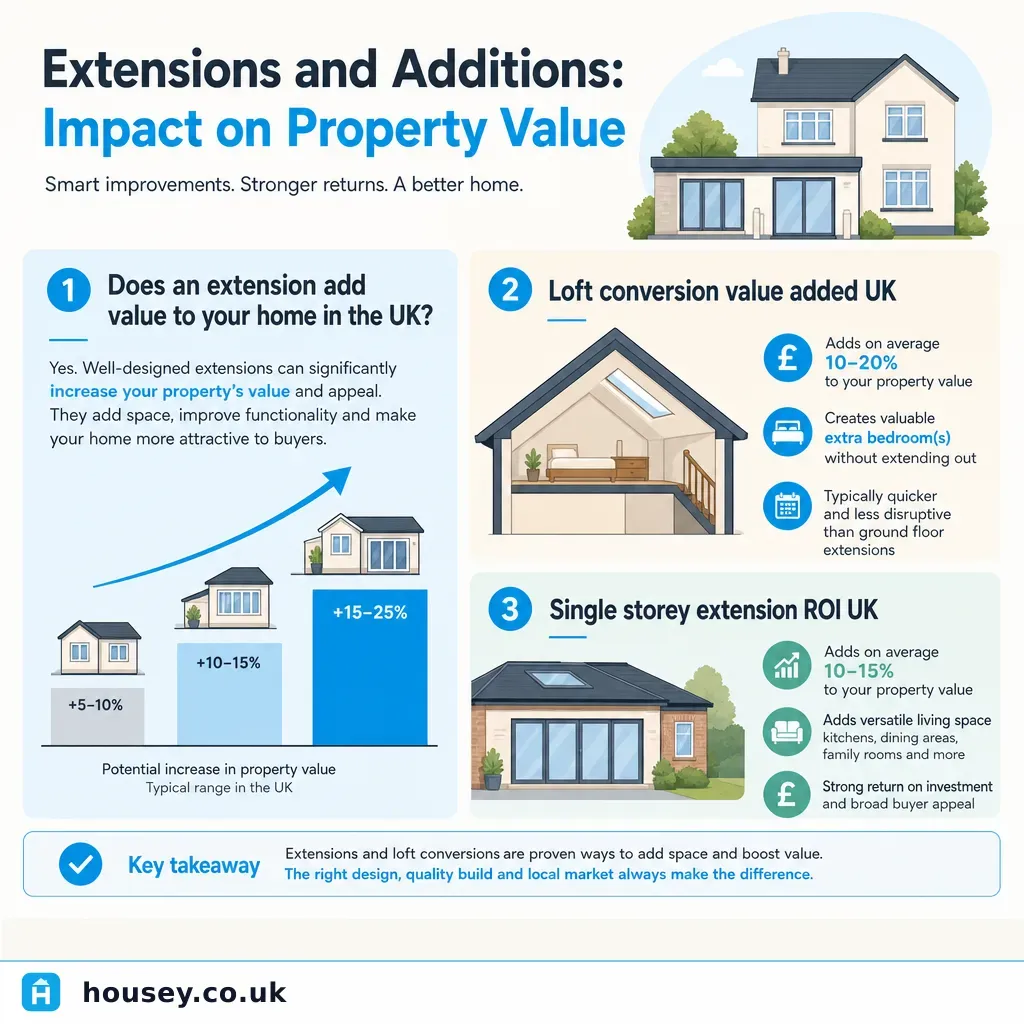
Extensions and Additions: Impact on Property Value
Extending your home is one of the more significant financial decisions a UK homeowner can make, and the return on that investment varies considerably depending on what is built, where the property sits, and how well the works are executed. The question of value uplift matters whether you are planning works now with a sale in mind in a few years, or trying to choose between a loft conversion and a rear extension within a constrained budget. Understanding which changes typically add value — and the conditions under which they do not — helps you spend in the right places.
Key points
- A loft conversion is consistently cited as one of the highest-value additions, with estimated uplifts of 10–20% in many UK markets, based on data reported by Nationwide Housing Research and Zoopla.
- A well-executed single-storey rear extension typically adds 5–8% to property value, though this depends significantly on what the existing layout lacked and local comparable sale prices.
- Over-capitalisation is a genuine risk: if your home is already near the ceiling price for its street, spending heavily on an extension may not be fully recovered at sale.
- Extensions built without a building regulations completion certificate cause complications at sale — conveyancing solicitors and mortgage lenders routinely require evidence of building control sign-off.
- A double-storey extension adds significant floor area but costs more per square metre to build than a single-storey addition and requires planning permission in most circumstances.
What drives value uplift from an extension?
Not all added square metres translate to equivalent market value. The factors that determine whether an extension genuinely improves saleability and achieved price include:
Floor area relative to local comparables. A four-bedroom 1930s semi with a rear extension creating an open-plan kitchen-diner will appeal to a wider pool of buyers than the same budget spent adding a utility room to an already generous layout. The new space should address a genuine gap in the existing floor plan.
Quality of finish and materials. A poor-quality extension — mismatched materials, low-specification windows, visible damp patches — can deter buyers and reduce perceived value. The addition must read as part of the original house, not an obvious afterthought.
Local ceiling price. Every street has a price ceiling: the point above which properties simply do not sell regardless of specification. If your home is already close to that level, you may not recover the full cost of a high-specification extension at sale.
Building regulations compliance. An extension without appropriate building control documentation introduces legal and financial uncertainty for buyers. Mortgage lenders may decline to lend on a property with unresolved building control issues, which can collapse an entire sale chain.
Typical value added by extension type in the UK
Indicative figures, last reviewed 2026-05-11. Percentages represent estimated value uplift; actual figures vary considerably by region, property type, quality of works, and prevailing market conditions. Sources: Nationwide Housing Research, Zoopla market analysis, Savills residential data.
Extension type | Typical uplift | Indicative build cost | Key condition for uplift |
|---|---|---|---|
Loft conversion (dormer) | 10–20% | £40,000–£70,000 | Creates a usable certified bedroom, ideally with en-suite |
Single-storey rear extension | 5–8% | £25,000–£50,000 | Adds kitchen-diner space or removes a dark, awkward room |
Double-storey extension | 10–15% | £50,000–£100,000 | Adds bedroom and living space; planning consent required |
Garage conversion | 5–10% | £15,000–£30,000 | Best where off-street parking is not scarce locally |
Side-return extension | 5–8% | £30,000–£55,000 | Opens up the narrow Victorian or Edwardian kitchen plan |
Garden room or outbuilding | 3–7% | £20,000–£60,000 | Depends heavily on finish quality and connectivity |
Basement conversion | 10–15% | £100,000–£250,000+ | Very high cost; most viable in prime urban markets |
Worked UK property scenario
This is a hypothetical example for illustration purposes only.
A semi-detached 1960s house in a mid-market East Midlands town is independently valued at £260,000. Comparable four-bedroom homes on the same street have sold for up to £310,000. The homeowner builds a 20 m² single-storey rear extension costing £42,000 including VAT and building regulations fees, converting a cramped galley kitchen into an open-plan kitchen-diner with sliding glass doors to a new paved terrace.
At sale, the property is listed at £295,000 and achieves £291,000 — an uplift of approximately £31,000 against the pre-extension value. In pure cash terms, the £42,000 invested has not been fully recovered. However, the property sold within three weeks of listing, while comparable unrenovated properties were sitting on the market for two to three months. In a stronger regional market, or with more headroom to the ceiling price, the financial return would look considerably different.
This scenario illustrates that value uplift is determined by what the local market will pay, not by what was spent on the works.
What not to assume
- Estate agent uplift estimates are often optimistic. Agents sometimes quote ambitious value-add figures to win an instruction. Independent sold prices data from HM Land Registry or comparable portals is more reliable than speculative estimates offered at a valuation appointment.
- Any extension automatically adds value. A poorly planned extension — wrong materials, insufficient garden space remaining, a new room that is dark or awkward in layout — can reduce buyer appeal rather than improve it.
- Permitted development means building regs are not needed. Permitted development status relates only to planning permission. Almost all extensions require building regulations approval regardless of planning status, and a completion certificate is essential documentation for future sale.
- A loft room counts as a bedroom simply because it has a bed. A loft space only qualifies as a bedroom for valuation and marketing purposes if it meets building regulations requirements for headroom (minimum 2.2 m at the ridge is a commonly used benchmark), adequate fire escape, and thermal insulation.
Red flags that may reduce value uplift
- Extension built without a building regulations completion certificate — a common and significant problem at sale.
- Materials clearly at odds with the original property (for example, render applied to a brick Victorian terrace, or uPVC detailing on a period stone cottage).
- Extension has reduced the usable garden below what buyers typically expect for the property type and local area.
- Works have affected shared drains, party walls, or foundations without appropriate consent or Party Wall Act notice.
- A new structural opening into the original house has no structural engineer's specification on file.
When to get professional help
If you are weighing up an extension as a financial investment, professional input before you commit can save significant expenditure on works that may not deliver the expected return. Key moments for professional input include:
- Before setting your budget — a valuation survey can confirm where your property sits relative to local ceiling prices, helping you calibrate how much to spend on works.
- When choosing between extension types — an architect or specialist builder can help you model options against your property's specific constraints and the local market.
- When comparing contractor quotes — always compare like-for-like specifications, not headline figures alone.
How Housey can help
Extension builders with experience across different property types and extension configurations can advise on feasibility, specification, and realistic cost from the outset. Before committing to a build programme, a valuation survey from an independent professional provides a grounded view of your property's current market position and how much headroom exists above the local ceiling price.
Frequently asked questions
Does a loft conversion always add value?
Usually, yes — particularly when it creates a properly certified bedroom with adequate headroom and, ideally, an en-suite. The degree of uplift depends on whether an additional bedroom is in demand locally, and whether the conversion was carried out without compromising other spaces such as landing width or bathroom access on floors below.
Do I need planning permission to extend my home?
Not always. Permitted development rights allow many single-storey rear extensions without a planning application — up to 4 m deep for detached houses and 3 m for semi-detached and terraced homes. Planning permission is required for double-storey extensions, side extensions in many cases, and works in conservation areas. Building regulations approval is required for all extensions regardless of planning status.
How do I avoid over-capitalising on an extension?
Research the ceiling price for comparable properties on your street using HM Land Registry sold prices data. If your home is already within £20,000–£30,000 of that ceiling, the financial case for a high-cost extension is weak. In that scenario you are building primarily for personal benefit rather than investment return — which may still be valid, but should be approached with clear expectations.
Could an extension increase my council tax band?
Possibly, but not automatically. The Valuation Office Agency (VOA) can reassess a council tax band following a sale if a significant extension is present, or during a general revaluation. An extension does not usually trigger an automatic mid-ownership band increase, though circumstances vary. The VOA publishes guidance on when a band reassessment may apply.
Sources and further reading
- HM Land Registry: search for sold house prices — HM Land Registry
- Valuation Office Agency: council tax bands guidance — Valuation Office Agency
- Planning Portal: house extensions — Planning Portal
- Building Regulations Approved Documents — GOV.UK
Useful next reads
 Improvement & Build
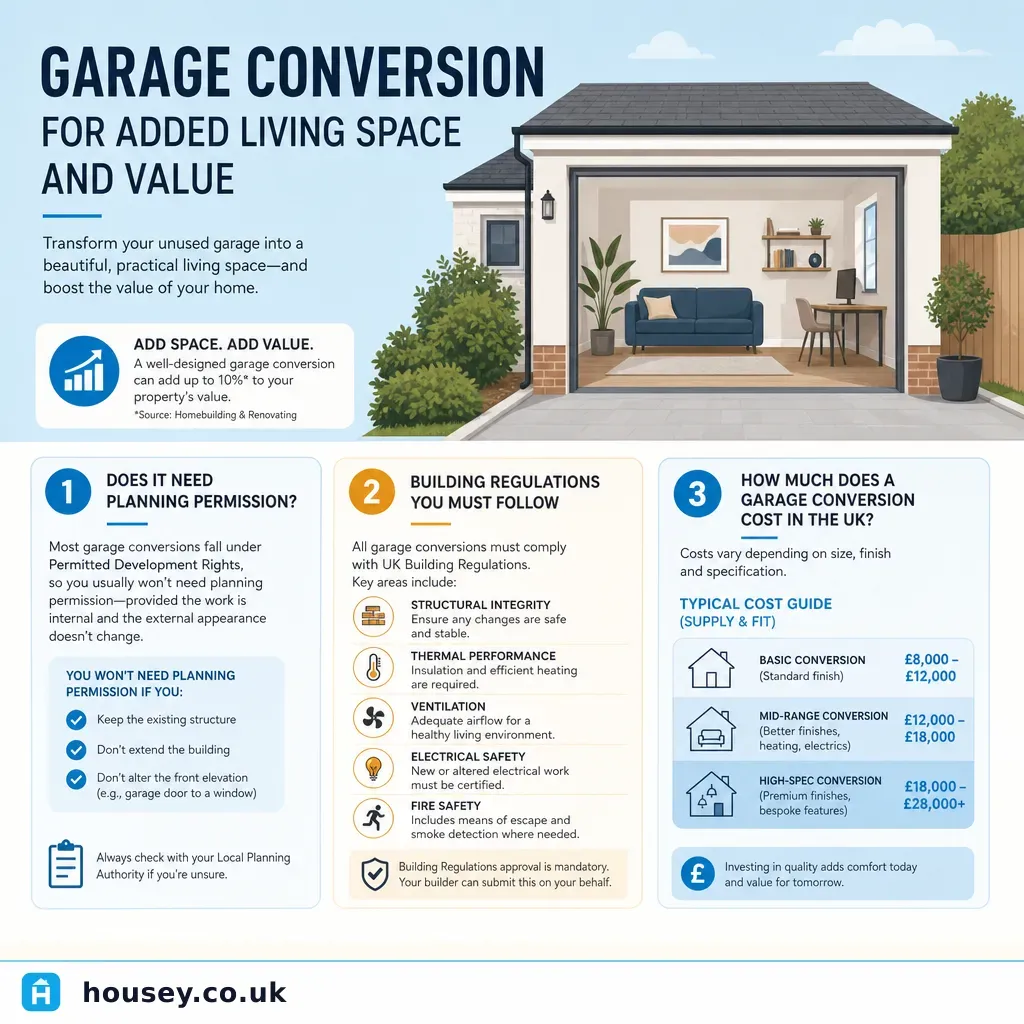
Garage Conversion for Added Living Space and Value
A garage conversion in England typically falls within permitted development and does not need a planning application, provided the property is a standard dwellinghouse with no restricting planning conditions.
 Improvement & Build
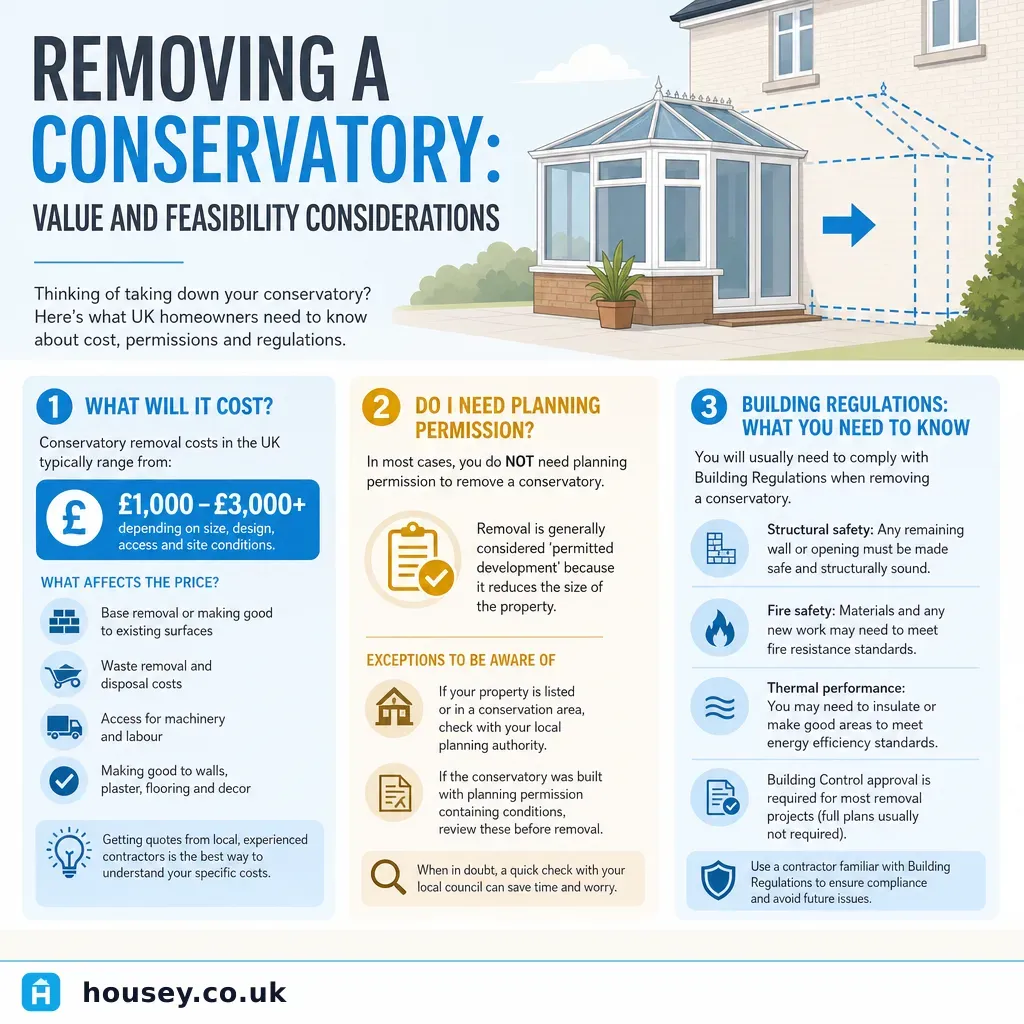
Removing a Conservatory: Value and Feasibility Considerations
Removing a conservatory in England usually does not need planning permission if the original structure was permitted development, but reinstating the original wall almost always requires a building regulations application covering structural, thermal, and moisture elements.
 Improvement & Build
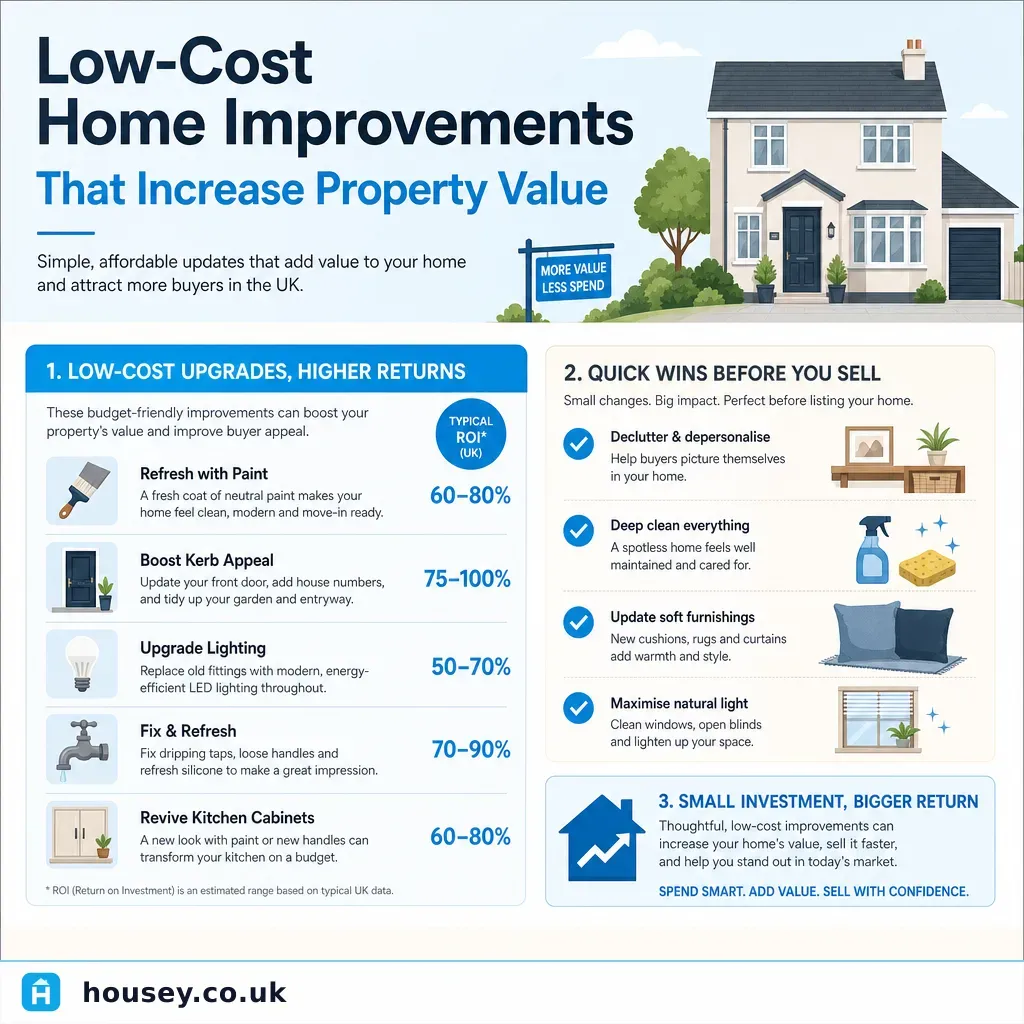
Low-Cost Home Improvements That Increase Property Value
Cosmetic upgrades such as fresh neutral paint, improved kerb appeal, tidied gardens, and refreshed kitchens and bathrooms can meaningfully improve a property's saleability and perceived value at relatively low cost.
 Improvement & Build
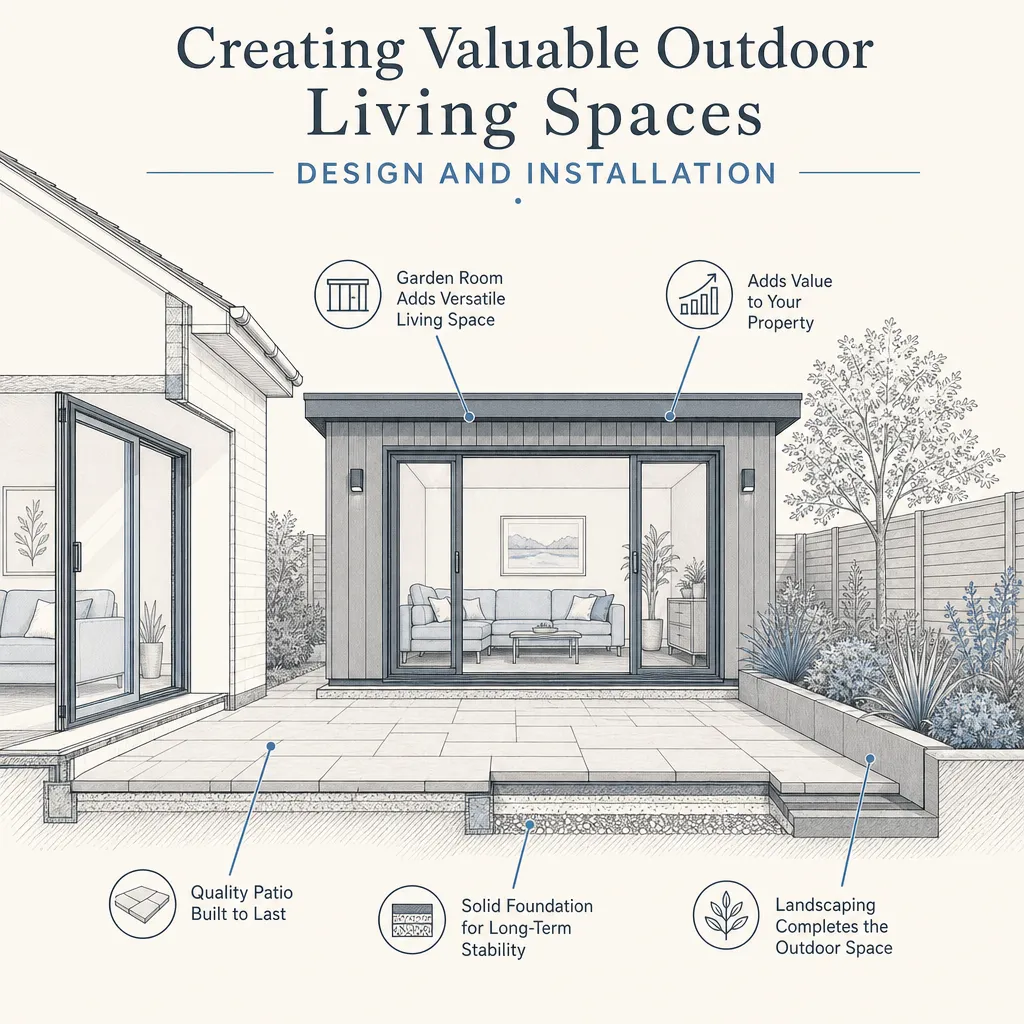
Creating Valuable Outdoor Living Spaces: Design and Installation
Creating an outdoor living space — patio, deck, garden room, or landscaped area — can add usable space and kerb appeal to a UK home.
 Improvement & Build
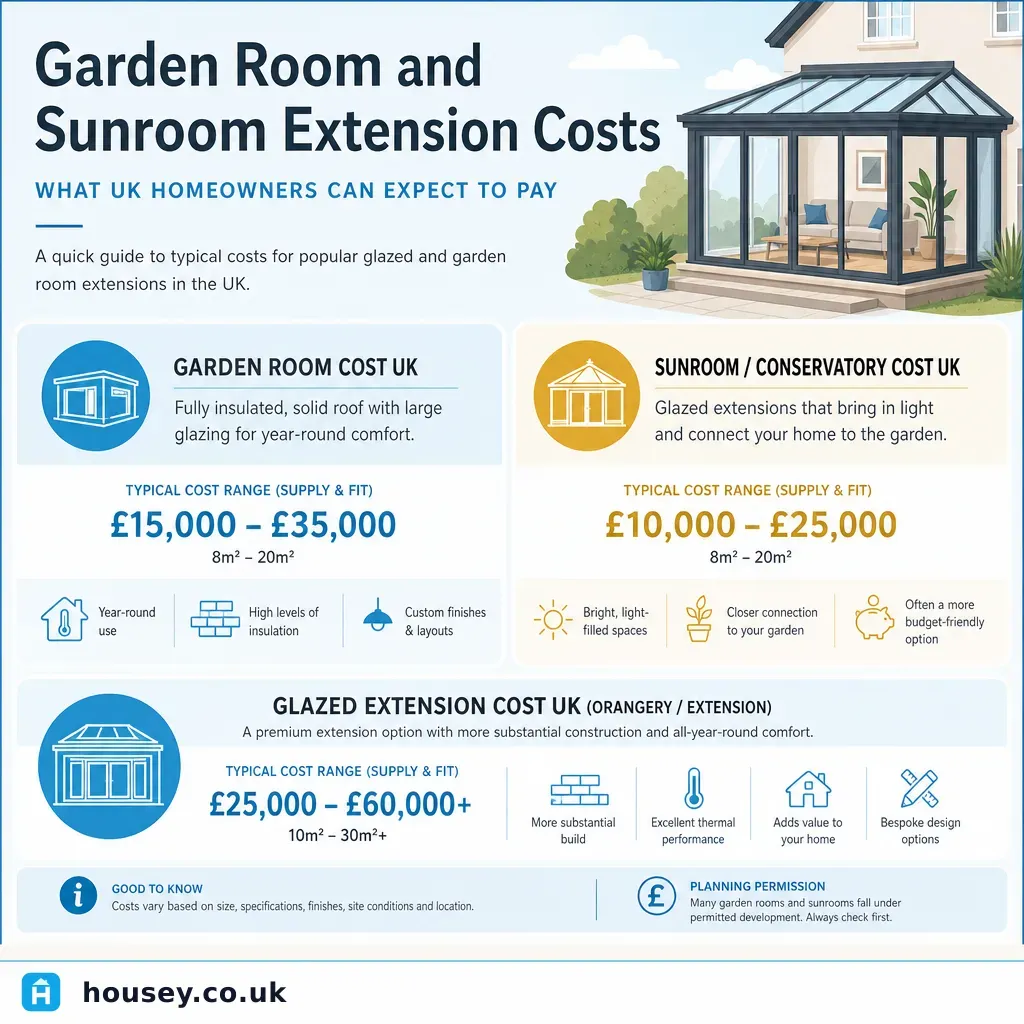
Garden Room and Sunroom Extension Costs
Garden rooms and sunroom extensions cost roughly £10,000–£80,000 installed in the UK depending on type, size, and glazing specification.