Building a Garage: Planning, Costs, and Regulations
By Housey · Last reviewed 6th of May 2026
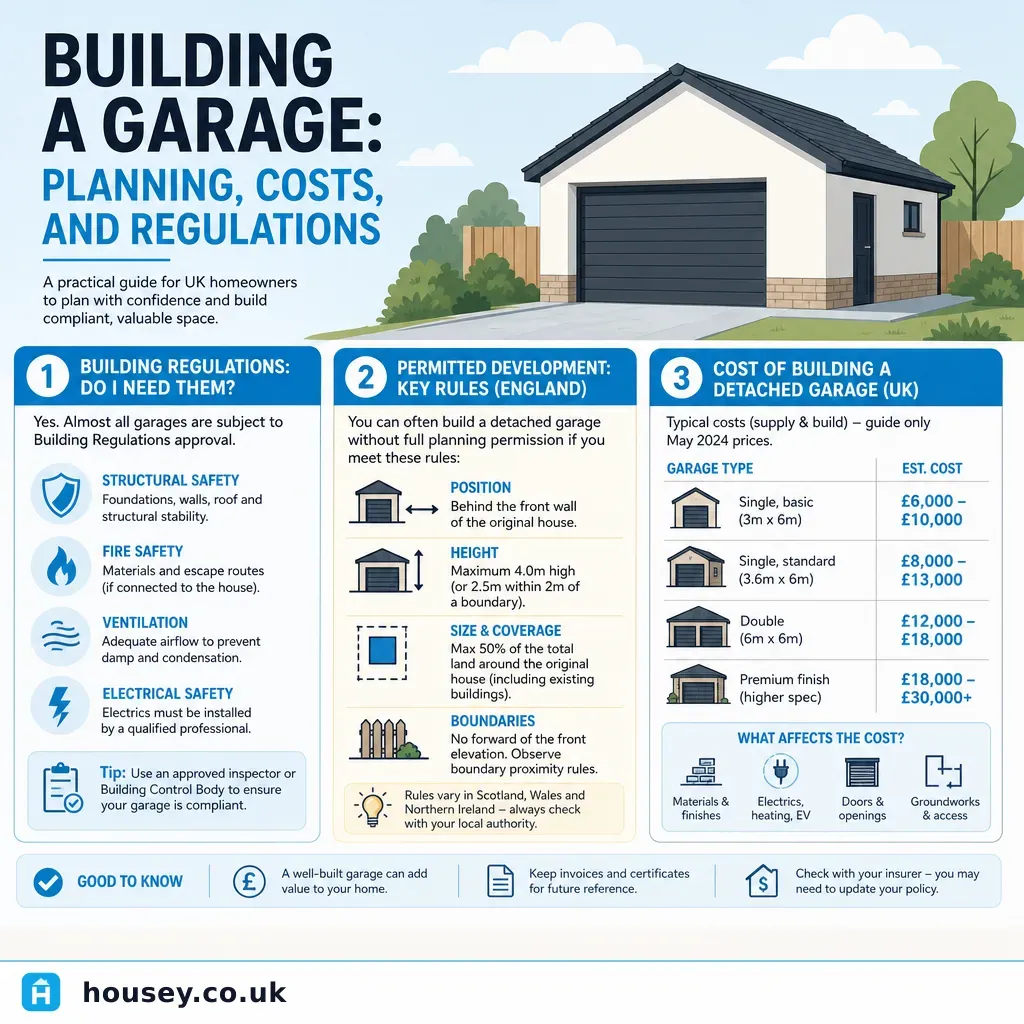
Building a Garage: Planning, Costs, and Regulations
Whether you are adding a detached garage for off-road parking, creating workshop space, or building an integral garage as part of a larger renovation, the planning and regulatory requirements depend heavily on your property type, location, and project scale. Many homeowners discover mid-project that the rules are more nuanced than expected — particularly around permitted development limits, building regulations thresholds, and the implications of building near boundaries.
Key points
- Detached garages under 15m² floor area are generally exempt from building regulations approval, provided they contain no sleeping accommodation and no fixed combustion appliance other than a space heater for the garage itself.
- Permitted development rights in England allow a detached garage without planning permission if it covers less than 50% of the curtilage, stays within height limits, and is not forward of the principal elevation.
- Planning permission is always required for garages at flats, maisonettes, listed buildings, and properties in conservation areas or subject to an Article 4 Direction removing permitted development rights.
- A garage attached to or forming part of the main house requires building regulations approval regardless of its size.
- Indicative UK costs range from £15,000–£25,000 for a single detached garage to £40,000–£60,000+ for a double with utility space (Indicative UK costs, last reviewed 2026-05-06).
Do you need planning permission?
Most detached domestic garages in England fall within permitted development rights under Schedule 2, Part 1 of the Town and Country Planning (General Permitted Development) (England) Order 2015. Planning permission is not required provided all of the following conditions are met:
- The garage and all other outbuildings combined do not cover more than 50% of the land around the original house, excluding the house footprint.
- It is not built forward of the principal elevation or any side elevation facing a highway.
- The maximum height is 4m for a dual-pitched roof, or 3m for any other roof type.
- Where the garage is within 2m of a property boundary, the eaves and ridge height must not exceed 2.5m.
- The property is a house — not a flat, maisonette, or a property originally built as something else.
- No conservation area designation, Article 4 Direction, or similar restriction removes permitted development rights.
Decision tree: does your garage project need planning permission?
- No planning permission needed if: the garage is detached, sited behind the principal elevation, within all curtilage and height limits, and the property is a standard house with no relevant designation.
- Apply for planning permission if: the garage is forward of the principal elevation, exceeds height or curtilage limits, or the property is a flat, listed building, or in a conservation area.
- Apply for a Lawful Development Certificate if: you are confident permitted development criteria are met but want formal confirmation — useful when selling or remortgaging.
- Consult your local planning authority (LPA) if: prior extensions or outbuildings may have reduced the available curtilage, or boundary positions are unclear.
- Contact a planning consultant if: the site is in a sensitive location or the LPA has previously issued enforcement notices.
Rules in Wales, Scotland, and Northern Ireland differ from those in England. Always check the applicable legislation for your nation.
Do you need building regulations approval?
Building regulations set minimum standards for structural stability, fire safety, drainage, ventilation, and energy efficiency. Whether approval is needed depends on garage size and its connection to the house.
Scenario | Building regulations required? |
|---|---|
Detached garage, under 15m² floor area, no sleeping accommodation | Generally no |
Detached garage, 15m²–30m², non-combustible materials or more than 1m from any boundary | Generally no |
Detached garage, 15m²–30m², combustible materials and within 1m of boundary | Yes |
Detached garage over 30m² floor area | Yes |
Garage attached to the house (integral or linked) | Yes, always |
Garage with sleeping accommodation or any habitable room | Yes, always |
Existing garage converted to habitable space | Yes, always |
Even where building regulations approval is not required for the structure itself, any electrical installation must comply with Part P of the Building Regulations and should be carried out by an NICEIC or NAPIT-registered electrician, or separately notified to building control.
Costs and what affects them
Garage construction costs vary by region, specification, ground conditions, and contractor. The figures below are indicative.
Garage type | Indicative cost range | Typical notes |
|---|---|---|
Single detached, block-built | £15,000–£25,000 | Pitched roof, one door, concrete floor |
Double detached, block-built | £28,000–£45,000 | Two-car, standard specification |
Double with loft or utility area | £40,000–£60,000+ | More complex structure, insulated, finished internally |
Integral garage (part of house or extension) | £20,000–£40,000+ | Highly variable depending on existing structure |
Indicative UK costs, last reviewed 2026-05-06. Exclude VAT at 20%, professional fees, building regulations fees, and drainage connections. Obtain at least three quotes.
Key cost drivers to discuss with contractors:
- Soil type and foundation depth — clay or made ground can add significantly to costs
- Roof design — pitched roofs cost more upfront but outperform flat roofs on long-term maintenance
- Door type — sectional and roller doors cost more than standard up-and-over
- Insulation specification — affects build cost and running costs
- Internal fit-out — plastering, lighting, sockets, plumbing
- Building regulations fees — typically £200–£600 depending on project scope
What to ask before accepting a quote
- Does the quote include foundations and floor slab, or are these priced separately?
- Who will prepare the structural calculations and building regulations drawings?
- Who will submit the building regulations application and liaise with the building control body?
- Are any Party Wall Act 1996 notifications required for work near the boundary?
- What structural guarantee or latent defects warranty will be provided?
- Is VAT included in the quoted price?
- What could change the price if ground conditions differ from those assumed?
- How many building control inspections are included, and who co-ordinates access?
Important limitations
This article provides general guidance for domestic garage construction in England. Rules differ in Wales, Scotland, and Northern Ireland. Permitted development rights, curtilage thresholds, and local designations vary by property and planning history. Cost figures are indicative and subject to market change. Nothing in this article constitutes structural, planning, or legal advice. A qualified professional should assess your specific property and project before work begins.
What to ask a qualified professional
Before instructing contractors, consider asking:
- Have previous extensions or outbuildings already reduced the curtilage available under permitted development?
- Does my property have any designation — conservation area, AONB, or listed building — requiring formal planning consent?
- Should I obtain a Lawful Development Certificate before proceeding?
- What structural engineer input will the building regulations application require?
- Is the Party Wall etc. Act 1996 engaged, and do I need to serve notices on neighbours?
When to get professional help
Seek professional advice before starting work if:
- The property is in a conservation area, listed building, World Heritage Site, or Area of Outstanding Natural Beauty.
- The garage will be attached to or structurally affect the existing house.
- The site has unusual ground conditions — sloping plots, clay soils, high water tables, or proximity to trees.
- The garage will include habitable rooms, plumbing, or a central heating system.
- There are boundary ambiguities or the project will be close to a shared boundary wall or fence.
How Housey can help
Where building regulations approval is needed, a building control consultant can manage the application and co-ordinate inspection stages throughout the build. If the garage is attached to the house or requires structural calculations, a qualified structural engineering professional can prepare the drawings and details needed for approval. Housey can help you request quotes from qualified professionals in your area.
Frequently asked questions
Does a new garage need foundations?
Yes. All masonry or timber-frame garages require suitable foundations — typically strip foundations or a reinforced concrete raft. The required depth depends on soil type, ground conditions, and proximity to trees. Where building regulations apply, the building control inspector will check the foundation excavation before the concrete is poured.
Can I build a garage right on the boundary?
Under permitted development, a garage within 2m of a boundary must have a maximum eaves and ridge height of 2.5m. If a wall is to be built on or astride the boundary, the Party Wall etc. Act 1996 may apply. Consult a party wall surveyor before work begins in these situations.
Do I need an architect to build a garage?
An architect is not always required for a straightforward detached garage, but you will typically need construction drawings and — where building regulations apply — structural calculations. An architectural technologist or building designer can often provide drawings at lower cost than a full architectural service.
How long does planning permission take if I need it?
For householder applications in England, the standard determination period is 8 weeks from validation. A Lawful Development Certificate application, used to confirm permitted development status before work starts or when selling, also typically takes 8 weeks. Processing times can vary by local planning authority.
Can I convert my garage into a habitable room later?
You can, but garage conversions always require building regulations approval, even if the original garage did not. You will need to demonstrate that insulation, ventilation, structural stability, and fire safety meet current standards. Planning permission may also be needed depending on the extent of change and your property's planning history.
Sources and further reading
- Permitted development rights for householders: technical guidance — GOV.UK / DLUHC
- Planning Portal: outbuildings guidance — Planning Portal
- Building Regulations 2010 and Approved Documents — GOV.UK
- Town and Country Planning (General Permitted Development) (England) Order 2015 — legislation.gov.uk
- Party Wall etc. Act 1996: guidance — GOV.UK
Useful next reads
 Planning & Pre-Build
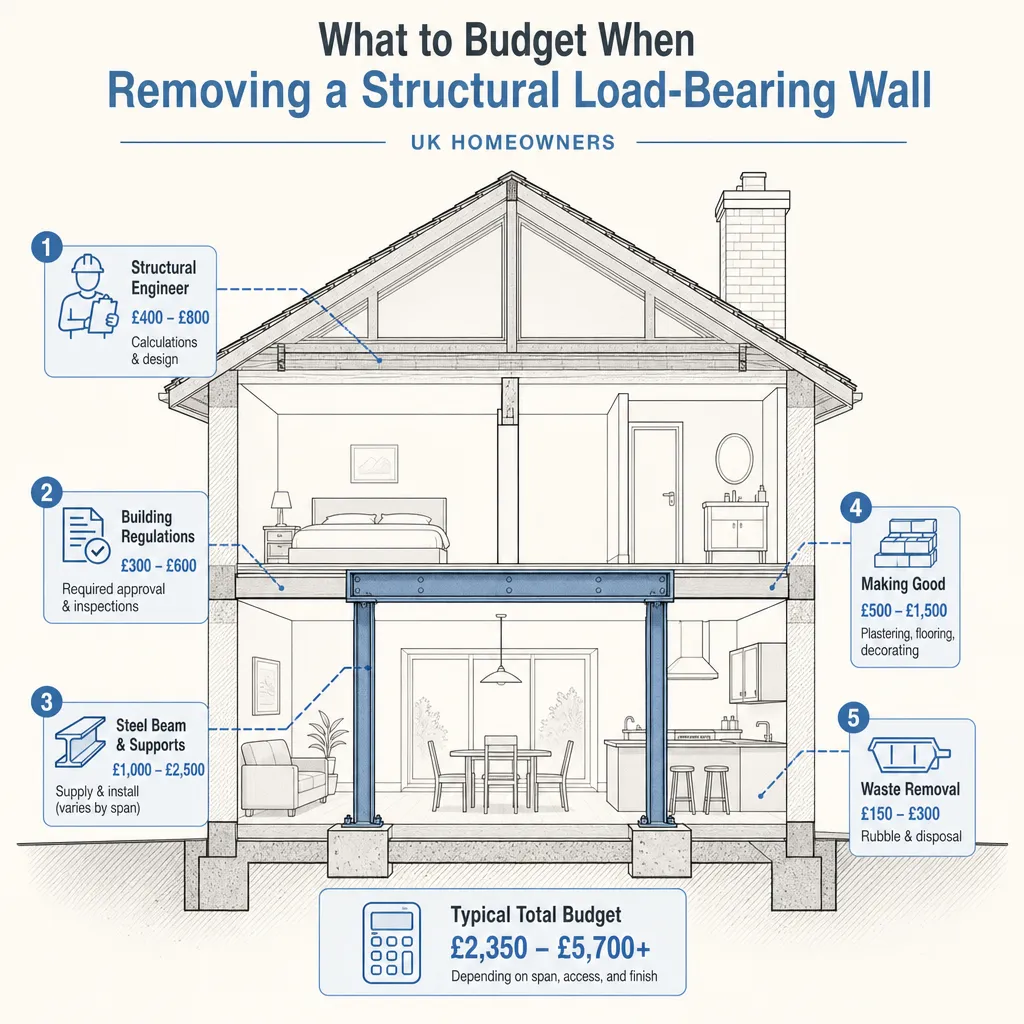
What to Budget When Removing a Structural Load-Bearing Wall
Removing a load-bearing wall in a typical UK home costs £2,500–£8,000 or more in total, covering a structural engineer's calculations, Building Regulations approval, the steel beam, builder's labour, and replastering.
 Planning & Pre-Build
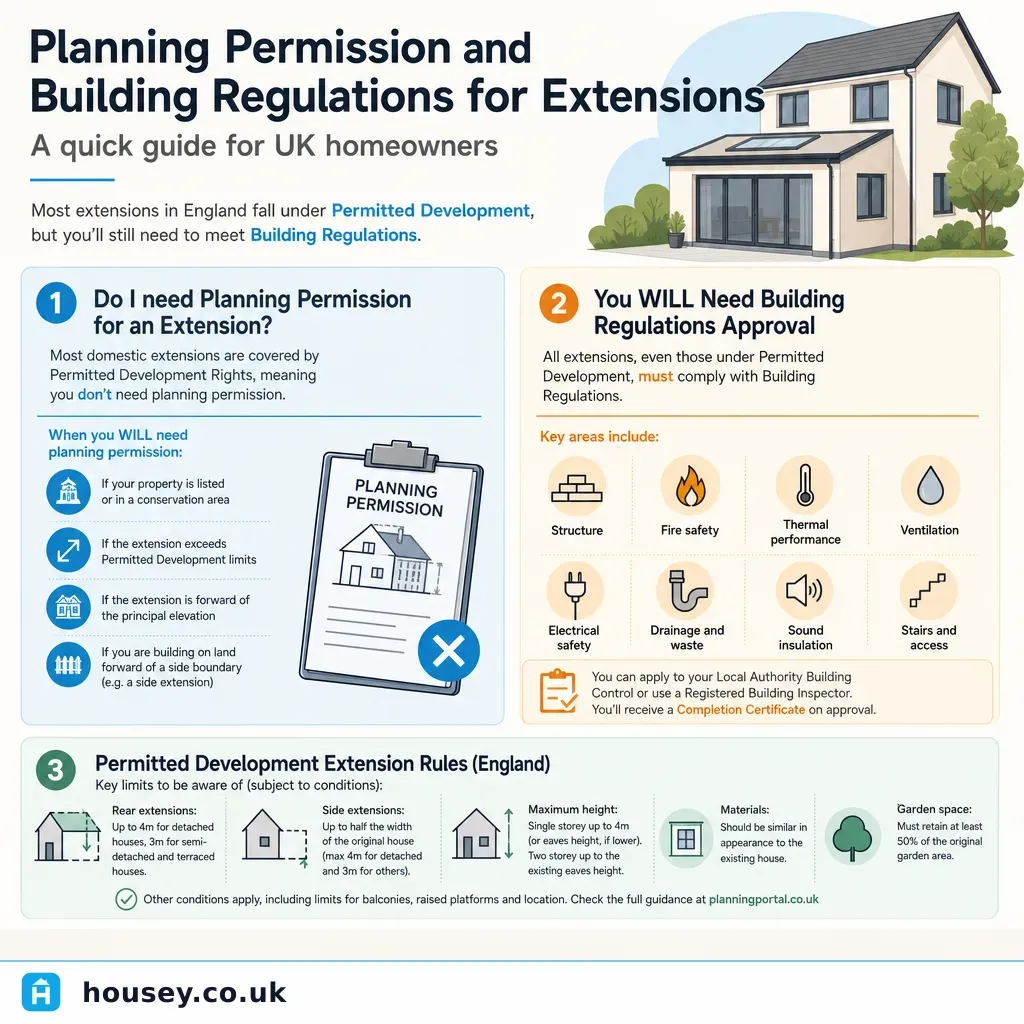
Planning Permission and Building Regulations for Extensions
UK home extensions usually require both planning permission and Building Regulations approval, though most smaller rear extensions qualify as Permitted Development under the GPDO 2015 and need no planning application.
 Planning & Pre-Build
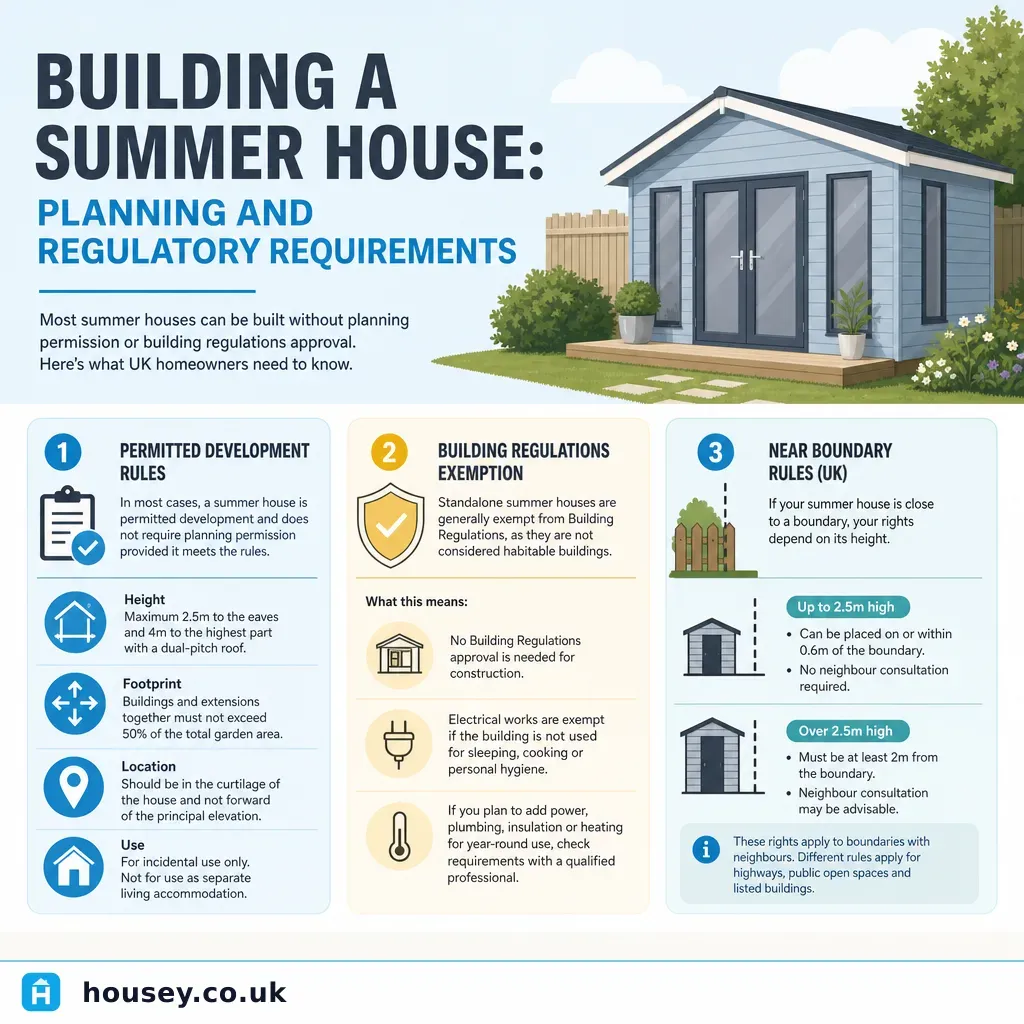
Building a Summer House: Planning and Regulatory Requirements
Most garden summer houses in England fall under Class E permitted development and need no planning permission, provided they are single-storey, within height limits, and not used for sleeping.
 Planning & Pre-Build
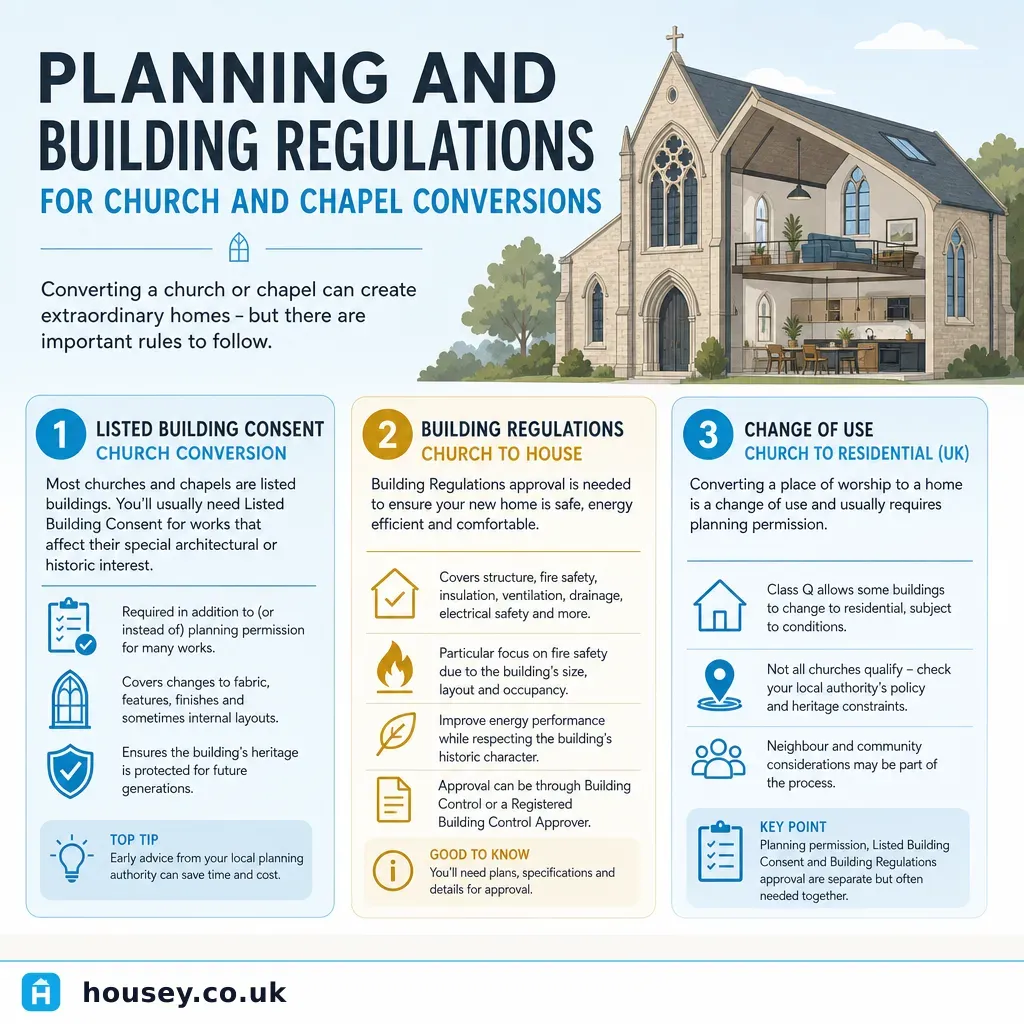
Planning and Building Regulations for Church and Chapel Conversions
Converting a church or chapel to residential use requires planning permission for change of use from Class F1 to Class C3, and listed building consent if the building is listed.
 Planning & Pre-Build
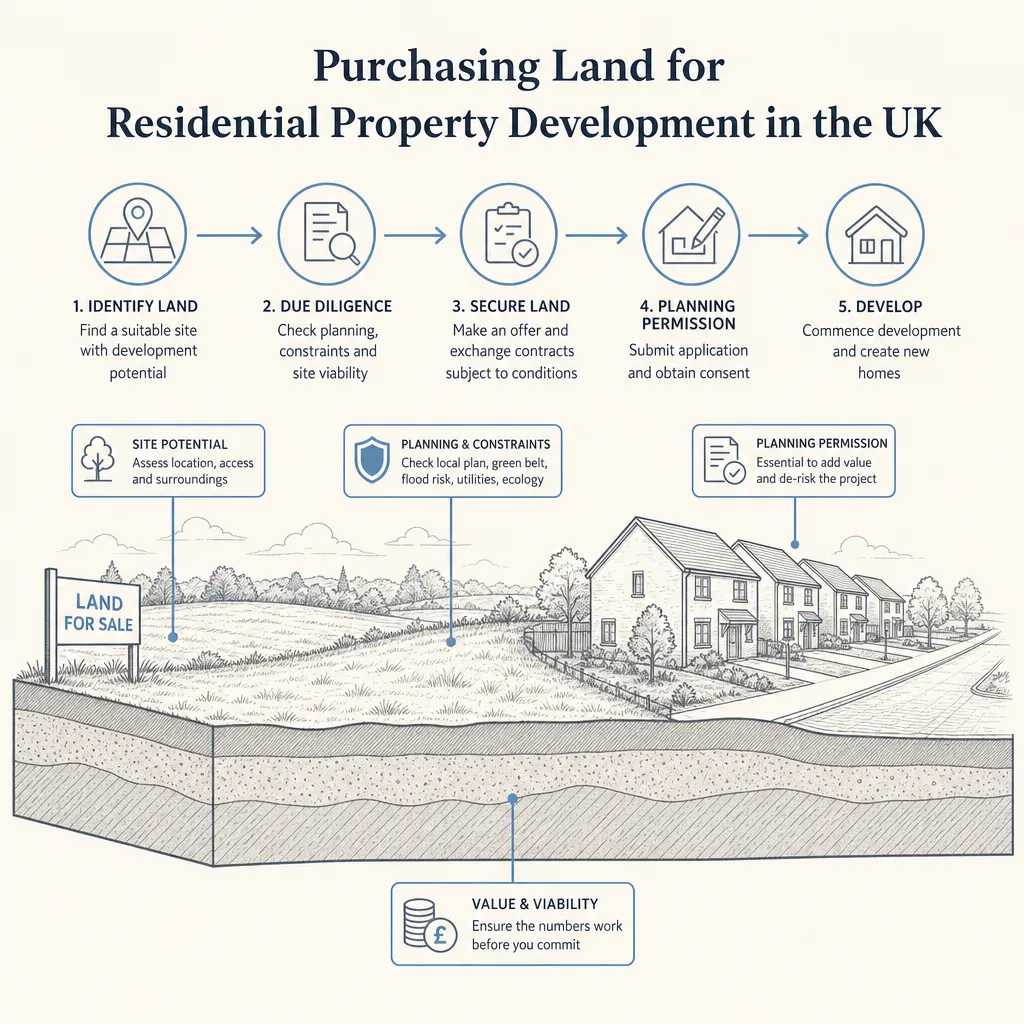
Purchasing Land for Residential Property Development in the UK
Buying development land in the UK involves due diligence on planning status, ground conditions, legal title, and utilities access before exchange.