Building a Garden Log Cabin: Planning and Installation
By Housey · Last reviewed 19th of May 2026
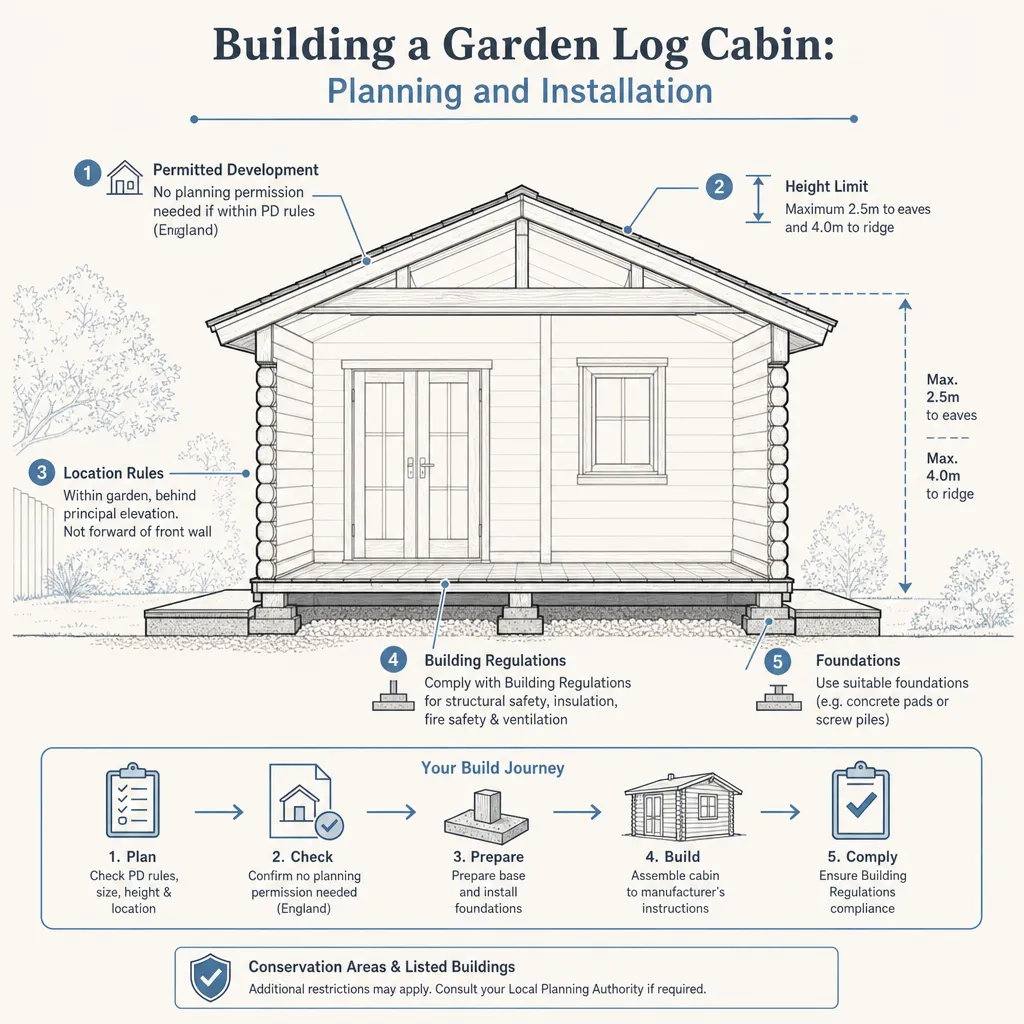
Building a Garden Log Cabin: Planning and Installation
Garden log cabins have become one of the most popular ways for UK homeowners to add practical space without extending the house — whether for a home office, a gym, a hobby room, or a place for guests to stay. Before ordering a kit or breaking ground, understanding when planning permission is needed, how building regulations apply, and what installation involves in practice on a typical residential plot will save you time, money, and potential enforcement headaches.
Key points
- Under England's permitted development rules, most garden log cabins can be built without planning permission provided they are within the garden curtilage, used for a purpose ancillary to the dwelling, and meet the height and site coverage limits set out in Schedule 2, Part 1, Class E of the Town and Country Planning (General Permitted Development) (England) Order 2015.
- The maximum height for a dual-pitched roof cabin under permitted development is 4 metres from ground level; for flat or mono-pitched roofs it is 3 metres, reducing to 2.5 metres within 2 metres of any boundary.
- All outbuildings combined must cover no more than 50% of the total garden area surrounding the original house — the original house footprint is excluded from this calculation.
- Building regulations do not generally apply to cabins under 15 m² used for ancillary, non-sleeping purposes; cabins between 15 m² and 30 m² may be exempt subject to fire-safety boundary distance conditions; cabins over 30 m² require a full building regulations application.
- Planning permission is always required on listed buildings, in conservation areas, or where the cabin will be used as self-contained residential accommodation.
When do I need planning permission for a garden log cabin?
For most detached or semi-detached houses in England, a garden log cabin is covered by permitted development rights under Schedule 2, Part 1, Class E of the Town and Country Planning (General Permitted Development) (England) Order 2015. No planning application is required if all of the following conditions are met:
- The cabin is within the curtilage of the main dwelling (your garden, not a separate plot)
- It is used for a purpose incidental to the enjoyment of the dwelling — a home office, gym, or games room — and not as a separate home or commercial premises
- The total area covered by outbuildings does not exceed 50% of the original garden area
- Height does not exceed 4 metres (dual-pitched roof), 3 metres (other roof types), or 2.5 metres within 2 metres of any boundary
- The cabin is not positioned forward of the principal elevation of the house
- The property is not a listed building, and is not in a National Park, Area of Outstanding Natural Beauty, World Heritage Site, or the Broads
Planning permission is required if any of these conditions cannot be met, or if:
- The property is a listed building or in a conservation area, where additional restrictions apply even to smaller structures
- An Article 4 Direction removes outbuilding permitted development rights in your area
- The cabin will be used as self-contained residential accommodation
Decision tree: do you need planning permission?
- Standard residential property, cabin within garden, ancillary use, under 4 m high, under 50% garden coverage: likely permitted development; consider a Lawful Development Certificate for certainty at resale.
- Cabin positioned within 2 metres of any boundary and over 2.5 metres high: planning permission required.
- Listed building or conservation area: planning permission required regardless of size, height, or proposed use.
- Cabin to be used as self-contained accommodation with cooking, sleeping, and bathroom facilities: planning permission required; may also require a change of use application.
- Front garden position: not covered by permitted development rights; planning permission required.
- Uncertain whether an Article 4 Direction applies: check with your local planning authority before proceeding.
Do building regulations apply to a garden log cabin?
Whether building regulations apply depends mainly on the floor area and intended use:
Floor area | Use | Building regulations position |
|---|---|---|
Under 15 m² | Ancillary (no sleeping) | Exempt — no application required |
15 m² to 30 m² | Ancillary (no sleeping) | May be exempt if at least 1 metre from any boundary; verify with your local building control body |
Over 30 m² | Any ancillary use | Building regulations apply — full application required |
Any size | Sleeping accommodation | Building regulations apply regardless of floor area |
Any size | Electrical installation | Part P of the Building Regulations applies to the electrical works |
For a cabin used solely as a garden office or hobby room with no sleeping accommodation, the threshold is 15 m² for full exemption. Between 15 m² and 30 m², an exemption may apply subject to fire-safety boundary distance conditions — verify this with your local building control body before relying on it. Even where the building itself is exempt, electrical works such as a new circuit to the cabin are notifiable under Part P and must be carried out by a Part P-registered electrician.
What does installation involve?
A typical garden log cabin installation in the UK covers the following stages:
- Ground preparation: the site must be cleared, levelled, and provided with a suitable base. Poor ground preparation is the most common cause of structural problems in garden cabins.
- Base construction: a concrete slab, poured pad, or proprietary ground-screw system are the most common approaches. Ground screws are increasingly popular on sloping plots or where minimising excavation is a priority.
- Cabin assembly: log cabin kits are delivered as pre-cut, numbered components and typically take a professional installation team 1–3 days to erect for a standard-sized cabin.
- Weatherproofing and treating: the timber must be treated with an appropriate preservative and exterior stain or paint system. Check what the manufacturer has already applied and what annual maintenance the product requires.
- Electrical installation: if lighting, sockets, or heating are required, this is notifiable work under Part P of the Building Regulations — use a Part P-registered electrician.
- Insulation: standard log cabin walls provide limited thermal performance. For year-round use in the UK climate, specify insulated wall systems or plan to add supplementary insulation to the floor, walls, and roof.
What not to assume
- Do not assume your cabin automatically qualifies for permitted development without checking height, boundary distances, and cumulative garden coverage.
- Do not assume that because a supplier says a cabin is exempt from planning permission, it is also exempt from building regulations — they are separate regimes.
- Do not assume that running a power cable to a garden cabin is a simple DIY job — it requires a new circuit, which is notifiable under Part P.
- Do not assume the standard cabin timber treatment is sufficient for the UK climate without checking the maintenance schedule.
- Do not assume a garden cabin can be used as an Airbnb or separate rental unit without planning permission — this is a change of use.
What to ask before installation
- Is the base design suitable for the ground conditions on my specific plot?
- What timber treatment has been applied by the manufacturer, and what annual maintenance is required?
- Will a Part P-registered electrician carry out the electrical installation and provide an Electrical Installation Certificate?
- What is the thermal performance (U-value) of the wall construction, and is it adequate for year-round use in the UK?
- What structural warranty does the manufacturer or installer provide, and for how long?
- Does the quoted price include base construction, or is that a separate cost?
Important limitations
This article describes the permitted development rules and building regulations framework for garden log cabins in England as at May 2026. Planning rules in Scotland, Wales, and Northern Ireland differ. Permitted development rights can be removed or varied by Article 4 Directions, planning conditions attached to the property title, or listed building status. Always verify the position with your local planning authority before proceeding. Nothing here constitutes planning or building advice specific to your property.
What to ask a qualified professional
If you are uncertain about the planning or building regulations position for your cabin:
- Does my property have any Article 4 Directions or planning conditions that affect permitted development rights for outbuildings?
- Is a Lawful Development Certificate worthwhile for my specific project?
- What are the fire-safety boundary distance rules for a cabin of my proposed size?
- If I install electrics and heating, what notifications or applications are required?
- Does the cabin footprint I am planning keep total outbuilding coverage below 50% of my original garden area?
When to get professional help
Seek professional planning or building advice before proceeding if:
- Your property is listed or in a conservation area
- The cabin will include sleeping or self-contained accommodation
- You are unsure whether an Article 4 Direction applies in your area
- The plot is on a significant slope, near a boundary, or has drainage constraints affecting the base design
- The cabin is over 30 m² and a building regulations application will be required
How Housey can help
Housey can connect you with the right professionals for your garden cabin project. Whether you need advice on the planning position, guidance on navigating building regulations for a larger structure, or want to compare quotes from experienced installers and designers, you can find vetted local professionals through our platform ready to help you plan and deliver your garden space.
Frequently asked questions
Can I use a garden log cabin as a home office without planning permission?
In most cases, yes. Using a garden cabin as a home office is considered an ancillary use incidental to the enjoyment of the dwelling, covered by permitted development rights provided the cabin meets the height, siting, and coverage conditions. If in doubt, apply to your local planning authority for a Lawful Development Certificate — this provides written confirmation that the use is lawful.
Can I live in my garden log cabin?
Using a cabin as self-contained residential accommodation — with sleeping, cooking, and bathing facilities forming a separate dwelling — is not covered by permitted development rights and requires planning permission. You should also check with your mortgage provider, home insurer, and local authority before pursuing this use, as council tax, building regulations, and planning policy implications all arise.
How large can a garden log cabin be without planning permission?
There is no single maximum floor area under permitted development rules — the key limits are height (4 m for dual-pitched roofs, 3 m for other roof types, 2.5 m within 2 m of a boundary) and that all outbuildings combined must not exceed 50% of the total garden area. Building regulations apply separately to cabins over 30 m² regardless of planning status.
Does a garden log cabin need foundations?
Log cabins do not require deep traditional foundations. A concrete slab, poured pad, or ground-screw system is typically sufficient. The base must be level, adequately drained, and capable of supporting the cabin's loads. On sloping plots or where ground conditions are uncertain, consult your installer or a structural engineer before finalising the base design.
Will a garden log cabin add value to my home?
A well-installed cabin in good condition can add appeal, particularly for buyers who work from home, but it is unlikely to increase the formal RICS valuation significantly — surveyors treat garden structures as an amenity rather than habitable floor space. The practical value during your own occupation is generally a more reliable argument for the investment than projected resale uplift.
Sources and further reading
- Permitted development rights for householders: technical guidance — GOV.UK
- Planning Portal: Outbuildings — Planning Portal
- Town and Country Planning (General Permitted Development) (England) Order 2015, Schedule 2 — legislation.gov.uk
- Building Regulations 2010: Schedule 2 exempt buildings and works — legislation.gov.uk
- Approved Document P: Electrical safety in dwellings — GOV.UK
Useful next reads
 Improvement & Build
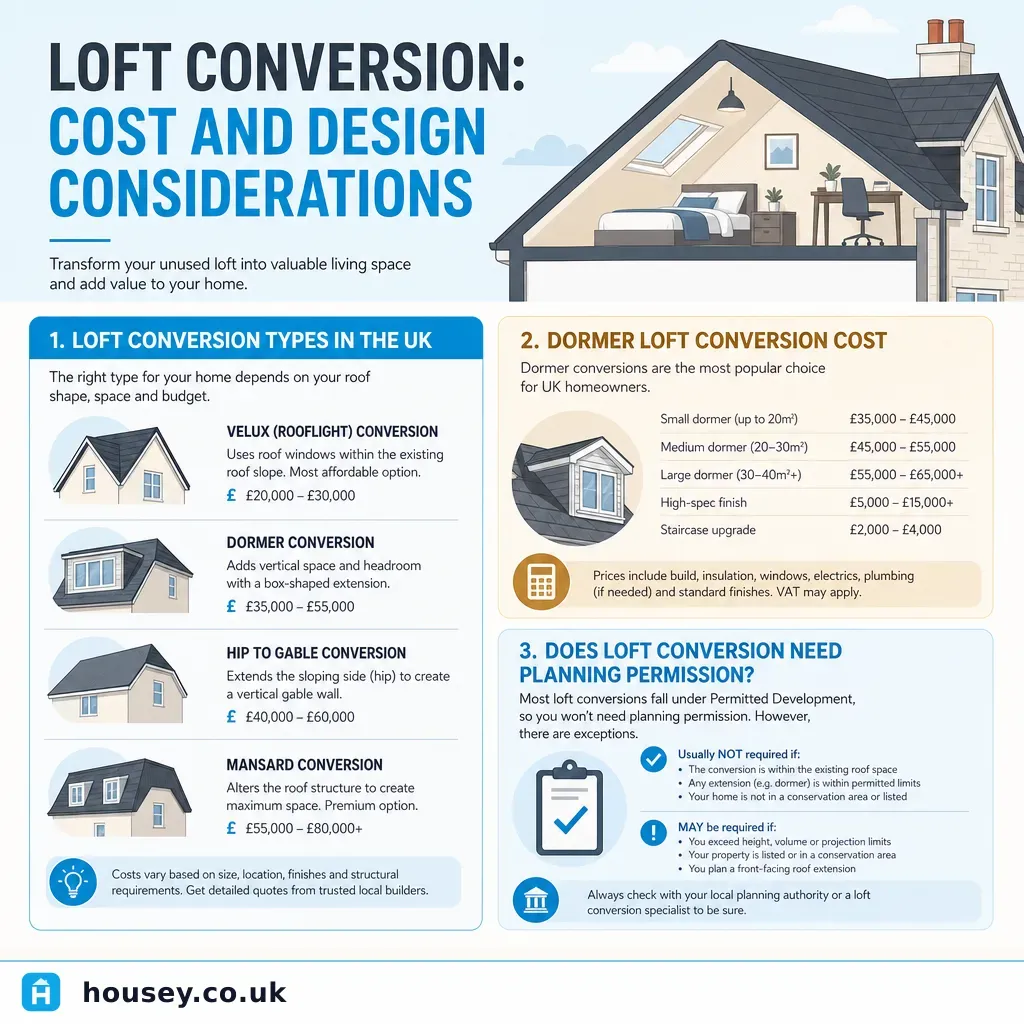
Loft Conversion: Cost and Design Considerations
UK loft conversion costs range from roughly £15,000 for a rooflight conversion to £70,000 or more for a full mansard.
 Improvement & Build
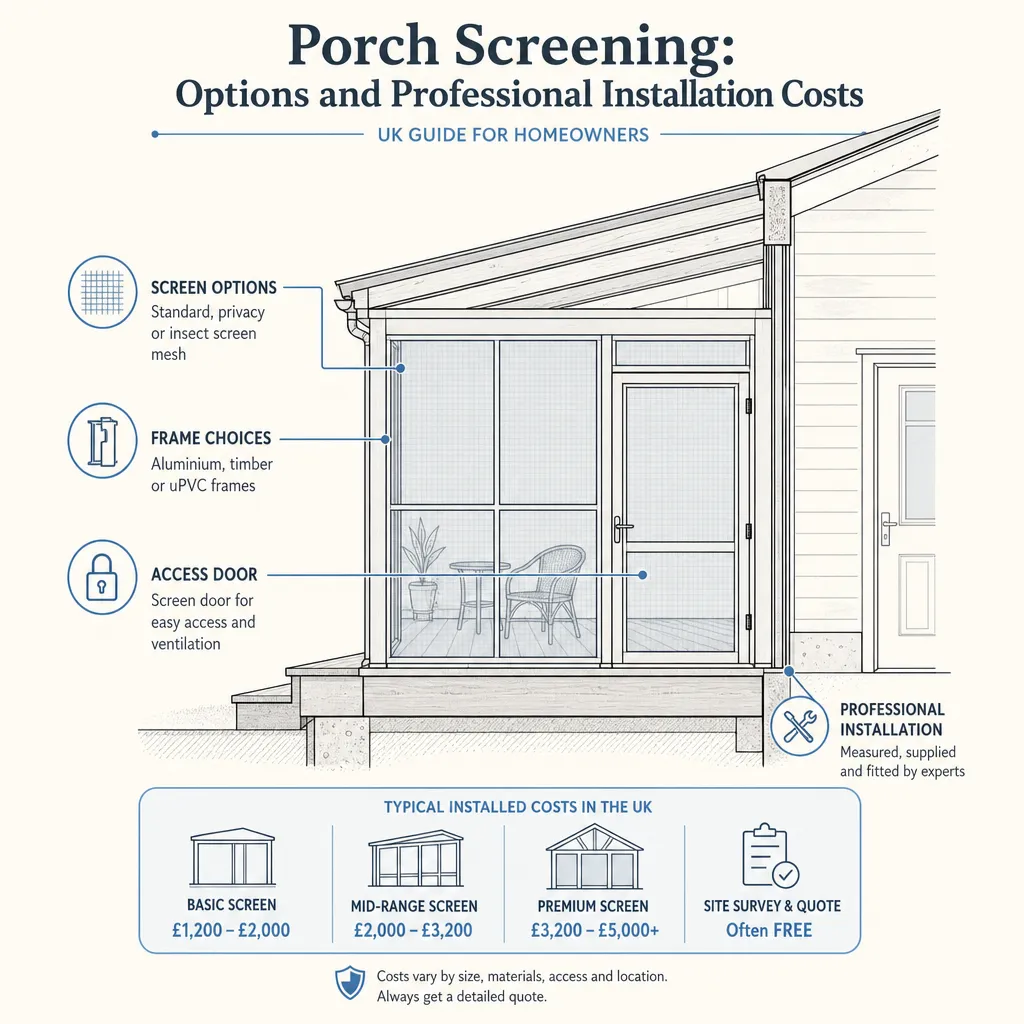
Porch Screening: Options and Professional Installation Costs
Porch screening ranges from simple insect mesh on a timber frame to bespoke aluminium-framed glazed enclosures.
 Improvement & Build
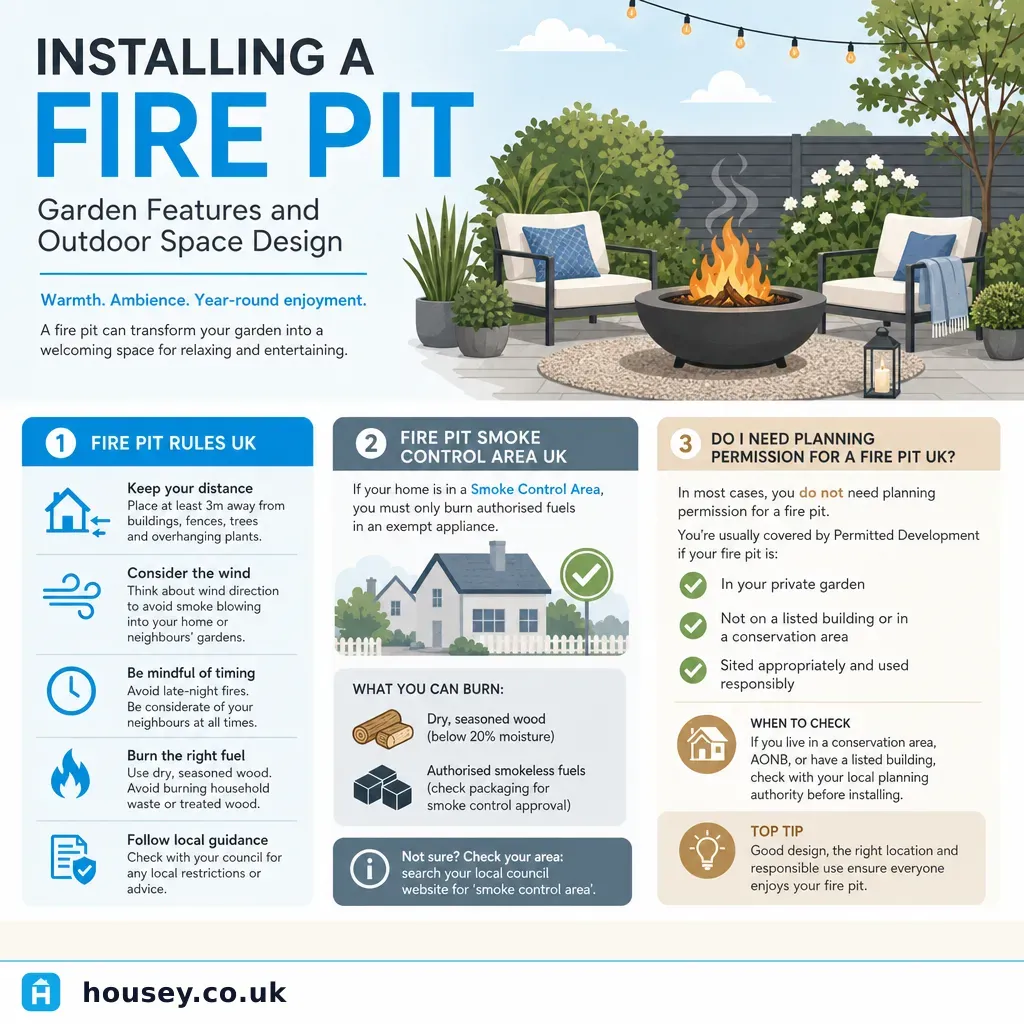
Installing a Fire Pit: Garden Features and Outdoor Space Design
Installing a garden fire pit in the UK is generally permitted, but Smoke Control Area rules prohibit open wood-burning in most towns and cities.
 Improvement & Build
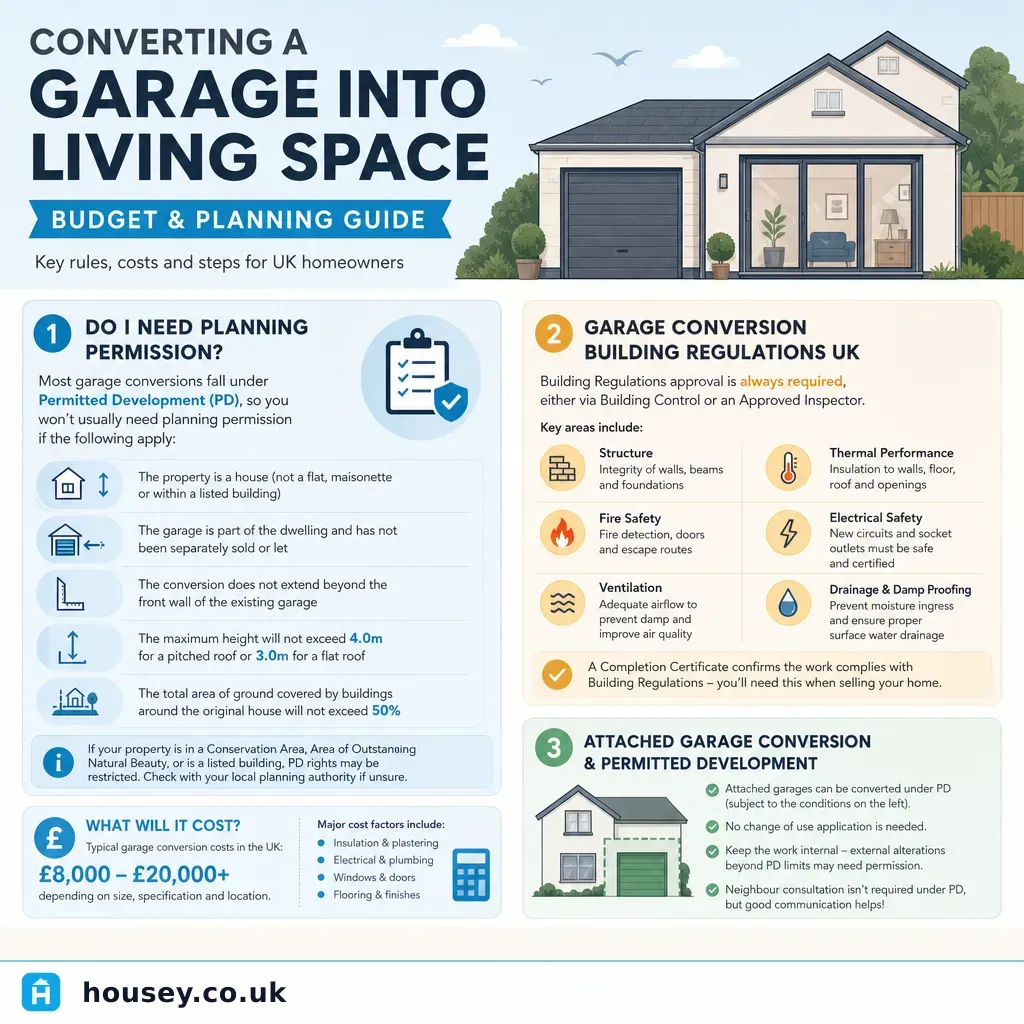
Converting a Garage into Living Space: Budget and Planning Guide
A single-garage conversion typically costs £8,000–£20,000 in the UK.
 Improvement & Build
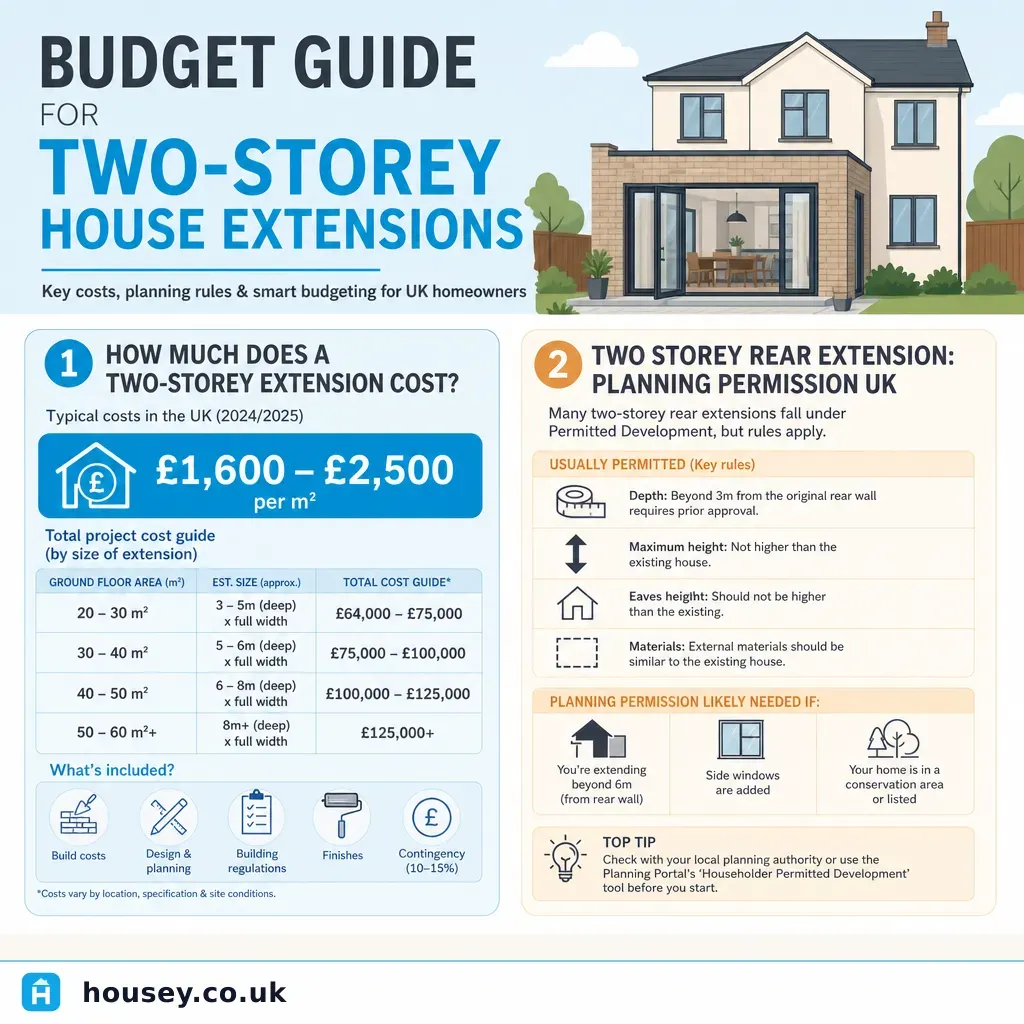
Budget Guide for Two-Storey House Extensions
A two-storey house extension in the UK typically costs £1,800–£3,000+ per square metre for the build alone.