Building a Garden Office: Design, Planning and Installation
By Housey · Last reviewed 19th of May 2026
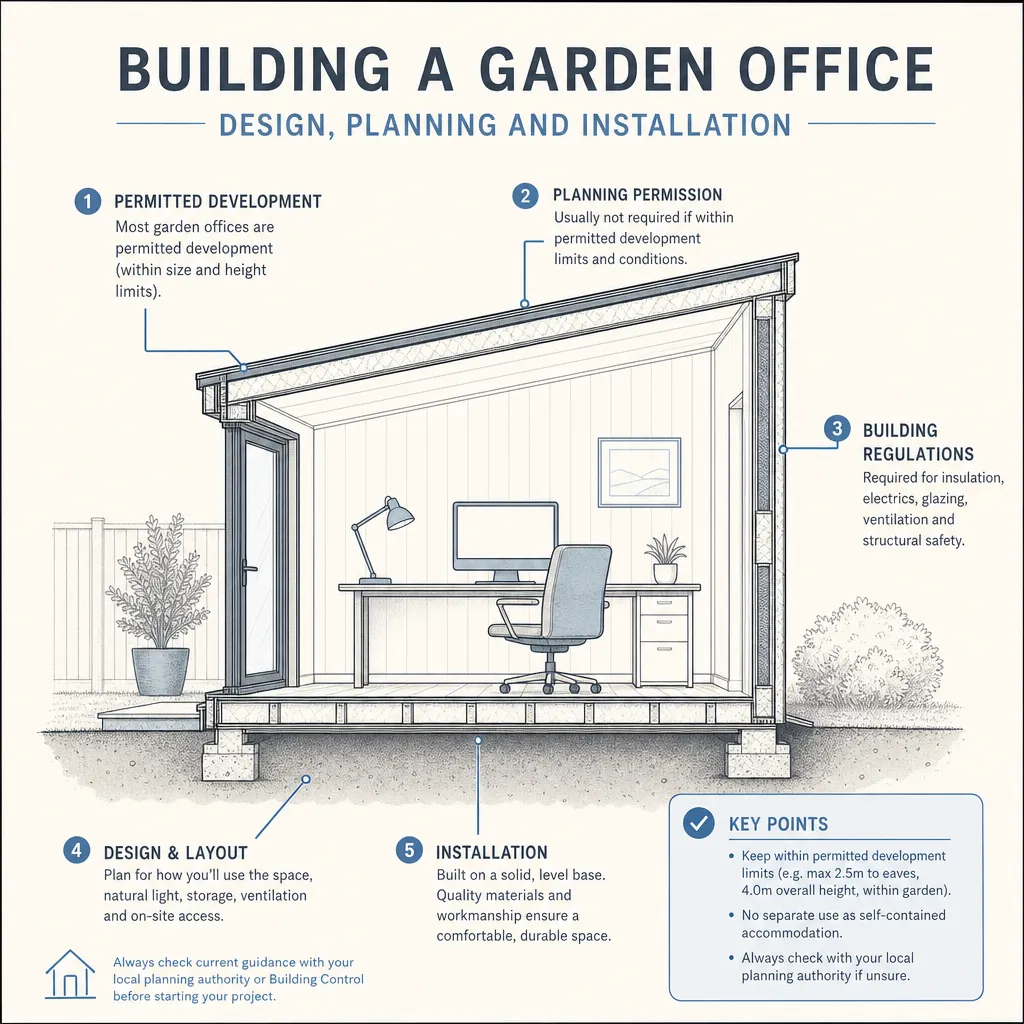
Building a Garden Office: Design, Planning and Installation
A garden office sits at the intersection of planning law, building technology, and everyday practicality — decisions about size, structure, and utilities made at the design stage will determine whether the finished space is warm in January, legally compliant, and genuinely usable. The rise of hybrid working has made garden studios one of the most-requested home improvements in the UK, and the market now ranges from flat-pack timber pods to architect-designed garden rooms with underfloor heating and gigabit broadband.
Key points
- Under Class E of Schedule 2 to the Town and Country Planning (General Permitted Development) (England) Order 2015, most single-storey garden offices require no planning permission provided they meet the relevant size and siting criteria.
- Permitted development allows a maximum eaves height of 2.5 m and an overall height of up to 4 m (dual-pitched roof) or 3 m (any other roof form).
- The total footprint of all outbuildings and extensions must not exceed 50% of the original curtilage; once that threshold is crossed, full planning permission is required.
- Properties in conservation areas, national parks, the Broads, and Areas of Outstanding Natural Beauty (AONBs) cannot rely on Class E permitted development for outbuildings within the curtilage.
- Electrical installation in a garden office must comply with Part P of the Building Regulations and be certified by a registered competent person (NICEIC or NAPIT registered electrician) or formally notified to building control.
Do I need planning permission for a garden office?
In England, garden offices usually fall under permitted development (PD) rights, meaning no formal planning application is required, provided all of the following apply:
- The building is single storey.
- The eaves height does not exceed 2.5 m and the total height does not exceed 4 m (dual-pitched roof) or 3 m (other roof form).
- The building is not positioned forward of the principal or side elevation fronting a highway.
- The combined area of all extensions and outbuildings does not exceed 50% of the total area of the original curtilage.
- The land is not in a conservation area, AONB, national park, or the Broads.
Decision tree: do I need planning permission?
- No planning permission needed if the building is single-storey, below 2.5 m at the eaves, within the 50% curtilage limit, sited behind the rear face of the house, and the property is not in a designated area.
- Check with your local planning authority (LPA) if the property is in a conservation area, AONB, national park, or listed building curtilage — PD rights may be restricted or removed entirely.
- Apply for planning permission if the office would be forward of the principal elevation, exceed the height limits, or push total outbuilding coverage above 50% of the original curtilage.
- Ask a planning consultant if you are unsure about prior extensions, designated-area status, or any Article 4 Direction that removes PD rights for your address.
Rules in Scotland, Wales, and Northern Ireland differ from England. The planning portal for each nation publishes equivalent permitted development guidance.
Do I need building regulations approval?
Planning permission and building regulations are separate requirements. For garden offices in England:
Floor area | Distance from boundary | Building regs position |
|---|---|---|
Under 15 m² | Any | Generally exempt (no sleeping accommodation) |
15 m²–30 m² | More than 1 m from all boundaries | Generally exempt (no sleeping accommodation) |
15 m²–30 m² | Within 1 m of a boundary | Building regs apply unless non-combustible construction |
Over 30 m² | Any | Building regs approval required |
Source: GOV.UK / Planning Portal householder outbuilding guidance.
Even where the structure is exempt, the electrical installation, any plumbing for a WC or sink, and structural elements such as a mezzanine floor will still attract specific Part P, Part G, or Part A requirements. An architectural technologist can advise on which regulations apply before you commission drawings. For projects that require a formal submission, building regulations drawings will need to meet building control specifications.
Choosing the right structure
Type | Best for | Not ideal for | Typical lead time |
|---|---|---|---|
Timber frame (SIP or stud) | Most residential gardens; good insulation potential | Smaller budgets seeking ultra-fast install | 6–14 weeks |
Log cabin / interlocking timber | Budget-conscious builds; natural aesthetic | High U-value performance without additional insulation | 2–6 weeks |
Steel-frame modular pod | Premium contemporary finish; fast installation | Listed building curtilages or conservation areas | 4–8 weeks |
Brick or block (traditional) | Permanent, high-value buildings | Speed and cost; requires full foundations | 10–20+ weeks |
For a working office used year-round, wall U-values of 0.28 W/m²K or better and roof U-values of 0.18 W/m²K or better will reduce heating costs noticeably. These align with the minimum fabric performance standards in Building Regulations Approved Document L — specifying them at the outset avoids retrofitting insulation later.
Insulation, heating, and ventilation
A garden office needs to manage heat gain in summer as well as heat loss in winter. Key design considerations:
- Wall insulation: mineral wool, PIR board, or spray foam depending on construction type. PIR board (such as Kingspan or Recticel) offers higher performance per millimetre of depth.
- Roof insulation: cold-roof or warm-roof construction; warm-roof is generally more effective and avoids interstitial condensation risk.
- Glazing: double or triple glazing with a low-emissivity coating. South-facing glazing should be shaded or fitted with external louvres to reduce overheating in summer.
- Heating: electric panel heaters or a small electric radiator are the simplest option for a garden office used eight to ten hours a day. Air source heat pumps are feasible for larger garden buildings but are often disproportionate for spaces under 20 m².
- Ventilation: even a small office needs background ventilation (trickle vents or equivalent) to manage CO₂ and humidity, particularly in a well-insulated building.
Connecting utilities
Electricity is the most common utility run to a garden office. The supply cable must be armoured (SWA), buried to a minimum depth of 500 mm under hard surfaces or 600 mm under cultivated ground, or run overhead on a suitable catenary. A qualified electrician registered with NICEIC or NAPIT should design, install, and certify the circuit. Where the installation is notifiable under Part P, a Building Regulations completion certificate must be issued.
Broadband can be delivered via a CAT6 or CAT6A cable run in the same duct as the electrical supply, or via a mesh Wi-Fi extender or dedicated garden-office access point. Buried data cable should be protected with conduit.
Water for a sink or WC requires a branch from the mains supply, a check valve, and frost protection on exposed runs. Any connection to the drainage system must be made to the existing foul-water network with building control notification.
Gas is rarely appropriate for a standalone garden office. Electric heating is simpler and generally more cost-effective for the space sizes involved.
What to check before choosing a supplier
Not all garden office suppliers handle planning compliance, building control, and utility connections with the same care. Before signing a contract, ask:
- Will the building comply with permitted development for my specific address, confirmed in writing before installation?
- What U-values does the specification achieve for walls, roof, and floor?
- Who carries out the electrical installation, and are they NICEIC or NAPIT registered? Will I receive a Part P completion certificate?
- What foundation type is proposed, and will a ground survey be carried out?
- What structural warranty does the building carry, and is it backed by a recognised scheme?
- What planning or building control documentation will be supplied on completion?
- Is VAT included in the quoted price?
When to get professional help
Most straightforward garden office projects can be managed directly with a specialist supplier. Seek independent professional input if:
- The property is in a conservation area, AONB, national park, or listed building curtilage.
- The project involves building regulations approval, foundations on uncertain ground, or sleeping accommodation.
- A bespoke design is needed that requires a full planning application.
- You are uncertain whether prior outbuildings have already used your 50% curtilage allowance.
How Housey can help
If you want a garden office that functions as a year-round workspace, the design and compliance details matter as much as the building itself. An architectural technologist can prepare drawings and specifications, advise on building regulations, and ensure your chosen structure meets the thermal performance standards you need. If your project requires a planning application, our planning consultancy service connects you with experienced consultants who understand local authority requirements. For a building that integrates naturally within the wider plot, a garden designer can help from the outset.
Frequently asked questions
Does a garden office add value to a property?
A well-insulated, properly built garden office with power and connectivity typically adds value, particularly where hybrid working is common. The increase depends on build quality, size, and buyer demand in your local market. A poorly built or non-compliant structure can be a liability rather than an asset, so planning compliance and build quality both matter at resale.
Can I use my garden office for a business that clients visit?
Regular business use by external clients may require a change of use under the Town and Country Planning Act. It may also affect home insurance, mortgage terms, and council tax banding. Check with your local planning authority and mortgage lender before using the space commercially. Occasional home-based work for yourself is generally not a planning concern.
How long does a garden office installation take?
From signing a contract to practical completion, expect six to sixteen weeks depending on structure type, supplier lead times, and whether groundworks or utility connections are needed. Factory-built modular pods can arrive and be installed in a single day once the base is prepared. Planning applications, if required, typically take up to eight weeks to be decided.
Do I need a Lawful Development Certificate for a garden office?
A Lawful Development Certificate (LDC) provides formal written confirmation from your local planning authority that the building is lawful under permitted development. It is not legally required, but is useful when you plan to sell the property or want certainty before committing to the build. An LDC application is submitted to and decided by your local planning authority.
Sources and further reading
- Planning Portal: outbuildings — Planning Portal
- GOV.UK: when you need building regulations approval — GOV.UK
- Town and Country Planning (General Permitted Development) (England) Order 2015, Schedule 2, Class E — legislation.gov.uk
- Approved Document P: electrical safety in dwellings — GOV.UK / MHCLG
- Energy Saving Trust: home insulation — Energy Saving Trust
Useful next reads
 Improvement & Build
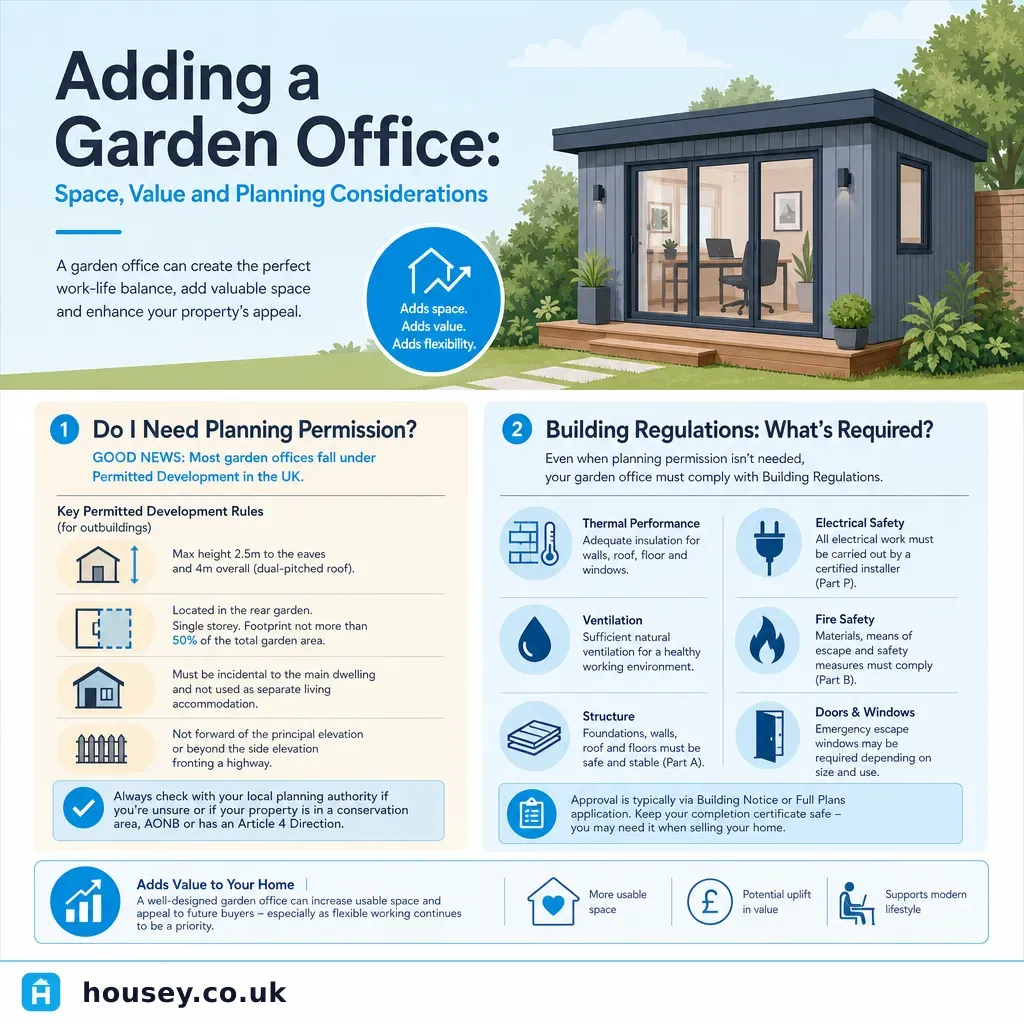
Adding a Garden Office: Space, Value and Planning Considerations
Most garden offices qualify as permitted development and do not need planning permission, provided they stay within specific size and height limits and are not used as separate sleeping accommodation.
 Improvement & Build
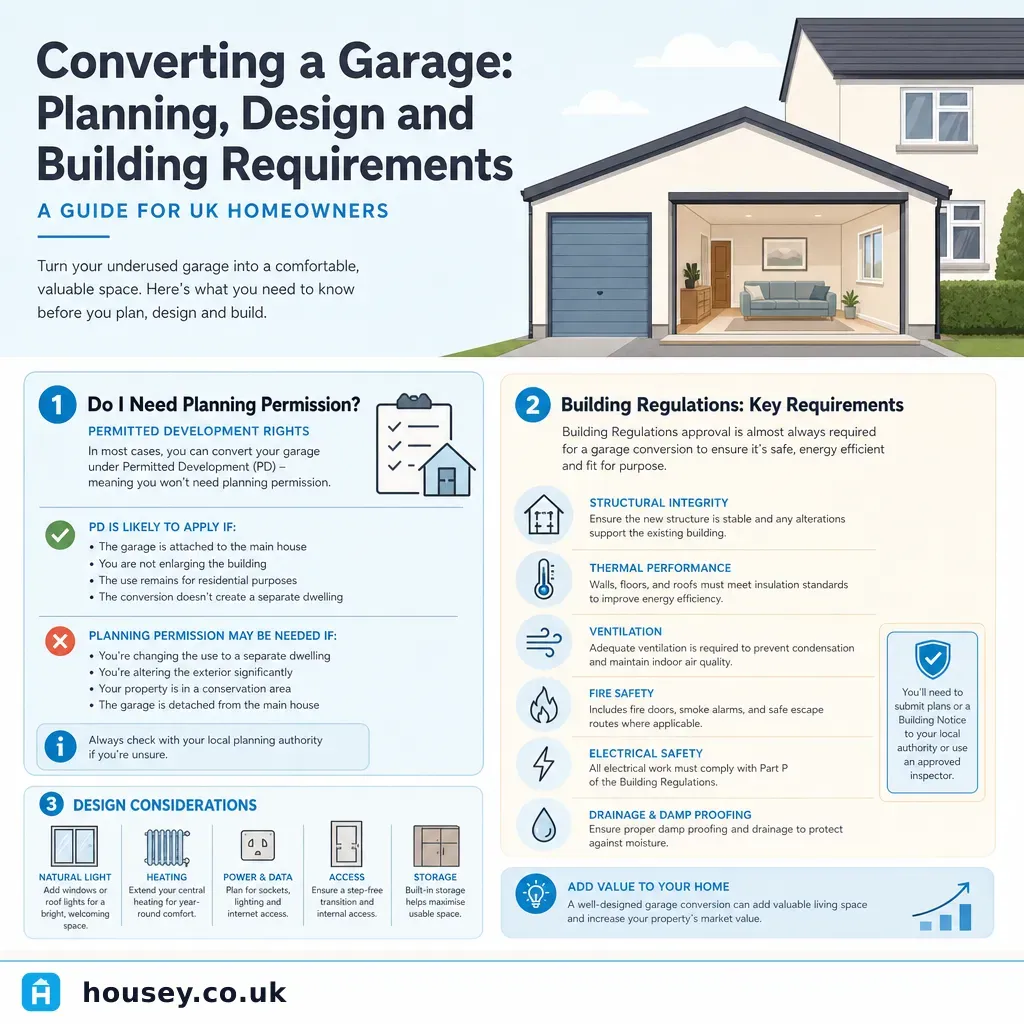
Converting a Garage: Planning, Design and Building Requirements
Most garage conversions in England do not need planning permission under permitted development rights, but all conversions require Building Regulations approval covering structure, thermal insulation, fire safety, and ventilation.
 Improvement & Build
Home Improvement Projects That Add Value to Your Property
Loft conversions, rear extensions, and kitchen refurbishments typically offer the strongest return on investment for UK homeowners.
 Improvement & Build
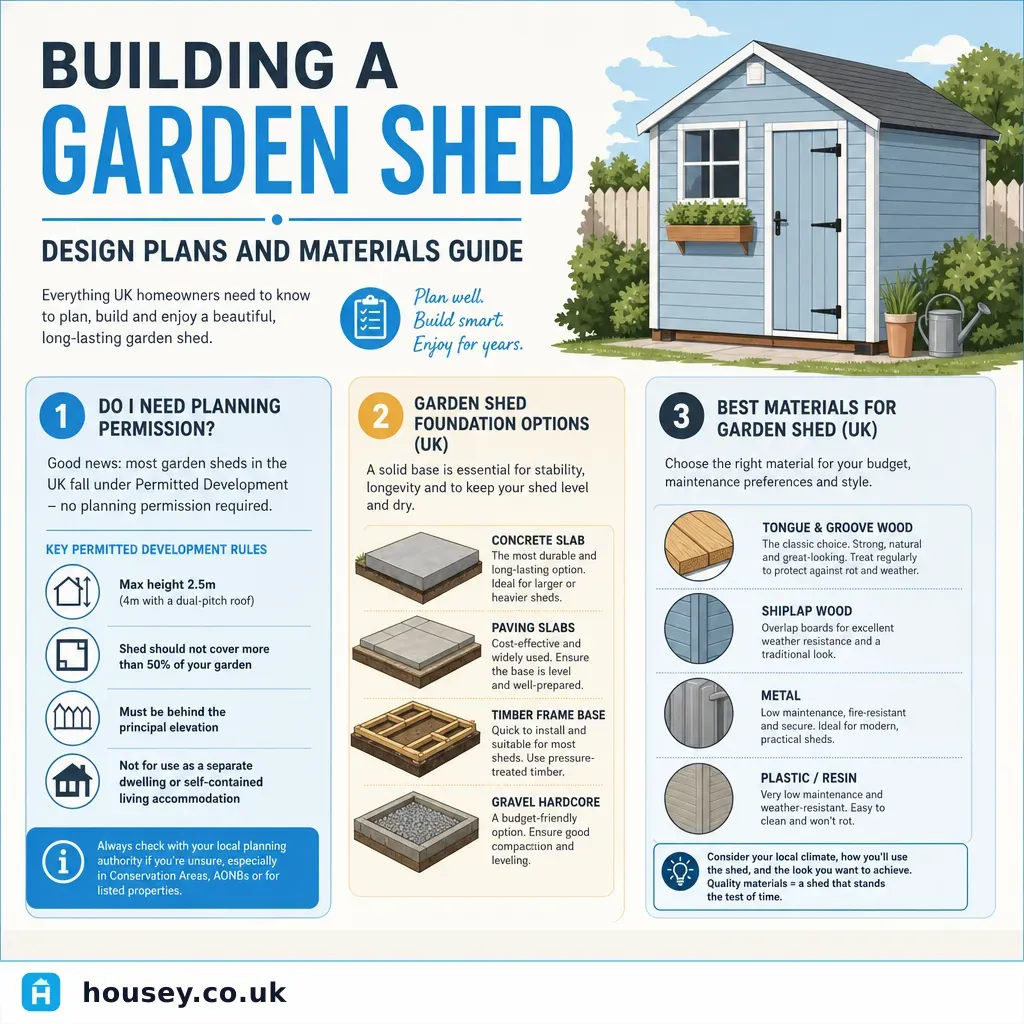
Building a Garden Shed: Design Plans and Materials Guide
Most garden sheds in England are Permitted Development, provided they sit behind the principal elevation, have eaves no higher than 2.
 Improvement & Build
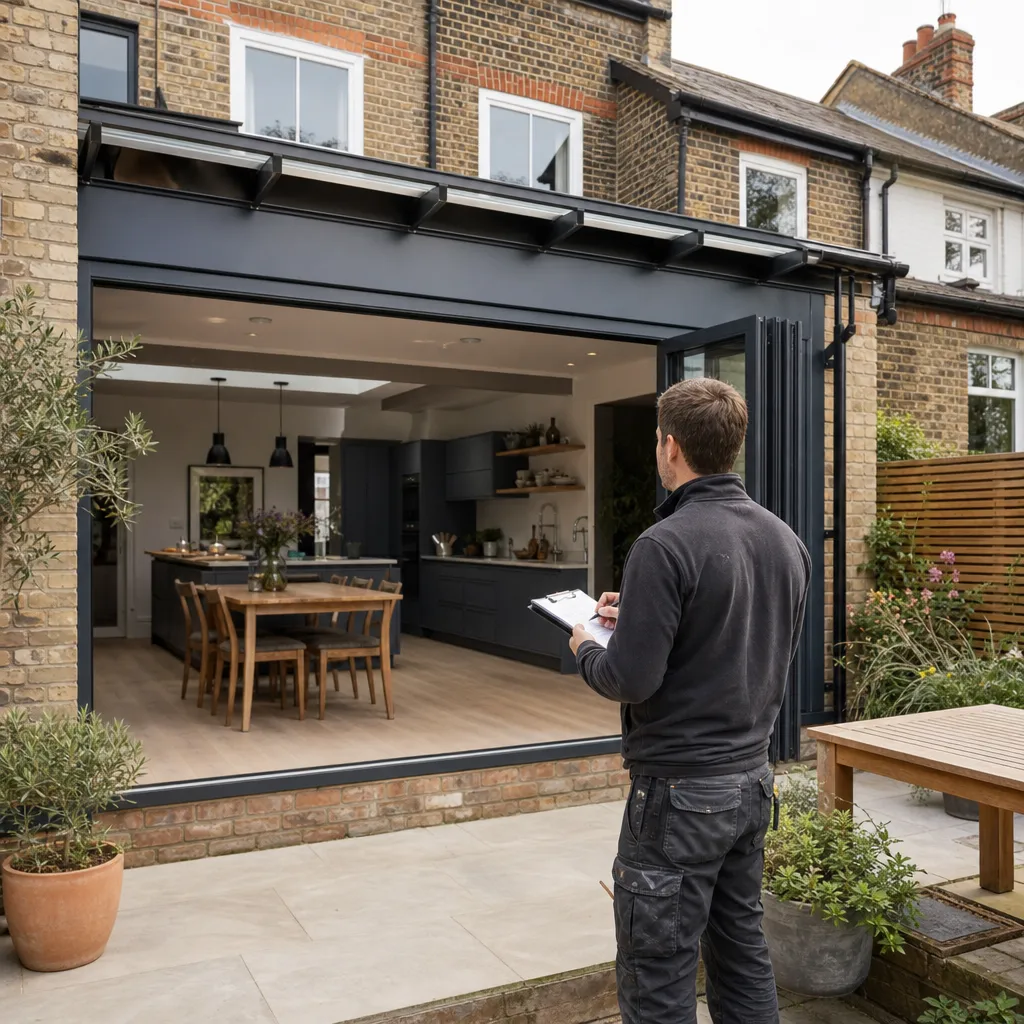
Maximising Value Through Strategic Home Improvement Projects
In the UK, loft conversions and kitchen extensions tend to deliver the strongest return on investment, with loft conversions potentially adding around 20% to property value according to Nationwide data.