Converting a Garage: Planning, Design and Building Requirements
By Housey · Last reviewed 19th of May 2026
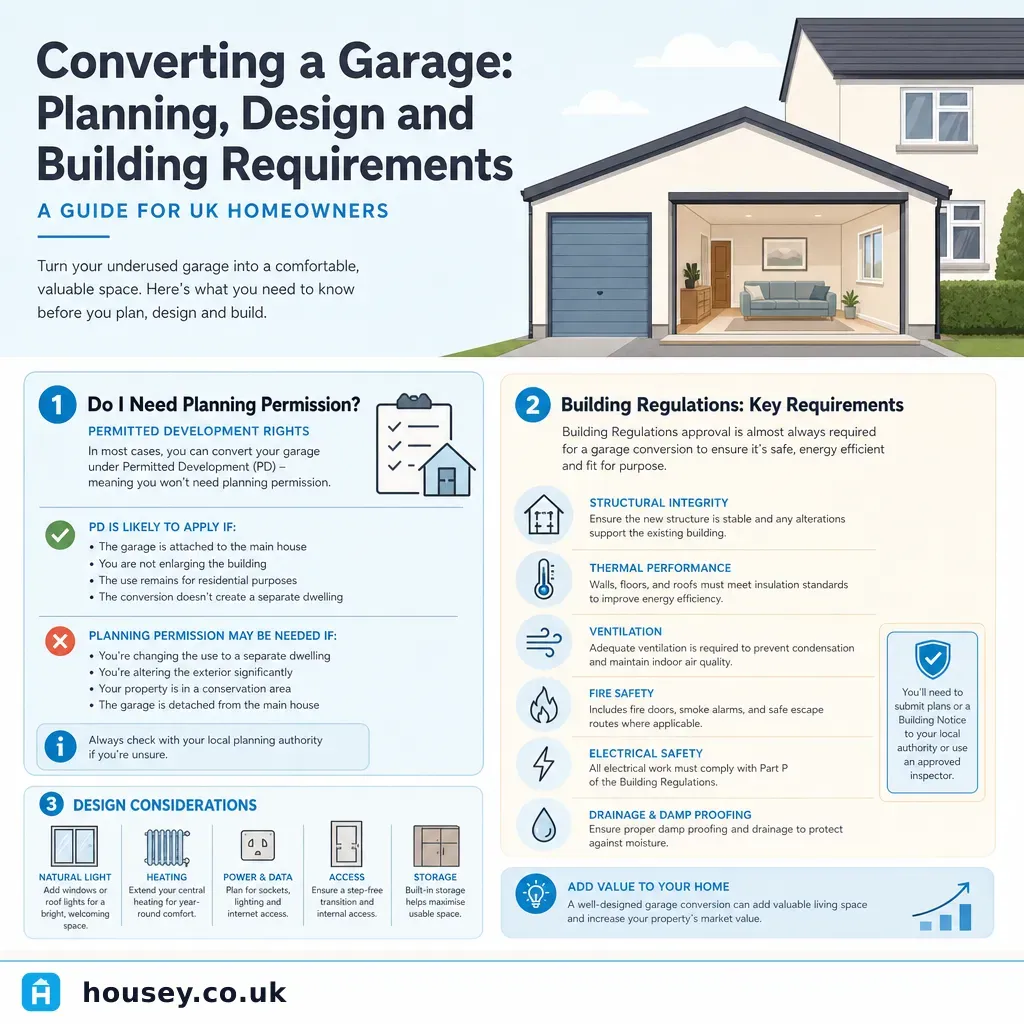
Converting a Garage: Planning, Design and Building Requirements
A garage conversion is one of the most cost-effective ways to add usable floor space to a UK home — a 20 m² integral garage can become a bedroom, home office, playroom, or studio without extending the building's footprint. But there are real planning, structural, and compliance questions to work through before you start, and skipping any of them can result in enforcement action, mortgage complications, or a failed sale years later.
Key points
- Most garage conversions in England fall under permitted development rights and do not need a planning application, but exceptions apply in conservation areas, Areas of Outstanding Natural Beauty, Article 4 Direction areas, and for listed buildings.
- All garage conversions require Building Regulations approval, covering structure (Approved Document A), fire safety (Approved Document B), thermal performance (Approved Document L), and ventilation (Approved Document F) as a minimum.
- The former garage floor typically needs raising and insulating to meet Approved Document L thermal standards; walls and the ceiling or roof also require insulation upgrades.
- If the garage structure touches a wall shared with a neighbouring property, the Party Wall etc. Act 1996 may apply — serve notice before beginning any structural work.
- A completion certificate from building control is required before the converted space can lawfully be occupied as habitable accommodation, and solicitors will ask for it on resale.
Do I need planning permission for a garage conversion?
In most cases in England, converting an integral, attached, or detached garage to habitable use falls under permitted development — no planning application is required. Planning permission is required if:
- The property is in a conservation area, National Park, Area of Outstanding Natural Beauty (AONB), or is a listed building
- An Article 4 Direction has removed permitted development rights in your area (common on some new-build estates)
- The conversion creates a self-contained unit with its own separate access and facilities, which is not covered by permitted development rights
- Planning conditions attached to the original property have removed permitted development rights
- The conversion would create additional dwellings separate from the main house
Always check with your local planning authority (LPA) before assuming permitted development applies. You can apply for a Lawful Development Certificate (LDC) from your LPA to formally confirm the conversion is lawful — the fee is around £103 in England (2026). An LDC is not mandatory but protects you at resale when buyers' solicitors query the planning position.
Which route applies to your situation?
- Choose the permitted development route if the property is a standard residential house in England, the conversion involves an integral or attached garage, and there are no conservation area, AONB, listed building, or Article 4 restrictions.
- Apply for planning permission if the property is listed, in a conservation area or AONB, subject to an Article 4 Direction, or if permitted development rights have been removed by a planning condition.
- Serve a Party Wall Act notice before work begins if any structural work touches a wall shared with a neighbour or a wall on the boundary line.
- Consult your LPA if the conversion will create a self-contained annexe — planning permission is almost certainly required in this scenario.
- Obtain a Lawful Development Certificate in all permitted development cases where you want written certainty at resale.
What Building Regulations apply?
Building Regulations approval is required for all garage conversions regardless of the planning position. The main Approved Documents you will need to address are:
Approved Document | What it covers | Typical garage conversion requirement |
|---|---|---|
Part A (Structure) | Structural stability | Floor loading assessment; lintel above former garage door opening |
Part B (Fire safety) | Escape routes and fire spread | Smoke alarms; fire door between converted room and house |
Part C (Resistance to moisture) | Damp-proofing | Damp-proof membrane in new floor build-up |
Part F (Ventilation) | Fresh air supply | Trickle vents in new windows; extract ventilation if a wet room |
Part L (Fuel and power conservation) | Thermal insulation | Floor, wall, and ceiling U-values to meet current standards |
Part E (Sound insulation) | Noise transfer | Required where the conversion adjoins a neighbouring property |
Your building control body — local authority or an Approved Inspector — will inspect at key stages and issue a completion certificate at the end. Do not occupy the new room until the completion certificate is in hand.
Structural considerations
Garage floors are typically uninsulated concrete slabs designed for vehicle loads, not domestic habitation. A conversion usually requires:
- A new floor build-up with a damp-proof membrane, insulation, and screed or floating floor — losing approximately 100–150 mm of headroom
- An assessment of the lintel above the former garage door opening, which may need upgrading if the structural load changes
- Insulation to walls: options include cavity fill, internal dry-lining, or external insulation depending on wall construction
- Insulation to the roof or ceiling to meet current Approved Document L standards
A structural engineer may be required if there are doubts about the slab condition, lintel capacity, or roof structure. Do not assume the existing garage structure is adequate without a professional assessment.
Homeowner checklist
Important limitations
This article provides general information on garage conversion requirements in England. Planning rules, permitted development conditions, and Building Regulations details vary by local planning authority, property type, lease terms, and project scope. Scotland, Wales, and Northern Ireland have separate planning and building standards regimes. Always verify requirements with your LPA and a qualified professional before starting work.
What to ask a qualified professional
Before appointing a designer or building control body for your garage conversion:
- Does my property have Article 4 Directions or planning conditions that remove permitted development rights?
- Should I apply for a Lawful Development Certificate alongside building regulations approval?
- What U-values will the floor, walls, and ceiling need to achieve under current Approved Document L?
- Does the existing concrete slab need to be broken up and replaced, or can it be overlaid with insulation and screed?
- Will the lintel above the garage door opening need upgrading given the new structural arrangement?
- Does the Party Wall etc. Act 1996 apply to any element of this project?
- What building control inspection stages will there be, and what access is required at each?
- What completion documents will I receive at the end of the project?
When to get professional help
A garage conversion involves structural, thermal, and fire safety elements that require professional oversight. Always involve:
- An architect or architectural technologist to prepare drawings for planning and building control
- A structural engineer if there is any doubt about floor loading, lintel capacity, or roof structure
- A planning consultant if permitted development rights are unclear or the property is in a sensitive area
If you buy a property where a garage has been converted without building regulations approval, ask a solicitor about the options — a regularisation application to building control may be possible, but timing and feasibility depend on the work involved and your local authority.
How Housey can help
Housey connects homeowners with experienced garage conversion specialists and architectural technologists who can prepare your building regulations drawings from the outset. If your planning position is uncertain, our network of planning consultancy professionals can advise on permitted development status and Lawful Development Certificate applications. Compare quotes from vetted local professionals through our platform.
Frequently asked questions
Does a garage conversion add value to a UK property?
A well-executed, building-control-approved garage conversion typically adds usable floor space that estate agents and RICS surveyors can count in a valuation. Value uplift depends on local demand, quality of finish, and whether losing garage parking affects buyers in your area. An approved conversion is generally worth more than an unconverted garage in most residential markets, but outcomes vary.
Do I need building regulations even if I use the permitted development route?
Yes. Planning permission and Building Regulations approval are entirely separate requirements. Permitted development only determines whether a planning application is needed — you still need Building Regulations approval for the structural, thermal, fire safety, and ventilation standards regardless of your planning position. There is no garage conversion that avoids building regulations.
Can I convert my garage into a self-contained annexe?
Converting a garage into a fully self-contained annexe — with its own kitchen, bathroom, and separate access — is likely to require planning permission, as it creates a separate unit of accommodation. Permitted development rights generally do not cover this. Always consult your local planning authority before designing for annexe use; some councils also have specific policies on annexes.
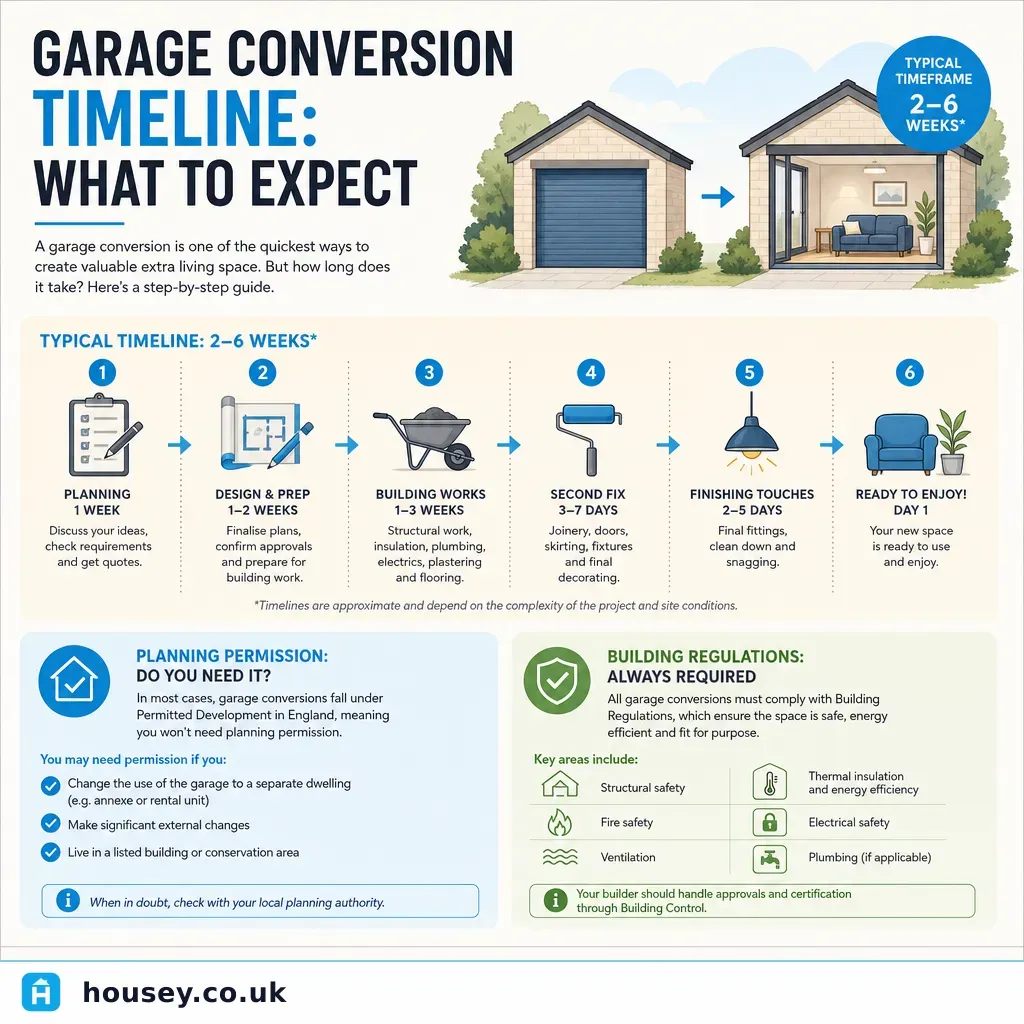
How long does a garage conversion take?
A straightforward integral garage conversion typically takes 4–8 weeks on site, depending on the structural works, insulation, plastering, and fit-out required. A full plans building regulations application can take 4–6 weeks for approval, so submitting drawings before contractors mobilise helps avoid delays once work begins.
What is a Lawful Development Certificate and do I need one for a garage conversion?
A Lawful Development Certificate (LDC) is a formal written confirmation from your local planning authority that the conversion is lawful under permitted development. It is not legally required, but protects you at resale — without it, buyers' solicitors may raise questions about the planning status of the converted space. The application fee is around £103 in England as of 2026.
Sources and further reading
- Planning Portal: Garage conversions — Planning Portal
- Approved Documents (Building Regulations) — GOV.UK
- Party Wall etc. Act 1996 explanatory booklet — GOV.UK
- Lawful Development Certificates guidance — GOV.UK
- Find your local planning authority — GOV.UK
Useful next reads
 Improvement & Build
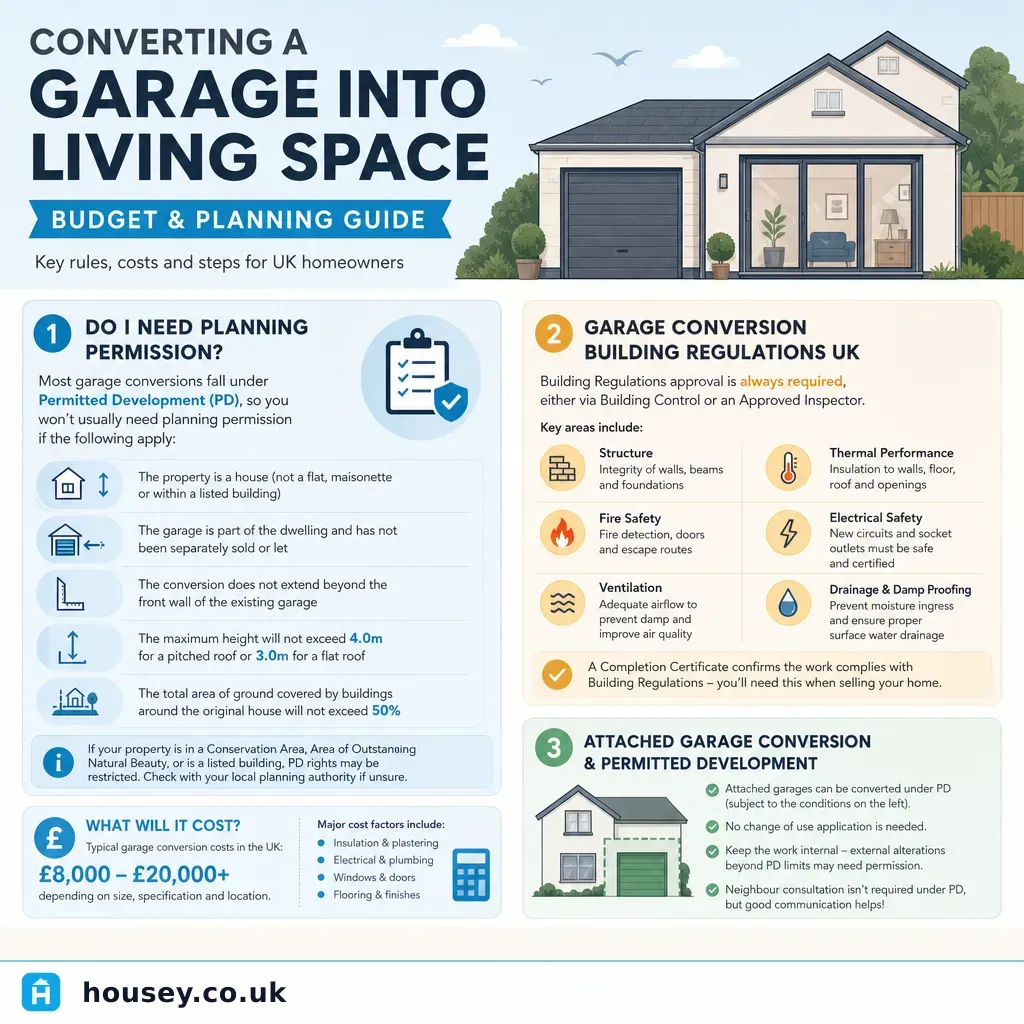
Converting a Garage into Living Space: Budget and Planning Guide
A single-garage conversion typically costs £8,000–£20,000 in the UK.
 Improvement & Build
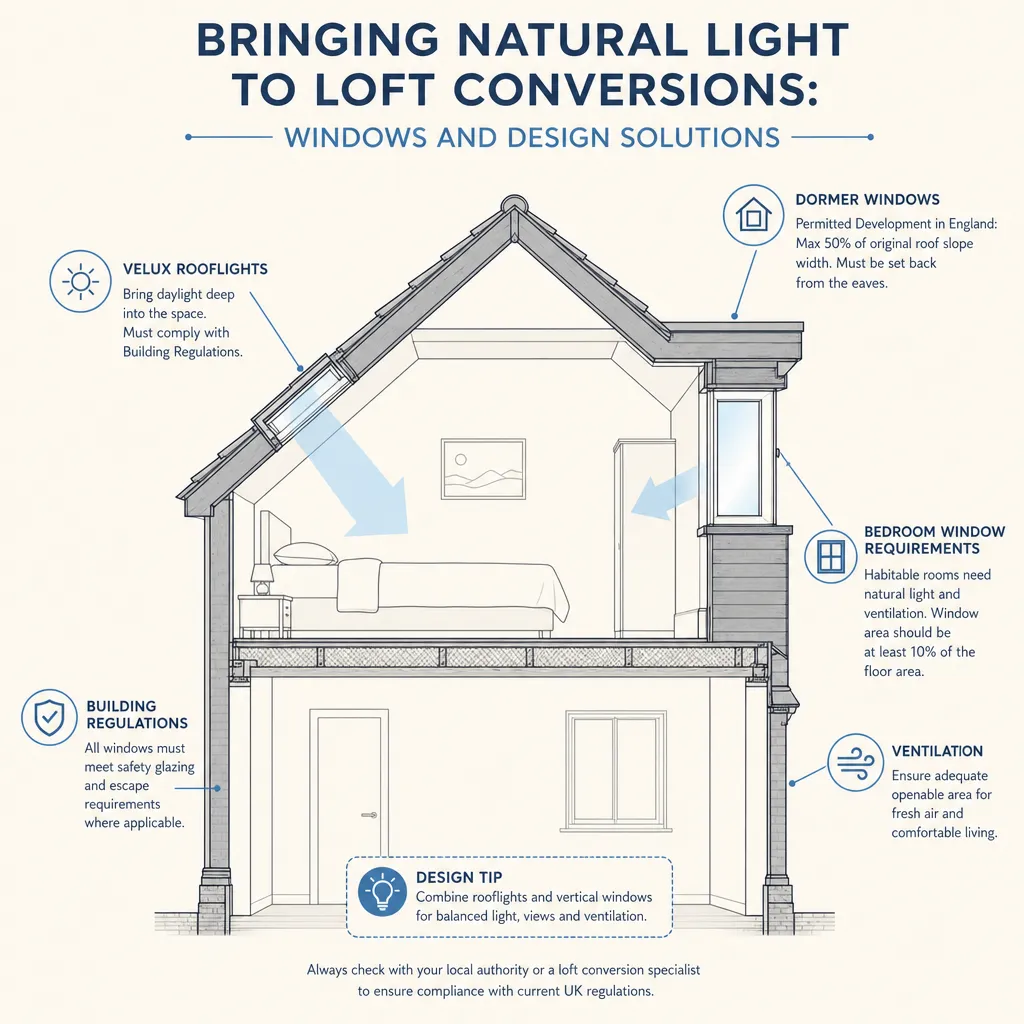
Bringing Natural Light to Loft Conversions: Windows and Design Solutions
Natural light in a loft conversion is usually achieved through roof lights, dormer windows, or gable-end glazing.
 Improvement & Build
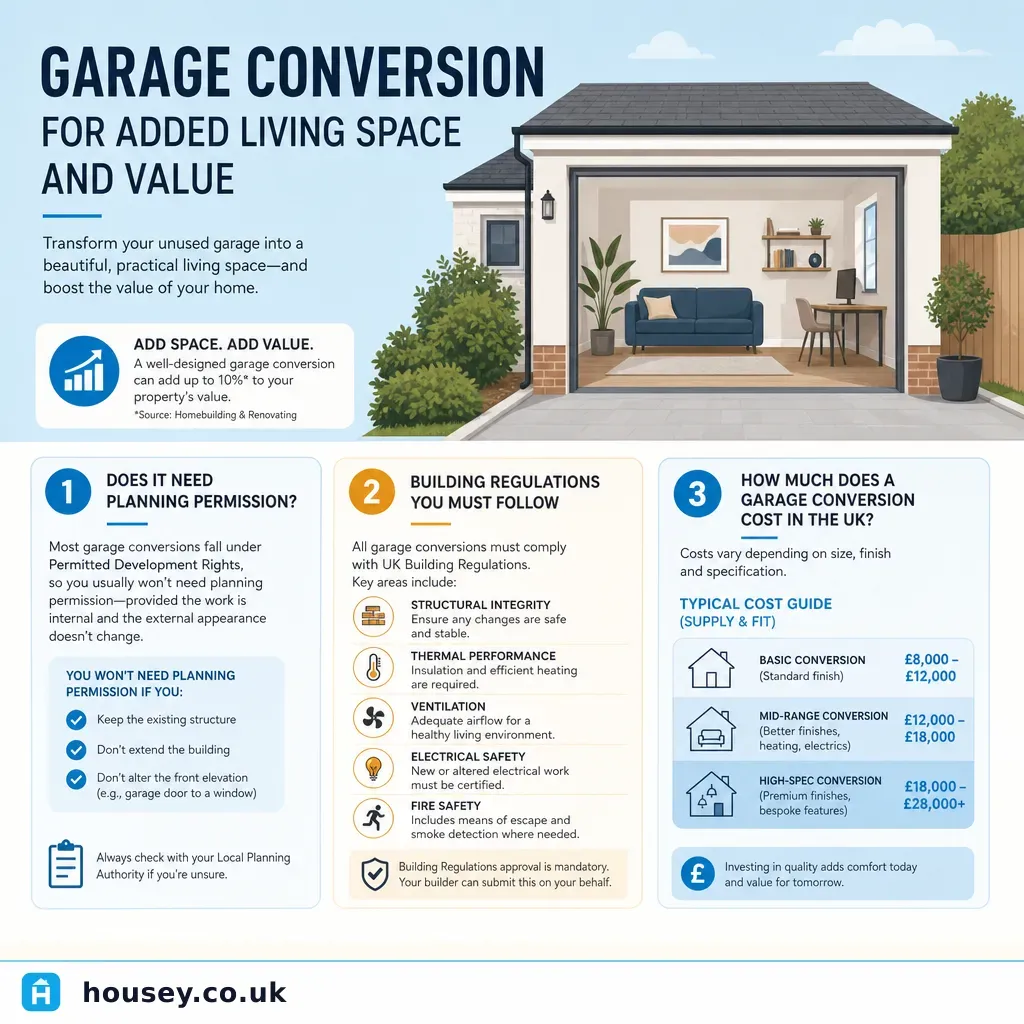
Garage Conversion for Added Living Space and Value
A garage conversion in England typically falls within permitted development and does not need a planning application, provided the property is a standard dwellinghouse with no restricting planning conditions.
 Improvement & Build
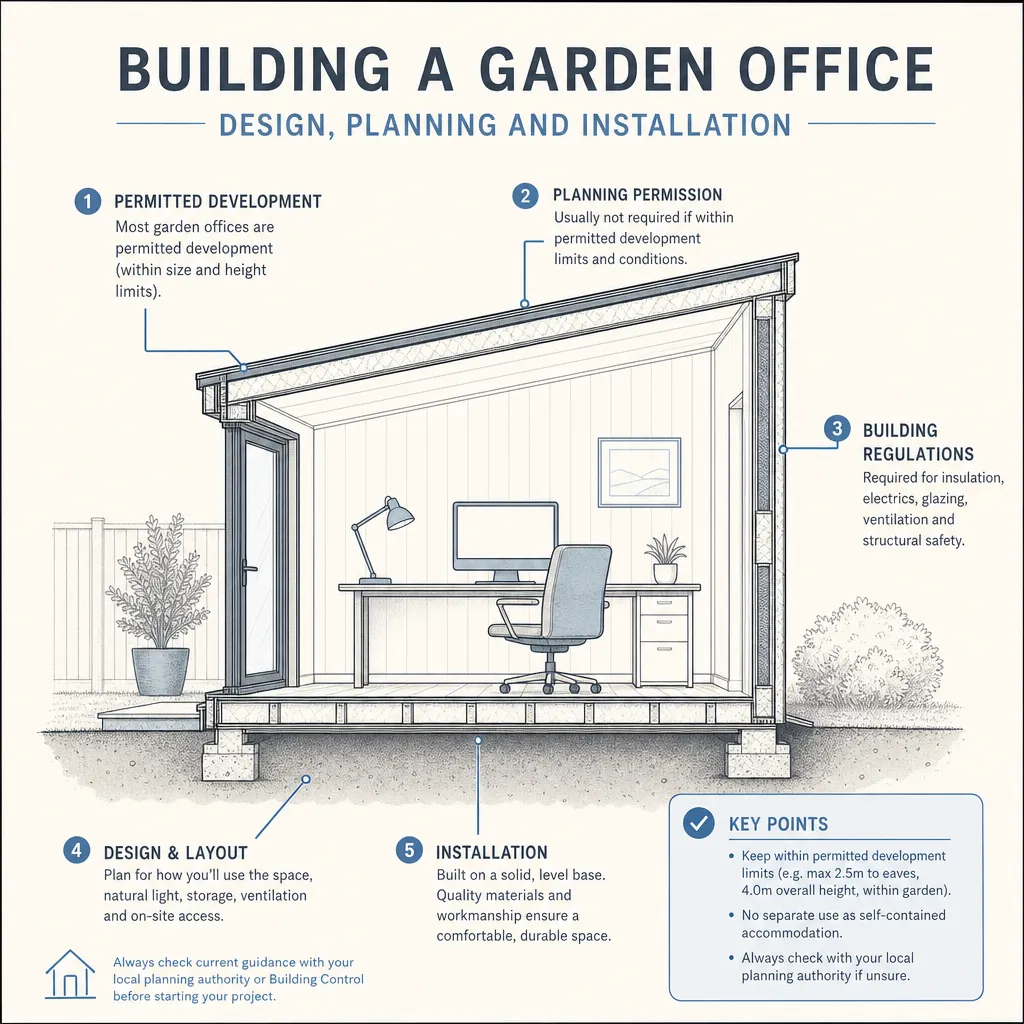
Building a Garden Office: Design, Planning and Installation
Most garden offices in England fall under permitted development and need no planning permission if they are single-storey, below 2.
 Improvement & Build
Garage Conversion Timeline: What to Expect
A straightforward attached garage conversion in England usually takes 4–8 weeks of construction, plus pre-start time for building control approval (5 working days for Full Plans).