Building a Garden Shed: Design Plans and Materials Guide
By Housey · Last reviewed 30th of May 2026
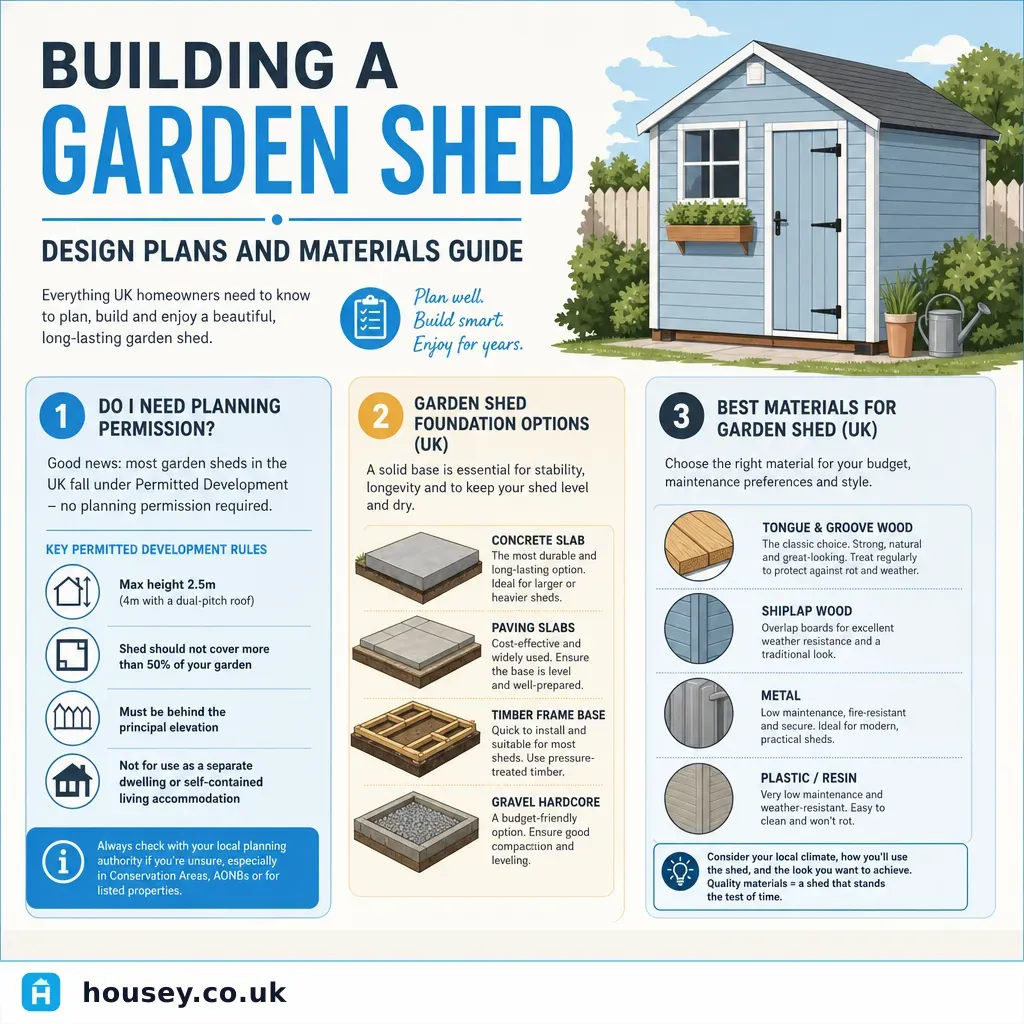
Building a Garden Shed: Design Plans and Materials Guide
Planning a garden shed quickly becomes more involved than it first appears — once you move beyond an off-the-shelf flatpack, sizing the base, choosing materials, and confirming whether planning permission applies are decisions that shape both the build process and the finished result. This guide is aimed at UK homeowners considering a self-build or contractor-built shed and covers the regulatory, design, and materials decisions you will need to make before starting work.
Key points
- Most garden sheds in England are Permitted Development under Schedule 2, Part 1, Class E of the Town and Country Planning (General Permitted Development) (England) Order 2015, provided they meet specific height, footprint, and position requirements.
- Permitted Development does not apply in conservation areas, Areas of Outstanding Natural Beauty (AONBs), or on listed building plots — these require separate planning consent.
- Building regulations generally do not apply to detached garden sheds under 15 m² that are not used for sleeping; sheds between 15 m² and 30 m² may also be exempt depending on proximity to boundaries.
- All timber in contact with or close to the ground must carry a UC3 or UC4 preservative treatment rating — untreated softwood in ground contact can fail within three to five years.
- Any electrical installation in a garden shed must comply with BS 7671 (18th Edition Wiring Regulations) and be certified under Part P of the Building Regulations.
Do you need planning permission?
Under Permitted Development rules in England (as at 2026), a garden shed is likely to be exempt from planning permission if all of the following apply:
- It sits behind the principal elevation of the house (not forward of the front wall facing the highway)
- Maximum eaves height is 2.5 m; maximum overall height is 4 m for a dual-pitch roof or 3 m for any other roof type
- The combined ground area of all outbuildings, sheds, and extensions does not exceed 50% of the total curtilage (excluding the house footprint)
- It is not used as a separate dwelling or for sleeping accommodation
- The property does not have an Article 4 Direction removing permitted development rights and is not a listed building or in its curtilage
Scotland, Wales, and Northern Ireland have different rules. In Scotland, check Planning Circular 1/2012. In Wales, the Householder Permitted Development Rights Order 2013 applies. In Northern Ireland, the Planning (General Development) Order 2015 (Northern Ireland) governs permitted development.
If you are in doubt, apply to your local planning authority (LPA) for a Lawful Development Certificate — a low-cost way to confirm the position on record before construction begins.
Foundations and groundworks: your options
The foundation choice depends on the size and weight of the shed, the soil type, and your budget.
Foundation type | Best for | Not ideal for | Indicative cost (2026-05-30) |
|---|---|---|---|
Concrete raft | Sheds over 6 m², permanent structures, heavy loads | Very small lightweight sheds; soft clay without adequate blinding | £200–£500 for a standard shed footprint |
Concrete strip footings | Large or heavy sheds, sloped ground | Small sheds or temporary structures | £300–£600+ |
Paving slabs on compacted hardcore | Small to medium sheds, flat ground, timber floor | Larger structures or poor-drainage areas | £80–£200 |
Treated timber bearers | Lightweight sheds where relocation is likely | Permanent or heavy-duty structures | £50–£150 |
Ground screws | Uneven or sloped ground, no excavation wanted | Heavy masonry structures | £300–£600 (professionally installed) |
For sheds over approximately 8 m², a concrete raft or strip foundation will provide the most stable and durable result. On clay soils, check whether ground movement is a risk — a groundworker with local experience can advise before you pour.
Choosing materials: timber, metal, or composite?
Timber
Timber is the most widely used UK material for self-build sheds. Key specification points:
- Frame: 75 × 50 mm regularised treated softwood (C16 or C24 graded) for wall plates, stud framework, and roof rafters.
- Cladding: Shiplap or tongue-and-groove boards in pressure-treated softwood, minimum 12–16 mm thickness. Confirm the preservative treatment carries a UC3 rating for above-ground external use.
- Roof decking: 18 mm exterior-grade Oriented Strand Board (OSB) or WBP plywood.
- Roofing covering: BS EN 13707-compliant reinforced bitumen felt as a minimum; an EPDM rubber membrane provides a longer service life.
- Floor: 18–22 mm exterior-grade tongue-and-groove plywood or OSB on treated joists, elevated off the base to allow airflow.
Metal
Pre-fabricated metal sheds (typically galvanised steel or aluminium) require minimal maintenance and resist rot. They can be noisier in heavy rain, suffer internal condensation without insulation, and are harder to modify after erection.
Composite (WPC)
Wood-plastic composite (WPC) cladding offers good rot resistance and low maintenance but typically costs two to three times more than treated softwood. It is increasingly available in the UK and suits homeowners wanting a durable, low-maintenance finish.
Design basics: dimensions, roof type, and drainage
A few principles to establish before ordering materials:
- Minimum practical size: 1.8 × 1.2 m will store bicycles or a few tools. Most homeowners find 2.4 × 1.8 m the smallest useful workshop size.
- Roof pitch: A minimum 15° pitch is generally adequate for roofing felt; steeper pitches shed water more effectively.
- Guttering: Always include guttering — unmanaged roof run-off causes erosion, saturates the base perimeter, and can damage boundary fencing.
- Ventilation: Include at least two opening vents or windows to prevent condensation and protect stored tools.
- Electrics: Any supply from the house must comply with BS 7671 and be certified under Part P. Involve an electrician at design stage so cable routes are planned before walls are closed.
Decision tree: which approach is right for you?
- Small shed under 4 m², flat ground, no electrics, no planning constraints → off-the-shelf flatpack on a paving slab base is likely sufficient.
- Medium shed 4–12 m², self-build, flat ground → concrete slab base, pressure-treated timber frame and cladding, standard roofing felt.
- Large shed or garden room over 12 m², or on sloped ground → consult a groundworker for foundation specification; consider EPDM or GRP roofing for longevity.
- Shed in conservation area, AONB, or listed building curtilage → check with your LPA before proceeding; planning permission is likely required and materials may need to match local character.
- Shed with a power supply → Part P-registered electrician required; plan cable routes at design stage.
- Shed intended as a home office or studio → consider building regulations requirements for thermal performance and ventilation; a garden designer can advise on layout and integration with the wider plot.
Typical materials checklist for a 2.4 × 3.6 m timber shed
- Concrete or aggregate for slab (or 600 × 600 mm paving slabs on compacted hardcore)
- 75 × 50 mm regularised treated C16/C24 softwood for frame (calculate total linear metres from your plans)
- Shiplap or T&G cladding boards, pressure-treated to UC3 (calculate from external wall area plus 10% for waste)
- 18 mm exterior-grade OSB for roof deck and floor
- Roofing felt (BS EN 13707) or EPDM membrane — roof area plus 150 mm lap allowance per sheet or roll
- Ridge capping strip or ridge tiles (for pitched roofs)
- Guttering: one or two lengths, one downpipe, underground drain connection
- Door and window frames (pre-made or site-made)
- Treated joist hangers and galvanised framing anchors
- Stainless or galvanised screws and nails throughout
- External wood preservative or stain — minimum two coats on all exposed surfaces
- Flashing tape for any wall abutments
Order materials after the foundation slab has fully cured — allow 28 days for concrete.
When to get professional help
Consider engaging a professional if:
- The site slopes more than 150 mm across the building footprint
- Soil is clay, made ground, or shows evidence of previous fill or contamination
- The shed exceeds 15 m² and you are uncertain about building regulations
- The property is in a conservation area or the curtilage of a listed building
- You want an electrical supply run from the house to the shed
- You are not confident setting out a perfectly square base — an out-of-square slab makes the rest of the build significantly harder
How Housey can help
For sheds that need professional groundworks or where the site presents challenges, Housey connects you with vetted groundworkers for foundation preparation and drainage. For more substantial garden rooms or studio builds, extension builders can manage the full project. A garden designer can help you integrate the structure into the wider plot, advise on position and screening, and ensure drainage does not affect neighbouring land.
Frequently asked questions
Do I need building regulations approval for a garden shed?
In England, a detached garden shed under 15 m² floor area does not require building regulations approval, provided it is not used for sleeping and is not within 1 m of a boundary unless built from predominantly non-combustible materials. Sheds between 15 m² and 30 m² may also be exempt. Above 30 m², building regulations apply. Rules differ in Scotland, Wales, and Northern Ireland — check with your local building control authority.
How long does a timber garden shed last?
A well-built and properly maintained pressure-treated timber shed can last 20–30 years. Key maintenance tasks include re-treating or re-staining all exposed timber every two to three years, inspecting and replacing roofing felt every 10–15 years, and clearing gutters regularly to prevent ground-level saturation at the base.
Can I build a shed right up to my boundary?
Under Permitted Development in England, you can build a shed up to your boundary provided the eaves height does not exceed 2.5 m. Where eaves are higher than 2.5 m, the structure must be set back at least 2 m from any boundary. Check your title deeds for restrictive covenants that may impose additional setback requirements beyond the standard planning rules.
Does a garden shed add value to a property?
A well-built shed with power and good access can be a practical selling point, particularly for buyers seeking home office or workshop space. Estate agents note that garden storage adds amenity value, though it is rarely a primary valuation driver. A purpose-built insulated garden room with electrics is more likely to be noted positively by a RICS surveyor than a basic storage shed.
Sources and further reading
- Town and Country Planning (General Permitted Development) (England) Order 2015 — Schedule 2, Part 1, Class E — legislation.gov.uk
- Outbuildings guidance — Planning Portal
- Building Regulations Approved Document A: Structure — GOV.UK
- BS 7671: Requirements for Electrical Installations (18th Edition) — IET
- Use class guidance for timber preservative treatments — Wood Protection Association
Useful next reads
 Improvement & Build
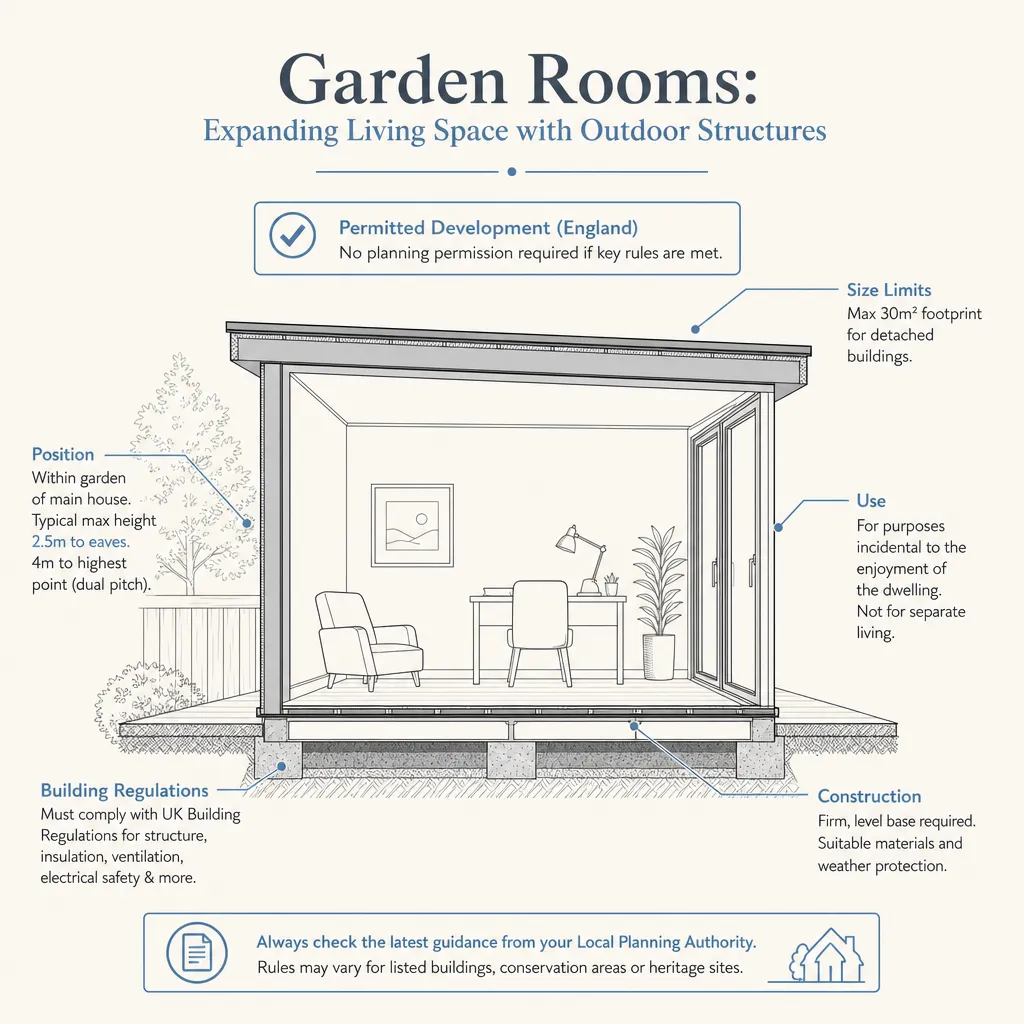
Garden Rooms: Expanding Living Space with Outdoor Structures
Most garden rooms in England qualify as permitted development and do not need planning permission, provided they meet conditions on height, footprint, boundary distances, and position relative to the house.
 Improvement & Build
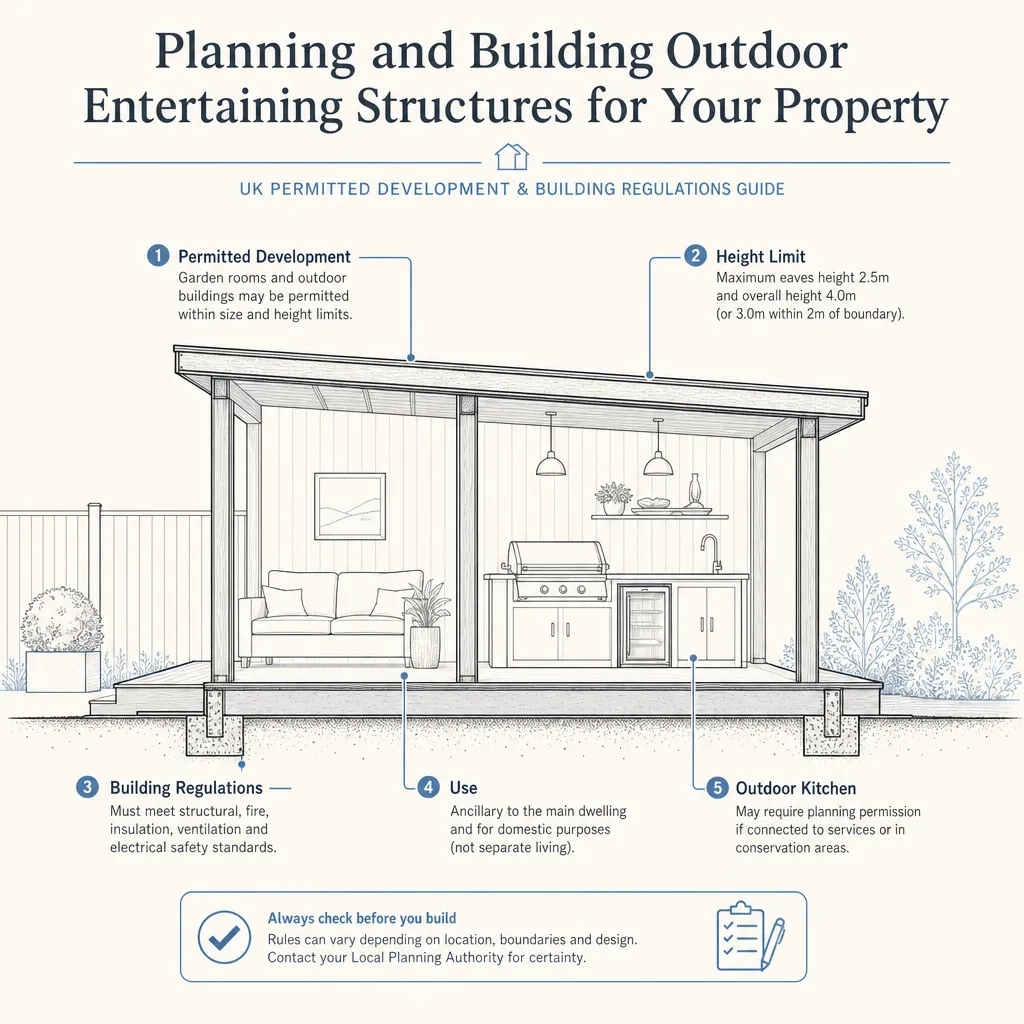
Planning and Building Outdoor Entertaining Structures for Your Property
Most garden rooms, sheds and outdoor entertaining structures fall under permitted development rights in England and need no planning permission, provided they stay within size and height limits, cover under 50% of the garden, and sit behind the main elevation.
 Improvement & Build
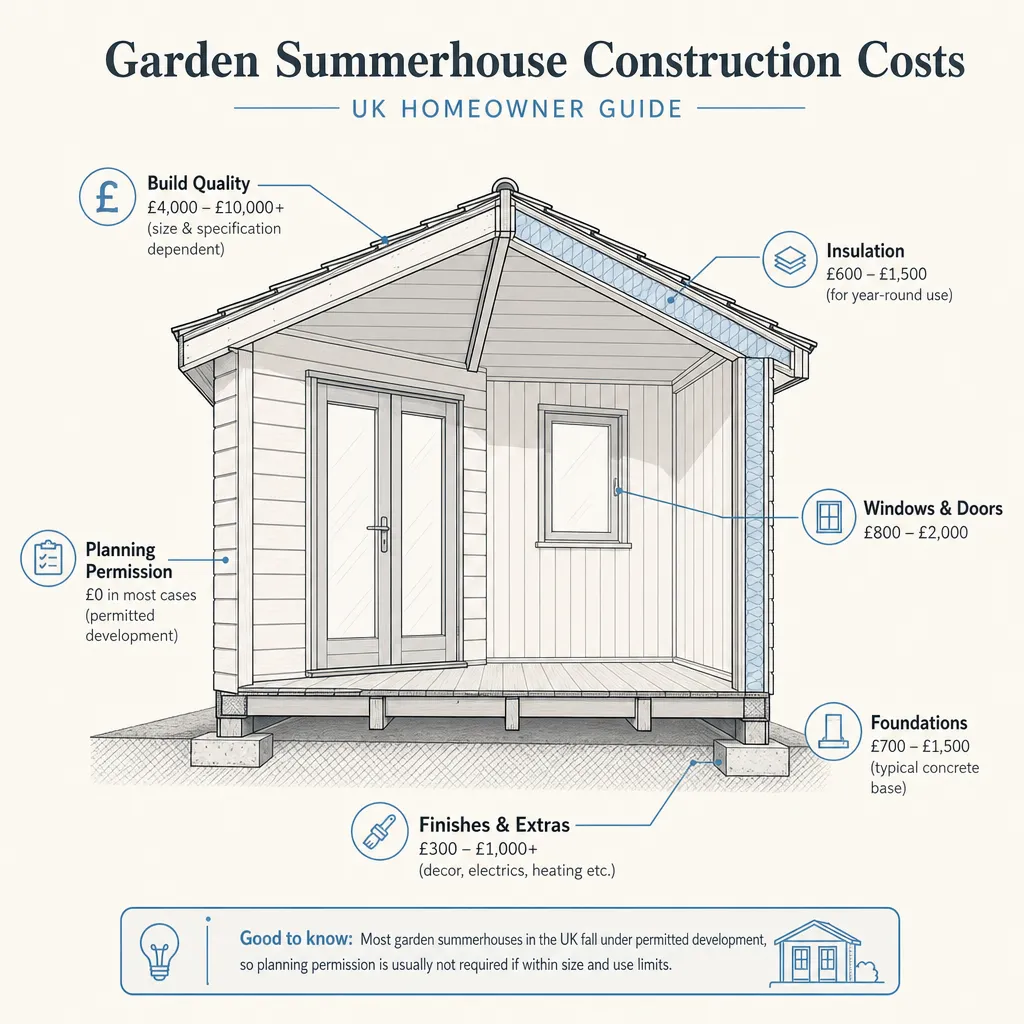
Garden Summerhouse Construction Costs
A garden summerhouse in the UK typically costs £2,000–£5,000 installed for a small standard timber unit, rising to £15,000–£25,000 for a large bespoke insulated garden room.
 Improvement & Build
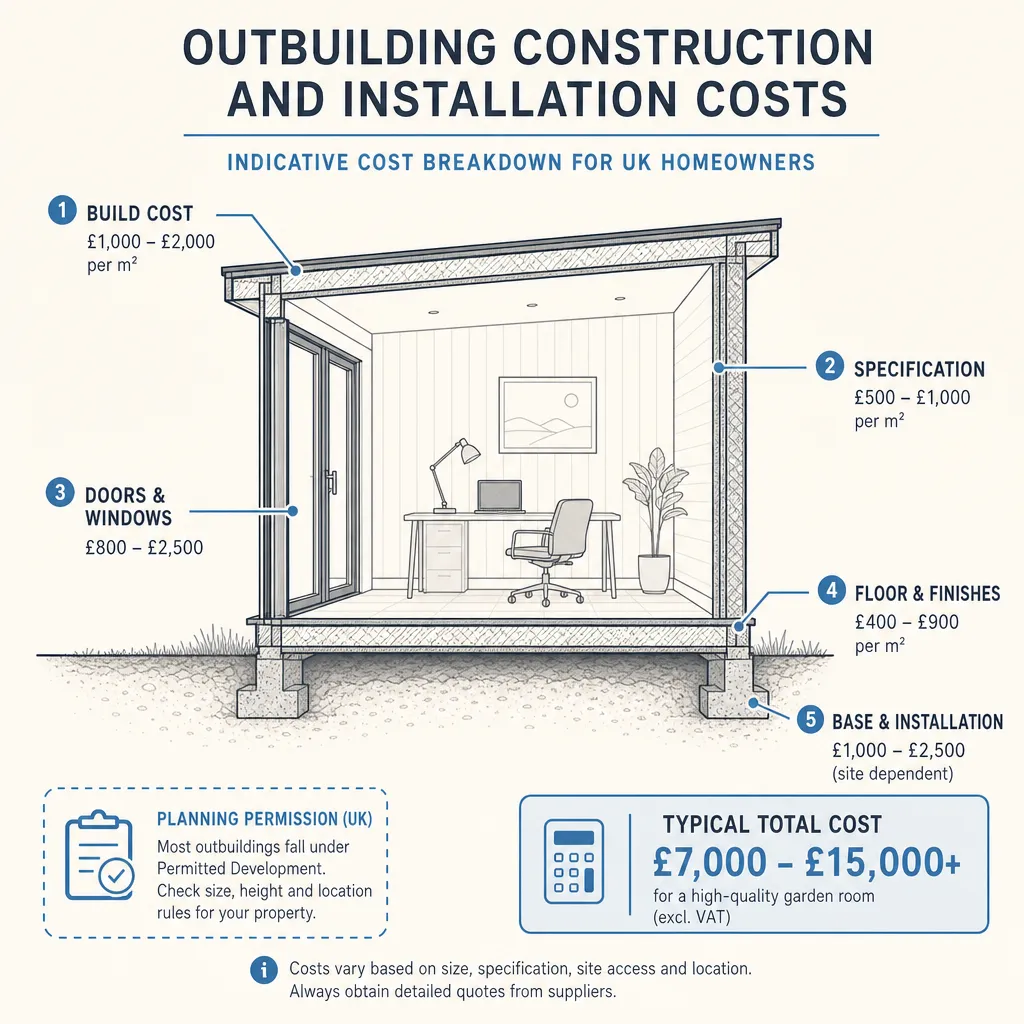
Outbuilding Construction and Installation Costs
Building an outbuilding in the UK typically costs between £5,000 and £60,000+, depending on size, materials, and specification.
 Improvement & Build
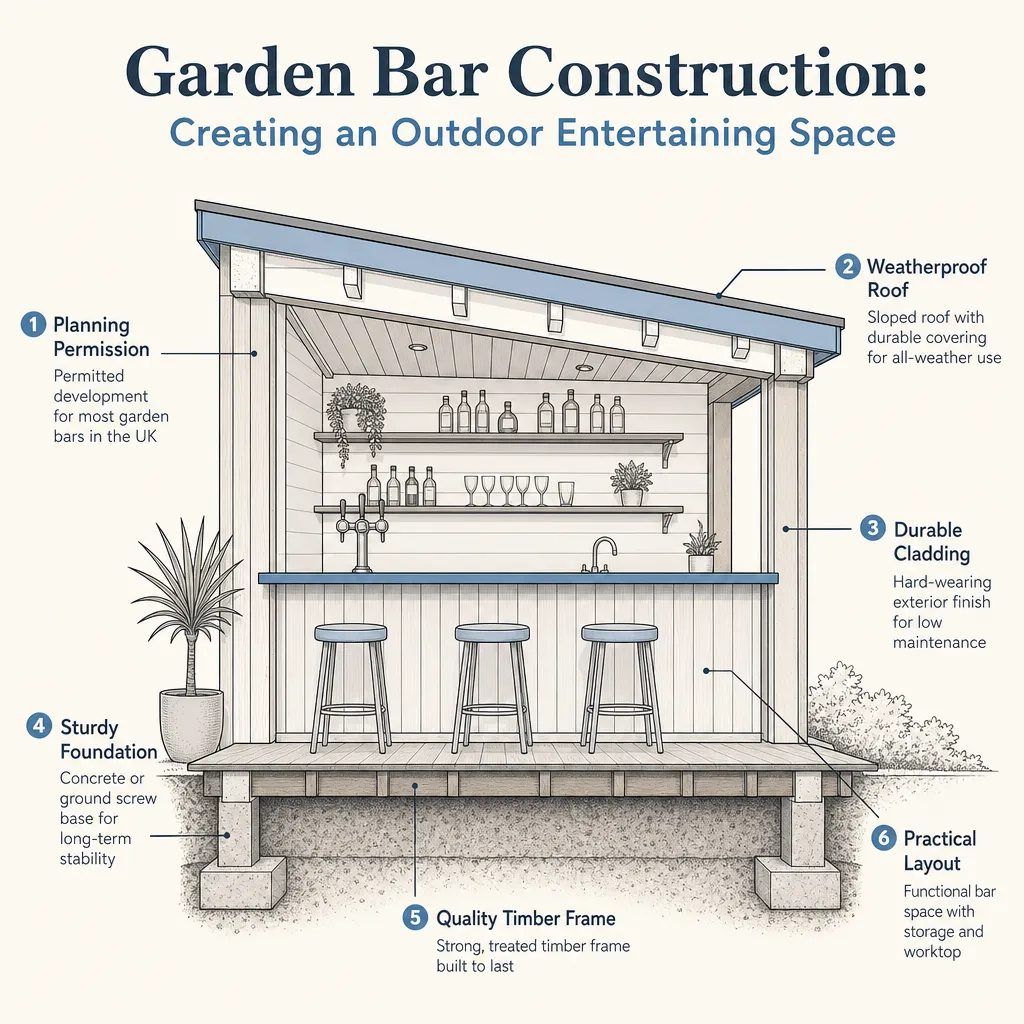
Garden Bar Construction: Creating an Outdoor Entertaining Space
A garden bar built as an outbuilding in England is usually permitted development — no planning permission needed — provided the structure stays within height and footprint limits and is not in a restricted area such as a conservation area or listed building curtilage.