Building a Garden Pond: Costs and Design Considerations
By Housey · Last reviewed 9th of May 2026
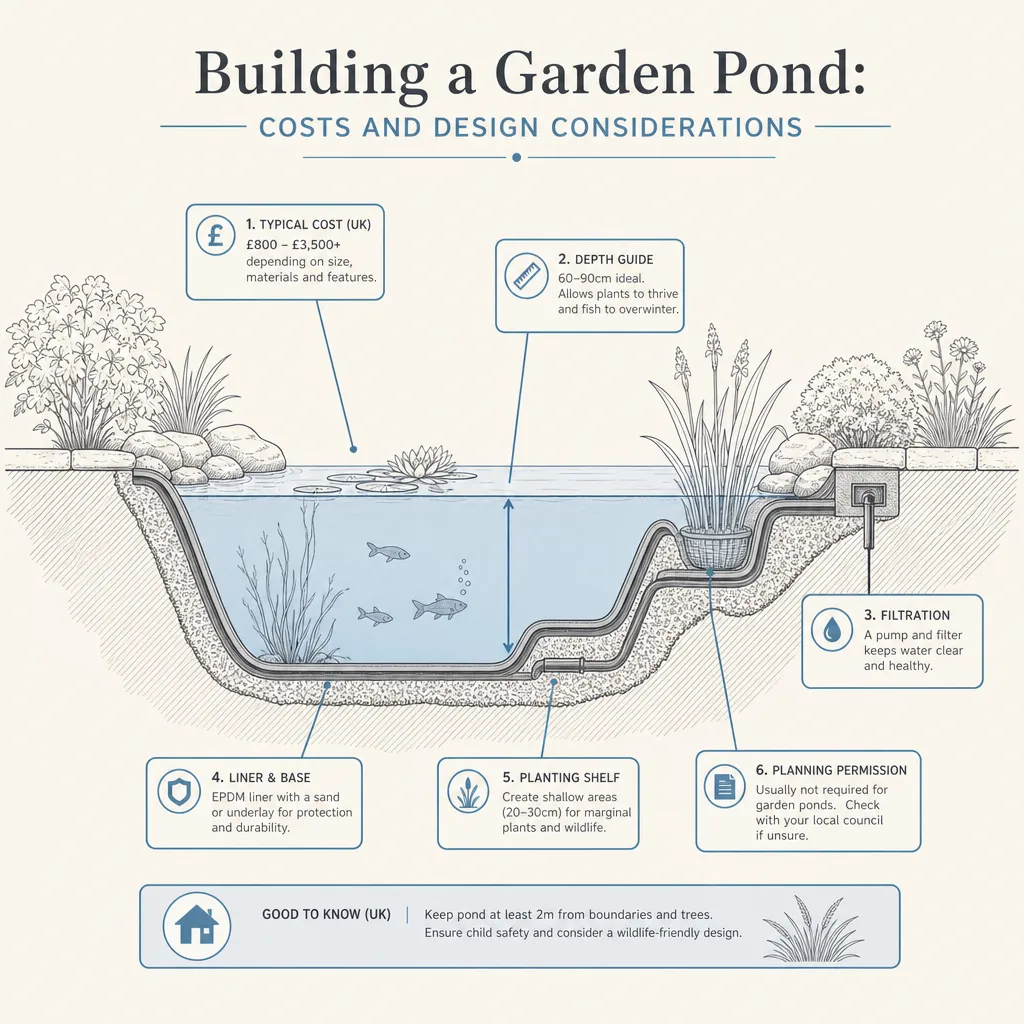
Building a Garden Pond: Costs and Design Considerations
A garden pond can transform an outdoor space, support local biodiversity, and add long-term character to a UK garden. Most homeowners begin thinking about pond construction when redesigning a garden, tackling a larger landscaping project, or when they move to a property where an existing pond needs renovating. The choices made at the design stage — size, depth, lining method, planting, and access for maintenance — significantly affect both the upfront cost and how much enjoyment the pond provides over the years that follow.
Key points
- A basic small garden pond (up to 3 m²) typically costs £500–£2,000 installed; a medium wildlife or ornamental pond (3–10 m²) commonly ranges from £2,000–£6,000; larger or heavily engineered koi ponds can reach £10,000–£30,000+. (Indicative UK costs, last reviewed 2026-05-09.)
- Under the Wildlife and Countryside Act 1981, great crested newts and several other species associated with ponds are legally protected in England — disturbing or destroying their habitat can carry criminal liability, so a preliminary ecological appraisal may be needed before excavation begins.
- Planning permission is not usually required for a garden pond in England under permitted development rights, but conservation areas, Article 4 Directions, and listed building status may all restrict earthworks or require consent.
- A minimum depth of 600mm (ideally 750mm–1m in the deepest part) is recommended in the UK to prevent complete winter freezing and support healthy aquatic ecology year-round.
- Ponds deeper than 600mm near public access areas or in gardens with children should have appropriate edge treatment; home insurance policies may also be affected — inform your insurer before work begins.
What does a garden pond cost in the UK?
Costs vary considerably depending on size, depth, lining method, filtration, planting, and the degree of landscaping integration required.
Pond type | Typical size | Indicative installed cost | Notes |
|---|---|---|---|
Small pre-formed pond | Up to 2 m² / 300–500 litres | £500–£1,500 | Rigid shell; limited design flexibility |
Small liner pond (wildlife) | 2–4 m² | £1,000–£3,000 | Butyl or EPDM liner; naturalistic planting |
Medium ornamental pond | 4–10 m² | £3,000–£7,000 | May include pump, fountain feature, marginal planting |
Large wildlife pond | 10–30 m² | £5,000–£15,000 | Significant excavation; may need a groundwork contractor |
Koi pond (engineered) | Variable | £8,000–£30,000+ | Specialist filtration, bottom drain, UV clarifier required |
Pond renovation or reline | Variable | £1,000–£5,000 | Depends on extent of work and existing condition |
Indicative UK costs, last reviewed 2026-05-09. Obtain current quotes before budgeting.
Key design decisions before you build
Site selection
Choosing the right location significantly affects the long-term success of a pond:
- Sunlight: 4–6 hours of direct sunlight per day supports healthy aquatic planting and helps control algae. Full shade encourages nuisance algae; all-day direct sun can overheat the water and reduce dissolved oxygen to dangerous levels for fish.
- Tree proximity: Avoid positioning a pond beneath deciduous trees — leaf fall enriches water with nutrients, promotes algae blooms, and can deplete oxygen dangerously in autumn. Roots from willows and poplars in particular can puncture liners.
- Ground conditions: Heavy clay soil retains moisture but can be harder to excavate cleanly. Sandy or gravelly ground may require more careful lining. Always check for underground services using the LSBUD (formerly Dial Before You Dig) search tool before any excavation.
- Distance from boundaries: Positioning the pond well away from fences and boundaries simplifies long-term maintenance and avoids potential surface water drainage disputes with neighbours.
Size and depth
The Royal Horticultural Society (RHS) and wildlife charities recommend:
- A minimum depth of 600mm in at least part of the pond to prevent complete freezing during a typical UK winter.
- Graduated shallow margins of 150–300mm to allow amphibians, birds, and hedgehogs to enter and exit safely.
- A surface area of at least 4 m² to support meaningful wildlife ecology; smaller ponds require more intensive management to remain balanced and clear.
Lining options compared
Lining type | Typical lifespan | Relative cost | Best for | Not ideal for |
|---|---|---|---|---|
Butyl rubber liner | 20–30+ years | Mid-range | Wildlife and ornamental ponds; irregular shapes | Koi ponds requiring drain points |
EPDM liner | 20–30+ years | Mid-range | Wildlife ponds; flexible shapes | Formal geometric designs |
Pre-formed fibreglass or rigid plastic | 10–25 years | Lower | Small decorative ponds; quick installation | Large or bespoke shapes |
Reinforced concrete | 30–50+ years | Higher | Koi ponds; formal designs; large feature ponds | Budget projects; informal naturalistic designs |
Bentonite clay liner | 20–50 years | Variable | Very large wildlife or rural ponds | Urban gardens; small residential ponds |
Filtration and pumps
Wildlife ponds managed with good planting generally do not need mechanical pumps or biological filtration. Ornamental ponds with any fish stocking require at minimum a submersible pump and biological filter to maintain water clarity and fish health. Koi ponds need engineered systems including multi-chamber biological filtration, UV clarifiers, and bottom drains — these are specialist installations and should be designed by a koi pond contractor.
Which professionals might you need?
Stage | Professional | Why |
|---|---|---|
Garden layout and pond design | Garden designer | Integrates the pond with planting, levels, and overall garden layout |
Excavation and earthworks | Groundworker or landscaper | Safe, level excavation; spoil removal and disposal |
Liner installation and edging | Specialist pond contractor or experienced landscaper | Correct liner installation prevents early failure |
Ecological assessment | Ecologist | Required if great crested newts or other protected species may be present |
Koi filtration design | Koi pond specialist | Bespoke system design for fish health and water quality |
Planning permission and legal considerations
Most garden ponds in England do not require planning permission under permitted development rights. However, there are circumstances where consent may be needed or legal duties apply:
- Conservation areas: Significant earthworks may require planning consent. Check with your local planning authority (LPA) before starting any groundworks.
- Listed buildings: Any alteration to the curtilage (the land surrounding a listed building) may require listed building consent, even for landscaping works.
- Protected species: If the garden or adjacent land might support great crested newts, water voles, or other pond-associated protected species, a preliminary ecological appraisal should be commissioned before excavation begins. Under the Wildlife and Countryside Act 1981, disturbing or damaging their habitats can constitute a criminal offence.
- Surface water drainage: A pond should not be positioned or constructed in a way that redirects surface water run-off onto neighbouring land.
- Home insurance: Notify your insurer before installing a large pond. Some policies may require confirmation of safe edge treatment, especially where children have access to the garden.
What to ask before accepting a quote
- What exactly is included in the scope — excavation, liner, underlay, edging, planting, and initial fill?
- What lining material and thickness is specified, and what warranty does the manufacturer offer?
- How will excavated spoil be disposed of, and is that cost included in the quote?
- Is the price based on assumed ground conditions — and what happens if something different is found during excavation?
- If a pump and filter are included, what ongoing maintenance do they require, and who supplies spare parts?
- Is VAT included?
- What guarantees or warranties are offered on the completed installation?
Which type of pond is right for you?
- Choose a pre-formed pond if you want a quick, low-cost installation in a small space and can work within a standard shape.
- Choose a butyl or EPDM liner pond if you want flexibility in shape and size, or plan to manage the pond primarily as a wildlife feature with naturalistic planting.
- Choose a concrete or engineered pond if you plan to keep koi, want a formal geometric design, or need the pond to integrate with hard landscaping such as decking or paving.
- Ask a specialist pond contractor or ecologist if the site may be used by protected species, or if you are planning a pond larger than 30 m².
- Check with your local planning authority if the property is listed, in a conservation area, or if the proposed earthworks are substantial.
When to get professional help
A small wildlife pond installed by a competent landscaper or as a careful DIY project is achievable for many homeowners. Involve professionals when:
- The proposed pond is larger than approximately 6 m² or deeper than 1 m, where excavation becomes more complex.
- You are in an area where great crested newts or other protected species may be present — an ecological check should precede any ground-breaking.
- The property is listed or in a conservation area.
- You want koi or significant fish stocking, where specialist filtration design is essential for fish health.
- Underground services or poor ground drainage make safe excavation uncertain.
How Housey can help
Housey can connect you with experienced garden designers to help plan a pond that works with your overall garden layout and planting scheme. For excavation, lining, and edging, you can request quotes from landscapers through the platform. For larger ponds requiring significant earthworks, vetted groundworkers are also available.
Frequently asked questions
Do I need planning permission for a garden pond in the UK?
In most cases, no — building a garden pond falls within permitted development rights in England and does not require planning permission. However, if your property is listed, in a conservation area, or if the works involve significant alteration to ground levels, check with your local planning authority before starting. Rules in Scotland and Wales may differ from those in England.
How deep should a UK garden pond be?
A minimum depth of 600mm in the deepest part is widely recommended to prevent complete freezing during a typical UK winter. For wildlife ponds, a graduated depth profile — with shallow margins of 150–300mm alongside a central zone of 750mm–1m — supports a wider range of species and provides important refuge for frogs, newts, and other amphibians throughout the year.
How long does it take to build a garden pond?
A small to medium liner pond typically takes 2–5 days to excavate, line, edge, and fill, though this varies with size, access, and ground conditions. A large engineered koi pond with concrete construction and specialist filtration may take several weeks. Allow additional weeks for aquatic plants to establish and for the water to mature biologically before introducing any fish.
How do I keep a garden pond clean without chemicals?
Good pond ecology reduces the need for chemical treatments. Plant marginal and submerged oxygenating species such as hornwort or water crowfoot. Avoid overfeeding fish and remove excess leaf fall in autumn. A barley straw float can help control algae naturally. If fish are present at any significant density, a biological pump and filter system is a more reliable long-term solution than manual or chemical intervention.
Sources and further reading
- Wildlife and Countryside Act 1981 — legislation.gov.uk
- Great crested newts: surveys and mitigation — Natural England / GOV.UK
- RHS: Ponds and water features — Royal Horticultural Society
- Permitted development rights for householders: technical guidance — GOV.UK
- LSBUD: check for underground services before you dig — LSBUD
Useful next reads
 Improvement & Build
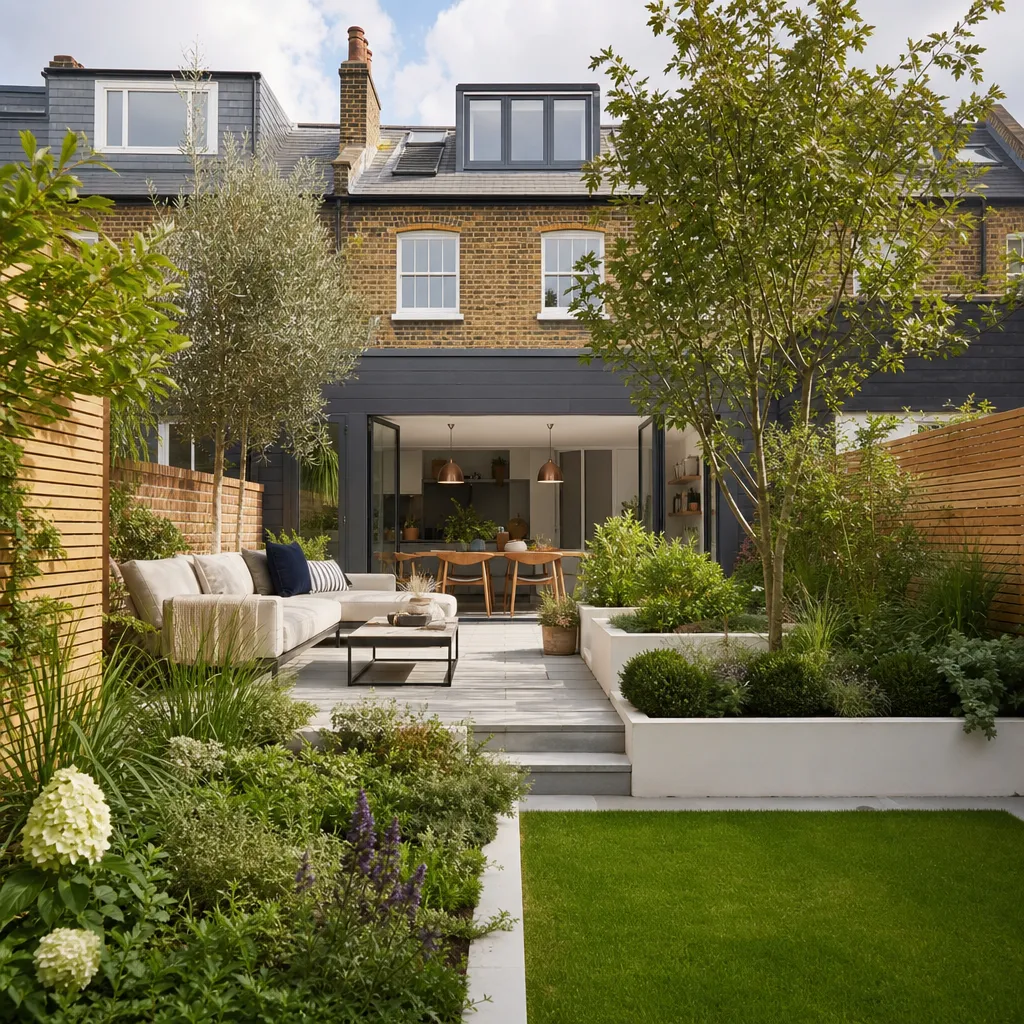
Seasonal Garden Transformations and Outdoor Design Ideas
A successful garden transformation in the UK works with the seasons rather than against them — establishing structure and hard landscaping in autumn or winter, planting in spring, and enjoying the results through summer.
 Improvement & Build
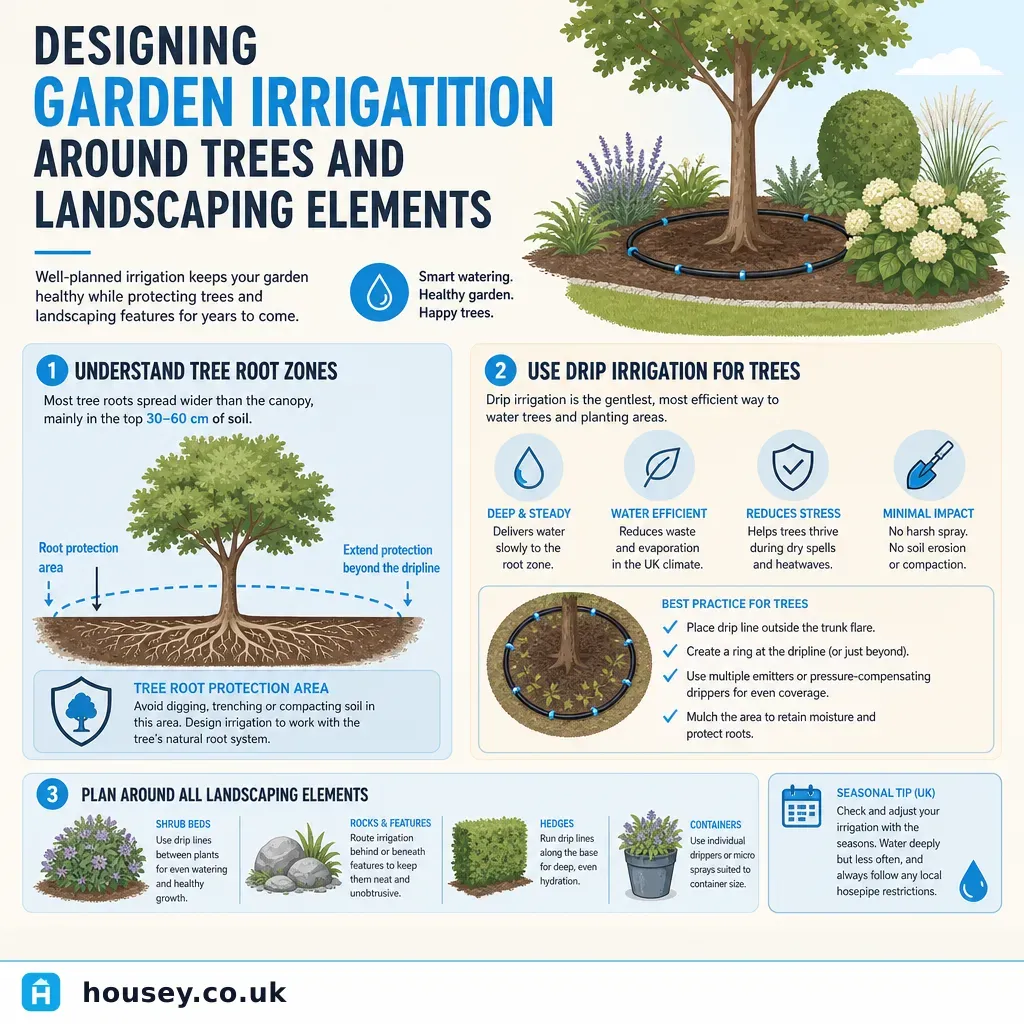
Designing Garden Irrigation Around Trees and Landscaping Elements
Design irrigation around trees by respecting the root protection area defined under BS 5837:2012, using drip or leaky pipe delivery rather than spray heads, and putting the tree zone on its own circuit.
 Improvement & Build
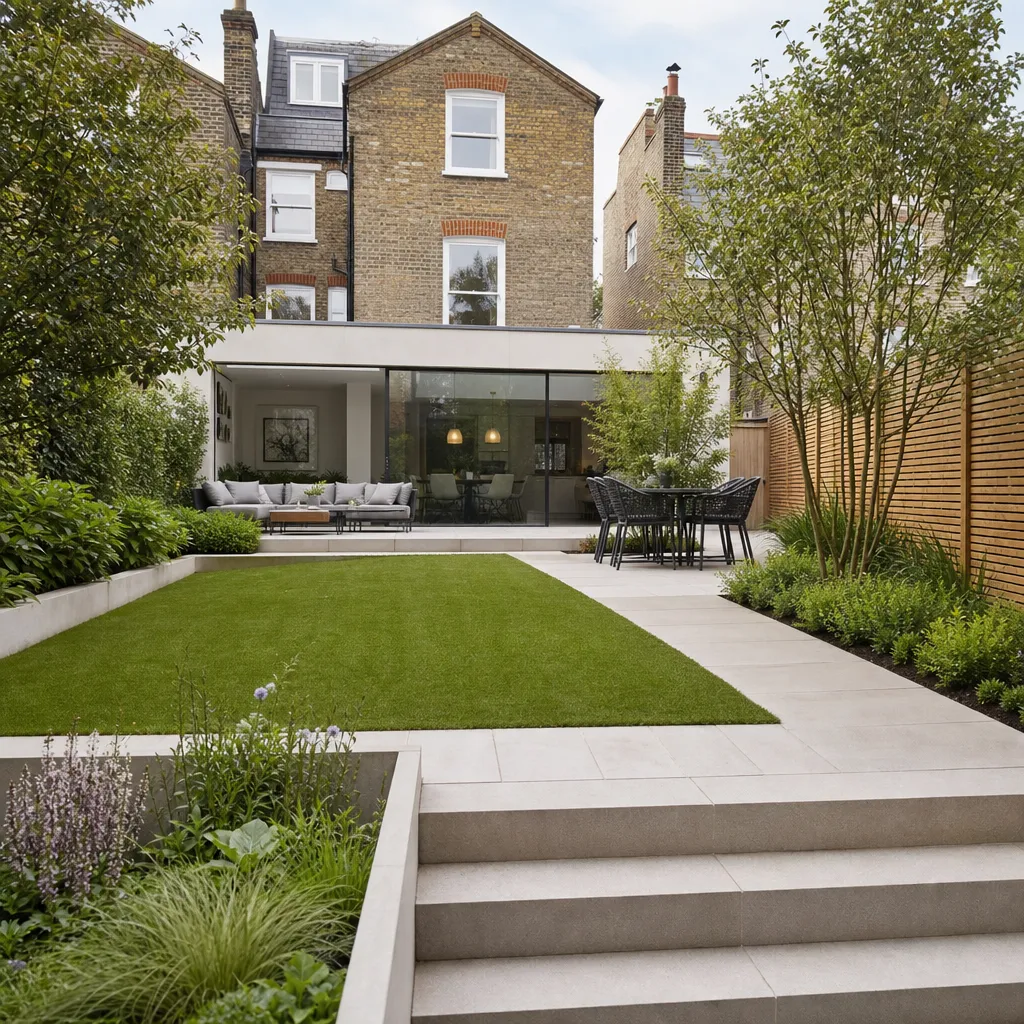
Garden Design Trends and Contemporary Landscaping Ideas
Contemporary UK garden design centres on low-maintenance naturalistic planting, multi-functional outdoor spaces, sustainable hard landscaping materials, and wildlife-friendly rewilded areas.
 Improvement & Build
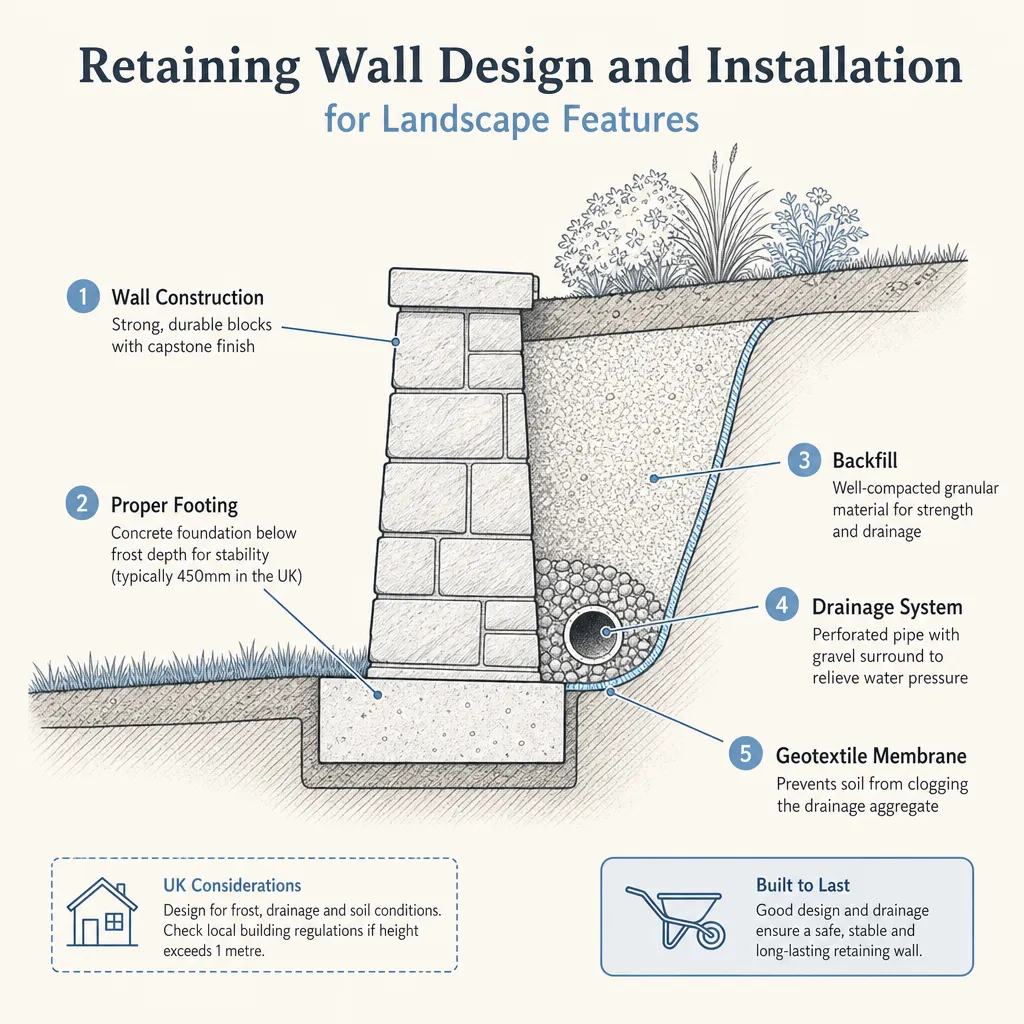
Retaining Wall Design and Installation for Landscape Features
A garden retaining wall holds back soil on a sloped plot using concrete blocks, stone, or timber.
 Improvement & Build
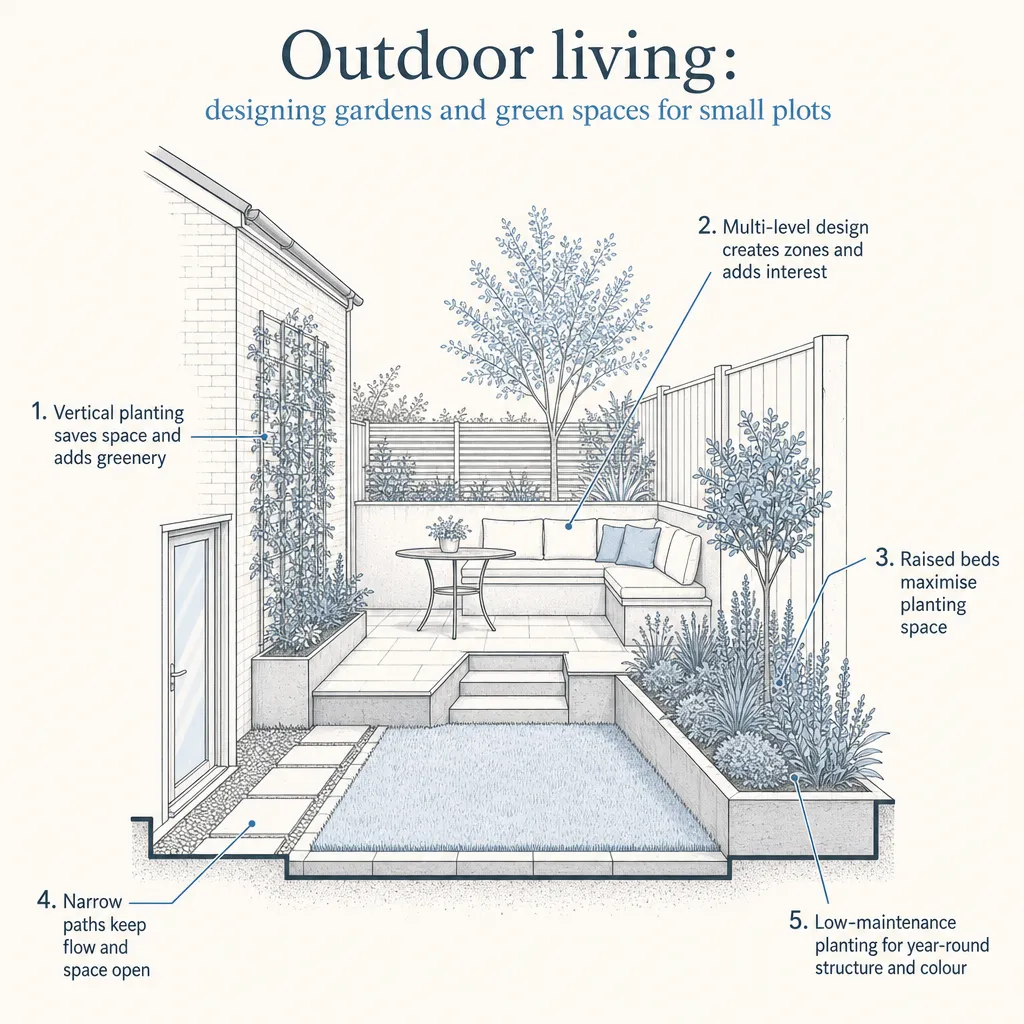
Outdoor living: designing gardens and green spaces for small plots
Small plots work best when divided into defined zones — seating, planting, and utility — before materials are chosen.