Retaining Wall Design and Installation for Landscape Features
By Housey · Last reviewed 1st of June 2026
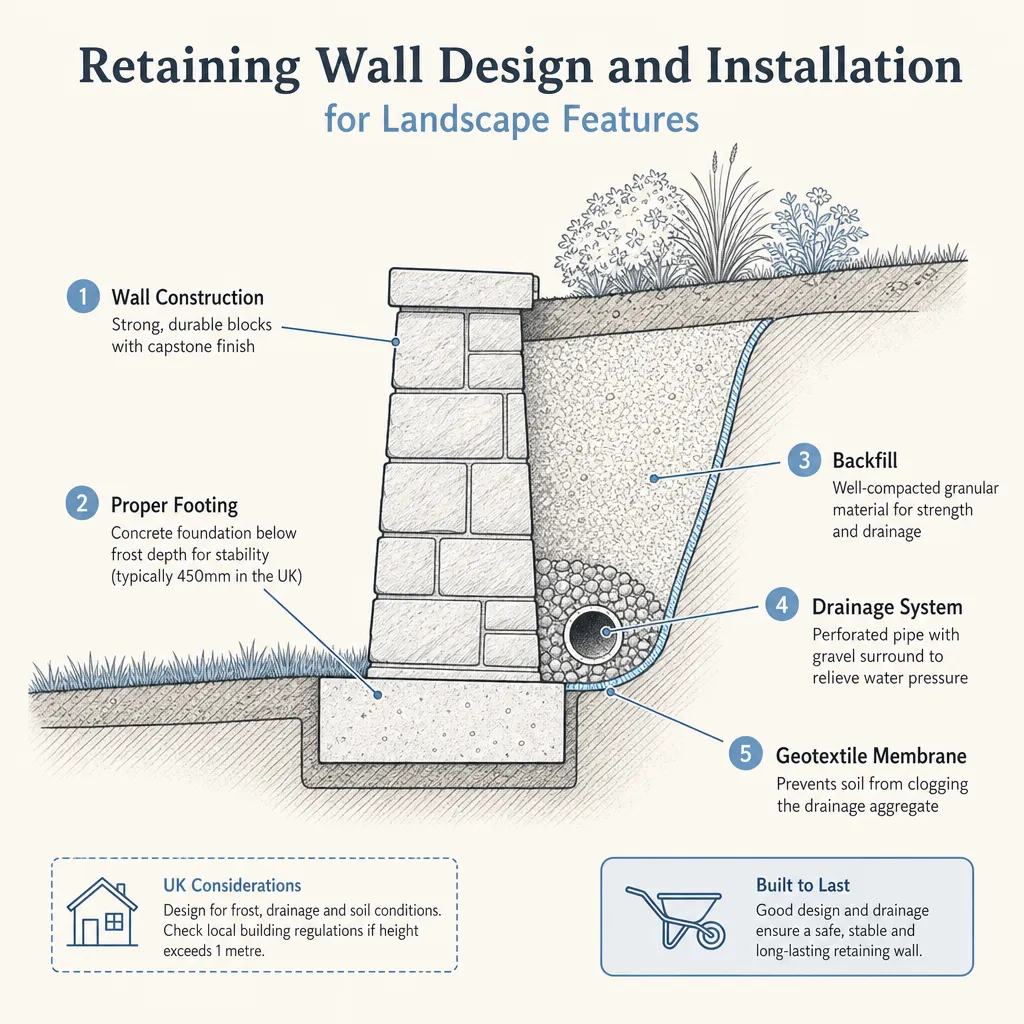
Retaining Wall Design and Installation for Landscape Features
Sloped gardens are among the most challenging plots to work with in the UK — and retaining walls are often the most effective way to convert an awkward gradient into usable, attractive terraces. Whether you are creating a level lawn on a hillside plot, building a raised kitchen garden beside a 1930s semi, or stabilising a bank that has been slowly encroaching on a Victorian terrace's borders, the design and installation of a retaining wall involves considerably more than stacking materials in a line. The wall must cope with soil pressure, water movement, and loading conditions that vary with every site.
Key points
- Retaining walls over 1 m high next to a highway, or forming part of a building's structure, may require Building Regulations approval under Approved Document A (Structure).
- Planning permission is generally not required for garden retaining walls under 1 m from a road or under 2 m elsewhere, but conservation areas, listed building curtilages, and Article 4 directions can remove permitted development rights.
- Drainage behind the wall — typically a French drain, granular backfill, and weep holes at approximately 900 mm centres — is essential to prevent hydrostatic pressure that can cause wall failure.
- Timber sleeper walls typically last 15–25 years; correctly installed concrete block or natural stone walls can last 50 years or more.
- A geotextile membrane between drainage backfill and retained soil reduces silting and helps maintain drainage performance over time.
Choosing the right retaining wall material
The material you choose affects cost, longevity, appearance, and the skill level required to install it correctly. No single material suits every situation — the right choice depends on wall height, soil type, garden style, and budget.
Material | Best for | Not ideal for | Typical lifespan | Main risk if wrong |
|---|---|---|---|---|
Timber sleepers | Low walls, informal gardens, raised beds | Walls over 1 m, wet soils, long-term use | 15–25 years | Rot, movement, collapse on taller walls |
Concrete block (modular walling) | Medium-height walls, clean contemporary look | Period or rural gardens | 50+ years | Cracking if drainage is poor |
Natural stone (dry-stone or mortared) | Rural, period, or cottage-style gardens | Tight budgets, sheer vertical faces | 50–100+ years | Expensive to repair if undermined |
Gabion baskets | Informal aesthetic; good inherent drainage | Formal or period settings | 30–50 years | Rust, wire failure over time |
Reinforced concrete (poured) | High walls, significant loads, structural use | Small decorative features | 50+ years | Specialist design required; higher cost |
Indicative guidance only. Material suitability depends on site conditions. Confirm with a qualified landscaper or structural engineer for walls over 600 mm.
Planning permission and Building Regulations
Most domestic garden retaining walls do not require planning permission under the Town and Country Planning (General Permitted Development) (England) Order 2015. Permitted development rights allow walls and fences up to 1 m high adjacent to a highway, or up to 2 m elsewhere — but these rights are not universal.
You may need to check whether:
- Your property is in a conservation area or the curtilage of a listed building — permitted development limits are stricter, and Listed Building Consent may be needed.
- An Article 4 direction has removed permitted development rights in your area. Check with your local planning authority (LPA).
- The wall forms part of a boundary with a neighbouring property — the Party Wall etc. Act 1996 may apply if excavation is required close to the boundary line.
Building Regulations under Approved Document A (Structure) may apply to walls over 1 m, particularly where they support a significant load or adjoin a highway. Your contractor or local building control body can advise whether a formal application is required.
How drainage makes or breaks a retaining wall
Poor drainage is the most common cause of retaining wall failure in UK gardens. When water cannot escape from behind the wall, hydrostatic pressure builds — sometimes to the point of pushing the wall forward or causing it to overturn.
Good drainage practice includes:
- Granular backfill (typically 20 mm clean stone) directly behind the wall face to allow water to move freely downward.
- French drain or perforated pipe at the base of the wall, running to a soakaway or suitable outfall.
- Weep holes in mortared or block walls — typically at 900 mm centres in the lowest course — to allow water to escape through the face of the wall.
- Geotextile membrane between the retained soil and drainage backfill to prevent silting over time.
In clay-heavy soils — common across much of the English Midlands and south-east — drainage design is especially critical. A landscaper or drainage contractor experienced with clay soils should be involved in the specification.
Deciding which retaining wall suits your garden
Use this guide to narrow down the right approach for your situation:
- Choose timber sleepers if the wall is under 600 mm, the garden style is informal or rural, and the budget is limited. Expect to replace within 20 years in consistently wet conditions.
- Choose concrete block or modular walling if you want a clean, long-lasting finish, the wall is between 600 mm and 1.5 m, and maintenance needs to be minimal.
- Choose natural stone if the property is period, rural, or in a conservation area and appearance is a priority. Budget accordingly — dry-stone and mortared stonework is a specialist craft.
- Choose gabion baskets if drainage is a significant concern or the design calls for an informal, textured aesthetic.
- Consult a structural engineer if the wall will be over 1.5 m high, is supporting a loaded area such as a driveway, building foundation, or significant slope, or if there is any doubt about ground stability.
- Check with your local planning authority if the property is in a conservation area, the curtilage of a listed building, or subject to an Article 4 direction.
Before work starts: homeowner checklist
Before briefing a contractor, confirm the following:
What to ask before accepting a quote
A retaining wall quote should be detailed. Ask each contractor:
- What foundation depth and type are you specifying, and why?
- What drainage system is included — French drain, weep holes, geotextile membrane?
- What material will be used for backfill?
- Is VAT included in the quoted price?
- Who will check for underground services before excavation begins?
- What guarantee do you offer on the wall structure and drainage?
- Will you obtain any required Building Regulations approval, and is that cost included?
- What could change the quoted price once excavation starts?
When to get professional help
Most retaining walls above 600 mm are best designed and built by a qualified professional. Seek expert input if:
- The wall will be more than 1 m high, particularly near a highway, driveway, or building.
- The slope above is significant, or the soil is unstable, waterlogged, or clay-heavy.
- There are signs of existing ground movement on the site.
- The wall is close to a neighbouring property's boundary.
- You are in a conservation area or the curtilage of a listed building.
- Previous walls on the same site have failed or moved.
How Housey can help
Housey connects homeowners with vetted landscapers, groundworkers, drainage contractors, and garden designers who can assess your plot, design an appropriate retaining structure, and manage installation from excavation to completion. Submit a single quote request to receive up to four competitive quotes from local professionals.
Frequently asked questions
Do I need planning permission for a retaining wall in my garden?
In most cases, no. Permitted development rights in England allow walls up to 1 m adjacent to a highway and up to 2 m elsewhere without planning permission. However, these rights can be restricted in conservation areas, listed building curtilages, and areas subject to an Article 4 direction. Always check with your local planning authority before starting work.
How deep should retaining wall foundations be?
A common rule of thumb is to bury roughly one-third of the total wall height below ground. Clay soils, loose fill, or taller walls may require deeper or wider footings. Your landscaper or groundworker should specify foundation dimensions based on a site assessment rather than a generic formula.
Can I build a retaining wall myself?
Low decorative walls under 600 mm in stable, well-drained conditions can be manageable as a DIY project with landscaping experience. For anything taller, adjacent to a building or boundary, on clay or unstable ground, or supporting a significant load, professional installation is strongly recommended. Poor drainage or construction can lead to costly failure.
What is the typical cost of a retaining wall in the UK?
Costs vary widely by material, height, length, drainage requirements, and site conditions. Indicative UK costs, last reviewed 2026-06-01: roughly £150–£350 per linear metre for timber sleepers, £250–£500 for concrete block, and £400–£900+ for natural stone, including drainage. These are indicative figures only — obtain itemised quotes from at least three contractors.
Sources and further reading
- Planning Portal — Fences, gates and garden walls — Planning Portal
- Approved Document A: Structure — HM Government
- Party Wall etc. Act 1996 — Explanatory Booklet — HM Government
- Linesearch Before U Dig (LSBUD) — Safe digging guidance
- Historic England — Conservation areas — Historic England
Useful next reads
 Improvement & Build
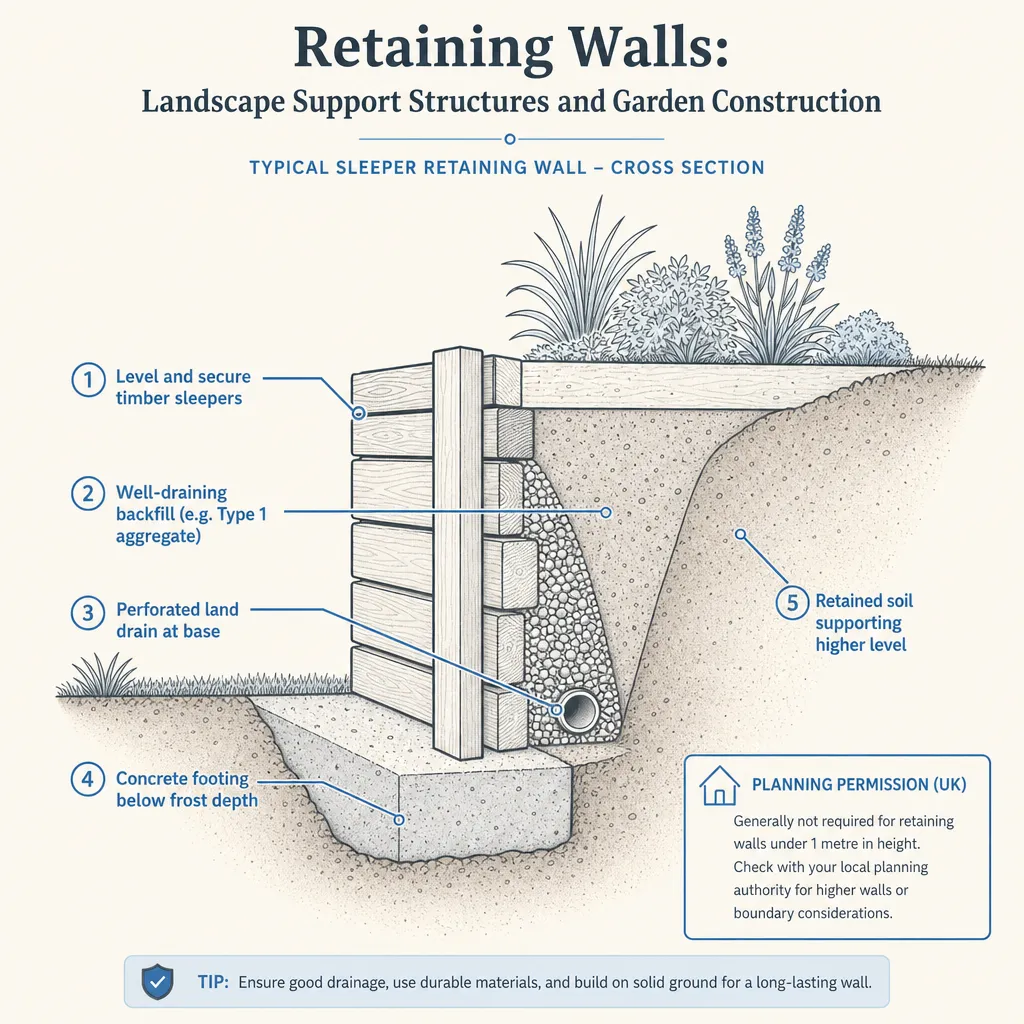
Retaining Walls: Landscape Support Structures and Garden Construction
A domestic retaining wall under 1 metre in height, away from buildings and boundaries, can usually be built by a landscaper or groundworker without structural calculations.
 Improvement & Build
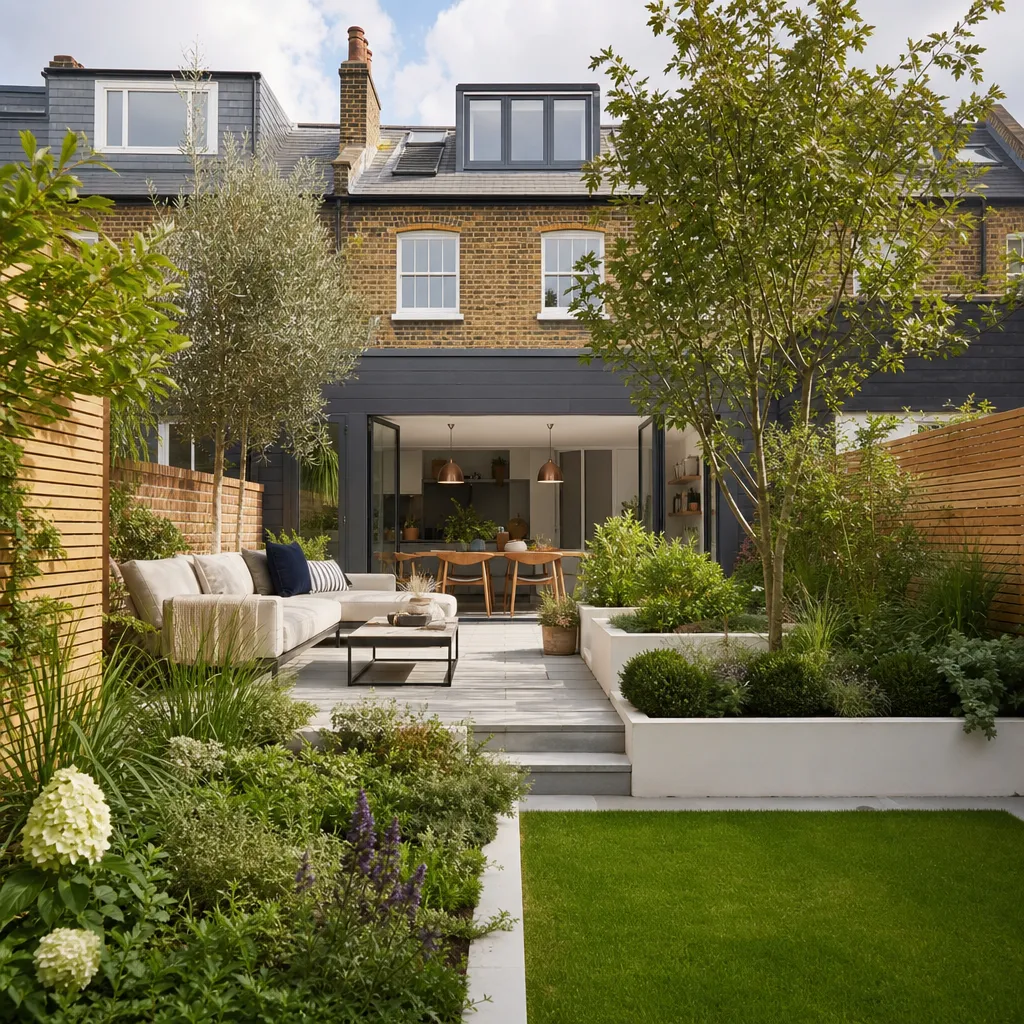
Seasonal Garden Transformations and Outdoor Design Ideas
A successful garden transformation in the UK works with the seasons rather than against them — establishing structure and hard landscaping in autumn or winter, planting in spring, and enjoying the results through summer.
 Improvement & Build
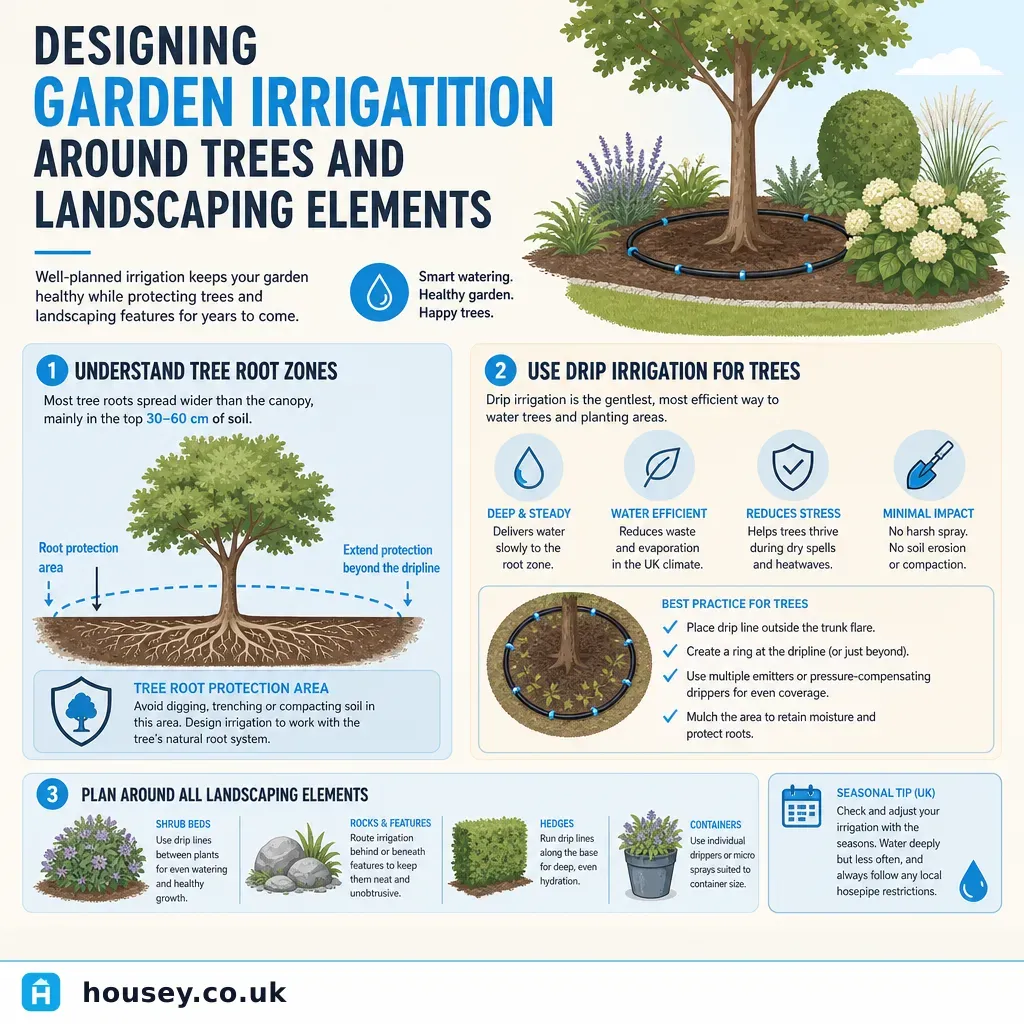
Designing Garden Irrigation Around Trees and Landscaping Elements
Design irrigation around trees by respecting the root protection area defined under BS 5837:2012, using drip or leaky pipe delivery rather than spray heads, and putting the tree zone on its own circuit.
 Improvement & Build
Garden Design Trends and Contemporary Landscaping Ideas
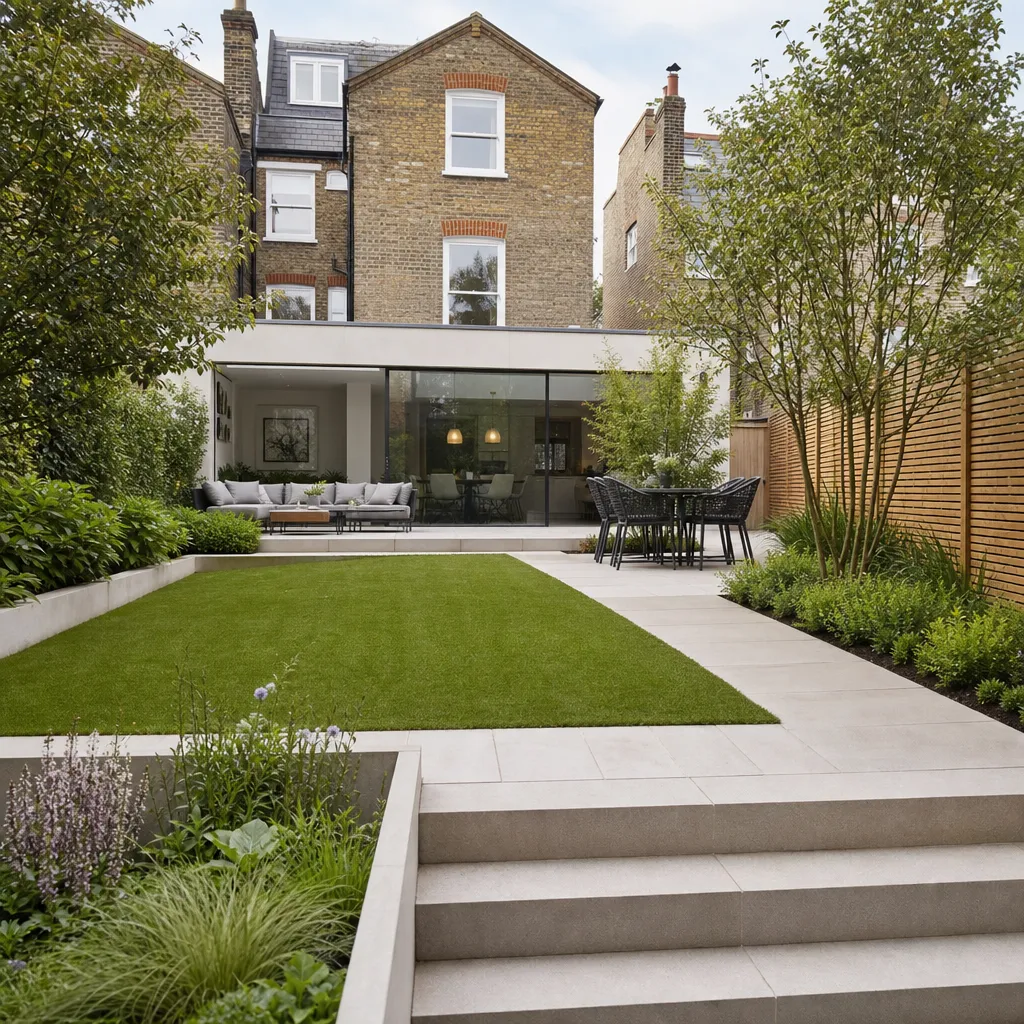
Contemporary UK garden design centres on low-maintenance naturalistic planting, multi-functional outdoor spaces, sustainable hard landscaping materials, and wildlife-friendly rewilded areas.
 Improvement & Build
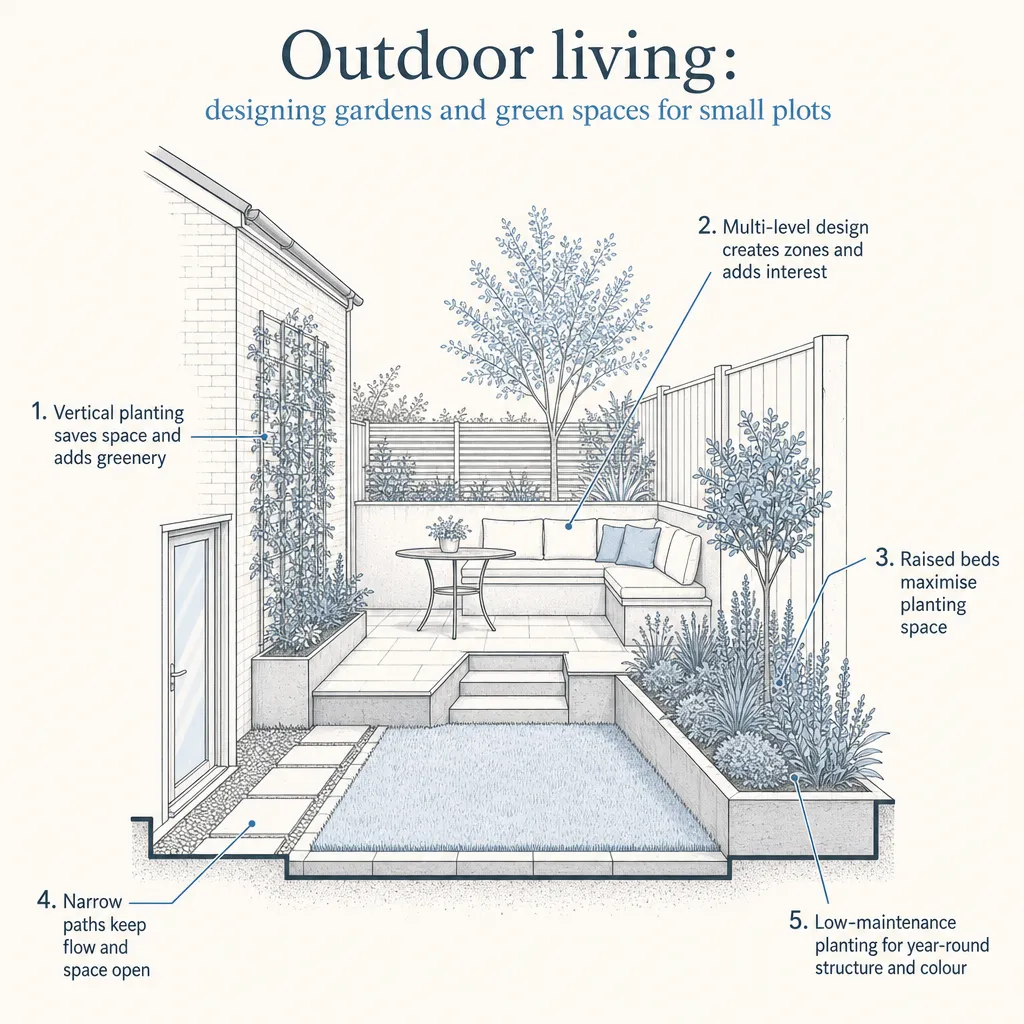
Outdoor living: designing gardens and green spaces for small plots
Small plots work best when divided into defined zones — seating, planting, and utility — before materials are chosen.