Designing Garden Irrigation Around Trees and Landscaping Elements
By Housey · Last reviewed 30th of May 2026
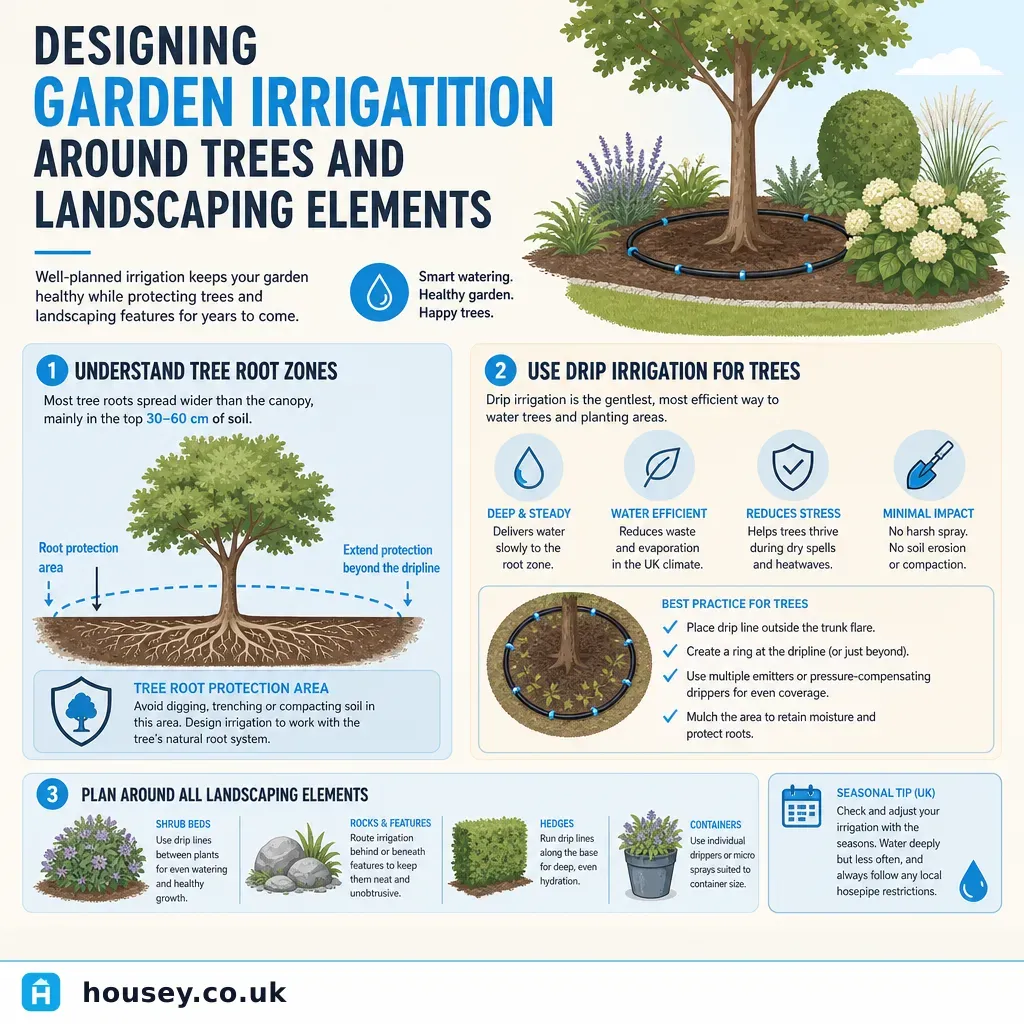
Designing Garden Irrigation Around Trees and Landscaping Elements
Planning an irrigation system in a mature or mixed garden is a more layered task than setting up watering in a simple lawn or border. Trees introduce competing root systems, variable water demands, and soil conditions that differ markedly from surrounding beds, while hard landscaping elements such as paths, raised borders, pergolas, and retaining walls add routing and installation complications. Getting the design right from the outset saves water, avoids root damage, and keeps the system functioning reliably through long UK dry spells.
Key points
- Root protection areas (RPAs) under BS 5837:2012 are calculated at 12 times the trunk diameter — this is the zone within which irrigation trenching can cause damaging root compaction or severance.
- Separate irrigation zones for trees, shrubs, lawns, and containers are recommended because each plant type has different water requirements and optimal delivery rates.
- Leaky pipe (seep hose) and drip emitter systems suit established UK garden beds and tree zones better than spray heads, which waste water to evaporation and can waterlog surface soils.
- Any automatic irrigation system connected directly to the mains must include an approved backflow prevention device under Regulation 6 of the Water Supply (Water Fittings) Regulations 1999.
- Temporary use bans (TUBs) issued under the Water Industry Act 1991 can restrict automatic irrigation during drought — check your water company's current restrictions before programming your system.
Understanding root zones before you dig
Tree root protection areas
Before laying any irrigation pipe near established trees, identify the root protection area (RPA) — the ground surface above the root system most critical for the tree's health. BS 5837:2012 (Trees in relation to design, demolition and construction) defines the default formula as:
RPA radius = trunk diameter (measured at 1.5 m height) x 12
For example, a tree with a 25 cm trunk diameter has an RPA radius of 3 metres. Trenching, pipe installation, or significant soil compaction within this zone risks severing or crushing feeder roots that the tree depends on for water and nutrient uptake.
Practical guidance within and near the RPA:
- Where pipe routing is unavoidable within the RPA, use directional drilling or careful hand-digging rather than mechanical trenching.
- Avoid pop-up sprinklers within the RPA — sustained wet surface conditions can encourage collar rot and fungal disease in susceptible species.
- If trees are significant, covered by a Tree Preservation Order (TPO), or within a conservation area, consult a qualified arboriculturist (member of the Arboricultural Association) before any excavation near or within the RPA.
Choosing the right irrigation method for each zone
Zone | Recommended system | Why it suits this zone | Avoid |
|---|---|---|---|
Established trees | Drip emitters or leaky pipe at root zone perimeter | Low-pressure slow delivery; minimal soil disturbance | Pop-up sprinklers (surface saturation, collar rot risk) |
Shrub and mixed borders | Leaky pipe or drip lines buried 50–100 mm | Even moisture across root area; low evaporation | Overhead spray on dense planting (disease risk) |
Lawn areas | Pop-up rotary or fixed sprinklers | Even coverage across open ground | Leaky pipe (uneven distribution on turf) |
Raised beds and containers | Drip emitters on timers | Precise delivery; less risk of overwatering | Broadcast sprinklers (wasteful; waterlogging risk) |
Newly planted trees (first 2–3 seasons) | Slow-release watering bags or drip emitters | Concentrated delivery to root ball during establishment | Broadcast sprinklers (water rarely reaches root ball) |
Indicative guidance; actual choice depends on soil type, slope, plant species, and mains pressure.
Routing pipes around hard landscaping
Hard landscaping — patios, pathways, driveways, raised walls — complicates pipe routing but can usually be accommodated with forethought:
- Sleeves under hard surfaces: when a patio or path is being laid, install conduit sleeves (typically 50 mm diameter plastic pipe) beneath the surface at regular intervals to allow irrigation pipes to pass through later without breaking out the finished surface.
- Raised beds: run drip lines along the inside base of raised bed walls before filling with compost. Secure lines to prevent disturbance during planting and cultivation.
- Retaining walls: avoid running supply pipes through wall footings. Route along the wall's top or via a defined sleeve at a single point, and ensure any penetration is waterproofed to prevent moisture ingress into the structure.
- Tree pits in paved areas: subsurface tree pit systems with structural cells and an integrated irrigation inlet pipe allow water delivery directly to the root zone without disturbing the pavement surface — a worthwhile investment for formal or urban garden settings.
Mains connection and legal requirements
Any automatic irrigation system connected directly to the mains water supply must include an approved backflow prevention device. This is a legal requirement under the Water Supply (Water Fittings) Regulations 1999. The minimum protection level for irrigation systems delivering water at or below ground level is typically a double check valve or a reduced pressure zone (RPZ) valve, depending on the assessed contamination risk. Your water company can confirm the required protection category for your specific installation.
Backflow prevention devices should be installed and tested by a competent plumber or specialist irrigation contractor. An incorrectly fitted device can allow contaminated garden water to re-enter the potable supply.
Programme controllers to water during early morning hours to reduce evaporation, minimise leaf scorch, and lower fungal disease risk compared with evening watering.
What to ask before hiring an irrigation contractor
- Are you a member of the Irrigation Association UK or the Chartered Institute of Horticulture?
- Will you provide a zoning plan showing separate circuits for trees, shrubs, and lawns?
- How will you handle pipe routing near tree RPAs, and will you check BS 5837:2012 RPA calculations before any excavation?
- What backflow prevention device will you fit, and is it compliant with the Water Supply (Water Fittings) Regulations 1999?
- Is commissioning and a test run included in the price, and will you leave a system map showing valve locations, zone layout, and isolation points?
- What winterisation procedure do you recommend to prevent frost damage to pipes, valves, and controllers?
- Is VAT included in the quoted price?
When to get professional help
A simple irrigation system in a straightforward garden can be a DIY project. Professional input is worth commissioning if:
- The garden contains trees subject to a Tree Preservation Order or within a conservation area, where work near roots may require local authority consultation or approval.
- The site has significant slopes, complex hard landscaping, or multiple distinct planting zones with different water demands.
- Mains connection is required and backflow prevention must be installed.
- The property is subject to a covenant or planning condition affecting landscaping works.
A qualified arboriculturist should assess any significant tree before irrigation trenching begins in or near the RPA.
How Housey can help
For a new irrigation scheme within a wider landscaping or garden redesign project, a professional landscaper can plan the system alongside planting and hard landscaping from the outset, ensuring zones and pipe routes are coordinated. A garden designer can incorporate irrigation zoning into the design brief so that plant species selection and water delivery requirements are matched at the planning stage, avoiding costly retrofits later.
Frequently asked questions
Can I run irrigation pipes under a patio near a mature tree?
Generally it is best avoided within the root protection area. If unavoidable, use directional boring rather than trenching, and keep the pipe diameter as small as practical to reduce root contact. A qualified arboriculturist can assess the specific risk, particularly for trees protected by a Tree Preservation Order or located within a conservation area.
Will an automated irrigation system be affected by a hosepipe ban?
A temporary use ban issued by a water company under the Water Industry Act 1991 typically restricts hosepipes for garden watering, which can include automated irrigation systems connected to the mains. Check the specific wording of any ban with your water company, as restrictions vary by operator and drought stage.
Do I need planning permission to install a garden irrigation system?
In most cases, no planning permission is required for a domestic garden irrigation system. However, if the property is listed, within a conservation area, or if works involve significant excavation near a Tree Preservation Order tree, check with your local planning authority before starting any works.
How deep should irrigation pipes be buried in a UK garden?
Drip and leaky pipe systems in beds are often buried 50 to 150 mm below the surface. Main supply pipes should be buried at least 450 mm to protect against frost and incidental cultivation damage. In areas subject to hard frosts or regular deep digging, greater depth may be appropriate.
Sources and further reading
- BS 5837:2012 Trees in relation to design, demolition and construction — BSI (British Standards Institution)
- Water Supply (Water Fittings) Regulations 1999 — legislation.gov.uk
- Arboricultural Association: find an approved contractor — Arboricultural Association
- RHS: garden irrigation guidance — Royal Horticultural Society
- Water UK: drought and temporary use bans — Water UK
Useful next reads
 Improvement & Build
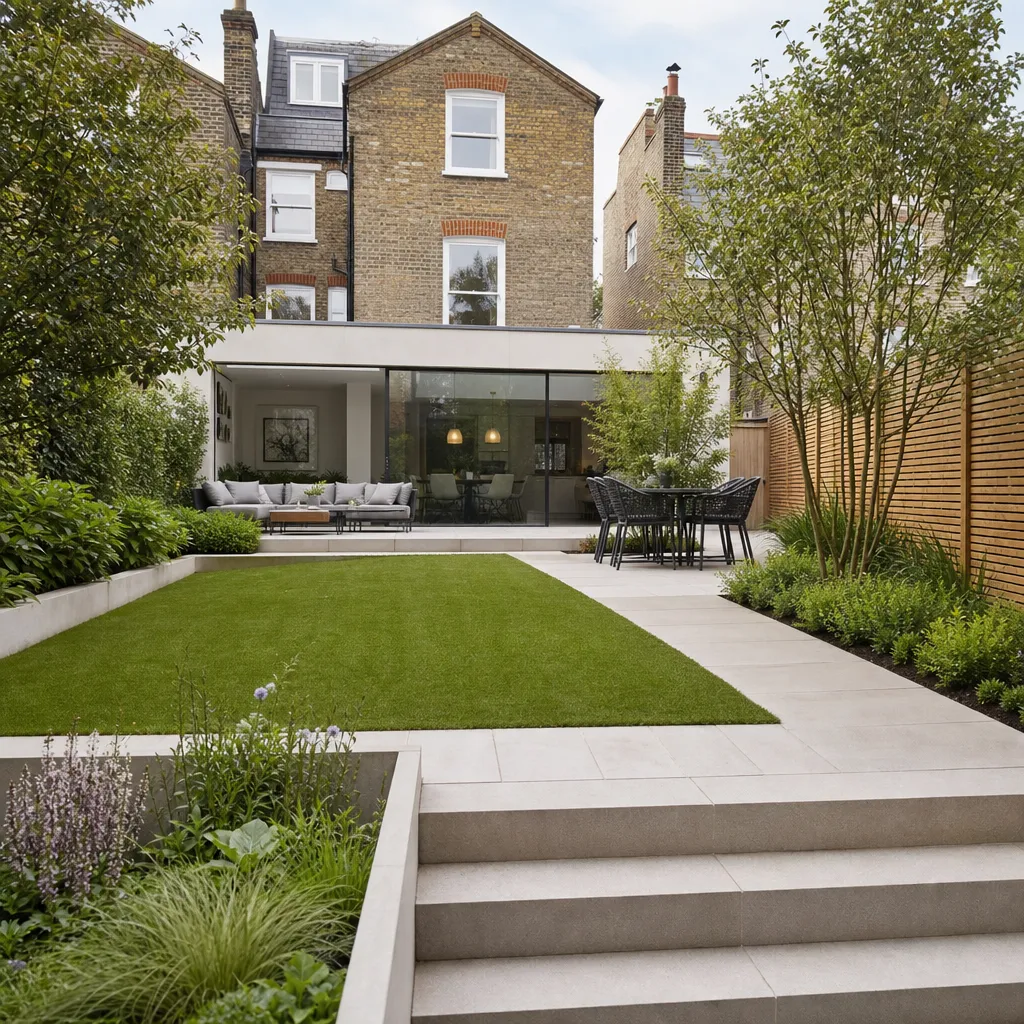
Garden Design Trends and Contemporary Landscaping Ideas
Contemporary UK garden design centres on low-maintenance naturalistic planting, multi-functional outdoor spaces, sustainable hard landscaping materials, and wildlife-friendly rewilded areas.
 Improvement & Build
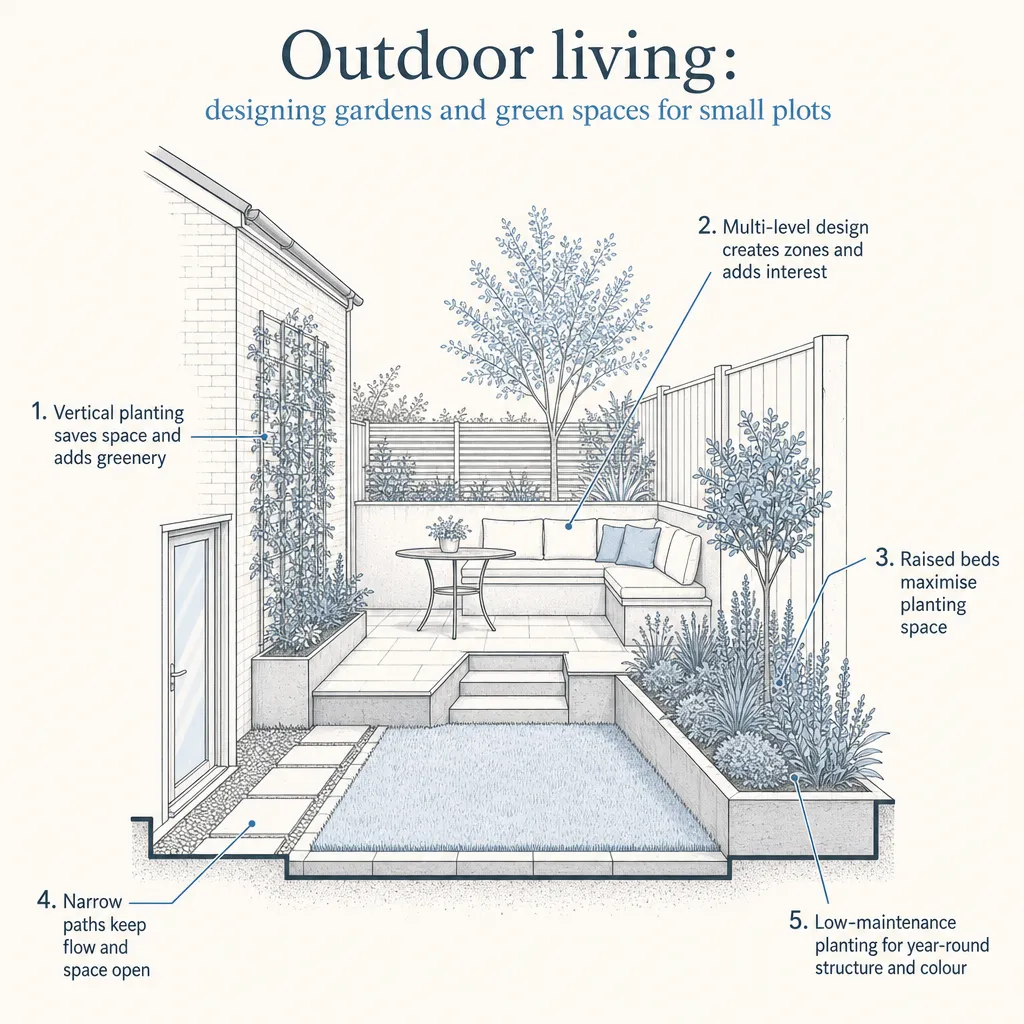
Outdoor living: designing gardens and green spaces for small plots
Small plots work best when divided into defined zones — seating, planting, and utility — before materials are chosen.
 Improvement & Build
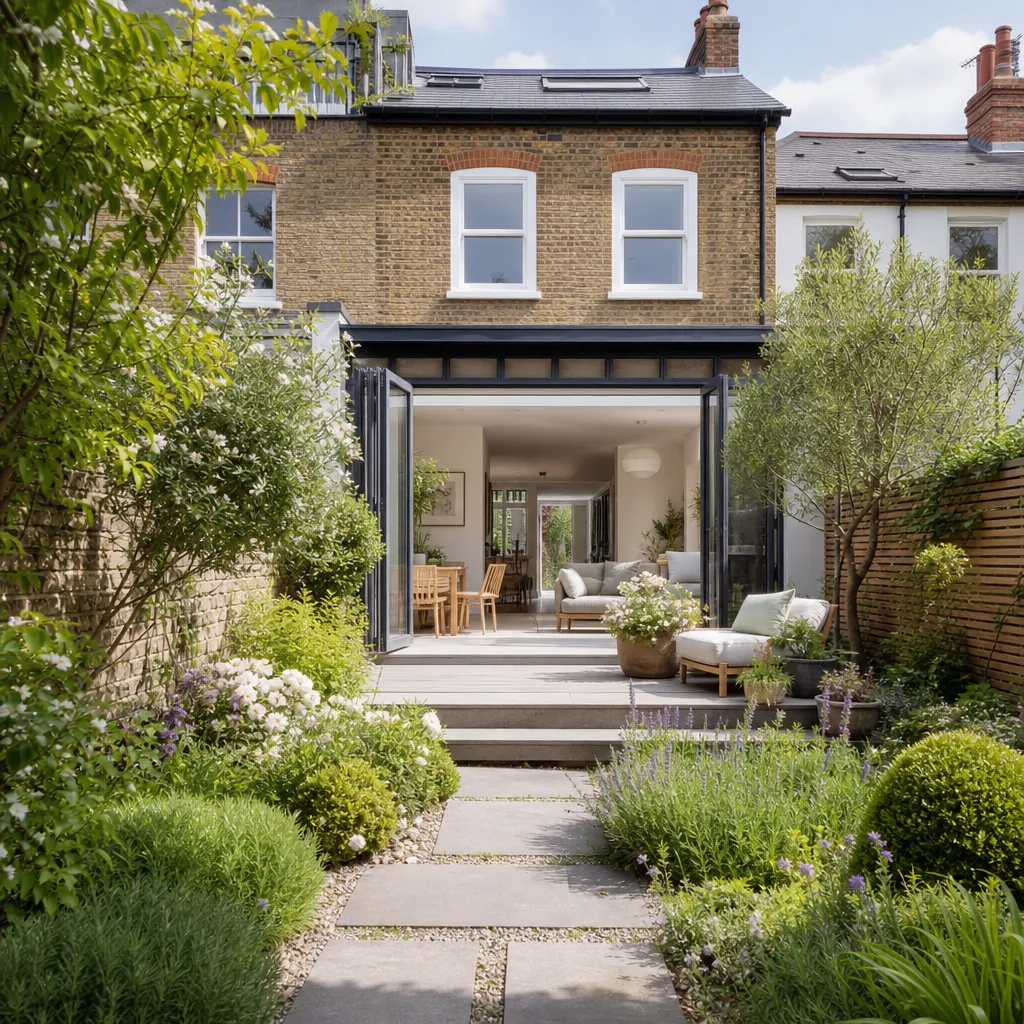
Spring Garden Transformations: Design Ideas to Enhance Your UK Property
Spring is the best time to transform a UK garden, with mild temperatures and longer days ideal for planting and landscaping.
 Improvement & Build
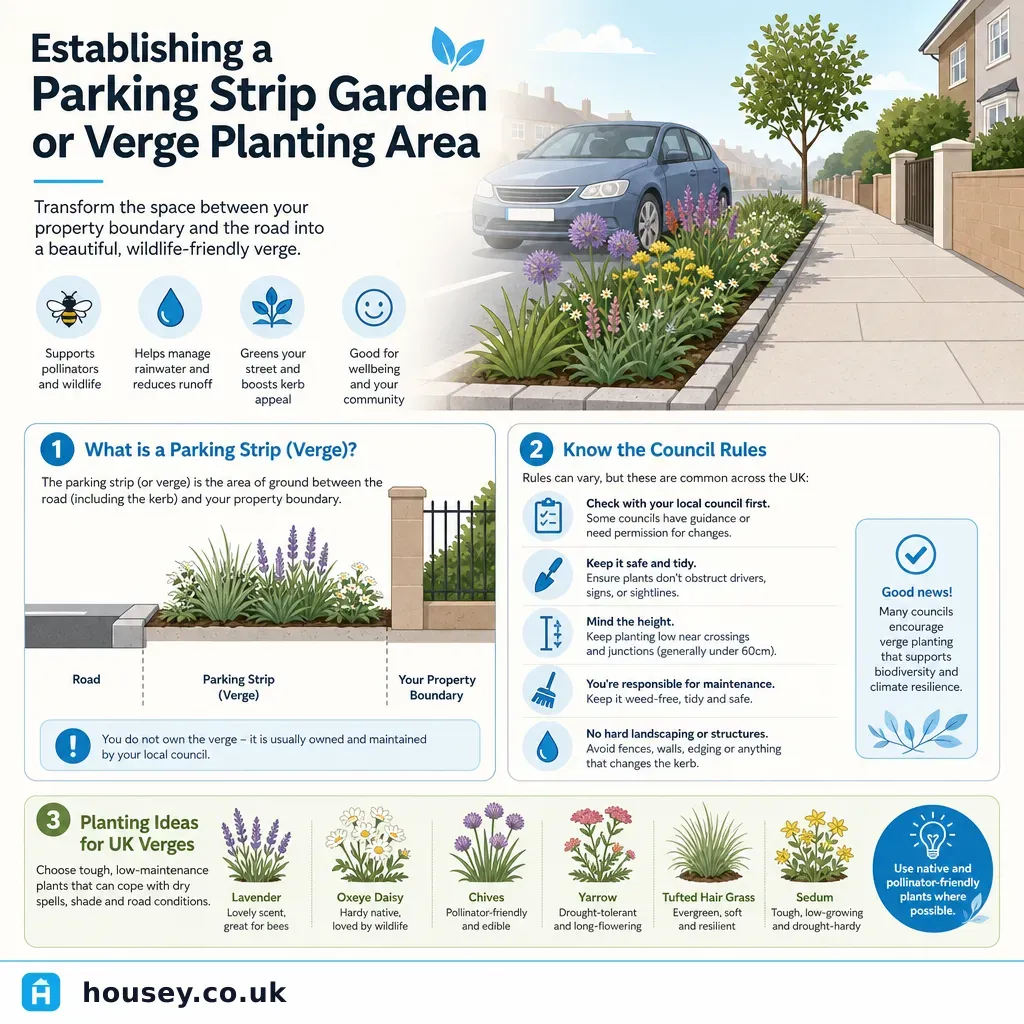
Establishing a Parking Strip Garden or Verge Planting Area
A parking strip or verge sits between your garden boundary and the road.
 Improvement & Build
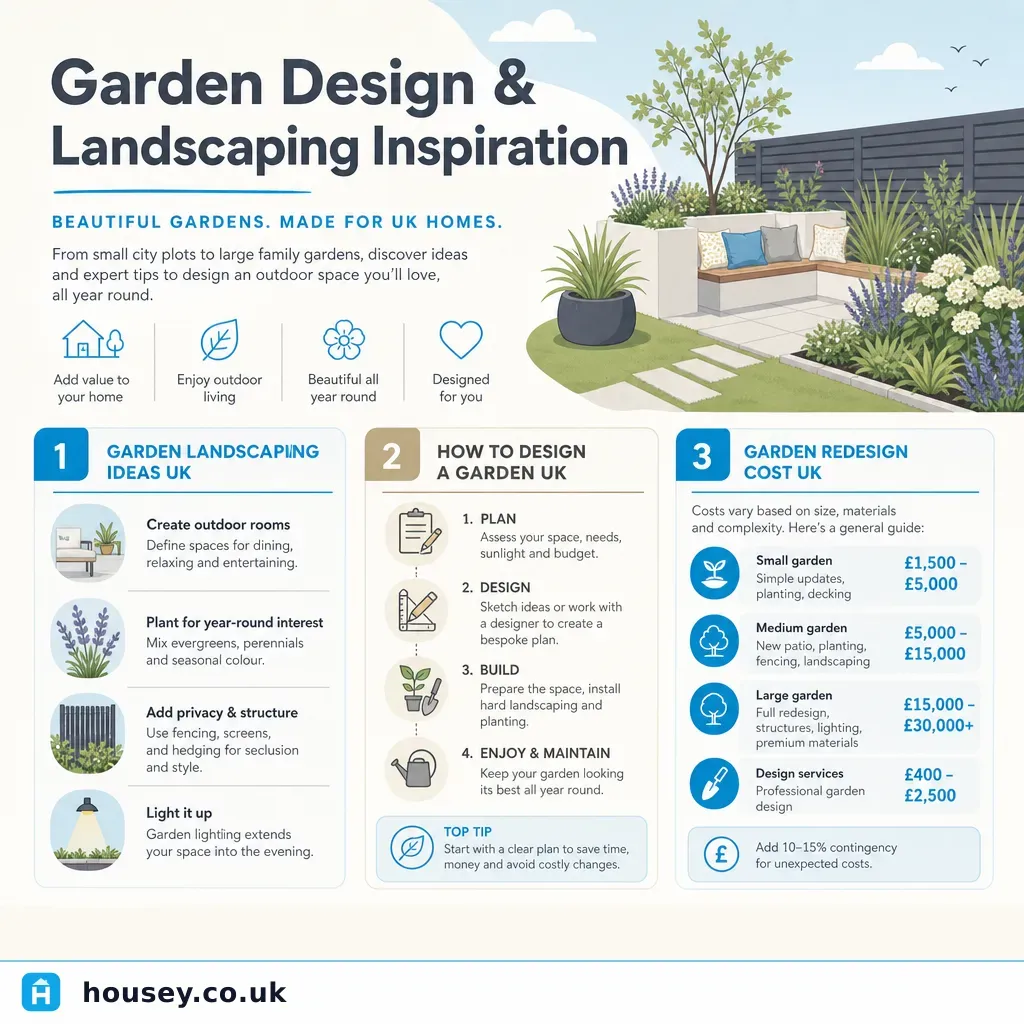
Garden Design and Landscaping Inspiration
Effective garden design starts with assessing your aspect, soil type, and existing features before commissioning any planting or hard landscaping.