Building a Garden Room: Planning, Costs and Timeline
By Housey · Last reviewed 7th of May 2026
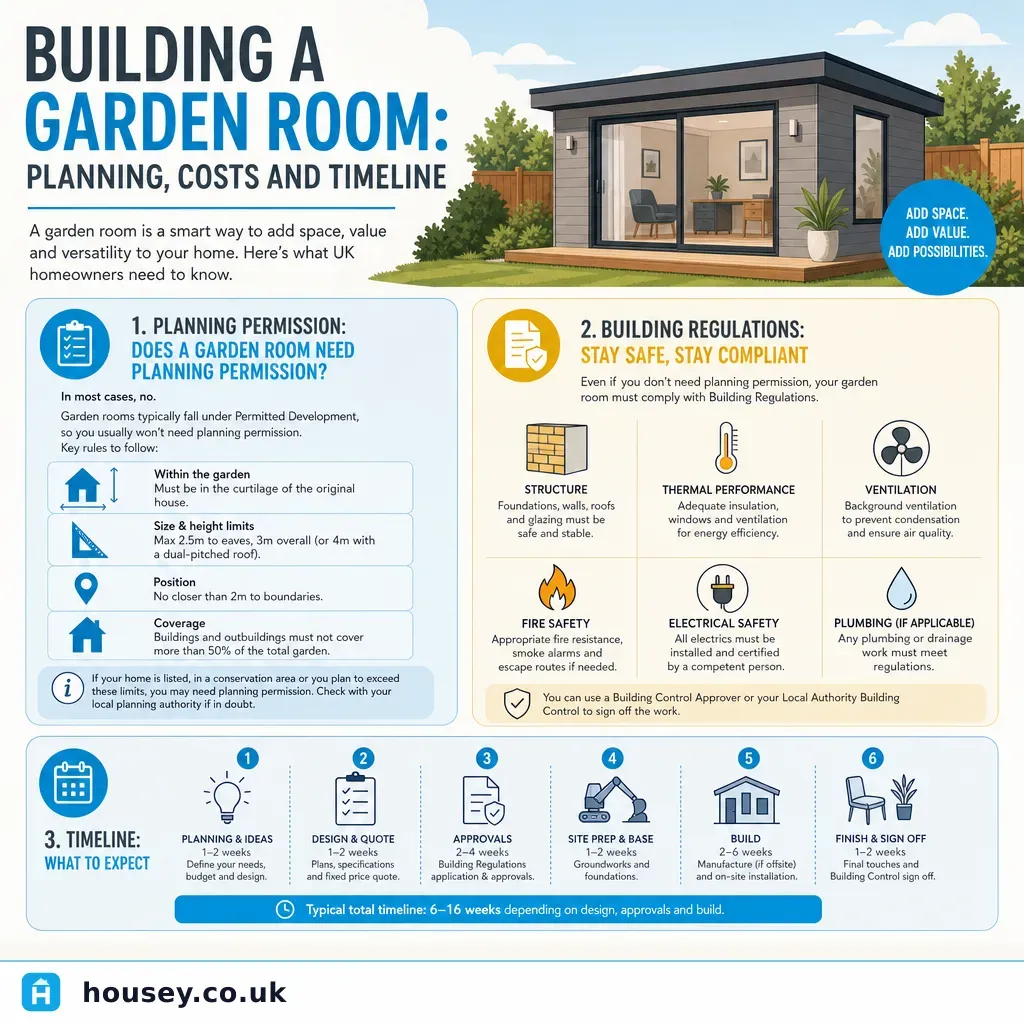
Building a Garden Room: Planning, Costs and Timeline
Garden rooms have become one of the most popular improvements UK homeowners make, driven by the growth of home working and the demand for dedicated year-round space. Whether you are planning a home office at the end of the garden or a creative studio, understanding the planning rules, realistic budget, and likely programme before you start will save time and prevent costly mistakes.
Key points
- Under Schedule 2, Part 1, Class E of the Town and Country Planning (General Permitted Development) (England) Order 2015, most detached garden rooms qualify as permitted development and require no planning application
- The maximum eaves height is 2.5 metres if any part of the structure falls within 2 metres of the property boundary
- A detached garden building under 15m² with no sleeping accommodation is generally exempt from Building Regulations; buildings between 15–30m² may be exempt if positioned more than 1 metre from any boundary
- Indicative UK costs range from around £10,000 for a basic insulated room to £50,000 or more for a high-specification bespoke build (indicative UK costs, last reviewed 2026-05-07)
- Most standard projects take 8–16 weeks from groundworks to handover
Does a garden room need planning permission?
Most garden rooms in England are built under permitted development rights and do not need a planning application, provided the conditions in Schedule 2, Part 1, Class E of the General Permitted Development Order (GPDO) 2015 are met.
Condition | Rule |
|---|---|
Location | Must not be forward of the principal elevation facing a highway |
Height within 2m of boundary | Maximum 2.5m to ridge and eaves |
Height elsewhere in garden | Up to 4m (dual-pitch roof) or 3m (any other roof type) |
Garden coverage | Combined outbuilding footprints must not exceed 50% of original curtilage, excluding the house itself |
Use | Must be incidental to the dwelling; not for sleeping, separate living, or letting |
Listed buildings | No permitted development rights — full planning permission required |
Conservation areas and AONBs | Additional restrictions apply; check with your local planning authority before building |
Decision tree: do I need planning permission?
- Is the property a listed building? → Apply for listed building consent and planning permission before proceeding.
- Is it in a conservation area, AONB, or subject to an Article 4 Direction? → Check with your local planning authority (LPA) before building.
- Will the room be used for sleeping accommodation or as a self-contained unit? → Planning permission is likely required.
- Will the structure cover more than 50% of the original curtilage? → Planning permission required.
- Is any part within 2m of a boundary and taller than 2.5m to the eaves? → Planning permission required.
- All answers No → The project likely falls under permitted development. Consider obtaining a Lawful Development Certificate (LDC) for a permanent record; typically £100–£250 from your LPA.
When Building Regulations apply
Garden rooms are not automatically exempt from Building Regulations 2010. Under Schedule 2 of those Regulations:
- Buildings under 15m² with no sleeping accommodation: generally exempt
- Buildings between 15–30m² with no sleeping accommodation: may be exempt if more than 1 metre from any boundary, or if substantially of non-combustible construction
- Buildings over 30m²: unlikely to qualify for exemption regardless of position
Regardless of floor area, Part P (electrical safety) applies to any fixed electrical installation connected to the domestic supply. Part H applies if drainage is connected, and Part L (energy efficiency) applies to new habitable buildings. Many modular suppliers state their products are designed to comply with Building Regulations — but compliance and formal approval are not the same thing. A building control consultant can review your drawings and confirm what is needed before work begins.
How much does a garden room cost?
Specification | Typical size | Indicative cost range |
|---|---|---|
Basic insulated garden cabin (kit or modular) | 10–15m² | £10,000–£18,000 |
Mid-range insulated room with electrics and heating | 15–25m² | £20,000–£35,000 |
High-spec bespoke with bi-fold doors and full electrics | 25–40m² | £35,000–£60,000 |
Premium architectural garden studio | 30–50m² | £55,000–£100,000+ |
Indicative UK costs, last reviewed 2026-05-07. Costs vary by region, groundwork conditions, and specification. Obtain at least three itemised quotes before committing.
Key cost drivers include groundworks (sloped or poor-condition sites can add £2,000–£8,000), insulation specification (meeting Part L U-value targets costs more upfront but reduces heating bills), electrical connection from the house (typically £1,500–£4,000), and glazing choices such as bi-fold doors or roof lights. Always confirm whether heating, VAT, and electrical certification are included in any quote before comparing figures.
Project timeline
Phase | Typical duration |
|---|---|
Design and specification | 2–4 weeks |
LDC application (if sought) | 4–8 weeks |
Planning permission (if required) | 8–13 weeks (statutory determination period) |
Base and groundworks | 1–2 weeks |
Structure on site (modular or SIP) | 3–7 days |
Fit-out, electrics, and finishing | 2–4 weeks |
Building Regulations inspection (if applicable) | Varies by project |
Allow additional time for restricted site access, unusual ground conditions, or a full planning application.
Homeowner checklist before you start
Red flags when reviewing quotes and contractors
- A supplier who cannot confirm whether Building Regulations approval applies to your specific project
- Quotes that exclude groundworks, electrical connection, or heating — common omissions that distort comparisons
- No written confirmation of insulation U-values or glazing performance
- A build timeline of fewer than four weeks for a structure over 20m²
- No discussion of drainage implications if a WC or sink is planned
- Contracts without stage payments tied to verified build milestones
When to get professional help
Most garden room projects can be managed directly with a specialist contractor. Independent input is worthwhile when the property is listed or in a conservation area, when the room will require Building Regulations approval for habitable use, when ground conditions are uncertain, or when the project involves mains drainage. A project manager can oversee the full build and coordinate trades from groundworks to handover.
How Housey can help
Housey connects UK homeowners with experienced tradespeople for garden room and home improvement projects. Whether you need extension builders for a bespoke structure or a building control consultant to verify that your project meets Approved Document requirements, you can request quotes through Housey directly.
Frequently asked questions
Does a garden room add value to a property?
A well-designed, insulated garden room often adds value, particularly if it functions as a usable year-round home office or studio. Estate agents commonly estimate a quality garden room adds 5–10% to a property's value, though this varies significantly by location, size, and specification. A basic uninsulated cabin is unlikely to achieve the same effect.
Can I use a garden room as a home office without planning permission?
Yes, in most cases. Using a garden room as a home office is considered incidental to the main dwelling and usually falls within permitted development rights, provided the structure meets height, coverage, and boundary conditions. The room must not be let separately or used as a primary residence.
Will I need to pay Council Tax on a garden room?
A standard garden room used for incidental personal purposes — home office, gym, or hobby space — is not separately rateable for Council Tax. If the room is used as self-contained accommodation or rented out, the Valuation Office Agency may assess it separately. Check with your local council if the use changes after construction.
What insulation specification should a garden room have?
For year-round use, aim for U-values broadly in line with Approved Document L: walls around 0.18 W/m²K, roof around 0.13 W/m²K, and floor around 0.22 W/m²K. A basic 50mm mineral wool structure will not achieve these targets. Always specify U-values in writing before accepting a quote from any supplier.
Do I need a Lawful Development Certificate for a garden room?
An LDC is not legally required for a permitted development garden room. However, it provides a permanent record that the build was lawful at the time of construction — useful when selling or remortgaging. Your local planning authority issues them for a fee, typically £100–£250 in England.
Sources and further reading
- Town and Country Planning (General Permitted Development) (England) Order 2015, Schedule 2, Part 1 — legislation.gov.uk
- Permitted development rights for householders: technical guidance — GOV.UK
- Building Regulations 2010, Schedule 2: Exempt buildings and work — legislation.gov.uk
- Outbuildings: do you need permission? — Planning Portal
Useful next reads
 Improvement & Build
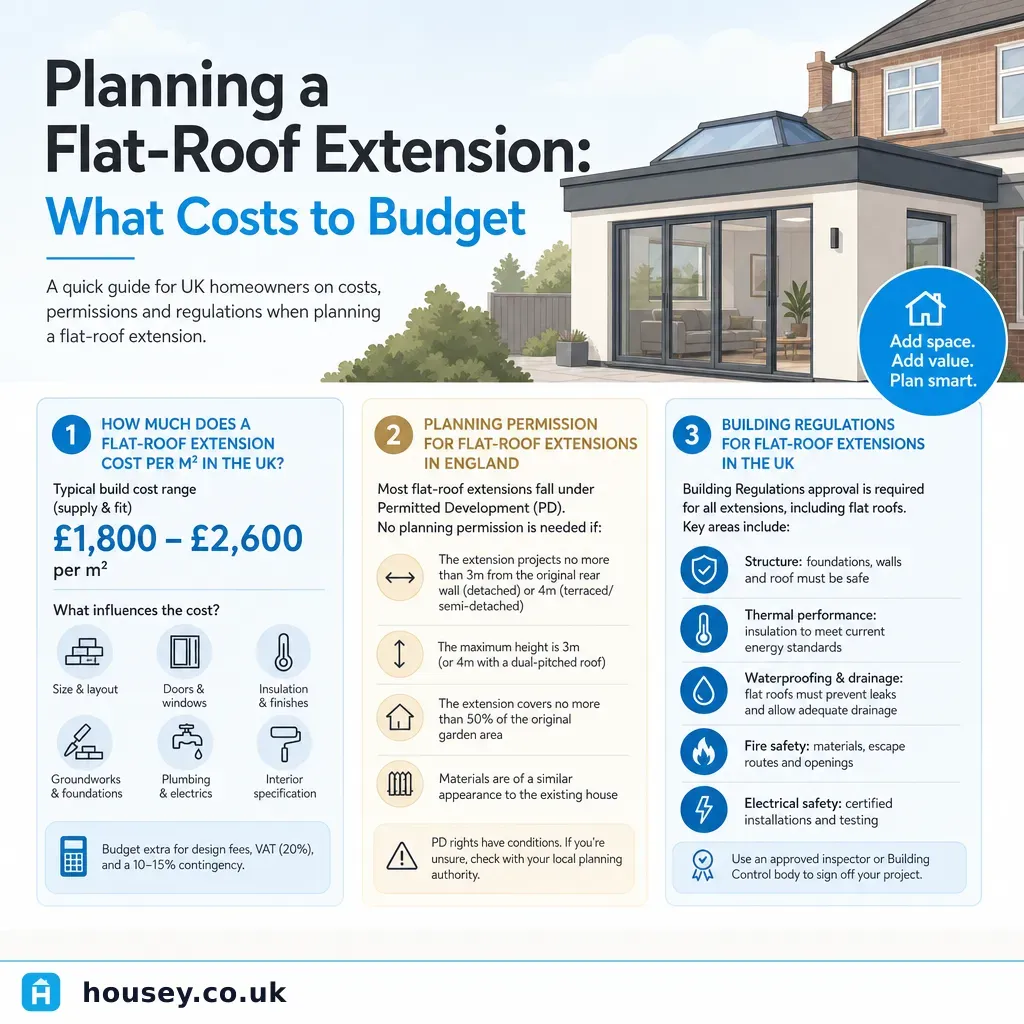
Planning a Flat-Roof Extension: What Costs to Budget
A flat-roof single-storey extension typically costs £1,500–£3,000 per m² in the UK, depending on size, specification, location, and roof membrane choice.
 Improvement & Build
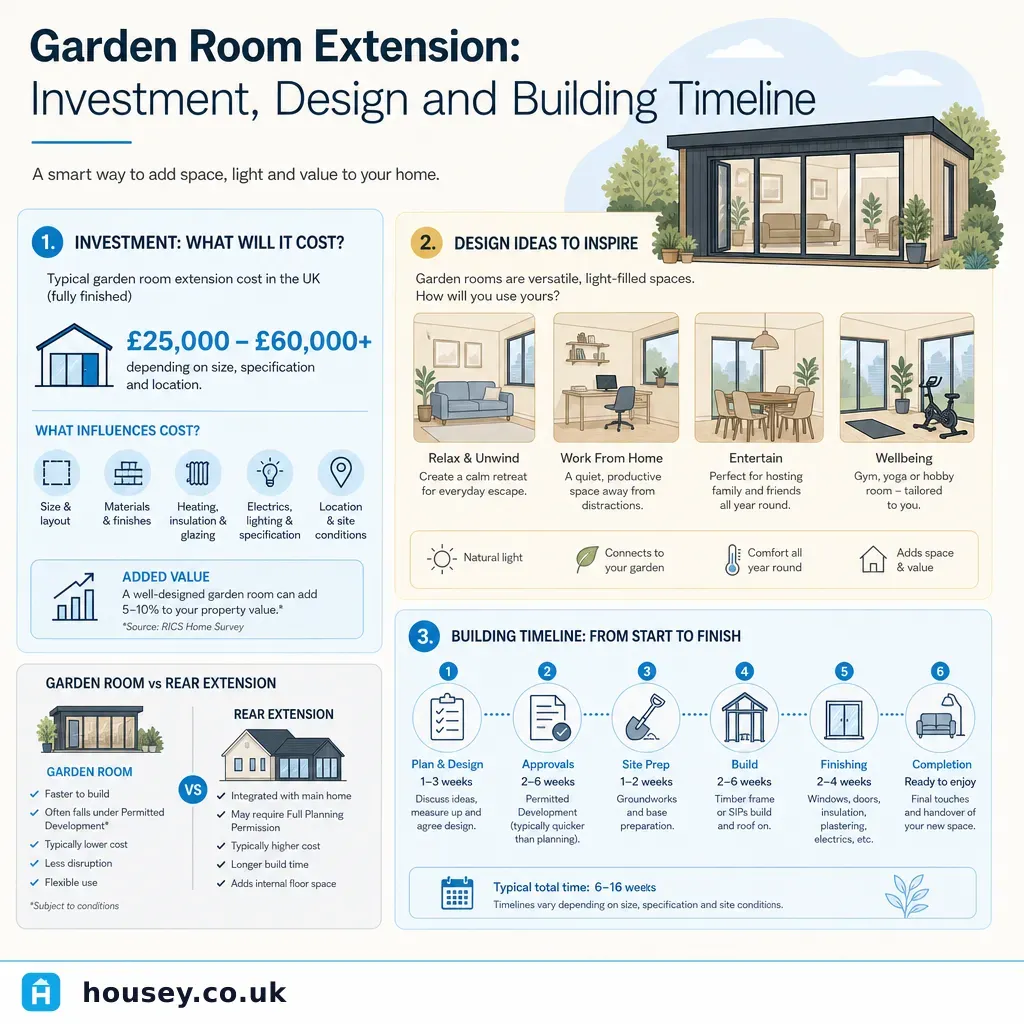
Garden Room Extension: Investment, Design and Building Timeline
A garden room or garden extension can add usable year-round space without always requiring planning permission.
 Improvement & Build
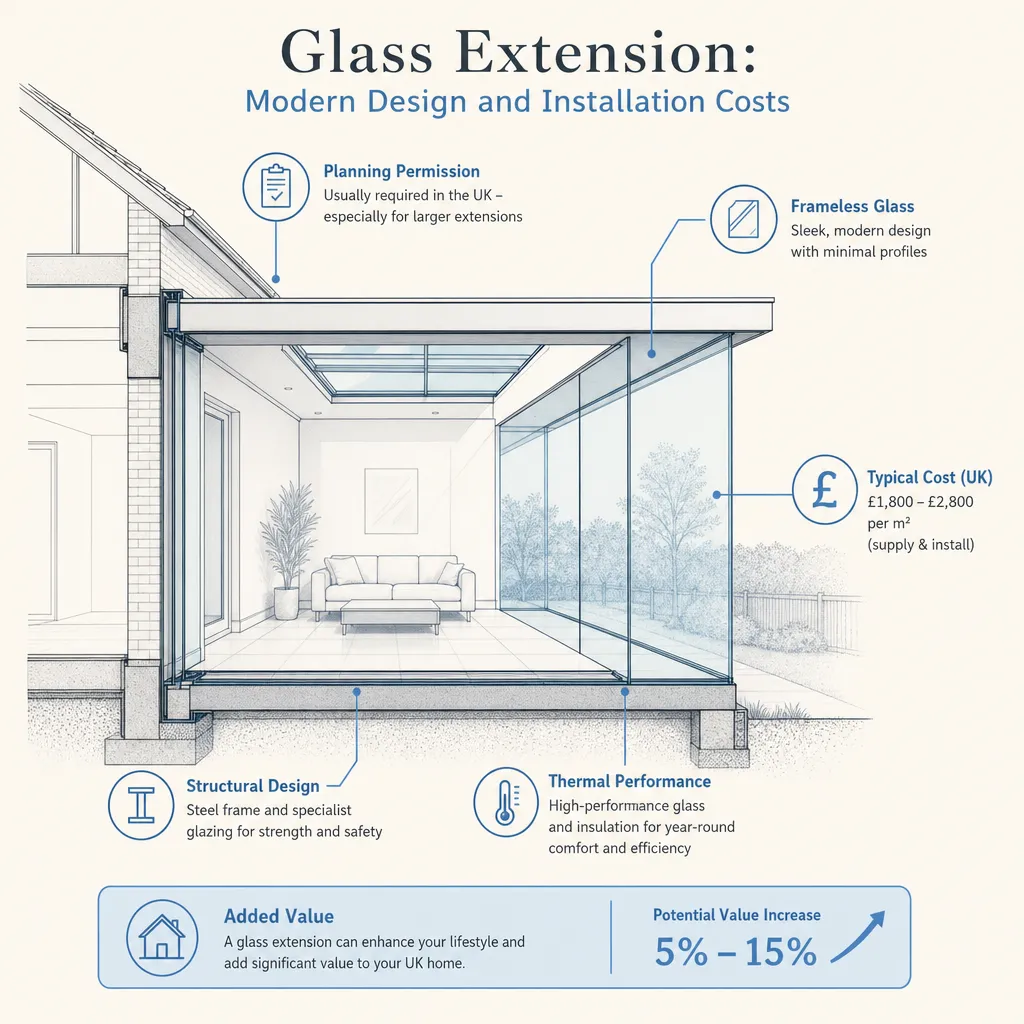
Glass Extension: Modern Design and Installation Costs
A glass extension in the UK typically costs £3,500–£6,500 per square metre fully installed for a bespoke structural glass system.
 Improvement & Build
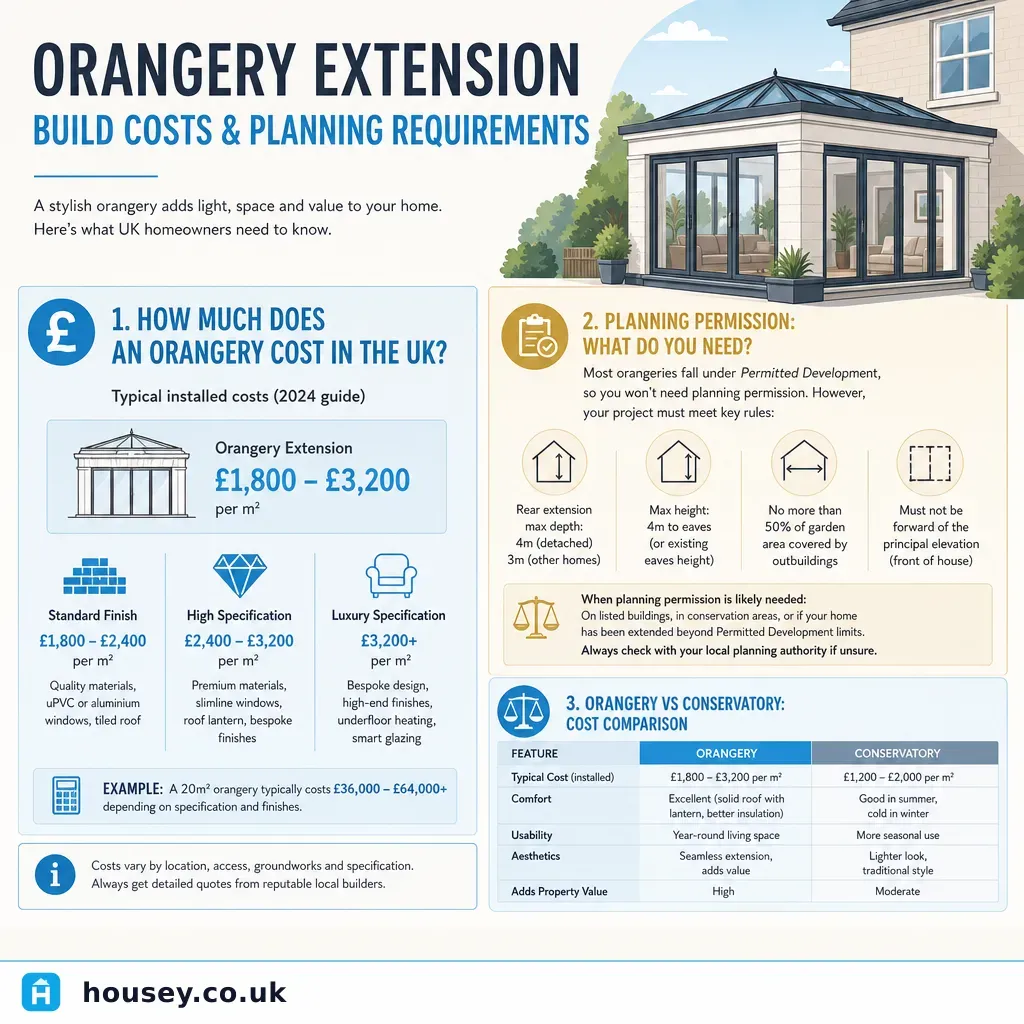
Orangery Extension Build Costs and Planning Requirements
An orangery extension in the UK typically costs £25,000–£100,000 depending on size, glazing specification, and finish.
 Improvement & Build
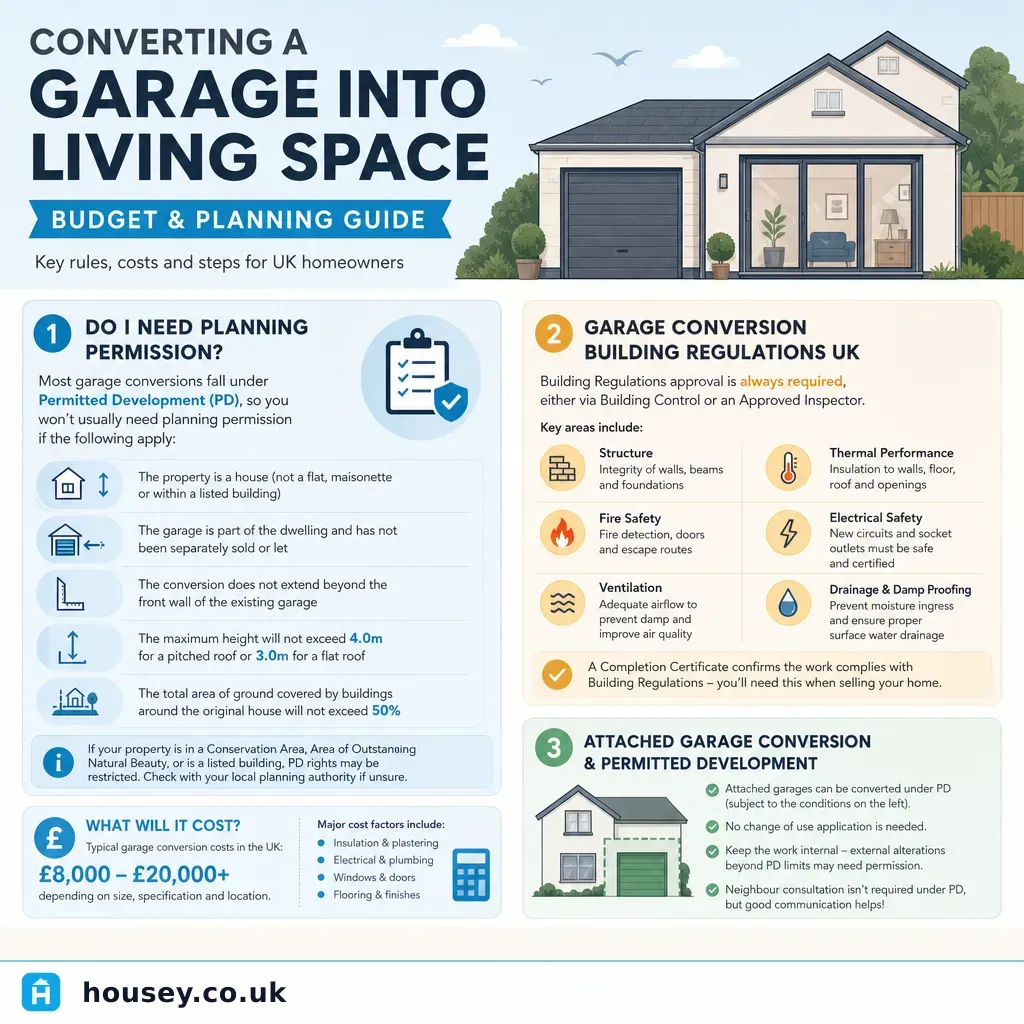
Converting a Garage into Living Space: Budget and Planning Guide
A single-garage conversion typically costs £8,000–£20,000 in the UK.