Orangery Extension Build Costs and Planning Requirements
By Housey · Last reviewed 7th of May 2026
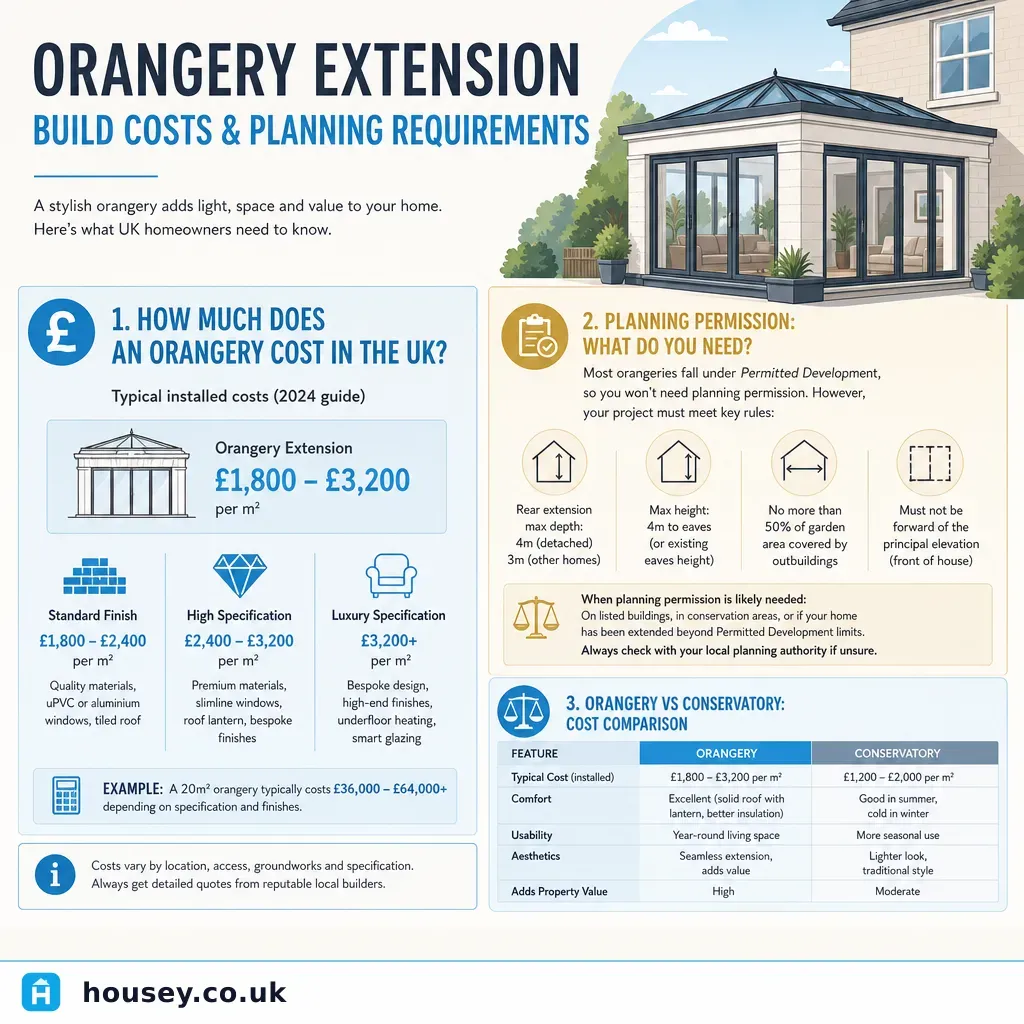
Orangery Extension Build Costs and Planning Requirements
An orangery occupies a distinct position in the UK extension market — more substantial than a conservatory, with masonry walls and a glazed roof lantern, but typically less expensive than a full brick extension of the same footprint. The planning position is often more straightforward than homeowners expect, while building regulations compliance is almost always required and costs vary considerably depending on size, glazing specification, and the structural work needed to open up the existing building.
Key points
- Orangery extensions in the UK typically cost £25,000–£100,000+ depending on size, specification, and finish (indicative UK costs, last reviewed 2026-05-07).
- Unlike many conservatories, orangeries are not exempt from Building Regulations because they are thermally integral to the main dwelling; Part A (structure), Part L (energy efficiency), and Part C (moisture resistance) all apply.
- Most rear orangeries on houses in England can be built under permitted development (PD) rights without a full planning application, subject to size limits under the Town and Country Planning (General Permitted Development) (England) Order 2015.
- PD rights do not apply to flats, listed buildings, or properties in conservation areas or subject to Article 4 Directions — a full planning application is required in these cases.
- A Lawful Development Certificate (LDC) is advisable even when PD rights apply, providing a formal legal record that is useful at point of sale.
What is an orangery?
An orangery combines masonry walls — typically brick or render — with a substantial glazed roof lantern covering roughly 30–50% of the roof area. The walls are solid rather than glazed to near floor level as in a conservatory, giving higher thermal mass, better acoustic performance, and a more permanent character. These qualities account for its premium over a conservatory but make it comparable to a full extension in feel and year-round usability.
Orangery vs conservatory vs full extension
Feature | Conservatory | Orangery | Full brick or block extension |
|---|---|---|---|
Walls | Mostly glazed (70%+ glass) | Masonry with glazed lantern | Solid masonry throughout |
Roof | Fully glazed or polycarbonate | Part solid, part glazed lantern | Tiled or flat roof |
Building Regulations | Often exempt if thermally separated | Almost always required | Always required |
Typical lifespan | 20–30 years | 30–50+ years | 50+ years |
Indicative mid-size cost | £12,000–£30,000 | £30,000–£100,000 | £40,000–£120,000 |
Year-round usability | Variable | Good with heating | Excellent |
Indicative UK costs, last reviewed 2026-05-07. Costs vary by size, specification, region, and contractor.
How much does an orangery cost in the UK?
Orangery size | Indicative build cost | Typical footprint |
|---|---|---|
Small lean-to orangery | £25,000–£45,000 | Up to 15 m² |
Mid-range rear orangery | £45,000–£75,000 | 15–25 m² |
Large or bespoke orangery | £75,000–£150,000+ | 25 m²+ |
Indicative UK costs, last reviewed 2026-05-07. Excludes VAT, professional fees, party wall awards, abnormal foundations, and internal fit-out. Professional fees typically add 10–15% to the build cost.
Key cost drivers
- Glazing specification: thermally broken frames, triple-glazed units, and self-cleaning glass add meaningfully to cost.
- Lantern complexity: a standard square lantern costs less than a hipped or bespoke design.
- Structural opening size: a wider opening into the existing building requires a larger steel beam and more structural work.
- Foundation conditions: poor ground, tree proximity, or a sloping site may require deeper or reinforced foundations.
- VAT: most orangery construction attracts 20% VAT. Work on listed buildings may qualify for zero-rating in certain circumstances — confirm with your contractor and HMRC.
Planning permission and permitted development
Most orangeries added to the rear of a house in England can proceed under permitted development without a full planning application, provided they comply with Schedule 2, Part 1, Class A of the Town and Country Planning (General Permitted Development) (England) Order 2015.
Key PD limits for single-storey rear extensions (England)
- No more than 4 metres beyond the original rear wall (detached house) or 3 metres (semi-detached or terraced) under standard PD. Extensions up to 8 metres (detached) or 6 metres (semi or terraced) may be permissible under the neighbour consultation scheme, subject to prior approval from the LPA.
- Total extensions and outbuildings must not cover more than 50% of the curtilage of the original house.
- Eaves height must not exceed 4 metres.
- Conservation areas, National Parks, AONBs, and Article 4 Direction areas restrict or remove these rights.
Do you need planning permission? A decision guide
- Use PD rights if the orangery is single-storey, rear-facing, within the size limits above, on a house (not a flat), and the property is neither listed nor in a designated area or Article 4 area.
- Apply for full planning permission if the property is a flat, the project exceeds PD limits, the building is listed, or it sits in a conservation area, National Park, or Article 4 area.
- Check with your LPA if previous extensions may have used part of the PD allowance (limits are cumulative across all additions since 1948), or if local conditions are uncertain.
- Apply for a Lawful Development Certificate even when PD rights appear to apply — it provides a formal legal record useful at point of sale and removes ambiguity.
Planning and PD rules differ in Wales, Scotland, and Northern Ireland. The limits above apply to England only.
Building regulations requirements
Orangeries integral to the dwelling cannot claim a building regulations exemption. The main areas requiring compliance are:
- Part A (Structure): foundations, structural opening into the existing building, lintel or steel beam sizing, and roof structure.
- Part C (Moisture): damp-proof courses, cavity trays, and weatherproofing at all junctions with the existing structure.
- Part L (Energy efficiency): U-value targets for walls, roof lanterns, and glazed elements — tightened by the June 2022 update to Part L.
- Part F (Ventilation) and Part P (Electrics): as applicable to the new habitable space.
Building regulations approval — a full plans application or a building notice — must be obtained before work starts. A building control body will carry out stage inspections at foundation level, structural frame, and on completion.
Important limitations
This article provides general guidance on orangery costs and planning requirements in England. Planning rules, permitted development limits, and building regulations details vary by property type, tenure, and location, and differ in Wales, Scotland, and Northern Ireland. Cost figures are indicative, reviewed May 2026, and actual costs depend on specification, contractor, and site conditions. This guide is not a substitute for professional advice from an architect, planning consultant, or structural engineer who has assessed your specific property and site.
What to ask a qualified professional
- Is my property within the permitted development size limits, accounting for all previous extensions since the original dwelling was built?
- Does an Article 4 Direction or conservation area designation apply locally?
- Would you recommend applying for a Lawful Development Certificate, and what does that process involve?
- What structural elements are required for the proposed opening — beam size, padstones, temporary propping?
- What Part L U-value targets apply to the walls, floor, and glazed roof lantern?
- Can you provide a full set of drawings and a specification for the building control submission?
- What party wall considerations apply, and will a party wall surveyor be needed?
When to get professional help
An architect or architectural technologist is recommended from the outset for any orangery project. They can confirm PD eligibility, produce drawings for building control, coordinate with a structural engineer, and help manage the build programme.
Red flags that the process may be being skipped:
- A contractor quoting without drawings, structural engineer input, or reference to building control approval.
- No mention of a Part L compliance calculation for the roof lantern and glazing.
- No discussion of party wall obligations with adjoining neighbours.
- A quote substantially below the indicative cost ranges above without a clear explanation of what is excluded.
How Housey can help
Starting an orangery project with the right professionals reduces risk and delays. Through Housey you can request quotes from experienced extension builders, find architects for your orangery design and planning advice, and connect with architectural technologists for building regulations drawings and specification — all through a single quote request.
Frequently asked questions
Do orangeries need building regulations approval?
Almost always yes. Orangeries are thermally integral to the main dwelling and cannot claim the exemption sometimes available to thermally separated conservatories. Part A (structure), Part L (energy efficiency), and Part C (moisture resistance) are the most relevant areas. Your building control body — whether a local authority or an approved inspector — will confirm what applies to your specific project.
Can I build an orangery under permitted development rights?
In many cases yes, for a single-storey rear addition to a house in England within the PD size limits. PD rights do not apply to flats, listed buildings, or properties in conservation areas or subject to Article 4 Directions. Because the allowance is cumulative across all extensions since 1948, always check your property's extension history before assuming PD rights apply.
How long does an orangery take to build?
Once planning and building regulations are in place, a typical orangery takes 8–14 weeks to construct depending on size and complexity. The pre-build phase — design, structural calculations, planning or Lawful Development Certificate application, and building regulations submission — commonly adds 3–6 months to the overall programme.
What is the difference between an orangery and a conservatory for planning and building regulations purposes?
For planning, both are assessed under the same permitted development limits. The key building regulations difference is thermal separation: a conservatory separated from the house by external-quality walls and doors may qualify for a building regulations exemption; an orangery integral to the main dwelling does not and must comply with Part A, Part L, and other relevant Parts.
Will an orangery add value to my home?
An orangery is generally regarded as a higher-value addition than a conservatory due to year-round usability, thermal performance, and more permanent character. Whether the cost is recovered at sale depends on the local market and build quality. A RICS-registered valuer is the most reliable source of advice on likely value uplift before committing to the project.
Sources and further reading
- Permitted Development Rights for Householders: Technical Guidance — GOV.UK
- Building Regulations Approved Document A: Structure — GOV.UK
- Building Regulations Approved Document L: Conservation of Fuel and Power — GOV.UK
- Extensions and Outbuildings — Planning Portal
- Apply for a Lawful Development Certificate — GOV.UK
Useful next reads
 Improvement & Build
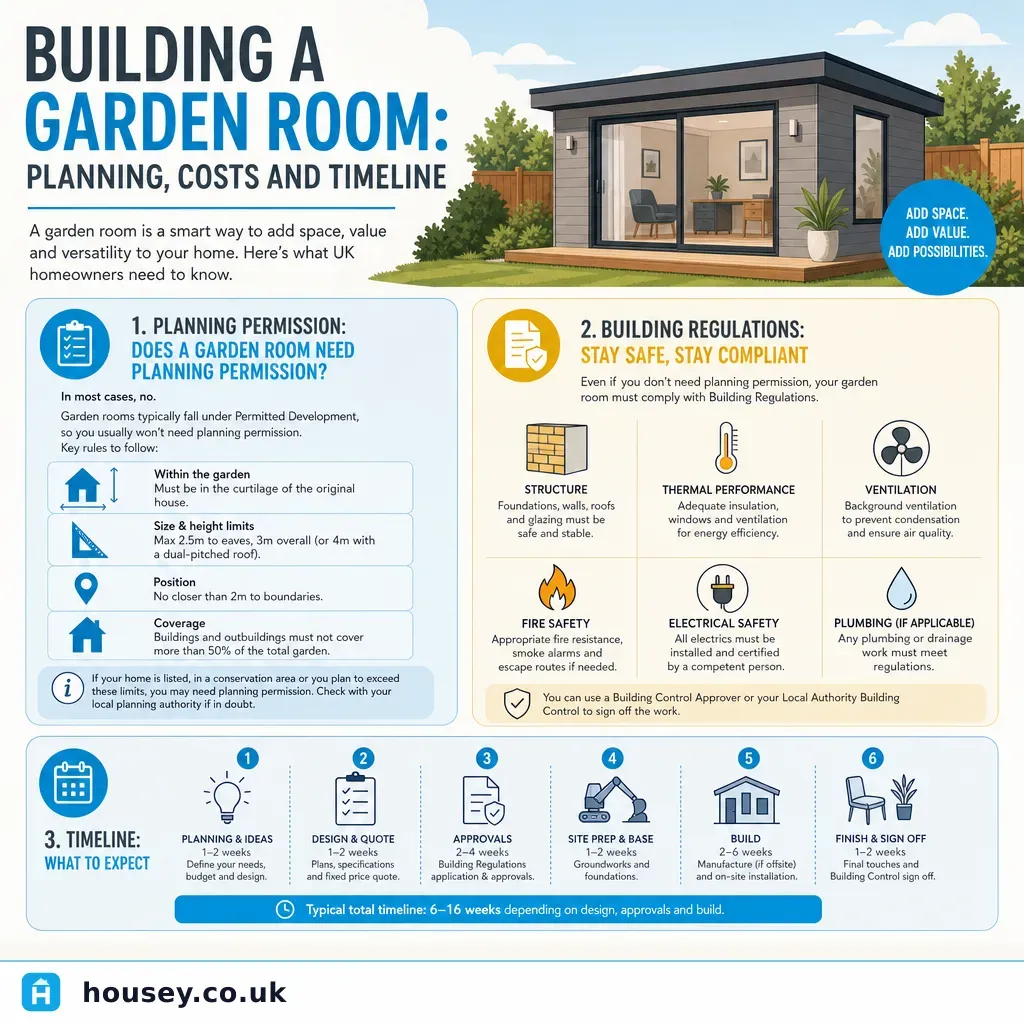
Building a Garden Room: Planning, Costs and Timeline
Most garden rooms in England fall under permitted development and don't need planning permission, provided the structure meets height, coverage, and boundary conditions.
 Improvement & Build
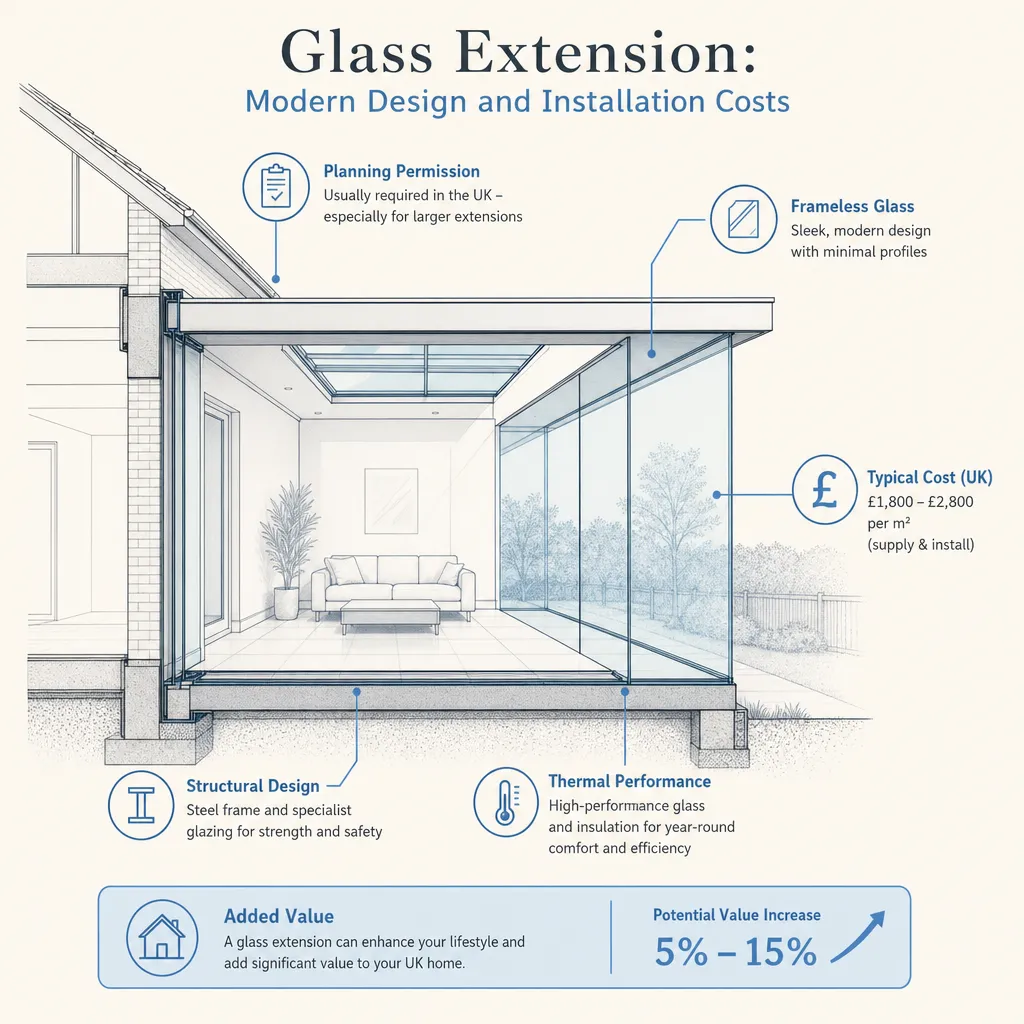
Glass Extension: Modern Design and Installation Costs
A glass extension in the UK typically costs £3,500–£6,500 per square metre fully installed for a bespoke structural glass system.
 Improvement & Build
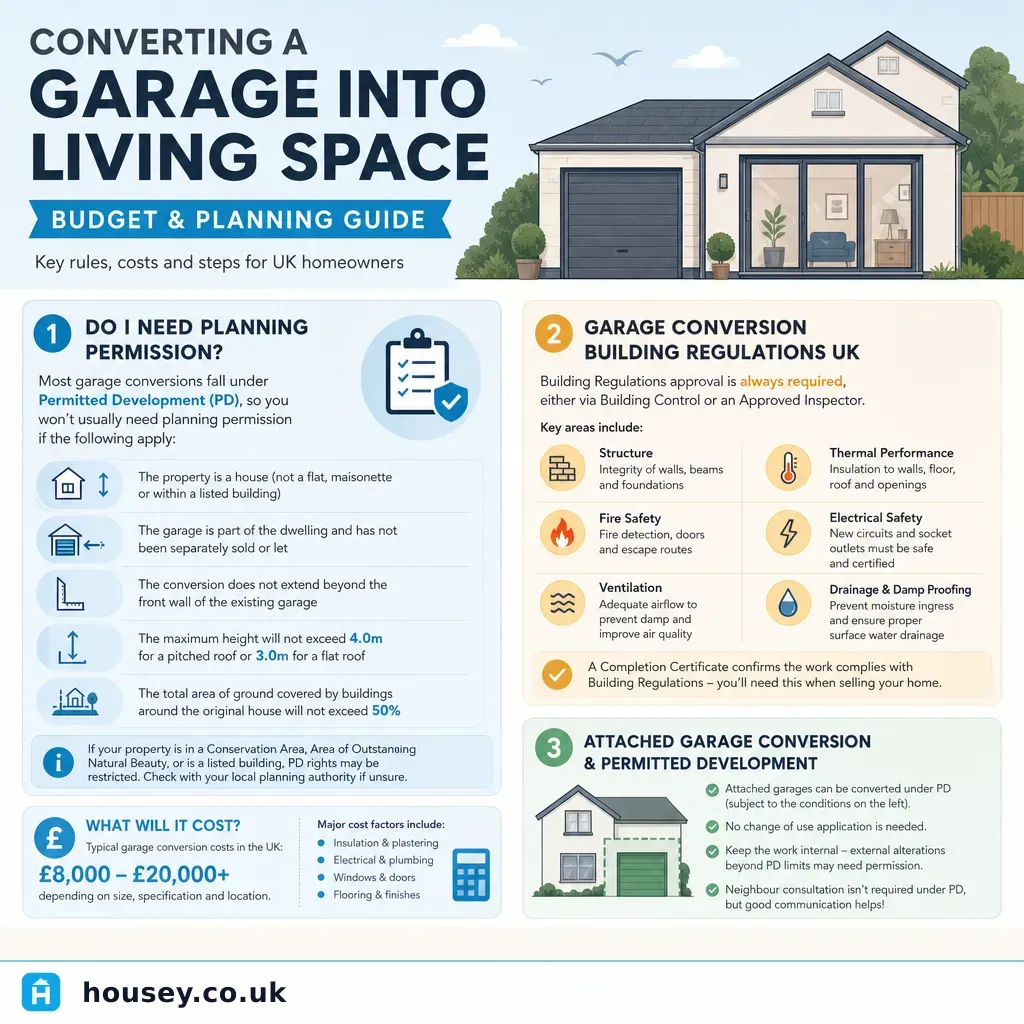
Converting a Garage into Living Space: Budget and Planning Guide
A single-garage conversion typically costs £8,000–£20,000 in the UK.
 Improvement & Build
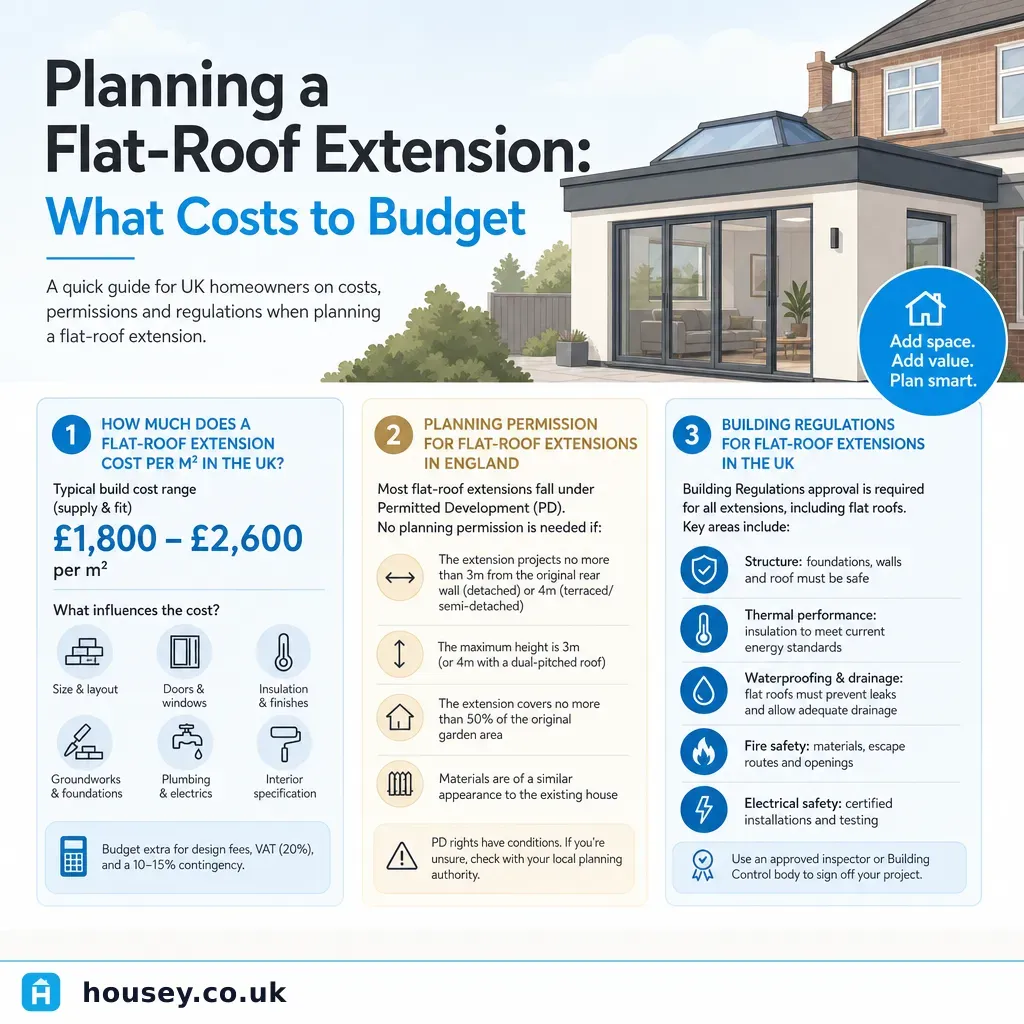
Planning a Flat-Roof Extension: What Costs to Budget
A flat-roof single-storey extension typically costs £1,500–£3,000 per m² in the UK, depending on size, specification, location, and roof membrane choice.
 Improvement & Build
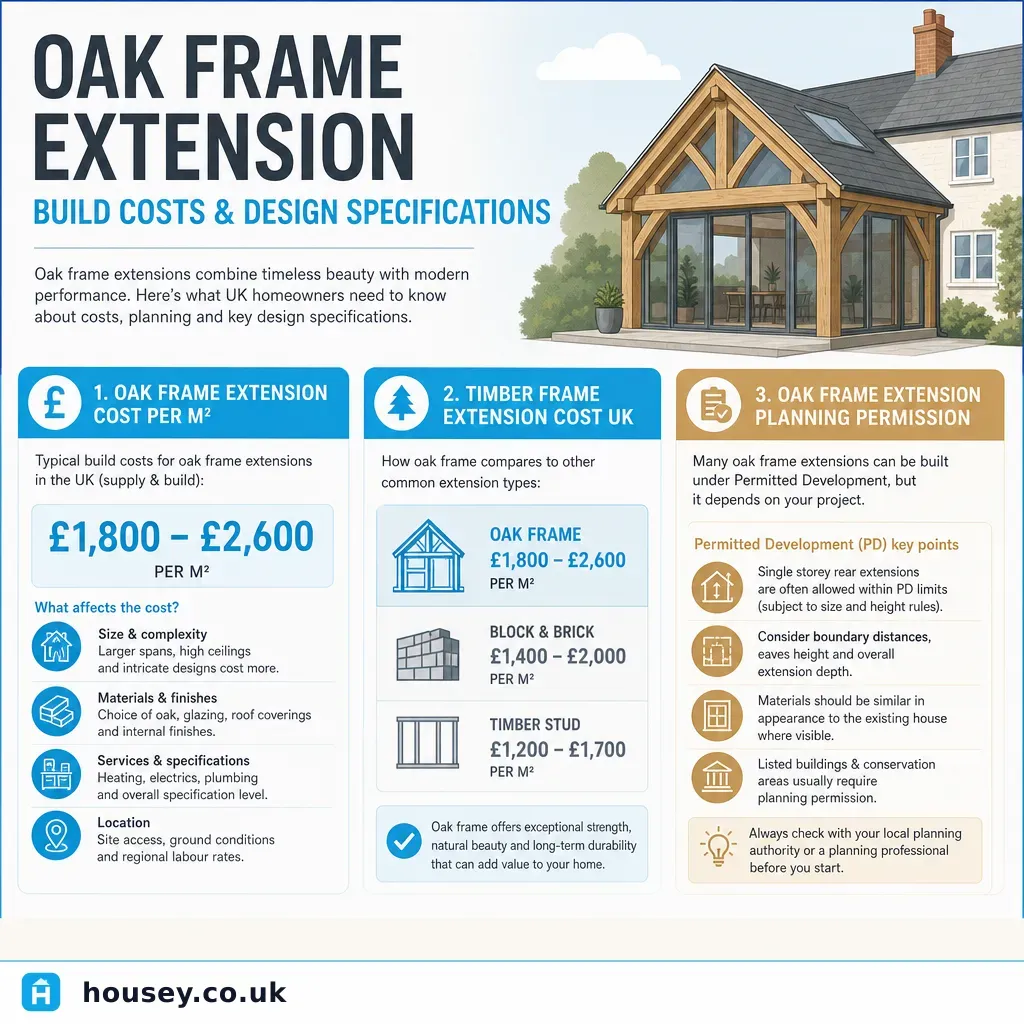
Oak Frame Extension Build Costs and Design Specifications
An oak frame extension typically costs £2,500–£4,500+ per m² all-in for the completed build in the UK.