Glass Extension: Modern Design and Installation Costs
By Housey · Last reviewed 7th of May 2026
Glass Extension: Modern Design and Installation Costs
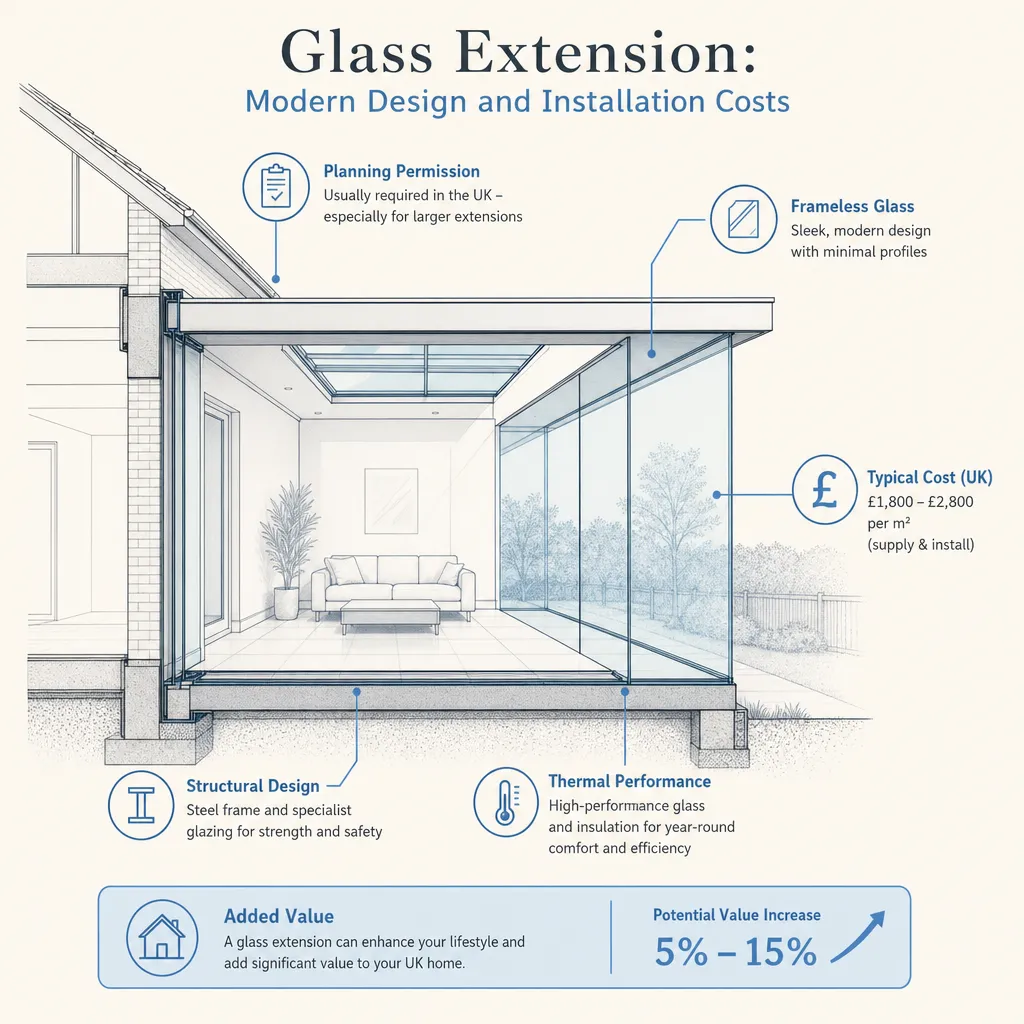
Glass extensions — from structural glass boxes to frameless glazing systems — have become a mainstream choice for UK homeowners seeking to add light-filled living space to terraced, semi-detached, and detached properties. Unlike a traditional conservatory, a contemporary structural glass extension is built to full building regulations standards as a habitable room, requiring architectural design, structural engineering, planning assessment, and building control approval from the outset.
Key points
- Building Regulations approval is required for all glass extensions attached to a dwelling — no exemption under current Approved Documents applies to glazed structures intended as habitable rooms.
- Permitted development (PD) rights allow rear extensions up to 4 metres (detached houses) or 3 metres (all other dwellings) without full planning permission, but PD rights are removed for listed buildings, conservation areas, national parks, and Areas of Outstanding Natural Beauty.
- Structural glass assemblies must be designed and certified by a chartered structural engineer; low-level glazing must use toughened or laminated safety glass under Approved Document K.
- Bespoke structural glass systems typically cost £2,500–£4,500 per m² for the glazing package; total project costs commonly reach £3,500–£6,500 per m² (indicative UK costs, last reviewed 2026-05-07).
- Glazed walls and rooflights in extensions to existing dwellings must achieve a U-value of 1.6 W/m²K or better under Approved Document L (2021 edition, England).
What counts as a glass extension?
The term covers a spectrum of designs, each with different structural, planning, and cost implications.
Design type | Description | Typical use |
|---|---|---|
Structural glass box | Frameless or minimal-frame glazing on walls and roof; glass fins or steel carry structural loads | Contemporary rear addition to period or modern home |
Glass roof extension | Masonry or timber-frame walls with a glazed lantern, flat, or pitched roof | Kitchen-diner extension maximising natural light |
Semi-glazed extension | Structural frame infilled with glazing and some solid panels | Balance of light, privacy, and thermal performance |
Traditional conservatory | Largely glazed structure; may be exempt from Building Regs under specific conditions | Garden room or sun lounge |
A structural glass box is the most complex and expensive option, requiring specialist installation and close co-ordination between architect, structural engineer, and glazing contractor.
Planning permission: what applies?
Planning rules for extensions in England are governed by the Town and Country Planning (General Permitted Development) (England) Order 2015, as amended.
Under permitted development, a single-storey rear extension does not require full planning permission if it meets all of the following:
- It does not extend beyond the rear wall of the original house by more than 4 metres (detached) or 3 metres (all other dwellings).
- The eaves height does not exceed 3 metres within 2 metres of the boundary.
- The overall height does not exceed the original roof ridge height.
- It does not cover more than half the garden area of the original dwelling.
- Materials are of similar appearance to the existing house — glazed systems are generally accepted under this test.
Permitted development rights do NOT apply if the property is a listed building (any grade), located in a conservation area, national park, AONB, or World Heritage Site, subject to an Article 4 Direction, or a flat or maisonette.
For extensions between 4 and 8 metres (detached) or 3 and 6 metres (other dwellings), the Neighbour Consultation Scheme — also called Prior Approval — applies. You must notify the local planning authority (LPA) and allow 42 days for objections. Work must not start until Prior Approval is confirmed in writing.
Wales, Scotland, and Northern Ireland have separate planning frameworks with different thresholds. Always confirm the position with your LPA before instructing designers.
Building regulations: always required
Building regulations approval is always required for extensions to dwellings in England and Wales, including glass structures. Key Approved Documents are:
- Approved Document A (Structure): load calculations and foundations must be certified by a chartered structural engineer.
- Approved Document L (Energy efficiency): U-values for all glazed elements; the extension must not worsen the dwelling's overall thermal performance.
- Approved Document K (Collision protection): all glazed elements at low level must use toughened or laminated safety glass.
- Approved Document B (Fire safety): means of escape and fire spread, especially relevant near boundaries or with rooflights.
- Approved Document C (Moisture): damp-proofing and drainage at the junction of old and new structure.
A building control body — your local authority or an approved inspector — must inspect at foundation, frame, and completion stages. The completion certificate is essential documentation for any future property sale.
What does a glass extension cost?
Costs vary significantly depending on design complexity, glazing specification, site conditions, and contractor.
Cost element | Indicative range |
|---|---|
Structural glass package (walls and roof) | £2,500–£4,500 per m² |
Steel frame or structural glass fins | £300–£800 per m² (additional) |
Base slab and groundworks | £150–£400 per m² |
Electrical, underfloor heating, plastering | £200–£600 per m² |
Architect and structural engineer fees | 10–15% of build cost |
Planning and building regulations fees | £200–£800 (varies by LPA) |
Total (bespoke, turnkey) | £3,500–£6,500 per m² |
Indicative UK costs, last reviewed 2026-05-07. Obtain at least three detailed quotes from specialist glazing contractors and extension builders.
A 20 m² glass extension typically costs £70,000–£130,000 fully installed. Simpler semi-glazed extensions with mixed glazed and solid panels can be achieved at lower cost.
Worked UK property scenario
A homeowner in a 1970s detached house in Surrey plans a 4m × 5m (20 m²) structural glass box to the rear, creating an open-plan kitchen and dining room.
- Planning: The 4-metre rear projection falls within permitted development limits for a detached house. A Prior Approval application (approximately £120) is submitted as a precaution; no Article 4 Directions apply. Approval is confirmed within the 42-day period.
- Design: An architect co-ordinates with a chartered structural engineer for steel frame and glass fin specifications and produces drawings for building control.
- Building control: A local authority building control officer is appointed; inspections are arranged at foundation, frame, and completion stages.
- Glazing specification: Triple-glazed structural glass panels at 0.7 W/m²K are specified to meet Approved Document L; toughened safety glass is used throughout at low level per Approved Document K.
- Total cost: Approximately £105,000 including all fees — around £5,250 per m², within the typical range for a bespoke structural glass box in the South East.
Important limitations
Planning and building regulations requirements vary significantly by property location, designation, history, and physical characteristics. Local planning authorities exercise discretion in how policies are applied, and rules can change. Nothing in this article constitutes planning, structural, or legal advice. Confirm the planning position with your LPA and appoint qualified professionals before committing to a design or contractor.
What to ask a qualified professional
Before instructing an architect, extension builder, or glazing contractor:
- Does my property have Article 4 Directions, listed building status, or conservation area designation that removes permitted development rights?
- Will this project require full planning permission, Prior Approval, or does it fall within permitted development?
- What U-values will the glazing achieve, and how do they satisfy Approved Document L?
- Will a chartered structural engineer produce the calculations for the building control submission?
- Which building control route — local authority or approved inspector — do you recommend, and what are the timescales and costs?
- What safety glazing specification will be used, and does it comply with Approved Document K?
- What drainage provisions are planned at the roof and at the junction with the existing structure?
- What is the programme from design start to building control completion certificate?
When to get professional help
A glass extension is not a project to undertake without qualified design and engineering input. Always appoint an architect or architectural technologist experienced in structural glazing before approaching contractors. Always use a chartered structural engineer — structural glass assemblies carry significant loads requiring specialist calculations. If your property is listed or in a conservation area, appoint a planning consultant before investing in detailed design work. Do not rely on a glazing contractor alone to certify planning or building regulations compliance.
How Housey can help
Housey connects homeowners with the professionals needed at every stage of a glass extension. Extension builders on the Housey platform can provide detailed quotes for the full build. A structural engineer provides the load calculations and certification needed for building control. A building control consultant can advise on the approval route and manage inspections through to the completion certificate.
Frequently asked questions
Do I need planning permission for a glass extension?
Not always. In England, a rear glass extension may fall within permitted development if it does not exceed 4 metres (detached) or 3 metres (other dwellings) beyond the original rear wall and meets height and siting criteria. Permitted development rights are removed for listed buildings, conservation areas, and properties with Article 4 Directions. Always check with your local planning authority before starting work.
Is a glass extension the same as a conservatory?
Not in the modern sense. A structural glass extension is built to full building regulations standards as a habitable room, with high-performance glazing providing thermal insulation and a proper heating system. A traditional conservatory may qualify for a building regulations exemption under specific conditions, including a glazed roof and separation by an external-quality door, but a structural glass extension does not meet this exemption.
How long does a glass extension take to build?
Typically 6–12 months from initial design to practical completion: around 2–4 months for design, planning, and building regulations approval, and 3–5 months for construction. Bespoke structural glazing systems can have 12–16 week manufacturing lead times. Programme length depends on planning requirements, structural complexity, and contractor availability.
Will a glass extension add value to my home?
A well-designed glass extension can add value, particularly where it creates open-plan living space. However, value uplift varies considerably by location, property type, and local market conditions. Valuers assess extensions on usable floor area, quality of finish, and planning compliance. An extension without a building control completion certificate may create complications at the point of sale.
What U-value is required for a glass extension under building regulations?
Under Approved Document L (2021 edition, England), the maximum U-value for windows and rooflights in extensions to existing dwellings is 1.6 W/m²K. High-performance double glazing typically achieves 1.2–1.4 W/m²K; triple glazing around 0.6–0.8 W/m²K. U-value calculations should be included in your building control submission, prepared by your architect or glazing contractor.
Sources and further reading
- Permitted development for householders: technical guidance — Planning Portal
- Approved Document L: Conservation of fuel and power (2021) — GOV.UK
- Approved Document K: Protection from collision, impact and trapping — GOV.UK
- Building regulations approval: what you need — GOV.UK
- The Town and Country Planning (General Permitted Development) (England) Order 2015 — legislation.gov.uk
Useful next reads
 Improvement & Build
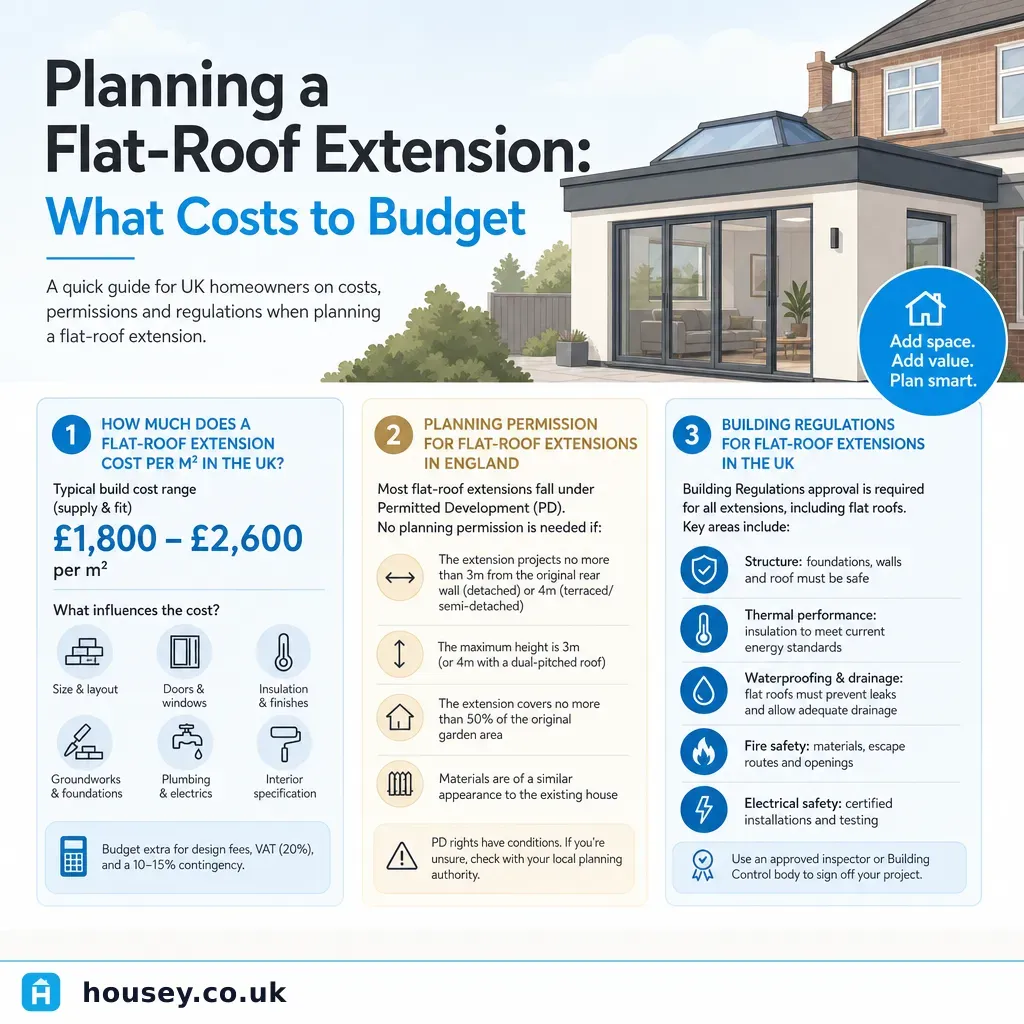
Planning a Flat-Roof Extension: What Costs to Budget
A flat-roof single-storey extension typically costs £1,500–£3,000 per m² in the UK, depending on size, specification, location, and roof membrane choice.
 Improvement & Build
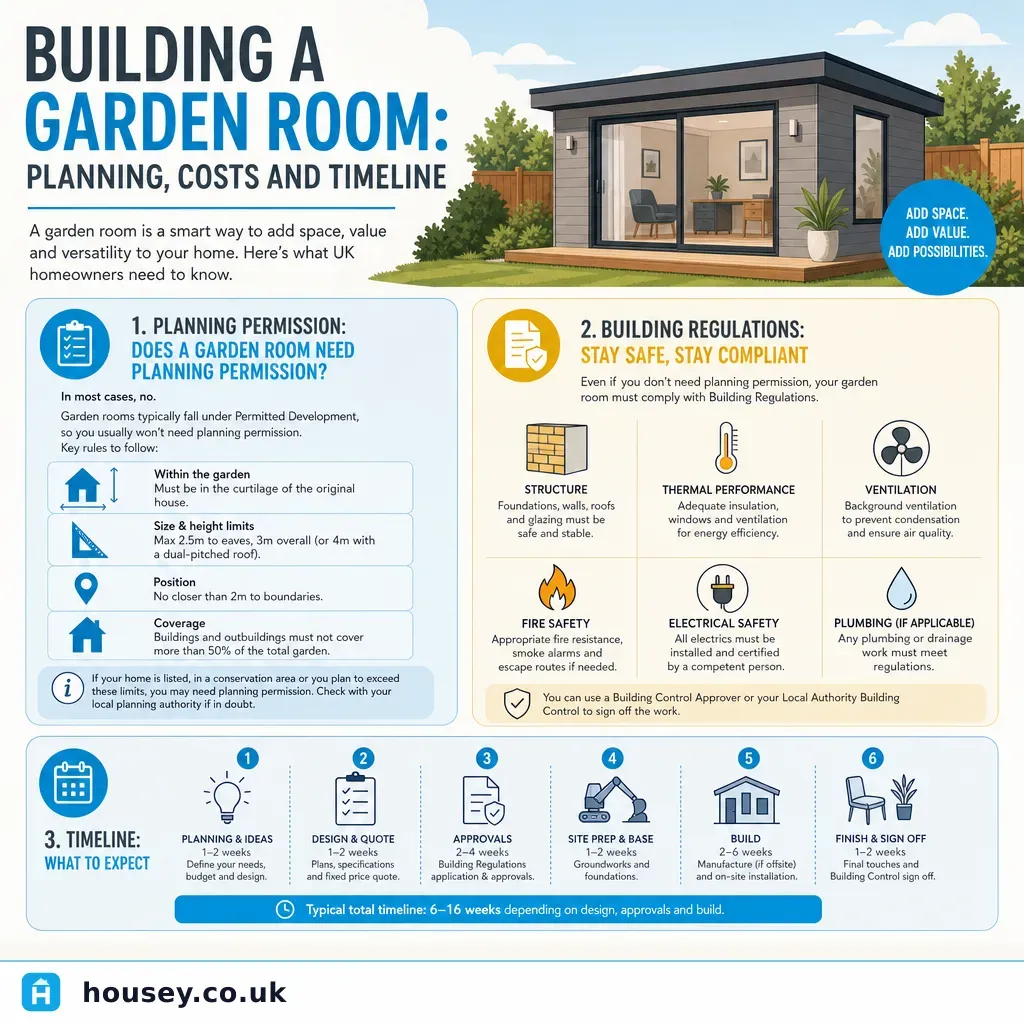
Building a Garden Room: Planning, Costs and Timeline
Most garden rooms in England fall under permitted development and don't need planning permission, provided the structure meets height, coverage, and boundary conditions.
 Improvement & Build
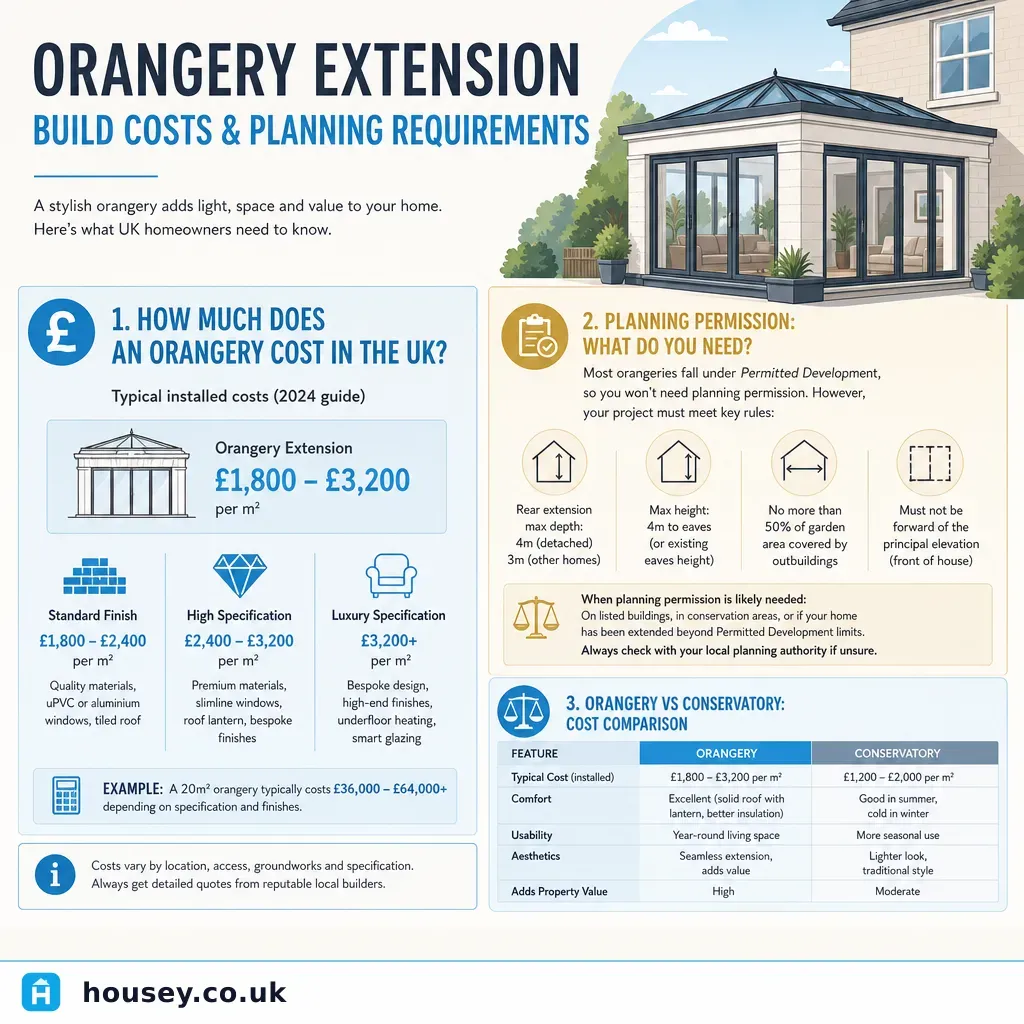
Orangery Extension Build Costs and Planning Requirements
An orangery extension in the UK typically costs £25,000–£100,000 depending on size, glazing specification, and finish.
 Improvement & Build
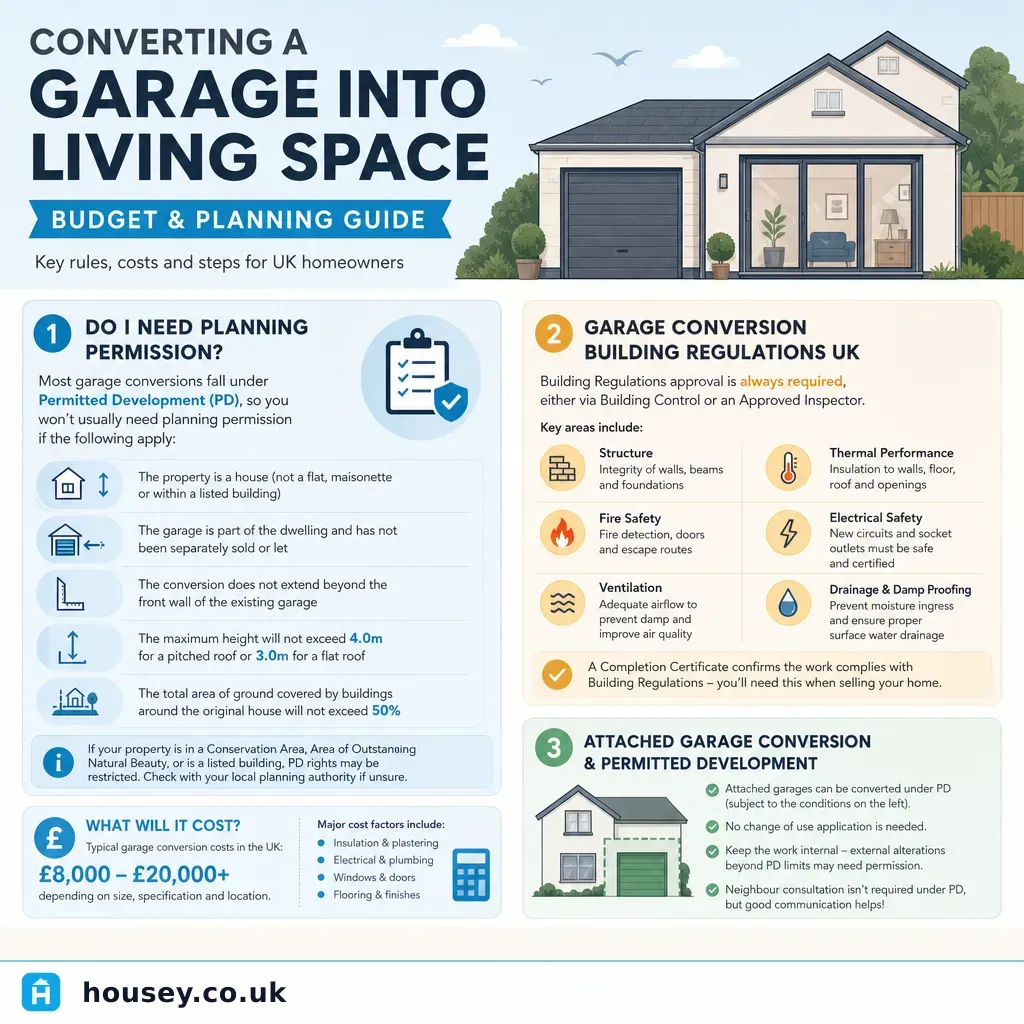
Converting a Garage into Living Space: Budget and Planning Guide
A single-garage conversion typically costs £8,000–£20,000 in the UK.
 Improvement & Build
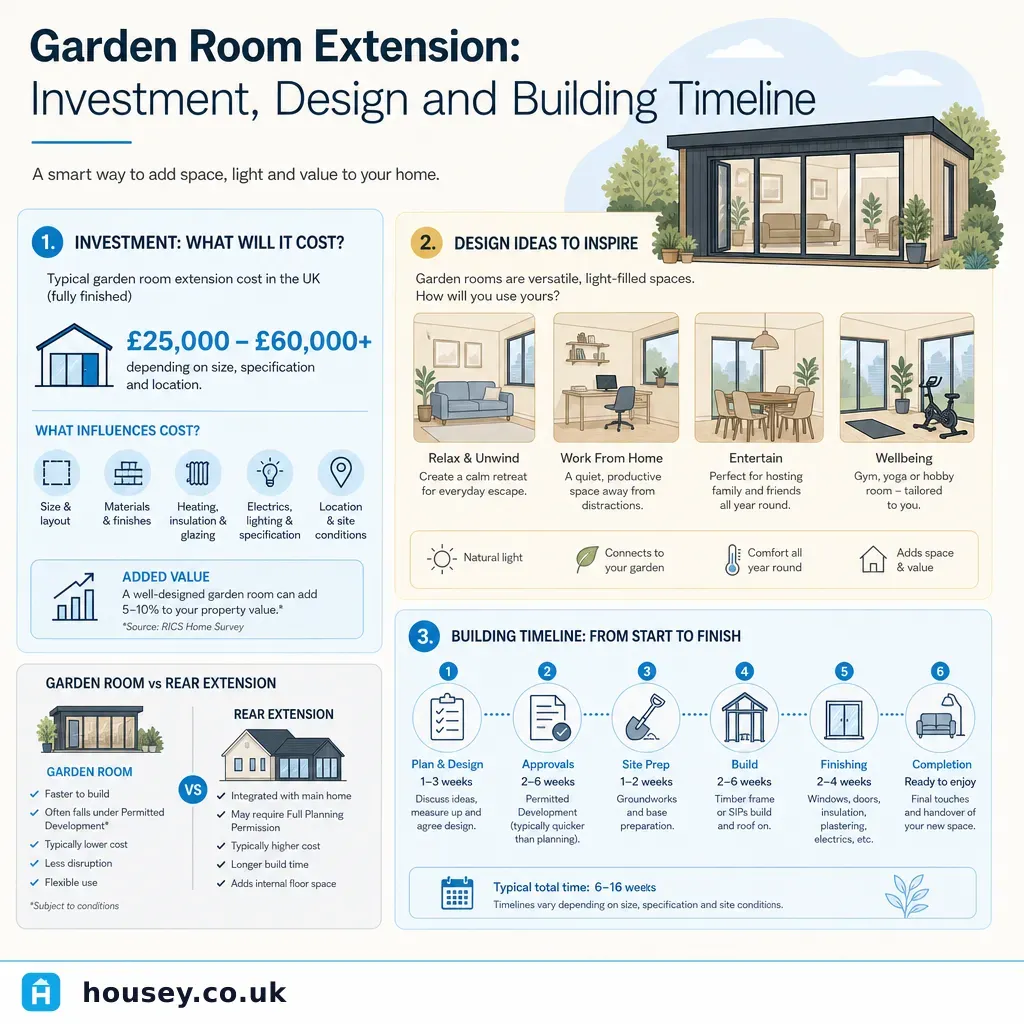
Garden Room Extension: Investment, Design and Building Timeline
A garden room or garden extension can add usable year-round space without always requiring planning permission.