Garden Bar Construction: Creating an Outdoor Entertaining Space
By Housey · Last reviewed 19th of May 2026
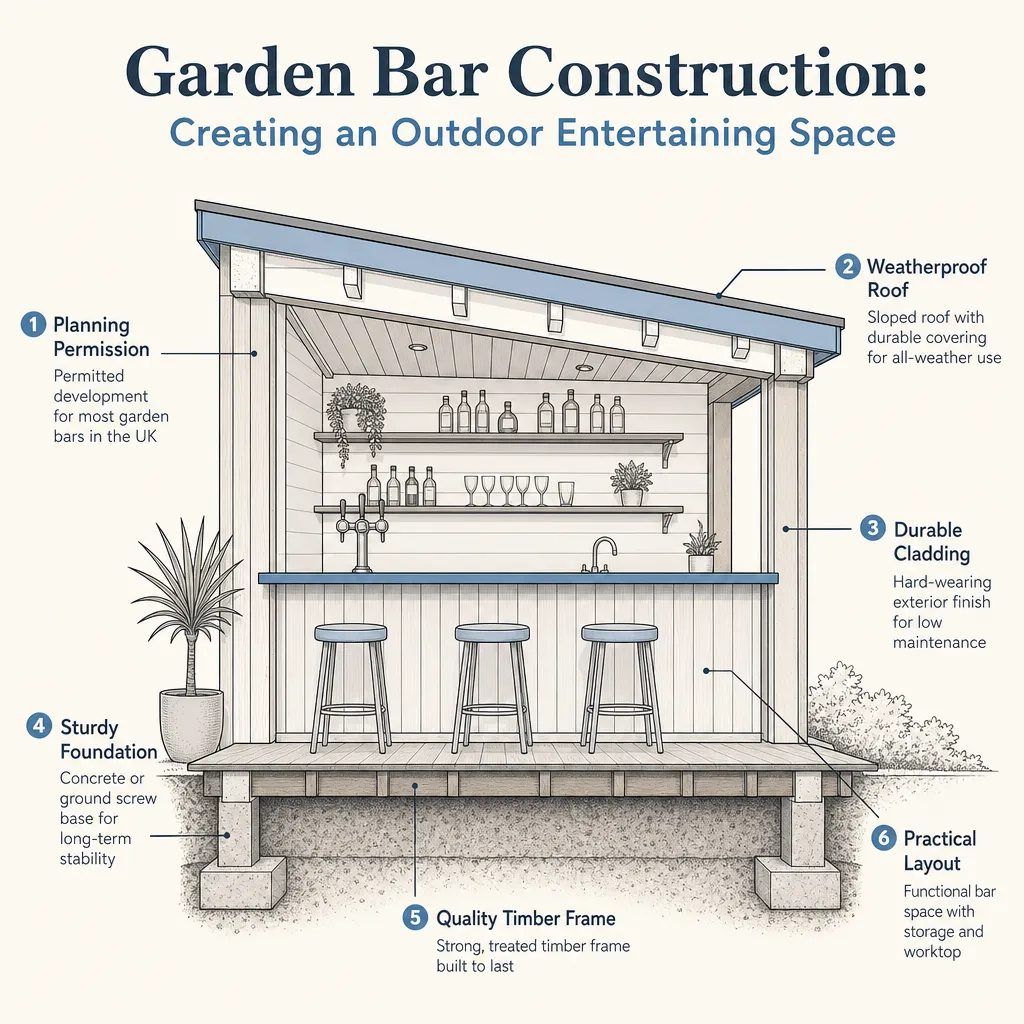
Garden Bar Construction: Creating an Outdoor Entertaining Space
A garden bar has become one of the more popular outdoor projects for UK homeowners — offering a dedicated space for entertaining that extends usable outdoor time well beyond the warmest months of the year. Whether you have in mind a simple covered counter at the end of the patio, a converted timber shed fitted with bar stools and a drinks fridge, or a purpose-built insulated outbuilding designed for year-round use, there are planning rules, structural requirements, and electrical safety considerations worth addressing before the first foundations go in.
Key points
- In England, a garden bar built as an outbuilding is typically permitted development provided the structure does not exceed 4 m in height (dual-pitched roof) or 3 m (any other roof type), does not cover more than 50% of the curtilage, and does not project forward of the principal elevation.
- Any outbuilding within 2 m of a boundary is restricted to a maximum height of 2.5 m under the General Permitted Development Order (GPDO) 2015.
- In conservation areas and the curtilage of listed buildings, outbuilding permitted development rights are more restricted — always check with your local planning authority before starting work.
- Adding electricity to a garden bar requires a new circuit installed by a Part P-competent electrician, typically run in armoured cable buried underground; RCD protection is mandatory for all outdoor circuits.
- A garden bar used for private domestic entertaining requires no alcohol licence; a premises licence is needed only when alcohol is sold commercially to members of the public.
Do I need planning permission for a garden bar?
For most properties in England, a garden bar built as an outbuilding falls within permitted development rights under the GPDO 2015 — no formal planning application is needed, provided specific conditions are met.
Use this to check your position before starting work:
- Planning permission likely not needed if: the structure is in the rear or side garden (not projecting forward of the house front), is single-storey, does not exceed 4 m in height (dual-pitched roof) or 3 m (flat or mono-pitch), stays at or below 2.5 m within 2 m of a boundary, and total outbuilding coverage does not exceed 50% of the curtilage excluding the original house footprint.
- Planning permission likely needed if: the property is a listed building, the structure would be in a conservation area and visible from the highway, the property sits within a National Park or Area of Outstanding Natural Beauty, or an Article 4 Direction has removed outbuilding permitted development rights in that area.
- Check with your local planning authority if you are unsure, have already built significant outbuildings, or the proposed structure is large or close to the boundary.
- Consider a Certificate of Lawful Development if you want formal written confirmation that the build is lawful — useful when you come to sell the property.
Rules differ in Wales, Scotland, and Northern Ireland — check with the relevant planning authority before starting work.
What type of garden bar suits your space?
Type | Best for | Key considerations | Typical planning status |
|---|---|---|---|
Converted timber shed | Smaller budgets; using an existing outbuilding | Insulation, electrical upgrade, damp-proof floor | Usually no permission needed |
Purpose-built timber kit outbuilding | Most gardens; relatively quick build | Foundation, weatherproofing, ventilation | Usually permitted development within size limits |
Open-sided covered pergola or canopy | Warm-season use; minimal footprint | Roof fixings, foundation, no walls required | Usually permitted development; check overall height |
Masonry or brick outbuilding | Year-round permanence; robust construction | Higher cost, longer build; planning more likely for larger structures | Check against GPDO size and location criteria |
Insulated log cabin | Year-round entertaining; residential feel | Condensation risk, thermal performance, power supply | Usually permitted development within standard limits |
What does building a garden bar involve?
A typical purpose-built garden bar project moves through these stages:
- Planning check — confirm permitted development status or obtain a Certificate of Lawful Development before any groundwork starts
- Design — determine the footprint, roof pitch, internal layout (bar counter, seating, storage), and whether the bar will be used year-round or seasonally
- Foundations — typically a poured concrete pad or concrete block grid; consult a builder if ground slopes or conditions are uncertain
- Frame and shell — erect the structural frame, apply external cladding, and fit the roof covering (EPDM membrane, felt, timber shingles, or tiles)
- Weatherproofing and insulation — particularly important if the bar will be used from autumn through spring
- Electrical installation — always by a Part P-competent electrician; plan circuits for sockets, lighting, a drinks fridge, and any electric heater
- Internal fit-out — bar counter, shelving, seating, and flooring (outdoor-rated tiles, composite decking boards, or engineered timber)
- Finishing — external timber treatment, guttering, decorative lighting, and landscaping around the base of the structure
What to ask before hiring a builder or designer
Before commissioning any contractor or designer, ask:
- Will you confirm the permitted development position, or apply for a Certificate of Lawful Development on my behalf?
- What foundation type is appropriate for my ground conditions, and have you assessed the specific site?
- What timber treatment and weatherproofing specification will be used, and what is the expected maintenance interval?
- Is electrical work included in your scope, and will a Part P-competent electrician carry it out and issue a certificate?
- What warranties or guarantees are provided for the structure and the roof covering?
- Is VAT included in the quoted price?
- What could change the cost or programme after work begins?
- How will unexpected ground conditions be managed if they differ from the initial assessment?
Practical considerations for year-round use
A garden bar used only in summer has simpler requirements than one designed for colder months:
- Insulation: Rigid foam board between structural timbers significantly reduces heat loss and condensation risk in an enclosed outbuilding
- Heating: An electric panel heater or infrared heater needs a dedicated circuit; a wood-burning stove requires a flue system complying with Building Regulations Approved Document J and must be installed by a HETAS-registered competent person
- Ventilation: Background trickle vents and openable windows or a roof lantern reduce condensation in enclosed, occupied spaces
- Lighting: A mix of ambient downlighters and dimmable festoon or LED strip lighting suits an entertaining space better than a single bright overhead fitting
- Drainage: If you plan a bar sink or glasswasher, drainage will need to connect to the existing drainage system — check the route before finalising the design, as this can affect layout significantly
When to get professional help
Seek professional advice if:
- The structure will sit within 2 m of your boundary or exceed 2.5 m in height — check planning rules carefully before building
- The property is listed, in a conservation area, or subject to an Article 4 Direction
- You want a wood-burning stove or flue — the installation must comply with Approved Document J and be carried out by a HETAS-registered competent person
- Any electrical work is planned — a Part P-competent electrician is required for all new outdoor circuits in England and Wales
- Ground conditions are uncertain, the plot slopes significantly, or large trees are nearby and may affect foundations
How Housey can help
Housey connects you with vetted garden designers and experienced landscapers who can help you plan, design, and build a garden bar suited to your space, style, and budget.
Frequently asked questions
Can I build a garden bar myself?
The structural carpentry and internal fit-out of a timber garden bar is within the capability of a competent DIYer, and many kit outbuildings are designed for self-assembly. However, any electrical installation — including running a new circuit from the house — must be carried out by a Part P-competent electrician who can self-certify the work. Do not attempt electrical installation without the appropriate qualification.
Does a garden bar affect my home insurance?
Adding a significant outbuilding may affect your buildings insurance, particularly if it contains electrical appliances, heating equipment, or a sound system. Notify your insurer before building starts and again once the structure and fit-out are complete. Most household policies can be extended to cover permanent outbuildings, but the insurer needs advance notice of the addition.
Do I need a licence to serve alcohol in my garden bar?
For private domestic entertaining — serving friends and family at no charge — no licence is required. A premises licence from the local authority is needed only when alcohol is sold commercially to members of the public. If you are considering any commercial operation from your home, seek advice from your local authority licensing department before proceeding.
Can I install a wood-burning stove in a garden bar?
Yes, but the installation must comply with Building Regulations Approved Document J (combustion appliances and fuel storage systems) and be carried out by a competent person. HETAS-registered installers are qualified for solid fuel and biomass appliances and can self-certify their work. The flue, hearth, and ventilation must all meet the specification — do not self-install a stove without the relevant competence.
How close to my boundary can I build a garden bar?
Under permitted development in England, any outbuilding within 2 m of a boundary cannot exceed 2.5 m in total height. Beyond 2 m from the boundary, the permitted height rises to 4 m for a dual-pitched roof or 3 m for any other roof type. Measure your plot carefully and consult your local planning authority if you are close to any threshold.
Sources and further reading
- Permitted development rights for householders: technical guidance — GOV.UK
- When is permission required? Planning Practice Guidance — GOV.UK
- Approved Document J: combustion appliances and fuel storage systems — GOV.UK
- Electrical safety in the home — Electrical Safety First
- HETAS registered installers — HETAS
Useful next reads
 Improvement & Build
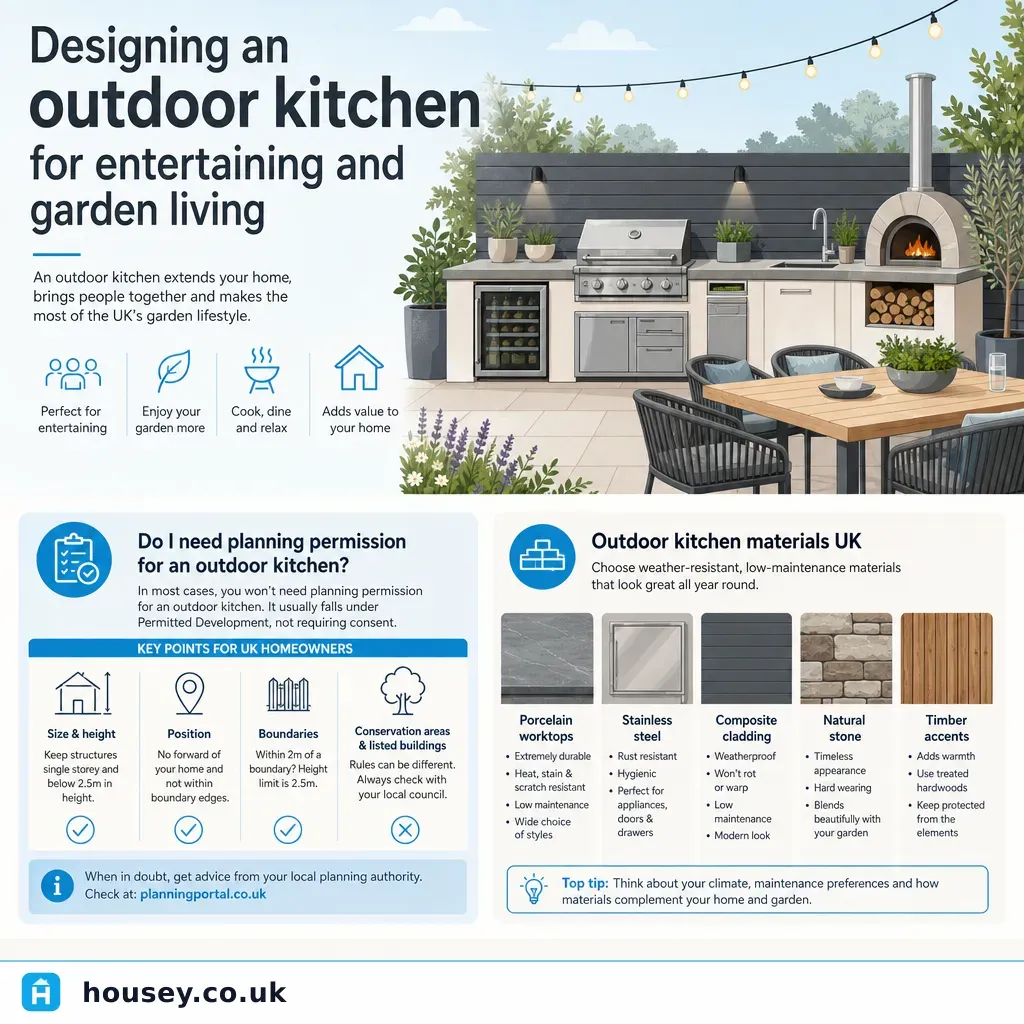
Designing an outdoor kitchen for entertaining and garden living
An outdoor kitchen in a UK garden needs a stable, level base — typically a concrete slab or quality paving — with weather-rated materials such as stainless steel grade 316 or frost-rated porcelain.
 Improvement & Build
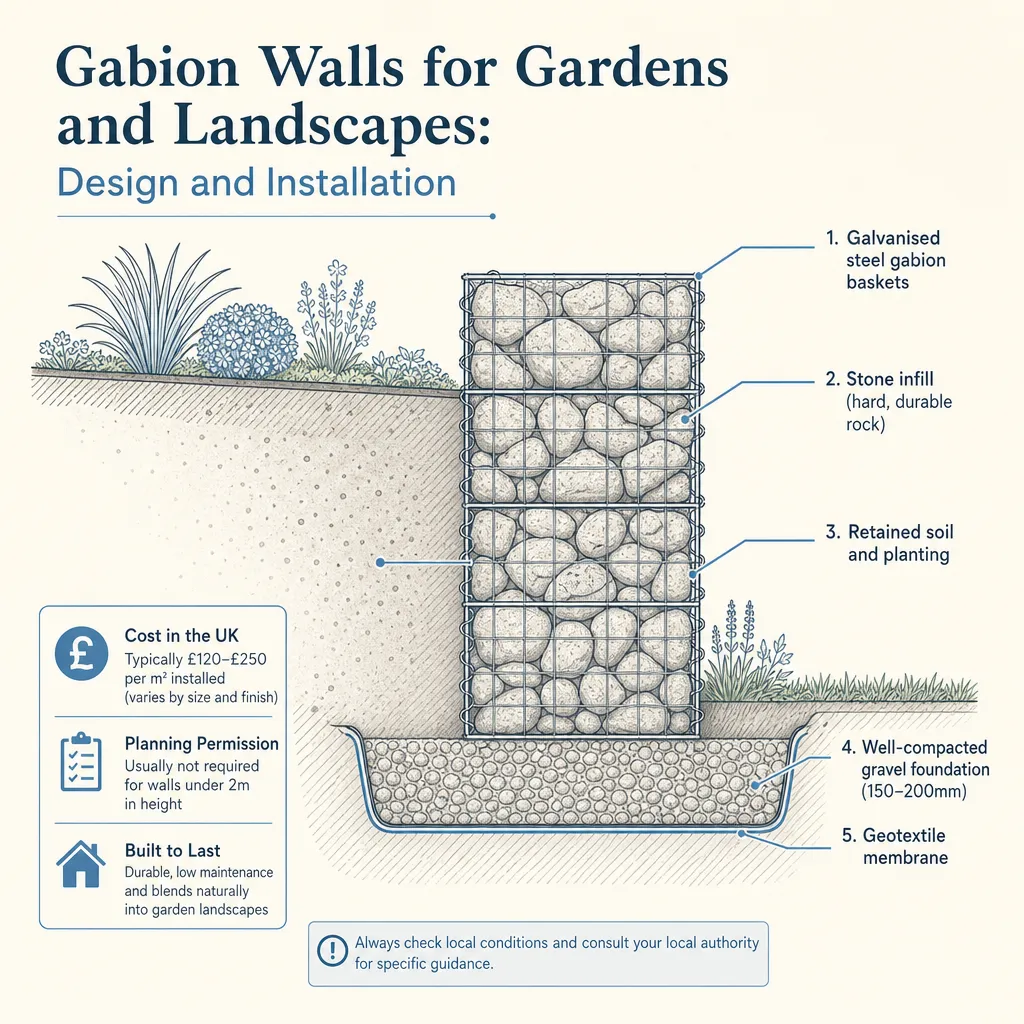
Gabion Walls for Gardens and Landscapes: Design and Installation
Gabion walls are wire mesh baskets filled with stone, stacked to form freestanding or retaining landscape structures.
 Improvement & Build
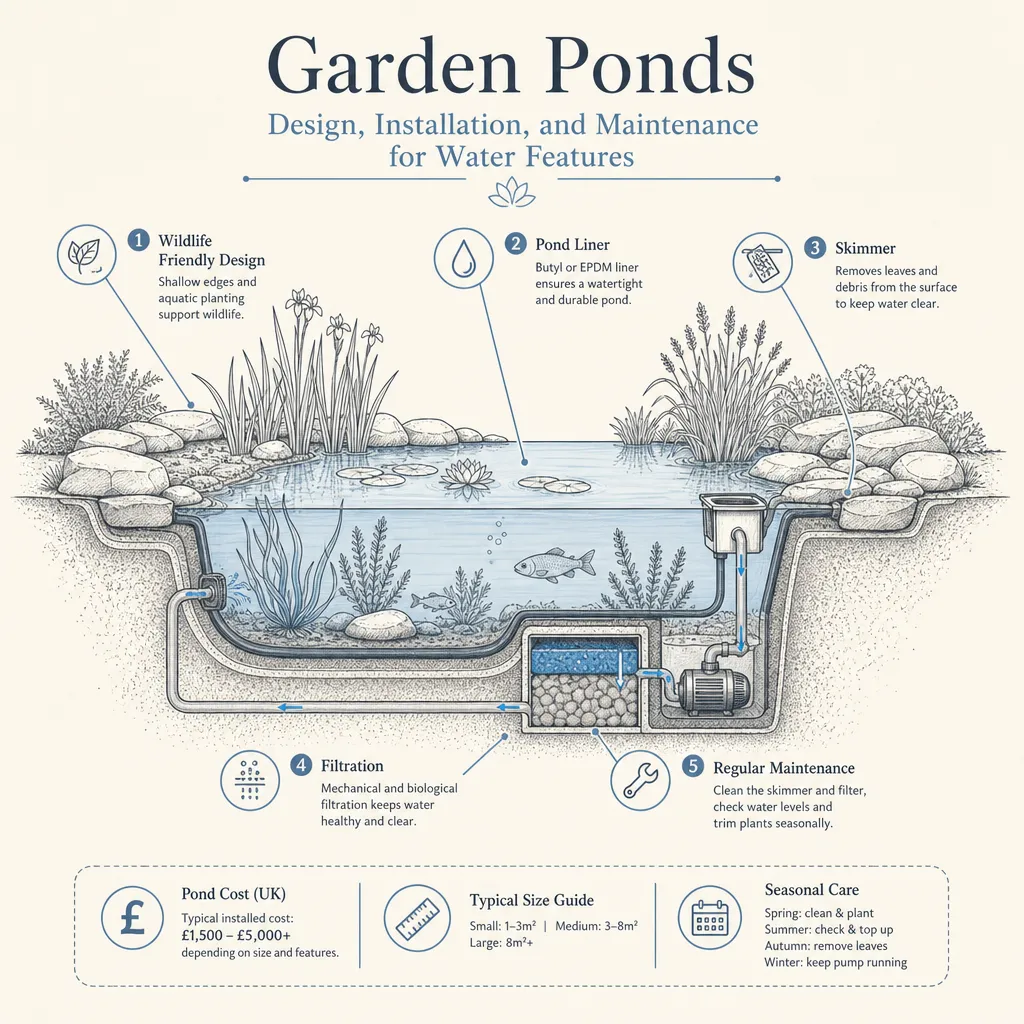
Garden Ponds: Design, Installation, and Maintenance for Water Features
Garden ponds can be installed by a specialist landscaper or pond contractor.
 Improvement & Build
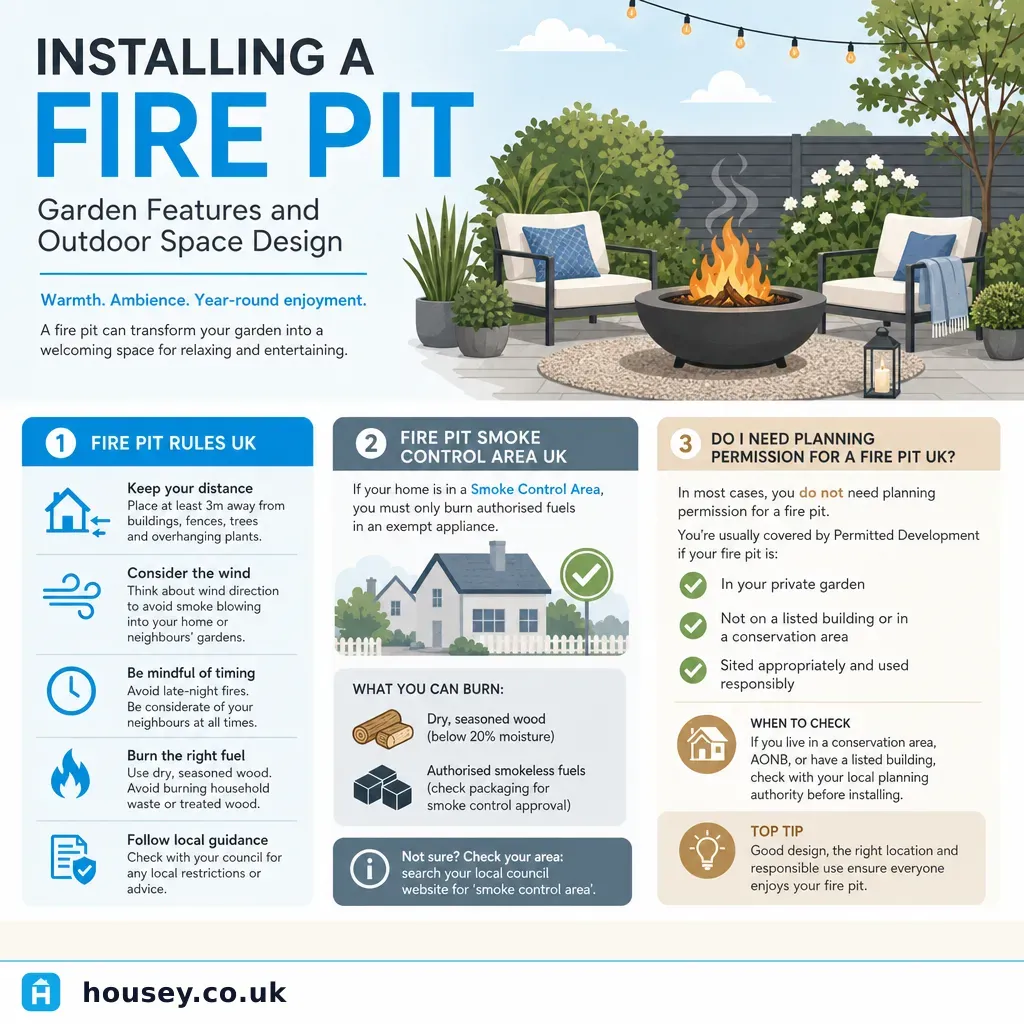
Installing a Fire Pit: Garden Features and Outdoor Space Design
Installing a garden fire pit in the UK is generally permitted, but Smoke Control Area rules prohibit open wood-burning in most towns and cities.
 Improvement & Build
Seasonal Garden Transformations and Outdoor Design Ideas
A successful garden transformation in the UK works with the seasons rather than against them — establishing structure and hard landscaping in autumn or winter, planting in spring, and enjoying the results through summer.