Planning and Building Outdoor Entertaining Structures for Your Property
By Housey · Last reviewed 30th of May 2026
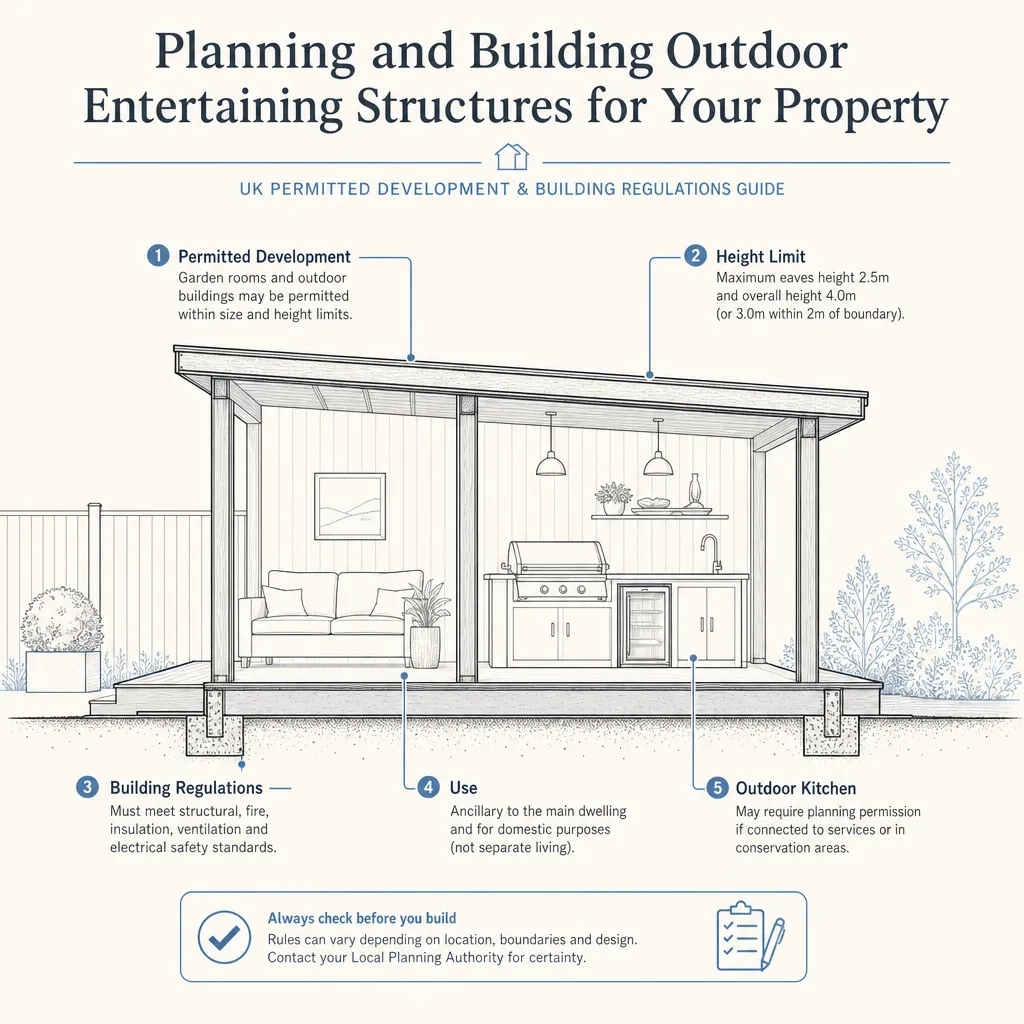
Planning and Building Outdoor Entertaining Structures for Your Property
Outdoor entertaining structures — from garden rooms and pergolas to pavilions and outdoor kitchens — are increasingly popular as homeowners look to extend usable living space without the cost and disruption of a full extension. The decision to build often arises during a landscaping project or when an existing garden simply lacks shelter and a proper cooking or seating area. Whether you are planning a modest timber shed or a fully fitted garden room with electrics and drainage, sorting the planning and regulatory questions before work begins saves significant time and expense later.
Key points
- Class E Permitted Development (Schedule 2, Part 1, Town and Country Planning (General Permitted Development) (England) Order 2015) covers most domestic garden outbuildings, but only where the combined area of extensions and outbuildings does not exceed 50% of the curtilage, excluding the original house footprint.
- Any outbuilding within 2 metres of a boundary is capped at a maximum height of 2.5 metres under permitted development rules — a taller structure within that distance needs a planning application.
- Structures with sleeping accommodation, or over 15m² and less than 1 metre from a boundary, are likely to require Building Regulations approval even where planning permission is not needed.
- Gas connections to outdoor kitchens or barbecue points must be installed by a Gas Safe registered engineer — a legal requirement under the Gas Safety (Installation and Use) Regulations 1998.
- Permitted development rights are automatically removed for listed buildings and may be restricted by Article 4 Directions or planning conditions on individual properties; always check your HM Land Registry title register before starting work.
What counts as an outdoor entertaining structure?
The term covers a wide range, from open-sided pergolas and simple timber sheds to fully insulated garden rooms with kitchenettes, fixed electrics, and plumbed drainage. Planning and regulatory treatment depends on the specific type, dimensions, and intended use of the structure.
Structure type | Typical use | Most likely planning route |
|---|---|---|
Garden shed or timber outbuilding | Storage, workshop | Permitted development (size limits apply) |
Pergola or open-sided sail shade | Dining, seating area | Usually no consent needed if open-sided |
Garden room or garden office | Home office, gym, leisure | Permitted development (conditions apply) |
Garden pavilion or summerhouse | Entertaining, relaxation | Permitted development (conditions apply) |
Outdoor kitchen (fixed structure) | Al-fresco cooking | Permitted development; Building Regs may apply for services |
Swimming pool enclosure | Pool shelter | Permitted development (size limits apply) |
The distinction between a storage shed and a habitable garden room matters most when Building Regulations are considered — sleeping accommodation triggers different requirements than a simple store.
Do I need planning permission?
Most domestic garden structures in England fall under Class E Permitted Development Rights under the Town and Country Planning (General Permitted Development) (England) Order 2015. No formal planning application is required, provided specific conditions are met.
Core permitted development conditions (England):
- The structure must be ancillary to the enjoyment of the house — it cannot function as a separate dwelling.
- The combined area of extensions and outbuildings must not exceed 50% of the total curtilage (the land around the house, excluding the original house footprint).
- Maximum eaves height: 2.5m; maximum overall height: 4m (dual-pitch roof) or 3m (any other roof type).
- If the structure is within 2m of any boundary, the maximum height is 2.5m.
- The structure must not be forward of the principal elevation of the house.
- In a designated area (national park, Area of Outstanding Natural Beauty, World Heritage Site), structures to the side of the house and over 10m² require a planning application.
Rules in Wales, Scotland, and Northern Ireland differ — check with your local planning authority (LPA) for the relevant regime.
When planning permission is required
- The property is a listed building — Class E permitted development does not apply, and listed building consent may also be required for structures within the curtilage.
- The property is in a conservation area and the proposed structure is to the side of the house or has a floor area over 10m².
- Permitted development rights have been removed by a planning condition on a previous application or by a local Article 4 Direction.
- The structure is intended for use as a separate residential unit or for short-term holiday lettings such as Airbnb — this usually requires planning permission as a change of use.
Which route applies to you?
- Choose no application (permitted development) if the structure is single-storey, within the size and height thresholds, not in a listed building curtilage or designated area, not forward of the principal elevation, and total outbuilding coverage stays under 50%.
- Submit a householder planning application if the structure falls outside permitted development conditions, or your LPA has issued an Article 4 Direction.
- Obtain listed building consent (in addition to any planning permission) if the structure sits within the curtilage of a listed building.
- Check your HM Land Registry title register for restrictive covenants — these can prevent building even where planning permits it.
- Use your LPA's pre-application advice service if the position is unclear; many councils provide written pre-application guidance for a modest fee.
Do outdoor structures need Building Regulations approval?
Building Regulations and planning permission are separate considerations. For most small garden buildings, an exemption applies under Schedule 2 of the Building Regulations 2010.
Generally exempt from Building Regulations:
- Detached single-storey buildings under 30m² with no sleeping accommodation, provided they are either more than 1m from any boundary or constructed from substantially non-combustible materials.
- Open-sided pergolas and structures without a continuous roof covering.
Building Regulations approval is likely required for:
- Structures with sleeping accommodation, regardless of floor area.
- Structures between 15m² and 30m² that sit less than 1m from a boundary.
- Any structure with a fixed gas supply (Approved Document J applies).
- Fixed electrical installations within the structure (Approved Document P — work must be carried out by a competent person or notified to building control).
- Structures connected to mains drainage or a water supply.
If uncertain, contact your local authority Building Control department, or use a registered Approved Inspector.
Outdoor kitchens: additional requirements
Outdoor kitchens introduce technical requirements beyond those for a straightforward garden room.
Gas connections must be installed by a Gas Safe registered engineer — a legal requirement under the Gas Safety (Installation and Use) Regulations 1998. Never allow a contractor who cannot produce a current Gas Safe Register ID card to work on any gas supply, including outdoor barbecue point connections.
Electrical installations for fixed outdoor sockets, lighting, or appliances must comply with BS 7671 (IET Wiring Regulations, 18th Edition). Outdoor locations are special locations requiring additional protection: residual current devices (RCDs) and weatherproof fittings rated to at least IP44. Work must be carried out by a NICEIC, NAPIT, or ELECSA-registered contractor under Part P of the Building Regulations.
Drainage: waste water from an outdoor sink must connect to the foul drainage system — discharging into a soakaway is not acceptable under Building Regulations Part H.
Red flags to watch for
- A contractor who confirms you do not need planning permission without having checked your specific title register, planning history, and LPA records.
- A build that would push total outbuilding coverage over 50% of the curtilage when combined with existing structures — enforcement notices have been issued for exactly this reason.
- Any work within the curtilage of a listed building carried out without listed building consent — a criminal offence under the Planning (Listed Buildings and Conservation Areas) Act 1990, regardless of the structure's scale.
- A gas connection installed by someone who cannot produce a current Gas Safe Register card.
- Electrical installations in an outbuilding that are not notified to building control and have no Electrical Installation Certificate.
Homeowner checklist before starting
Important limitations
This article provides general information about the planning and building regulations framework in England. Permitted development rules vary significantly by property type, location, planning history, and local authority policy. Nothing here constitutes planning or legal advice, and no assurance can be given that any specific structure will meet permitted development criteria. Consult a planning consultant, your LPA's pre-application service, or a qualified architect where the position is unclear for your property.
What to ask a qualified professional
Before instructing a garden designer, design-and-build firm, or planning consultant:
- Can you confirm in writing whether this structure falls within permitted development, or advise on what application will be required?
- Have you reviewed the title register and the planning history for this specific property?
- If Building Regulations approval is needed, will you manage the application, or will you notify me of my obligations?
- Who will carry out any gas or electrical work, and what competent person scheme are they registered with?
- Will I receive an Electrical Installation Certificate or a Building Regulations completion certificate at the end of the project?
- Does the quote address party wall or boundary surveying if the structure is close to a shared boundary?
When to get professional help
Consult a planning consultant or your LPA's pre-application advice service if:
- Your property is listed, within a conservation area, national park, or AONB.
- You are unsure whether previous planning conditions have removed your permitted development rights.
- You intend to use the structure for holiday lettings or as a self-contained dwelling.
- The structure is close to a boundary and you want written confirmation of the permitted height and setback requirements.
Instruct a structural engineer or qualified architect if the structure is unusually large, uses non-standard construction, or involves significant foundation or groundworks on uncertain ground.
How Housey can help
If you are ready to move forward with an outdoor entertaining structure, garden designers can translate your brief into a design that works within your permitted development envelope. Design-and-build firms can manage the full process from initial planning queries through to certified completion.
Frequently asked questions
Is a garden room classed as a bedroom for council tax purposes?
A garden room used solely as a home office or leisure space is not normally treated as a separate dwelling for council tax. A structure with its own sleeping and cooking facilities that functions as a self-contained unit may prompt your local billing authority to reassess your council tax band. Contact your local authority before the structure is completed if you are uncertain.
Can I build right up to my boundary fence?
Under permitted development rules, any structure within 2 metres of a boundary is restricted to a maximum height of 2.5 metres at the highest point of the roof. A structure taller than this within 2m of a boundary requires a householder planning application rather than relying on permitted development rights.
Do I need a party wall agreement for a garden building?
The Party Wall etc. Act 1996 applies if you are building on the line of a boundary, excavating within 3 metres of a neighbour's building, or digging within 6 metres at a depth below the neighbour's foundations. A small shed on a shallow slab is unlikely to engage the Act, but a larger structure with deeper foundations close to a shared boundary may do so. A party wall surveyor can advise.
Will my home insurance cover a new garden room?
Standard buildings insurance often covers outbuildings up to a specified limit, but a garden room with electrical installation, insulation, and fitted furniture may exceed that limit. Contact your insurer before work starts and ask for the structure to be specifically added to your policy schedule at its full replacement value.
Sources and further reading
- Permitted development rights for householders: technical guidance — GOV.UK
- Town and Country Planning (General Permitted Development) (England) Order 2015 — legislation.gov.uk
- Building Regulations 2010: Schedule 2 exempt buildings and work — legislation.gov.uk
- Gas Safety (Installation and Use) Regulations 1998 — legislation.gov.uk
- Approved Document P: Electrical safety in dwellings — GOV.UK
- Historic England National Heritage List for England — Historic England
Useful next reads
 Improvement & Build
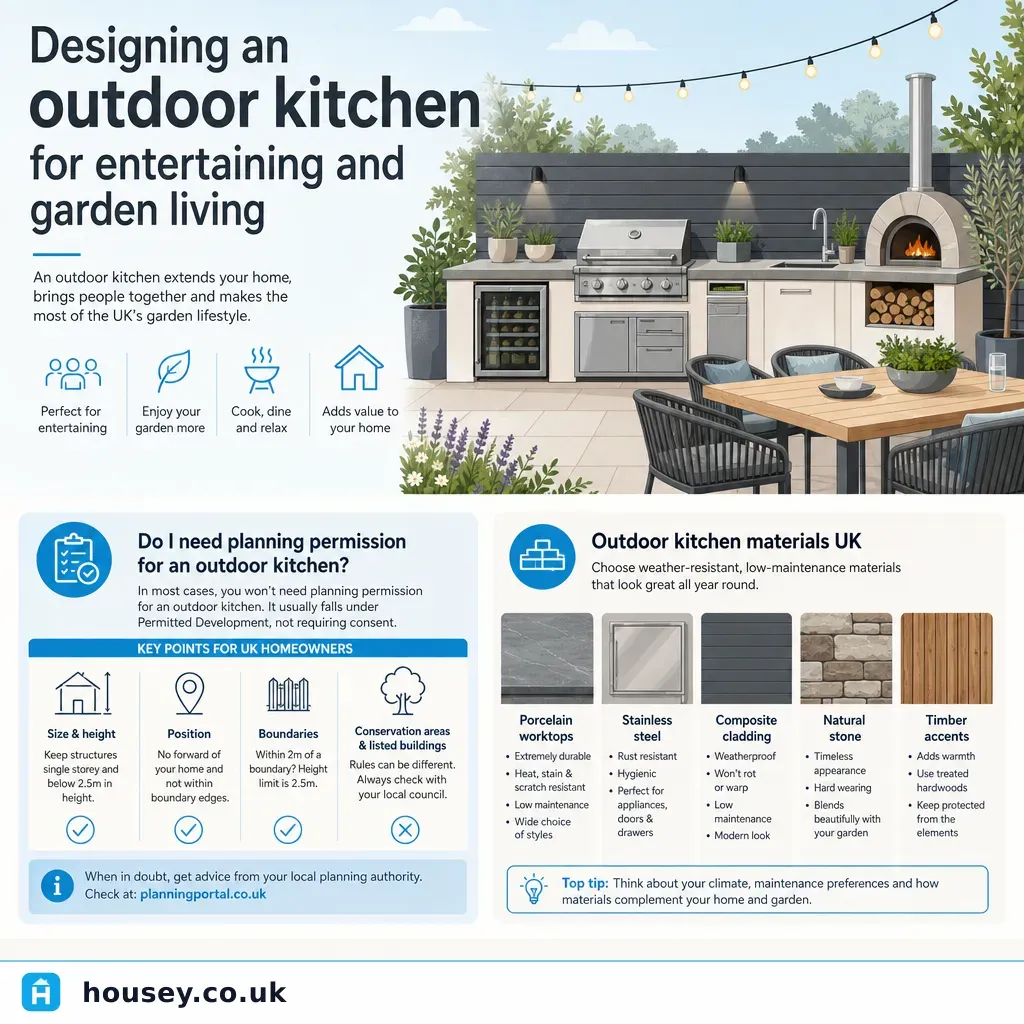
Designing an outdoor kitchen for entertaining and garden living
An outdoor kitchen in a UK garden needs a stable, level base — typically a concrete slab or quality paving — with weather-rated materials such as stainless steel grade 316 or frost-rated porcelain.
 Improvement & Build
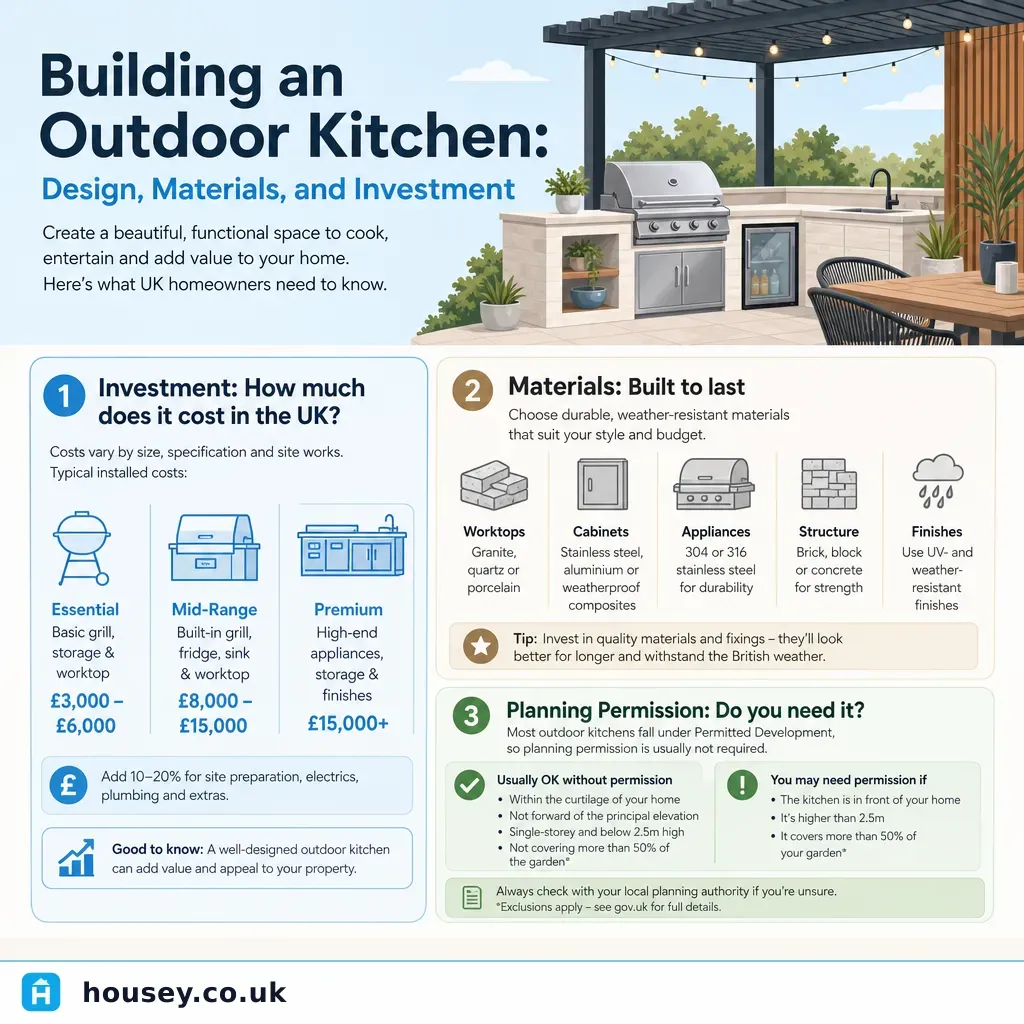
Building an Outdoor Kitchen: Design, Materials, and Investment
Building an outdoor kitchen in the UK costs roughly £3,000–£25,000 depending on size and materials.
 Improvement & Build
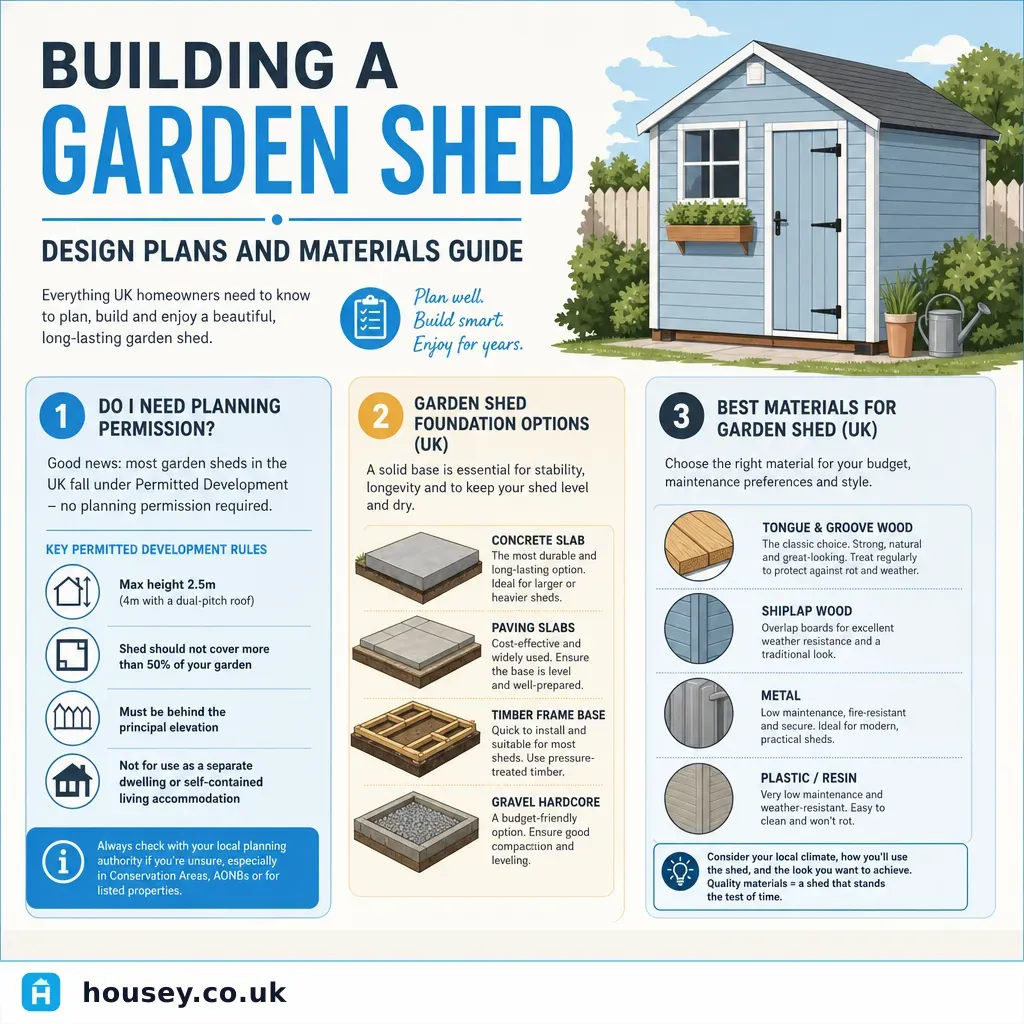
Building a Garden Shed: Design Plans and Materials Guide
Most garden sheds in England are Permitted Development, provided they sit behind the principal elevation, have eaves no higher than 2.
 Improvement & Build
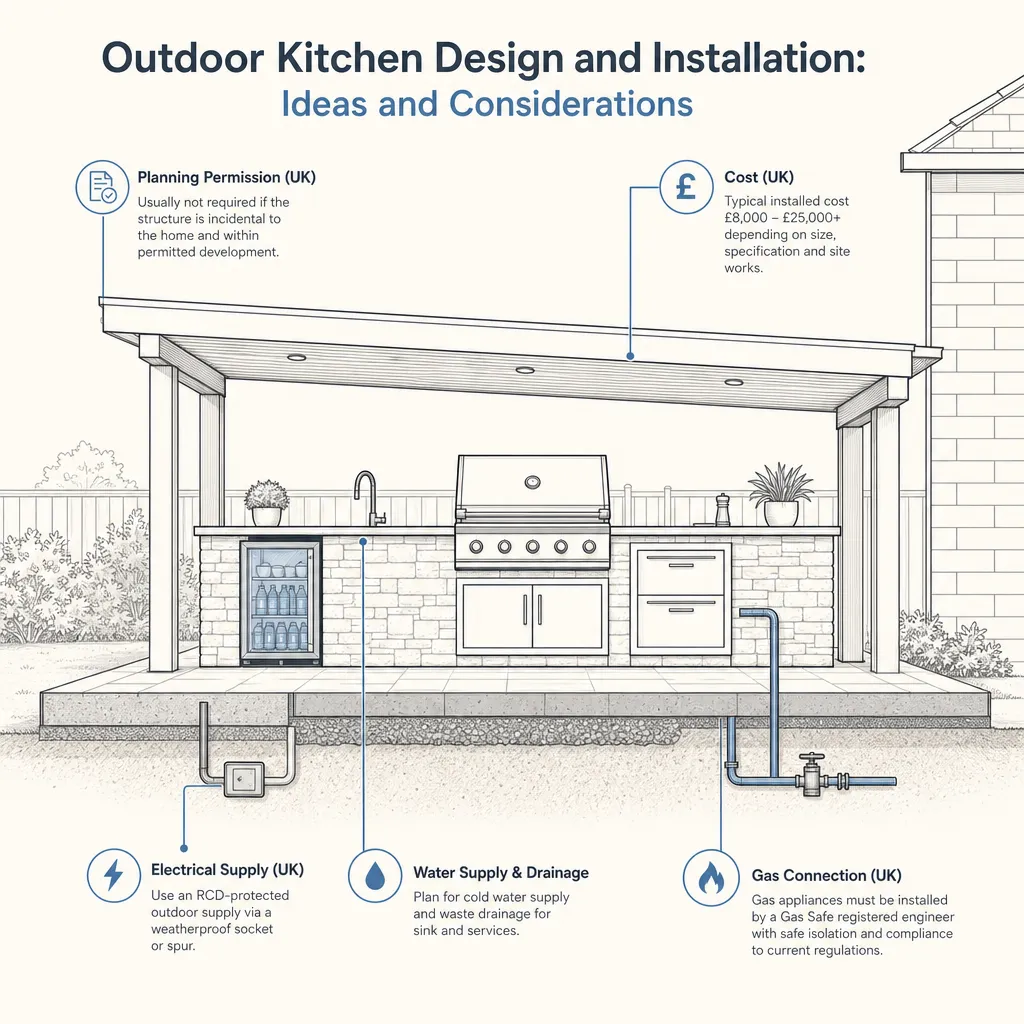
Outdoor Kitchen Design and Installation: Ideas and Considerations
An outdoor kitchen in the UK typically costs £3,000–50,000 depending on size and specification.
 Improvement & Build
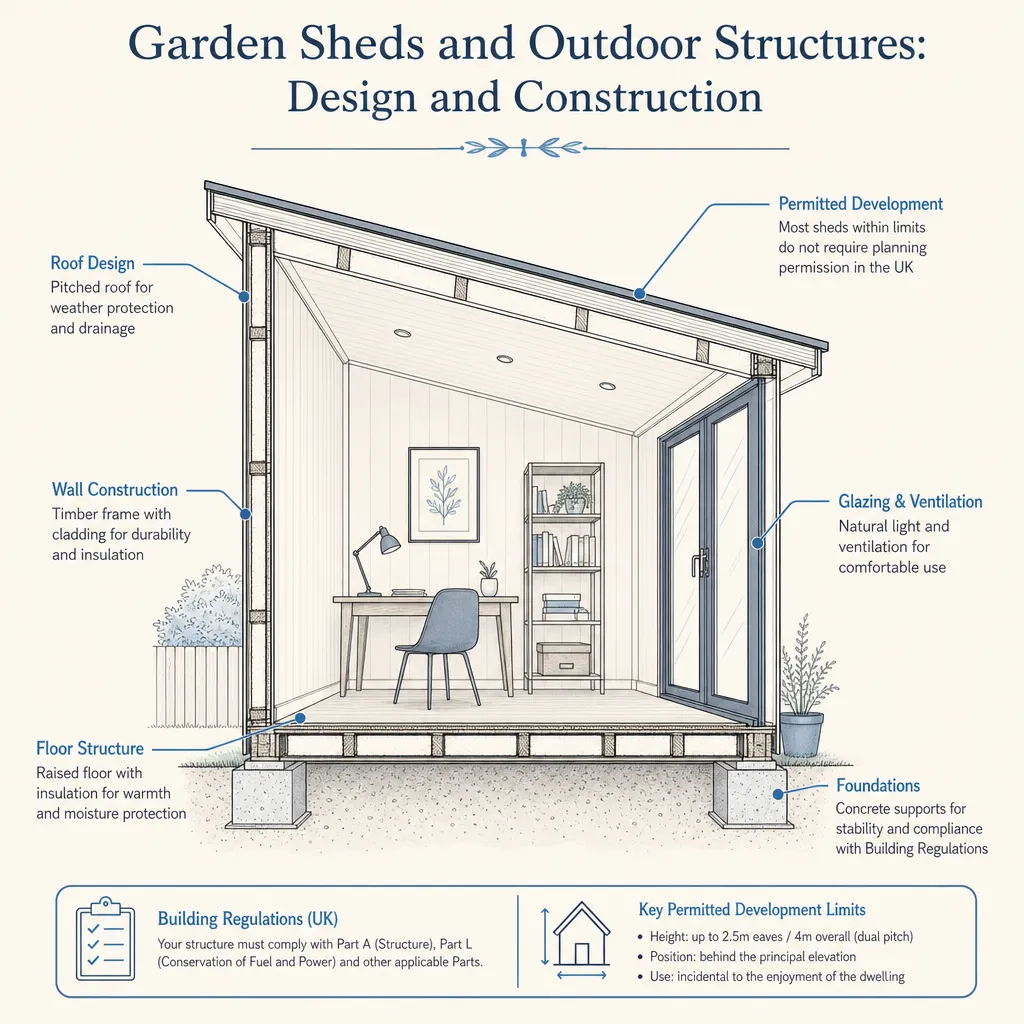
Garden Sheds and Outdoor Structures: Design and Construction
Most garden sheds and outbuildings in England fall under Class E permitted development rights and do not need planning permission, provided total outbuilding coverage stays below 50% of the garden, the structure is not forward of the house, and height limits are met.