Outbuilding Construction and Installation Costs
By Housey · Last reviewed 7th of May 2026
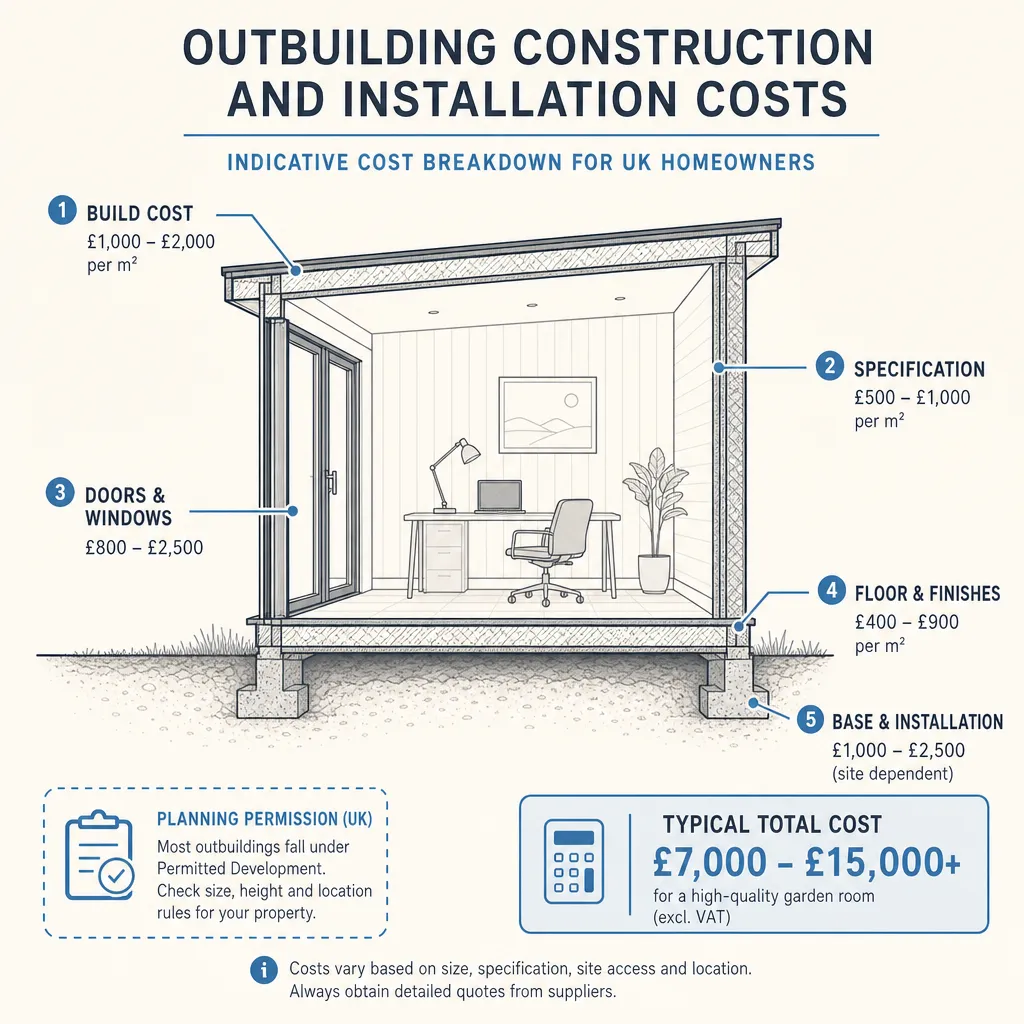
Outbuilding Construction and Installation Costs
For UK homeowners planning a garden office, workshop, gym, or annexe, understanding the full cost of construction—from groundwork to roof—is essential before committing to a design or contractor. Costs vary considerably depending on the structure's size, materials, intended use, and whether planning permission or building regulations approval is required. Getting the budget right at the outset helps avoid costly surprises once work is under way.
Key points
- Many outbuildings in England qualify as permitted development under Class E of the Town and Country Planning (General Permitted Development) (England) Order 2015, but conservation areas, Areas of Outstanding Natural Beauty, and listed-building land are subject to tighter restrictions.
- Building regulations approval is generally not required for single-storey outbuildings under 30 m² not used for sleeping accommodation, provided boundary and combustibility rules under Schedule 2 of the Building Regulations 2010 are met.
- Foundation type—concrete slab, pad, strip, or screw-pile—is a significant cost driver and must reflect ground conditions assessed before work begins.
- Timber-frame outbuildings are generally the most affordable construction method; brick-and-block and steel-frame structures cost substantially more.
- Adding electricity, heating, or plumbing typically adds £2,000–£15,000+ to the overall cost and may require notification under Building Regulations Part P (electrical) or Part G (drainage).
What counts as an outbuilding?
An outbuilding is any structure ancillary to the main dwelling: garden offices, home gyms, workshops, hobby rooms, garages, annexes, and pool houses all fall into this category. In England, Class E of the 2015 Permitted Development Order governs what can be built without a formal planning application. Scotland, Wales, and Northern Ireland have separate planning rules.
Permitted development decision tree
- No application needed if the outbuilding is single storey; maximum eaves height 2.5 m and overall height 4 m (dual-pitch) or 3 m (other); sits more than 2 m from any boundary if over 2.5 m high; is not in front of the principal elevation; and total curtilage coverage (all outbuildings combined) does not exceed 50%.
- Submit a planning application if the site is in a conservation area, National Park, or Area of Outstanding Natural Beauty; if the structure is in front of the principal elevation; or if height or coverage limits are exceeded.
- Ask your local planning authority (LPA) if Article 4 directions or the property's planning history may have removed permitted development rights.
- Check with your LPA before starting on any boundary-sensitive or listed-building site—enforcement action for unauthorised works can be costly.
How much does an outbuilding cost?
Indicative UK costs, last reviewed 2026-05-07.
Outbuilding type | Typical size | Indicative cost range | Notes |
|---|---|---|---|
Timber-frame garden room / office | 10–20 m² | £8,000–£25,000 | Insulated; electrics typically included |
Timber log-cabin style | 10–20 m² | £5,000–£18,000 | Insulation spec varies; check U-values |
Brick-and-block outbuilding | 15–30 m² | £15,000–£40,000 | More durable; building regs may apply |
Steel-frame workshop | 20–50 m² | £12,000–£50,000+ | Long spans; planning often required |
Pool house / garden bar | 15–30 m² | £20,000–£60,000+ | Full services and heating add cost |
Habitable annexe | 25–40 m² | £40,000–£80,000+ | Building regs and planning likely required |
Costs are indicative and exclude professional fees, planning fees, and landscaping reinstatement unless stated. Obtain at least three quotes.
What drives outbuilding costs?
Foundation and groundwork
- Concrete slab: suited to stable, level ground; typically £60–£120 per m².
- Pad foundations: used where a timber-frame manufacturer specifies them; often economical on flat sites.
- Strip foundations: required for brick-and-block structures or variable ground.
- Screw-pile foundations: increasingly used for garden rooms; typically £300–£600 per pile.
A groundworker should assess ground conditions before foundation type is finalised. Poor preparation is one of the most common causes of outbuilding defects.
Materials and construction method
Method | Main advantages | Main disadvantages |
|---|---|---|
Timber frame (SIP or stud) | Fast, lightweight, good insulation | Requires maintenance; durability varies |
Brick-and-block | Durable, low maintenance | Slower; higher material and labour costs |
Steel frame | Long spans, very durable | Harder to insulate; specialist contractors needed |
Log cabin | Attractive aesthetic, often kit-supplied | Insulation often below modern standards |
Services and professional fees
Electrical installation must be carried out by an NICEIC- or NAPIT-registered contractor and notified under Part P. For bespoke or larger outbuildings, design fees from a design-and-build firm typically add 10–15% to the build cost.
Building regulations for outbuildings
Under Schedule 2 of the Building Regulations 2010, a detached single-storey outbuilding is generally exempt if the floor area does not exceed 30 m², it contains no sleeping accommodation, and—if within 1 m of a boundary—external walls are of substantially non-combustible construction. Approval is required for larger structures, habitable annexes, notifiable electrical installations (Part P), and drainage connections (Part G). Always verify the current position with your local building control body.
What to ask before accepting a quote
- Is the foundation design included, and what type is proposed?
- What insulation specification and U-values will be achieved?
- Who carries out electrical or plumbing work, and are they registered (NICEIC, NAPIT)?
- Is planning permission or a lawful development certificate in scope?
- What does the quote exclude—access, reinstatement, skip hire, VAT?
- What warranty applies to the structure and installed services?
- What could change the price or timeline once work begins?
When to get professional help
Seek specialist advice if the site has sloping ground, a high water table, or made-up ground; if the building will be used for sleeping or as a self-contained annexe; if the outbuilding is close to a boundary, protected tree, or listed structure; or if the structure exceeds 30 m² in floor area. An extension builder experienced in outbuildings can coordinate groundwork, structure, and services trades, reducing programme risk on larger projects.
How Housey can help
Housey connects UK homeowners with vetted contractors for outbuilding projects of all sizes. Whether you need a groundworker for foundations, a design-and-build firm for a bespoke garden room, or an extension builder to manage a larger build end to end, Housey makes it straightforward to request and compare quotes.
Frequently asked questions
Do I need planning permission for an outbuilding?
Many outbuildings can be built under Class E permitted development rights without a planning application, provided they stay within the size, height, and location limits in the Town and Country Planning (General Permitted Development) (England) Order 2015. Conservation areas, listed buildings, and Article 4 directions may remove these rights. Check with your local planning authority before starting work.
How long does it take to build an outbuilding?
A prefabricated garden room typically takes 2–5 days to install once the foundation is ready. A bespoke timber-frame outbuilding may take 4–8 weeks, while brick-and-block construction usually takes 6–16 weeks depending on size and trade availability. Foundation curing time adds to the overall programme.
Can I use an outbuilding as a home office?
Yes. A garden office is one of the most popular outbuilding uses in the UK. Provided it is ancillary to the main dwelling and not used as a self-contained dwelling unit, planning permission is unlikely to be needed within permitted development limits. A well-insulated, electrified garden office typically costs £10,000–£25,000 depending on size and specification.
Does an outbuilding need building regulations approval?
Not always. Single-storey outbuildings under 30 m² with no sleeping accommodation are generally exempt under Schedule 2 of the Building Regulations 2010. Approval is required for larger structures, habitable annexes, and any outbuilding with a notifiable electrical installation under Part P or a drainage connection under Part G.
Can an outbuilding add value to my home?
A well-built, permanent outbuilding may add appeal and some value, particularly where it provides genuinely usable additional floor space. Value uplift varies by location and buyer demand. An outbuilding that required building regulations approval but did not obtain it could complicate a future sale, so retaining compliance documentation matters.
Sources and further reading
- Planning Portal: Outbuildings — Planning Portal
- GOV.UK: Building regulations approval — GOV.UK
- Town and Country Planning (General Permitted Development) (England) Order 2015 — legislation.gov.uk
- Building Regulations 2010, Schedule 2: Exempt buildings — legislation.gov.uk
- GOV.UK: Planning fees for applications in England — GOV.UK
Useful next reads
 Improvement & Build
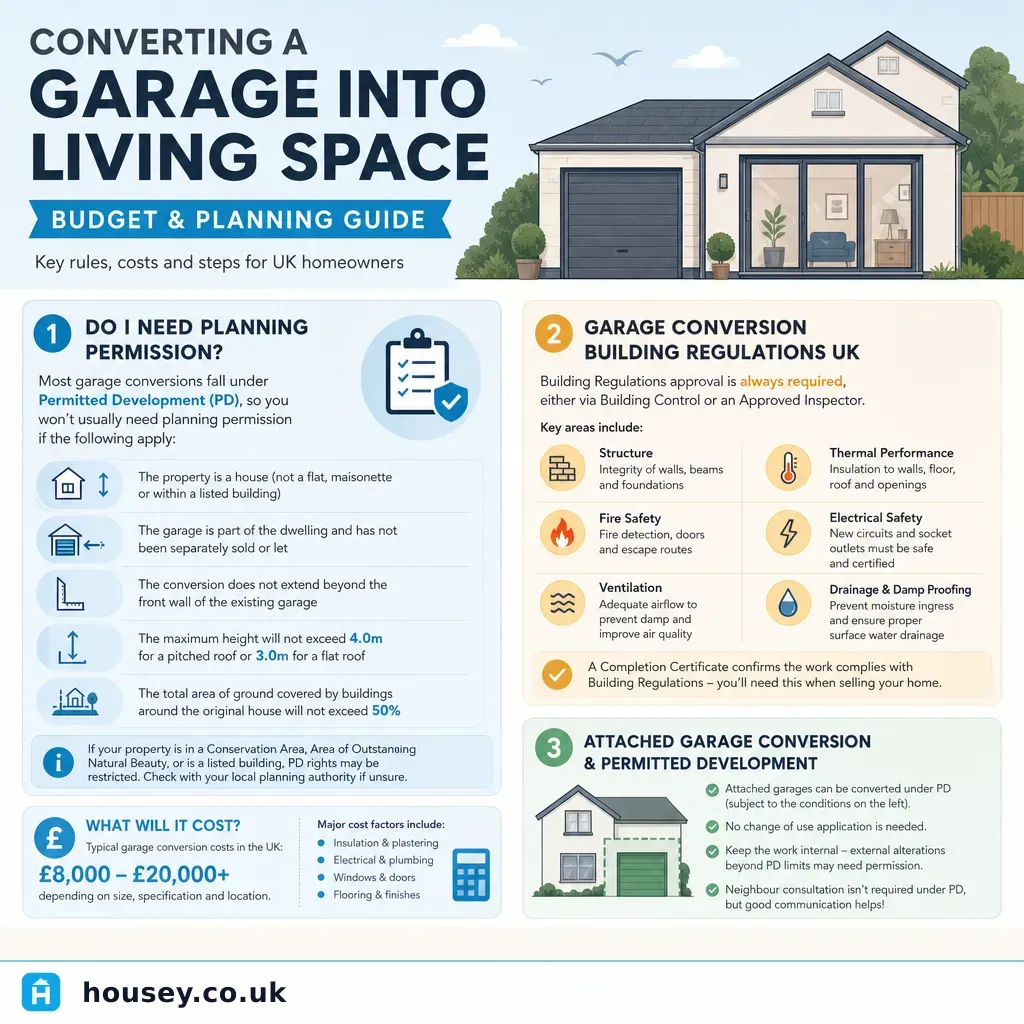
Converting a Garage into Living Space: Budget and Planning Guide
A single-garage conversion typically costs £8,000–£20,000 in the UK.
 Improvement & Build
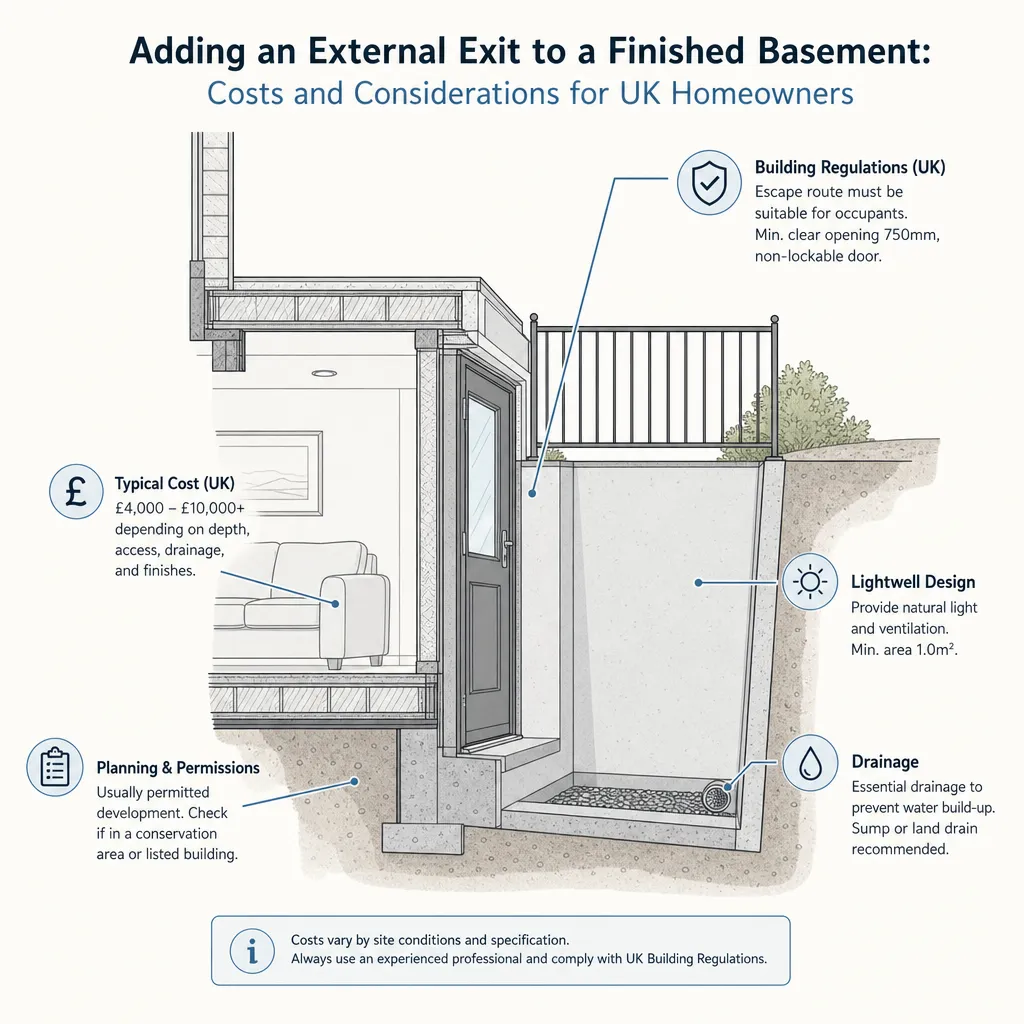
Adding an External Exit to a Finished Basement: Costs and Considerations
Adding an external exit to a finished UK basement always requires building regulations approval and a structural engineer's assessment before any wall is cut.
 Improvement & Build
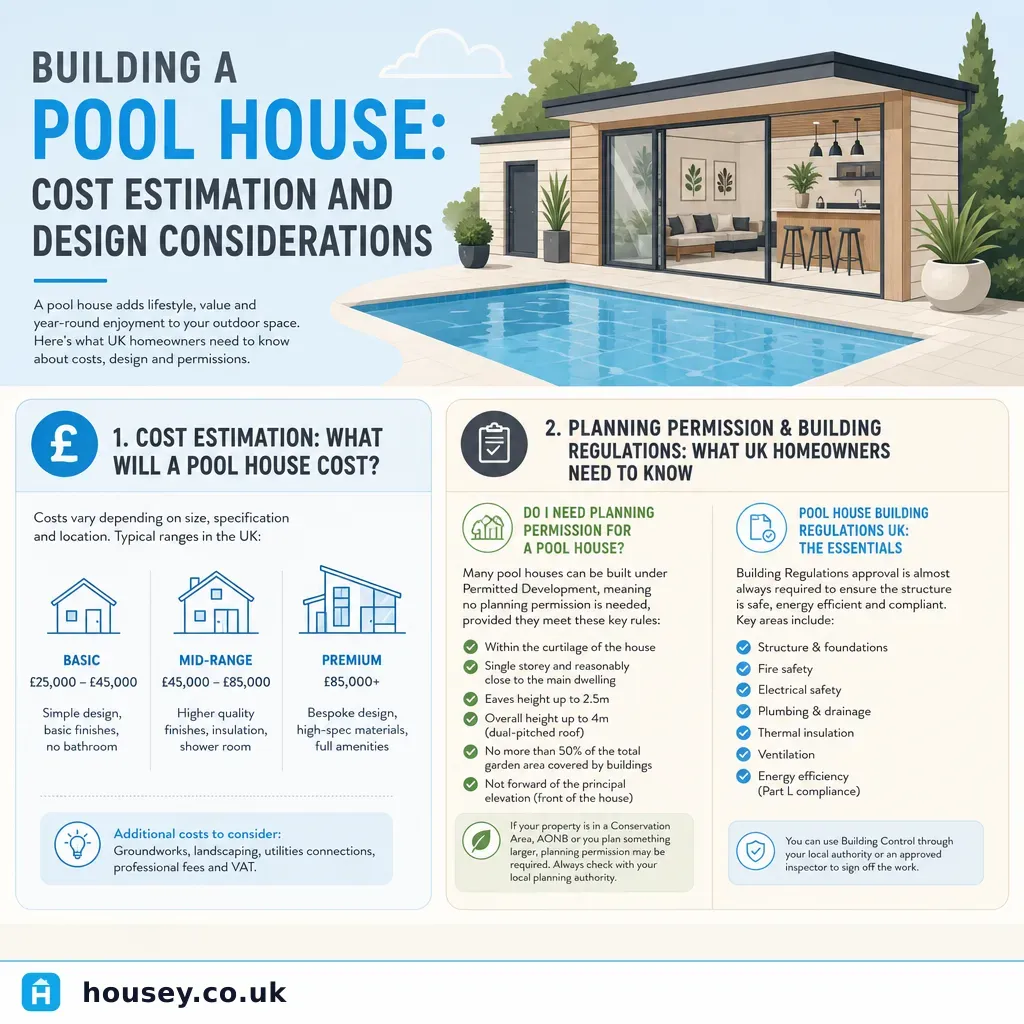
Building a Pool House: Cost Estimation and Design Considerations
A pool house in the UK typically costs between £20,000 and £180,000 depending on size, construction method, and specification.
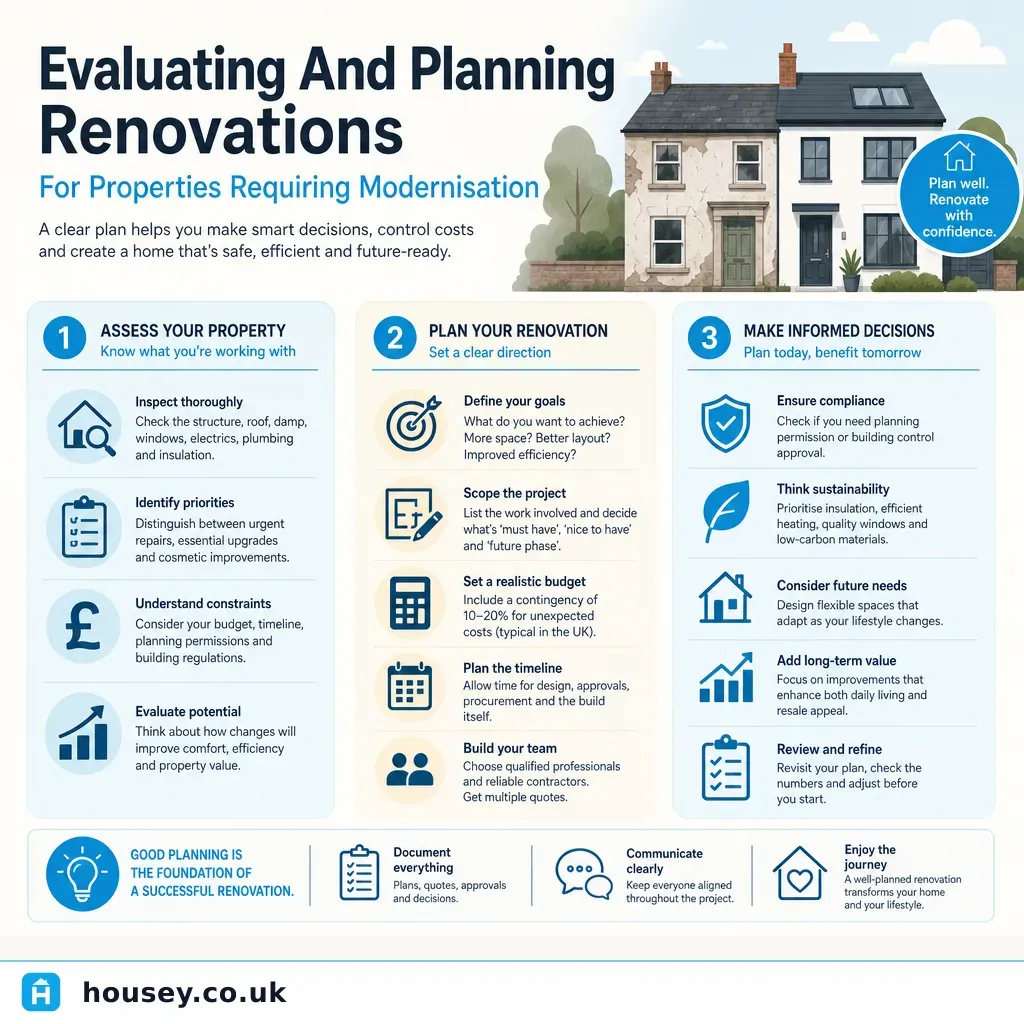 Improvement & Build
Evaluating And Planning Renovations For Properties Requiring Modernisation
Start by commissioning a condition survey — RICS Level 3 for pre-1919 properties — to identify structural defects, damp, and services issues before finalising a budget.
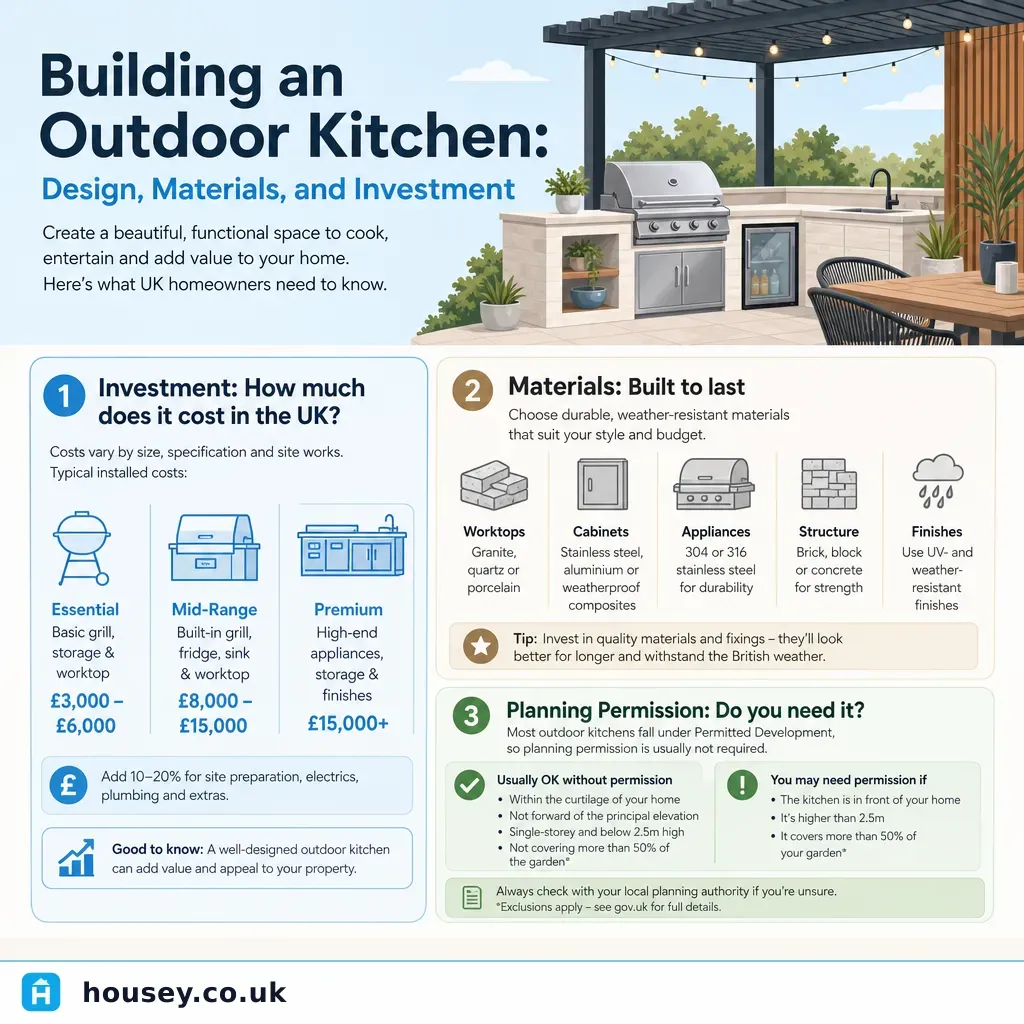 Improvement & Build
Building an Outdoor Kitchen: Design, Materials, and Investment
Building an outdoor kitchen in the UK costs roughly £3,000–£25,000 depending on size and materials.