Building a Garden Treehouse: Design, Logistics, and Construction
By Housey · Last reviewed 11th of May 2026
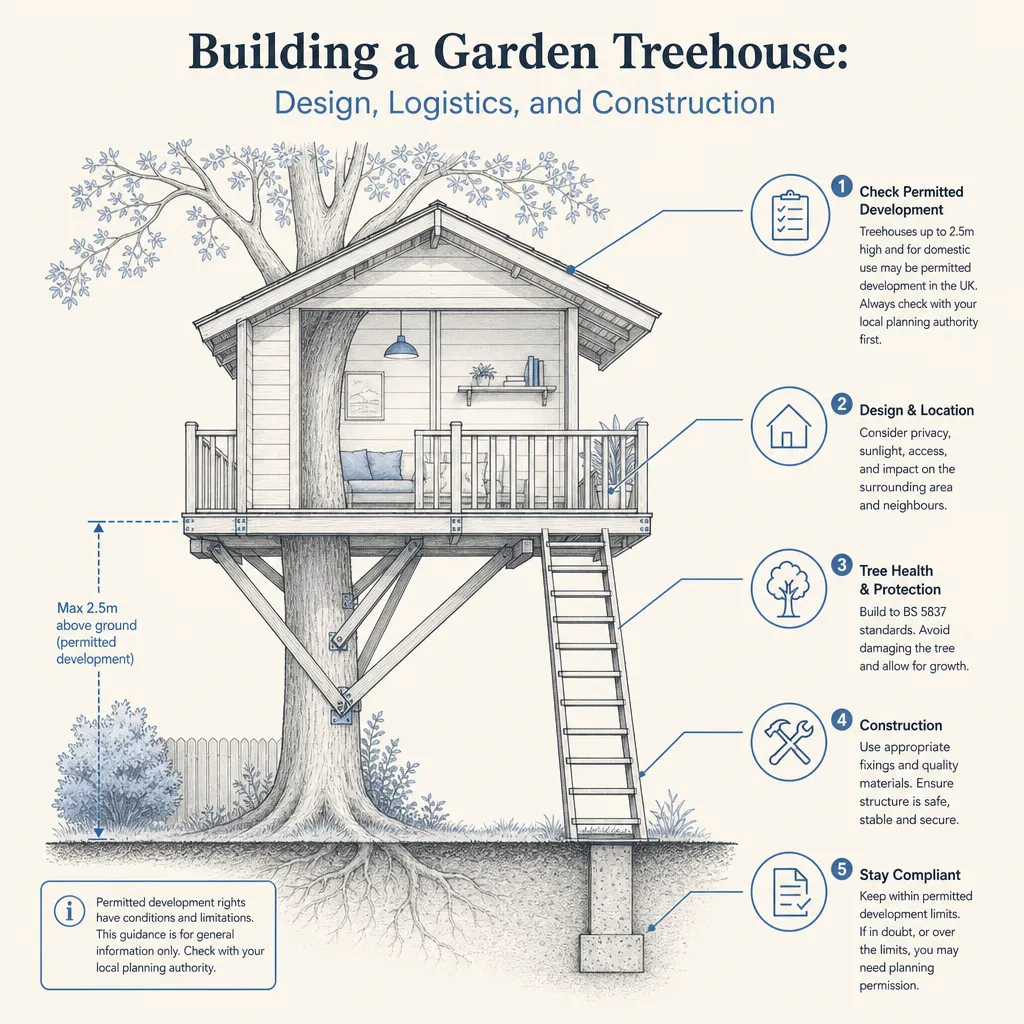
Building a Garden Treehouse: Design, Logistics, and Construction
Most treehouse projects begin with a straightforward request from a child and quickly become a surprisingly involved planning exercise for the adults carrying it out. In England, treehouses occupy an interesting position: they are assessed as garden outbuildings under planning policy, yet they are physically attached to a living structure whose health, protected status, and root spread all influence what you can build and how. Whether you are planning a simple platform with a rope ladder in a suburban back garden or a multi-deck structure with an enclosed cabin, understanding the planning rules, structural options, and material requirements before buying timber will save time, money, and potential enforcement headaches.
Key points
- Treehouses are classed as outbuildings under the Town and Country Planning (General Permitted Development) (England) Order 2015 and usually fall within permitted development rights.
- Permitted development allows outbuildings up to 4 metres high (dual-pitched roof) or 3 metres (any other roof type), provided the structure is not forward of the principal elevation of the house.
- The combined footprint of all outbuildings and extensions must not exceed 50% of the original curtilage of the dwelling.
- Before fixing anything to a tree, check whether it is subject to a Tree Preservation Order (TPO) or sits within a Conservation Area — both require separate consent from the local planning authority (LPA).
- Most single-storey garden structures under 30 m² are exempt from Building Regulations approval, though exceptions apply where the structure includes sleeping accommodation or a mains electrical supply.
Planning permission: do you need it?
Most garden treehouses in England are built under permitted development rights, meaning no planning application is required — provided the build stays within the defined limits.
Decision tree: planning permission for your treehouse
- Use permitted development if the structure is in the rear garden, does not exceed 4 m high (dual-pitch) or 3 m (single or flat pitch), is not within a National Park, Area of Outstanding Natural Beauty, or Conservation Area, total outbuilding coverage stays below 50% of the original curtilage, and the house is not listed.
- Submit a householder planning application if you are in a Conservation Area and the structure exceeds 10 m² in floor area, or if the treehouse extends forward of the principal elevation.
- Apply for a Certificate of Lawful Development if you want formal written confirmation that the build is permitted — particularly useful when selling the property.
- Contact your LPA before starting if the tree is in a Conservation Area or subject to a TPO, even if the structure itself appears to fall within permitted development — works to the tree itself may require separate consent.
Scotland, Wales, and Northern Ireland operate under separate planning regimes with similar but not identical rules. Always check with your LPA before commencing.
Tree Preservation Orders and Conservation Areas
A Tree Preservation Order (TPO) is a legal protection placed on individual trees or groups of trees by a local authority under the Town and Country Planning Act 1990. Attaching structural fixings to a TPO-protected tree without consent is a criminal offence and can result in unlimited fines.
To check whether a tree is protected:
- Search your LPA's online planning portal or GIS map — most authorities now publish TPO registers publicly.
- Submit a written TPO enquiry to the LPA if the online record is unclear or the boundary is ambiguous.
- Trees within Conservation Areas have equivalent protection — you must give the LPA six weeks' written notice before carrying out any work, to allow time to assess whether a TPO should be made.
If consent is required, an arboricultural report showing that the proposed fixings will not cause lasting harm to the tree is typically required. Use an ARB Approved Contractor or Fellow of the Arboricultural Association for the tree assessment.
Structural design: how treehouses attach to trees
The central principle of treehouse structural design is transferring load without causing unnecessary damage to the host tree. Specialist builders and structural engineers typically use one of three attachment approaches:
Method | Description | Best for | Main consideration |
|---|---|---|---|
TABs (Treehouse Attachment Bolts) | Large-diameter galvanised bolts drilled into the heartwood | Mature trees with trunk diameter ≥ 30 cm | Requires professional specification; minimises wound area compared with multiple smaller fixings |
Perch brackets | Cradle the trunk without penetrating — ratchet-adjusted around the bark | Trees where minimal invasiveness is the priority | Can shift over time; less rigid than bolt-based systems |
Ground posts | Steel or timber posts carry the structural load; tree provides lateral bracing only | Younger or smaller trees, or where branch spread limits direct attachment | May alter the planning classification in some interpretations |
An arborist should assess the tree's health, trunk diameter, species, and root spread before any fixing method is specified. Loading a structurally compromised tree is a serious safety risk.
DIY versus professional build: a comparison
Factor | DIY build | Professional specialist |
|---|---|---|
Typical cost | £500–£3,000 in materials for a simple platform | £5,000–£25,000+ for a custom design (indicative UK costs, last reviewed 2026-05-11) |
Structural safety | Depends on builder's skill and tree assessment quality | Specialist assesses tree health and specifies fixings correctly |
Planning knowledge | Homeowner's responsibility throughout | Experienced builders familiar with permitted development limits |
Build time on site | Several weekends for most DIYers | Typically 3–10 days for a single-platform design |
Finish and weatherproofing | Variable | Higher; specialist joinery and correctly detailed weatherproofed junctions |
Best for | Simple platforms, healthy mature trees, large gardens, confident woodworkers | Complex structures, multiple decks, enclosed rooms, TPO trees, or limited access sites |
For design input and integration with the wider garden, working with garden designers or landscapers with outdoor structures experience is often worthwhile, even if a local carpenter carries out the physical build.
Choosing materials for UK weather
Persistent damp, freeze-thaw cycling, and UV exposure make the UK climate one of the harder environments for outdoor timber structures. Timber selection and finishing both matter:
- Larch and Douglas fir: naturally durable species with good dimensional stability; widely used for structural framing and exterior cladding.
- Western red cedar: excellent natural resistance to rot and insects; commonly used for cladding boards, decking, and shingles.
- Pressure-treated softwood: cost-effective for structural elements; confirm the preservative treatment complies with BS 8417 guidance and is rated for the relevant hazard class.
- Composite decking boards: low maintenance for the platform surface but heavier than solid timber — factor the additional weight into the structural load assessment.
All cut ends should be sealed with end-grain preservative on site. Plan an annual inspection and re-treatment of exposed surfaces, particularly at fixing points and anywhere water can pond.
Homeowner checklist: before starting the build
Red flags: when to stop and seek advice
- The tree shows signs of disease, canopy dieback, hollow sections, or root damage — do not load a compromised tree without a full arboricultural survey.
- The planned structure exceeds 3 m at the eaves or ridge (unless dual-pitched) — review permitted development height limits carefully before proceeding.
- The tree has a metal identification tag, appears on the LPA's TPO register, or is within a Conservation Area — seek consent before any work begins.
- The treehouse will be used as sleeping accommodation — Building Regulations Parts A (structure), B (fire safety), and M (access) may apply; check with local building control.
- The property is in Wales, Scotland, or Northern Ireland — devolved planning rules differ from England.
When to get professional help
A simple treehouse platform built by a competent carpenter on a healthy, mature tree in a standard residential garden often proceeds without extensive professional input beyond a basic tree health check. Specialist involvement is worth arranging if the tree has a trunk diameter under 30 cm or shows any stress, if the design includes multiple levels or an enclosed cabin, if the garden is in a Conservation Area, or if the structure will be used regularly by younger children. In the last case, applying the design principles of EN 1176 — the play equipment safety standard, formally applicable to public spaces but a useful reference for private builds — is sensible practice.
How Housey can help
Housey connects you with vetted garden designers, landscapers with outdoor structures experience, and extension builders and outdoor structure specialists who can take a treehouse from initial design brief through to a finished build. Describe your tree, garden layout, and design ambitions, and compare quotes from local professionals.
Frequently asked questions
Do I need planning permission for a garden treehouse in England?
Most garden treehouses fall within permitted development rights, provided the structure is in the rear garden, does not exceed 4 metres high with a dual-pitched roof (or 3 metres with any other roof type), and total outbuilding coverage stays below 50% of the original curtilage. You will need full planning permission if the property is listed, or if you are in a Conservation Area and the footprint exceeds 10 m².
What happens if the host tree has a Tree Preservation Order?
If the tree has a TPO, you must apply to your local planning authority for consent before attaching any structural fixings. Carrying out work without consent is a criminal offence with potentially unlimited fines. An arboricultural report is typically required to demonstrate that the proposed fixings will not cause unacceptable long-term harm to the tree. Use an ARB Approved Contractor for the assessment.
What wood is best for a garden treehouse in the UK?
Larch, Douglas fir, and western red cedar are widely used for UK treehouses due to their natural durability and wet-weather resistance. Pressure-treated softwood is suitable for structural framing. All exposed timber should be treated with a wood preservative compliant with BS 8417 guidance, and the structure should be inspected and re-treated annually to prevent early deterioration in the UK climate.
How much does a professionally built treehouse cost in the UK?
A simple DIY platform treehouse can cost £500–£3,000 in materials. Professionally built custom treehouses typically range from £5,000 to £25,000 or more, depending on complexity, site access, and the specification of decking, roofing, and features. These are indicative UK costs, last reviewed 2026-05-11 — always get at least three quotes from specialist builders before committing.
Do building regulations apply to a garden treehouse?
Most garden treehouses under 30 m² are exempt from Building Regulations. The exemption does not apply if the structure is intended for sleeping accommodation, includes a mains electrical installation, or has a platform significantly elevated above ground level. If your design falls into any of these categories, contact your local building control body before starting work to clarify what notification is needed.
Sources and further reading
- Outbuildings: permitted development guidance — Planning Portal
- Tree Preservation Orders and trees in conservation areas — GOV.UK
- Playground equipment and surfacing — Health and Safety Executive
- Find an ARB Approved Contractor — Arboricultural Association
Useful next reads
 Improvement & Build
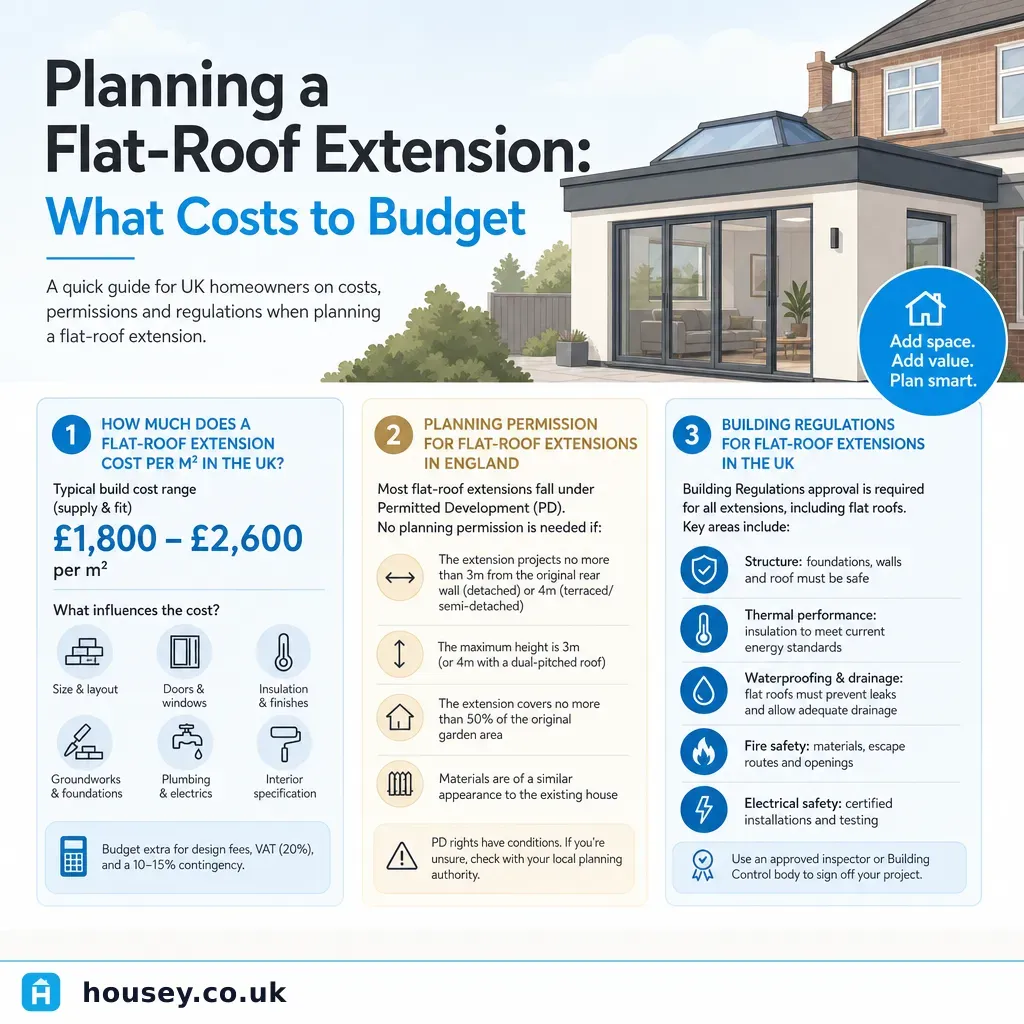
Planning a Flat-Roof Extension: What Costs to Budget
A flat-roof single-storey extension typically costs £1,500–£3,000 per m² in the UK, depending on size, specification, location, and roof membrane choice.
 Improvement & Build
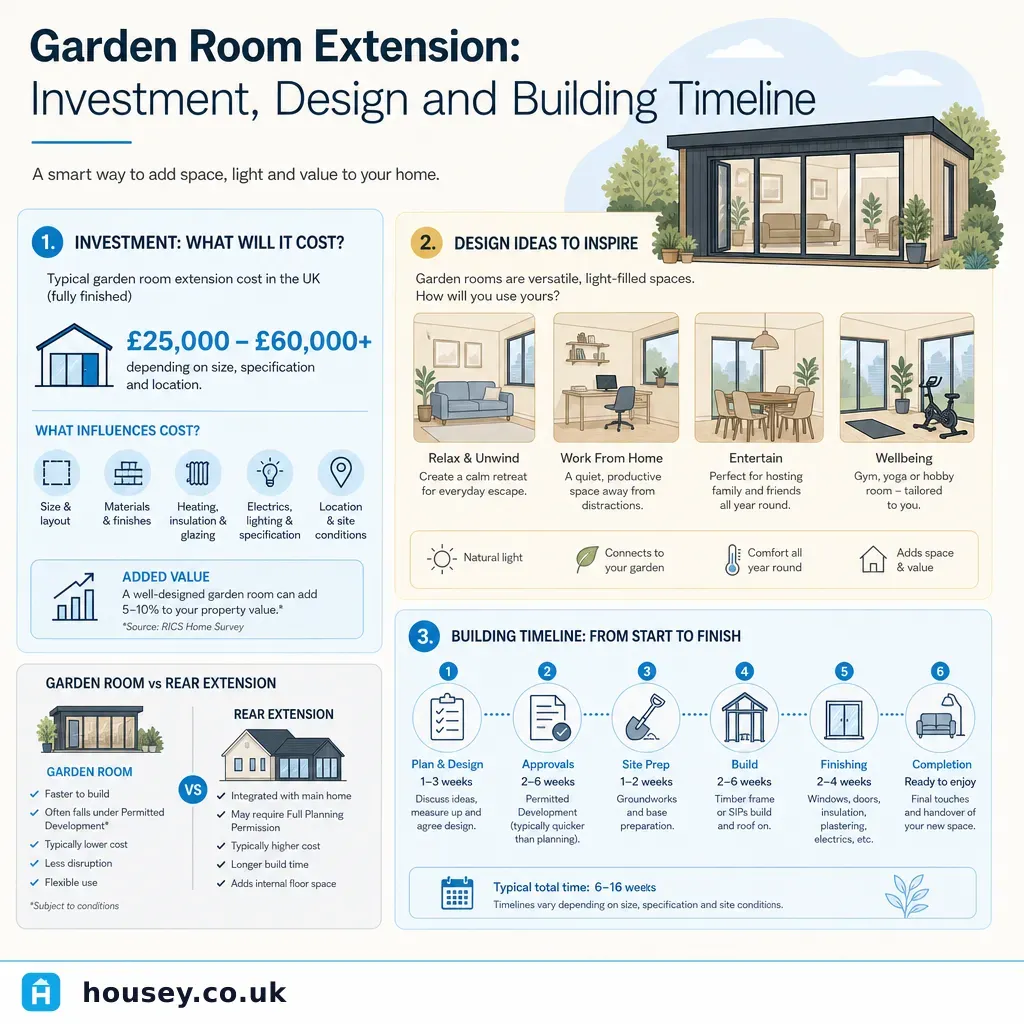
Garden Room Extension: Investment, Design and Building Timeline
A garden room or garden extension can add usable year-round space without always requiring planning permission.
 Improvement & Build
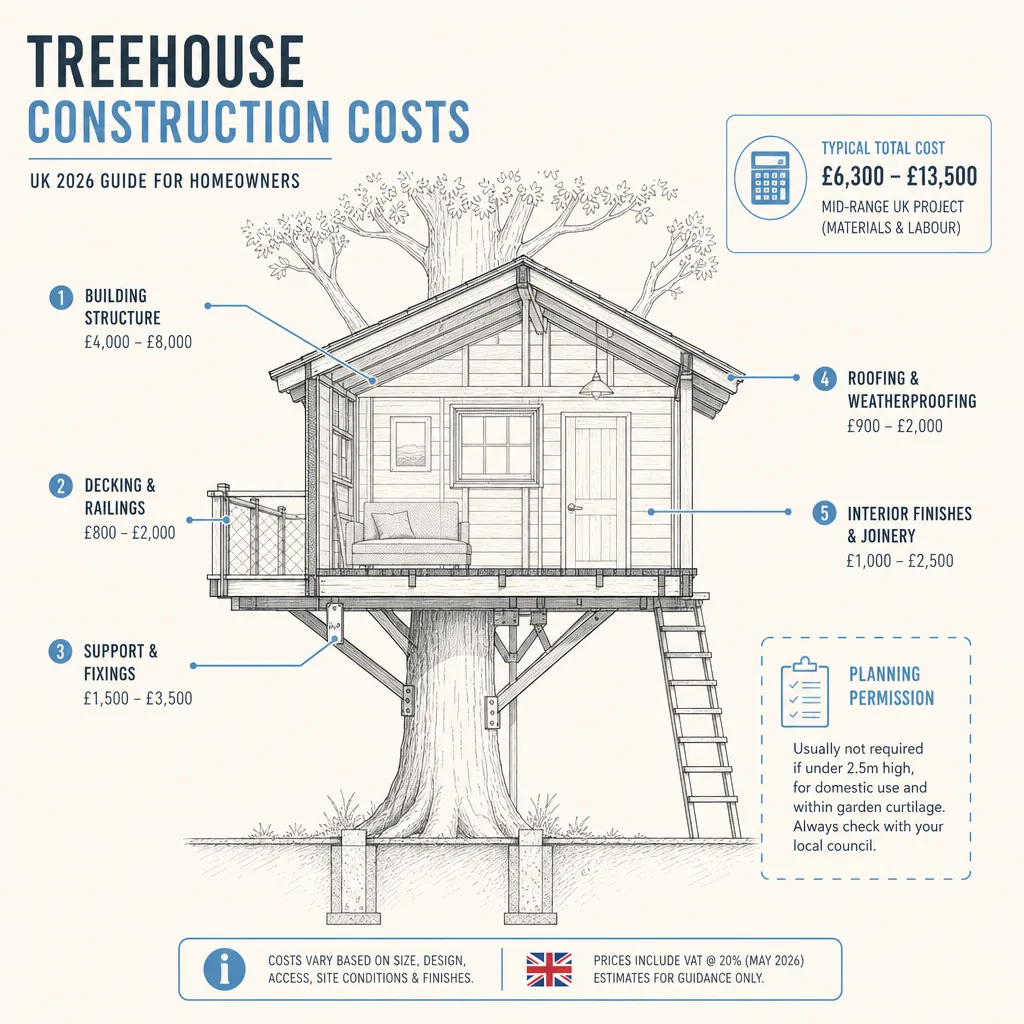
Treehouse Construction Costs
A basic garden treehouse in the UK costs around £1,500–£5,000 for a simple platform or play structure.
 Improvement & Build
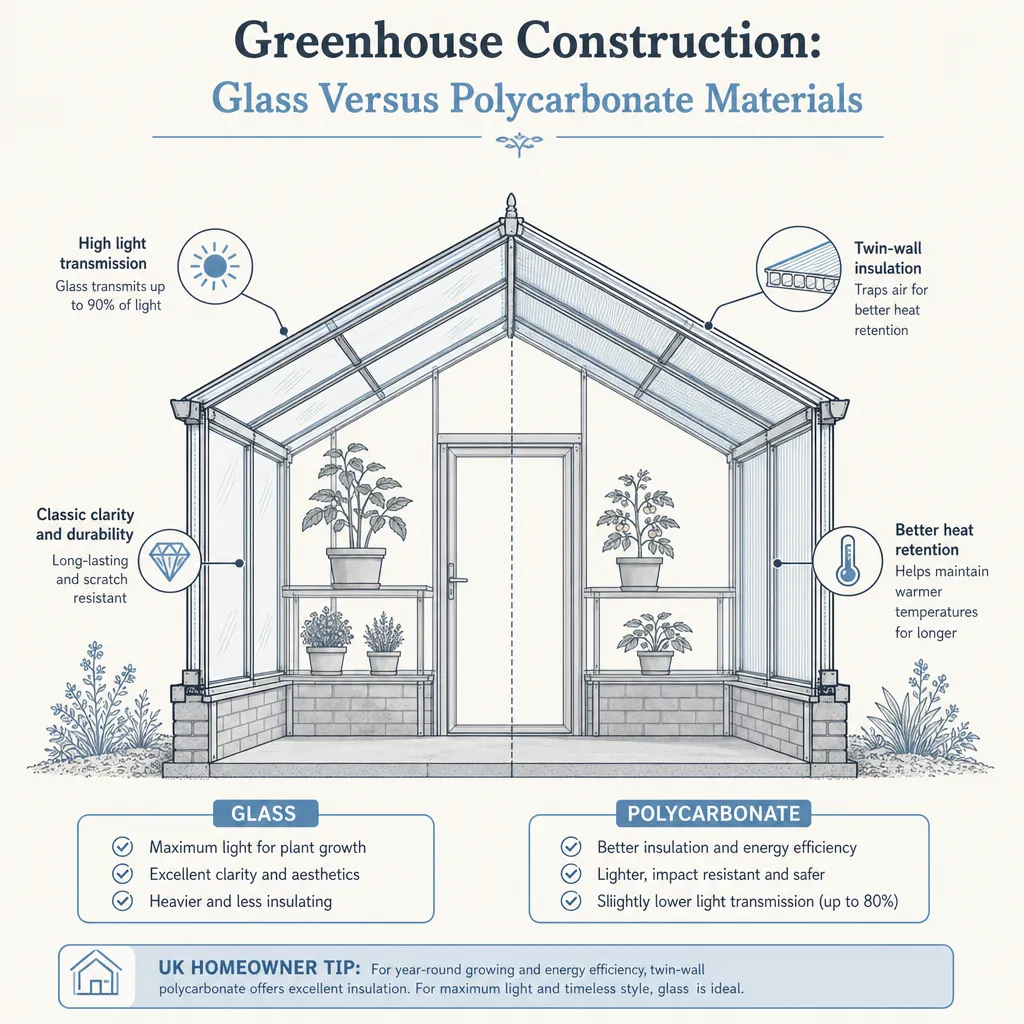
Greenhouse Construction: Glass Versus Polycarbonate Materials
Glass transmits around 90% of available light and lasts indefinitely if unbroken, but insulates poorly and shatters into sharp fragments.
 Improvement & Build
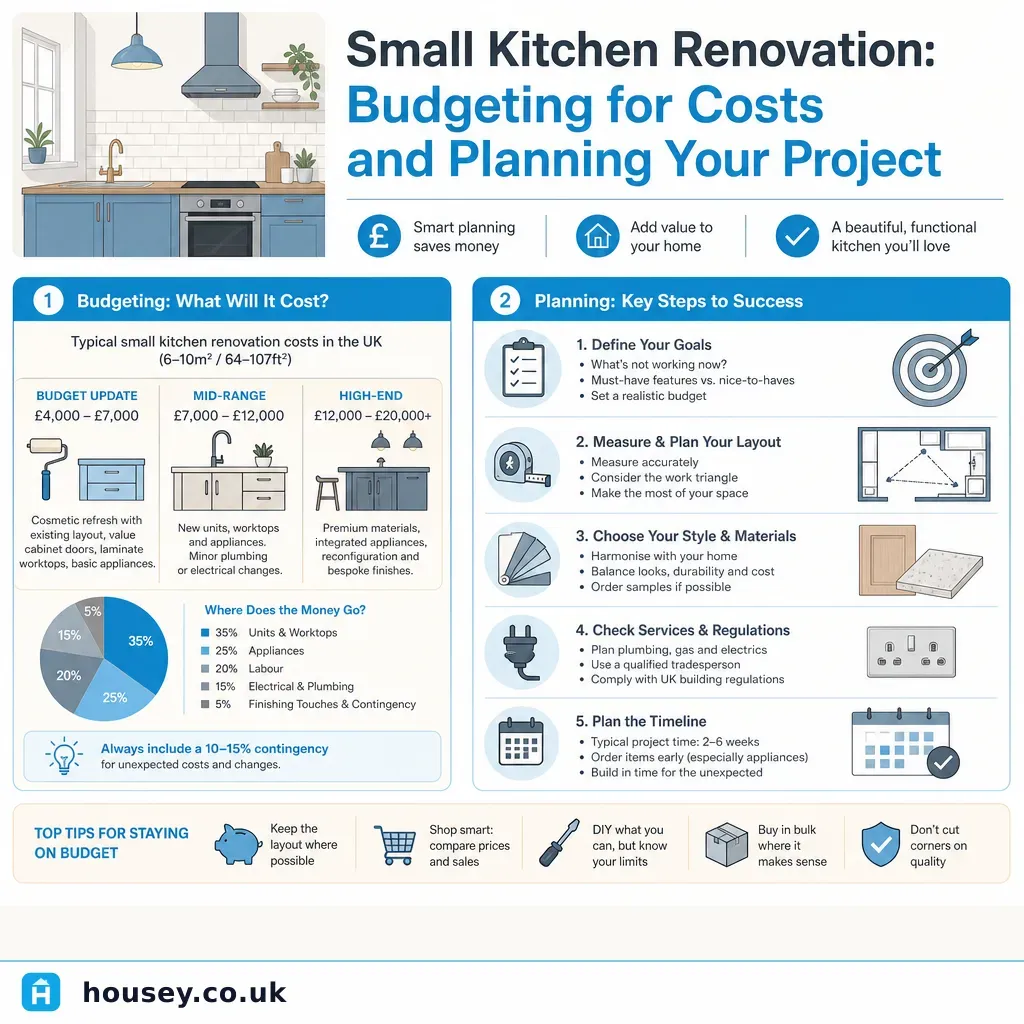
Small kitchen renovation: budgeting for costs and planning your project
A small kitchen renovation in the UK typically costs £5,000–£15,000 for a full refresh including new units, worktops, tiling, and appliances, though costs vary widely by specification, region, and whether structural changes or rewiring are involved.