Treehouse Construction Costs
By Housey · Last reviewed 11th of May 2026
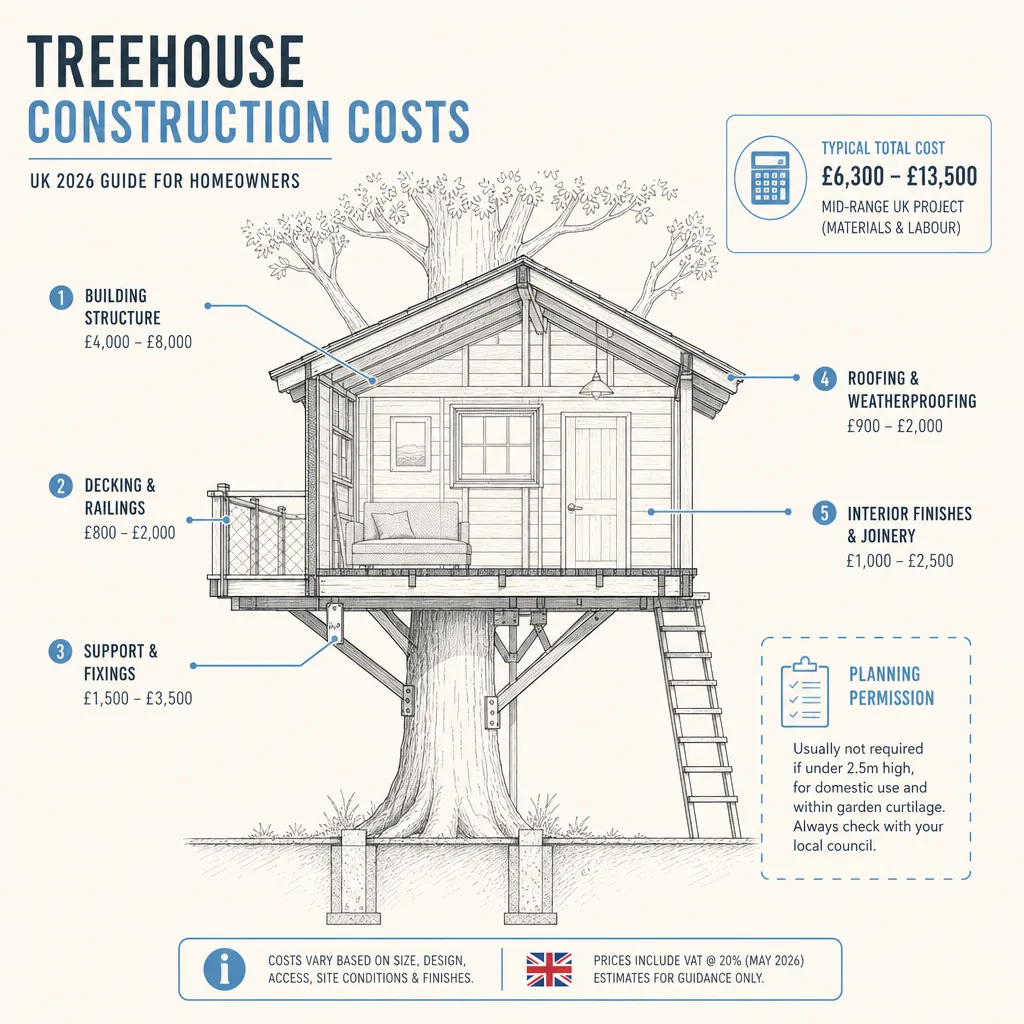
Treehouse Construction Costs
A well-built treehouse turns an established garden tree into something functional and enduring — a children's play space, a garden retreat, or a compact home office. Because every project is shaped by the host tree's species, size, and health, as well as by the platform height and specification, costs vary more widely than most other garden structure projects. Careful planning before commissioning a builder is well worth the effort.
Key points
- A basic platform treehouse costs approximately £1,500–£5,000; a mid-range bespoke cabin with enclosed walls, windows, and a balcony typically runs £8,000–£20,000 (indicative UK costs, last reviewed 2026-05-11).
- Most residential treehouses fall within Class E permitted development rights and do not require a planning application, but those in conservation areas, AONB designations, or listed building curtilages may need LPA consent.
- The host tree should be assessed by a qualified arborist before construction — species suitability, root health, and structural integrity all affect whether a safe build is feasible.
- Garnier Limb (GL) fixings are the current standard structural attachment method; they allow the tree to grow around them without girdling the cambium layer.
- Treehouses are generally not covered under standard home buildings insurance without specific disclosure to your insurer; check before any build commences.
What affects treehouse construction cost?
Tree species and structure
Oak, ash, and mature beech provide excellent host platforms due to their trunk diameter and branch architecture. Birch, fruit trees, and conifers can support lighter structures but are less suited to heavy enclosed cabins. The more complex the tree's geometry, the more custom metalwork and design adaptation is required, which adds to cost.
Platform height and access
A platform at 1–2 m is simpler to construct and carries less structural risk than one at 3–4 m. Higher platforms require more robust fixings, safer access arrangements such as fixed timber stairs rather than rope ladders, and may benefit from a structural engineer's input for heavily loaded or very tall designs.
Finish and features
Build type | What is typically included | Indicative cost |
|---|---|---|
Basic platform | Deck boards, safety railing, ladder or rope access | £1,500–£3,500 |
Play treehouse | Enclosed cabin, windows, slide, rope bridge | £3,500–£8,000 |
Mid-range retreat | Insulated cabin, full-height door, decking, balcony | £8,000–£20,000 |
High-end bespoke | Weatherproofed cabin, electrics, plumbing, custom joinery | £20,000–£50,000+ |
Indicative UK costs, last reviewed 2026-05-11. Prices vary by contractor, region, tree configuration, and specification.
Materials
Pressure-treated softwood is standard for most builds. Green oak frames, hardwood cladding, or EPDM rubber roofing increase both cost and longevity. Rope bridges, zip wires, and climbing walls are popular additions but are typically priced separately.
Access features
A simple rope ladder or fixed wooden steps are the most affordable access options. A fixed timber staircase with handrail — more appropriate where elderly family members or young children will use the structure regularly — adds £500–£2,500 depending on length and specification.
Does a treehouse need planning permission?
Most treehouses built for domestic use within the residential garden fall within Class E permitted development rights in England, meaning no planning application is required. However, you should check your position carefully if:
- The property is in a conservation area, Area of Outstanding Natural Beauty (AONB), or a National Park, where permitted development rights are restricted.
- The property is a listed building or sits within its curtilage.
- A condition attached to an earlier planning consent has removed permitted development rights.
- The structure is intended for business use or regular overnight occupation as sleeping accommodation.
The GOV.UK guidance on when permission is required and your LPA's pre-application enquiry service can confirm your position without a full application fee. Rules in Wales, Scotland, and Northern Ireland differ from those in England.
Tree health: getting an arborist assessment
Before committing to a design, have the host tree assessed by a qualified arborist. A BS 5837 survey or equivalent structural assessment should cover:
- Root system stability, particularly on slopes, made-up ground, or clay soils.
- Signs of decay — bracket fungi at the base, cavities, dead wood, or weeping at the trunk.
- Whether the tree carries a Tree Preservation Order (TPO), which may affect attachment consent.
- Likely future crown growth and how it will interact with the platform over time.
A combined post-and-tree design — where the platform is supported partly by ground posts and partly by the tree — is a practical solution when tree condition is borderline or where the tree's architecture does not suit a fully suspended platform.
Checklist: before you commission a treehouse
When to get professional help
For any treehouse beyond a low basic platform, professional design and construction is strongly advisable:
- Engage a qualified arborist before selecting the host tree and during the design phase.
- Involve a structural engineer if the platform exceeds 2–3 m in height or includes a fully enclosed habitable space.
- Consult your LPA's pre-application service if there is any uncertainty about permitted development or Tree Preservation Order implications.
Working at height during construction carries its own risks; ensure any contractor engaged holds appropriate insurance and follows HSE guidance on working at height.
How Housey can help
Housey connects you with experienced landscapers and garden builders who can advise on tree suitability, structural approach, and planning compliance before providing detailed quotes. Compare multiple local professionals through your Housey dashboard to find the right fit for your project.
Frequently asked questions
Do treehouses need building regulations approval?
Basic garden treehouses used for children's play and not connected to mains services are generally exempt from Building Regulations. However, an enclosed structure intended for regular overnight use, business purposes, or connected to an electrical supply may require approval. Contact your local authority's Building Control team to confirm your specific situation before starting work.
Will a treehouse damage the host tree?
A poorly built treehouse — particularly one using through-bolts that restrict the tree's radial growth — can cause long-term damage to the cambium layer. Reputable builders use Garnier Limb fixings or equivalent dynamic fixings that allow the tree to grow around them without constriction. An arborist's assessment before construction helps protect the tree's long-term health.
How long will a treehouse last?
A well-built treehouse using pressure-treated timber and quality fixings should last 15–25 years with appropriate maintenance. Annual inspections of the fixings, structural members, and any timber in direct contact with the tree are recommended to catch deterioration early and extend the structure's service life.
Is VAT charged on treehouse construction?
Yes. Treehouse construction is subject to standard-rate VAT, currently 20%. Confirm whether quotes are VAT-inclusive or exclusive before comparing figures between contractors. This applies to all elements of the build, including access features, any electrical works, and separate arborist or engineer fees.
Sources and further reading
- Permitted development rights for householders — technical guidance — GOV.UK
- Tree Preservation Orders and trees in conservation areas — GOV.UK
- Working at height — overview — Health and Safety Executive
- BS 5837:2012 Trees in relation to design, demolition and construction — BSI Group
Useful next reads
 Improvement & Build
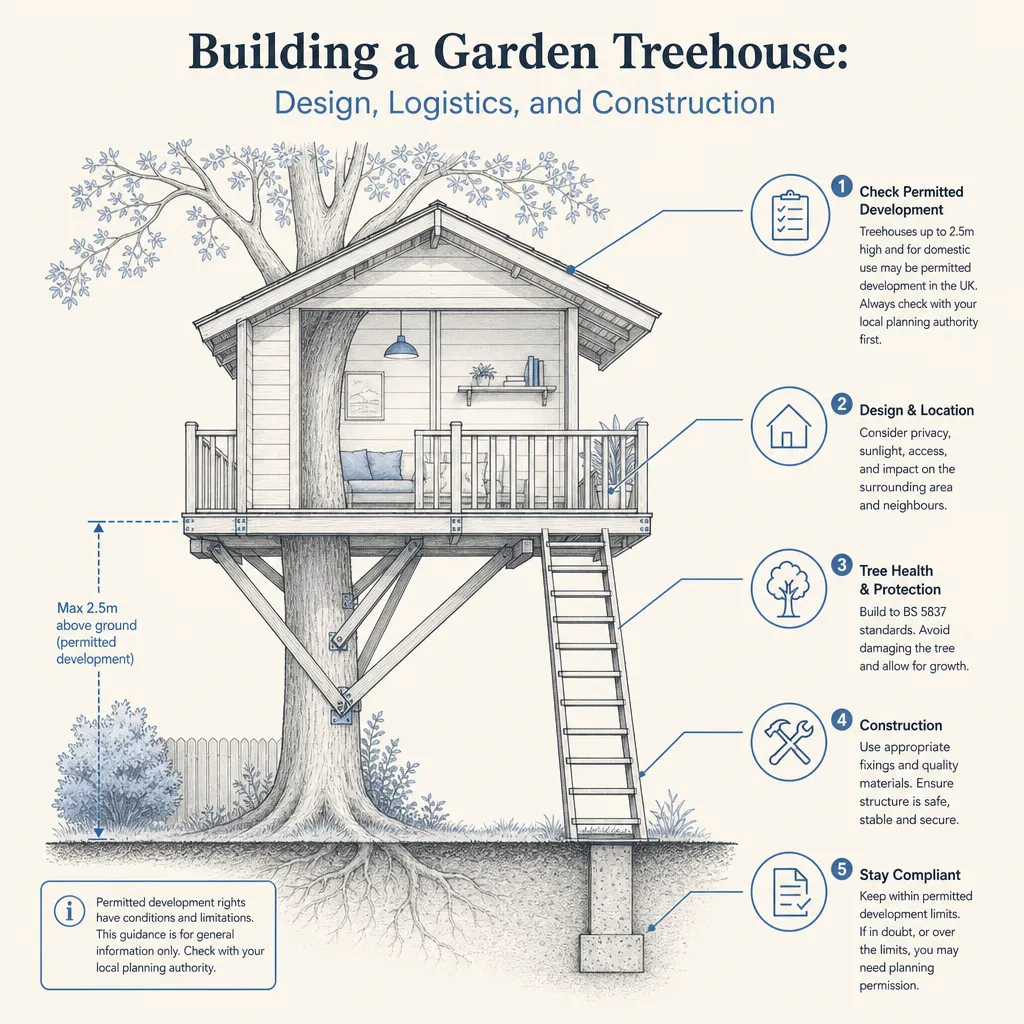
Building a Garden Treehouse: Design, Logistics, and Construction
A garden treehouse in the UK usually falls under permitted development as an outbuilding, provided it stays within permitted height and footprint limits.
 Improvement & Build
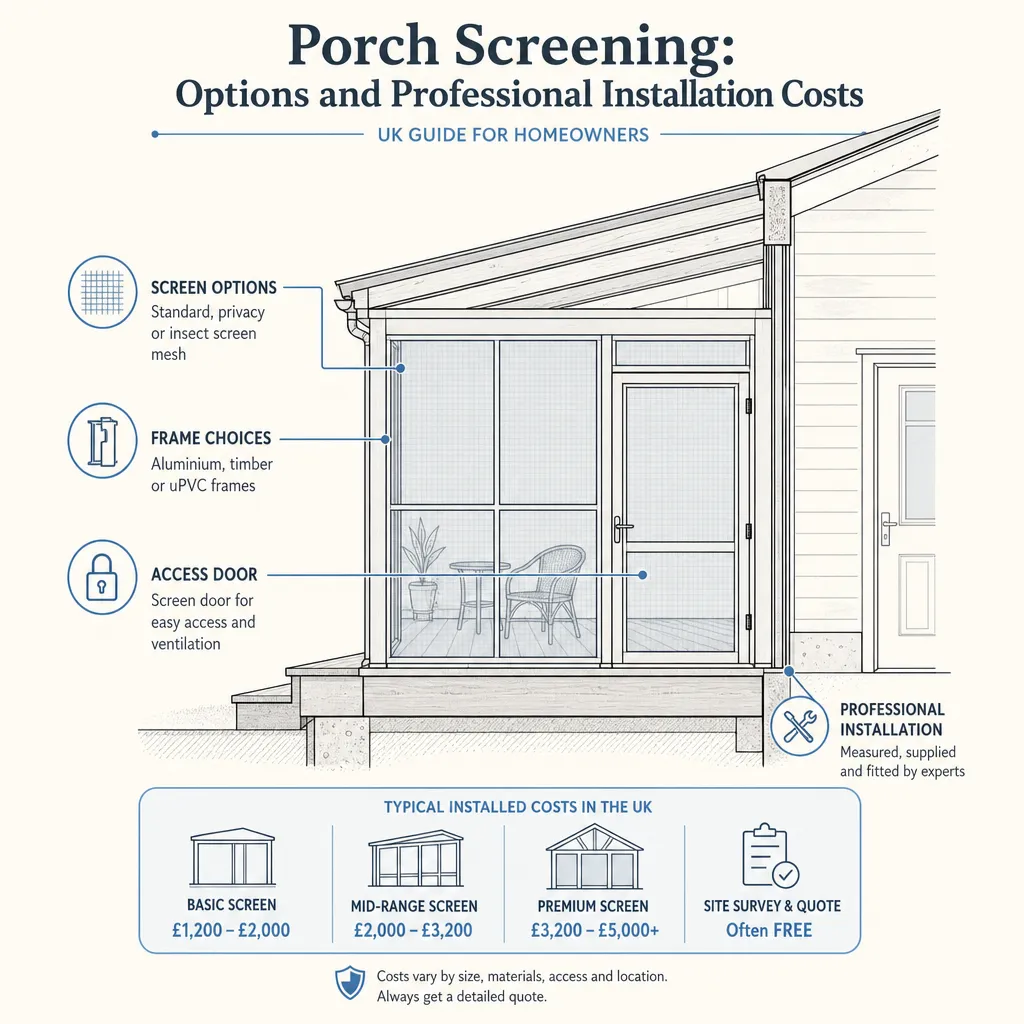
Porch Screening: Options and Professional Installation Costs
Porch screening ranges from simple insect mesh on a timber frame to bespoke aluminium-framed glazed enclosures.
 Improvement & Build
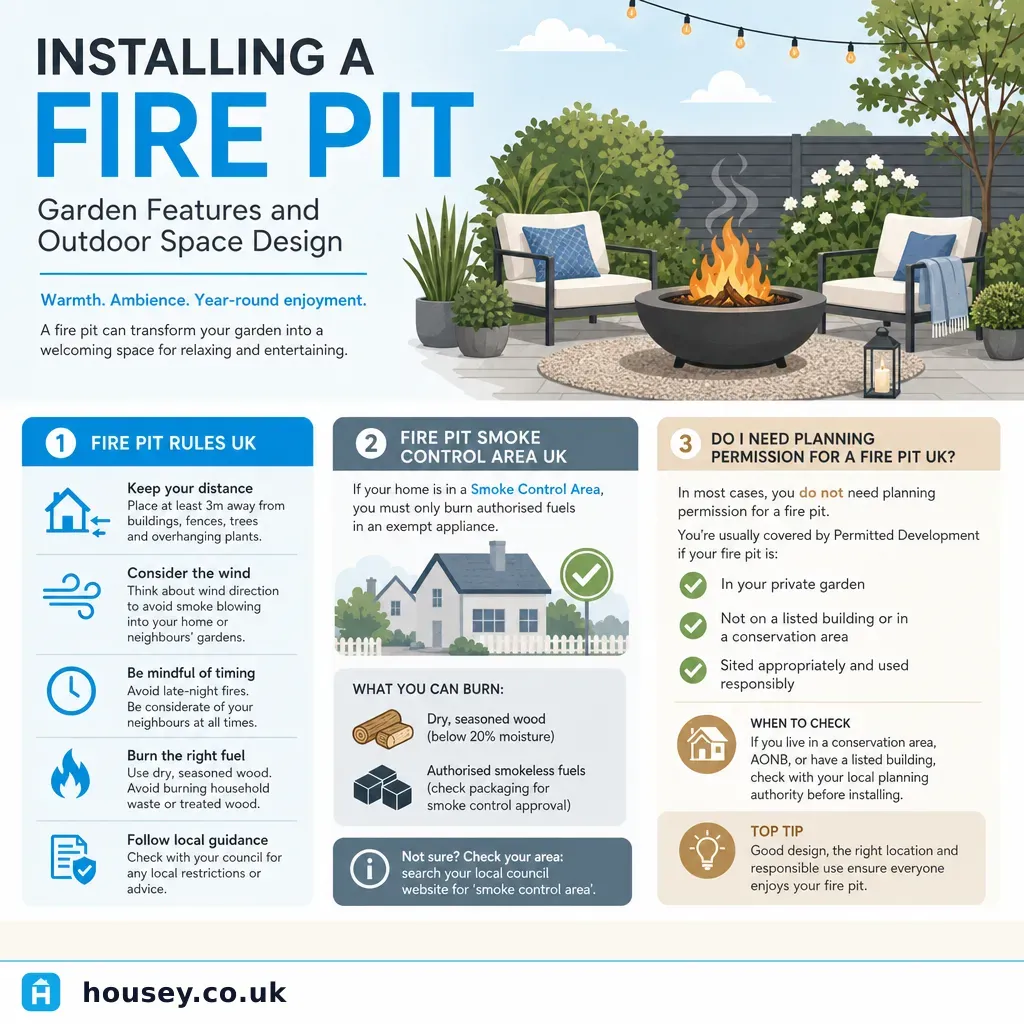
Installing a Fire Pit: Garden Features and Outdoor Space Design
Installing a garden fire pit in the UK is generally permitted, but Smoke Control Area rules prohibit open wood-burning in most towns and cities.
 Improvement & Build
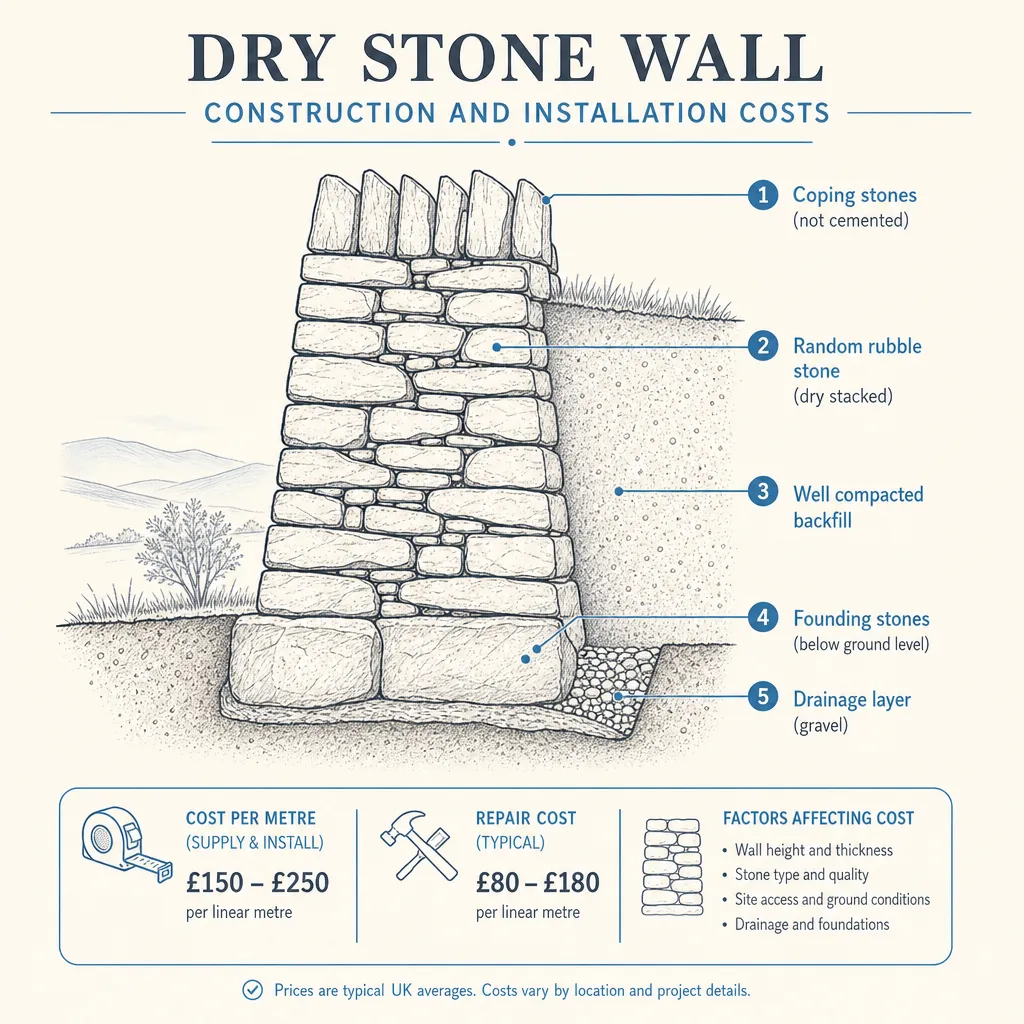
Dry Stone Wall Construction and Installation Costs
Dry stone wall construction in the UK typically costs £150–£350 or more per linear metre for new build, with repairs usually less expensive.
 Improvement & Build
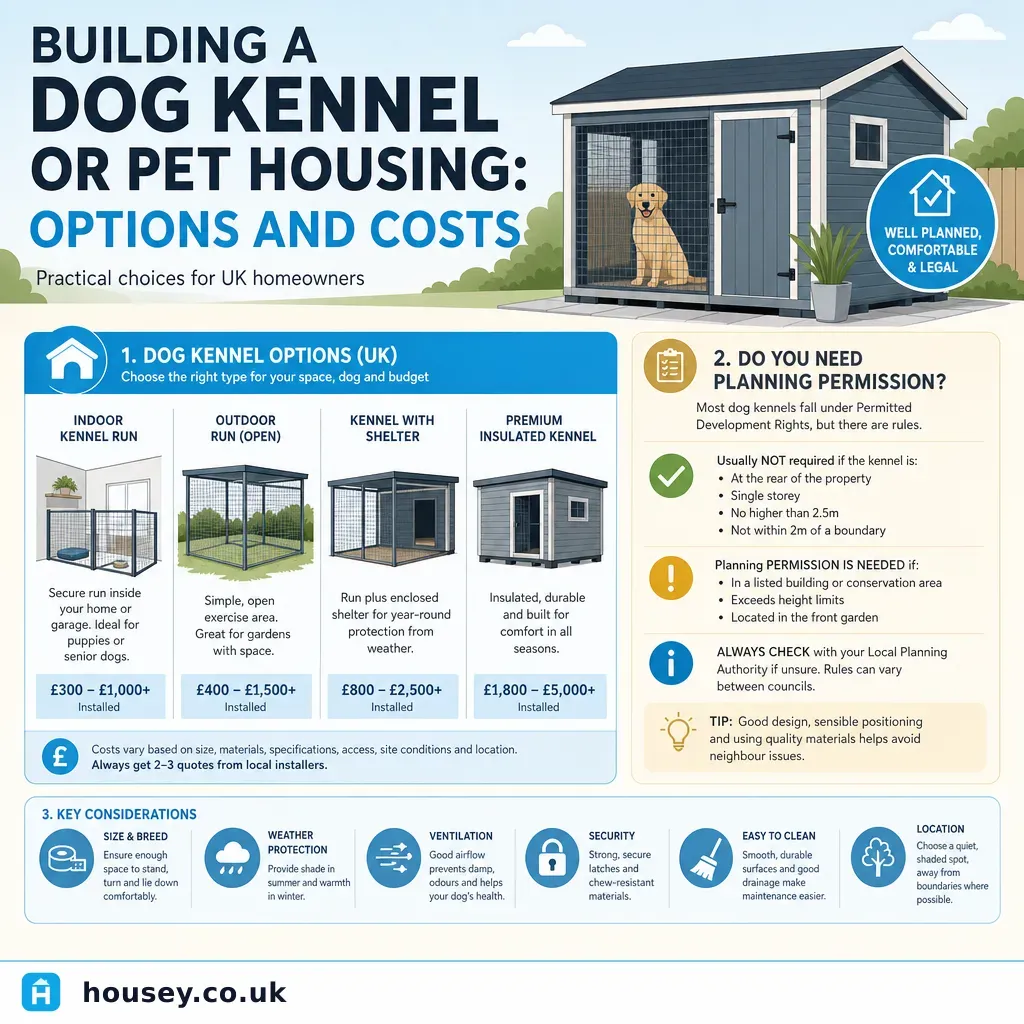
Building a Dog Kennel or Pet Housing: Options and Costs
A domestic dog kennel or pet housing structure is almost always permitted development in England and does not need planning permission if sited behind the house, below 2.