Core Drilling for Building Penetrations: Uses and Costs
By Housey · Last reviewed 5th of May 2026
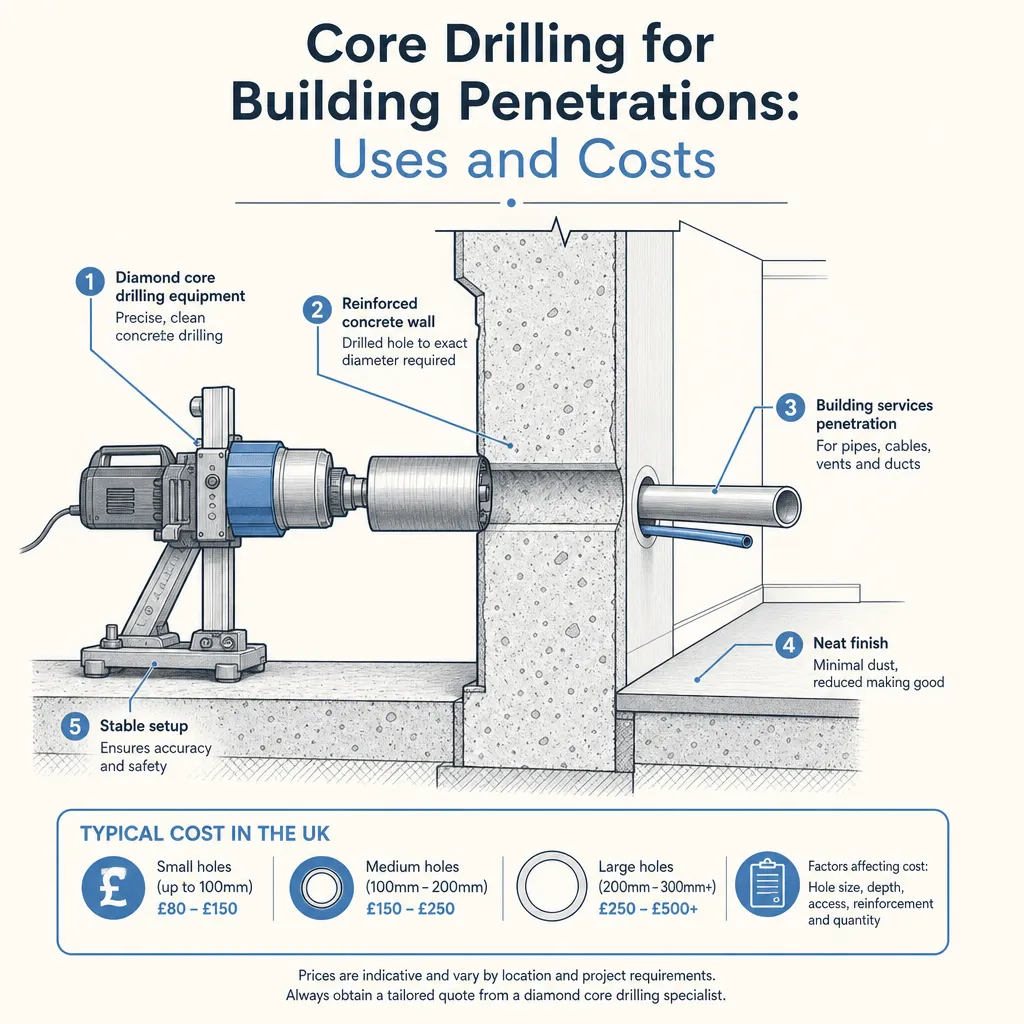
Core Drilling for Building Penetrations: Uses and Costs
Core drilling is a specialist technique used when services, utilities, or openings need to pass cleanly through concrete, masonry, or stone — typically during construction, renovation, or when upgrading building services. UK homeowners increasingly encounter it when installing MVHR systems, heat pump refrigerant lines, EV charger cables, or new drainage runs, where precision and minimal structural disturbance matter.
Key points
- Diamond-tipped core drilling produces clean, circular holes through concrete, brick, stone, or block without the vibration and fracture risk associated with hammer-action tools.
- Penetrations in or near load-bearing walls, beams, or ground-bearing slabs must comply with Building Regulations Approved Document A (Structure); a structural engineer should confirm hole position and diameter before work proceeds.
- Core drilling is commonly required for soil and waste pipes, MVHR and mechanical ventilation ducts, EV charger cable entry, heat pump refrigerant lines, gas service entry, broadband ducting, and radon sumps.
- Indicative UK costs start at around £100–£200 per hole for straightforward domestic work, rising with diameter, depth, material hardness, and site access (Indicative UK costs, last reviewed 2026-05-05; quotes vary significantly).
- The act of drilling is not itself notifiable under the Building Regulations 2010, but many of the services it enables — drainage, gas, MVHR, EV charging — do require building control approval.
What is core drilling and when is it used?
Core drilling uses a rotating hollow drill bit with diamond-impregnated cutting segments to bore a precise cylinder through hard materials. Unlike standard masonry drilling, it produces a clean, smooth-sided hole with no fracture lines or vibration damage — particularly important when drilling close to existing services, structural reinforcement, or dense concrete.
In UK residential and light commercial construction, core drilling serves a wide range of building penetrations:
Application | Typical hole diameter | Common material | Notes |
|---|---|---|---|
Soil or waste pipe | 110–160 mm | Brick, block, or concrete wall | Requires adequate fall; check for nearby services before drilling |
MVHR or mechanical ventilation duct | 100–250 mm | External masonry or cavity wall | Insulated sleeves needed to prevent cold bridging |
EV charger cable entry | 25–50 mm | External brick or block wall | Typically close to consumer unit or garage wall |
Heat pump refrigerant line | 50–80 mm | External or cavity wall | Position as close as practical to the outdoor unit |
Gas service entry (new or rerouted) | 50–80 mm | Foundation wall or floor slab | Gas Safe registered engineer must manage the connection |
Radon sump installation | 100–150 mm | Ground-bearing concrete slab | Required in high-radon-risk areas of England and Wales |
Utility or broadband ducting | 50–100 mm | External wall or basement slab | Oversize duct to allow for future cable runs |
What affects the cost of core drilling?
Indicative UK costs for domestic core drilling start at around £100–£200 per hole for a straightforward single-layer masonry or block wall. Cost rises with:
- Diameter: larger holes (150 mm or more) may require multiple passes or a larger rig.
- Material hardness: reinforced concrete takes more time and causes greater bit wear than brick or block.
- Depth: thick foundations, multi-leaf walls, or deep slabs add drilling time.
- Access: confined spaces, basement work, or overhead drilling add labour and setup time.
- Mobilisation: many contractors apply a minimum call-out charge of £150–£300 regardless of hole count; scheduling multiple holes on the same visit is more cost-efficient.
- Wet vs dry drilling: wet drilling (water-cooled) is faster and cleaner but generates slurry that must be collected and disposed of; dry drilling avoids water near services but produces more dust.
Indicative UK costs, last reviewed 2026-05-05. Obtain at least two or three itemised quotes before instructing work.
Does core drilling need building regulations approval?
Core drilling itself is not a notifiable process under the Building Regulations 2010, but many of the services it enables require building control notification or a completion certificate:
- New soil stack or drainage connection — Approved Document H.
- Mechanical ventilation systems including MVHR — Approved Document F.
- New gas service entry or appliance installation — Approved Document J; a Gas Safe registered engineer must carry out the gas connection.
- Radon protective measures in new or altered dwellings — Approved Document C.
- EV charging point installation in homes undergoing certain works — Approved Document S (England, in force from June 2022).
For any penetration into or alongside a structural element — load-bearing walls, floor slabs, beams, or lintels — consult a structural engineer before drilling. Even a small hole in the wrong position can reduce the load-carrying capacity of a structural member.
What to ask a core drilling contractor before instructing
- What diameter and depth of hole is needed for my application, and can you confirm this with the service installer?
- Will you locate existing services — electric cables, water pipes, gas lines, reinforcing steel — before drilling, and what detection method will you use?
- Is wet or dry drilling appropriate for my situation, and how will slurry or dust be managed and disposed of?
- What public liability insurance do you carry, and is it adequate for domestic residential work?
- Does your quote include making good around the penetration after drilling?
- What happens if you encounter reinforcement rebar or unexpected obstructions during drilling?
- Is VAT included, and is there a minimum call-out charge?
Red flags when hiring a core drilling contractor
- No evidence of appropriate public liability insurance — drilling near hidden services creates real exposure.
- Quoting a fixed price without visiting site or reviewing drawings, particularly for large-diameter or deep work in concrete.
- No service-detection scan or written method statement for locating cables, pipes, and reinforcement.
- Unwillingness to wait for written confirmation from a structural engineer before drilling into elements that may be load-bearing.
- Extremely low prices with vague scope — making good around the penetration and slurry disposal are often excluded from cut-price quotes.
When to get professional help
Core drilling is a specialist trade requiring the right equipment, method, and insurance. Seek professional input beyond the drilling contractor when:
- Any penetration will pass through or close to a structural element — obtain written sign-off from a structural engineer before work starts.
- The work involves a basement or below-ground slab where water ingress through the core is a risk.
- Drilling is planned in a listed building, heritage structure, or conservation area — additional consents from the local planning authority may apply.
- The penetration serves a notifiable building service (gas, MVHR, radon sump) — building control and the relevant registered tradesperson must be involved from the outset.
- You are uncertain whether reinforced concrete contains pre- or post-tensioned tendons — specialist guidance is essential before any drilling.
How Housey can help
Housey connects UK homeowners and developers with specialist contractors for building penetration work. If your project involves structural elements or notifiable building work, our structural engineering specialists and building control consultants can help ensure the work is correctly specified and approved before any drilling begins.
Frequently asked questions
How do I know if there are cables or pipes inside a wall before core drilling?
A competent contractor should carry out a service detection scan before drilling. This typically uses a pipe-and-cable detector (CAT scanner) and may include a signal generator for locating buried cables. On complex sites — particularly reinforced concrete or commercial buildings — ground-penetrating radar (GPR) may be needed.
Can core drilling be done through a cavity wall?
Yes, but the correct bit length and diameter must be used, and the core hole must be sleeved and sealed to prevent cold bridging, water ingress, and air infiltration. The sleeve material and fixing method will depend on the service being installed and the applicable Building Regulations requirements.
Is core drilling noisy or disruptive?
Compared to hammer-action breaking, wet core drilling is relatively low vibration and produces a controlled level of noise. It generates slurry — water mixed with masonry or concrete dust — that must be managed and disposed of correctly. Drilling through a floor slab from below or in a confined basement increases disruption.
Do I need building control approval just for the drilling itself?
No — drilling a core hole does not itself require building control approval. Approval is determined by the work the penetration serves, such as a new drainage connection, MVHR system, or gas service entry. Always check which Approved Document applies to the service being installed before work begins.
Sources and further reading
Useful next reads
 Planning & Pre-Build
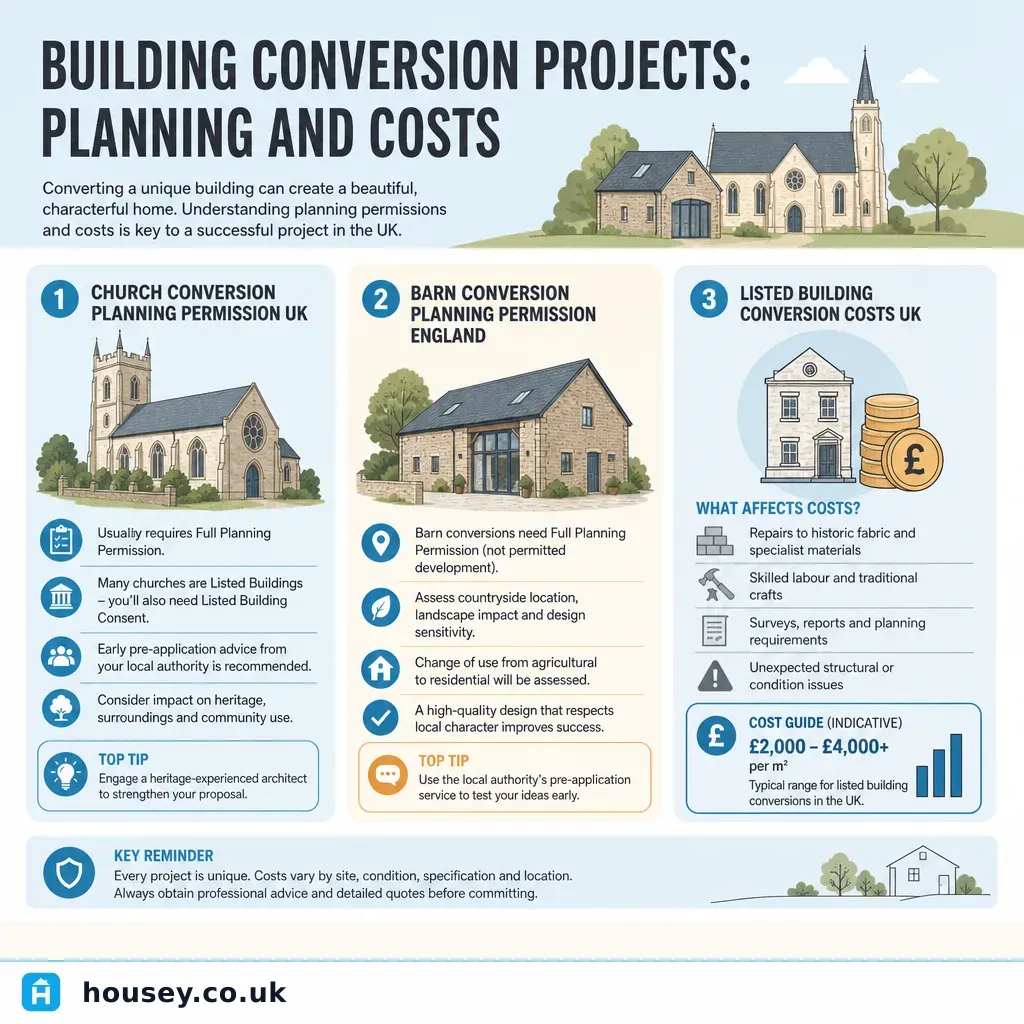
Building Conversion Projects: Planning and Costs
Converting a non-residential building in the UK — such as a barn, church, or commercial property — typically requires full planning permission and often Listed Building Consent.
 Planning & Pre-Build
Building a Granny Annexe: Planning, Regulations, and Investment
A granny annexe in the UK may or may not need planning permission depending on whether it is classed as incidental to the main house or as a separate dwelling.
 Planning & Pre-Build
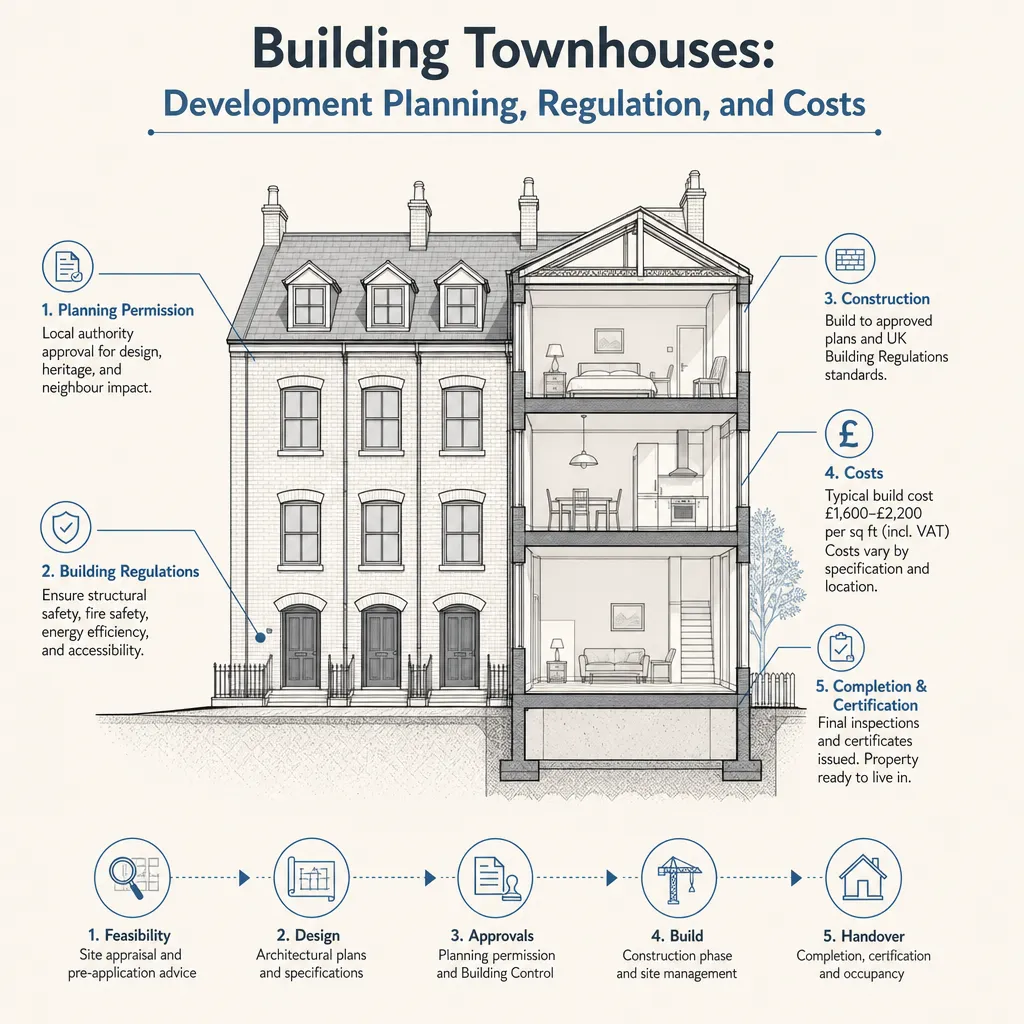
Building Townhouses: Development Planning, Regulation, and Costs
Building townhouses in the UK requires full planning permission for all new dwellings — permitted development rights do not apply to new residential construction.
 Planning & Pre-Build
Building a Bungalow in the UK: Design, Planning, and Costs
Building a bungalow in the UK typically costs £1,500–£3,000 per square metre, putting a 100m² bungalow at roughly £150,000–£300,000 in build costs before land, professional fees, and VAT.
 Planning & Pre-Build
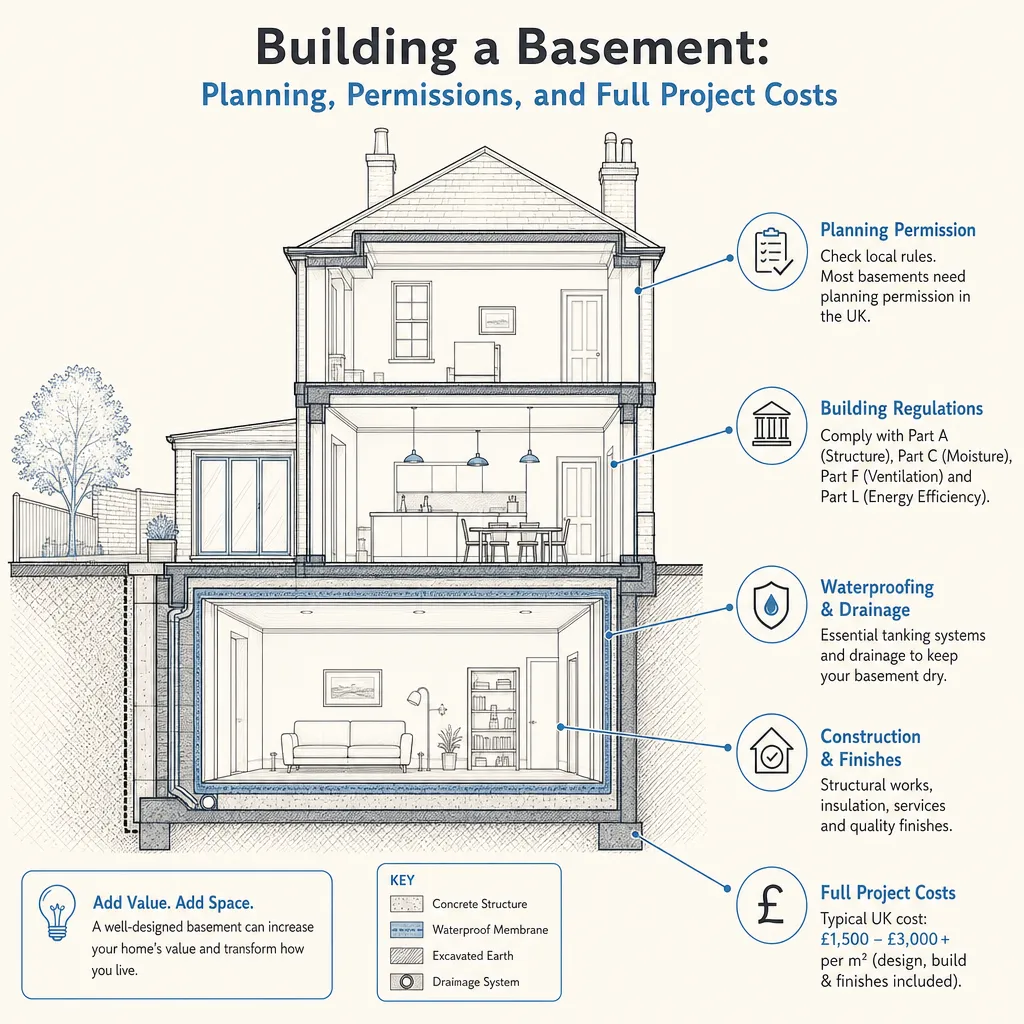
Building a Basement: Planning, Permissions, and Full Project Costs
Building a basement in the UK usually requires full planning permission where new excavation or external changes are involved.