Building a New Garage: Planning, Design and Building Regulations
By Housey · Last reviewed 19th of May 2026
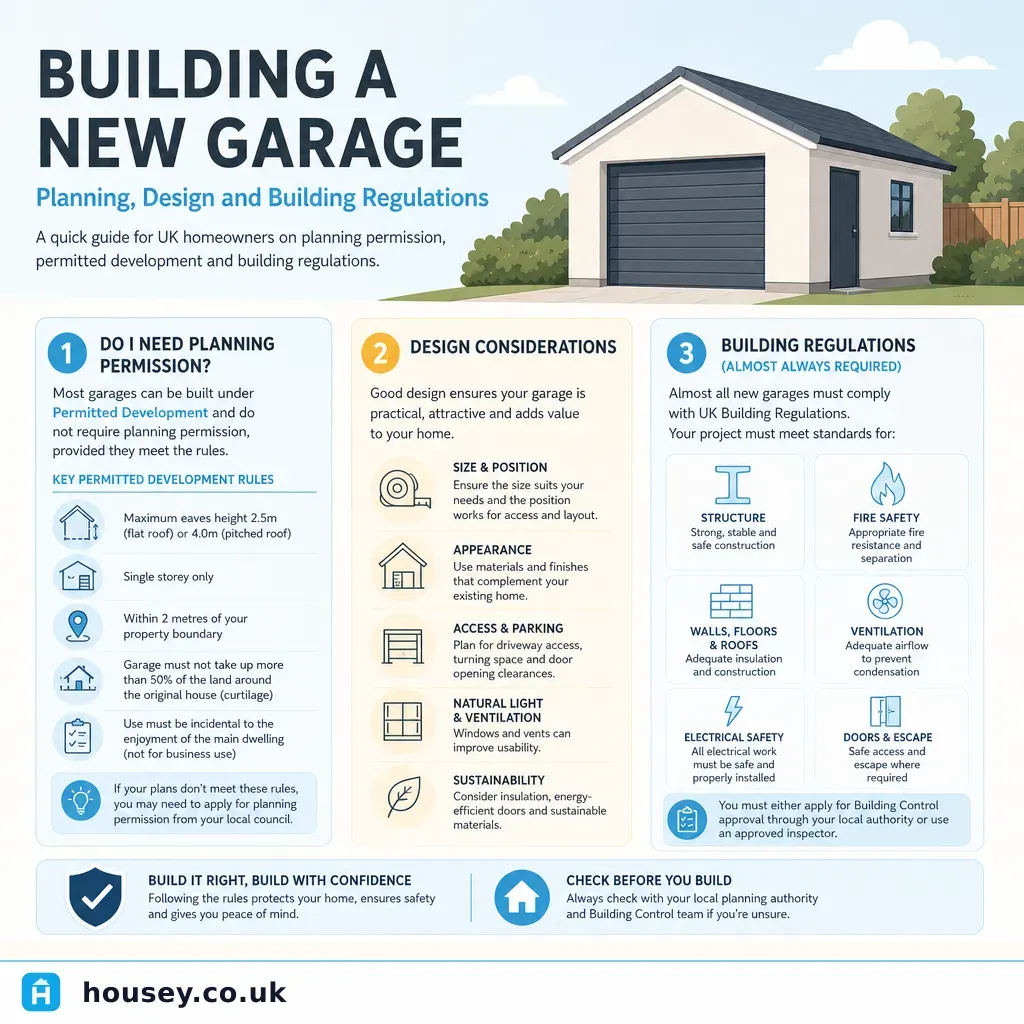
Building a New Garage: Planning, Design and Building Regulations
Building a new garage involves a set of overlapping regulatory requirements that catch many homeowners off guard — from permitted development limits and planning permission to Building Regulations structural requirements and surface water drainage rules. Whether you are planning a detached single garage for a 1960s estate house or a double garage with a room above for a rural property, understanding the regulatory framework before work begins protects your investment and avoids enforcement problems at the point of sale.
Key points
- A detached garage with a floor area of up to 15m² does not require building regulations approval, provided it contains no sleeping accommodation and is not constructed of combustible material within 1m of a boundary.
- Garages between 15m² and 30m² require building regulations approval if any part is within 1m of a boundary; those over 30m² require approval regardless of position.
- Most new garages qualify as permitted development under Class E, Schedule 2 of the Town and Country Planning (General Permitted Development) (England) Order 2015 — but only if the garage is not within 5m of the dwelling, does not cover more than half the garden, and meets the specified height limits.
- Planning permission is required if the property is listed, if it is in a conservation area with a footprint over 10m², or if an Article 4 direction has removed Class E permitted development rights.
- New hardstanding over 5m² that is not permeable and does not drain to a lawn or planted area requires planning permission — a rule introduced to manage surface water run-off.
Do I need planning permission for a new garage?
Most new detached garages in England fall under permitted development rights under Class E of Schedule 2 to the Town and Country Planning (General Permitted Development) (England) Order 2015. However, several conditions must all be met simultaneously.
Permitted development or planning permission?
- Permitted development likely applies if: the garage is in the rear or side curtilage (not forward of the principal elevation), it does not take total outbuildings coverage over 50% of the land around the original house, its eaves height does not exceed 2.5m and ridge height does not exceed 4m (dual-pitch) or 3m (other roof types), it is not within 5m of the dwelling, and the property is not listed and not in an area with Article 4 restrictions.
- Planning permission is required if: the garage is within 5m of the house (it is treated as part of the dwelling), it would take outbuildings coverage over 50% of the garden, the property is listed, it is in a conservation area or AONB and the footprint exceeds 10m², or an Article 4 direction has removed Class E rights.
- Check with your local planning authority if you are uncertain — many LPAs offer pre-application advice, and prior extensions or outbuildings may have already used your permitted development allowance.
In Wales, Scotland, and Northern Ireland, permitted development rules differ from those in England. Consult the relevant national planning guidance or your local authority if your property is outside England.
Even where permitted development applies, applying for a Lawful Development Certificate from your LPA is strongly recommended. This provides written confirmation that the works are lawful — something conveyancers and mortgage lenders may request when you sell or remortgage.
Do I need building regulations for a new garage?
The need for building regulations approval depends primarily on floor area and proximity to boundaries.
Garage floor area | Distance from any boundary | Building regs required? |
|---|---|---|
Up to 15m² | Any | No (unless sleeping accommodation) |
15m²–30m² | More than 1m from all boundaries | No |
15m²–30m² | Within 1m of any boundary | Yes |
Over 30m² | Any | Yes |
Any size with habitable use | Any | Yes |
When building regulations do apply, the structural design must comply with Approved Document A (Structure), the roof and walls with Approved Document C (resistance to moisture), and any electrical installation with Approved Document P. If the garage will be heated or used as conditioned space, Approved Document L (conservation of fuel and power) may also apply to the thermal envelope.
For garages over 30m², those with a room above, or those on ground where conditions are uncertain, a specialist in structural engineering should prepare the foundation specification and structural calculations for the building control submission.
Design considerations
Foundations
Most standard single-skin block garages sit on strip foundations, typically 600–750mm wide and 450–600mm deep in stable ground conditions. On clay soils — common across South East and Midland England — deeper trench-fill foundations or engineer-specified alternatives are often required to accommodate seasonal clay movement. A building regulations drawings specialist or structural engineer will confirm the appropriate specification for your site conditions.
Wall construction
- Single-skin concrete block — lowest cost, standard for non-habitable storage garages
- Cavity wall — required if insulation is needed for any habitable or conditioned space
- Timber frame — faster to erect, well-suited to detached ancillary buildings
Roof type
- Pitched roof (clay or concrete tile) — most common, longest lifespan, easily matched to the main dwelling
- Flat roof (GRP or EPDM single-ply membrane) — lower profile; requires correct falls and drainage detailing to prevent ponding
Drainage and hardstanding
Rainwater from the garage roof should be collected and directed to a soakaway or water butt rather than discharging to the street. Any new hardstanding — driveway or apron in front of the garage — over 5m² must be permeable (block paving with permeable jointing, gravel, or similar) or drain to a lawn or planted area, otherwise planning permission is required. This condition applies under the permitted development rules introduced to manage surface water run-off.
Electrical installation
If the garage will have lighting, power sockets, or electric vehicle (EV) charging, the electrical installation must be carried out by an NICEIC- or NAPIT-registered electrician, or notified to building control under Part P of the Building Regulations. EV charging points above 3.7kW may require separate notification to the Distribution Network Operator.
Important limitations
This guide provides general information about the regulations governing new garage construction in England. Planning rules, permitted development rights, and Building Regulations thresholds vary by property type, location, tenure, and history of prior works. Nothing in this guide constitutes planning, structural, or legal advice for your specific circumstances. Your property may be subject to Article 4 directions, restrictive covenants, or conditions attached to prior planning consents that cannot be identified from general guidance alone. Always check with your local planning authority before starting any work where there is uncertainty.
What to ask a qualified professional
Before submitting a planning or LDC application — consider a planning consultancy:
- Has my property's permitted development allowance already been used by prior outbuildings or extensions?
- Are there any Article 4 directions, covenants, or planning conditions affecting what I can build?
- Should I apply for a Lawful Development Certificate even if the garage appears to be permitted development?
Before instructing a structural engineer:
- What foundation specification do you recommend for these ground conditions, and why?
- Will you provide calculations in the format required for the building control submission?
- Is a site visit required, or will you work from borehole or trial pit data?
Before appointing a builder:
- Do you have experience with building regulations submissions for garages in this local authority area?
- Who will prepare the structural calculations and building regulations drawings?
- What foundation type are you proposing, and on what basis?
- Are building control inspection fees included in your quote?
- Is VAT included?
When to get professional help
A small detached garage built within permitted development limits, below the building regulations threshold, and on straightforward ground is relatively low risk to manage. However, engage a planning consultancy if:
- The property is listed, in a conservation area, or subject to an Article 4 direction
- You want formal written confirmation of permitted development status before building
- Your proposed garage is close to the 5m-from-dwelling threshold, coverage limit, or boundary
Engage a specialist in structural engineering if:
- The garage is over 30m² or includes a room above
- The plot is on clay, fill, made ground, or other variable conditions
- The site is in an area with a known history of subsidence
Red flags during construction:
- Builder proposing to skip building control inspections where they are required
- Foundations shallower than those specified in the structural calculations
- No allowance for surface water drainage from hardstanding or roof
- Electrical work carried out by an unregistered contractor
How Housey can help
Housey can connect you with vetted local professionals to support your garage build from the outset. A planning consultancy can confirm whether your design falls within permitted development or requires a formal application. Specialists in building regulations drawings can prepare the plans and documentation needed for your building control submission. If your garage requires engineering input — deep foundations, a room above, or unusual structural loading — a structural engineering consultant can provide the calculations your builder and building control inspector need.
Frequently asked questions
Does a detached garage add value to a UK property?
A well-built detached garage in good condition generally adds value, particularly in areas where off-street parking is scarce or in demand. The value uplift varies by location, size, condition, and whether the garage has power, lighting, or habitable space. An independent RICS-registered valuer can advise on the likely impact for your specific property and local market.
Can I build a garage without planning permission in a conservation area?
In England, detached outbuildings with a footprint greater than 10m² in conservation areas, Areas of Outstanding Natural Beauty, or National Parks are not permitted development and require planning permission. Smaller structures within 10m² may still qualify for permitted development if all other conditions are met, but you should check with your local planning authority before starting work.
What is the difference between a building notice and a full plans application for a garage?
A Full Plans application involves submitting detailed drawings and structural calculations to building control for approval before work starts, giving formal written certainty before the build begins. A Building Notice means notifying building control that work is starting without submitting detailed plans; inspectors visit as the work progresses. A Full Plans application is generally recommended as it reduces the risk of being required to alter completed work.
Can I convert a newly built garage into living space later?
Yes, but converting a garage into habitable accommodation is a material change of use requiring planning permission and full building regulations compliance, including thermal performance, ventilation, fire safety, ceiling height, and natural light. It is usually more cost-effective to design for potential habitable use from the outset if conversion is a possibility.
Do I need to inform my mortgage lender before building a new garage?
Most mortgage lenders do not require notification for outbuildings qualifying as permitted development. However, if the garage requires planning permission or affects the property's structure, review your mortgage conditions and consult your lender or a solicitor. Update your buildings insurance to cover the new structure from the point construction begins.
Sources and further reading
- Planning Portal: Outbuildings — permitted development guidance — Planning Portal
- Town and Country Planning (General Permitted Development) (England) Order 2015: Schedule 2, Class E — legislation.gov.uk
- Building Regulations Approved Document A: Structure — GOV.UK
- Building Regulations Approved Document P: Electrical safety in dwellings — GOV.UK
- GOV.UK: Paving your front garden — planning rules for hard surfaces — GOV.UK
Useful next reads
 Improvement & Build
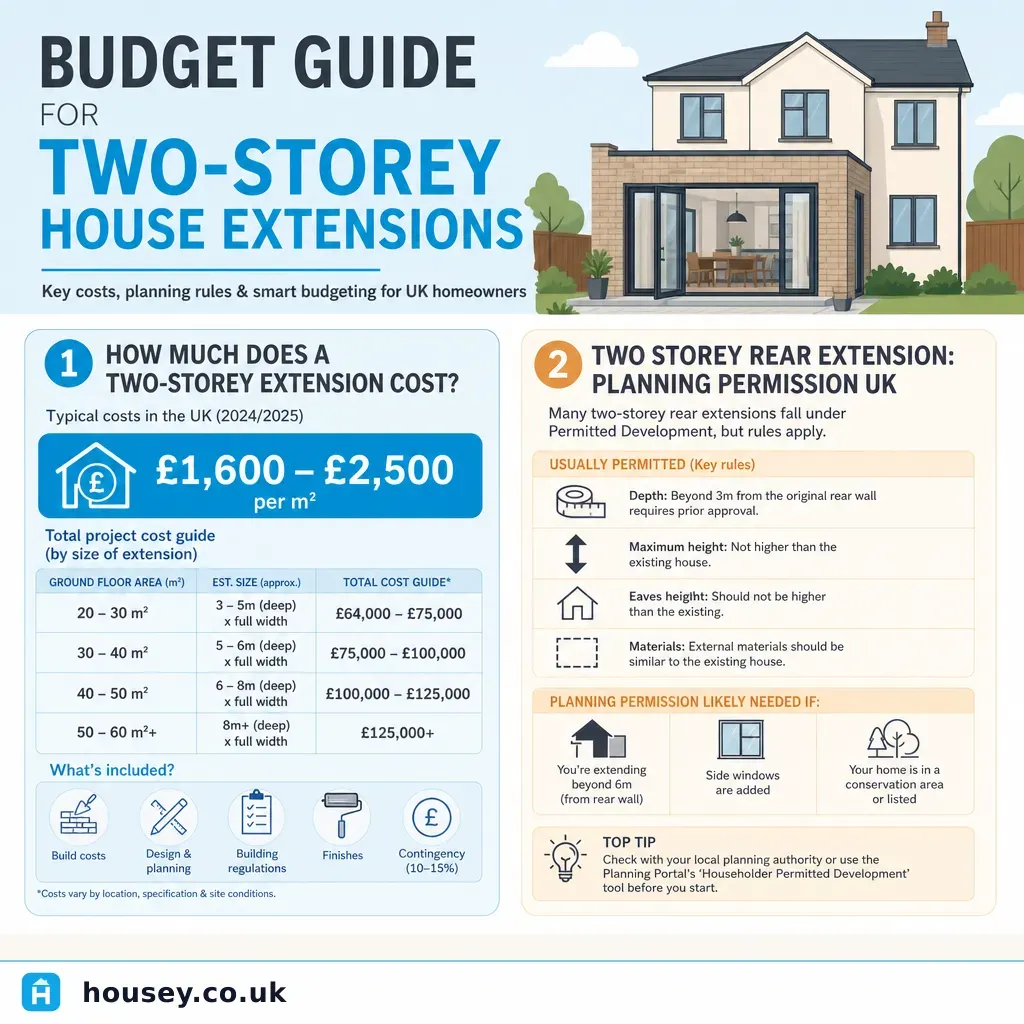
Budget Guide for Two-Storey House Extensions
A two-storey house extension in the UK typically costs £1,800–£3,000+ per square metre for the build alone.
 Improvement & Build
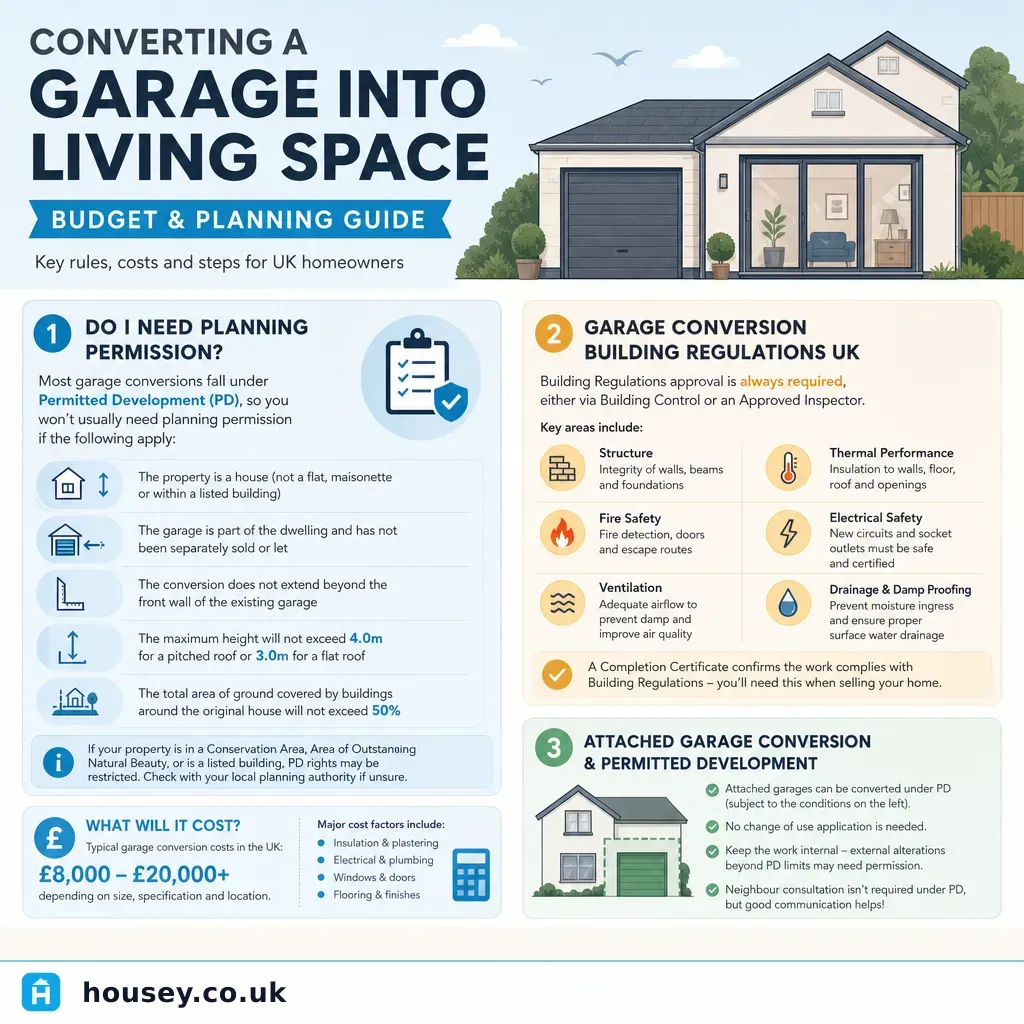
Converting a Garage into Living Space: Budget and Planning Guide
A single-garage conversion typically costs £8,000–£20,000 in the UK.
 Improvement & Build
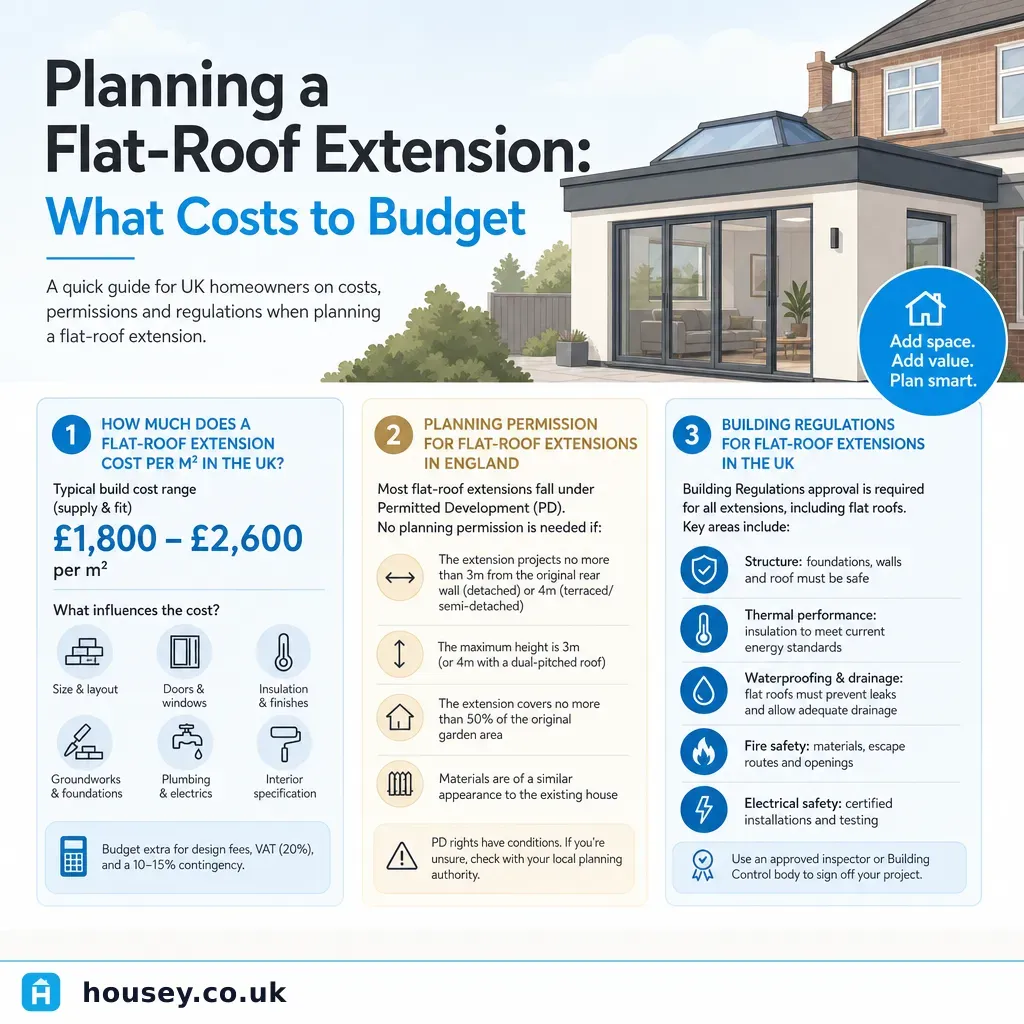
Planning a Flat-Roof Extension: What Costs to Budget
A flat-roof single-storey extension typically costs £1,500–£3,000 per m² in the UK, depending on size, specification, location, and roof membrane choice.
 Improvement & Build
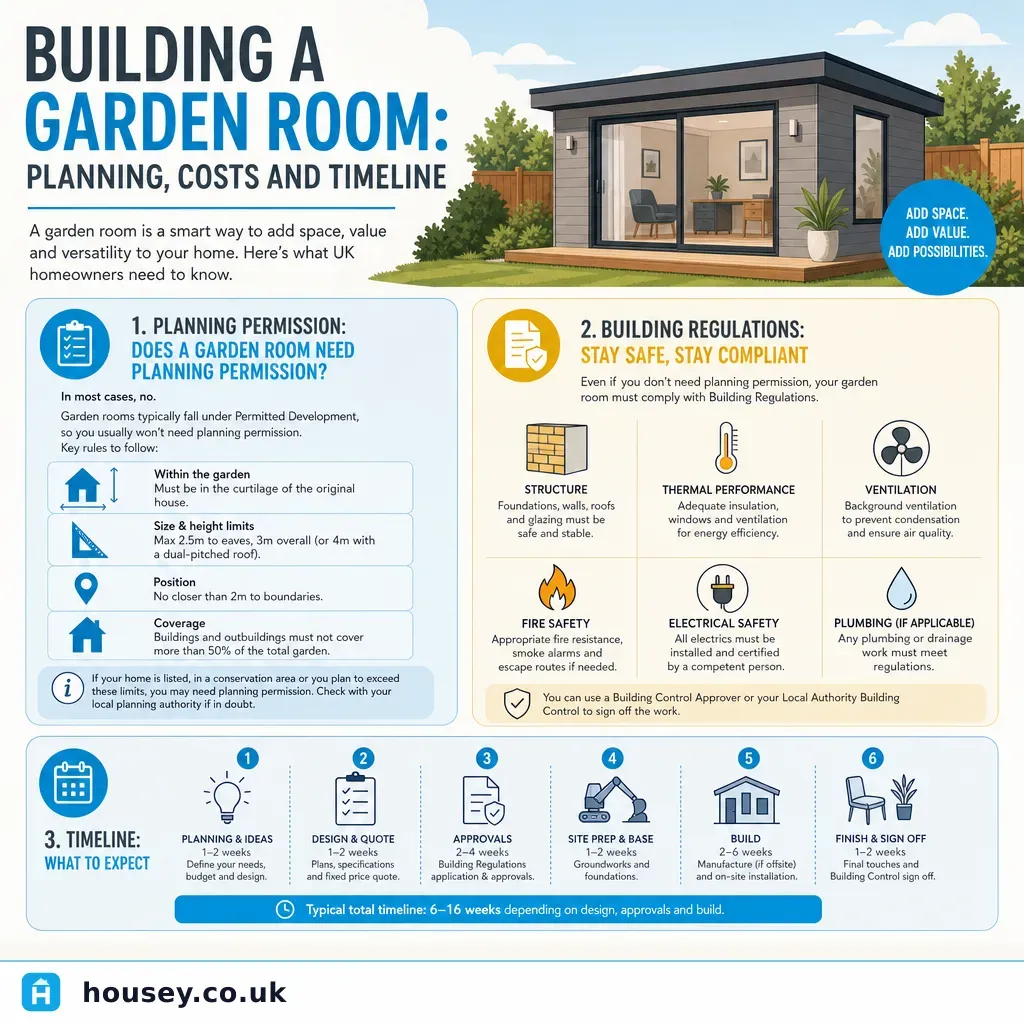
Building a Garden Room: Planning, Costs and Timeline
Most garden rooms in England fall under permitted development and don't need planning permission, provided the structure meets height, coverage, and boundary conditions.
 Improvement & Build
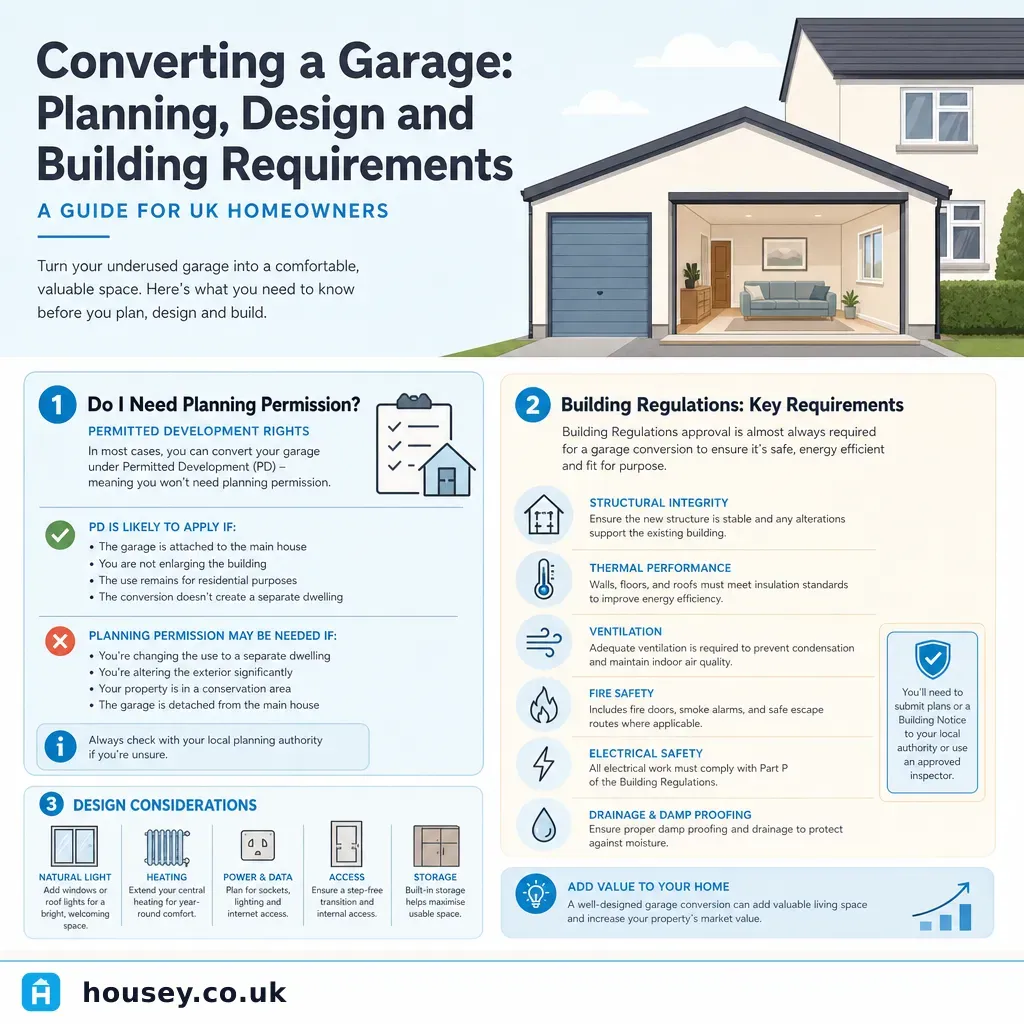
Converting a Garage: Planning, Design and Building Requirements
Most garage conversions in England do not need planning permission under permitted development rights, but all conversions require Building Regulations approval covering structure, thermal insulation, fire safety, and ventilation.