Building Brick Steps: Construction and Installation
By Housey · Last reviewed 5th of May 2026
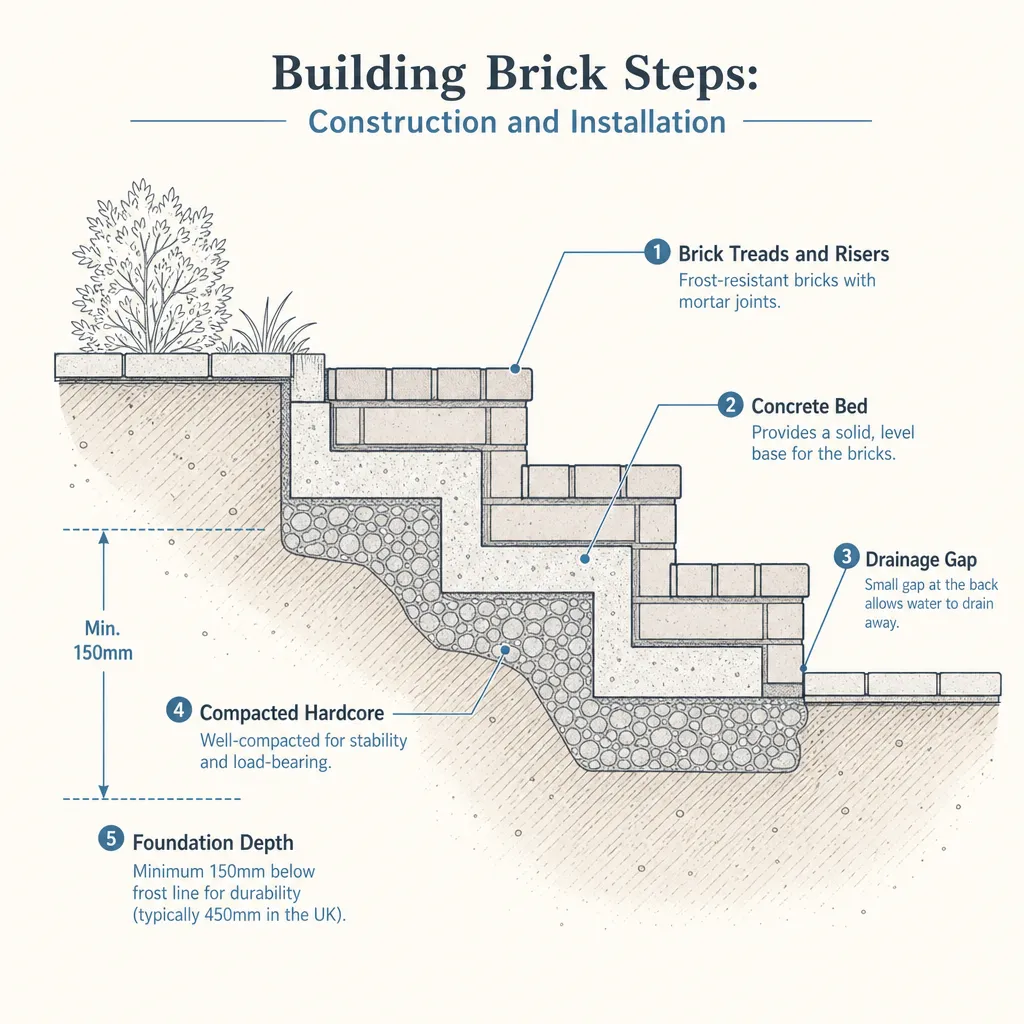
Building Brick Steps: Construction and Installation
Brick steps are a durable, traditional addition to UK gardens and driveways, most often needed when a garden is terraced, a patio is raised, or a property entrance is being upgraded. Getting the proportions, foundations, and materials right from the outset avoids costly remedial work and reduces the risk of settlement, cracking, or slipping in wet conditions — all common outcomes when steps are built without a proper specification.
Key points
- Step risers for external brick steps are commonly set at 150–175 mm, with a tread depth (going) of at least 280–300 mm for safe, comfortable use.
- A concrete foundation — typically 100–150 mm of compacted hardcore plus 75–100 mm of concrete — is required under the first step course to prevent settlement.
- Engineering bricks (Class B or Class FL per BS EN 771-1) are recommended for treads on external steps; they are frost-resistant and dense enough for repeated wet-weather use.
- A mortar mix of approximately 1:4 (cement:sharp sand) is generally used for engineering brick steps; a stronger 1:3 mix is appropriate for the foundation course.
- Building Regulations do not usually apply to domestic garden steps, but steps forming part of a building's accessible entrance, means of escape, or adjacent retaining structure may have additional requirements.
Planning and design: getting the dimensions right
Poor step proportions are the most common cause of discomfort, trips, and falls on external brick steps. UK design practice for external steps aligns with principles in BS 8300 (accessible design) and Building Regulations Approved Document K (protection from falling), even where those documents do not strictly apply to domestic garden works.
Riser (height): 150–175 mm is the accepted range for comfortable domestic external steps. Below 100 mm becomes nearly invisible as a step and creates a trip hazard. Above 200 mm is difficult for older users and children.
Going (tread depth): A minimum of 280 mm is generally recommended for an external tread. 300–350 mm is more comfortable and allows the full foot to land safely. Allow an additional 25–50 mm nosing overhang if the tread is bullnosed.
The 2R+G rule: A formula used by designers to check step comfort: 2 × riser + going = 600–650 mm. This produces steps that feel natural to walk at a comfortable pace. A 150 mm riser paired with a 320 mm going gives 620 mm — comfortably within range.
Width: A minimum of 900 mm is usually recommended for a single-person garden path step; 1,200 mm or more for a formal entrance or shared access.
Cross-fall (drainage): Treads should slope slightly — 1–2% towards the front or to one side — to allow rainwater to drain. Ponding water on step surfaces significantly increases the risk of ice in winter.
Worked example: terraced rear garden in a 1930s semi-detached
A homeowner in the East Midlands needed to connect a new raised patio — 450 mm above the existing lawn — to the lower garden of their 1930s semi-detached.
- Three steps required: 3 × 150 mm risers = 450 mm total rise.
- Tread depth chosen: 320 mm, plus a 25 mm nosing = 345 mm visible tread.
- Comfort check: 2R+G = (2 × 150) + 320 = 620 mm — within the 600–650 mm range. ✓
- Foundation: 150 mm compacted MOT Type 1 hardcore + 100 mm C20 concrete haunching.
- Bricks: Staffordshire Blue engineering bricks (Class B) — frost resistant, dense, and well suited to the exposed East Midlands climate.
- Mortar: 1:4 (OPC:sharp sand) for bedding; matching pigmented mortar for pointing.
- Step width: 1,500 mm, matching the patio width for a clean, proportionate finish.
The homeowner obtained two quotes from local groundworkers, asked each to provide a written specification including brick type and foundation depth, and confirmed their experience with patio and step construction before committing.
Materials: which bricks to use for external steps
Not all bricks are suitable for external steps in the UK climate. Freeze-thaw cycling causes frost-sensitive bricks to spall — chipping and crumbling — within a few winters, leaving treads uneven and potentially dangerous.
Brick type | Frost resistance | Best for | Notes |
|---|---|---|---|
Engineering brick (Class B) | High | Risers, treads, base course | Most common choice for UK external steps |
Engineering brick (Class FL) | Very high | Exposed or waterlogged sites | FL = Frost resistant / Low water absorption |
Hard facing brick (F2 rating) | Good | Sheltered feature steps | F2 = Frost resistant per BS EN 771-1 |
Standard facing brick (F0/F1) | Low–moderate | Not recommended for treads | Risk of spalling within 5–10 years |
Reclaimed brick | Variable | Aesthetic matching only | Test frost resistance before specifying |
The relevant British Standard for brick classification is BS EN 771-1. For external step treads, specify F2 (frost resistant) and S2 (low active soluble salt content) designations as a minimum. Engineering bricks satisfy both.
Construction process overview
This is an outline of the process a competent groundworker or builder would follow. External brick steps involve concrete foundations and mortar work; a qualified contractor should carry out or oversee the construction.
- Mark out and excavate — Peg out the step footprint; excavate to the depth required for hardcore and concrete below the first course.
- Lay hardcore and compact — 100–150 mm of compacted MOT Type 1 hardcore; compact thoroughly with a plate compactor or hand rammer.
- Pour concrete foundation — 75–100 mm of C20 concrete, levelled and left to cure for at least 24 hours before bricklaying begins.
- Lay the base course — Engineering bricks bedded in 1:3 mortar on the cured concrete, checked for level and alignment.
- Build up risers — Subsequent brick courses forming the risers, kept plumb and level with a string line.
- Bed treads — Tread bricks laid with a slight forward fall (1–2%) for drainage; 10 mm joints fully filled.
- Point joints — Once mortar is thumb-print firm, re-point with matching exterior mortar.
- Protect and cure — Keep mortar covered in cold or wet weather for at least 48 hours; avoid foot traffic for 48–72 hours.
What to ask a groundworker or builder before accepting a quote
- What brick type and specification do you recommend, and why?
- What foundation depth and concrete mix will you use?
- How will you allow for drainage on the treads?
- Are movement or expansion joints needed at any point?
- What is included — excavation, spoil disposal, materials, pointing?
- Is VAT included in the quoted price?
- What is the guarantee period for materials and workmanship?
- Will you provide a written specification or method statement before starting?
When to get professional help
Brick steps in most domestic gardens are a routine task for an experienced builder or groundworker. However, consider seeking additional professional input if:
- The steps are adjacent to a retaining wall — retaining structures over 1 m in height may require a structural engineer's design
- The ground is sloping, unstable, or shows signs of subsidence or made-up ground
- Steps form part of an accessible entrance required to comply with Approved Document M of the Building Regulations (for example, an HMO, converted property, or commercial premises)
- The steps affect or adjoin a neighbour's property or a public right of way
- You are in a conservation area — hard landscaping works may require prior notification or approval from the local planning authority
How Housey can help
If you need brick garden steps built or a raised patio constructed, Housey can connect you with experienced groundworkers and patio builders in your area. Describe your project, share photos of the site, and receive detailed written quotes from local contractors to compare side by side.
Frequently asked questions
Do I need planning permission to build brick garden steps?
Planning permission is not usually required for garden steps within the residential curtilage of a house, provided they do not form a raised platform or affect a listed building. Steps associated with a wall exceeding 1 m in height adjacent to a highway, or 2 m elsewhere, may require permission. Conservation areas may carry additional restrictions. Always check with your local planning authority if in doubt.
How long do brick garden steps last?
Well-constructed brick steps using frost-resistant engineering bricks and correct mortar can last 30–50 years with minimal maintenance. The most common causes of early failure are frost-sensitive bricks spalling in wet conditions, inadequate concrete foundations causing settlement, and poor drainage causing water to pond on treads, accelerating freeze-thaw damage. Correct material specification at the outset is the most important factor in longevity.
Can I build brick garden steps myself?
Single-flight garden steps on level, stable ground are within the capability of a competent DIY builder with masonry experience. However, concrete foundation depth and mortar specification are critical, and errors are costly to correct. For more than three or four steps, steps adjacent to a structure, or steps on sloping or uncertain ground, using a professional contractor is strongly advisable.
What is the best mortar mix for external brick steps?
A 1:4 cement-to-sharp sand mortar is commonly used for bedding brick steps in UK external conditions. A slightly richer 1:3 mix may be used for the base course on the concrete foundation. Avoid weak or lime-rich mixes on external treads, as these erode more quickly. Plasticisers may be added to improve workability, but do not weaken the mix below 1:4.
How much does it cost to have brick garden steps built?
Indicative UK costs, last reviewed 2026-05-05. A simple flight of three brick steps typically costs £500–£1,500 depending on size, brick specification, access, and the contractor's location. Larger or more complex projects — wider flights, multiple flights, or integrated retaining walls — cost considerably more. Always obtain at least two written quotes specifying materials, foundation design, and what is included.
Sources and further reading
- Planning Portal — Fences, gates and garden walls — Planning Portal / MHCLG
- Approved Document K: Protection from falling, collision and impact — MHCLG
- HSE — Slips, trips and falls — Health and Safety Executive
- BSI — BS EN 771-1: Specification for masonry units — BSI
Useful next reads
 Improvement & Build
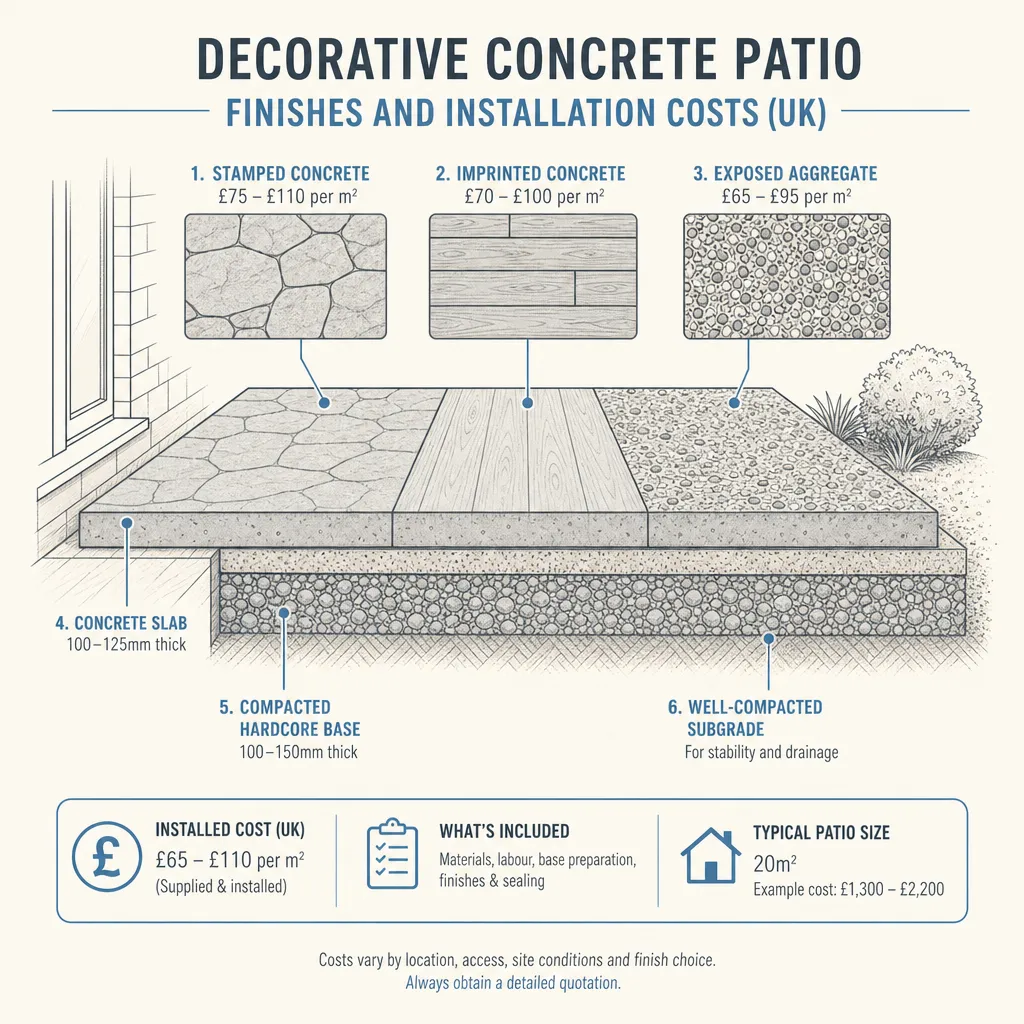
Decorative concrete patio finishes and installation costs
A decorative concrete patio costs roughly £80–£200+ per square metre in the UK, depending on the finish — from brushed concrete to stamped, exposed aggregate, or stencilled designs.
 Improvement & Build
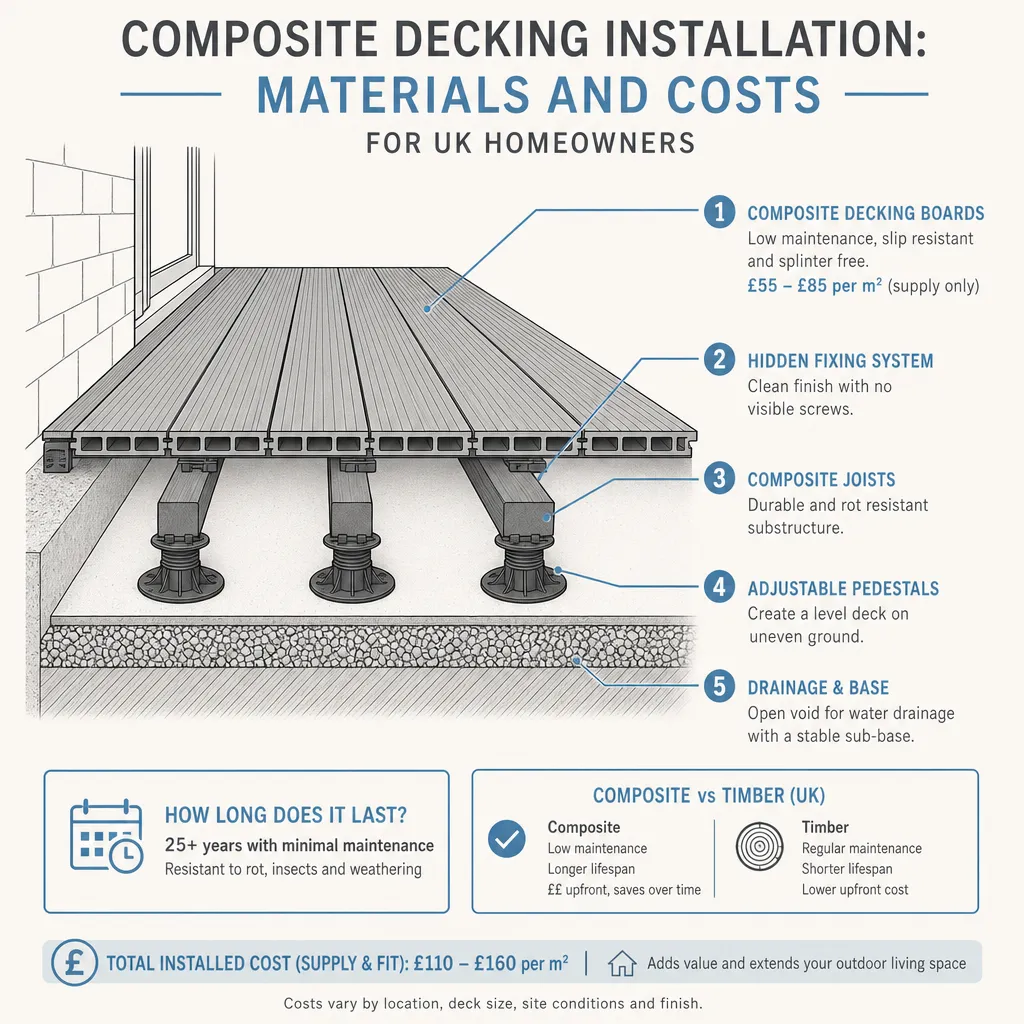
Composite Decking Installation: Materials and Costs
Composite decking typically costs £80–£200 per m² fully installed in the UK, depending on board grade, subframe type, and site conditions.
 Improvement & Build
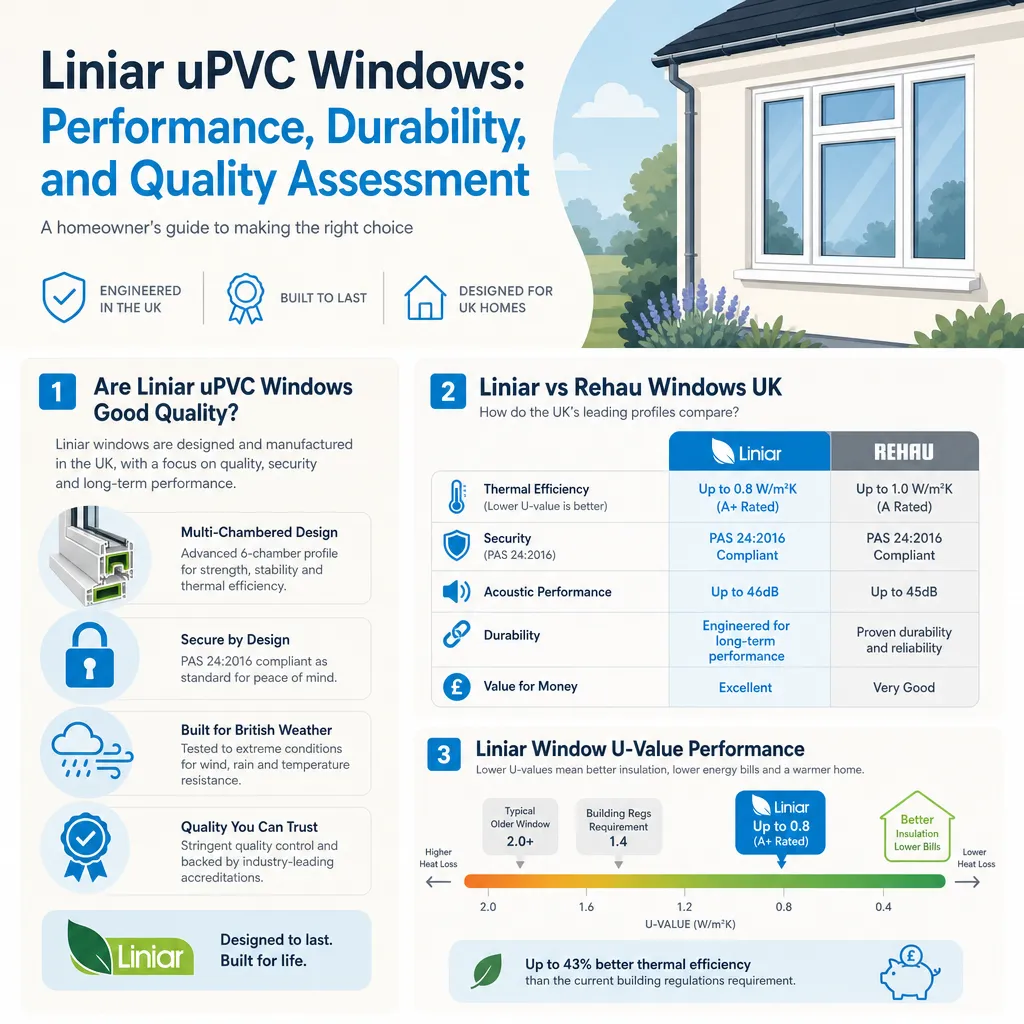
Liniar uPVC Windows: Performance, Durability, and Quality Assessment
Liniar uPVC window profiles are manufactured in the UK using multi-chambered, foamed frames.
 Improvement & Build
Garden Tap Installation with Hot and Cold Water: Plumbing Options
Adding a cold garden tap is a common DIY project, but routing hot water outdoors requires a plumber to connect to your domestic hot water system and comply with the Water Supply (Water Fittings) Regulations 1999.
 Improvement & Build
Sealing and Maintaining Historic Leaded Glass Windows: Preservation and Performance
Leaded glass windows are maintained using traditional linseed oil cement — not silicone or modern sealants, which prevent natural movement in the lead came.