Decorative concrete patio finishes and installation costs
By Housey · Last reviewed 12th of May 2026
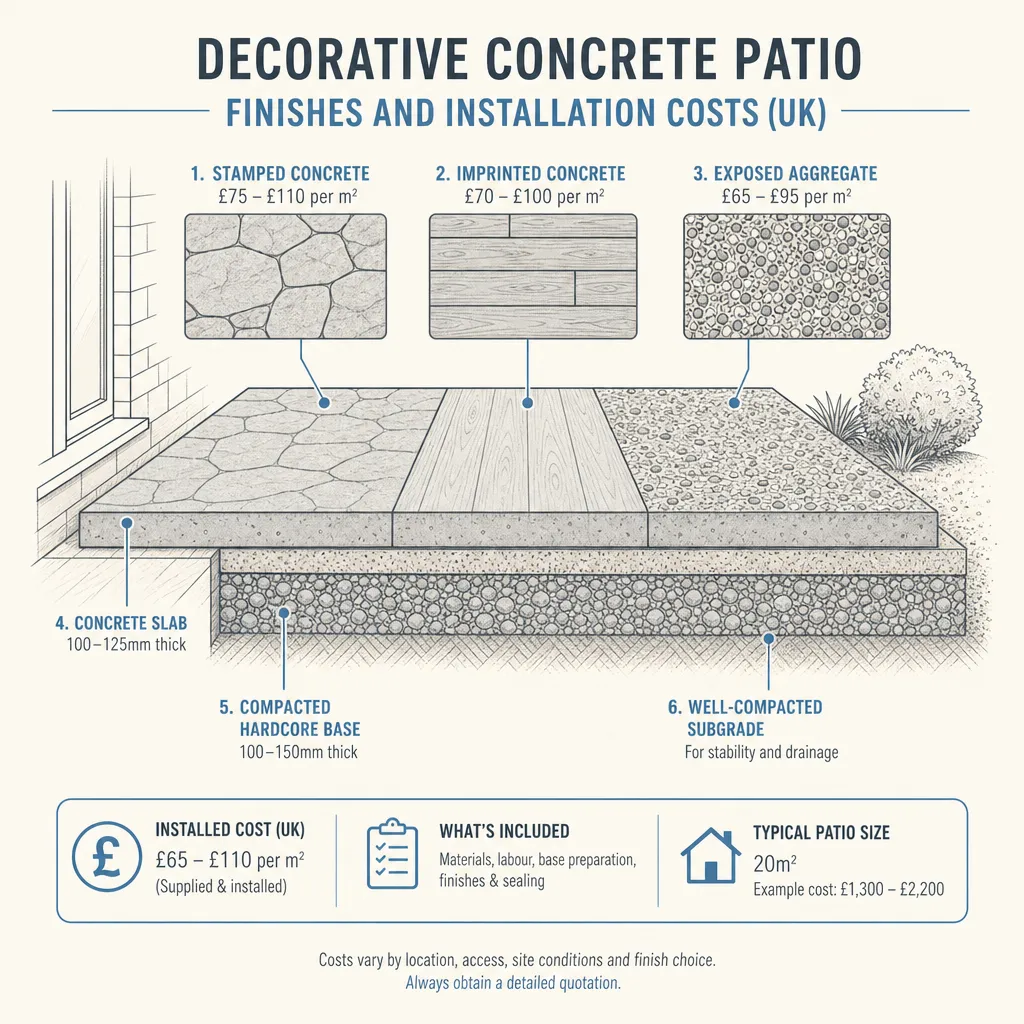
Decorative concrete patio finishes and installation costs
Concrete has shed its purely utilitarian image in UK gardens over the past decade. Homeowners who once defaulted to paving slabs or gravel are increasingly choosing decorative concrete for patios, paths, and terraces — drawn by the range of textures, colours, and patterns available and, often, by the lower long-term maintenance demands compared with individually jointed paving. The challenge is understanding which finish suits your outdoor space, what the installation process genuinely involves, and how to get an accurate and comparable quote.
Key points
- Decorative concrete patio finishes include brushed (broom-finished), exposed aggregate, stamped (imprinted), stencilled, and polished or acid-etched concrete — each requiring different equipment, timing, and installation expertise.
- A domestic concrete patio typically requires a minimum 100 mm compacted Type 1 MOT hardcore sub-base and a 75–100 mm reinforced concrete slab to achieve adequate structural performance.
- Impermeable surfaces over 5 m² that drain towards a public highway require a permeable design or connected drainage under GOV.UK guidance — check with your local planning authority before laying.
- A fall of at least 1:60 away from the house is needed to direct rainwater clear of the building's damp-proof course.
- Indicative UK installation costs for decorative concrete patios range from approximately £80–£200+ per square metre, depending on the finish, site conditions, and location (Indicative UK costs, last reviewed 2026-05-12).
Decorative concrete finish options
Brushed or broom-finished concrete
The most straightforward decorative treatment. The surface is textured with a stiff broom while the concrete is still green, creating parallel ridges that improve slip resistance. Integral pigments can add colour. This is the most affordable option and suits utility paths, side returns, and practical working areas.
Exposed aggregate concrete
The top layer of cement paste is washed and brushed away while the concrete is at the correct stage of cure, revealing the aggregate — stone chips, pebbles, or decorative gravel — below. The finish is naturally textured and slip-resistant. Aggregate colour and size can be selected to complement planting schemes or adjacent hard landscaping.
Stamped (imprinted) concrete
Rubber or polyurethane stamps are pressed into the concrete surface before it sets to create patterns mimicking natural stone, slate, brick, cobbles, or timber. Colour hardeners and release agents create contrast and depth. This is the most visually versatile option but also the most technically demanding — the decorative window is time-critical and highly sensitive to temperature and humidity during installation.
Stencilled concrete
A stencil is laid on the concrete surface and a colour hardener or dye broadcast over it; when the stencil is removed it leaves a pattern in the surface layer. Similar in appearance to stamped concrete but with less dimensional relief and generally a lower cost for complex patterns.
Polished or acid-etched concrete
Most relevant to covered outdoor spaces or indoor-outdoor living areas in the UK. Polished concrete requires a high-quality pour with minimal voids; the surface is then ground and polished to a specified sheen. Acid etching creates a subtler texture by reacting chemically with the cement paste. Both finishes have lower inherent slip resistance and are less suited to open, exposed garden areas in the UK climate.
Comparison: decorative concrete finishes
Finish | Slip resistance | Maintenance | Relative cost | Best for |
|---|---|---|---|---|
Brushed / broom-finished | Good | Low | £ | Utility paths, side returns, working areas |
Exposed aggregate | Excellent | Low–medium | ££ | Gardens, pool surrounds, paths |
Stamped / imprinted | Variable — specify anti-slip sealer | Medium | £££ | Statement patios, feature terraces |
Stencilled | Moderate | Medium | ££–£££ | Defined pattern on a tighter budget |
Polished / acid-etched | Lower — specify anti-slip additive | Medium–high | ££££ | Covered or sheltered outdoor spaces |
What does installation involve?
A decorative concrete patio installation follows a broadly consistent sequence regardless of the chosen finish:
- Excavation and disposal. The existing surface is removed and soil excavated to the required depth — typically 200–300 mm below finished patio level.
- Sub-base compaction. A 100 mm layer of Type 1 MOT hardcore is laid and mechanically compacted to form a stable, load-bearing base.
- Formwork installation. Timber shuttering is set accurately to planned levels and falls.
- Membrane and reinforcement. A damp-proof membrane and steel reinforcement mesh (typically A142 for domestic patios) are placed before the pour.
- Concrete pour and levelling. Ready-mixed concrete (C25/30 or higher for domestic use) is poured and screeded to level.
- Decorative treatment. Applied at precisely the right stage of cure — this window narrows with rising temperature and is most critical for stamped and imprinted finishes.
- Expansion joint cutting or tooling. Joints are formed at regular intervals — typically every 3–4.5 m — to control cracking as the concrete cures and moves with seasonal temperature changes.
- Curing and protection. The concrete must be protected from rain, frost, and direct sun for at least 24–48 hours; full structural strength is reached at 28 days.
- Sealing. Most decorative finishes should be sealed to improve colour retention, resist staining and frost damage, and extend the service life.
Worked UK property scenario
Scenario: A homeowner in the East Midlands wants to replace a 40 m² cracked paving slab patio with an imprinted concrete terrace in an ashlar slate pattern with a charcoal colour hardener and mid-grey release agent.
Item | Detail | Indicative cost |
|---|---|---|
Break out and remove existing slabs | 40 m² | £400–£600 |
Excavation and sub-base (100 mm Type 1 MOT) | 40 m² | £400–£700 |
Ready-mixed concrete supply and pour (C30) | 40 m² at 100 mm depth | £800–£1,300 |
Imprinted pattern, colour hardener, and release agent | 40 m² | £1,600–£2,800 |
Expansion joints, edge shuttering, and sealer coat | Included or quoted separately | £300–£500 |
Total |
| £3,500–£5,900 |
Indicative UK costs, last reviewed 2026-05-12. Actual quotes will vary by region, site conditions, concrete specification, and contractor.
Planning and drainage considerations
A patio at ground level does not usually require planning permission. However, Building Regulations Approved Document H and GOV.UK guidance on hard surfaces make clear that if a new impermeable patio drains towards a public highway, you may need to use a permeable surface design or direct run-off to a soakaway or drainage system. Properties in conservation areas or those that are listed may face additional constraints. Always confirm drainage intent with your contractor and, if in doubt, check with your local planning authority before committing to materials.
The patio must also be designed so that surface water falls away from the house at a gradient of at least 1:60, keeping run-off clear of the damp-proof course.
What to ask before accepting a quote
- Is the price fully inclusive of excavation, disposal, sub-base, reinforcement mesh, concrete pour, decorative treatment, expansion joints, and the first sealer coat — or are any items excluded?
- What concrete mix specification (C-value and slump class) will be used, and what slab thickness and sub-base depth will be laid?
- What expansion joint spacing is planned, and how will joints be formed?
- How will the finished surface be sealed, and what sealer product and application method will be used?
- What is the contingency plan if weather conditions change during the pour or decorative stage?
- Can the contractor provide references or photographs of comparable decorative concrete work they have completed recently?
- Is VAT included in the quoted price?
- What are the payment stages, and are they linked to defined completion milestones?
When to get professional help
Decorative concrete installation — particularly stamped or imprinted finishes — is not a standard DIY project. The decorative stage is time-critical and the equipment (stamps, texturing mats, colour hardeners, release agents, sealing machinery) is specialised. Errors made during the pour are very expensive and difficult to correct.
- Always use a contractor with demonstrable, specific experience in the finish you have chosen; ask for photographs of recent completed work and check references.
- For large patios (over 30 m²), significant level changes, or sites with poor drainage, ask a groundworker to assess sub-base and drainage requirements before work begins.
- If the ground is made-up, filled, or shows any signs of instability, a groundworker or civil engineer should assess bearing capacity before a concrete slab is laid.
How Housey can help
Getting the right specialist for decorative concrete work matters — poor installation is very expensive to rectify. Housey connects you with vetted landscapers and groundworkers who can advise on which finish suits your outdoor space, prepare accurate detailed quotes, and deliver the sub-base groundwork that makes the decorative layer perform and last.
Frequently asked questions
How long will a decorative concrete patio last in the UK?
A well-installed, properly sealed decorative concrete patio can last 20–30 years or more. Longevity depends on the sub-base quality, concrete specification, expansion joint placement, sealing maintenance, and exposure to freeze-thaw cycles. UK winters can be hard on unsealed or poorly jointed concrete surfaces, so periodic re-sealing is important.
Can decorative concrete crack?
All concrete can crack. Properly designed expansion joints — typically every 3–4.5 m in each direction — along with adequate sub-base preparation and the correct concrete mix specification significantly reduce the risk of uncontrolled cracking. Minor surface cracks can usually be repaired with a compatible filler, though colour-matching can be challenging.
Is a decorative concrete patio slippery when wet?
It depends on the finish. Exposed aggregate and broom-finished concrete offer good natural slip resistance. Stamped or imprinted patterns with smooth relief can be slippery when wet unless an anti-slip additive is included in the sealer. Always specify an anti-slip sealer for shaded or frequently wet garden areas.
Do I need planning permission for a concrete patio in the UK?
In most cases, no. A patio at ground level is generally permitted development. However, if the surface is impermeable and drains towards a public highway, you may need to use a permeable design or install connected drainage. Check with your local planning authority if the patio is adjacent to a highway or the property is listed.
Sources and further reading
- GOV.UK: When is permission required — hard surfaces and paving — GOV.UK
- Building Regulations Approved Document H: Drainage and Waste Disposal — GOV.UK
- The Concrete Society: Decorative concrete guidance — The Concrete Society
- Planning Portal: Patios and driveways — Planning Portal
Useful next reads
 Improvement & Build
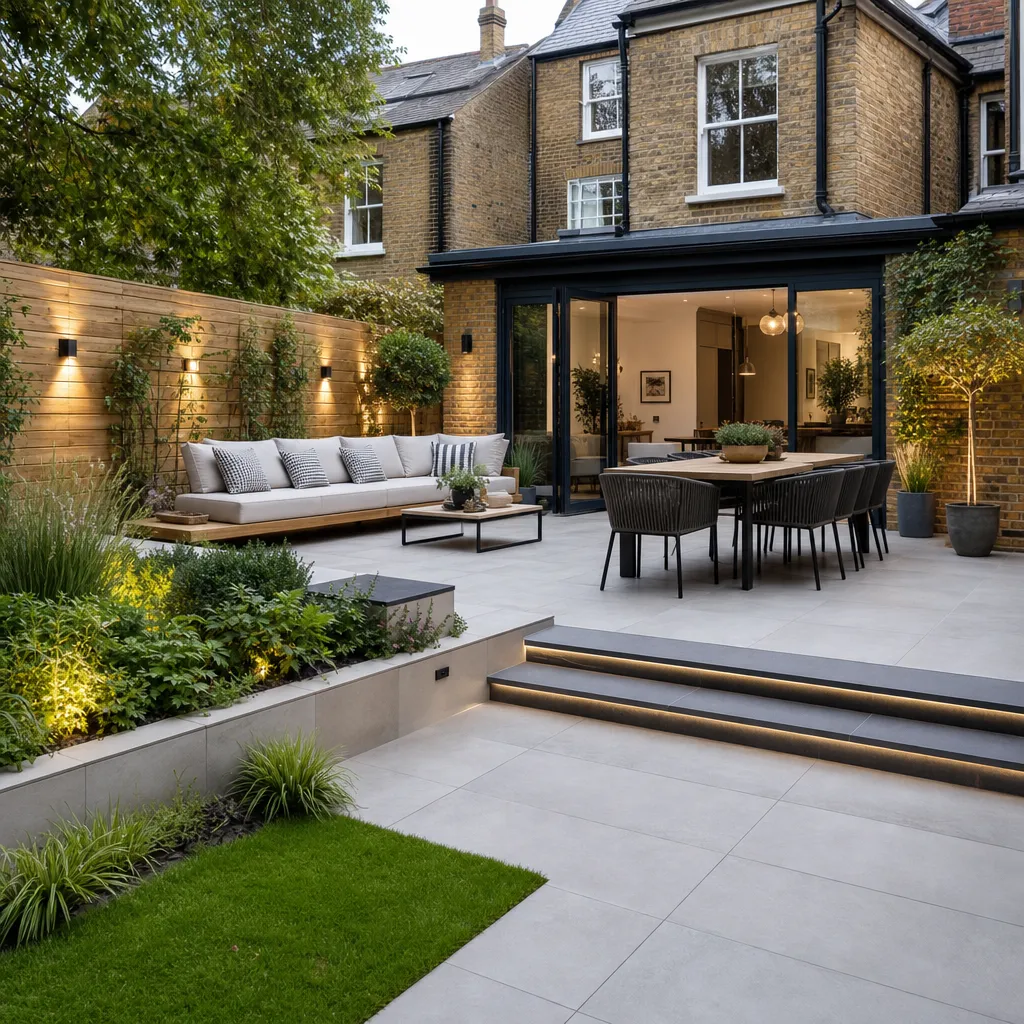
Creating Functional and Attractive Outdoor Entertainment Areas
A well-planned outdoor entertainment area combines a level surface — patio, decking, or gravel — shelter or shade, appropriate lighting, and power access if needed.
 Improvement & Build
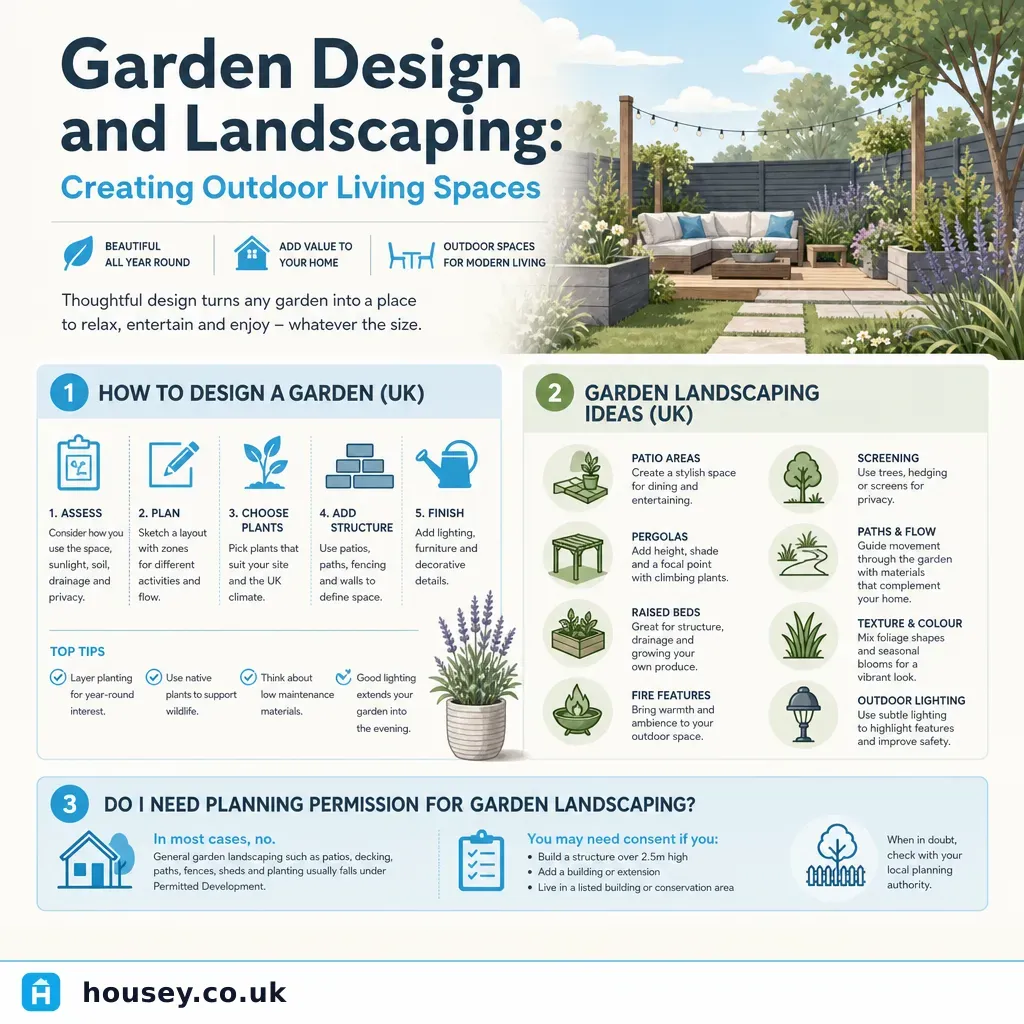
Garden Design and Landscaping: Creating Outdoor Living Spaces
Garden design creates functional outdoor living spaces through a combination of hard landscaping such as paving and decking, soft landscaping including planting and lawns, and structures such as pergolas or raised beds.
 Improvement & Build
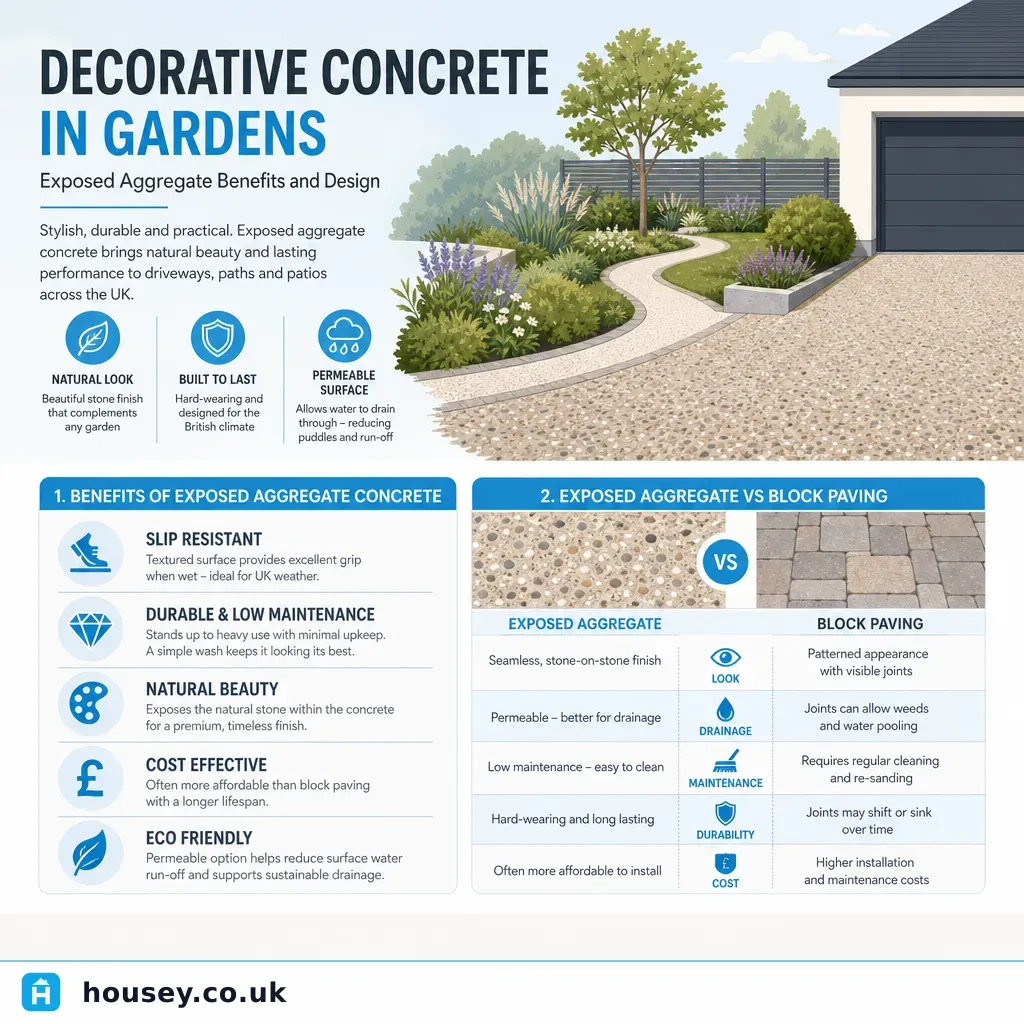
Decorative Concrete in Gardens: Exposed Aggregate Benefits and Design
Exposed aggregate concrete is a decorative hard-landscaping finish made by removing the surface cement paste to reveal the underlying stone.
 Improvement & Build
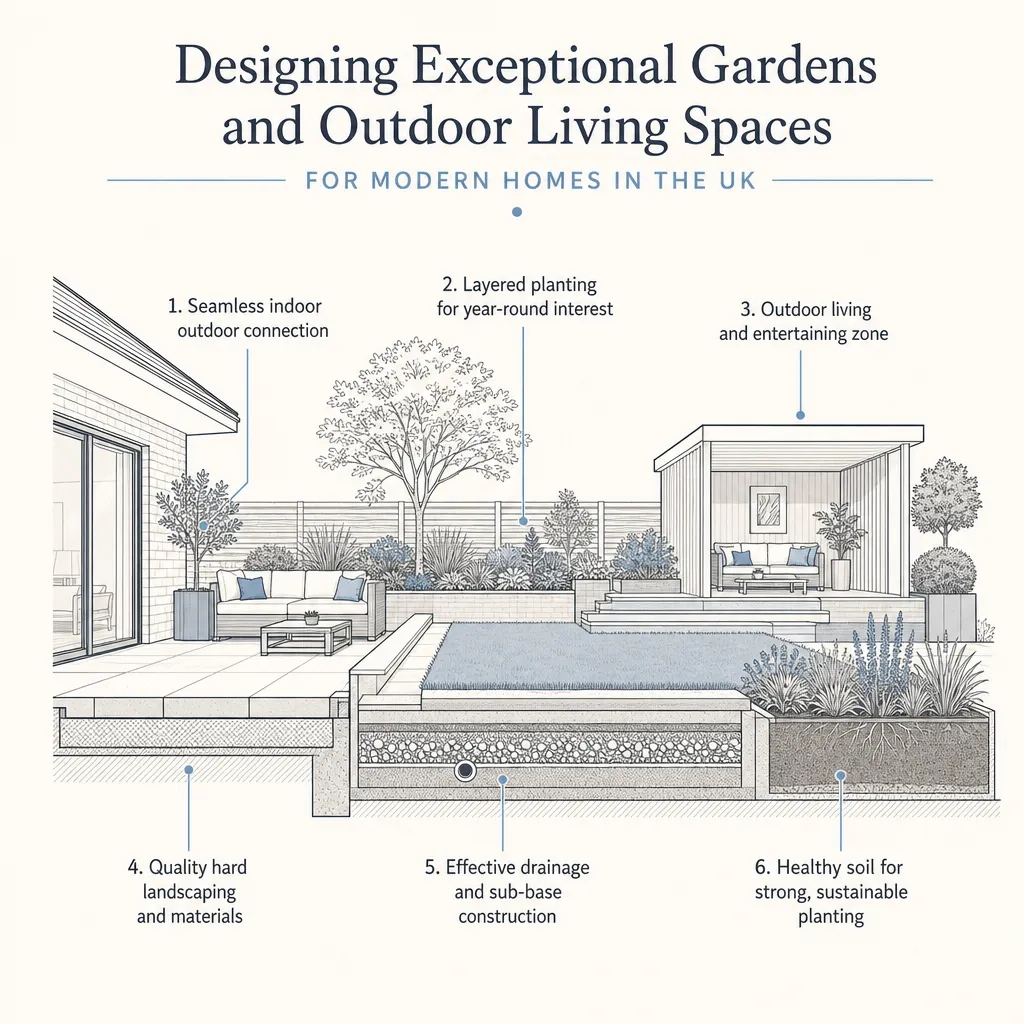
Designing Exceptional Gardens and Outdoor Living Spaces for Modern Homes
A well-designed garden blends practical zones — seating, lawn, planting, and hard landscaping — with your household's needs.
 Improvement & Build
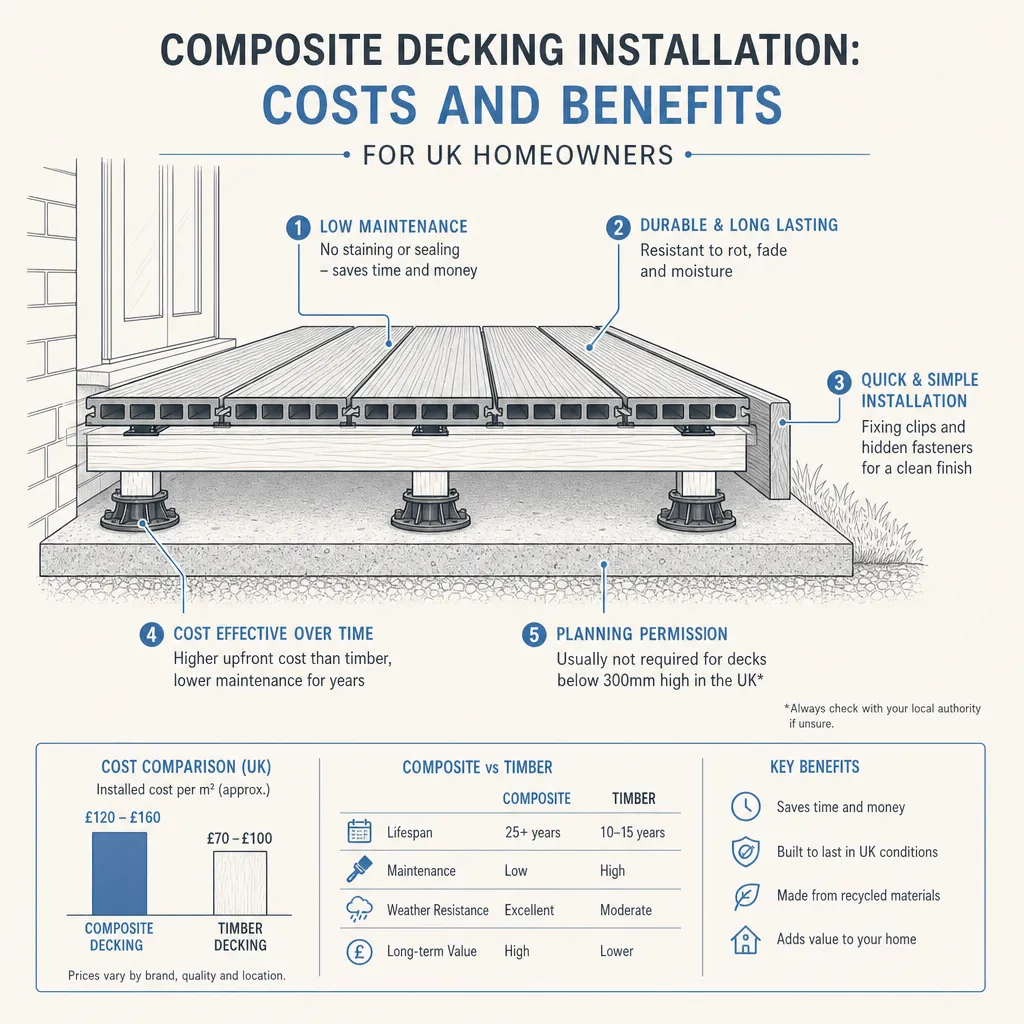
Composite Decking Installation: Costs and Benefits
Composite decking installation in the UK typically costs £100–£200 per square metre for supply and fit, depending on product grade and site complexity.