Composite Decking Installation: Materials and Costs
By Housey · Last reviewed 9th of May 2026
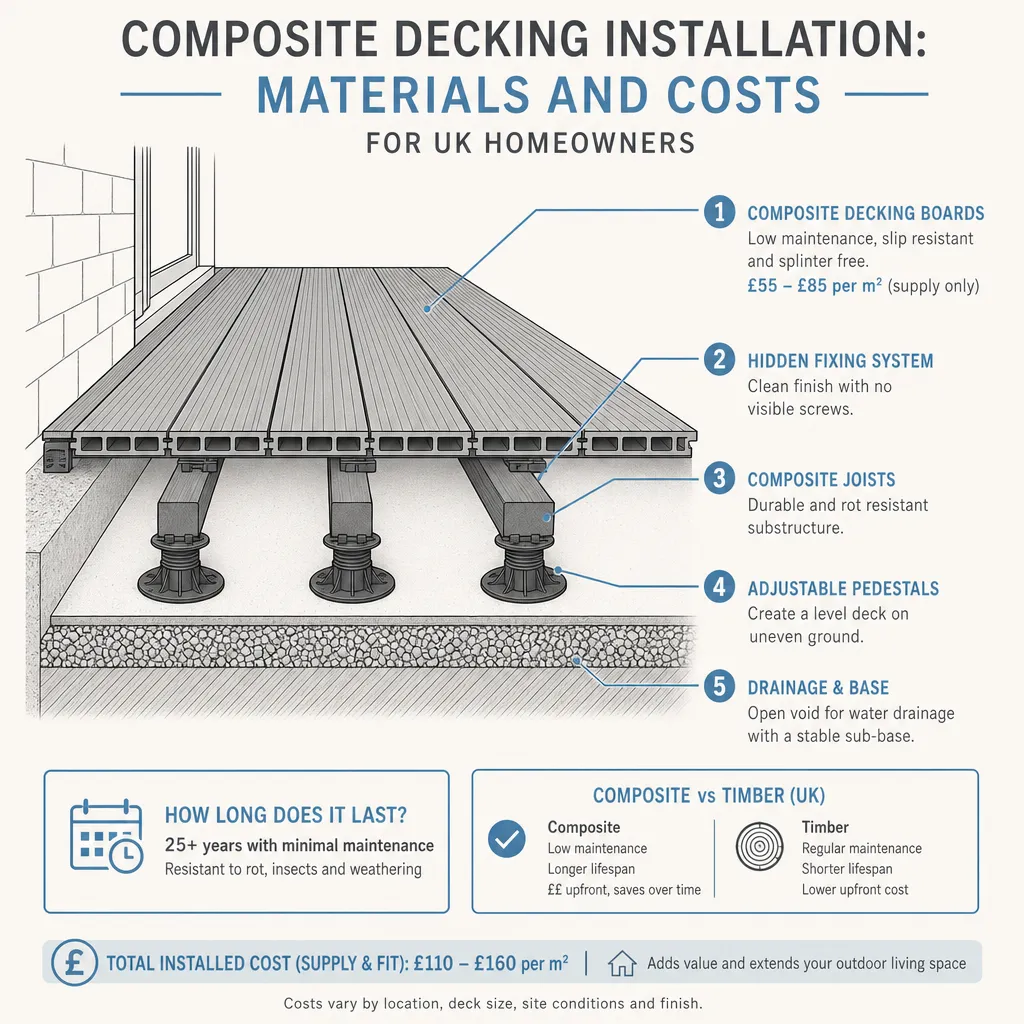
Composite Decking Installation: Materials and Costs
Composite decking has become one of the most popular garden upgrade choices for UK homeowners, particularly in north-facing or shaded gardens where softwood timber rots quickly in damp conditions. Whether you are replacing an ageing wooden deck or building from scratch on a new patio area, the material specification and installer you choose will significantly affect both your upfront budget and long-term satisfaction. Getting the details right before requesting quotes avoids costly revisions once work is underway.
Key points
- Composite decking typically costs £80–£200 per m² fully installed in the UK, depending on board grade, subframe material, and site conditions (Indicative UK costs, last reviewed 2026-05-09).
- Most composite boards carry 10–25 year manufacturer warranties against fading, splitting, and structural failure — considerably longer than pressure-treated softwood.
- Decking raised more than 300mm above ground level may require building regulations approval under Approved Document K (protection from falling).
- Hollow-core boards are lighter and cheaper; solid-core boards are more durable underfoot and better suited to high-traffic areas and heavy garden furniture.
- Composite boards containing ≥50% recycled content are widely available — check manufacturer specifications if environmental credentials matter to your project.
What is composite decking and how does it differ from timber?
Composite decking is manufactured from a blend of recycled wood fibre (typically 50–70%) and plastic polymers, usually PVC or polyethylene. Unlike pressure-treated softwood or hardwood, composite boards do not require annual oiling, staining, or sealing, and they resist moisture, mould, and insect damage more effectively in the UK's wet climate.
Timber decking costs less upfront — often £30–£80 per m² installed — but ongoing maintenance costs over 10 years typically close that gap considerably. A composite deck installed correctly should look similar after 15 years to how it looked on day one. Untreated or poorly maintained softwood will discolour and splinter within three to five years in a typical UK garden.
Feature | Composite | Pressure-treated timber | Hardwood (e.g. Ipe) |
|---|---|---|---|
Upfront installed cost (per m²) | £80–£200 | £30–£80 | £100–£250 |
Annual maintenance | Low (clean only) | Moderate (oil/treat) | High (oil annually) |
Typical lifespan | 20–30 years | 10–15 years | 25–40 years |
Slip resistance (wet) | Good (grooved boards) | Variable | Variable |
Sustainability credentials | Recycled content available | FSC-certified options | FSC-certified options |
Best for | Low-maintenance gardens, shaded areas | Budget-conscious projects | Premium aesthetics |
How much does composite decking cost in the UK?
Costs vary considerably depending on board grade, subframe specification, deck size, access, and regional labour rates. The figures below are indicative; always request itemised quotes from at least three installers.
Board supply costs only (per m², common UK grades):
- Entry-level hollow-core composite: £20–£45 per m²
- Mid-range solid-core composite: £45–£80 per m²
- Premium capped composite (e.g. Millboard, Trex, Cladco): £80–£150 per m²
Fully installed costs (supply + labour + subframe):
- Small deck (up to 20 m²): £1,800–£4,500 total
- Medium deck (20–40 m²): £2,500–£7,500 total
- Large deck (40 m²+): £4,000–£12,000+
Indicative UK costs, last reviewed 2026-05-09. Quotes vary by region, installer, ground conditions, and material choice.
Key cost drivers to discuss with your installer:
- Ground preparation: uneven or sloped ground increases subframe complexity and labour time
- Subframe material: aluminium subframes are more durable than treated timber but command a premium of £10–£20 per m²
- Steps, balustrades, and integrated lighting all add to the total and should be specified upfront
- Removal and disposal of existing decking or hard landscaping
Worked UK scenario: replacing a 25 m² timber deck in a Victorian terrace garden
A homeowner in Birmingham is replacing a 25 m² pressure-treated softwood deck at the rear of a Victorian terrace. The existing deck is at near-ground level on reasonably flat ground. They choose a mid-range solid-core composite board with a treated timber subframe.
- Board supply (mid-range solid-core at £55/m²): approximately £1,375
- Treated timber subframe, joists, and fixings: approximately £500
- Labour (two days, two-person team): approximately £800–£1,000
- Removal of old deck and skip hire: approximately £200–£350
- Estimated total: £2,875–£3,225
If the same homeowner upgraded to a premium capped board (e.g. Millboard at £120/m²) with an aluminium subframe, the total might reach £4,500–£5,500. Getting three itemised quotes is the most reliable way to benchmark pricing for a specific site, as labour rates and material availability vary across UK regions.
Does composite decking need planning permission?
In most cases, composite decking at ground level or low rise does not require planning permission in England, provided:
- The deck is no higher than 300mm at its highest point above the existing ground level.
- It does not cover more than 50% of the total garden area.
- The property is not a listed building or within a conservation area.
- The deck is positioned to the rear of the property — front garden decking is subject to stricter permitted development rules.
If your deck will be raised above 300mm, building regulations under Approved Document K may apply, particularly regarding balustrade height (minimum 1,100mm for platforms above 600mm) and structural loading of the subframe. Always check with your local planning authority before starting work — rules can vary depending on location and property history, and enforcement risk for non-compliant structures is real. GOV.UK guidance on when planning permission is required is a reliable starting point.
Choosing a composite decking board: what to look for
Capped vs uncapped: Capped composite boards have a protective polymer coating on all four sides (or at minimum the top face and sides), making them more resistant to staining, fading, and moisture ingress at cut ends. Uncapped boards are cheaper but may show more wear over time in exposed UK conditions. For most residential gardens, capped boards are the better long-term choice.
Hollow vs solid core: Hollow-core boards are lighter and adequate for most domestic use. Solid-core boards handle heavy furniture, frequent foot traffic, and commercial settings better. If you plan to use heavy planters or the deck will be a primary outdoor entertaining space, solid-core is worth the additional cost per m².
Grooved vs smooth finish: Grooved boards offer better wet-weather grip — important in the UK climate. Smooth boards look more contemporary but can be slippery when wet. Check the Pendulum Test Value (PTV) rating before selecting; a PTV of 36 or above is generally considered slip-resistant for pedestrian use.
Homeowner checklist before requesting composite decking quotes
When to get professional help
Most composite decking is installed by landscapers or specialist decking contractors rather than general builders. Professional involvement is particularly important when:
- The deck is elevated more than 300mm, requiring engineered subframe design and potentially building regulations sign-off under Approved Document K.
- The garden has significant slope or uneven ground requiring groundworks prior to installation.
- You want integrated balustrades, steps, or lighting, which increase the technical complexity of the project.
- You are uncertain whether planning permission or building regulations apply to your specific property.
Always check that your installer holds relevant accreditations such as TrustMark registration or FMB membership, and ask for references or photos from completed composite decking projects before committing.
How Housey can help
Housey connects UK homeowners with vetted local professionals for garden and outdoor improvement projects. If you are ready to get quotes, you can request quotes from local landscapers or find a garden designer to help plan and specify your outdoor space before committing to a build.
Frequently asked questions
How long does composite decking last in the UK?
Most reputable composite decking brands carry warranties of 10–25 years against fading, splitting, and structural failure. With correct installation — particularly a well-ventilated subframe and appropriate board expansion gaps — a quality composite deck can perform well for 20–30 years in the UK climate. Always check the specific warranty terms before purchasing, as coverage varies considerably between brands and board grades.
Does composite decking get hot in the sun?
Composite decking can become warmer to the touch than timber in direct sunlight, particularly with darker-coloured boards. Premium capped boards from brands such as Millboard and Trex have improved heat-dissipation properties. If you have young children or pets using the deck regularly, lighter-coloured boards and partially shaded areas are worth factoring into your specification.
Can I install composite decking myself?
Many manufacturers supply DIY-friendly systems with clip-fixing profiles and detailed installation guides. However, ground preparation, subframe construction, and achieving correct drainage falls are technically demanding. A poorly constructed subframe is the most common cause of long-term composite decking problems. For raised decks, or where building regulations may apply, professional installation is strongly advisable.
Is composite decking slippery when wet?
Grooved composite boards with a textured surface generally perform well in wet conditions. A Pendulum Test Value (PTV) rating of 36 or above indicates adequate slip resistance for pedestrian use. Smooth-finish boards can be more slippery when wet. Always check the manufacturer's PTV rating before selecting a board for a UK garden, where wet weather is frequent.
Do I need building regulations approval for composite decking?
Building regulations under Approved Document K may apply if your deck is raised above 300mm, particularly regarding balustrade height (minimum 1,100mm for platforms above 600mm) and structural loading. Decking at or near ground level typically does not require building regulations sign-off, but rules can vary by local authority. Always check before starting work.
Sources and further reading
- When is Planning Permission Required? — GOV.UK
- Approved Document K: Protection from Falling, Collision and Impact — Ministry of Housing, Communities & Local Government
- TrustMark: Find a Trustworthy Tradesperson — TrustMark
- Planning Portal: Outbuildings and Decking — Planning Portal
Useful next reads
 Improvement & Build
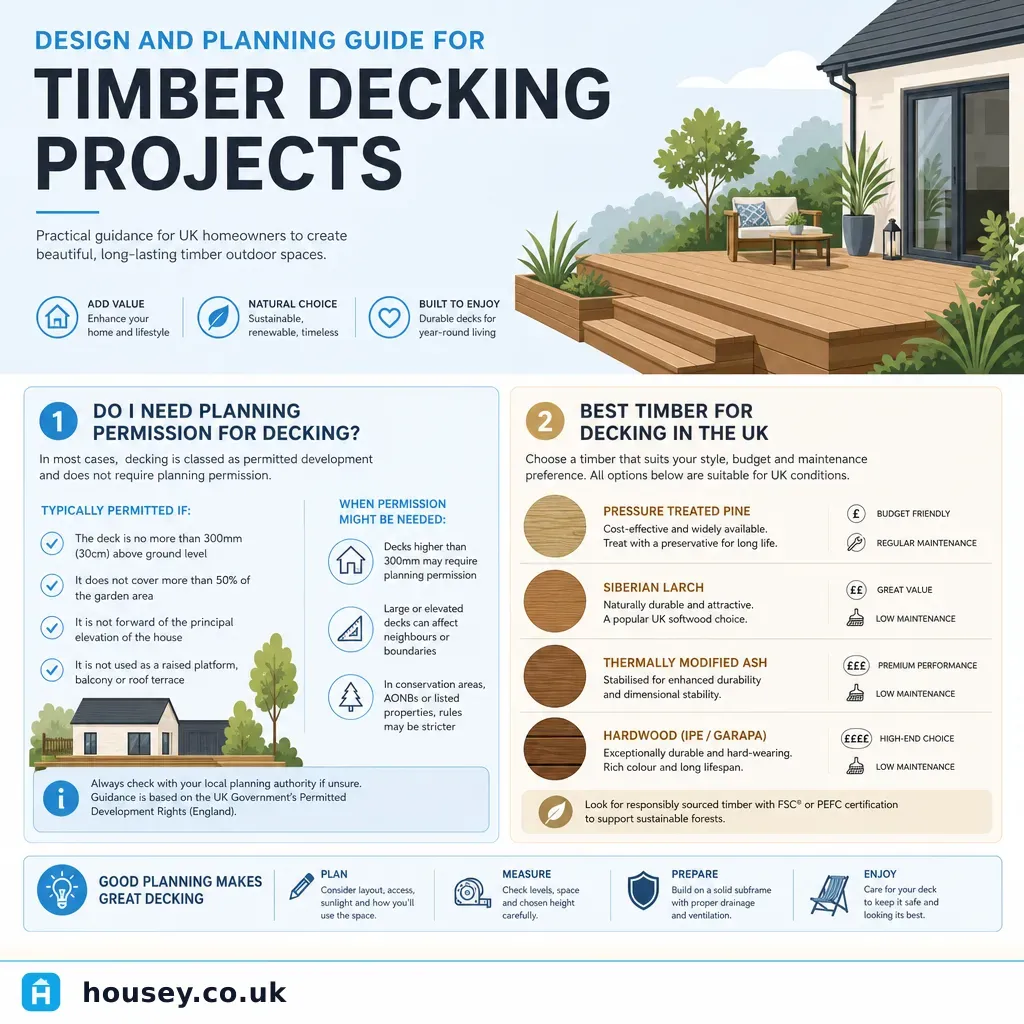
Design and Planning Guide for Timber Decking Projects
Planning a timber deck in the UK involves checking permitted development rules — in England, a deck under 300mm high that covers no more than 50% of the garden (combined with other outbuildings) is usually permitted development.
 Improvement & Build
Designing an outdoor kitchen for entertaining and garden living
An outdoor kitchen in a UK garden needs a stable, level base — typically a concrete slab or quality paving — with weather-rated materials such as stainless steel grade 316 or frost-rated porcelain.
 Improvement & Build
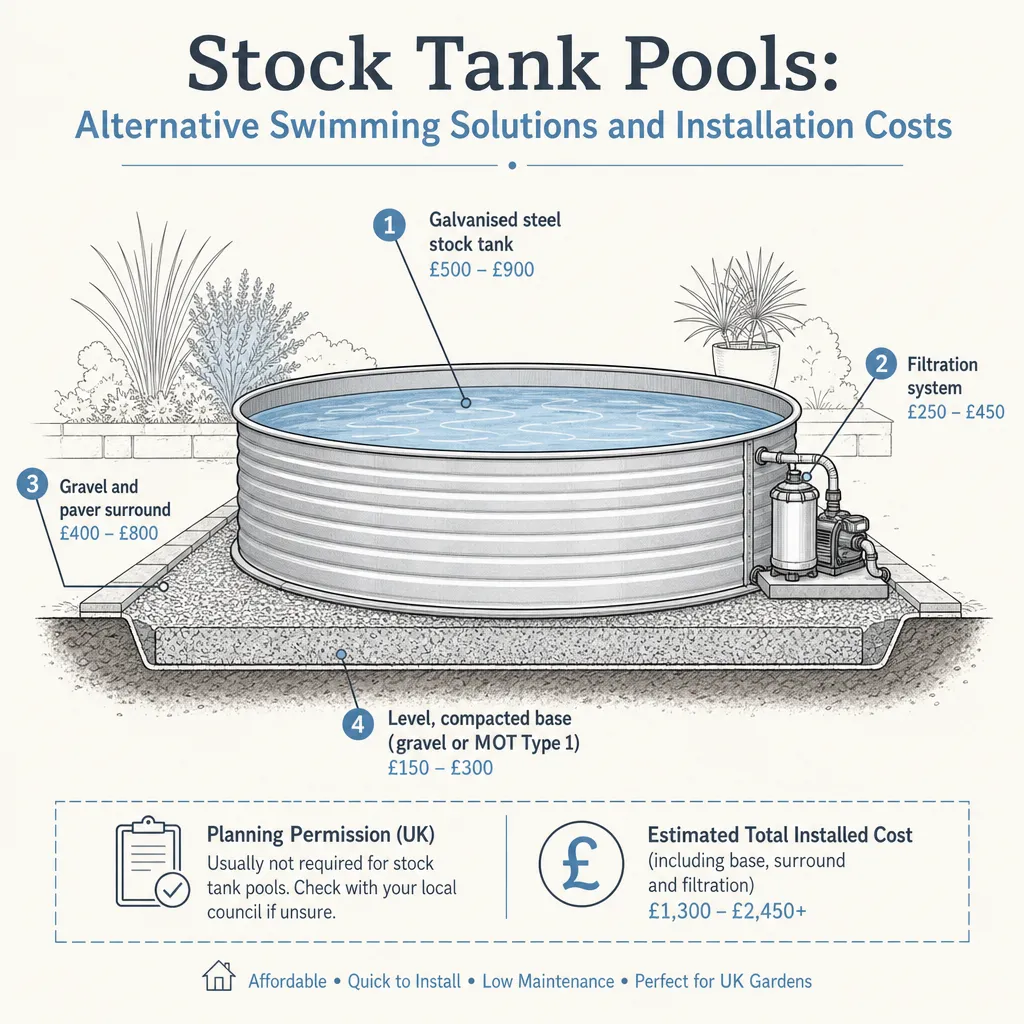
Stock Tank Pools: Alternative Swimming Solutions and Installation Costs
A stock tank pool is a galvanised steel agricultural trough repurposed as a garden plunge or swimming pool.
 Improvement & Build
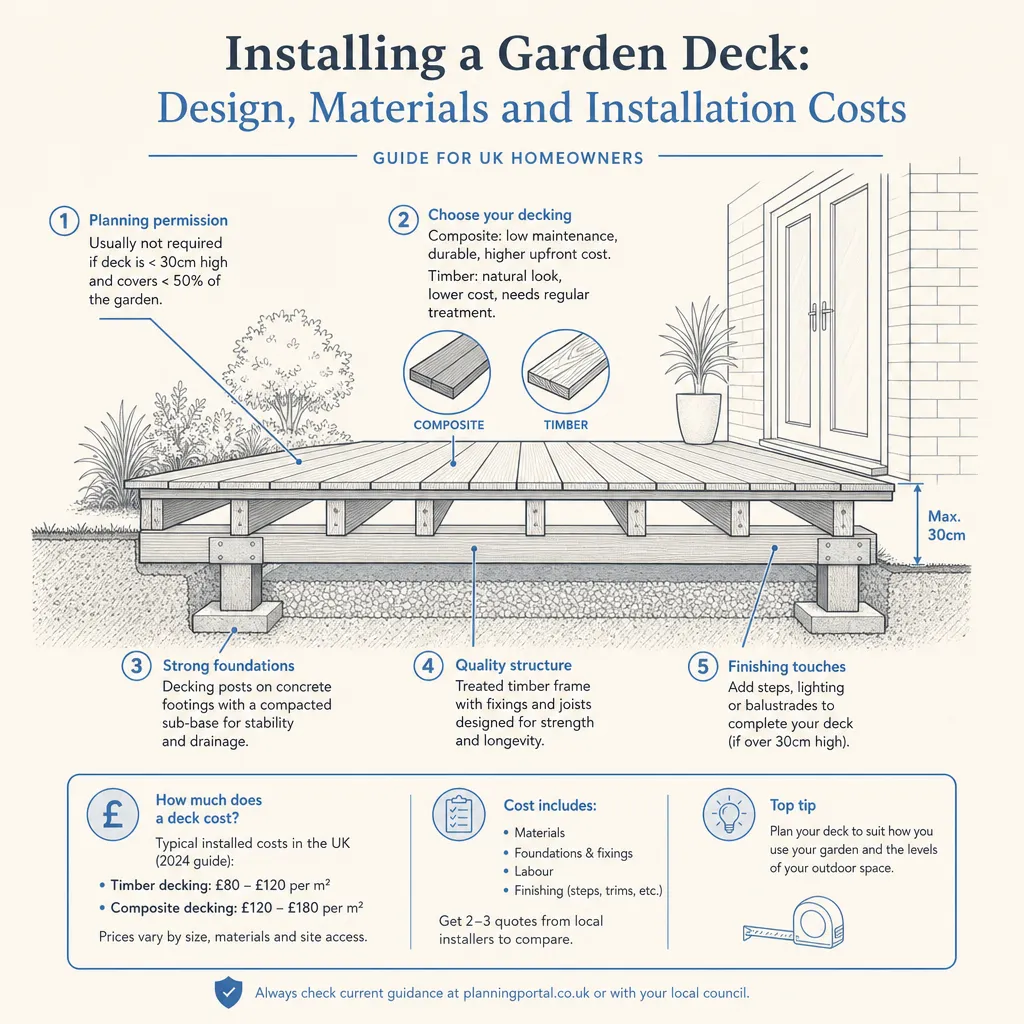
Installing a Garden Deck: Design, Materials and Installation Costs
Garden decking costs £80–250 per m² installed in the UK depending on material — softwood is cheapest, composite the most durable.
 Improvement & Build
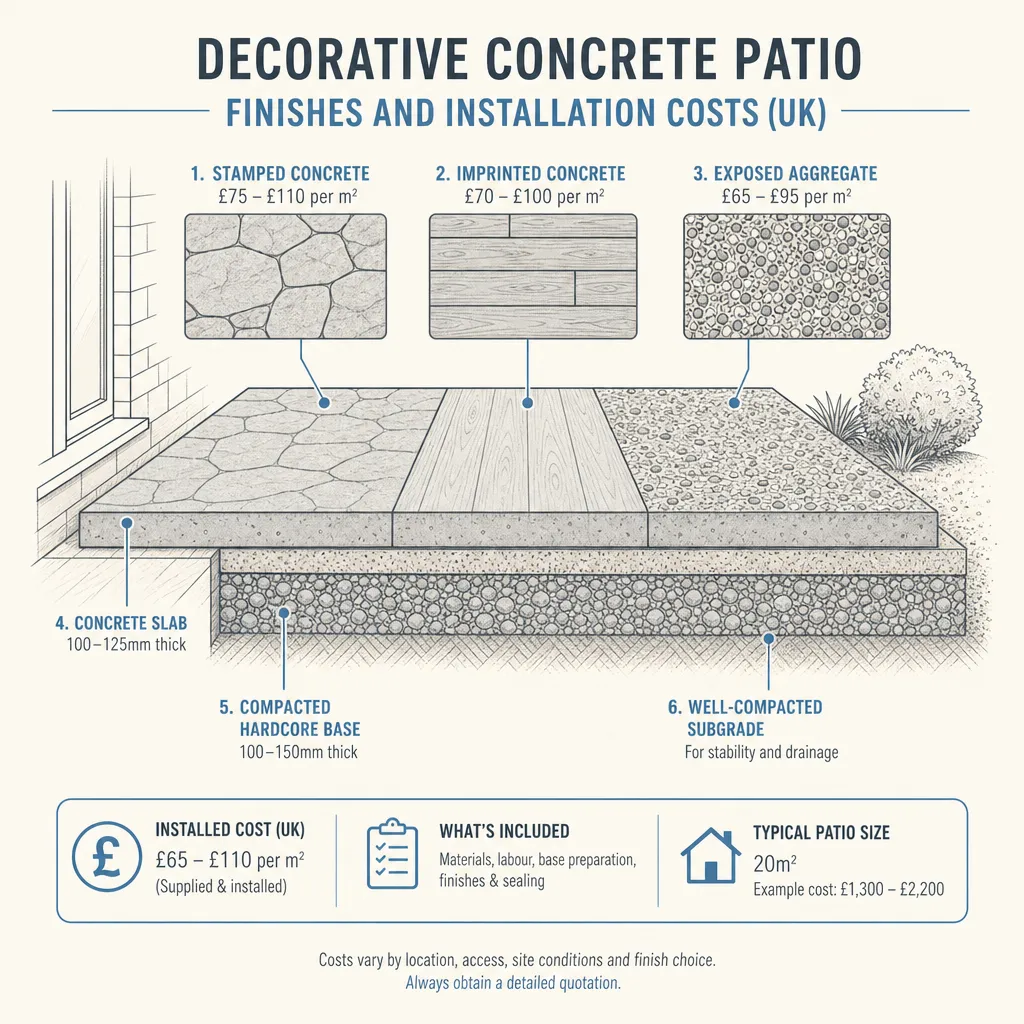
Decorative concrete patio finishes and installation costs
A decorative concrete patio costs roughly £80–£200+ per square metre in the UK, depending on the finish — from brushed concrete to stamped, exposed aggregate, or stencilled designs.