Structural Engineering Consultation and Survey Costs
By Housey · Last reviewed 11th of May 2026
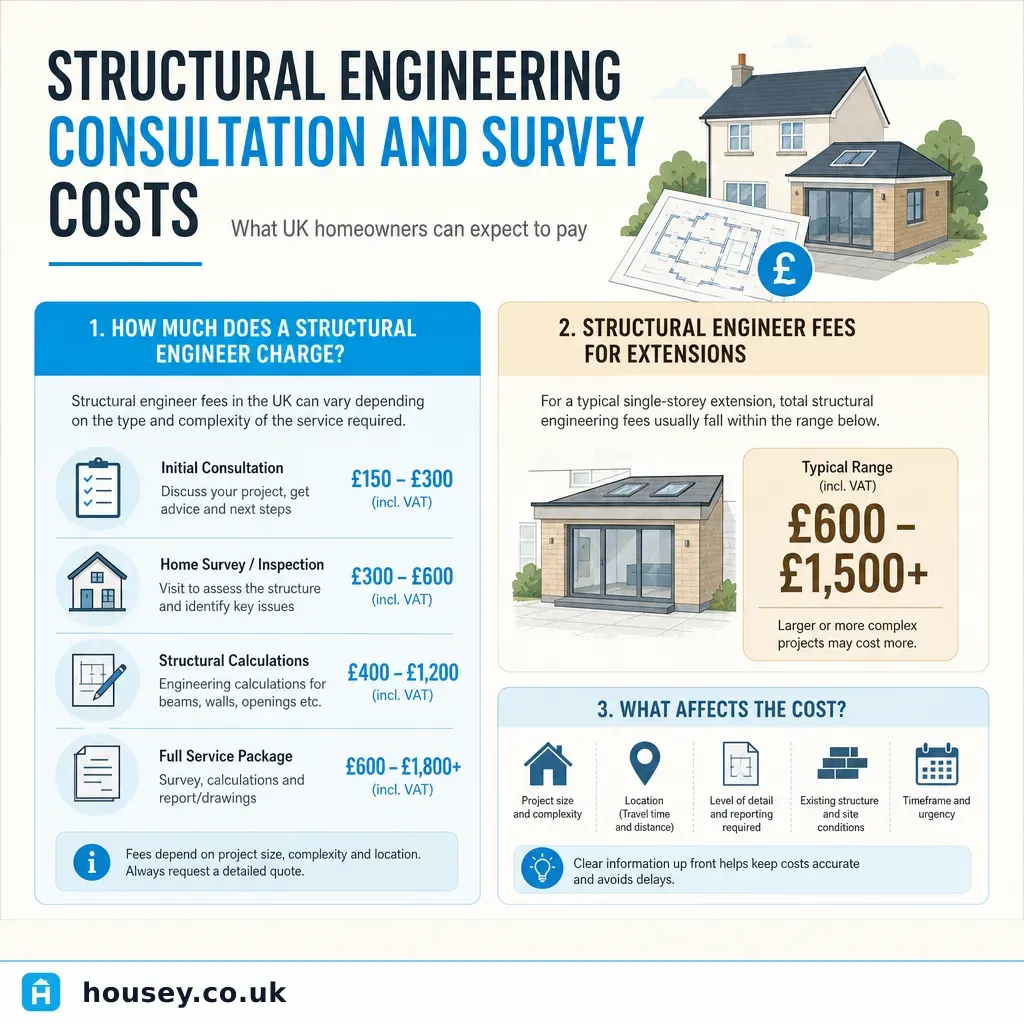
Structural Engineering Consultation and Survey Costs
Questions about structural engineering fees tend to arise at moments of uncertainty — a crack has appeared in a wall, an extension is being planned, a surveyor has recommended further investigation, or a lender has flagged a structural issue. Knowing what a structural engineer actually charges, what different types of instruction include, and when an engineer is the right professional rather than a chartered building surveyor or architect, helps homeowners commission the right service without paying for more than they need — or less than is safe.
Key points
- Structural engineering fees in the UK are not regulated; engineers set their own rates and fees vary by professional experience, location, project complexity, and scope of deliverables.
- A chartered structural engineer should hold membership of IStructE (Institution of Structural Engineers) or ICE (Institution of Civil Engineers) and must carry professional indemnity insurance — always verify credentials before instructing.
- Building Regulations Approved Document A (Structure) requires structural calculations to be submitted to building control for most extensions, loft conversions, and structural alterations, including load-bearing wall removals.
- A defect report for a specific concern — crack, suspected subsidence, sagging floor — typically costs £300–£800 including a site visit and written report; full structural design for a single-storey extension typically costs £800–£2,000.
- Structural engineer hourly rates in the UK typically range from £75 to £200 per hour depending on experience and location, with London and South East rates generally 15–30% above national averages.
What does a structural engineer actually do?
Structural engineers assess, design, and certify the structural integrity of buildings and civil structures. For residential homeowners, the most common instructions fall into three categories:
Defect investigation and report: The engineer inspects a specific concern — a crack, suspected subsidence, a sagging floor, a failing lintel — and produces a report with findings, likely cause, and recommended remediation. This is the most common residential instruction.
Structural design for building works: The engineer produces structural calculations and drawings for proposed works — a single-storey extension, a loft conversion, a load-bearing wall removal, or a steel beam installation. These documents are submitted to building control as part of a Building Regulations application.
Pre-purchase structural assessment: Commissioned alongside or following a RICS Level 2 or Level 3 survey when a structural concern has been identified and needs engineering-level opinion before exchange of contracts.
How much does a structural engineer cost in the UK?
Indicative UK costs, last reviewed 2026-05-11. Fees vary substantially by region, engineer experience, and project complexity. Always obtain at least three quotes.
Instruction type | Typical fee range | What is typically included |
|---|---|---|
Single-property defect report (crack, movement, lintel) | £300–£800 | Site visit, written report, findings and recommendations |
Pre-purchase structural assessment | £400–£900 | Site visit, written assessment, opinion on risk and urgency |
Structural calculations for single-storey extension | £800–£2,000 | Calculations for building control, beam sizes, foundation design |
Loft conversion structural design | £1,000–£2,500 | Calculations, steel sizing, party wall structural details if required |
Load-bearing wall removal (beam design) | £600–£1,500 | Calculations, beam specification, pad stone detail |
Full new-build residential structural design | £3,000–£10,000+ | Full structural package, site inspections, building control liaison |
Structural engineer vs building surveyor vs architect: who do you need?
Scenario | Most likely professional | Why |
|---|---|---|
Crack in external brickwork, uncertain cause | Structural engineer | Engineering diagnosis of cause and structural risk |
General survey before buying a property | RICS Level 2 or Level 3 building surveyor | Overall condition assessment; may flag need for engineer if structural concern is found |
Planning and design of an extension or loft | Architect (who may also appoint structural engineer) | Design, planning, and coordination; structural engineer provides the structural package |
Removing a load-bearing wall | Structural engineer (direct or via architect) | Structural calculations required for building control under Part A |
Subsidence or ground movement | Structural engineer, possibly geotechnical engineer | Soil and structural assessment needed to diagnose cause |
Damp, leaks, or general defects (non-structural) | Building surveyor or specialist damp surveyor | Condition, cause, and repair specification |
Extension structural calculations for building control | Structural engineer | Only a suitably qualified engineer can certify Part A structural compliance |
What affects structural engineering fees?
Project complexity and scope
A single steel beam calculation for a kitchen knock-through takes far less engineer time than a loft conversion with a complex hip roof, a party wall to consider, and a defective existing foundation. Scope of work is the primary fee driver. Always agree the scope in writing before instructing.
Site visits and access
Most residential instructions include one site visit. Projects requiring multiple visits — phased inspections during construction, return visits after remediation, or complex multi-storey properties — will cost more. Some engineers charge separately for additional visits; clarify this when requesting a quote.
Deliverables required
A written opinion letter costs less than a formal report with drawings and building control certificates. If building control requires stamped structural drawings or a structural warranty, this adds engineer time and therefore cost.
Location
Engineers in London and the South East charge higher rates. Rural locations with limited local coverage may also result in travel premiums. When comparing quotes, check whether travel time and mileage are included.
Speed of service
Urgent turnaround — a report needed within 48–72 hours for a conveyancing chain — usually attracts a premium of 20–50% above standard rates. Budget for this if you are working to a tight exchange deadline.
A worked example: buying a 1930s semi with a wall crack
Sarah is buying a 1930s semi-detached house in Manchester. During the RICS Level 3 survey, the surveyor flags a stepped crack in the rear external wall running diagonally through the brickwork and recommends a structural engineer's assessment before exchange.
Sarah commissions a structural engineer for a defect report. The engineer visits the property, inspects the crack pattern and surrounding brickwork, checks internal ceiling and floor levels for distortion, and reviews whether the crack is live or historic. The report concludes the crack is historic, most likely caused by thermal movement and minor differential settlement, with no evidence of ongoing movement. Remediation is cosmetic repointing only.
Fee: £450 including site visit and written report. Turnaround: 5 working days.
Exchange proceeded. The engineer's report was shared with both solicitors and the mortgage lender, who was satisfied with the conclusion.
This is a worked example using a realistic UK property scenario to illustrate a typical instruction; individual cases will differ in scope, findings, and cost.
Important limitations
Structural engineering covers a wide range of technical disciplines and property types. The fee ranges in this article are indicative only, based on publicly available guidance and industry norms; actual fees may differ materially from those shown. Structural advice must be tailored to the specific property, ground conditions, construction method, and nature of the works. Nothing in this article constitutes structural engineering or legal advice. Always instruct a suitably qualified engineer — preferably a chartered member of IStructE or a chartered civil engineer (CEng) with relevant residential experience — for any structural matter.
What to ask a qualified professional
Before instructing a structural engineer:
- Are you a chartered member of IStructE or ICE, and do you have experience with this type of property and defect?
- Do you hold professional indemnity insurance, and what is the level of cover?
- Is your fee fixed for the agreed scope, or hourly? What triggers a fee increase?
- Will you be carrying out the site visit personally, or will a junior engineer attend?
- What will the report or calculations include, and will they be accepted by my building control body?
- How long will the report or calculations take to produce?
- If additional issues are discovered during the inspection, how will you handle the additional scope and cost?
When to get professional help
Instruct a structural engineer — or ask your surveyor or architect to recommend one — when:
- A crack is widening, stepped through brickwork, or accompanied by sticking doors or windows.
- A floor is noticeably bouncing, sagging, or uneven across a significant span.
- You are planning to remove a wall and are uncertain whether it is load-bearing.
- A RICS Level 2 or Level 3 survey recommends further structural investigation before exchange.
- A lender or insurer has raised a structural concern as a condition of offer.
- You are planning any extension, loft conversion, or structural alteration requiring Building Regulations Part A compliance.
- There is evidence of subsidence, ground movement, or tree root damage near the foundations.
How Housey can help
Housey connects homeowners and self-builders with qualified structural engineers who can provide defect reports, pre-purchase assessments, and full structural design for extensions and conversions. Request quotes, compare fees and credentials, and find an engineer with experience in your property type.
Frequently asked questions
Do I need a structural engineer or a building surveyor?
A building surveyor — particularly a RICS Level 3 chartered surveyor — provides a broad assessment of the property's overall condition and will identify structural concerns. A structural engineer provides an engineering diagnosis and, where required, certified calculations for building control. For a pre-purchase inspection, start with a RICS Level 3 survey; the surveyor will recommend an engineer if needed. For a specific defect diagnosis or building control compliance, instruct a structural engineer directly.
Can a structural engineer sign off a party wall agreement?
No. A party wall agreement under the Party Wall etc. Act 1996 is administered by a party wall surveyor — typically a chartered building surveyor or architect acting in that role. A structural engineer may provide structural details that inform a party wall award, but the agreement itself is a legal document requiring a separately instructed party wall professional. The two roles are distinct and should not be confused.
How long does a structural engineer's report take?
For a standard residential defect report, most engineers complete a written report within five to ten working days of the site visit. Urgent instructions, sometimes needed in conveyancing chains, can be turned around in 48 to 72 hours at a premium. Structural calculations for a building control submission typically take two to four weeks, depending on workload and project complexity.
Is a structural engineer's report required for a mortgage?
Not routinely. However, if a surveyor or valuer has flagged a structural concern, a mortgage lender may require a structural engineer's report before releasing funds. The lender will usually specify the scope they require. Your solicitor or mortgage broker can clarify exactly what the lender needs, and some insurers also require structural sign-off before offering buildings cover on certain property types.
Sources and further reading
- Institution of Structural Engineers — Find an Engineer — IStructE
- Building Regulations Approved Document A — Structure — GOV.UK
- RICS — consumer guidance on surveys — RICS
- Party Wall etc. Act 1996 — legislation.gov.uk
- Local Authority Building Control — LABC
Useful next reads
 Planning & Pre-Build
Structural Engineer versus Architect: Key Differences and When to Engage Each
Architects design spaces, manage planning applications, and coordinate construction contracts.
 Planning & Pre-Build
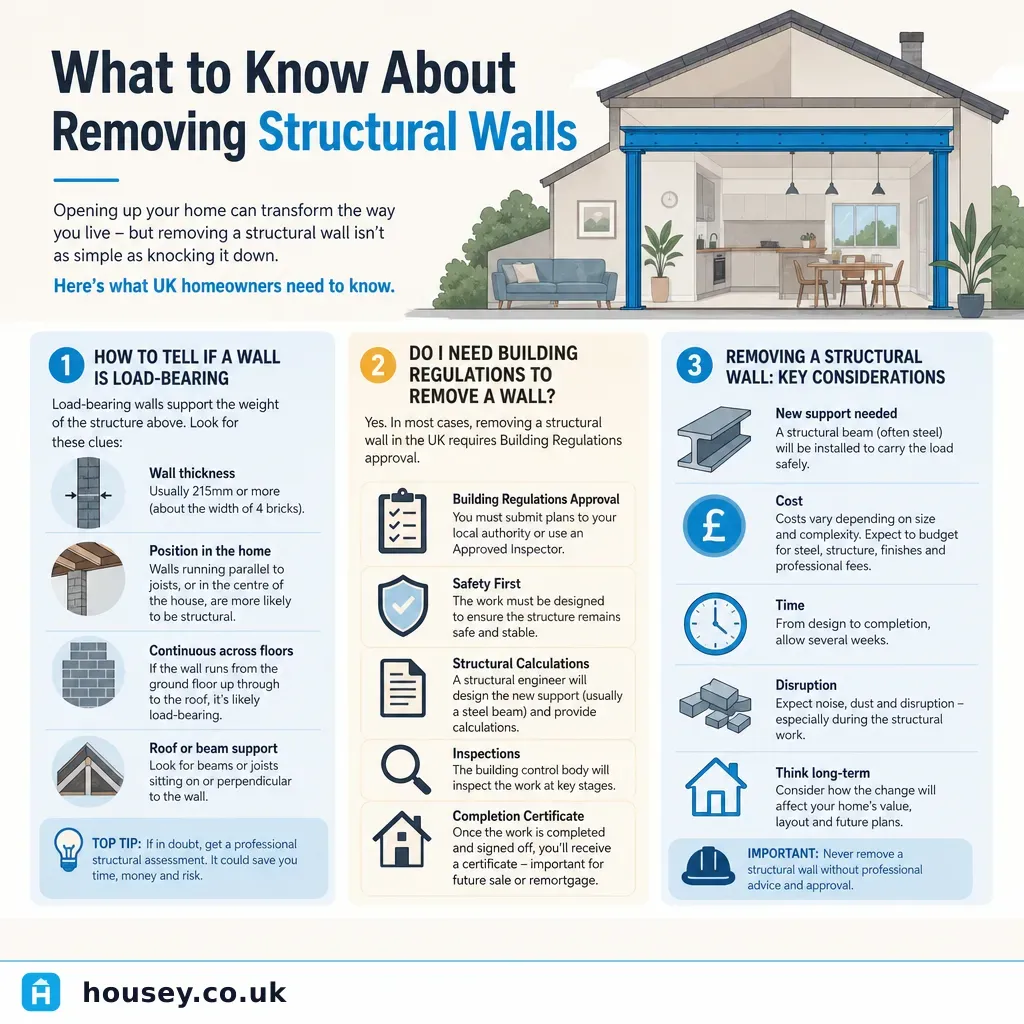
What to Know About Removing Structural Walls
Removing a structural or load-bearing wall in a UK home requires a structural engineer's assessment, a correctly specified steel beam (RSJ), and Building Regulations approval.
 Planning & Pre-Build
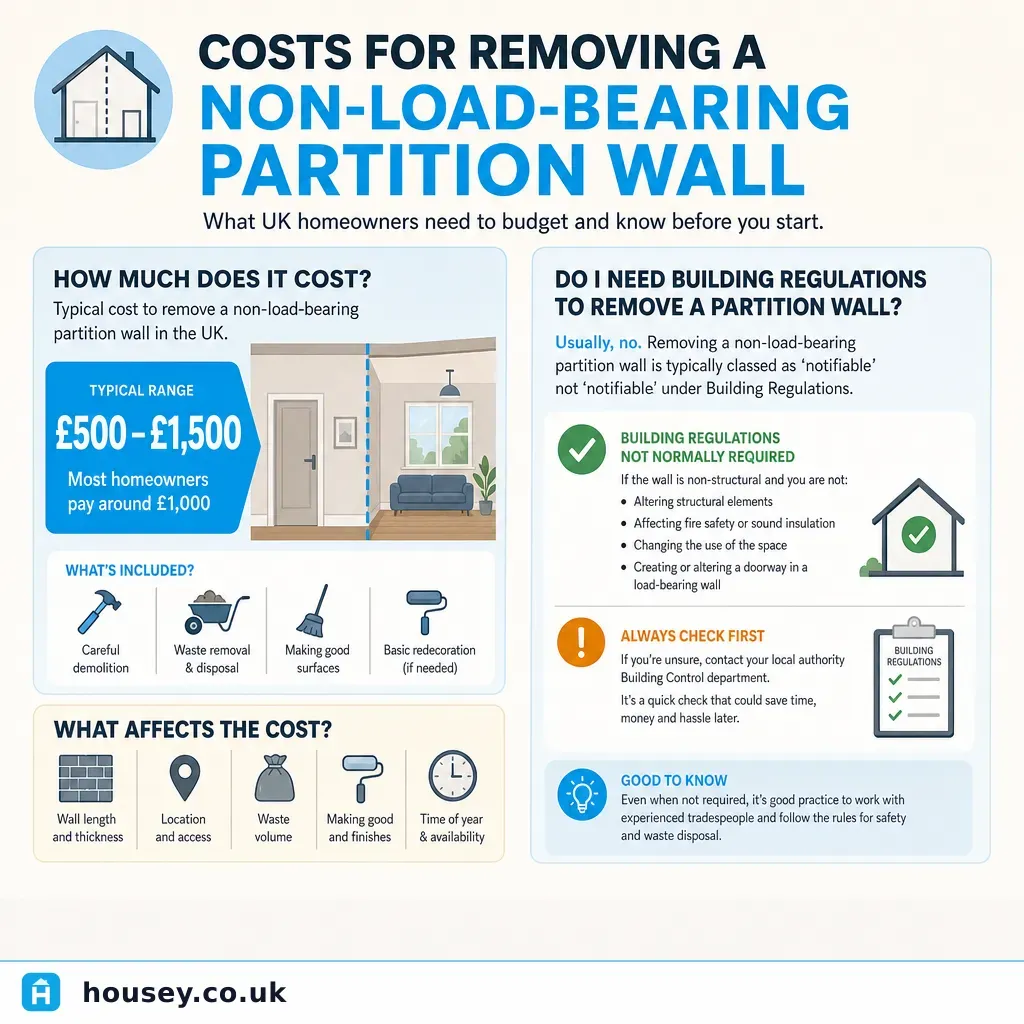
Costs for removing a non-load-bearing partition wall
Removing a non-load-bearing partition wall in a UK home typically costs £300–£1,500 in labour, plus £200–£600 or more for replastering and making good.
 Planning & Pre-Build
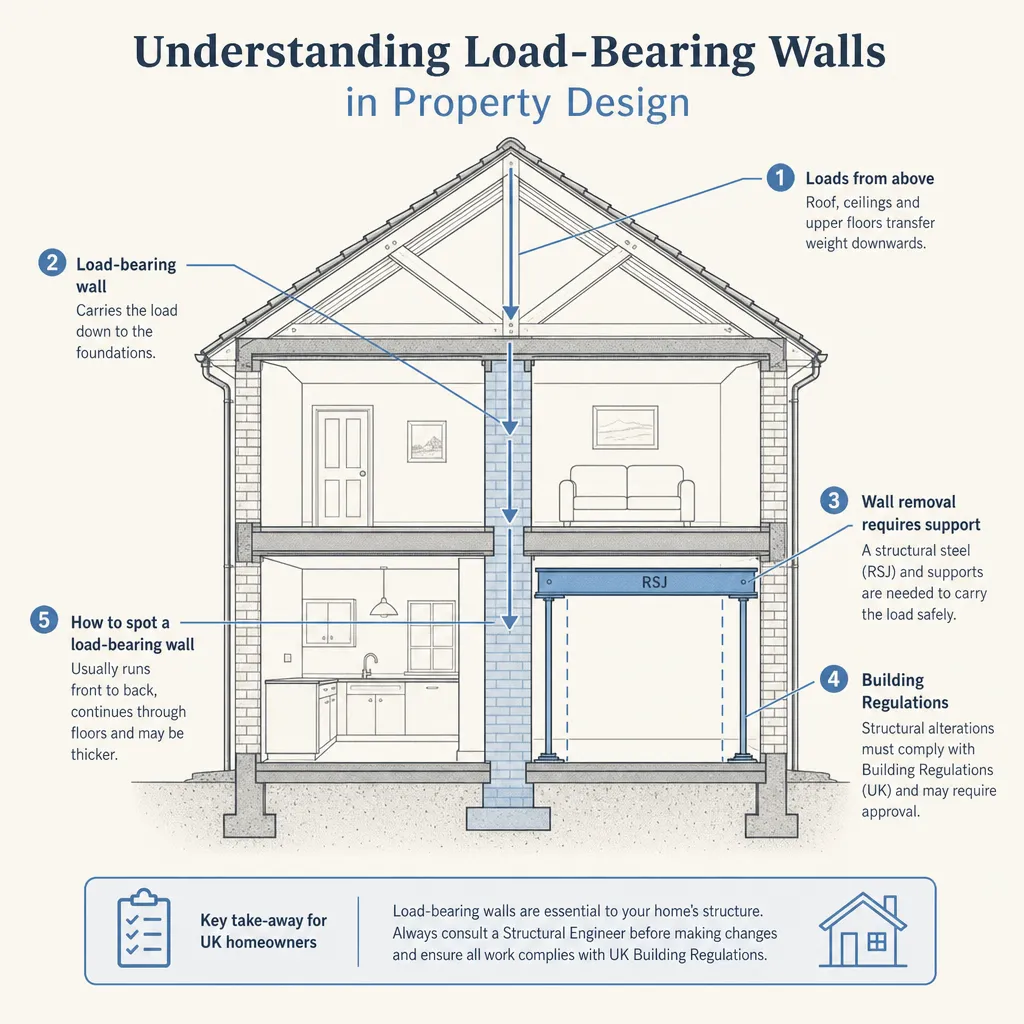
Understanding Load-Bearing Walls in Property Design
A load-bearing wall carries the weight of floors, roofs, or other walls above it down to the foundations.
 Planning & Pre-Build
Building Climate-Resilient Homes: Design and Energy Strategies
A climate-resilient UK home handles hotter summers, wetter winters, and rising energy costs through high-performance insulation, overheating mitigation, flood-resilient construction, low-carbon heating, and good water management.