Overhang Finishes for Earth-Sheltered Residential Design
By Housey · Last reviewed 25th of May 2026
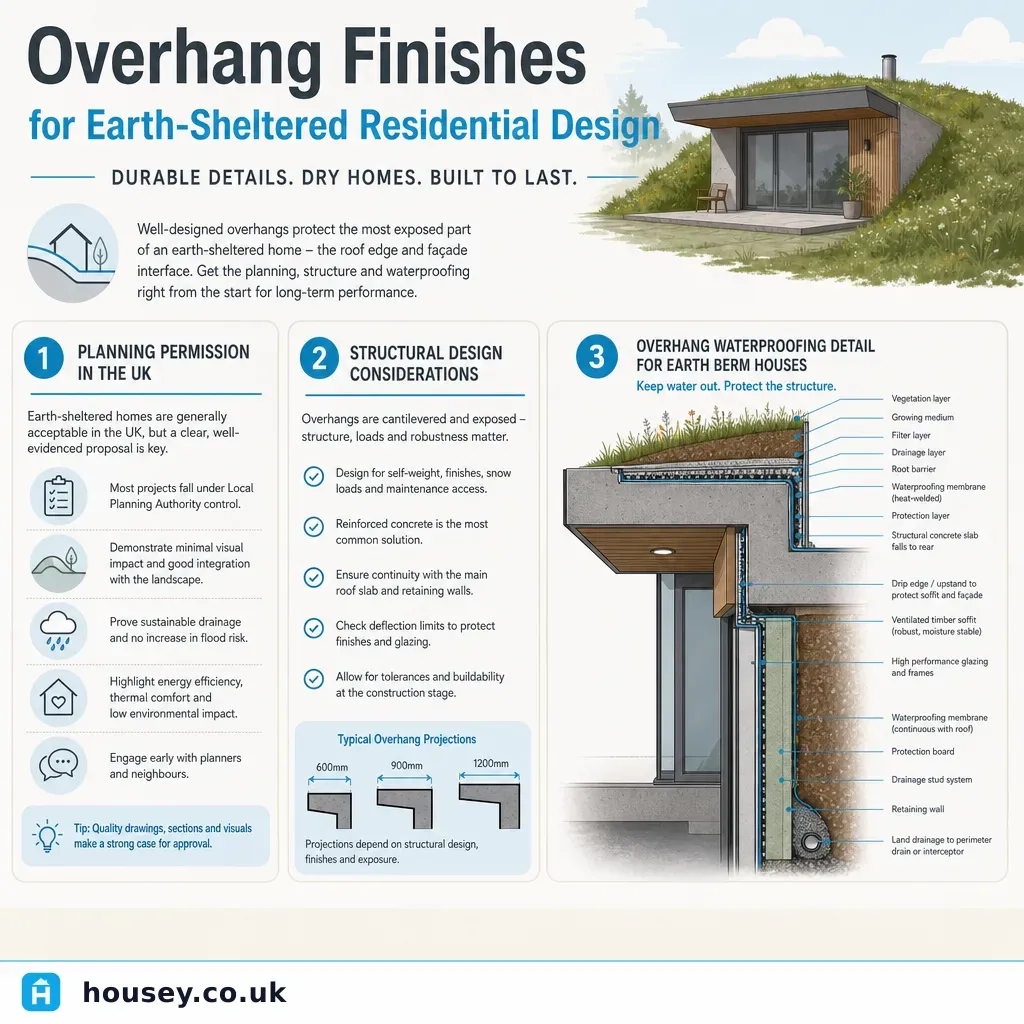
Overhang Finishes for Earth-Sheltered Residential Design
Earth-sheltered homes occupy a specialist niche in UK self-build, combining passive thermal mass with a low visual footprint that suits sensitive landscapes, greenbelt-adjacent sites, or locations where planning policy favours minimal above-ground impact. The overhang — the section of structure projecting beyond the earth berm or roof-level ground plane — is one of the most technically demanding elements of the design, sitting at the intersection of structural engineering, waterproofing, thermal performance, and architectural finish. Getting this detail wrong can result in water ingress, chronic cold-bridge heat loss, or structural movement that is costly to diagnose and correct after the building is occupied.
Key points
- Earth-sheltered overhangs must resist both downward loads (dead and live loads from retained soil, drainage layers, and planting) and uplift forces, requiring a structural engineer's design compliant with Eurocode 2 (reinforced concrete) or Eurocode 5 (engineered timber).
- BS 8102:2022 (Protection of below-ground structures against water from the ground) requires a primary and secondary waterproofing system at the roof-to-overhang junction, with the membrane turning down the exposed face to a minimum 150 mm upstand above finished soil or drainage layer level.
- Planning permission in England is normally required for earth-sheltered dwellings; most proposed sites fall within landscape-sensitive designations — AONB, greenbelt, conservation areas — where a Design and Access Statement and detailed architectural drawings are essential to a successful application.
- Uninsulated concrete overhang soffits act as significant cold bridges and can account for 15–25% of a building's total fabric heat loss depending on plan shape and perimeter length; continuous external insulation wrapping the slab edge reduces this contribution markedly.
- External cladding finishes must comply with Building Regulations Approved Document B on external fire spread; the architect should confirm the fire classification of any proposed timber or composite cladding for the specific building height and use before specifying.
What makes overhang design different in earth-sheltered homes
In a conventional house, the eaves overhang is a relatively simple carpentry detail. In an earth-sheltered design, the overhang marks the transition from the buried structure to the exposed facade, and it must simultaneously fulfil four distinct roles:
- Structural: resisting the combined load of retained earth, drainage layers, growing medium, and any vehicle or pedestrian surcharge on the roof, together with wind and snow loads on the exposed face.
- Waterproofing: preventing ground moisture from tracking along the roof-to-wall junction and into the habitable space below.
- Thermal: avoiding a cold bridge that undermines the building's fabric performance and risks interstitial condensation forming on the underside of the slab.
- Architectural: providing a finished appearance that satisfies planning conditions, the homeowner's aesthetic, and any material palette requirements set by the local planning authority.
These four requirements are often in tension. A deep concrete overhang offers structural robustness but creates a substantial thermal bridge. A slender cantilevered steel frame reduces thermal mass but demands very careful waterproofing detailing at each structural penetration.
Structural options for the overhang
Structure type | Typical span | Best for | Main structural concern | UK professionals needed |
|---|---|---|---|---|
In-situ reinforced concrete cantilever | Up to 3 m | Monolithic earth-sheltered builds; durable finish | Deflection, thermal bridge at slab edge | Structural engineer (Eurocode 2) |
Precast concrete planks | Up to 6 m | Modular or phased builds; factory quality control | Bearing length, joint waterproofing | Structural engineer + precast specialist |
Glulam or CLT cantilever | Up to 4 m | Timber-frame earth-sheltered; lower embodied carbon | Moisture exposure, bearing connections | Structural engineer (Eurocode 5) + timber specialist |
Steel cantilever frame | Up to 8 m | Long spans, minimal visual bulk | Thermal bridge at penetrations, corrosion protection | Structural engineer + metal fabricator |
For most UK self-build earth-sheltered homes, reinforced in-situ concrete remains the most common structural choice because it integrates naturally with the retaining walls and roof slab. Embodied carbon considerations and the growing availability of engineered timber products are prompting some designers to explore CLT or glulam alternatives, particularly for shorter spans where moisture management can be more readily controlled.
Waterproofing the overhang junction
The junction between the earth-covered roof and the overhang face is the highest-risk waterproofing detail in the building. Guidance under BS 8102:2022 and from specialist waterproofing contractors recommends a minimum three-element approach:
- Primary membrane: a continuous tanking system — bonded sheet, liquid-applied, or cavity drain — extending from the below-ground walls up and over the roof slab, terminating on the exposed overhang face with a turned-down upstand.
- Secondary protection: a drainage layer (dimple mat or geocomposite drainage board) placed over the primary membrane to manage any water that reaches the membrane surface and direct it to outlets.
- Upstand and drip edge: the waterproofing membrane must turn up a minimum of 150 mm above the finished soil or drainage layer level at the roof edge; the overhang soffit should incorporate a drip groove or projecting drip edge to prevent water tracking back onto the building face and causing staining or freeze-thaw damage.
Movement joints between the retaining structure and any lighter overhang element must be accommodated with a compressible filler and flexible waterproofing membrane lapping across the joint on both faces.
Overhang finishes: material options and performance
The exposed soffit and face of the overhang are the principal visible elements of an earth-sheltered home's facade. Common finish options in UK practice:
Finish | Thermal performance | Maintenance requirement | Planning considerations | Key notes |
|---|---|---|---|---|
Exposed board-marked concrete | Moderate (insulation must be added separately) | Low | Generally acceptable in landscape settings | Requires high-quality shuttering; surface staining develops over time |
Lime render over insulated substrate | Good with continuous insulation layer | Moderate — repoint every 10–15 years | Often preferred in conservation areas or AONB | Breathable; suits vernacular material palettes |
Timber cladding (larch, cedar, Accoya) | Good with ventilated cavity and insulation | Moderate — treatment every 3–5 years | Check Approved Document B fire classification | Natural appearance; often favoured by planning authorities |
Zinc or copper standing seam | Good when laid over insulation | Very low once installed | May require design justification in sensitive landscape settings | High embodied energy; 60–80 year service life |
Green or living wall system | Can improve thermal performance | High — irrigation and plant management | Positive in ecological and landscape appraisals | Structural loading must be included in the cantilever design |
Always confirm finish materials with your architect and verify local planning policy before finalising a specification — most earth-sheltered homes sit in landscape-sensitive designations where material palettes are closely controlled by planning conditions.
Thermal performance and cold-bridge risk
A common design error is treating the buried roof and the exposed overhang soffit as separate insulation zones. Any discontinuity in the insulation layer at the roof edge creates a repeating thermal bridge that can significantly increase fabric heat loss and generate a risk of interstitial condensation forming on the underside of the slab.
Worked UK property scenario: in a 200 m² earth-sheltered home in Shropshire with 300 mm EPS insulation to the buried roof but no insulation applied to a 2 m concrete overhang soffit, the cold-bridge heat-loss contribution from the uninsulated perimeter could account for 15–25% of the building's total fabric heat loss, depending on plan shape and perimeter length. Adding 100 mm phenolic insulation board to the overhang soffit — secured with stainless-steel fixings and finished with a suitable cladding — can reduce this contribution to under 5%.
Where structural elements such as columns, steel cantilever plates, or embedded beam ends penetrate the insulation layer, proprietary thermal breaks (such as Schöck Isokorb or equivalent products) should be specified by the structural engineer to prevent localised cold bridging at the point of penetration.
What to ask your architect and structural engineer
Before finalising the overhang design, seek clear written answers to each of these questions:
- What is the total design dead load — concrete slab, drainage layer, growing medium, and mature plant load — that the cantilever must carry, and has an appropriate safety factor been applied to all variable loads?
- How is waterproofing continuity achieved at the roof-to-overhang junction, and what is the confirmed minimum upstand height above finished soil level?
- Where are the movement joints located, and how are they waterproofed on both sides of the joint?
- How is the thermal bridge at the slab edge addressed in the specification, and are proprietary thermal breaks called up at all structural penetrations through the insulation?
- What is the fire classification of the proposed external cladding finish under Approved Document B, and does it comply for this building height and use?
- How is overhang surface drainage directed away from the building base and the below-ground tanking system?
Red flags in earth-sheltered overhang design
Be alert to these warning signs during design review or on site:
- No structural engineer's cantilever design — even visually simple overhangs carry complex combined loads from retained earth, drainage, planting, and environmental forces.
- Waterproofing membrane terminating flush at the slab edge rather than turning down the exposed face with a proper upstand and drip groove detail.
- No insulation specified to the overhang soffit — this is a designed-in cold bridge that directly undermines the thermal logic of the earth-sheltered concept.
- Cladding fixed directly to concrete without a ventilated cavity — this traps moisture against the face and accelerates material degradation.
- No movement joint between the overhang and the main structure where different materials or differing structural spans are used.
- Drainage layer absent or disconnected from outlets — trapped ground water will eventually track along the primary membrane and find its way to the junction detail.
Important limitations
Earth-sheltered overhang design involves structural, waterproofing, thermal, and planning considerations that are site-specific and highly interdependent. This article provides general orientation, not a design specification. Regulations, planning policies, and structural requirements vary significantly by site, soil type, topography, and local planning authority policy. Always engage a chartered architect with verifiable experience in earth-sheltered design and appoint a structural engineer at the earliest possible stage for any scheme involving retained earth or cantilevered structures.
What to ask a qualified professional
When interviewing architects or engineers for an earth-sheltered project, ask:
- Have you designed earth-sheltered or below-ground residential structures before, and can you provide references or examples of completed schemes?
- How do you address the waterproofing upstand and movement joint at the overhang junction in your standard construction detail?
- Which waterproofing system grade (Grade 1, 2, or 3 under BS 8102:2022) do you recommend for this application, and why?
- How do you model and mitigate thermal bridging at the slab edge and at structural penetrations through the insulation layer?
- Who carries out the waterproofing quality inspection before the drainage layer is placed over the membrane, and is this documented in a site record?
When to get professional help
Seek specialist professional advice at the earliest design stage if:
- You are proposing a cantilever overhang of more than 1.5 m.
- The overhang is to support a planted or green roof with significant surcharge loading from growing medium or retained water.
- The site is in a flood risk zone, on a slope, or on ground with variable or poor bearing capacity.
- Your local planning authority has requested structural or drainage details as a pre-application or planning condition requirement.
- You have noticed water ingress, staining, or cracking at an existing overhang junction on a completed earth-sheltered build.
How Housey can help
Housey can connect you with architects experienced in bespoke residential design and structural engineers who understand the specific technical demands of earth-sheltered construction — from initial concept and planning application through to building control sign-off and waterproofing quality assurance on site.
Frequently asked questions
Do earth-sheltered homes need planning permission in England?
Yes, in almost all cases. Earth-sheltered dwellings are not automatically permitted development, and most are proposed in landscape-sensitive locations — AONB, greenbelt, or conservation areas — where a full planning application with detailed drawings and a Design and Access Statement is required. Some local planning authorities are receptive to well-designed schemes where visual impact is demonstrably low, but early pre-application engagement is strongly advisable before purchasing land for this purpose.
What is the typical structural depth of a concrete overhang in an earth-sheltered home?
A reinforced concrete cantilever overhang spanning 2–3 m typically requires a slab depth of 200–400 mm, depending on span, applied loads, reinforcement arrangement, and the structural engineer's Eurocode 2 design. Shallower profiles may be achievable with post-tensioned concrete or by incorporating steel sections, but both options require specialist structural input and have direct implications for the waterproofing and insulation strategy at the slab edge.
How is the waterproofing membrane protected from damage during construction?
The primary waterproofing membrane should be covered immediately after installation with a rigid protection board or the drainage layer specified by the designer. Foot traffic directly on an exposed membrane is a common cause of punctures on site. A quality inspection record confirming the membrane is defect-free before covering is good practice and is often required by the membrane manufacturer to maintain the product warranty and by building control as evidence of compliance with BS 8102.
Can engineered timber be used for earth-sheltered overhangs?
Yes, cross-laminated timber (CLT) or glulam can be used for overhang structures in earth-sheltered homes. Key considerations are moisture protection for exposed end-grain, the fire classification of any external timber finish under Approved Document B, and the structural design to Eurocode 5. Thermally modified timber and Accoya offer enhanced durability for exposed applications and typically have a longer maintenance interval than untreated softwood cladding.
Sources and further reading
- Planning Portal: when you need planning permission — Planning Portal
- BS 8102:2022 — Protection of below-ground structures against water from the ground — BSI Group
- Approved Document B: Fire safety — Volume 1 (dwellings) — GOV.UK
- BRE Good Building Guide 54: Waterproofing basements and other below-ground structures — Building Research Establishment
- LABC Warranty technical guidance for non-standard construction — LABC Warranty
Useful next reads
 Planning & Pre-Build
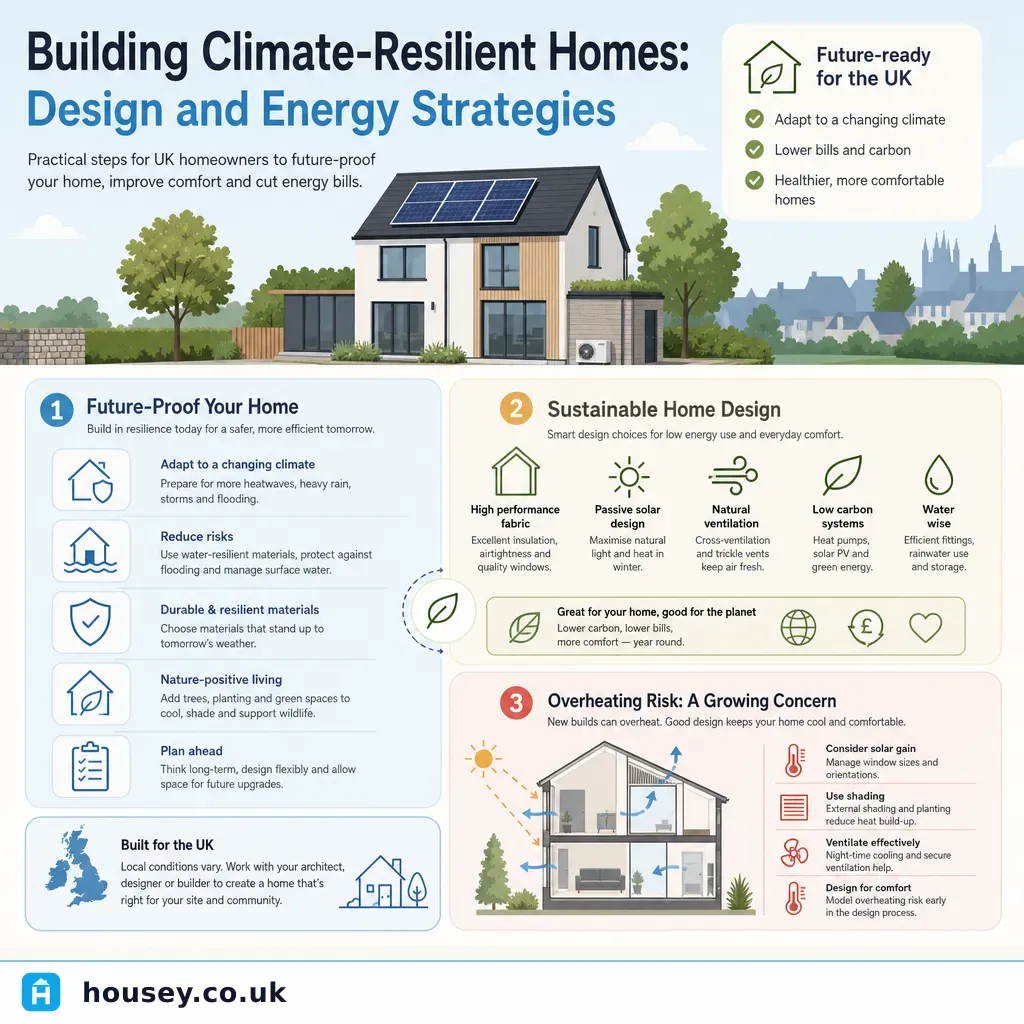
Building Climate-Resilient Homes: Design and Energy Strategies
A climate-resilient UK home handles hotter summers, wetter winters, and rising energy costs through high-performance insulation, overheating mitigation, flood-resilient construction, low-carbon heating, and good water management.
 Planning & Pre-Build
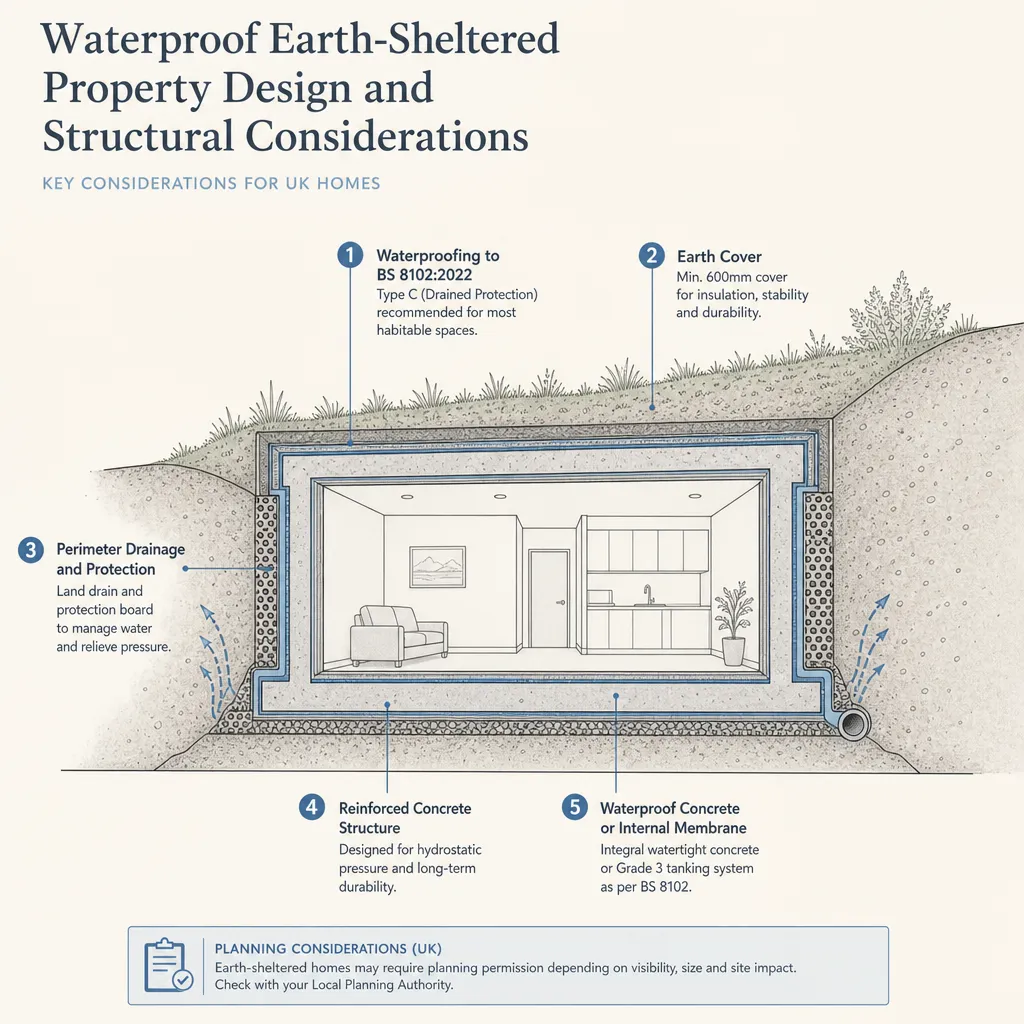
Waterproof Earth-Sheltered Property Design and Structural Considerations
Earth-sheltered homes in the UK require specialist structural design to manage lateral soil pressure and hydrostatic loads, along with a waterproofing strategy compliant with BS 8102:2022.
 Planning & Pre-Build
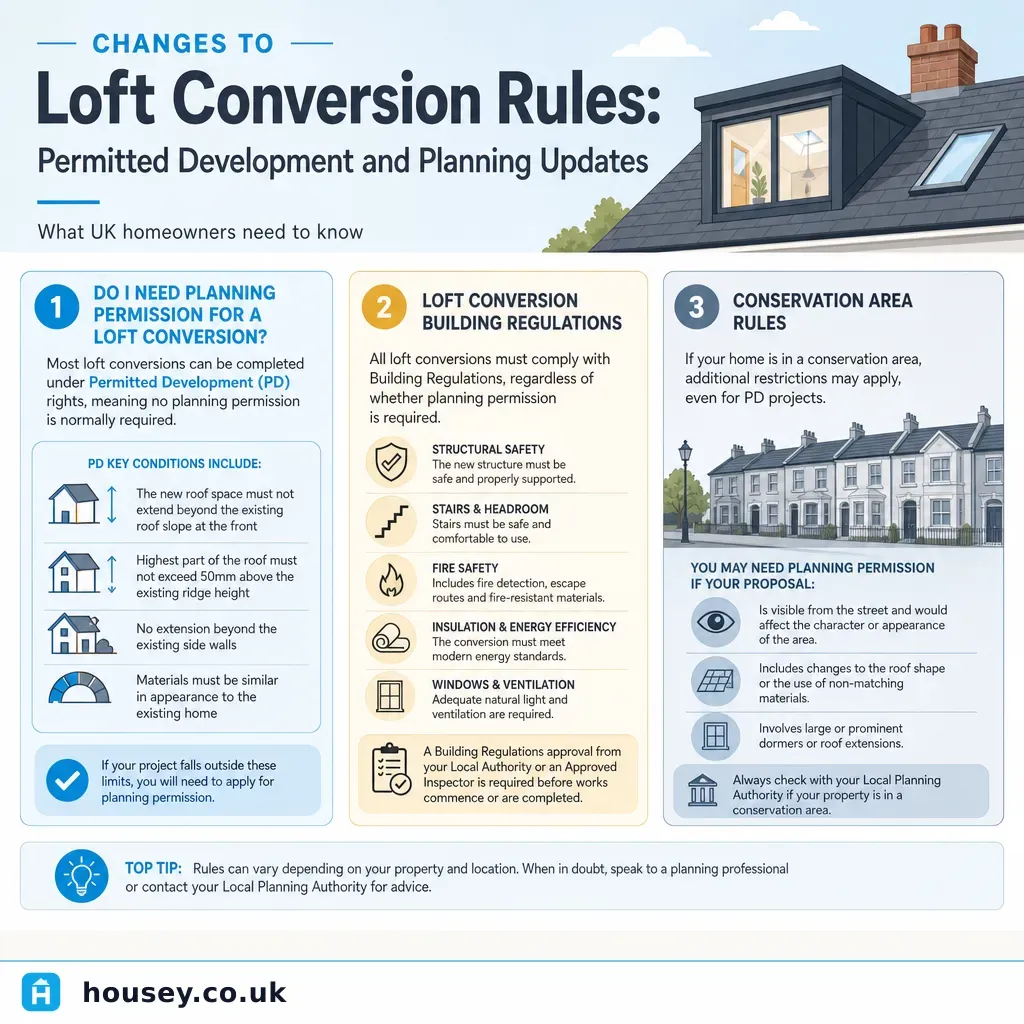
Changes to Loft Conversion Rules: Permitted Development and Planning Updates
In England, most loft conversions on standard houses qualify as Permitted Development under Class B of the GPDO 2015, allowing up to 40 cubic metres (terraced) or 50 cubic metres (detached or semi-detached) without a planning application — if conditions are met.
 Planning & Pre-Build
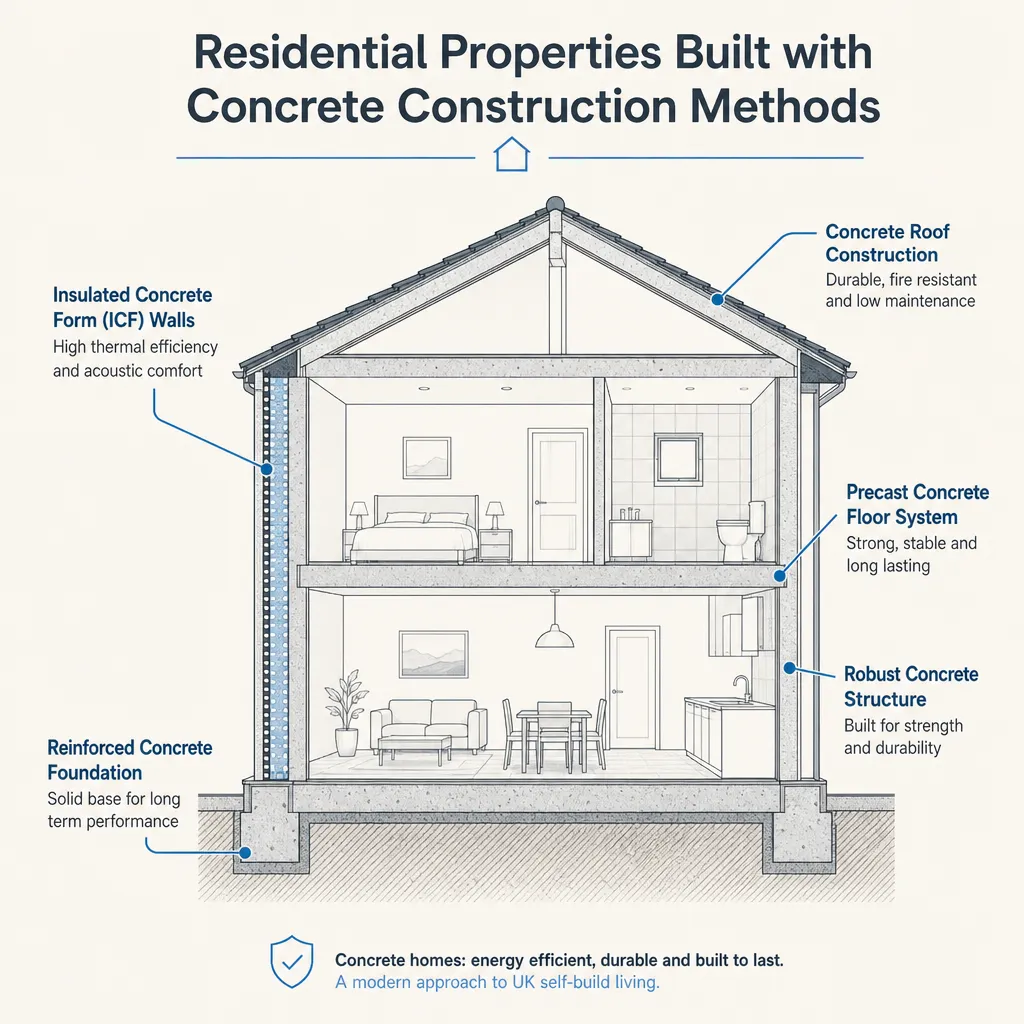
Residential Properties Built with Concrete Construction Methods
UK homes are built using several concrete methods: in-situ cast concrete, precast panel systems, insulating concrete formwork (ICF), and older non-traditional types such as Wimpey No-Fines and Laing Easiform.
 Planning & Pre-Build
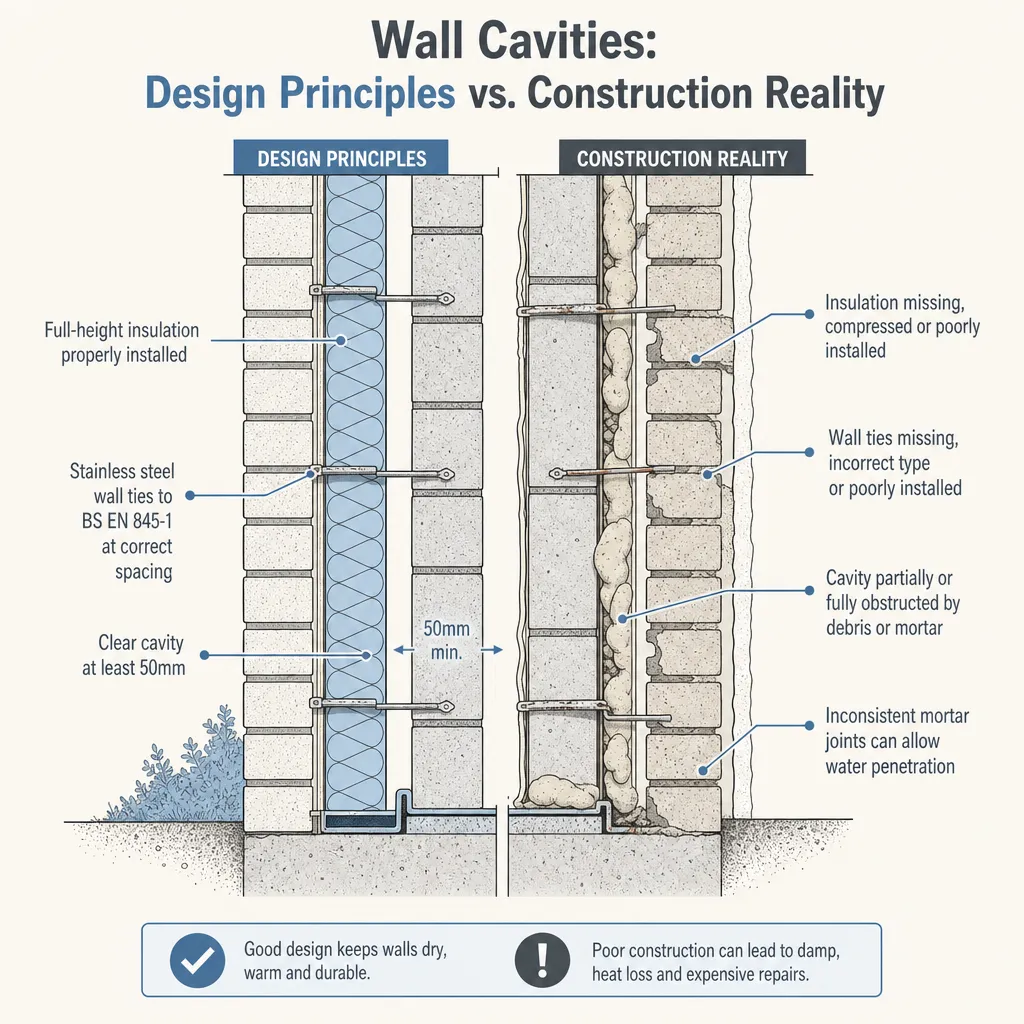
Wall Cavities: Design Principles vs. Construction Reality
A UK cavity wall is designed to resist weather, control heat loss, and structurally link two masonry leaves.