Building Concrete Homes with Foam Forms: Alternative Construction
By Housey · Last reviewed 25th of May 2026
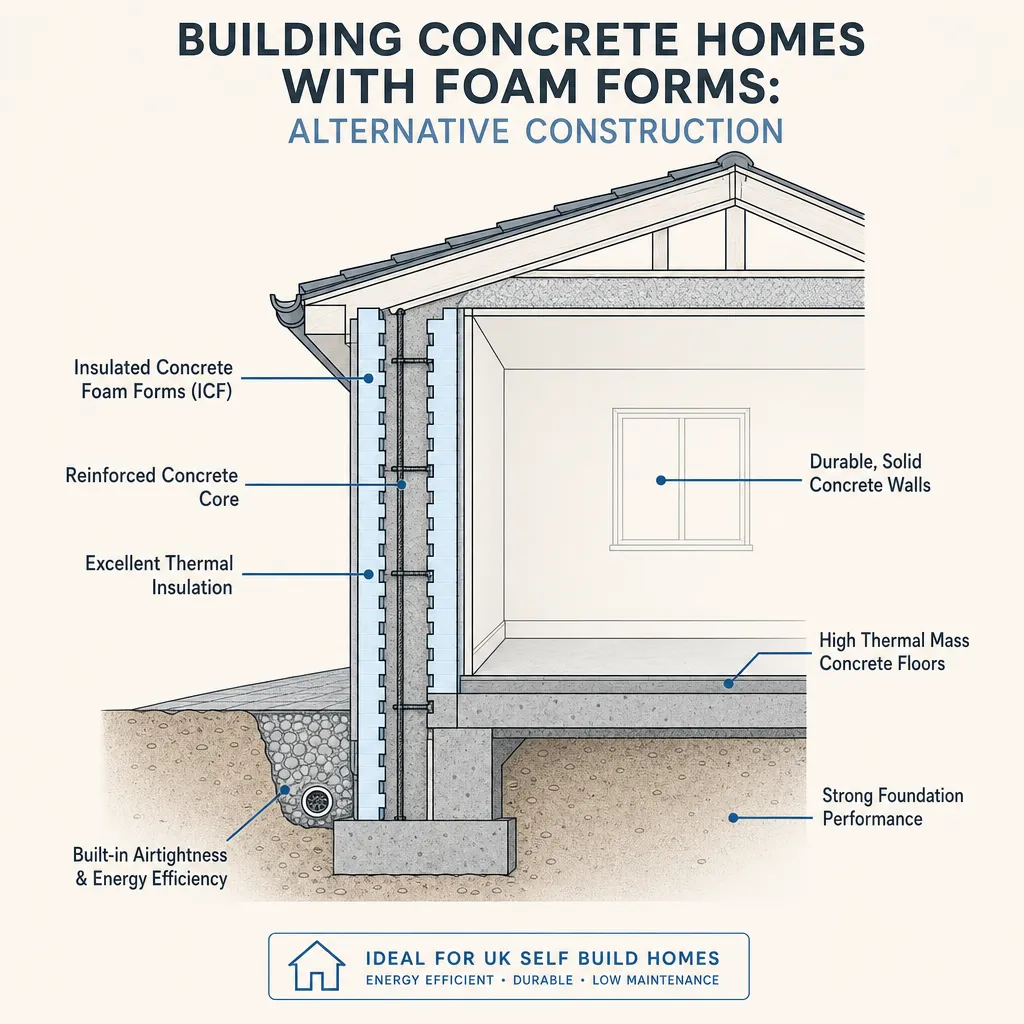
Building Concrete Homes with Foam Forms: Alternative Construction
Insulated concrete formwork (ICF) has been widely used across North America and parts of northern Europe for decades, but it remains a niche choice among UK self-builders and developers. Interest is growing as homeowners seek better thermal performance, lower air-leakage rates, and resilience against increasingly variable British weather — questions that typically arise when commissioning custom new builds, significant extensions, or commercial-to-residential conversions. Understanding how ICF works, how it compares to the UK's mainstream build systems, and what building regulations require is essential before committing to the method.
Key points
- ICF uses expanded polystyrene (EPS) foam blocks as permanent shuttering: rebar and ready-mixed concrete are placed inside the cavity, and the foam stays in position as continuous insulation on both wall faces once the concrete has cured.
- UK ICF external walls typically achieve U-values of 0.15–0.20 W/m²K, often bettering the Building Regulations Part L 2021 minimum of 0.18 W/m²K for new dwellings in England.
- Building regulations approval and a chartered structural engineer's sign-off are mandatory for any new build or structural extension using ICF — no ICF system is self-certifying under the Building Act 1984.
- Most UK ICF products carry a British Board of Agrément (BBA) or UK Technical Assessment (UKTA) certificate, which building control bodies and mortgage lenders use to assess fitness for purpose.
- Specialist ICF contractors are required for the concrete pour stage: mainstream bricklayers and groundworkers generally lack the training to manage blowout prevention, pour rates, and concrete vibration correctly.
What is insulated concrete formwork?
ICF is a permanent-stay shuttering system. Lightweight EPS foam units — typically interlocking hollow blocks resembling large bricks — are stacked to form a wall cavity. Reinforcing steel (rebar) is placed inside, then ready-mixed concrete is poured and vibrated to fill the cavity. Once cured, the concrete provides the structural element while the foam stays in place as insulation on both the inner and outer faces of the wall.
The result is a monolithic reinforced-concrete wall with a continuous thermal envelope. Unlike traditional cavity masonry, there are no cold bridges at mortar joints and no gaps from poorly fitted insulation batts — two of the most common thermal failure modes in conventional UK construction. The outer foam face is rendered, clad in brick slip, or boarded; the inner face receives drylining board or direct-applied finish plaster.
Standard UK ICF block widths for external walls typically range from 200 mm to 300 mm overall — combining two foam faces and the structural concrete core — broadly comparable to a standard cavity masonry external wall.
How ICF compares to traditional build methods
Feature | ICF concrete | Cavity masonry | Timber frame |
|---|---|---|---|
Typical U-value (external wall) | 0.15–0.20 W/m²K | 0.18–0.28 W/m²K (insulation-dependent) | 0.18–0.25 W/m²K (insulation-dependent) |
Airtightness | High — monolithic structure reduces leakage points | Moderate — depends heavily on workmanship | Moderate–high with correctly fitted membrane and tapes |
Acoustic performance | Good — concrete mass reduces airborne sound | Moderate | Lower (lightweight structure) |
Speed of erection | Moderate — specialist team needed at shell stage | Slow (traditional bricklaying pace) | Fast (panelised factory systems) |
UK trade familiarity | Low — specialist trades required | Very high — mainstream | High — well established |
Mortgage and warranty availability | Available with BBA/UKTA certification; some lenders cautious | Straightforward with standard warranty | Generally mainstream with NHBC or equivalent |
Typical cost vs cavity masonry | Broadly comparable; materials higher, potential labour saving at shell stage | Lowest overall for simple designs | Varies; packages can be competitive |
Suitability for extensions | Possible with structural engineer input at junction | Standard | Possible with appropriate junction detailing |
Indicative comparisons only. Actual performance depends on specification, contractor skill, and site conditions.
Planning permission and building regulations
ICF construction does not change the planning permission requirements for a project. Permitted development rights and local planning policy apply in exactly the same way as for masonry or timber-frame new builds and extensions. A rendered or clad ICF facade can look visually identical to conventional construction.
Building Regulations are the critical compliance requirement. Full building regulations approval is required for any new dwelling or structural extension, regardless of the wall system used. The building control body — either a local authority building control (LABC) or a CICAIR-registered approved inspector — will typically require:
- Structural design calculations from a chartered structural or civil engineer, including reinforcement schedules, concrete specification, and pour sequence.
- Third-party system certification — a current BBA certificate or UKTA confirming the ICF product is fit for purpose in the UK.
- Part L thermal calculations demonstrating compliance with the Conservation of Fuel and Power requirements for the building type.
- Part B fire safety documentation — ICF systems must demonstrate appropriate reaction-to-fire and surface spread of flame ratings; foam faces are typically protected by plasterboard or render.
Confirm early with your chosen building control body which specific documentation they require for the ICF product you plan to use.
Which build method should you choose?
- Choose ICF if your priority is very high thermal performance, excellent airtightness, and long-term energy efficiency, and specialist ICF contractors are available locally for your project.
- Choose ICF if your design involves curved walls, complex geometry, or a requirement for high acoustic insulation, as the system accommodates non-standard plans well.
- Choose cavity masonry if local building trades are unfamiliar with ICF, the project is a modest extension, or mainstream contractors are significantly more cost-competitive for your design.
- Choose timber frame if speed of shell erection is critical, you are using a design-and-manufacture package, or site access restricts concrete delivery vehicles.
- Ask a structural engineer before using ICF for conversions, basements, or retaining-wall applications — these involve different loading and waterproofing considerations from standard above-ground walls.
- Check with your local planning authority if the property is listed, in a conservation area, or if any existing structural element must connect to the proposed ICF construction.
Specification, contractors, and structural warranty
Several established ICF system suppliers operate in the UK, each with proprietary block geometry and installation details. Your choice of system partly determines which contractors are trained and approved to use it. Key steps when specifying:
- Confirm the system holds a current BBA or UKTA certificate before proceeding.
- Use a contractor trained and approved by the system manufacturer — several UK systems operate registered installer schemes.
- Engage a structural engineer experienced with ICF to produce the reinforcement schedule, concrete mix specification, and a pour sequence supervision plan.
- Obtain a 10-year structural warranty from a recognised provider (NHBC Buildmark, Premier Guarantee, or LABC Warranty) before ground breaks — mortgage lenders typically require this for new dwellings.
The concrete pour is the most critical construction stage. Incorrect pour rates, inadequate temporary bracing, or poorly consolidated concrete can cause wall blowouts or structural voids. This stage is not appropriate for self-builder DIY, even for experienced builders.
When to get professional help
ICF requires professional involvement at every structural stage. Escalate to a specialist immediately if any of the following apply:
- A contractor proposes ICF without referencing a certified, BBA or UKTA-approved system product.
- Structural drawings omit rebar schedules or specify a non-standard concrete mix without engineering justification.
- A building control body is unfamiliar with ICF and cannot confirm how they will assess compliance — consider engaging a CICAIR-registered approved inspector with relevant ICF experience.
- There is uncertainty about foundation suitability for a monolithic concrete structure, particularly on clay-heavy or variable-ground sites.
Engage a chartered structural engineer (CEng MIStructE or CEng MICE) and a building regulations drawing specialist for Part L and Part B documentation well before ground is broken.
How Housey can help
Housey connects self-builders and developers with design-and-build firms experienced in alternative construction methods, structural engineers who can review ICF specifications and reinforcement schedules, and building regulations drawing specialists who prepare Part L thermal and Part B fire safety compliance packages for your project.
Frequently asked questions
Does ICF construction cost more than traditional brick-and-block in the UK?
Overall build costs for ICF are broadly comparable to traditional cavity masonry for many projects. Material costs for the foam system are higher, but trained teams can erect the shell faster, potentially offsetting some labour costs. Specialist ICF contractors command higher day rates than mainstream groundworkers. Obtain itemised quotes from at least two ICF-specialist firms before comparing them against traditional-build estimates.
Can ICF be used for extensions to existing masonry homes?
Yes, but the junction between new ICF and existing masonry requires careful structural and thermal detailing. A structural engineer should assess existing foundations, load transfer at the junction, and thermal bridging at the connection. Building control will require evidence that the junction is both structurally sound and thermally compliant with Part L.
Will a mortgage lender accept an ICF-built home?
Most mainstream lenders will consider ICF homes provided the property holds a recognised structural warranty — such as NHBC Buildmark or LABC Warranty — and the ICF system carries a BBA or UKTA certificate. Some lenders remain less familiar with the method and may request a surveyor's report. Confirm lender acceptance early, particularly for properties intended for onward sale.
Does ICF construction require planning permission?
ICF is a structural method, not a planning category. Planning rules apply based on what is being built — a new dwelling, extension, or outbuilding — and where it is situated, including conservation areas and listed buildings. Permitted development rights may apply to certain extensions regardless of construction method. Always check with your local planning authority before commencing work.
Sources and further reading
- Approved Document L: Conservation of Fuel and Power (2021) — GOV.UK / DLUHC
- Approved Document B: Fire Safety — GOV.UK / DLUHC
- BBA certificate register — British Board of Agrément
- NHBC Technical Standards and Guidance — NHBC
- CICAIR register of approved inspectors — CICAIR
Useful next reads
 Planning & Pre-Build
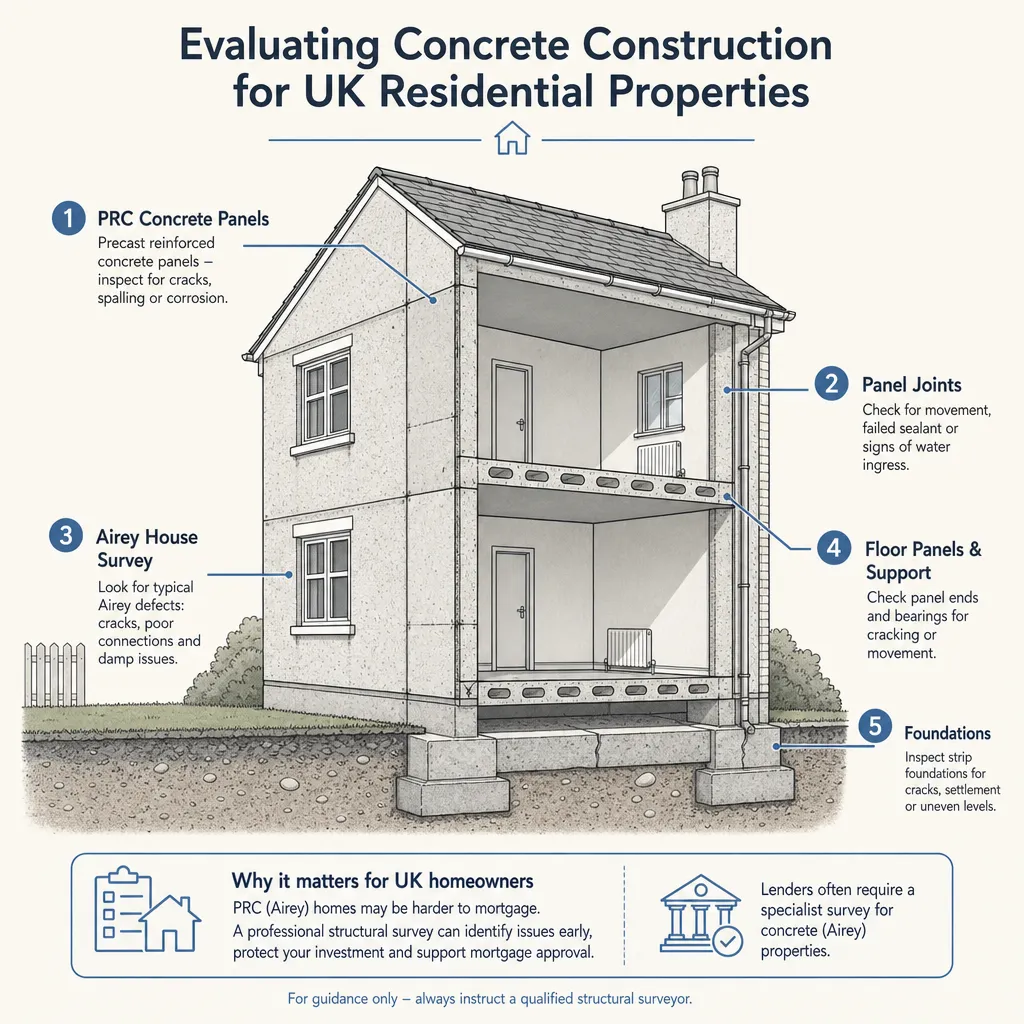
Evaluating Concrete Construction for UK Residential Properties
Concrete construction in UK homes covers post-war non-traditional housing — such as Airey and Wimpey No-Fines properties — typically classified as non-standard by mortgage lenders, and modern systems including ICF and block cavity wall, which are generally standard.
 Planning & Pre-Build
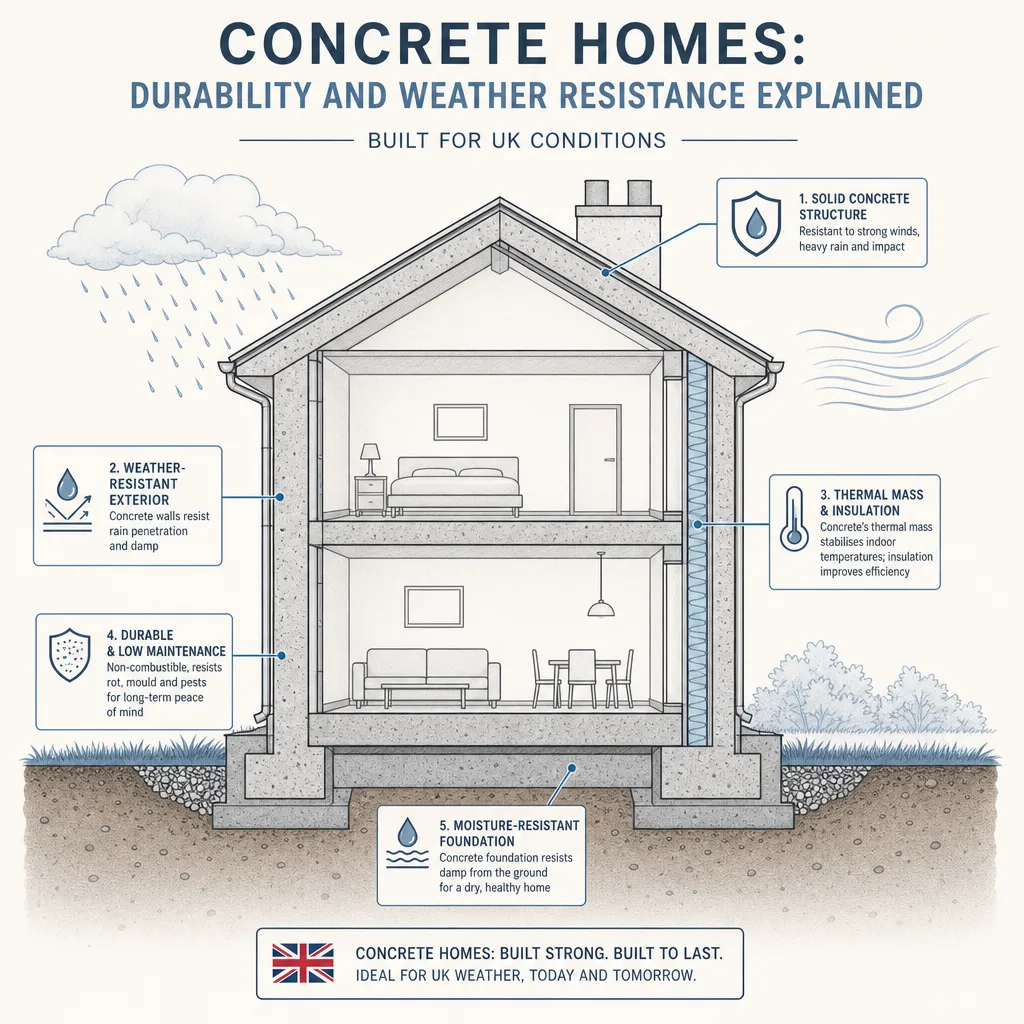
Concrete Homes: Durability and Weather Resistance Explained
Concrete homes can be highly durable and weather-resistant when correctly specified and built.
 Planning & Pre-Build
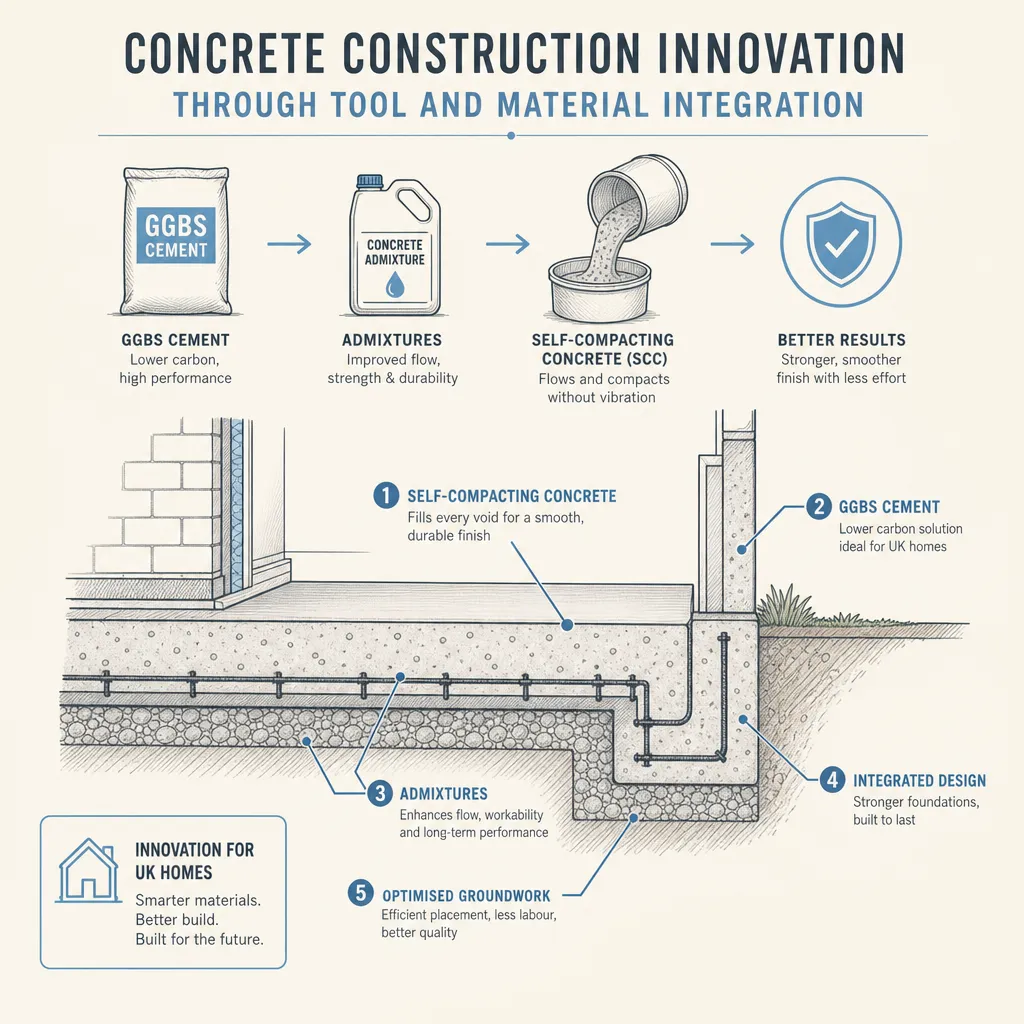
Concrete Construction Innovation Through Tool and Material Integration
Modern concrete mixes — self-compacting, fibre-reinforced, and low-carbon GGBS blends — require specific placement equipment and admixtures to perform correctly.
 Planning & Pre-Build
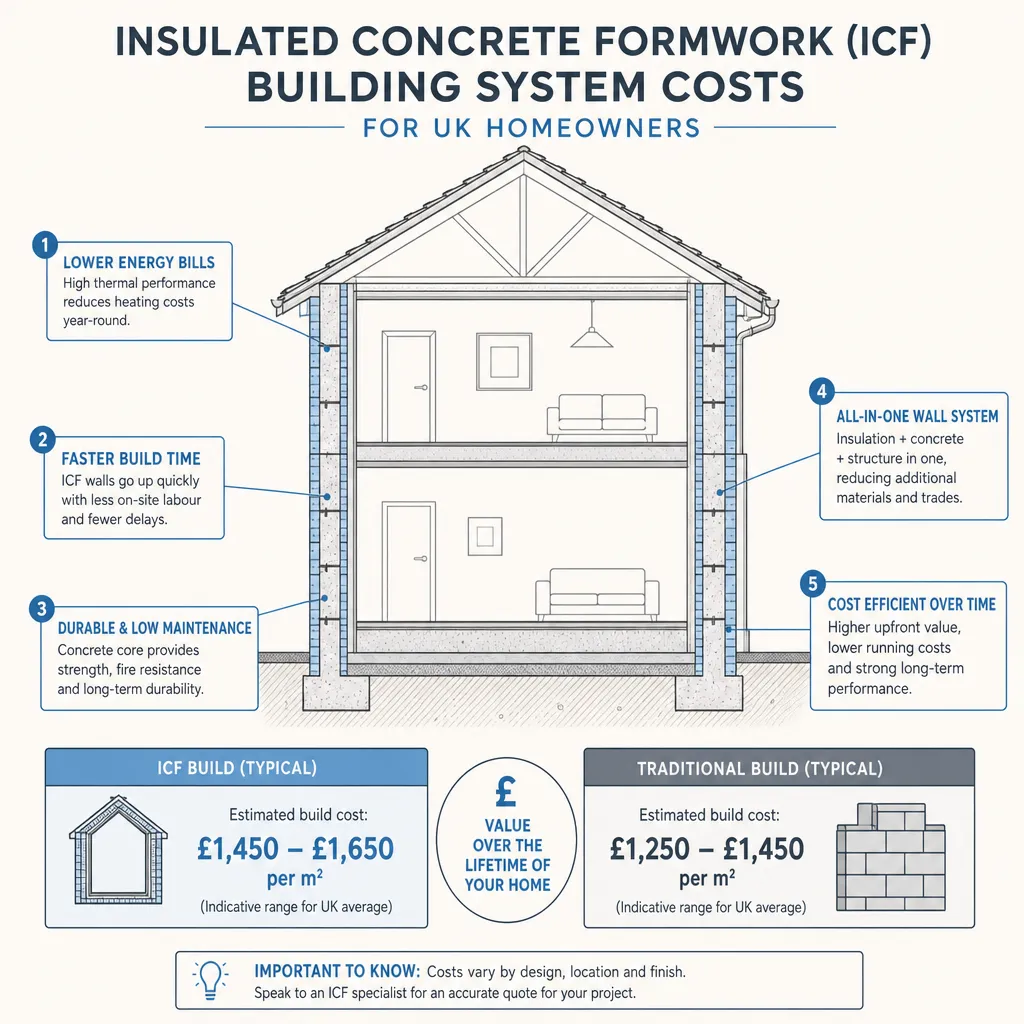
Insulated Concrete Formwork Building System Costs
In the UK, ICF (Insulated Concrete Formwork) materials typically cost £25–£50 per m² of wall area, with a completed shell wall at £80–£130 per m².
 Planning & Pre-Build
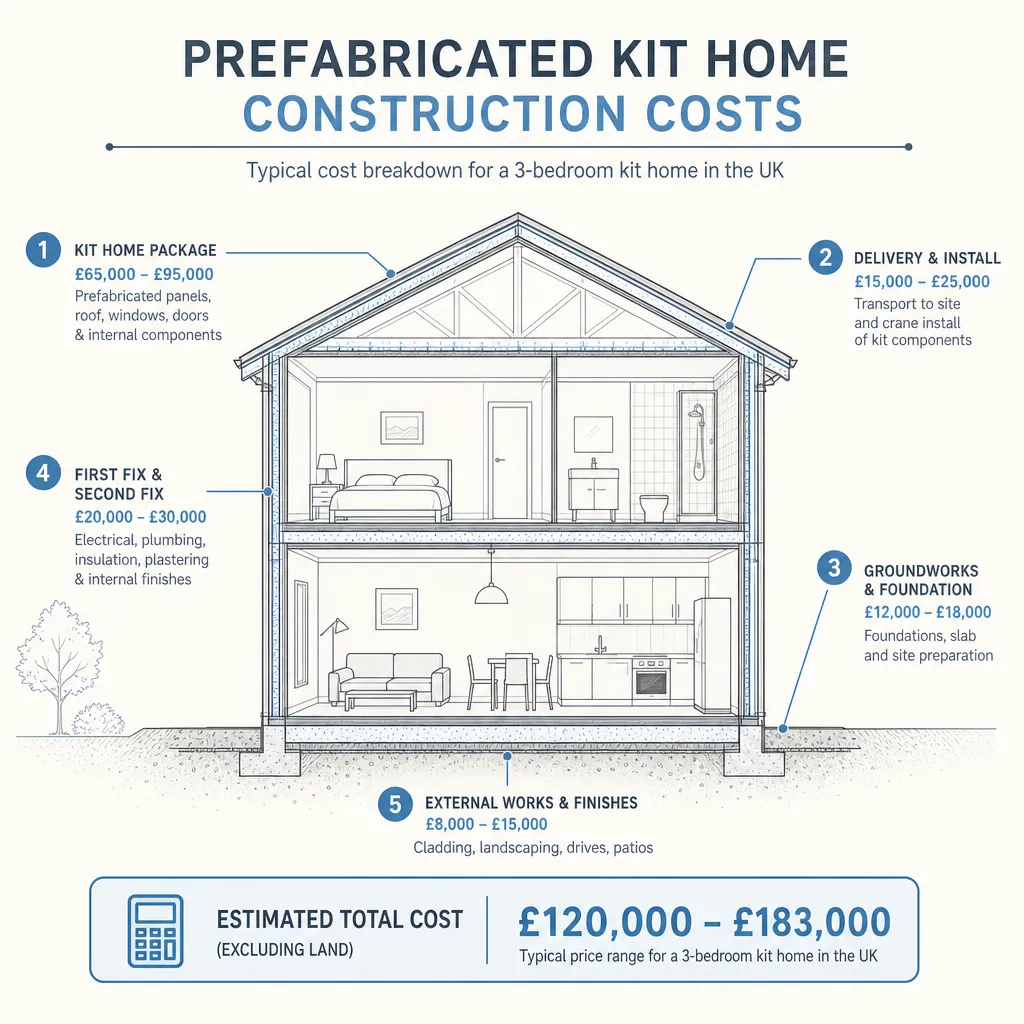
Prefabricated Kit Home Construction Costs
UK kit home construction costs range from around £1,000 to £2,500 per m² for a completed home, depending on the system — timber frame, SIPs, or volumetric modular — and the specification.