Prefabricated Kit Home Construction Costs
By Housey · Last reviewed 7th of May 2026
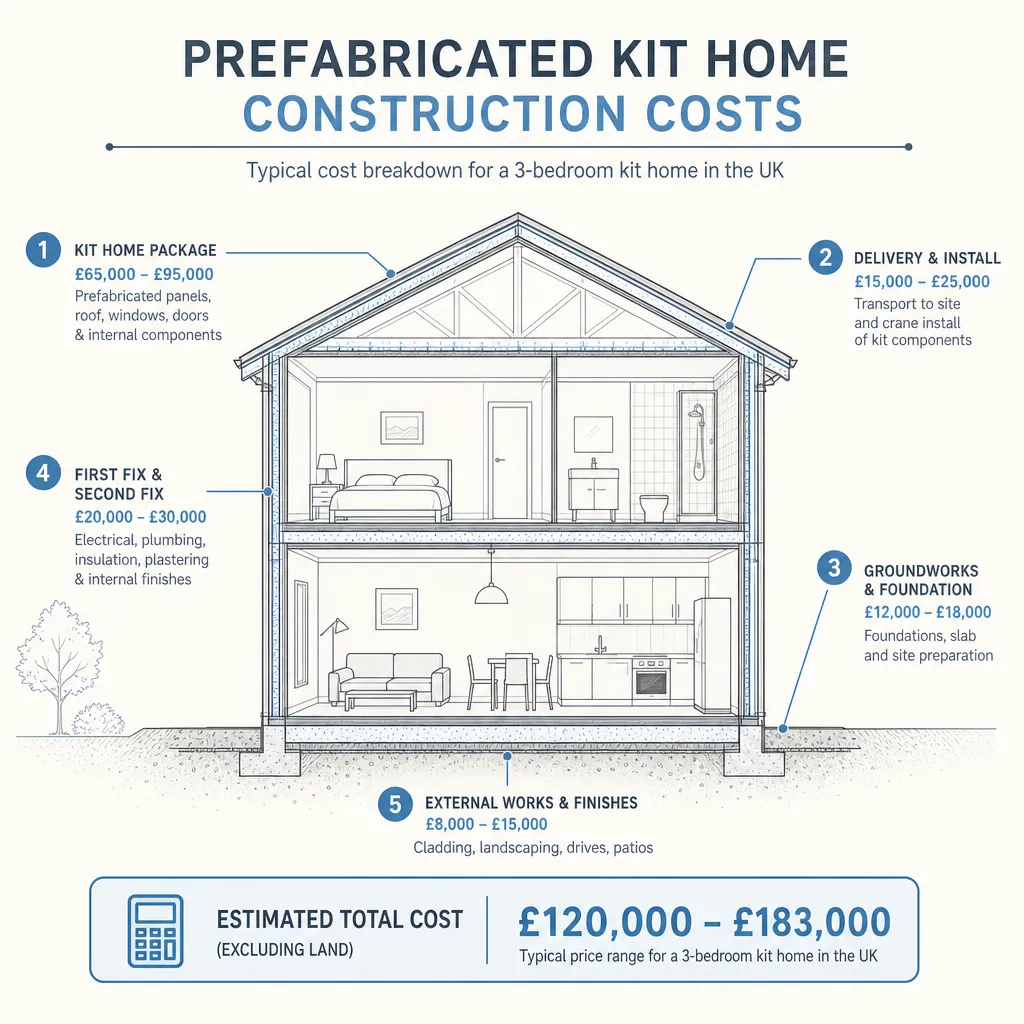
Prefabricated Kit Home Construction Costs
Choosing a factory-built kit home is increasingly popular among UK self-builders who want tighter programme control, better energy performance, and a construction process less vulnerable to on-site labour variability. The challenge is that a supplier's headline kit price often covers far less than buyers expect — making realistic budgeting difficult without a clear breakdown of every cost category from the outset.
Key points
- Indicative total build costs for UK kit homes range from roughly £1,000 to £2,500 per m² depending on the system and specification, with the kit package itself typically covering the structural shell only (Indicative UK costs, last reviewed 2026-05-07).
- Three main factory-built systems are widely used in the UK: closed-panel timber frame, structural insulated panels (SIPs), and volumetric modular — each has different cost profiles, lead times, and suitability for different planning conditions.
- A new-build kit home requires full planning permission and Building Regulations approval regardless of construction method; permitted development rights do not apply to new dwellings.
- Groundworks, foundations, services connections, and internal fit-out typically add 40–70% on top of the structural kit package cost.
- VAT paid on eligible self-build construction materials is reclaimable under HMRC's DIY Housebuilders Scheme — a claim that can amount to tens of thousands of pounds on a complete project.
What is a kit home?
A kit home is a dwelling whose primary structural components are manufactured off-site in a factory environment and assembled on a prepared foundation. The term covers several distinct construction systems used across the UK:
System | How it works | Typical UK use case |
|---|---|---|
Closed-panel timber frame | Insulated wall, floor, and roof panels factory-built and crane-erected on site | Most common self-build route; suits most plot types and planning conditions |
Open-panel timber frame | Structural frame only; insulation added on site | Lower upfront kit cost but more on-site labour required |
Structural insulated panels (SIPs) | Rigid foam core bonded between OSB boards; high airtightness | Energy-efficient builds targeting Passivhaus-adjacent performance |
Volumetric / modular | Fully fitted three-dimensional modules stacked and connected on site | Tight programmes, multi-unit residential, remote or constrained sites |
Light-gauge steel frame | Prefabricated cold-rolled steel sections assembled on site | Unusual spans or commercial-influenced residential projects |
Each system has distinct cost drivers, structural characteristics, and suitability for specific UK plot conditions, planning constraints, and energy targets. The right choice depends on your programme, specification ambitions, and available budget.
How much does a kit home cost in the UK?
Costs vary significantly by system, supplier, storey count, specification level, and what the manufacturer includes in their package. The figures below are indicative, based on published industry guidance and self-build cost data current as of May 2026. Always obtain itemised quotes and compare on a like-for-like basis.
Kit package — structural shell supply only
Indicative UK costs, last reviewed 2026-05-07:
- Closed-panel timber frame (supply only): £400–£700 per m² of floor area
- SIPs (supply and erect): £550–£900 per m²
- Volumetric modular (to weather-tight stage): £1,000–£1,800 per m²
These figures typically cover structural panels or modules, windows, external doors, and the outer envelope — but not groundworks, foundations, services, or internal fit-out.
Total completed build cost
For a fully finished, habitable home:
- Timber frame self-build (owner-managed): £1,200–£1,900 per m²
- SIPs build (architect-managed): £1,400–£2,100 per m²
- Volumetric modular (turnkey from manufacturer): £1,600–£2,500 per m²
A 120 m² three-bedroom home therefore has an indicative total build cost of between £144,000 and £300,000 depending on the system and specification — before land costs, professional fees, and planning application costs.
Source: NaCSBA Self Build & Custom Housebuilding Market Report; RICS Building Cost Information Service (BCIS). Individual projects vary widely.
What does the kit price include — and what does it not?
Misreading a supplier's headline figure is one of the most common causes of budget overrun on kit home projects. Before accepting any quote, map every cost category to a confirmed figure or a provisional allowance.
Typical inclusions in a kit package
- Factory-fabricated structural panels or modules
- Windows and external doors (specification varies by supplier and contract tier)
- Roof structure and sometimes roof covering
- Erection crew labour (supply-and-erect contracts only; some suppliers supply only)
- Technical drawings for a Building Regulations application
Typical exclusions
- Plot purchase and conveyancing
- Groundworks and foundation engineering
- Utility connections (water, electricity, drainage, gas or heat network)
- Internal partitions, staircase, and internal doors
- Plumbing, heating, and ventilation (including MVHR if specified)
- Electrical installation
- Plastering, flooring, kitchen, bathrooms, and decoration
- Architect or architectural technologist fees
- Structural engineer fees
- Building control and planning application fees
- Site insurance and 10-year structural warranty (required by most self-build lenders)
Planning permission and building control
Planning permission is required for all new dwellings, regardless of construction method. The kit system has no bearing on the planning assessment — design, scale, massing, external materials, and local planning policy are the determining factors. In conservation areas, national parks, or areas subject to local design codes, the external appearance may be subject to additional conditions. Seek pre-application advice from your local planning authority before committing to a plot or a kit design.
Building Regulations apply to all new homes, covering Part A (structure), Part L (energy efficiency), Part F (ventilation), Part O (overheating prevention), and others. Most reputable kit suppliers provide structural calculations and drawings to support a Building Regulations application, but you will need to appoint a building control body — either local authority building control (LABC) or an Approved Inspector — to oversee and sign off the build.
Structural warranty: Most self-build mortgage lenders require a 10-year structural warranty. Recognised providers include NHBC Buildmark, Premier Guarantee, LABC New Home Warranty, and Build-Zone. Confirm lender acceptability before selecting a warranty provider, as not all lenders accept all schemes.
Worked UK scenario: 130 m² two-storey kit home in the East Midlands
Situation: A couple purchase a serviced plot with planning permission already granted for £90,000 and contract a closed-panel timber frame manufacturer for supply and erect.
Indicative cost breakdown:
Item | Estimated cost |
|---|---|
Kit package (supply and erect, closed-panel, 130 m²) | £78,000 |
Groundworks and foundations | £22,000 |
Roof covering (concrete interlocking tiles) | £12,000 |
Mechanical and electrical fit-out | £28,000 |
Kitchen and bathrooms (mid-range specification) | £18,000 |
Internal fit-out (plastering, flooring, decoration) | £20,000 |
Architect and structural engineer fees | £14,000 |
Planning and building control fees | £3,500 |
10-year structural warranty | £3,000 |
Contingency (10%) | £19,850 |
Total build cost (excluding plot) | £218,350 |
Indicative UK costs, last reviewed 2026-05-07. Actual costs depend on specification, supplier, plot conditions, and regional location. Obtain multiple itemised quotes before committing.
What drives cost differences between kit home projects?
- Storey count: Two-storey homes typically cost less per m² than single-storey because the roof and foundations serve a greater floor area.
- Specification: Triple glazing, Passivhaus airtightness detailing, and mechanical heat recovery ventilation (MVHR) increase upfront cost but reduce energy running costs over the building's life.
- Location: Labour and material costs are higher in London and the South East; remote or difficult-access sites add logistics costs regardless of system.
- Supplier model: Some manufacturers offer a full design-and-build turnkey service; others supply the kit only and leave coordination to you. The turnkey route costs more per m² but reduces programme risk.
- Plot conditions: Made ground, shrinkable clay, or high water table can substantially increase foundation costs and may require a structural engineer's input before a kit can be ordered.
- Programme pressure: Volumetric modular can reduce on-site construction time significantly, but the product cost per m² is generally higher than panel systems.
Homeowner checklist before committing to a kit home supplier
When to get professional help
Kit home projects involve multiple professional disciplines working in sequence. Attempting to coordinate them without experienced support significantly increases the risk of cost overrun and programme delay. Seek professional input if:
- You are unsure whether your plot has planning consent, or whether the approved design matches the kit system you are considering
- Ground conditions are uncertain or the plot has slopes, made ground, or high groundwater
- You are targeting Passivhaus or near-zero-carbon energy standards
- The kit supplier's contract contains unusual exclusions or risk-transfer clauses
- You need an independent cost plan to support a self-build mortgage application
- The project involves a listed building or sits within a conservation area
How Housey can help
An independent build cost estimating service can prepare a detailed cost plan before you commit to a kit supplier, helping you identify budget gaps and compare quotes on a like-for-like basis. For an integrated approach that combines design, procurement, and construction under one contract, Housey can connect you with design-and-build firms experienced in prefabricated construction who can manage the entire process from planning through handover.
Frequently asked questions
Is a kit home cheaper than a traditional brick-and-block build in the UK?
Kit homes can offer competitive costs at the shell stage and often a faster programme, but total build cost depends heavily on specification and what each quote covers. A high-performance closed-panel timber frame can cost broadly the same as masonry construction. The primary advantages are programme speed, factory quality control, and airtightness performance — not a guaranteed cost saving over conventional methods.
Can I get a mortgage on a kit home in the UK?
Yes, though not all lenders accept all construction systems. Most major self-build mortgage lenders accept NHBC-warranted timber frame homes. Volumetric or non-standard steel systems may limit lender choice. Check with a specialist self-build mortgage broker before committing to a system, and confirm which structural warranty providers your preferred lender will accept.
Do kit homes hold their value?
Modern kit homes built under Building Regulations with a structural warranty from a recognised provider generally hold their value in line with comparable conventional homes. Post-war prefab types — such as BISF houses or Cornish Units — are a different category and may have limited mortgage-ability. If buying an existing prefab, ask a RICS surveyor to confirm the construction type and lender acceptability before proceeding.
How long does it take to build a kit home?
Factory lead time is typically 12–20 weeks from order placement. On-site erection of the structural shell takes 1–4 weeks for most timber frame systems. Total programme from planning permission grant to practical completion is typically 12–24 months, encompassing groundworks, shell erection, services installation, and internal fit-out.
What VAT relief is available for UK self-builders?
The HMRC DIY Housebuilders Scheme allows eligible self-builders to reclaim VAT paid on building materials for a new qualifying dwelling. The claim must be submitted within three months of the completion certificate being issued and can return a substantial sum on larger projects. Review the GOV.UK guidance and consider specialist VAT advice before starting work.
Sources and further reading
- NaCSBA Self Build and Custom Housebuilding — National Custom and Self Build Association: market reports, cost guidance, and plot-finding resources
- Planning Portal: Planning permission for new dwellings — GOV.UK-hosted guidance on when planning permission is needed for new homes
- Claim a VAT refund on a new build if you are a DIY housebuilder — HMRC official guidance on the DIY Housebuilders VAT refund scheme
- NHBC Buildmark warranty for self-build homes — 10-year structural warranty provider; eligibility and lender acceptability
- Structural Timber Association — UK trade body for timber frame and engineered timber construction; member search and technical guidance
Useful next reads
 Planning & Pre-Build
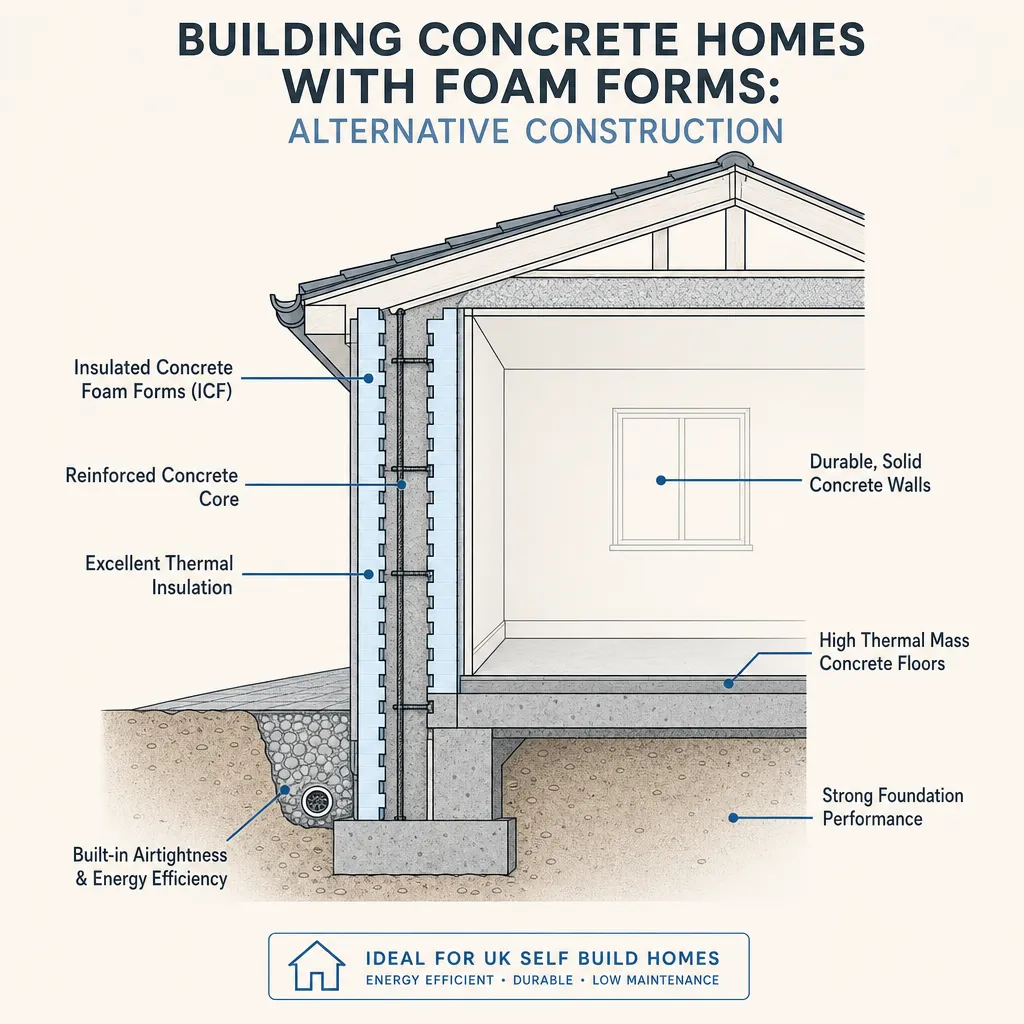
Building Concrete Homes with Foam Forms: Alternative Construction
Insulated concrete formwork (ICF) uses lightweight EPS foam blocks as permanent shuttering filled with reinforced concrete to form walls.
 Planning & Pre-Build
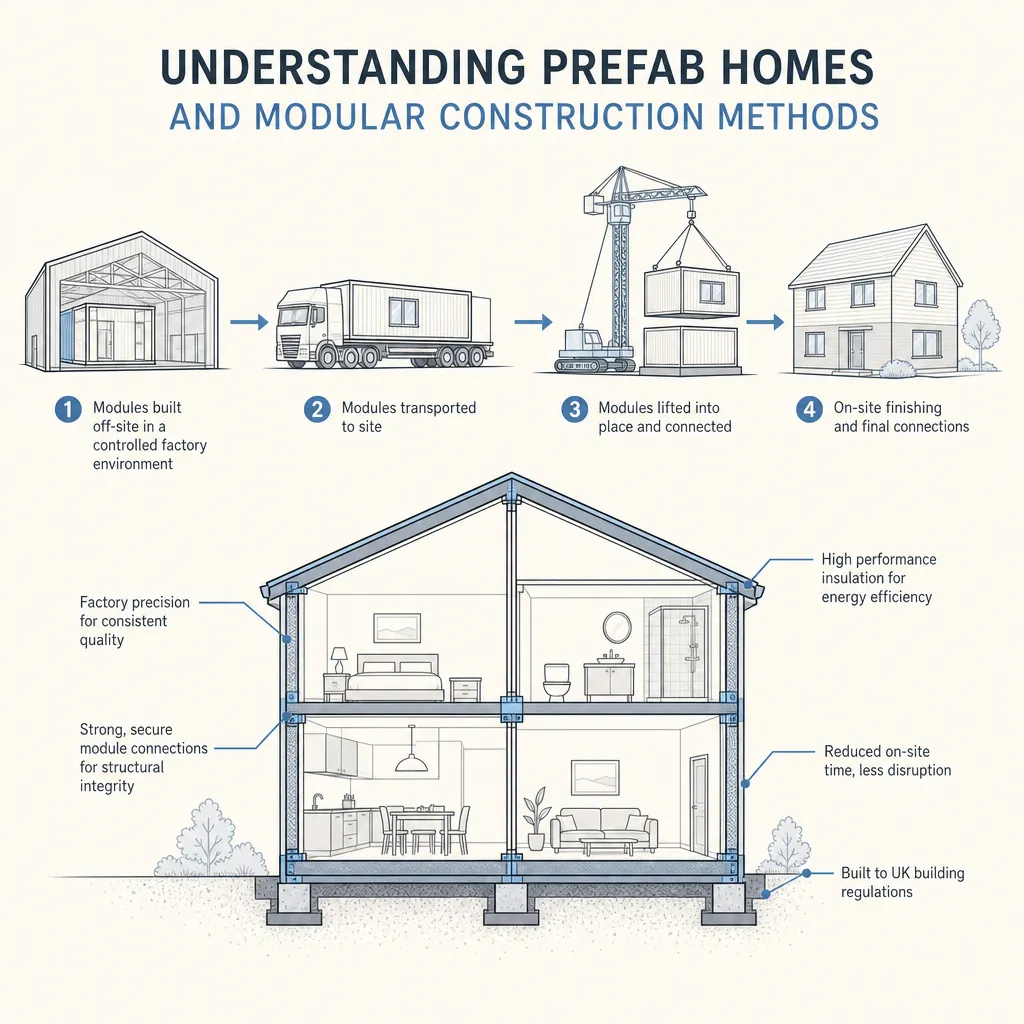
Understanding prefab homes and modular construction methods
Prefab and modular construction covers a range of off-site manufacturing methods, from timber frame panels to fully volumetric room modules craned into position.
 Planning & Pre-Build
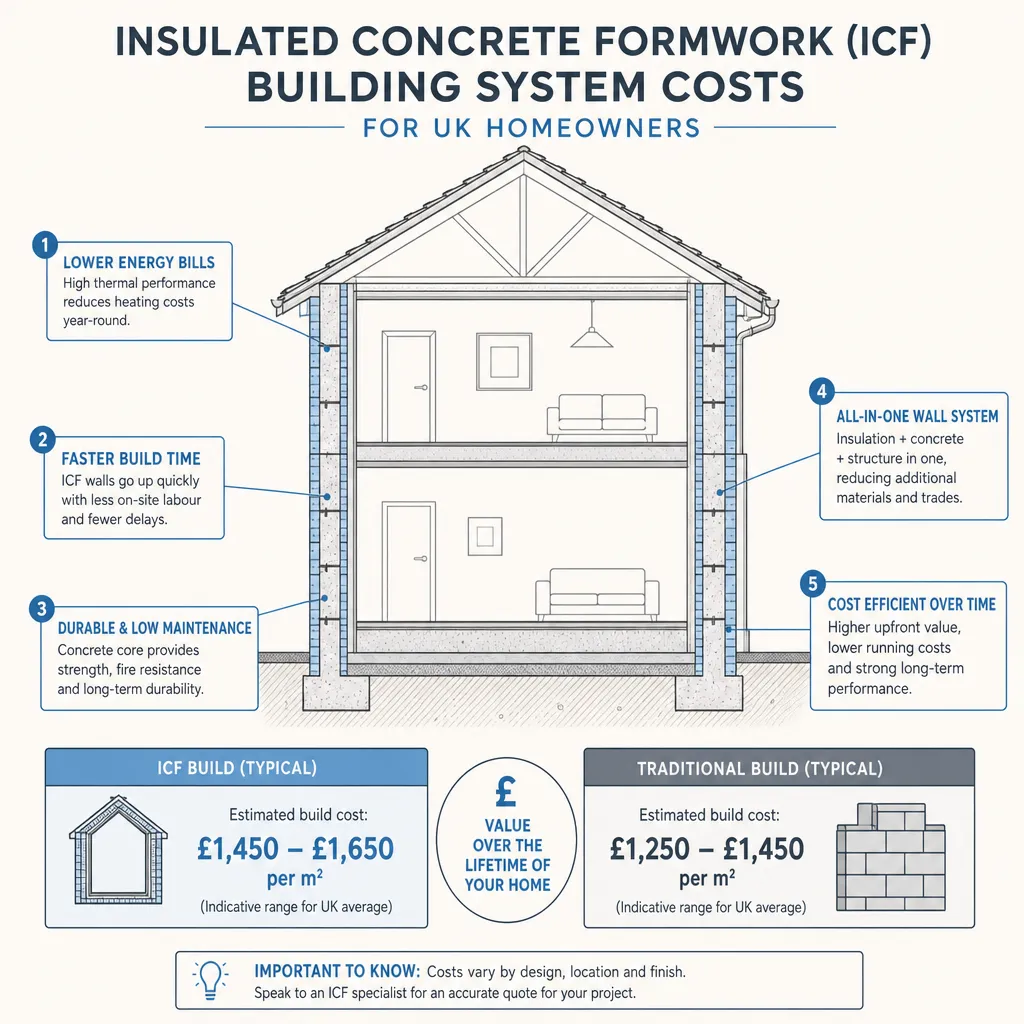
Insulated Concrete Formwork Building System Costs
In the UK, ICF (Insulated Concrete Formwork) materials typically cost £25–£50 per m² of wall area, with a completed shell wall at £80–£130 per m².
 Planning & Pre-Build
Changes to Loft Conversion Rules: Permitted Development and Planning Updates
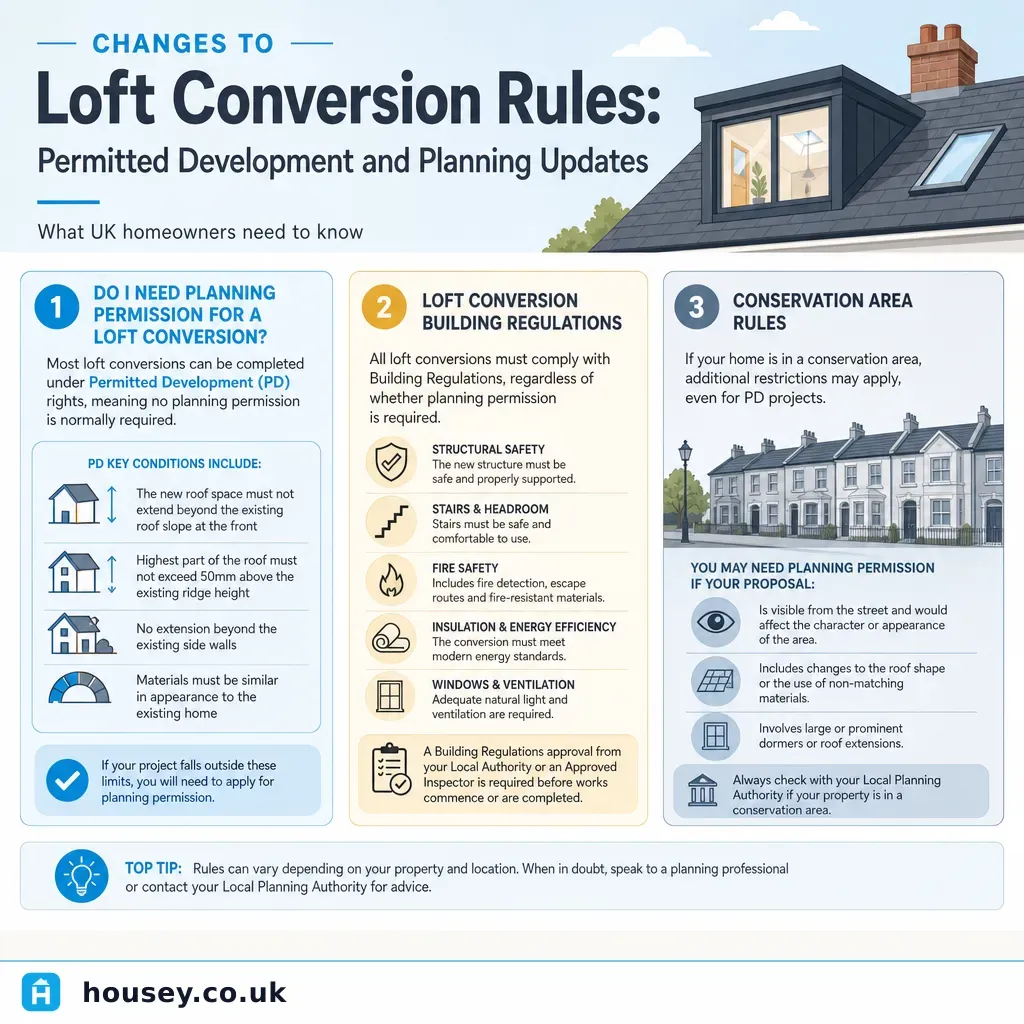
In England, most loft conversions on standard houses qualify as Permitted Development under Class B of the GPDO 2015, allowing up to 40 cubic metres (terraced) or 50 cubic metres (detached or semi-detached) without a planning application — if conditions are met.
 Planning & Pre-Build
Residential Properties Built with Concrete Construction Methods
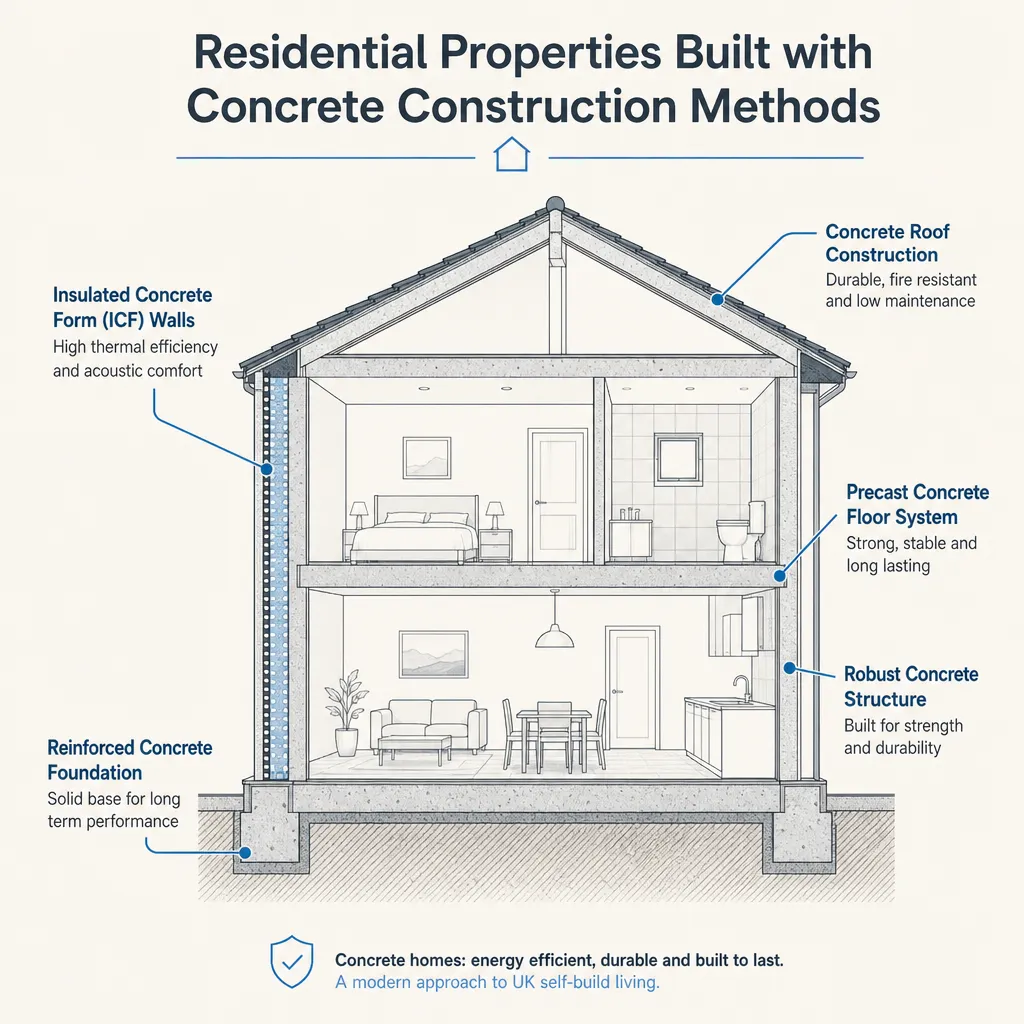
UK homes are built using several concrete methods: in-situ cast concrete, precast panel systems, insulating concrete formwork (ICF), and older non-traditional types such as Wimpey No-Fines and Laing Easiform.