Concrete Homes: Durability and Weather Resistance Explained
By Housey · Last reviewed 11th of May 2026
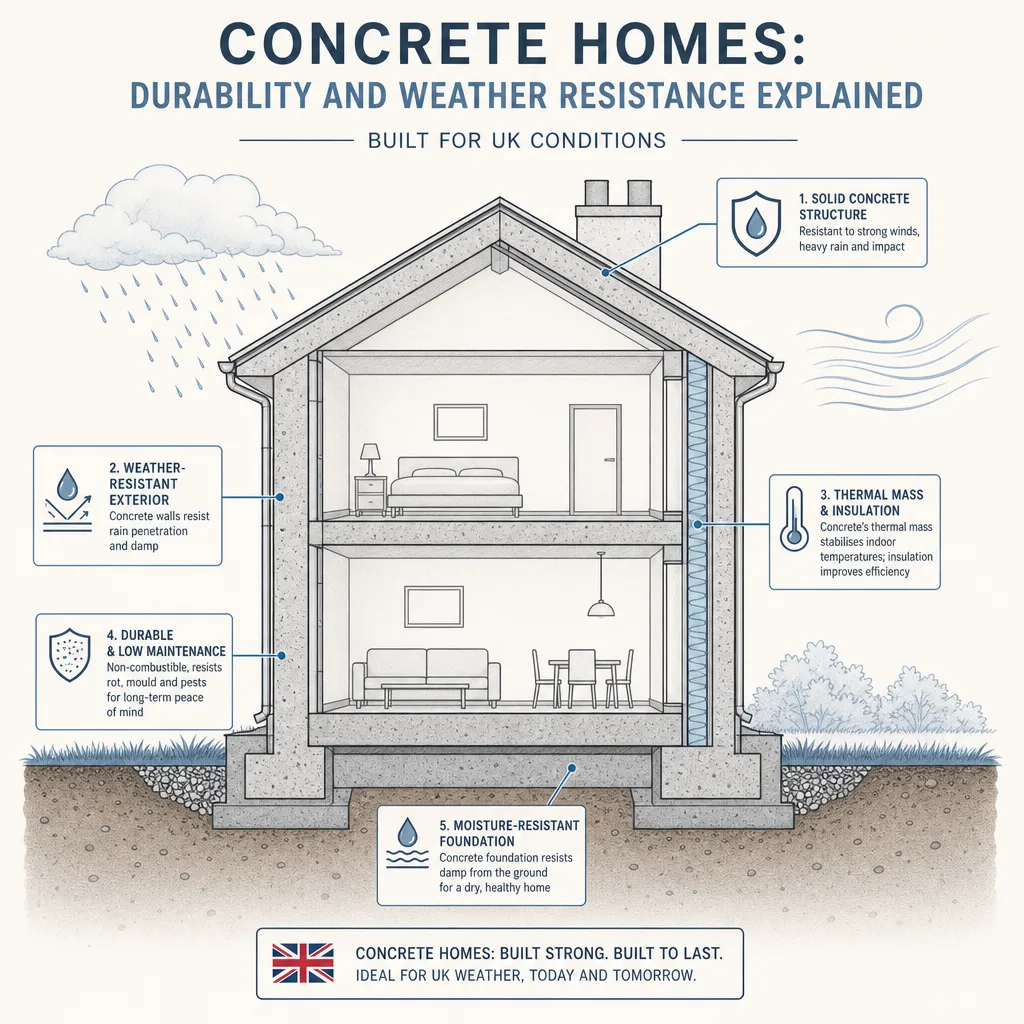
Concrete Homes: Durability and Weather Resistance Explained
Choosing concrete as a primary construction material — or assessing an existing concrete home — involves understanding how the material performs over decades of exposure to the UK's wet, variable climate. The question arises most often at the planning stage for a new self-build, when purchasing an older non-traditional property, or when a surveyor flags concerns about an existing concrete-framed house. What's at stake is the long-term structural performance of the building, as well as its mortgageability and insurability.
Key points
- Concrete buildings designed to BS EN 1992 (Eurocode 2) carry an indicative design life of 50–100 years depending on structural class and exposure category.
- Post-war prefabricated reinforced concrete (PRC) homes built under 1945–1970s government housing programmes are classified as non-standard construction by most UK mortgage lenders.
- Carbonation — the gradual neutralisation of concrete's alkalinity by atmospheric CO₂ — is the primary deterioration mechanism in older UK concrete structures, accelerating reinforcement corrosion.
- Concrete's thermal mass helps moderate internal temperatures but requires additional insulation to comply with Building Regulations Part L (2021 edition) U-value targets.
- Insulated concrete formwork (ICF) systems used in UK self-build projects typically achieve wall U-values of 0.15–0.18 W/m²K, meeting and often exceeding current Part L requirements.
How durable is concrete as a building material?
Correctly specified, placed, and cured concrete is one of the most durable building materials available. Its performance in the UK climate depends on three factors: the concrete mix design, the quality of reinforcement cover and detailing, and ongoing maintenance.
Compressive strength and structural class
Modern structural concrete in residential buildings is typically specified to a minimum compressive strength class of C25/30 (25 N/mm² cylinder strength) under BS EN 206. Higher-specification mixes — C30/37 and above — are used in foundations, retaining walls, and externally exposed elements where the durability exposure class demands it.
Carbonation and reinforcement corrosion
The main deterioration risk in older UK concrete homes is carbonation. Atmospheric CO₂ reacts with calcium hydroxide in the concrete matrix, reducing pH from around 13 to below 9. Below pH 9, the passive oxide layer protecting steel reinforcement breaks down, allowing rust to form. Rust expands in volume and causes spalling — the characteristic crumbling and surface cracking visible on many 1960s and 1970s buildings.
Chloride ingress
In coastal locations or where de-icing salts are used near the building, chloride ions can penetrate concrete and trigger reinforcement corrosion even where carbonation has not yet reached reinforcement depth. This is a recognised issue in some post-war concrete housing stock in UK coastal towns.
How does concrete perform against UK weather?
Concrete is inherently resistant to rain penetration when properly specified, but the UK climate presents specific challenges across seasons:
Weather factor | Concrete performance | Key risk | Mitigation |
|---|---|---|---|
Driving rain | Good — dense concrete has low water absorption | Cracked surfaces allow direct water ingress | Surface treatment and regular inspection |
Freeze-thaw cycling | Moderate — susceptible if mix is poor or cover is inadequate | Spalling and surface scaling in exposed elements | Air-entrained concrete mix to BS EN 206 |
Thermal movement | Moderate — lower expansion coefficient than steel | Cracking at poorly detailed joints | Correct movement joint spacing and sealing |
UV and weathering | Good — not degraded by UV unlike some polymers | Surface carbonation accelerates in polluted air | Coatings available but require periodic maintenance |
Wind-driven moisture | Good for dense in-situ concrete | Precast panel joints can admit water if seals fail | Regular joint inspection and repointing |
Post-war concrete homes: what to know before buying
The UK has a significant stock of non-traditional concrete homes built under post-war government housing programmes. System-built concrete homes — including Airey houses, Wimpey no-fines, and Laing Easi-Form — were constructed between roughly 1945 and the mid-1970s across local authority and private housing estates.
Worked UK scenario: Airey house in a northern English town
A buyer encounters a 1952 Airey house — a prefabricated concrete column-and-panel system. Their mortgage lender classifies it as non-standard construction and declines to lend without further information. The buyer commissions a RICS Level 3 Building Survey alongside a specialist PRC structural assessment. The surveyor finds carbonation has reached the reinforcement in several columns and recommends a licensed PRC Homes Ltd repair scheme. The buyer uses the report to negotiate a price reduction, and the vendor instructs an approved contractor before exchange.
Key considerations for buyers of PRC homes:
- Most standard high-street lenders will not mortgage an unrepaired PRC home — confirm lender criteria before making an offer.
- A licensed repair scheme approved by PRC Homes Ltd may restore mortgageability, but not all PRC types have an approved scheme.
- Some PRC home types are effectively unmortgageable on the open market without specialist lenders.
- Always commission a specialist structural report alongside a standard RICS survey.
Insulated concrete formwork (ICF) for new builds
For new-build projects, insulated concrete formwork has grown in popularity among UK self-builders. ICF involves casting in-situ concrete into expanded polystyrene formwork that remains in place as permanent insulation, combining a structural concrete core with a continuous thermal envelope.
Comparison: ICF concrete vs cavity masonry vs timber frame for UK new build
Criteria | ICF concrete | Cavity masonry | Timber frame |
|---|---|---|---|
Thermal performance | Excellent — U-values of 0.15–0.18 W/m²K achievable | Good — careful detailing needed for Part L 2021 | Good — dependent on membrane and insulation spec |
Airtightness | Very good — monolithic core limits infiltration | Moderate — requires careful sealing at junctions | Good — dependent on membrane installation quality |
Thermal mass | High — useful for summer overheating mitigation | Moderate–high | Low–moderate |
Build speed | Moderate | Moderate | Fast |
Mortgageability | Good — mainstream lenders accept modern ICF | Mainstream | Mainstream |
Design life | 100+ years for the concrete core | 60–100 years | 60–100 years with correct maintenance |
Indicative finished build cost | £1,500–£2,000/m² | £1,300–£1,800/m² | £1,200–£1,700/m² |
Indicative UK costs, last reviewed 2026-05-11. Quotes vary significantly by region, specification, and site conditions.
When to get professional help
Concrete homes benefit from specialist input at several stages. Seek professional advice if:
- A surveyor or mortgage valuer has flagged non-standard construction, carbonation risk, or reinforcement concerns.
- You are purchasing a post-war prefabricated concrete home and need a structural assessment.
- Cracks, spalling, rust staining, or water ingress are visible in any concrete element.
- You are planning a new ICF or in-situ concrete build and need structural calculations or Building Regulations approval drawings.
- Your mortgage lender requires a specialist structural report before lending on a concrete property.
How Housey can help
If you are planning a new concrete or ICF build, or need specialist input on an existing concrete home, Housey connects you with qualified professionals. An architect experienced in concrete construction can advise on ICF systems, structural form, and detailing for planning and building regulations. A structural engineer can provide the structural calculations and assessments needed for Building Regulations approval or a mortgage lender's specialist report on a non-traditional property.
Frequently asked questions
Are concrete homes harder to sell than brick-built homes in the UK?
Modern ICF concrete homes are broadly accepted by mainstream mortgage lenders and generally straightforward to sell. Older non-traditional PRC homes are a different matter — most high-street lenders require a specialist structural report and, in many cases, a licensed repair scheme before they will lend. Always check lender criteria before purchasing or remortgaging a non-traditional concrete property.
Do concrete homes have damp problems?
Dense, well-specified concrete has very low water absorption and is inherently resistant to damp. However, older precast panel systems with failed joint sealants can admit moisture, and carbonation can allow water to reach corroding reinforcement. If damp is suspected in a concrete home, commission a specialist survey rather than treating it as standard cavity-wall damp.
Can a concrete home be insulated to current Building Regulations standards?
Yes. New ICF construction easily achieves Part L 2021 U-value requirements. Existing concrete homes can be externally or internally insulated, but any upgrade should be designed carefully to avoid interstitial condensation, particularly in solid-concrete or PRC wall systems. A retrofit designer or accredited energy assessor should assess the wall build-up before specifying insulation materials.
How long does a concrete house last?
Correctly specified and maintained in-situ concrete has a design life of 50–100 years under Eurocode 2 (BS EN 1992). Some well-built mid-20th-century concrete structures have lasted considerably longer. The main risk to lifespan is reinforcement corrosion driven by carbonation or chloride ingress, which can be mitigated through adequate cover depth, good mix design, and periodic professional inspection.
Sources and further reading
- Approved Document A: Structure — GOV.UK
- Approved Document L: Conservation of fuel and power — GOV.UK
- BS EN 1992 Eurocode 2: Design of concrete structures — BSI
- PRC Homes Ltd — approved repair schemes — PRC Homes Ltd
- BRE — concrete durability and carbonation guidance — BRE Group
- RICS guidance on non-standard construction — RICS
Useful next reads
 Planning & Pre-Build
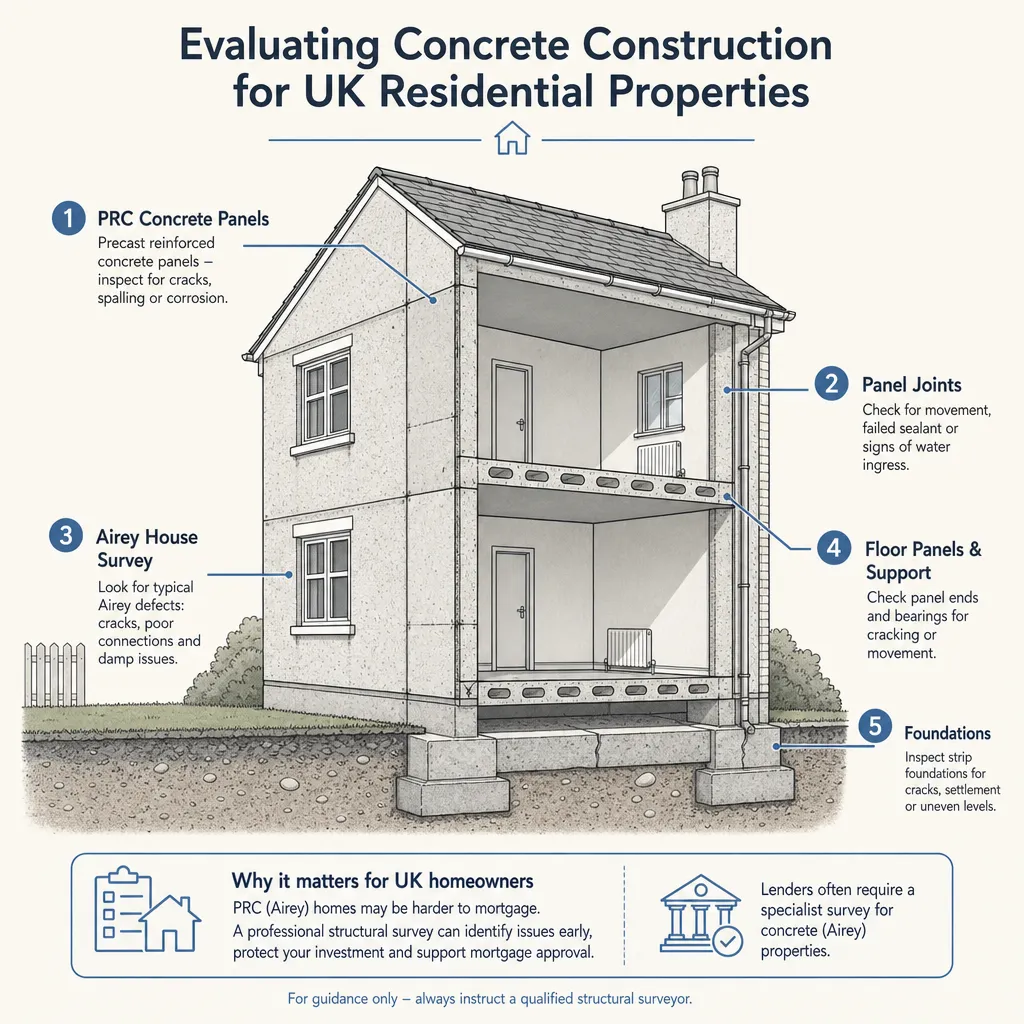
Evaluating Concrete Construction for UK Residential Properties
Concrete construction in UK homes covers post-war non-traditional housing — such as Airey and Wimpey No-Fines properties — typically classified as non-standard by mortgage lenders, and modern systems including ICF and block cavity wall, which are generally standard.
 Planning & Pre-Build
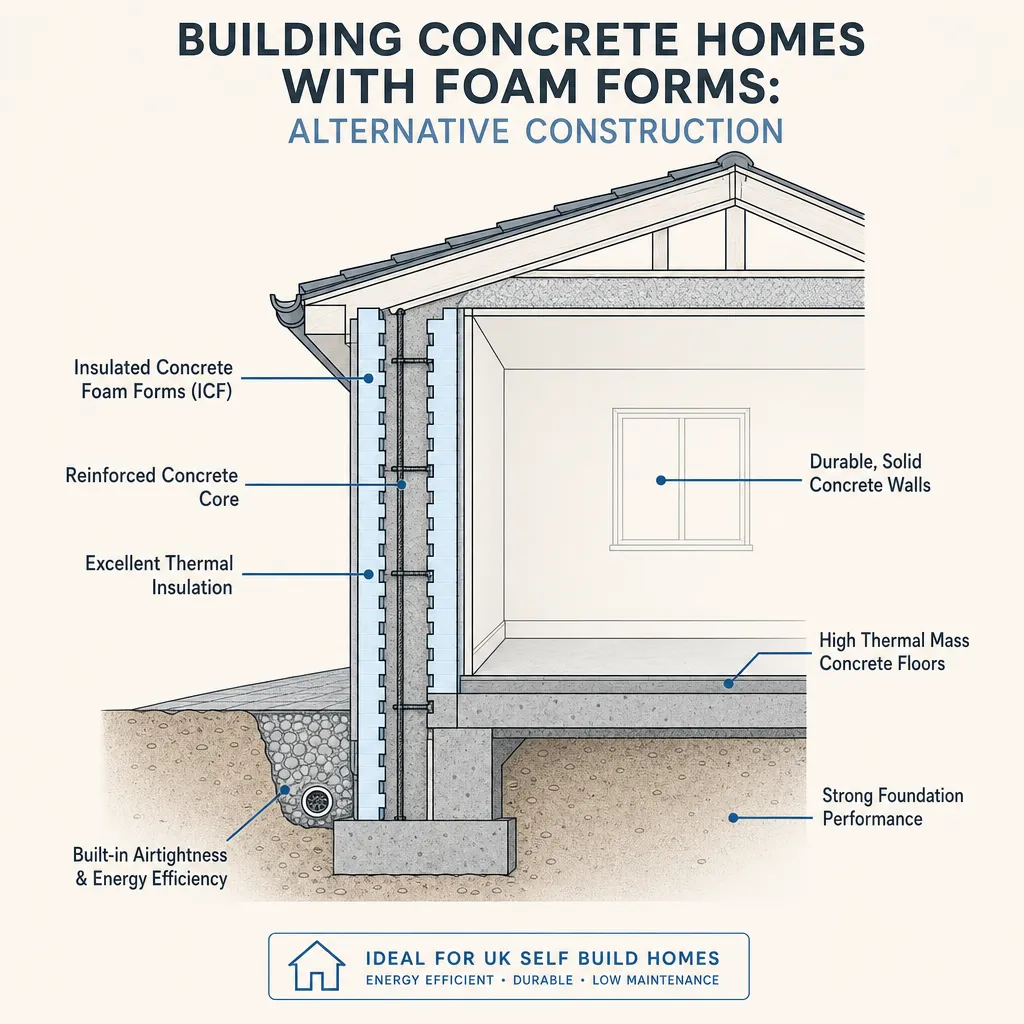
Building Concrete Homes with Foam Forms: Alternative Construction
Insulated concrete formwork (ICF) uses lightweight EPS foam blocks as permanent shuttering filled with reinforced concrete to form walls.
 Planning & Pre-Build
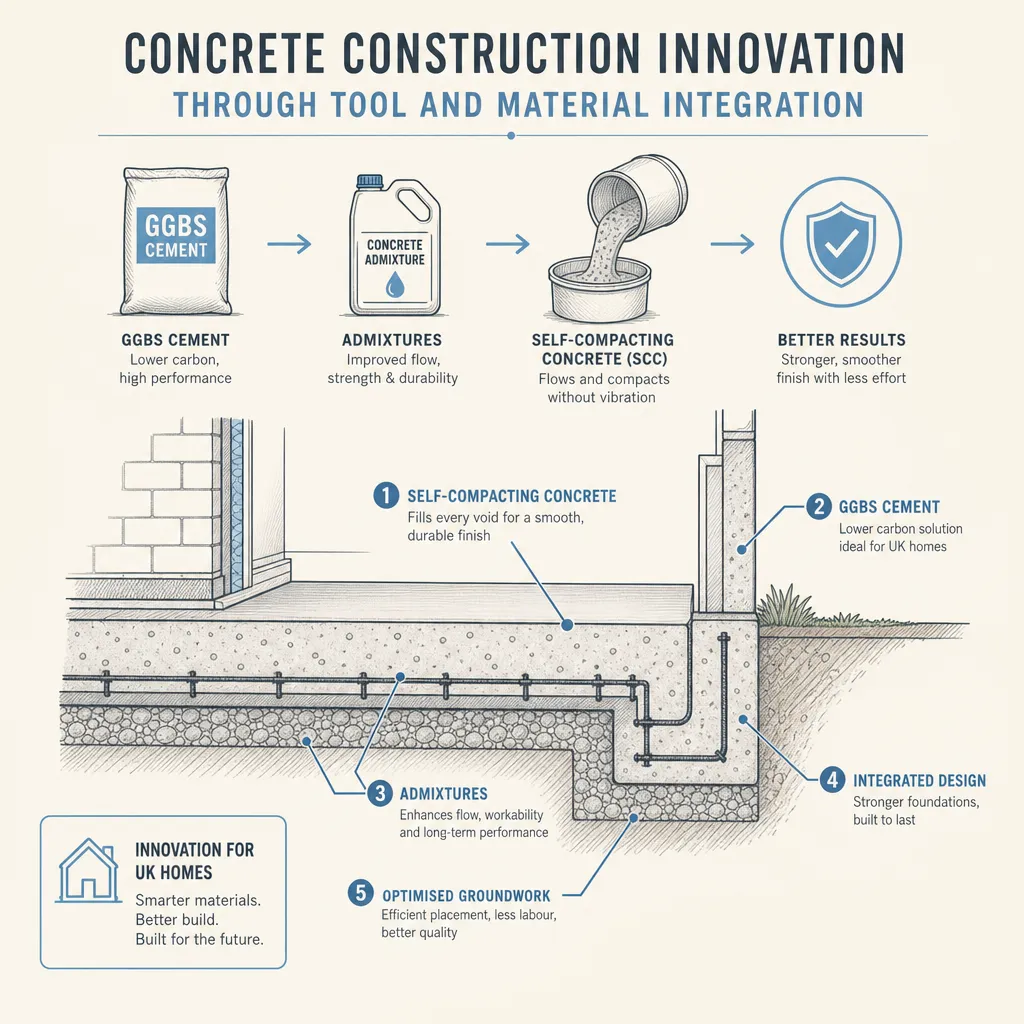
Concrete Construction Innovation Through Tool and Material Integration
Modern concrete mixes — self-compacting, fibre-reinforced, and low-carbon GGBS blends — require specific placement equipment and admixtures to perform correctly.
 Planning & Pre-Build
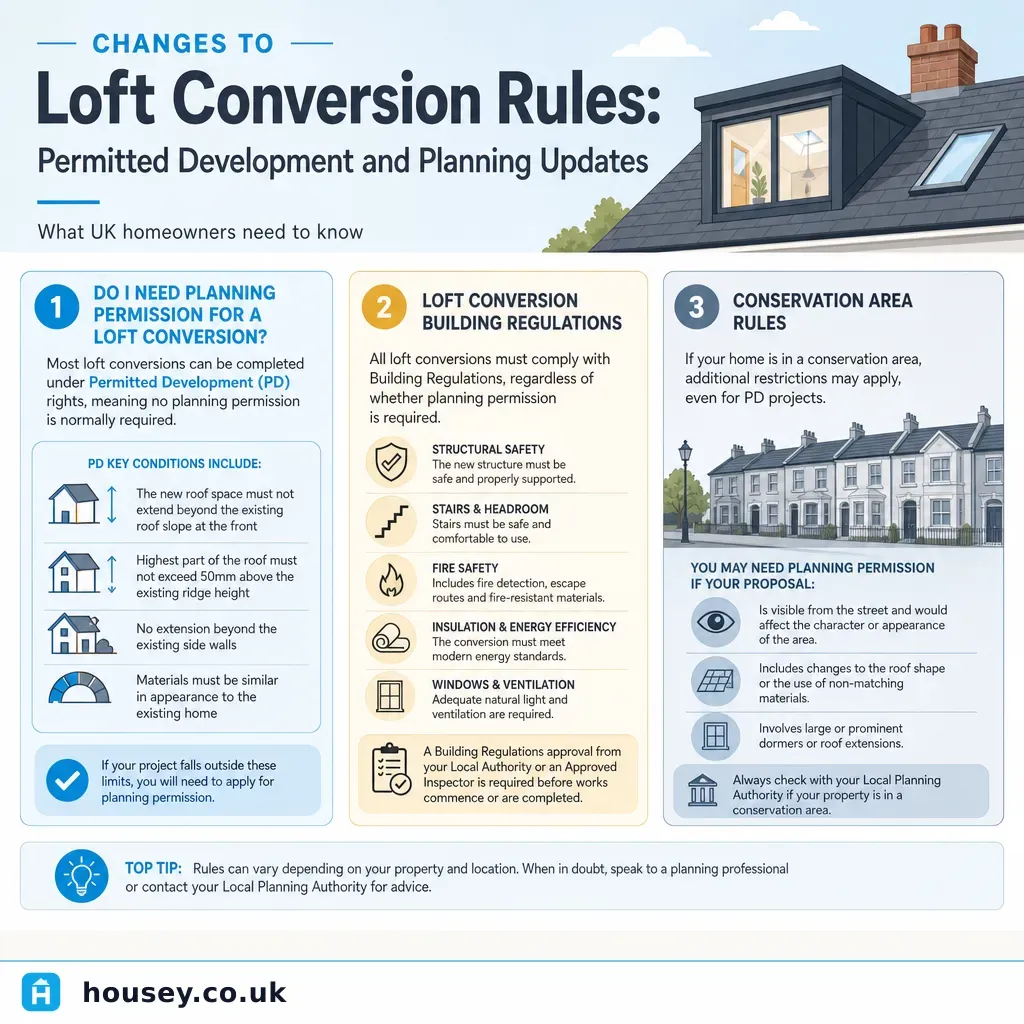
Changes to Loft Conversion Rules: Permitted Development and Planning Updates
In England, most loft conversions on standard houses qualify as Permitted Development under Class B of the GPDO 2015, allowing up to 40 cubic metres (terraced) or 50 cubic metres (detached or semi-detached) without a planning application — if conditions are met.
 Planning & Pre-Build
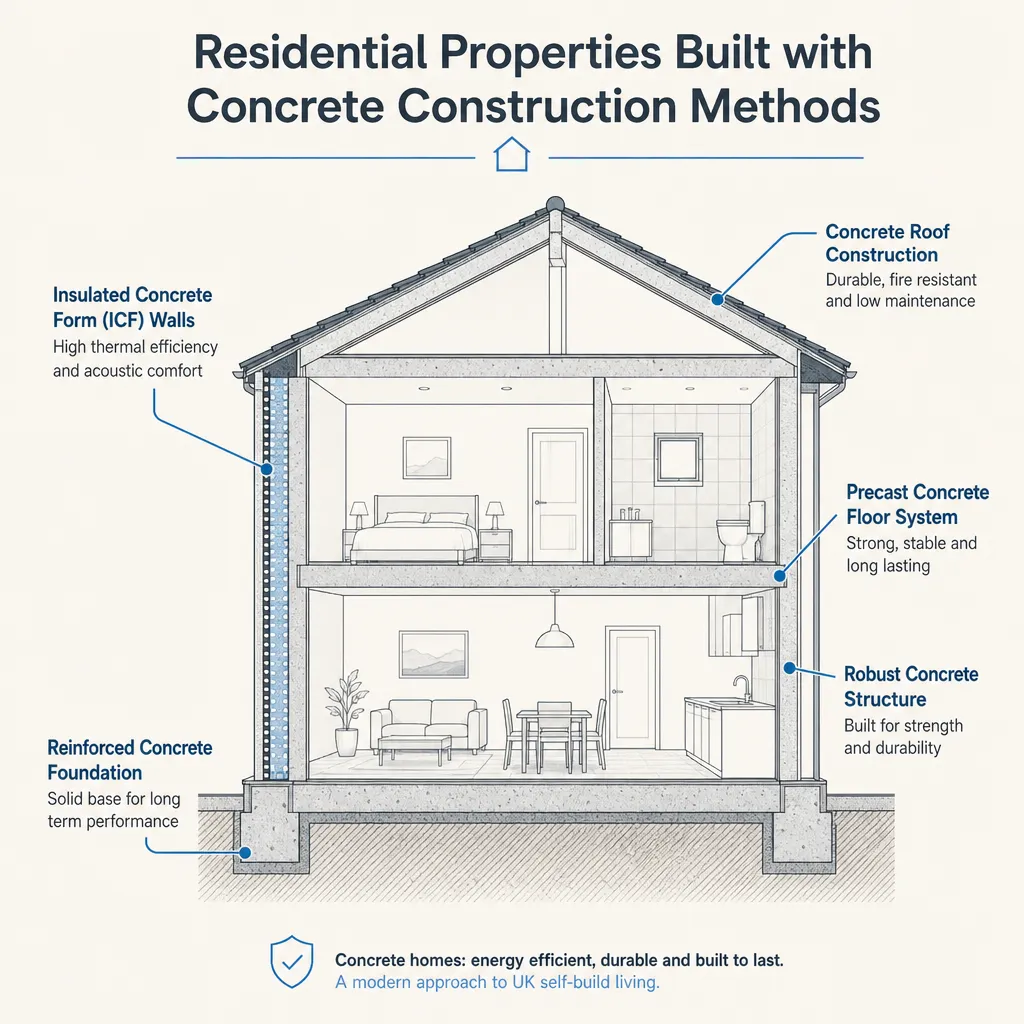
Residential Properties Built with Concrete Construction Methods
UK homes are built using several concrete methods: in-situ cast concrete, precast panel systems, insulating concrete formwork (ICF), and older non-traditional types such as Wimpey No-Fines and Laing Easiform.