Understanding Building Control Approvals and Planning Compliance Requirements
By Housey · Last reviewed 30th of May 2026
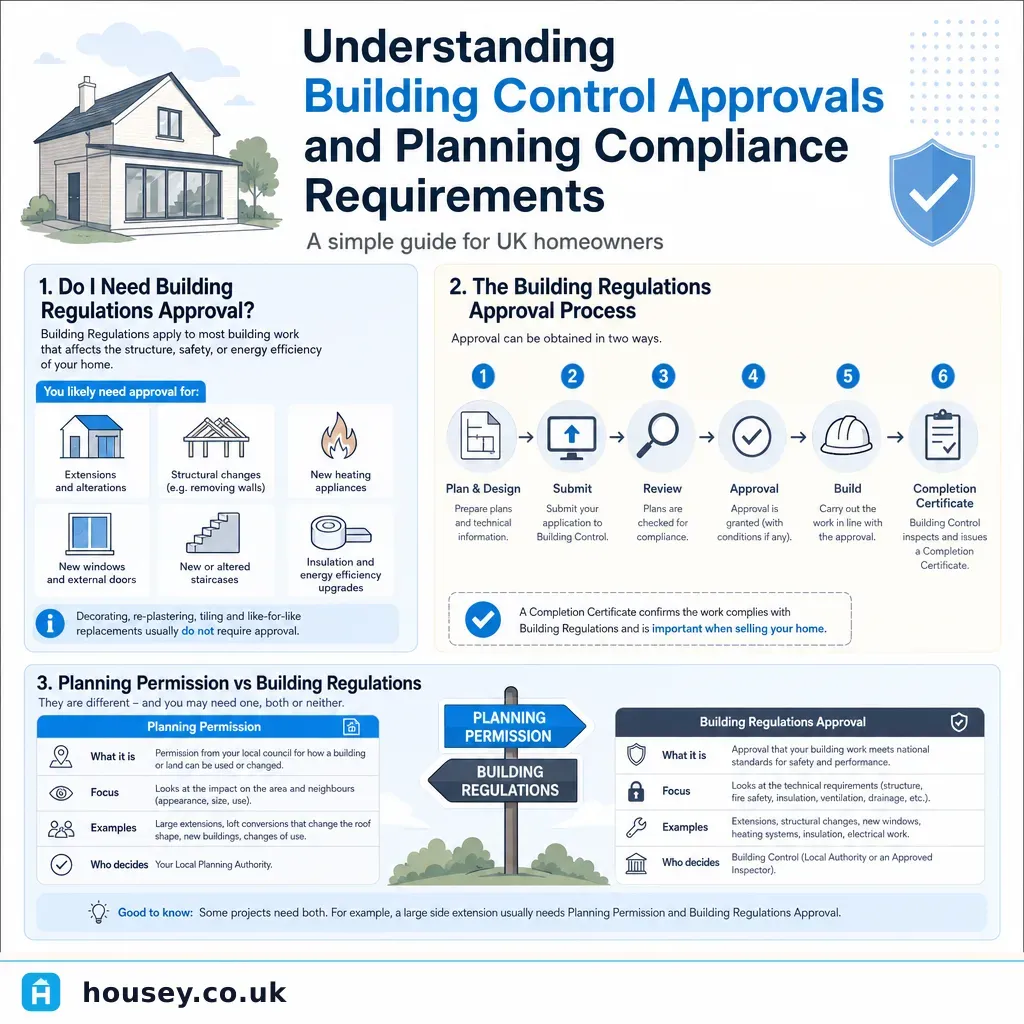
Understanding Building Control Approvals and Planning Compliance Requirements
Most significant home improvement and construction projects in England and Wales require statutory approval — yet the distinction between planning permission and building regulations is one of the most common points of confusion for UK homeowners and developers. Proceeding without the correct consent can result in enforcement action, costly remediation works, or serious complications at conveyancing, where solicitors routinely request documentary evidence of compliance before exchange.
Key points
- Planning permission and building regulations approval are entirely separate consent regimes — obtaining one does not grant the other.
- A Completion Certificate issued by building control confirms that finished work complies with Building Regulations; mortgage lenders and solicitors routinely require this on property sales.
- Permitted development rights allow certain works — including many loft conversions, single-storey rear extensions, and garage conversions — without planning permission, but conditions vary by property type, location, and prior works history.
- A Full Plans application to building control must be approved before work begins; a Building Notice allows work to start within 48 hours but carries greater risk if inspections reveal non-compliant construction.
- The Building Safety Act 2022 introduced a new regime for Higher-Risk Buildings (HRBs — residential buildings above 18 m or 7 storeys), with the Building Safety Regulator as the new building control authority for this class.
Planning permission vs building regulations: key differences
These two regimes control different aspects of development and are frequently confused. The table below summarises each consent:
| Planning permission | Building regulations approval |
|---|---|---|
What it controls | Land use, external appearance, impact on neighbours and environment | Structural integrity, fire safety, energy performance, drainage, accessibility |
Who decides | Local planning authority (LPA) | Local authority building control (LABC) or a Registered Building Inspector |
When required | Change of use, most extensions, new buildings, external alterations in sensitive areas | Most structural works, new builds, extensions, loft conversions, electrical and heating changes |
Can work start without it? | No (unless permitted development applies) | No for Full Plans; 48 hours after submission for Building Notice (at your risk) |
Output document | Planning decision notice | Completion Certificate |
Enforcement period | Generally 4 years for dwellings; up to 10 years for change of use | Ongoing liability |
Which consent do I need?
Use this decision guide for common domestic projects:
- Rear single-storey extension — likely permitted development (check size limits and conditions on the Planning Portal or with your LPA); building regulations required for structural, drainage, and Part L energy compliance.
- Loft conversion — usually permitted development within volume allowances; building regulations required for structural work, fire safety, insulation, and escape route compliance.
- Garage conversion — usually permitted development if no external changes are made; building regulations required for insulation, ventilation, structural, and fire provisions.
- New build or replacement dwelling — planning permission required; full building regulations submission required.
- Listed building or conservation area — listed building consent may be needed in addition to, or instead of, planning permission; permitted development rights are often restricted; check with your LPA.
- Change of use (e.g., to HMO or commercial to residential) — planning permission likely required; building regulations typically required for structural and fire safety compliance.
- New boiler or heating system — building regulations apply; self-certification is available through a Gas Safe registered engineer.
- New windows or doors — building regulations apply to thermal performance under Part L; FENSA-registered installers can self-certify.
Building Notice vs Full Plans application
Route | Full Plans application | Building Notice |
|---|---|---|
When to use | Complex or significant projects | Small, straightforward works only |
What you submit | Detailed plans and specifications | Short notice form |
Approval before work begins? | Yes — typically within five weeks | No — work can start 48 hours after submission |
Risk if issues found | Low — problems identified before construction | Higher — non-compliant work may need to be exposed or removed |
Completion Certificate issued? | Yes, on satisfactory completion | Yes, on satisfactory completion |
Preferred by lenders and solicitors? | Yes | Less commonly accepted for larger works |
For the majority of domestic projects, a Full Plans application provides greater certainty and is typically preferred by mortgage lenders and solicitors at the point of sale.
Document preparation list
Before submitting a building regulations application, gather:
Important limitations
This article provides general guidance only. Building regulations, planning rules, permitted development conditions, and the scope of the Building Safety Act 2022 are complex and vary by property type, location, local authority, and project scope. Rules differ substantially for listed buildings, flats, and Higher-Risk Buildings. Always verify requirements with your local planning authority and local authority building control before starting work. This article does not constitute legal or professional planning advice.
What to ask a qualified professional
Before instructing a designer, contractor, or building control body, ask:
- Does my project require planning permission, or does permitted development apply?
- Are there any article 4 directions, conservation area restrictions, or listed building constraints affecting my property?
- Should I proceed via a Full Plans or Building Notice route for building regulations, and why?
- Will a Registered Building Inspector or the local authority manage inspections, and who arranges them?
- What structural calculations or energy compliance evidence will be required for submission?
- At what stages will building control site inspections take place?
- How do I ensure I receive a Completion Certificate on satisfactory completion?
- Does my project fall under the Higher-Risk Buildings regime of the Building Safety Act 2022, and does the Building Safety Regulator need to be engaged?
When this becomes urgent
Seek professional advice before starting any work, and act immediately if:
- Works have already begun without the required approvals — stopping and applying retrospectively is possible in some cases, but costs increase significantly and enforcement risk rises.
- You are buying or selling a property where previous works lack planning permission or a building regulations Completion Certificate — solicitors will raise this, and regularisation or indemnity insurance may be needed before exchange.
- The property is listed, in a conservation area, or subject to an article 4 direction — unauthorised works can result in enforcement requiring full reinstatement at the owner's cost.
- The project involves a building over 18 m or 7 storeys — the Building Safety Regulator must be engaged under the Building Safety Act 2022 before work begins.
How Housey can help
Housey connects homeowners and developers with experienced professionals across the pre-build approvals process, including building control consultants, specialists in planning consultancy, and those who can prepare building regulations drawings to support a compliant Full Plans submission.
Frequently asked questions
What happens if work is carried out without building regulations approval?
If work proceeds without the required building regulations approval, you may be required to expose, alter, or remove elements of the construction to allow inspection. Selling the property becomes complicated — solicitors will ask for Completion Certificates and may request indemnity insurance if they are absent. In serious cases, local authorities can issue enforcement notices requiring remediation.
How long does building regulations approval take?
A Full Plans application is typically decided within five weeks of a valid submission, or up to two months if extended by mutual agreement. Complex projects involving structural calculations, fire safety assessments, or energy compliance evidence may take longer. Engaging building control early in the design process helps avoid delays.
Can I regularise works carried out without approval?
Many local authority building control departments offer a Regularisation Certificate process for work completed without approval after 11 November 1985. Inspectors will assess compliance, which may require opening up parts of the structure. A regularisation certificate is generally more acceptable to solicitors and mortgage lenders than indemnity insurance alone.
Is planning permission permanent once granted?
Planning permissions in England typically expire after three years if development has not meaningfully begun. Conditions attached to the permission must also be discharged before certain stages of construction commence. Check with your local planning authority to confirm what constitutes a valid start and which pre-commencement conditions apply to your permission.
Sources and further reading
- Planning permission – GOV.UK — GOV.UK
- Building regulations approval – GOV.UK — GOV.UK
- Building Safety Act 2022 — legislation.gov.uk
- Permitted development rights – Planning Portal — Planning Portal
- Local Authority Building Control (LABC) — LABC
Useful next reads
 Planning & Pre-Build
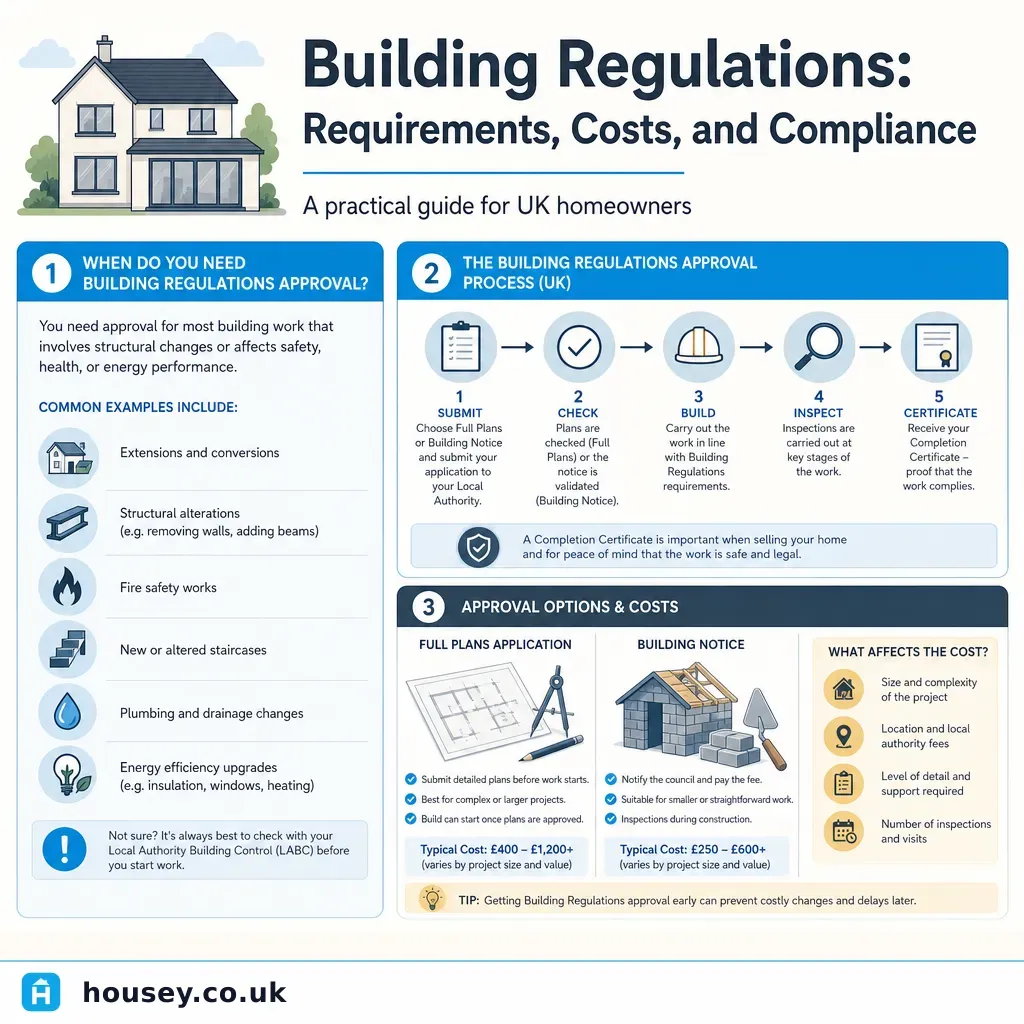
Building Regulations: Requirements, Costs, and Compliance
Building regulations set minimum standards for how construction work is carried out in the UK, covering structural stability, fire safety, energy efficiency, and ventilation.
 Planning & Pre-Build
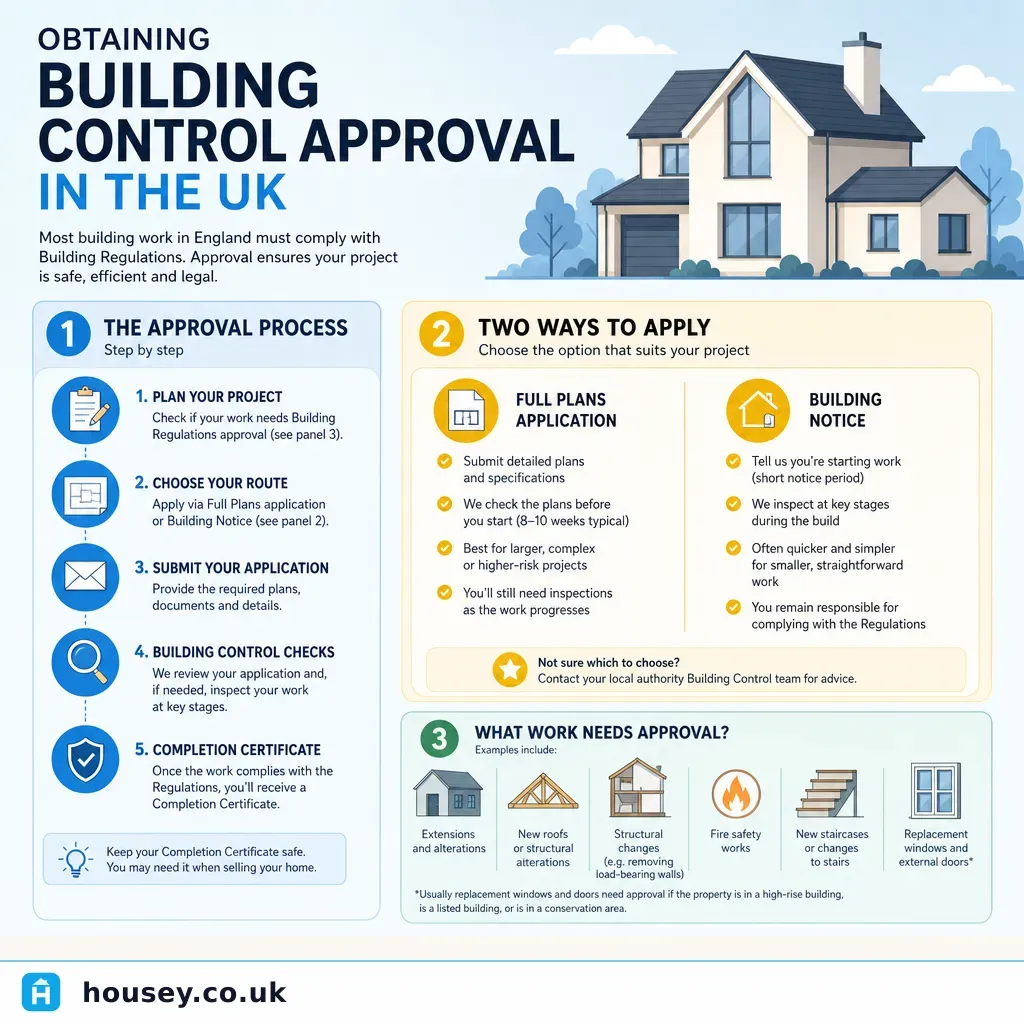
Obtaining Building Control Approval in the UK
Building control approval in the UK is required for most structural changes, extensions, loft conversions, and new builds.
 Planning & Pre-Build
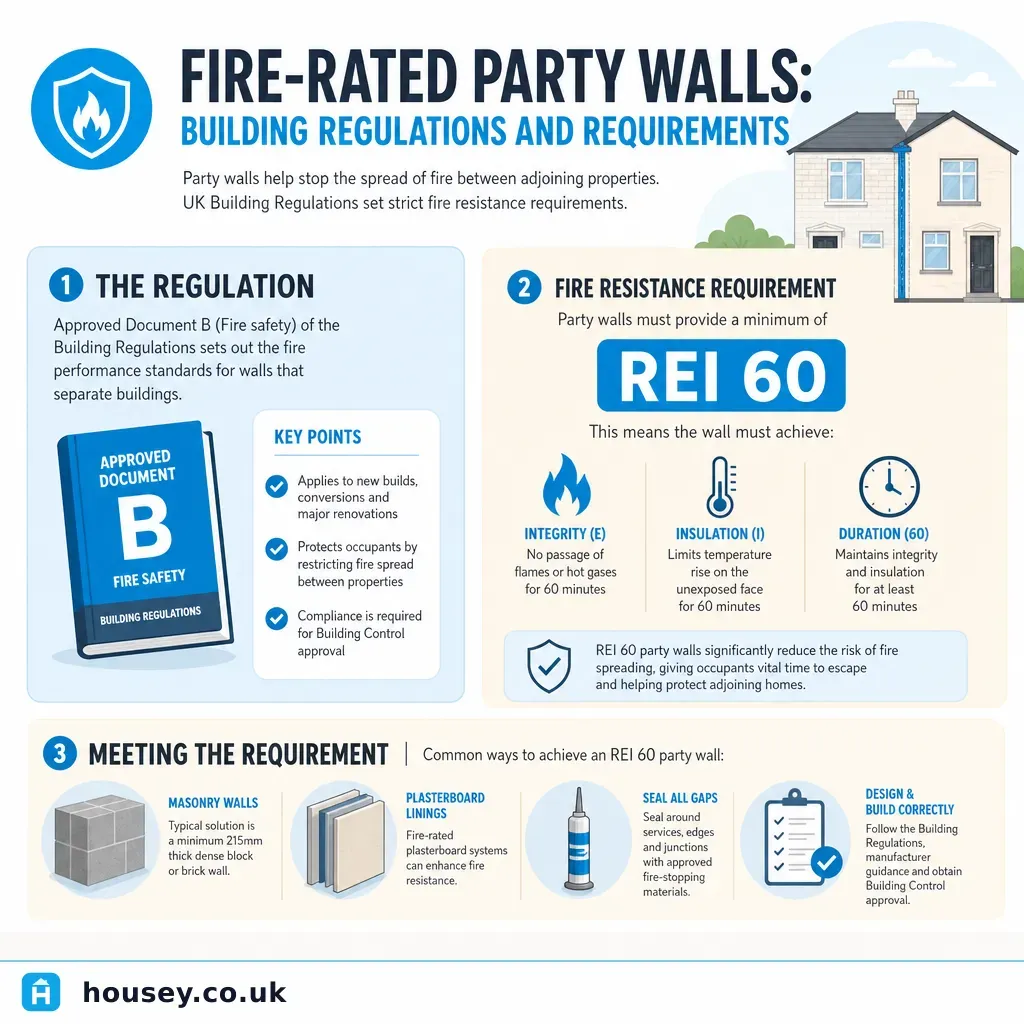
Fire-Rated Party Walls: Building Regulations and Requirements
Party walls between dwellings must achieve at least 60 minutes' fire resistance, expressed as REI 60, under Building Regulations Approved Document B.
 Planning & Pre-Build
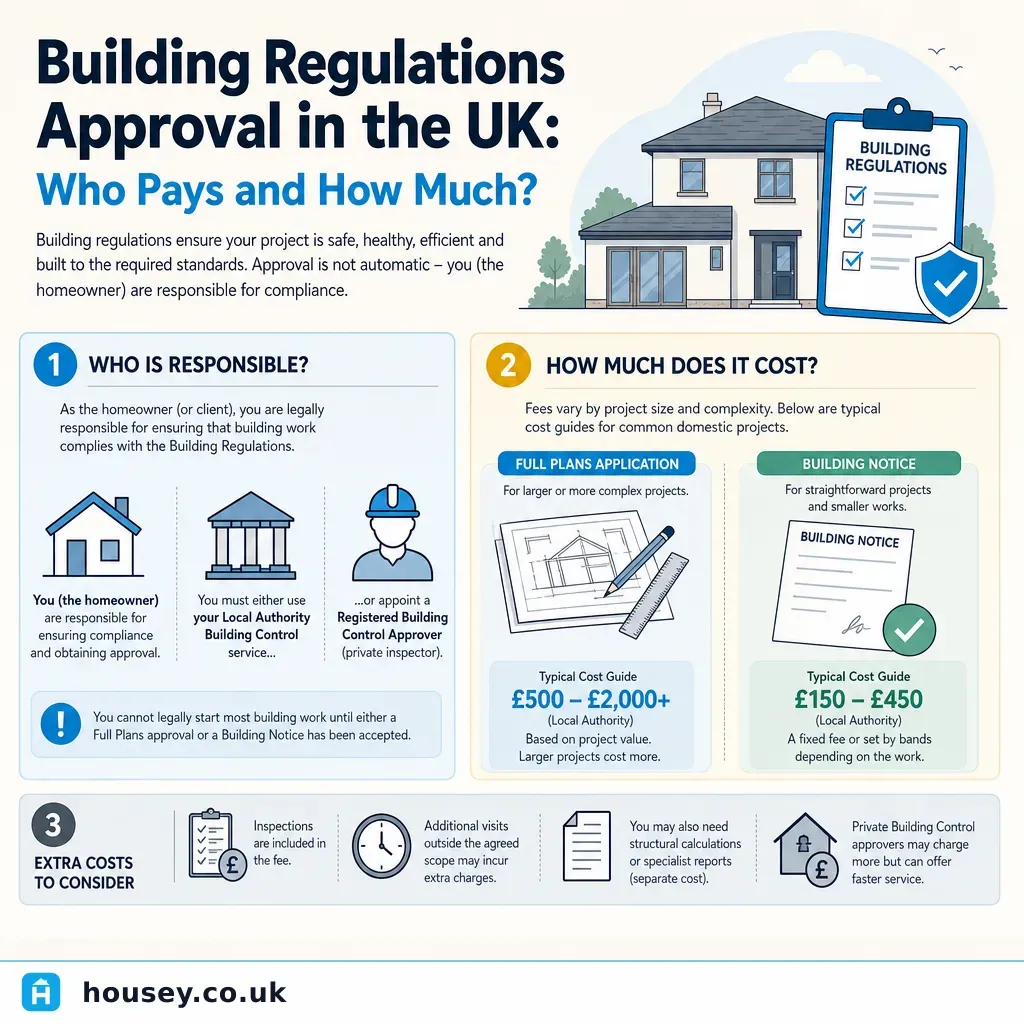
Building Regulations Approval in the UK: Who Pays and How Much?
Building regulations approval fees are almost always paid by the homeowner or the person commissioning the work, not the contractor.
 Planning & Pre-Build
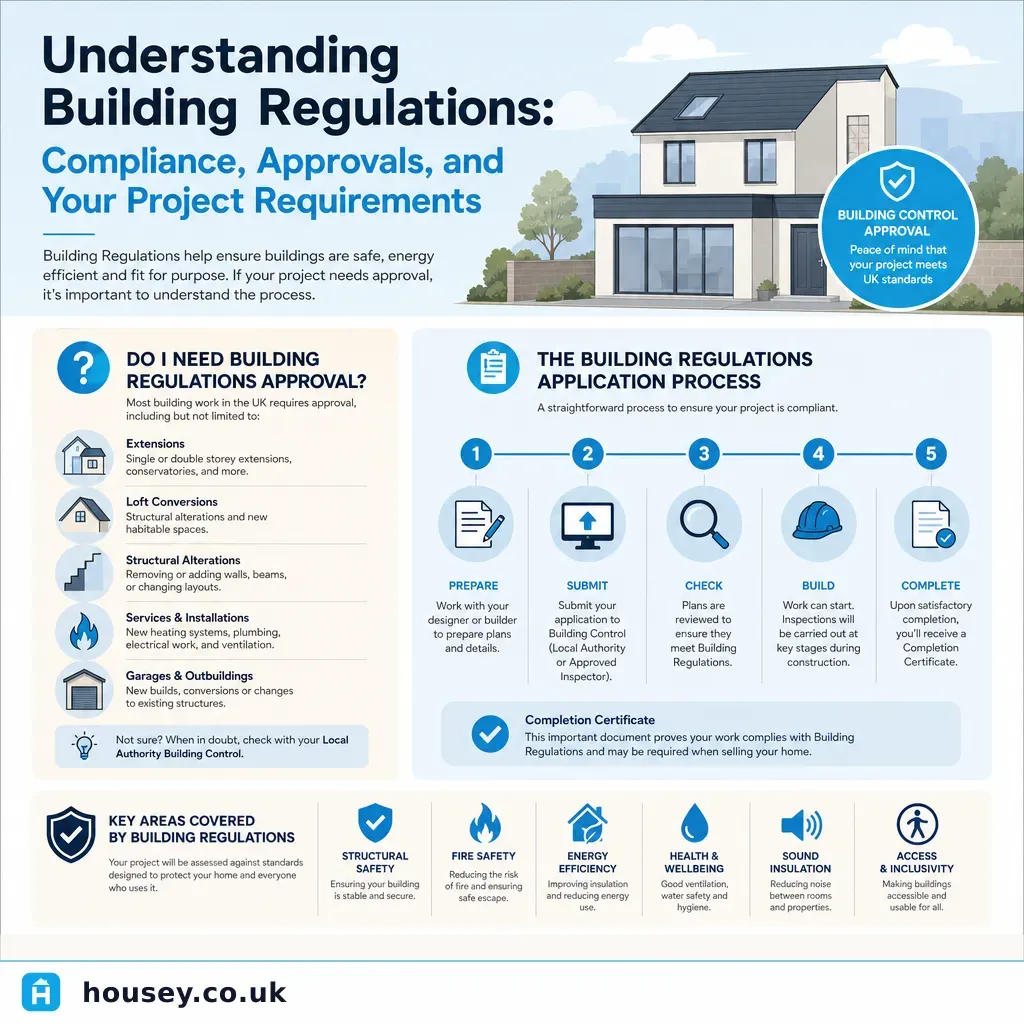
Understanding Building Regulations: Compliance, Approvals, and Your Project Requirements
Building regulations set minimum standards for design, construction, and alterations to buildings in England and Wales.