Fire-Rated Party Walls: Building Regulations and Requirements
By Housey · Last reviewed 11th of May 2026
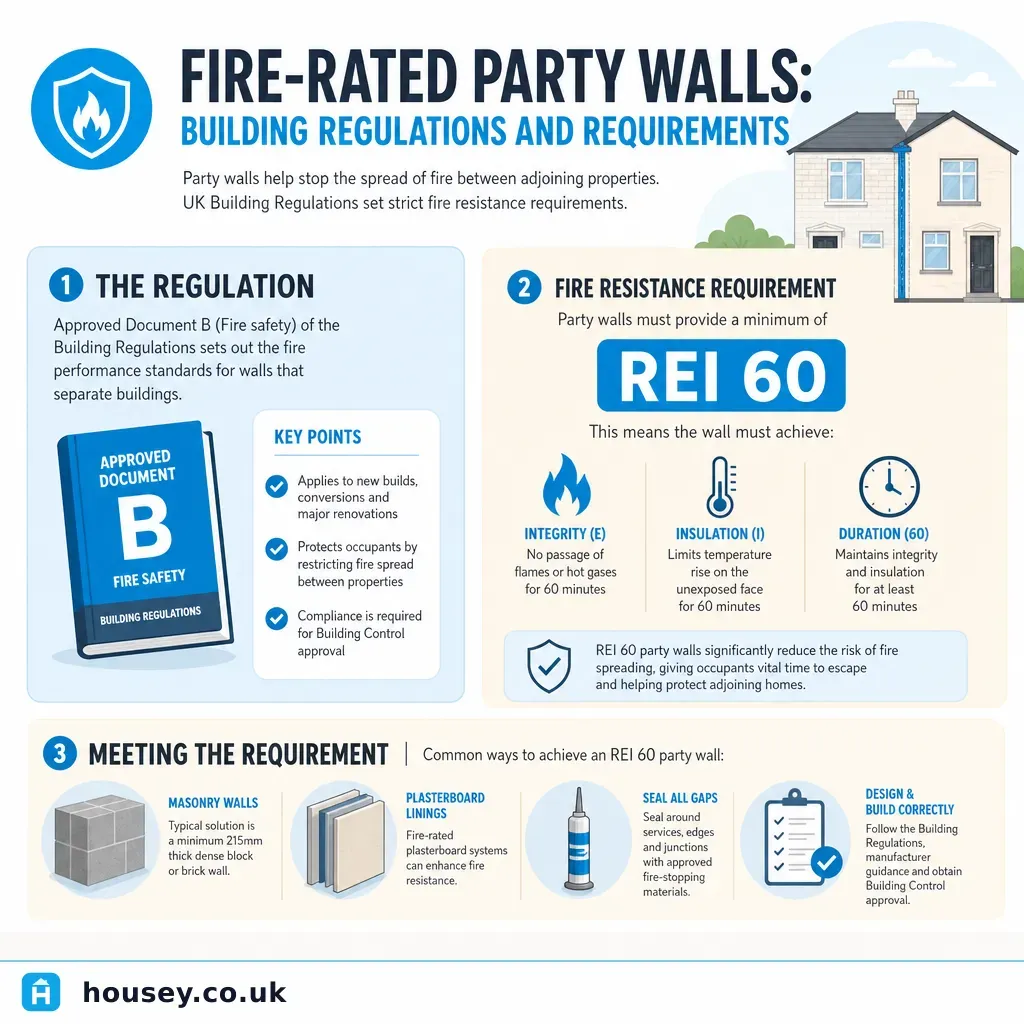
Fire-Rated Party Walls: Building Regulations and Requirements
Party walls — the shared walls between terraced or semi-detached homes — sit at the intersection of two separate regulatory regimes. When any work affects these walls, homeowners and builders must navigate both fire safety requirements under Building Regulations and the procedural obligations of the Party Wall etc. Act 1996. Getting either wrong can result in a failed building control inspection, enforcement action, or a wall that genuinely endangers the occupants of both properties.
Key points
- Party walls separating dwellings must achieve a minimum 60 minutes' fire resistance (REI 60) under Approved Document B (Fire Safety) Volume 1.
- Fire resistance is measured across three criteria: load-bearing Resistance, fire Integrity (no gaps through which flames or hot gases can pass), and thermal Insulation against heat transfer.
- Building Regulations and the Party Wall etc. Act 1996 are entirely separate legal frameworks — one governs construction standards, the other governs neighbour notice and dispute procedures.
- Any party wall that is altered, rebuilt, or newly formed as part of a loft conversion, extension, or new-build requires building control approval before and after the work.
- Approved Document B, Volume 1 also requires a party wall to rise to the full height of the building — with no gaps — to prevent fire travelling into the roof void.
What fire resistance in a party wall actually means
Fire resistance is not a single pass/fail measurement — it is expressed as three performance criteria under BS EN 13501-2:
- R — Load-bearing capacity: the wall continues to carry structural loads throughout the test period.
- E — Integrity: no cracks, gaps, or openings through which flames or hot gases can pass.
- I — Insulation: the temperature on the unexposed face does not exceed a defined limit.
A party wall separating two dwellings must satisfy REI 60 — 60 minutes on all three criteria simultaneously. This is the minimum standard in Approved Document B, Volume 1 (Dwellinghouses), Table A1. Where the party wall also forms part of a compartment separating floors in a block of flats, higher ratings (REI 90 or REI 120) may apply under Approved Document B Volume 2.
The requirement extends beyond the wall itself. Every element that penetrates a party wall — pipes, cables, flues, extract ducts — must be protected with fire stopping that maintains the 60-minute rating. Unfilled penetrations are one of the most frequent failures identified at building control inspection.
Construction types and how they achieve the required rating
Different wall constructions achieve REI 60 by different means. Building control inspectors check that the actual construction matches a tested or calculated specification.
Construction type | Typical specification | Achieves REI 60? | Notes |
|---|---|---|---|
Solid clay brick masonry | 215 mm brick, both faces plastered | Yes | Traditional solution; widely accepted by building control |
Dense aggregate concrete block | 100 mm dense block, both faces plastered | Yes | Common in modern masonry construction |
Timber frame with plasterboard | Timber studs, 2 x 15 mm Type F plasterboard each side, mineral wool cavity | Yes (if detailed correctly) | Must follow a tested system — see NHBC Standards Chapter 6.4 |
Steel stud partition | 70 mm steel frame, 2 x 15 mm Type F plasterboard each side | Yes (if detailed correctly) | Correct stud gauge and screw pattern required |
AAC (aircrete) block | 100 mm AAC block with plaster | Dependent on block density | Lighter blocks may not achieve REI 60 without additional plasterboard |
Critical detail for all types: the wall must extend to the full height of the building envelope. Where the roof void is continuous between dwellings, Approved Document B requires the party wall either to project above the roof covering or to be carried to the underside of the covering with adequate fire stopping. A gap in the party wall at roof level is among the most common building control failure points in loft conversion projects.
The Party Wall etc. Act 1996 — a separate obligation
The Party Wall etc. Act 1996 does not set fire resistance standards. It is a procedural framework designed to protect both parties' legal interests when party wall works are planned.
You must serve notice under the Act if you intend to:
- Build on or at the boundary (Line of Junction Notice — 1 month notice).
- Carry out works to an existing party wall, including cutting in for joists, raising, thickening, or underpinning (Party Structure Notice — 2 months notice).
- Excavate within 3 m or 6 m of a neighbouring foundation (Adjacent Excavation Notice).
If the adjoining owner consents in writing, no party wall award is needed. If they dissent or do not respond within 14 days, both parties must appoint surveyors to prepare a party wall award — a legally binding document that records the existing condition of the wall, describes the permitted works, and sets out access rights.
A party wall award does not replace building control approval. Both obligations must be met independently and run in parallel.
When building control approval is required
Building Regulations apply whenever you:
- Form a new party wall in a new-build or when subdividing a property into flats.
- Alter the structure of an existing party wall (raising, thickening, inserting steel beams or padstones).
- Carry out a loft conversion that uses the party wall as structural support or that requires raising the wall into the new roof space.
- Install a new flue or chimney through or adjacent to a party wall.
A Full Plans application — submitted before work starts — is the recommended route. The building control body checks the proposed construction against Approved Document B before any work begins. A Building Notice is a faster route but carries more risk: if the construction does not comply at inspection, remedial work is required.
Completion certificates matter for conveyancing. If you sell without one, a buyer's solicitor will raise enquiries and may require retrospective Building Regulations consent or professional indemnity insurance.
Important limitations
This article provides general information about the fire resistance requirements and regulatory framework applicable to party walls in England. Approved Document B contains numerous qualifications and additional requirements that depend on building type, number of storeys, floor area, and use. The Building Safety Act 2022 introduces heightened obligations for higher-risk buildings above 18 m or seven storeys in height. Rules for listed buildings and properties in conservation areas may also differ. A qualified building control surveyor or fire engineer should assess any specific project.
When to get professional help
Seek advice from a party wall surveyor or building control consultant if:
- You are converting a house into flats — party walls between floors may need upgrading to REI 90 or REI 120.
- The existing wall construction is unknown or cannot be confirmed by a builder or structural engineer.
- A building control inspector has flagged non-compliance during or after works.
- Your project involves a building above 11 m — additional requirements under the Building Safety Act 2022 may apply.
- Your neighbour has served party wall notice on you and the proposed works involve altering the fire resistance of the shared wall.
What to ask a qualified professional
Before instructing a party wall surveyor or building control consultant, ask:
- Does the proposed construction achieve REI 60 under a tested or calculated specification, or will it require a fire engineering assessment?
- Does the party wall need to extend above the roof covering, and how will fire stopping be detailed at that junction?
- Are there any penetrations (pipes, cables, or flues) through the wall that need intumescent collars or fire stopping?
- Does the Party Wall etc. Act 1996 apply to this project, and have the correct notices been served with the correct notice periods?
- Will building control require a Full Plans application, or is a Building Notice acceptable for this scope of work?
- Does the building's height or type bring it within the scope of the Building Safety Act 2022?
How Housey can help
Housey connects you with experienced party wall surveyors who can advise on notice obligations and manage the party wall process, and with building control consultants who can review your wall specification against Approved Document B before work begins. Early professional input avoids costly remedial work and delays at inspection stage.
Frequently asked questions
Does a party wall always need 60 minutes' fire resistance?
In most residential situations — terraced houses, semi-detached homes, and properties divided into flats — 60 minutes' fire resistance (REI 60) is the minimum required under Approved Document B. Where the party wall also separates floors in a building containing flats, or in taller buildings covered by Volume 2 of Approved Document B, 90 or 120 minutes may apply. Your building control body can confirm which applies to your project.
Can I upgrade a party wall to meet fire regulations as part of a loft conversion?
Yes, and this is often required. Many loft conversions involve raising the existing party wall or adding to it, and the construction used — whether masonry, timber frame, or steel stud — must comply with a tested specification. Building control will inspect the construction at key stages and before the roof covering is closed in.
Do I need both a party wall surveyor and a building control consultant?
They serve different functions. A party wall surveyor manages the legal notice and dispute process under the Party Wall etc. Act 1996. A building control consultant checks compliance with Building Regulations. Some projects need both running simultaneously — a new extension with a new party wall typically requires both processes to be in train before work starts.
What happens if the party wall fails a building control inspection?
The inspector will require remedial work before issuing a completion certificate. This may mean adding layers of Type F plasterboard, sealing penetrations with intumescent products, extending the wall to close gaps in the roof void, or opening up already-closed areas to inspect and correct the construction. Completion certificates are difficult to obtain retrospectively if defects are significant.
Sources and further reading
- Approved Document B (Fire Safety) Volume 1: Dwellinghouses — GOV.UK
- Party Wall etc. Act 1996 — explanatory guidance — GOV.UK
- Building Safety Act 2022 overview — GOV.UK
- NHBC Standards — NHBC
- BS EN 13501-2: Fire classification of construction products and building elements — British Standards Institution
Useful next reads
 Planning & Pre-Build
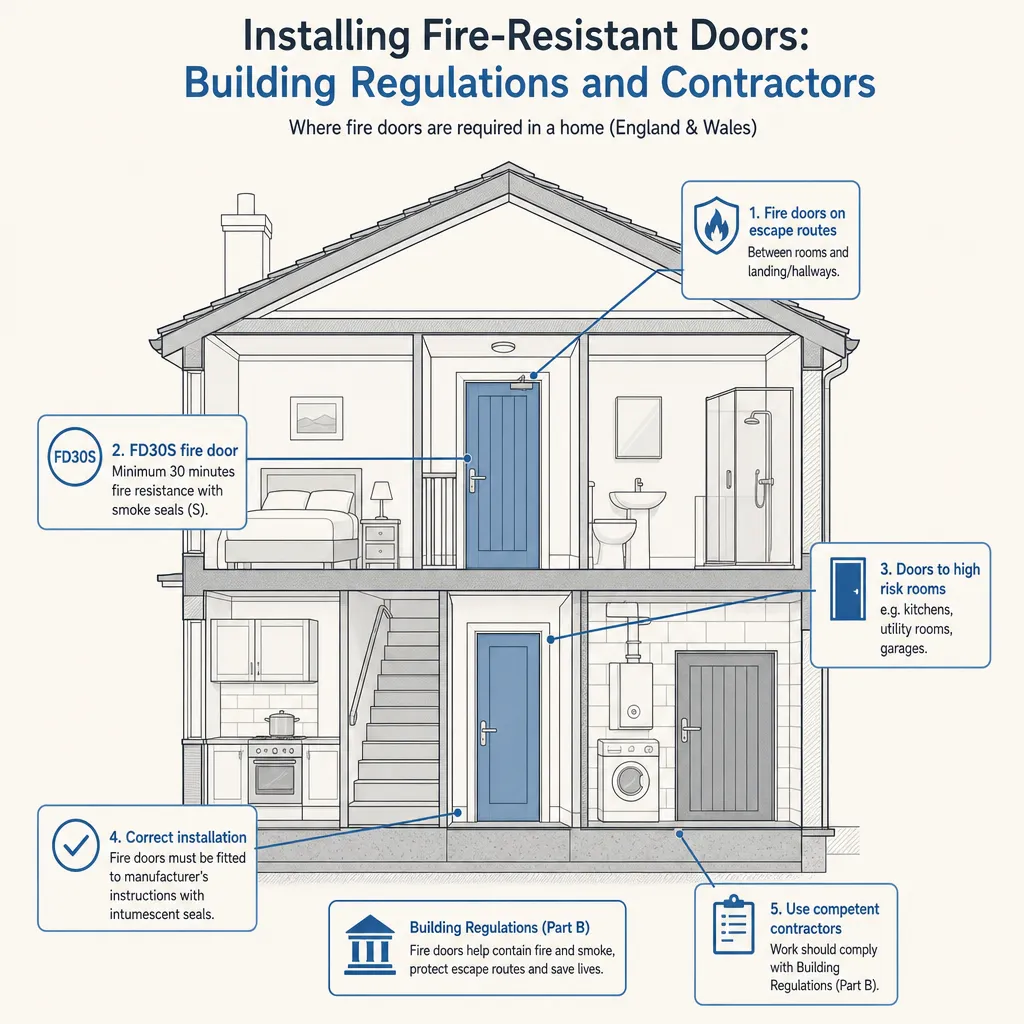
Installing Fire-Resistant Doors: Building Regulations and Contractors
Fire doors are required by Building Regulations in specific locations — including integral garages, properties of three or more storeys, loft conversions, and HMOs.
 Planning & Pre-Build
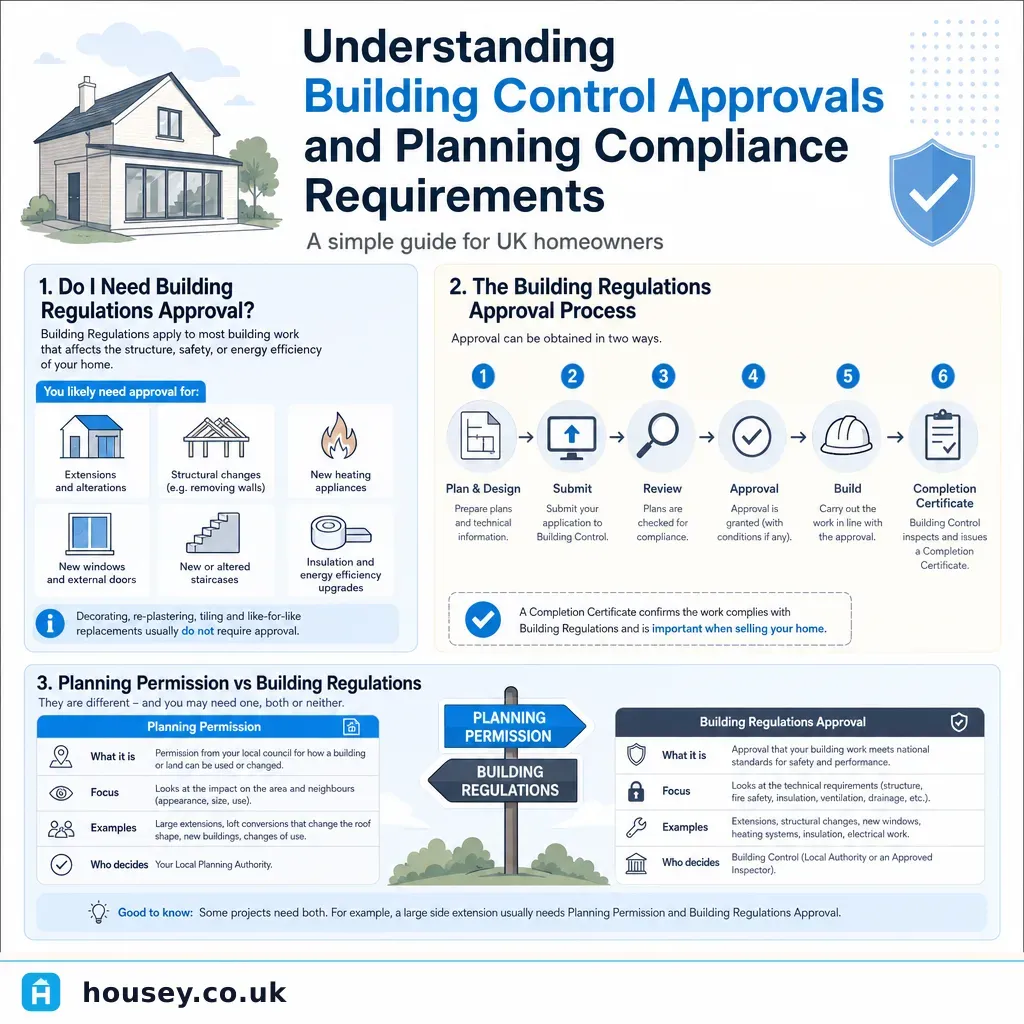
Understanding Building Control Approvals and Planning Compliance Requirements
Planning permission and building regulations are separate consents.
 Planning & Pre-Build
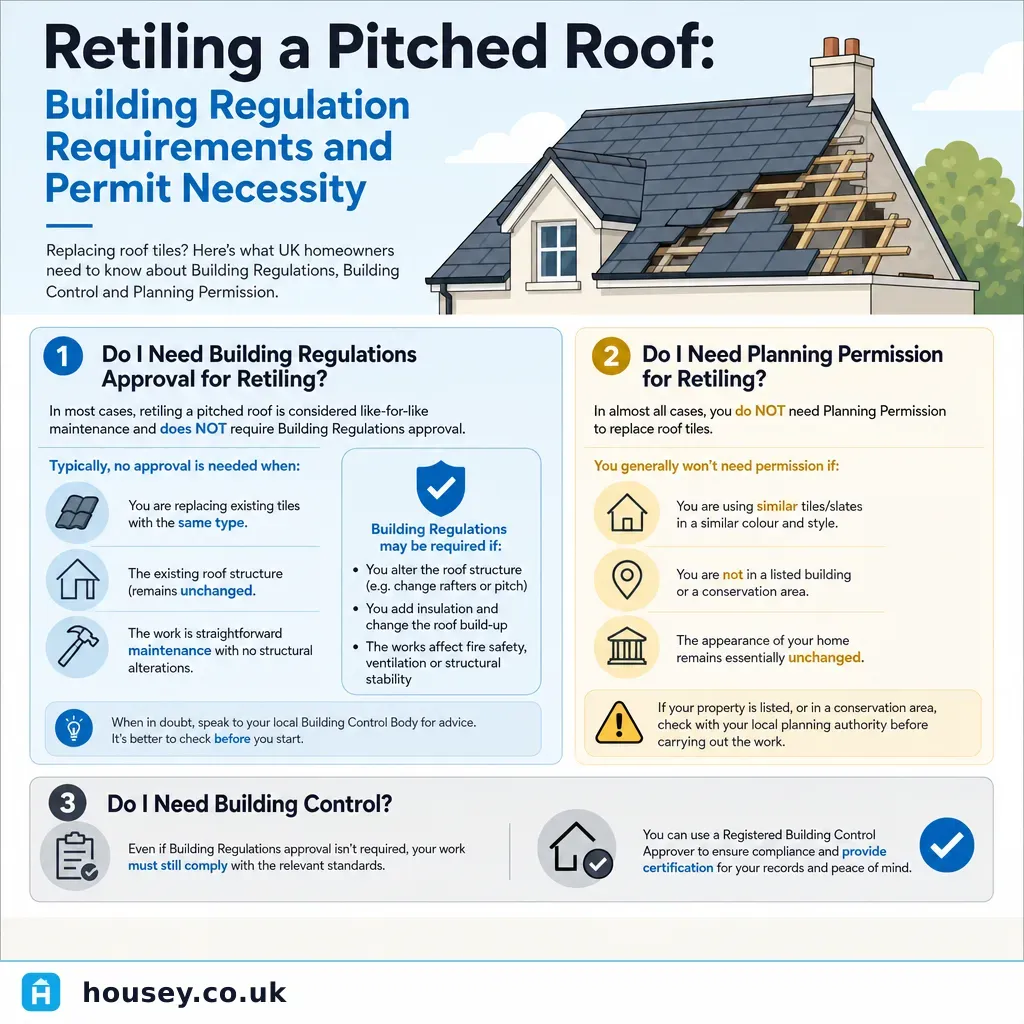
Retiling a Pitched Roof: Building Regulation Requirements and Permit Necessity
Like-for-like retiling of a pitched roof in England does not usually require planning permission or a building control application.
 Planning & Pre-Build
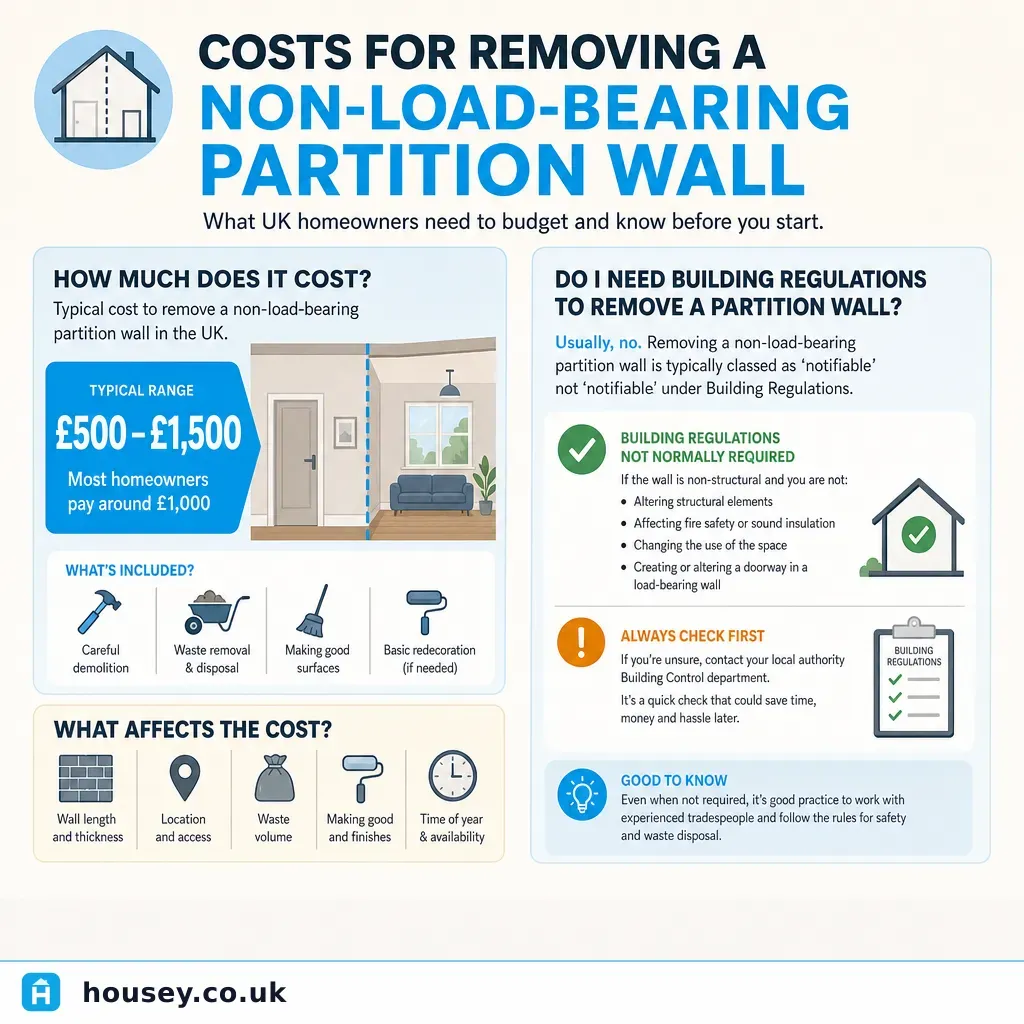
Costs for removing a non-load-bearing partition wall
Removing a non-load-bearing partition wall in a UK home typically costs £300–£1,500 in labour, plus £200–£600 or more for replastering and making good.
 Planning & Pre-Build
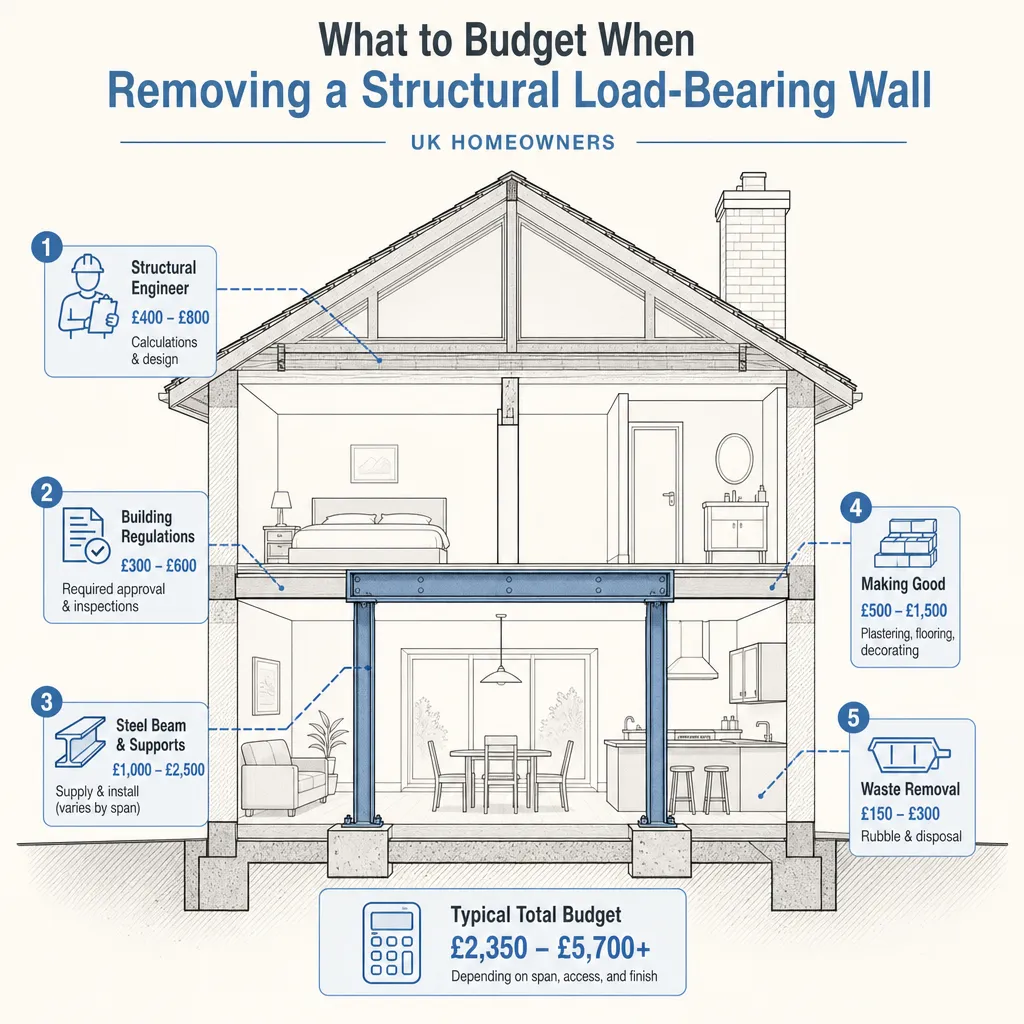
What to Budget When Removing a Structural Load-Bearing Wall
Removing a load-bearing wall in a typical UK home costs £2,500–£8,000 or more in total, covering a structural engineer's calculations, Building Regulations approval, the steel beam, builder's labour, and replastering.