Building Regulations Approval in the UK: Who Pays and How Much?
By Housey · Last reviewed 31st of May 2026
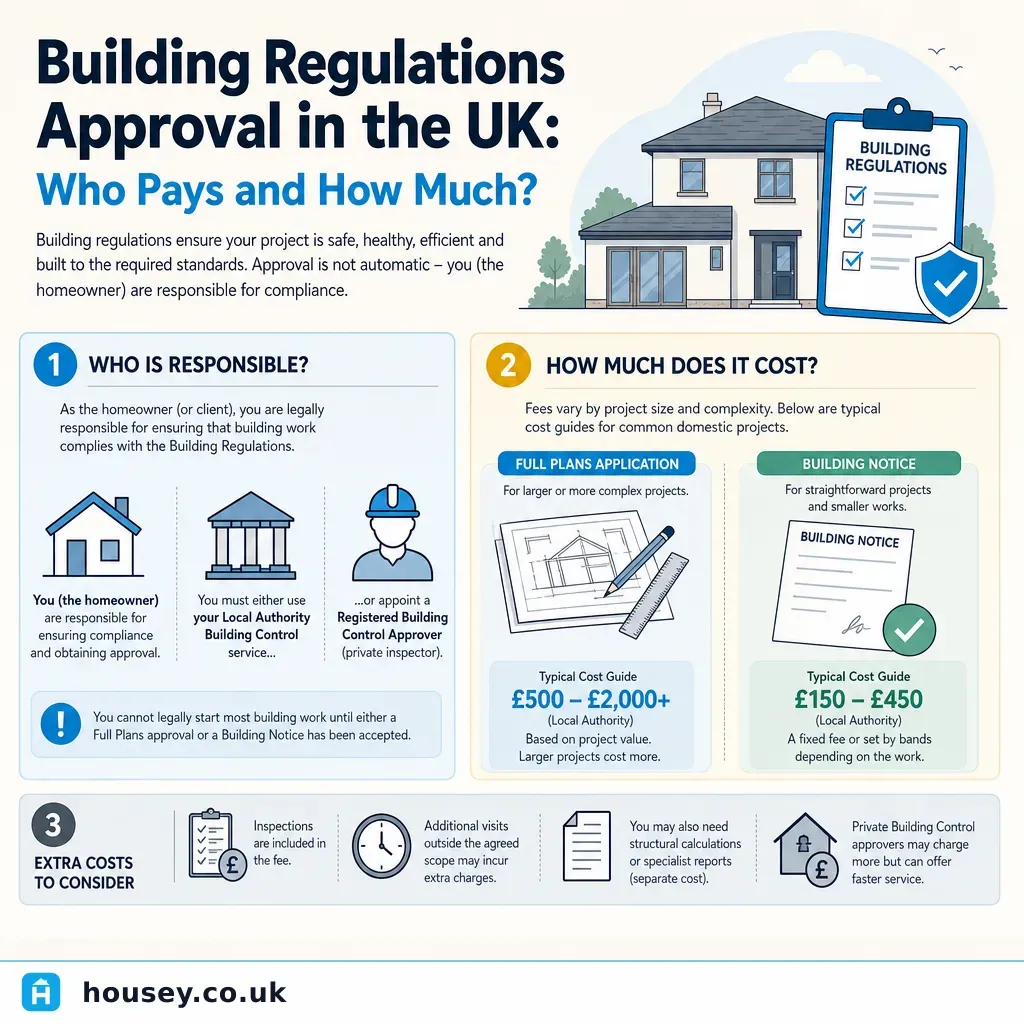
Building Regulations Approval in the UK: Who Pays and How Much?
Most UK homeowners encounter building regulations for the first time when planning an extension, loft conversion, or structural alteration. Understanding who is responsible for obtaining — and paying for — building control approval can prevent costly surprises mid-project. The rules changed significantly following the Building Safety Act 2022, which introduced a revised framework for building control bodies from October 2023.
Key points
- Building regulations approval is a legal requirement under the Building Act 1984 for most structural, electrical, drainage, plumbing, and heating work — it is separate from planning permission.
- The legal duty to obtain building regulations approval rests with the person carrying out the work or the building owner, not the contractor — even if the contractor handles the application on your behalf.
- Since October 2023, private building inspectors are now called Registered Building Control Approvers (RBCAs), replacing the previous approved inspector designation under the Building Safety Act 2022.
- Local authority building control (LABC) fees are set individually by each council; RBCA fees are commercially negotiated — both are typically paid by the applicant, usually the homeowner or their appointed agent.
- A completion certificate (issued by LABC) or final certificate (issued by an RBCA) confirms that inspected work meets the regulations — this document is essential when you come to sell the property.
Who is legally responsible for building regulations compliance?
Under the Building Act 1984, the person 'carrying out the building work' is responsible for complying with the Building Regulations 2010 (as amended). In practice, this usually means the homeowner or the person commissioning the works — not the contractor directly, though contractors can apply on the owner's behalf.
If your contractor says they will 'handle building regulations', clarify in writing whether they will submit the application, manage inspections, and obtain the completion certificate — and in whose name the application will be registered. If work does not comply, liability ultimately follows the building owner.
Note: Some contractors include building control fees within their quoted price. Always check whether the cost is bundled or chargeable separately before accepting a quote.
Which application route should you use?
There are three main routes for obtaining building regulations approval in England and Wales:
Route | How it works | Best for | Key risk |
|---|---|---|---|
Full plans application | Submit detailed drawings and specifications before starting; formal approval is granted | Extensions, loft conversions, larger structural projects | Slower start; revisions to drawings may be needed before approval |
Building notice | Submit a notice and start work without formal pre-approval; inspections take place during the build | Smaller works on straightforward properties with experienced contractors | No formal approval document; not permitted for higher-risk buildings |
Regularisation | Retrospective approval for unauthorised work already carried out | Work completed without prior approval | Higher fees than standard routes; no guarantee of approval; may require opening up finishes |
Building notice applications are not permitted for higher-risk buildings — typically residential buildings of seven or more storeys or 18 metres or more in height — under the higher-risk buildings regime introduced by the Building Safety Act 2022.
How much do building regulations fees cost?
Building control fees depend on the type and scale of work and the application route taken.
Indicative UK costs, last reviewed 2026-05-31. Fees are set by individual councils and RBCAs; always confirm current charges before applying.
Work type | Typical LABC fee range |
|---|---|
Single-storey extension (up to 40m²) | £200–£500 |
Two-storey extension | £400–£800 |
Loft conversion | £300–£700 |
Garage conversion | £150–£400 |
New dwelling | £800–£2,000+ |
RBCA fees are commercially negotiated and can differ significantly from LABC rates — sometimes higher, sometimes lower depending on the firm and project. Obtain quotes from both if you want to compare. VAT is chargeable on LABC and RBCA fees alike. Some LABC fee schedules split the charge between a plan fee (payable on submission) and an inspection fee (payable on commencement of works).
Source: Local authority websites publish their own fee schedules; LABC guidance covers application routes and the inspection process.
Does the contractor pay or does the homeowner pay?
The homeowner (or building owner) is usually the formal applicant and fee payer. In practice, there are three common arrangements:
- Many contractors include building control fees in their quote. The contractor applies on the homeowner's behalf and recovers the cost within their overall project price. This is convenient but means you are trusting the contractor to manage the process.
- Some contractors apply in their own name, particularly for common project types such as boiler replacements or electrical work under competent person schemes. Confirm that the certificate or notification will cover your property address.
- DIY applicants and self-build clients pay directly to the local authority or an RBCA and manage their own inspections.
If a contractor applies and pays on your behalf, confirm in writing that they will obtain and hand over the completion certificate. Losing this document causes difficulties on resale and may require costly remediation.
Homeowner checklist: before your project starts
What to ask before accepting a contractor's quote
- Are building regulations fees included in your quoted price, or will they be charged separately?
- Which application route will you use — full plans or building notice — and why?
- Who will be the named applicant on the building control submission?
- Will I receive the completion certificate, and will it be issued in relation to my property address?
- Which building control body will you use — the local authority or a Registered Building Control Approver?
- What happens if the inspector requires remedial work — is the cost of any necessary rectification included in your quote?
Important limitations
This article provides general information about building regulations in England and Wales. Requirements differ in Scotland (governed by the Building (Scotland) Act 2003) and Northern Ireland. Building regulations requirements vary by project type, building classification, and location. This article does not constitute legal or professional advice. Always check with your local authority or a qualified building control professional before starting work on your property.
When this becomes urgent
Seek professional advice immediately if:
- Work has already started or been completed without building regulations approval.
- You are buying a property and discover that past structural, electrical, or drainage works lack a completion certificate.
- Your project involves a higher-risk building (seven or more storeys, or 18 metres or more in height).
- You have received an enforcement notice from your local authority.
- Your contractor refuses to obtain or hand over the completion certificate.
What to ask a qualified professional
Before instructing a building control consultant or submitting your application, ask:
- Do I need full plans approval or can I use a building notice for this project?
- Are there aspects of my planned works that are particularly likely to be scrutinised under current Part L or structural regulations?
- If I use an RBCA, what is the process if their registration status changes mid-project?
- What are the required inspection stages for my project type?
- How do I obtain a regularisation certificate for previous works carried out without approval, and what are the likely costs?
When to get professional help
A building control consultant can prepare drawings, manage the application, and liaise with the building control body, reducing the risk of rejection or delays. Consider professional help if:
- Your project involves structural alterations, unusual construction methods, or significant changes to drainage or building services.
- Your contractor has limited experience with the formal building control process.
- You are dealing with a retrospective regularisation application.
- You are buying or selling a property with missing or incomplete building control documentation.
A solicitor should be consulted if enforcement notices have been issued or if you are in a dispute about missing compliance documentation.
How Housey can help
Housey connects you with building control consultants who can prepare plans, liaise with the local authority or a Registered Building Control Approver, and manage inspections through to the completion certificate. Compare quotes from qualified professionals before your project starts.
Frequently asked questions
Do I always need building regulations approval in England?
Not always. Some minor works are exempt, including like-for-like repairs, most garden structures below a certain size, and some internal alterations that do not affect structural elements, drainage, or controlled services. Check the GOV.UK guidance on building regulations exemptions or speak to your local authority before assuming work is exempt.
What happens if I sell a property without a completion certificate?
Missing completion certificates can delay or block a sale. Buyers' solicitors routinely request building control documentation, and mortgage lenders may refuse to lend on properties with unresolved compliance issues. Options include obtaining a regularisation certificate, arranging indemnity insurance, or having the work retrospectively signed off — each has different cost and legal implications.
Can my contractor apply for building regulations on my behalf?
Yes. Contractors can submit the application as the person carrying out the work. However, the legal duty to ensure compliance ultimately follows the building owner. Always confirm in writing that you will receive the completion certificate and that it covers the works at your specific property address.
What is the difference between planning permission and building regulations?
Planning permission controls whether a development is acceptable in terms of land use, appearance, and impact. Building regulations set technical standards for the safety, structure, energy performance, and accessibility of the work itself. Many projects need both, but some permitted development works require building regulations approval without needing separate planning permission.
Sources and further reading
- Building regulations approval — GOV.UK
- Building Safety Act 2022 — legislation.gov.uk
- Local Authority Building Control guidance — LABC
- Building Safety Regulator — Health and Safety Executive
Useful next reads
 Planning & Pre-Build
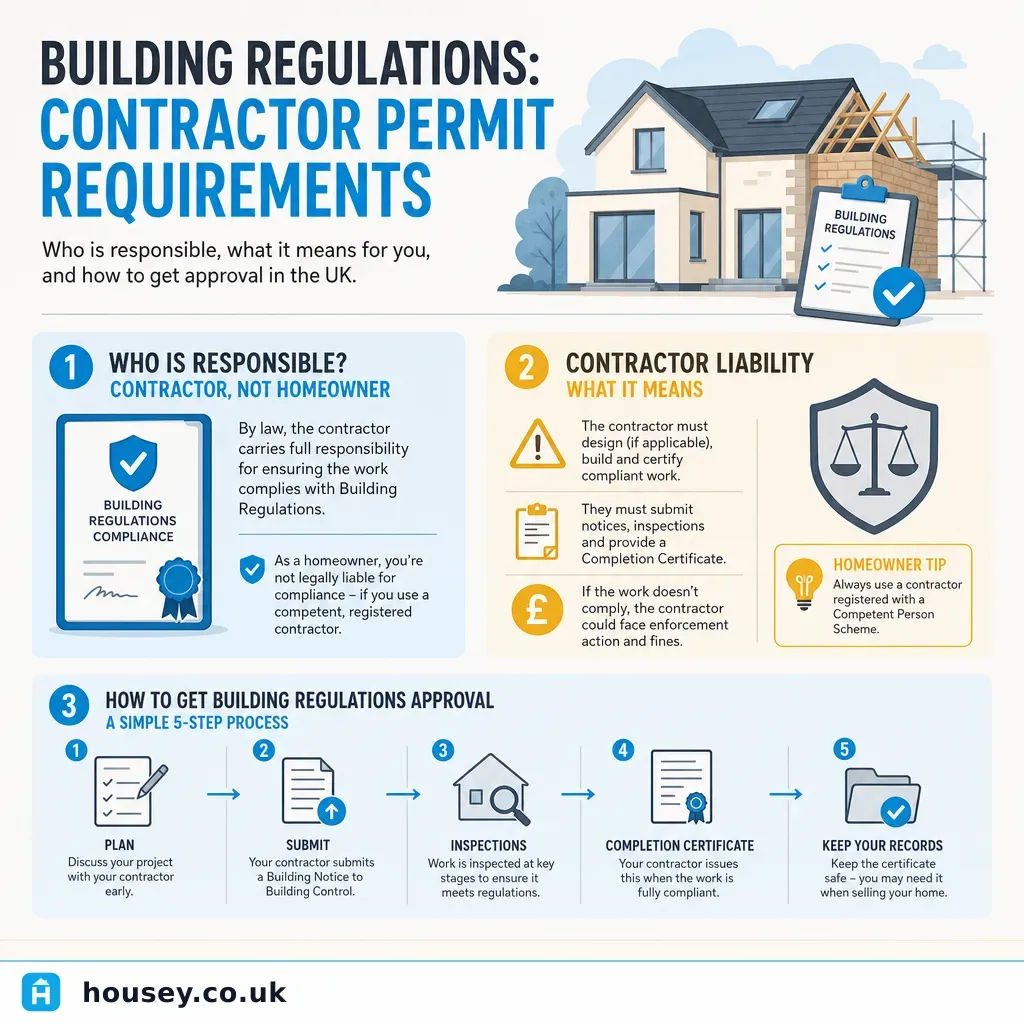
Building Regulations: Contractor Permit Requirements
In England and Wales, the person carrying out the building work — usually the contractor — is legally responsible for notifying building control under the Building Regulations 2010.
 Planning & Pre-Build
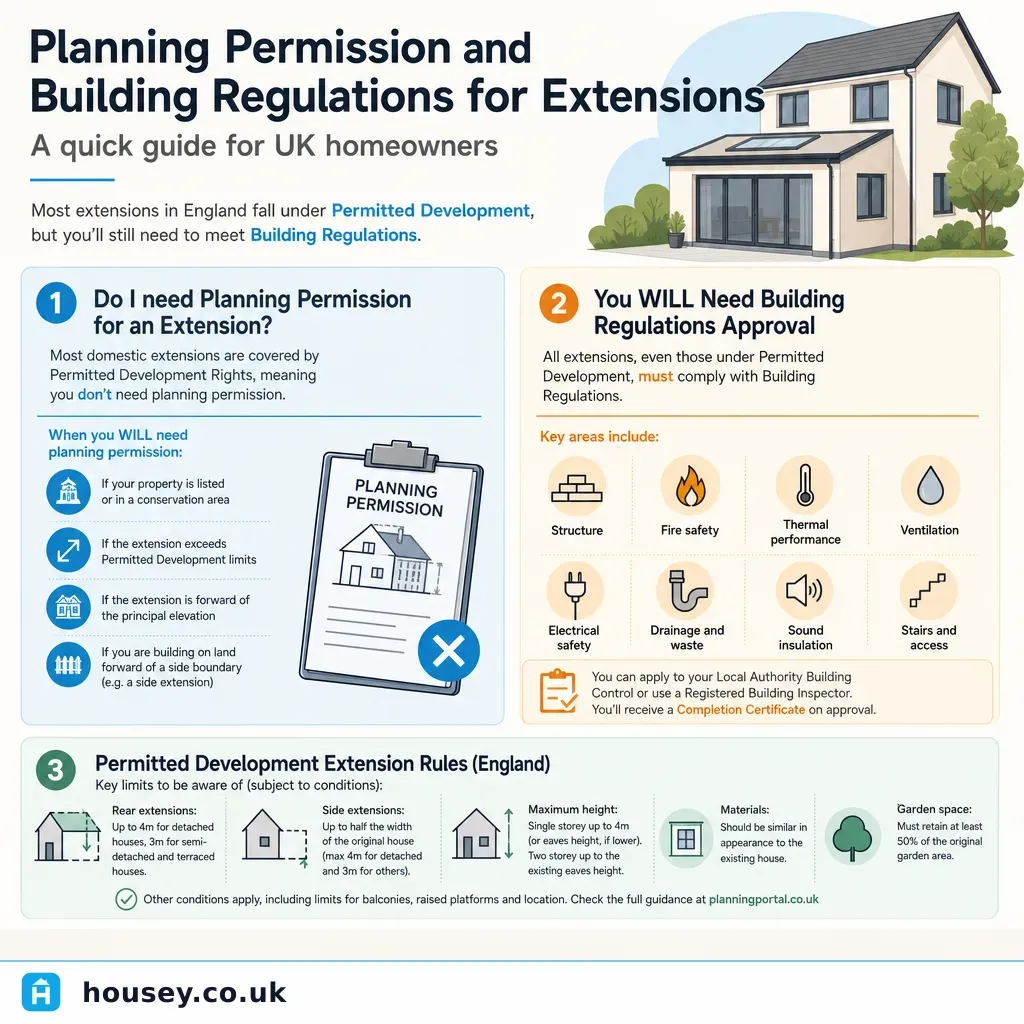
Planning Permission and Building Regulations for Extensions
UK home extensions usually require both planning permission and Building Regulations approval, though most smaller rear extensions qualify as Permitted Development under the GPDO 2015 and need no planning application.
 Planning & Pre-Build
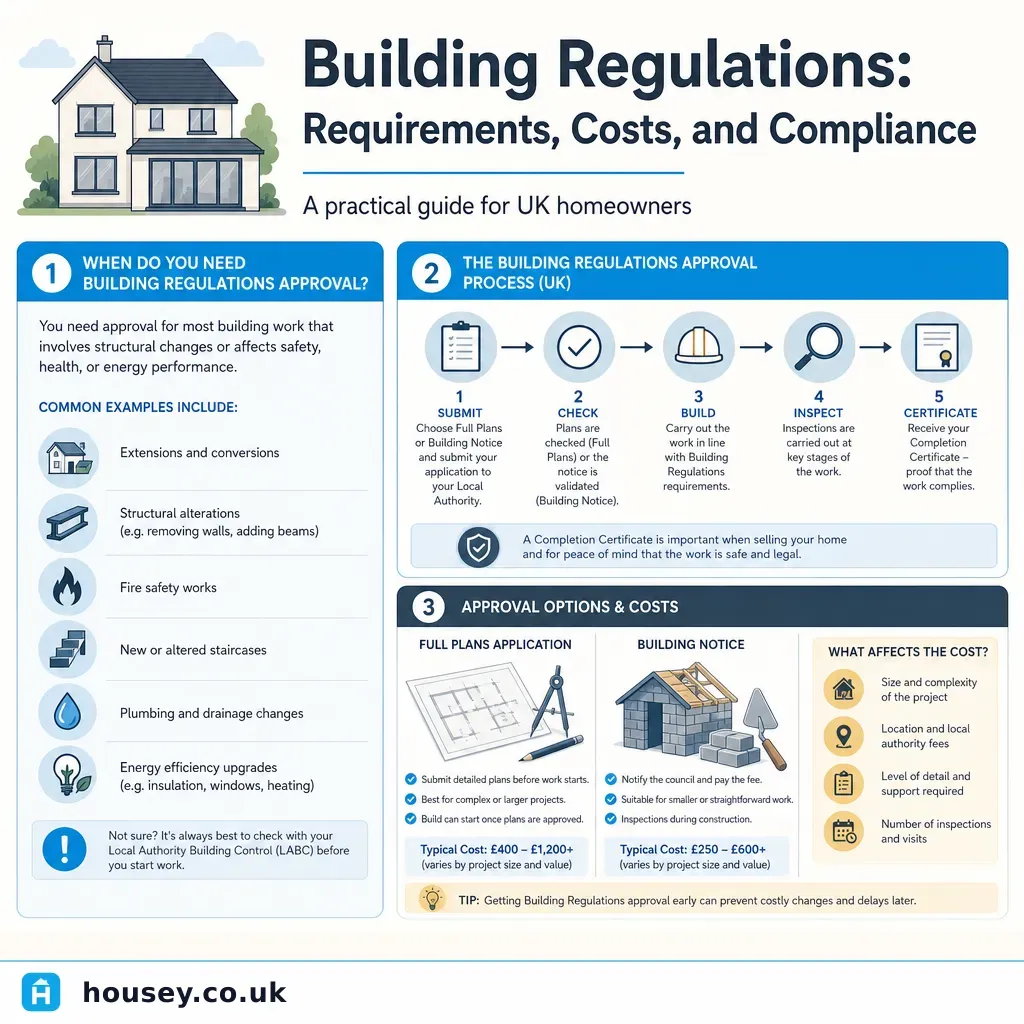
Building Regulations: Requirements, Costs, and Compliance
Building regulations set minimum standards for how construction work is carried out in the UK, covering structural stability, fire safety, energy efficiency, and ventilation.
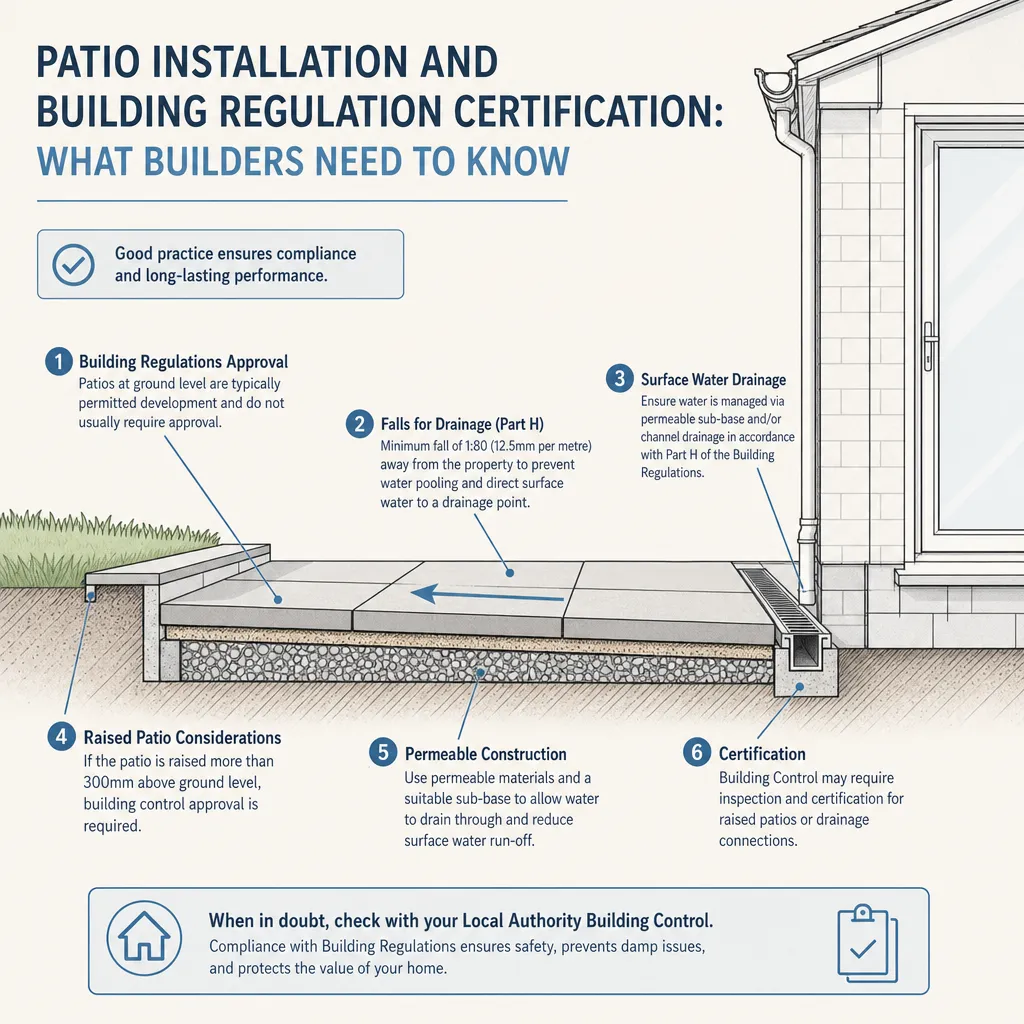 Planning & Pre-Build
Patio Installation and Building Regulation Certification: What Builders Need to Know
Most ground-level patios in England do not require building regulations approval.
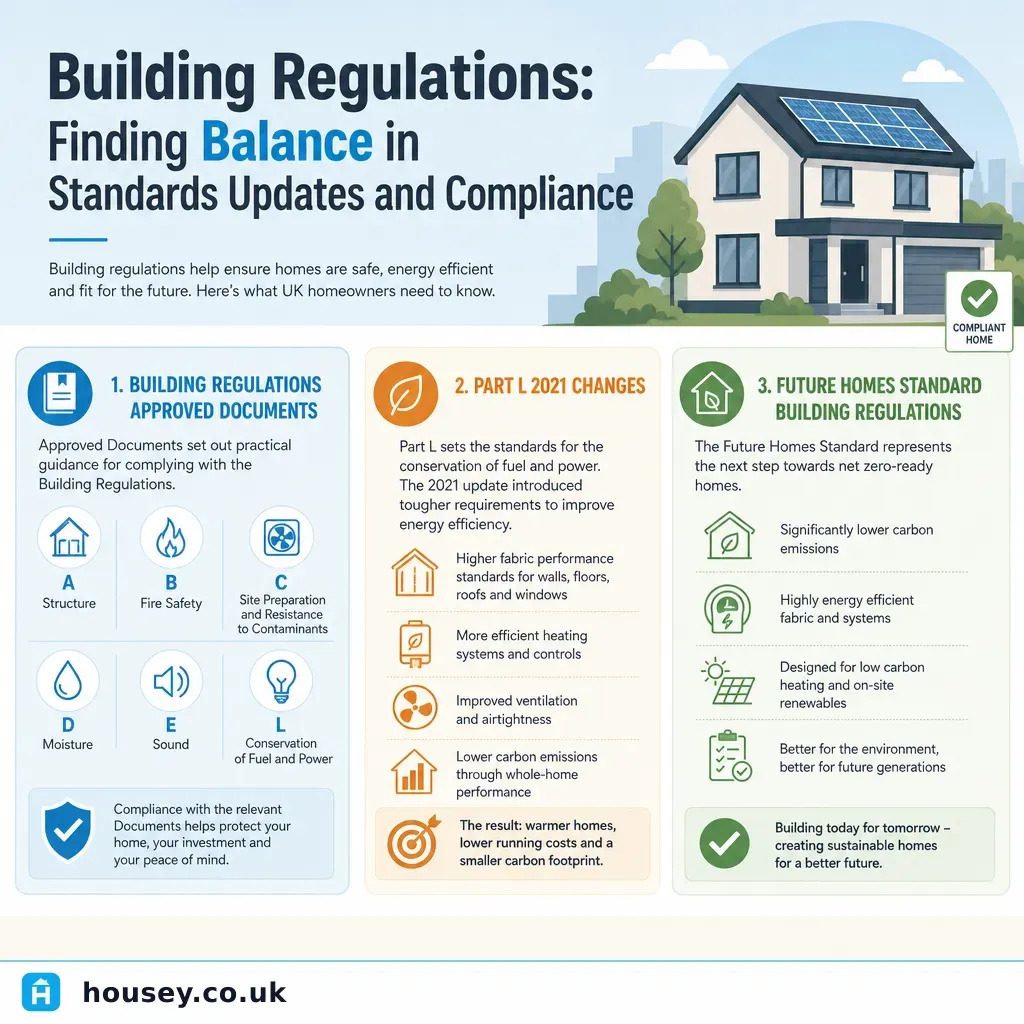 Planning & Pre-Build
Building Regulations: Finding Balance in Standards Updates and Compliance
Building regulations in England and Wales set minimum standards for construction, covering structure, fire safety, energy efficiency, and ventilation.