Obtaining Building Control Approval in the UK
By Housey · Last reviewed 11th of May 2026
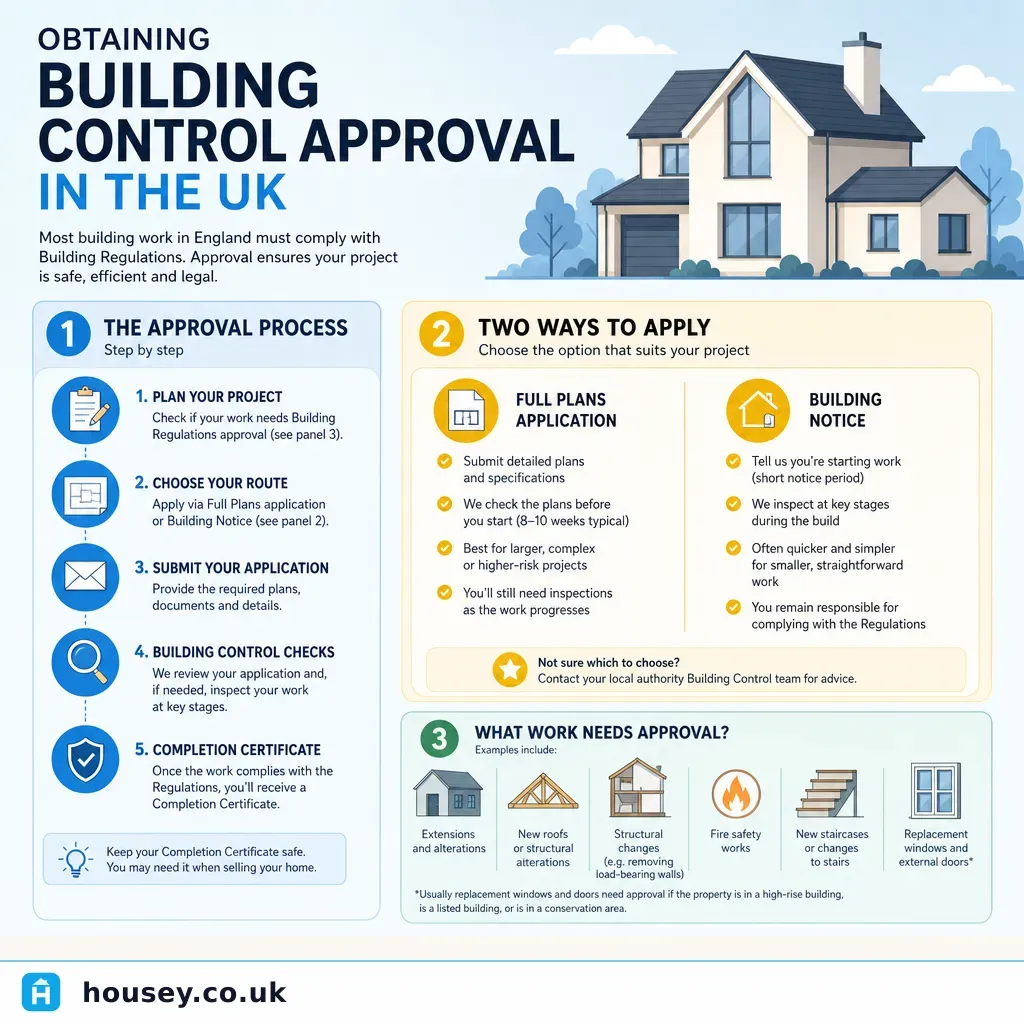
Obtaining Building Control Approval in the UK
Most substantive building work in England — from rear extensions and loft conversions to structural alterations and electrical consumer unit replacements — creates a legal obligation to comply with the Building Regulations 2010. This requirement catches many homeowners by surprise: the question typically arises once a contractor has been quoted, once a mortgage lender requests documentation, or once a conveyancer flags a historic gap in the paperwork on a property being sold. Getting the process right from the outset protects both the safety of the work and its legal standing on any future sale or remortgage.
Key points
- The Building Regulations 2010 (as amended) establish minimum performance standards for structural integrity, fire safety, energy efficiency (Part L), and ventilation (Part F) for most building work in England; Wales, Scotland, and Northern Ireland each operate their own but broadly comparable legislation.
- Under the Building Safety Act 2022, Approved Inspectors became Registered Building Control Approvers (RBCAs), all of whom must be registered with the Building Safety Regulator from April 2024.
- Higher Risk Buildings (HRBs) — residential buildings over 18 metres or 7 storeys in England — are subject to a mandatory three-Gateway regime; Gateway 2 approval from the Building Safety Regulator must be secured before construction begins.
- A Full Plans application provides the strongest protection: drawings are formally deposited and approved before work starts, and the local authority or RBCA must respond within five weeks (or two months if agreed in writing).
- Failure to obtain required building regulations approval can flag on property searches; a Regularisation Certificate is available to retrospectively approve unauthorised work carried out after 11 November 1985.
What does building control cover?
Building control is the process by which building work is checked for compliance with the Building Regulations 2010 — a set of Approved Documents (labelled A through S) covering structural integrity (Part A), fire safety (Part B), sound insulation (Part E), ventilation (Part F), energy efficiency (Part L), drainage, accessibility, and more. It is separate from planning permission: a project can hold planning permission but still require building regulations approval, and some work needs building control but not planning permission.
Common projects requiring building regulations approval include:
- Extensions, including single-storey and two-storey rear or side additions
- Loft conversions to habitable space
- Garage conversions to living accommodation
- New structural openings in load-bearing walls
- Replacement of a consumer unit (fuse board) or full rewiring
- Installation of a new boiler or wet central heating system
- Addition of a new bathroom to an existing property
Some minor works — such as like-for-like repairs, certain small detached outbuildings under 15 m², or exempt porches — may fall outside the regulations. The Planning Portal provides interactive guides that clarify exemptions for specific project types and locations.
Which approval route should you choose?
There are three principal routes for building regulations approval in England:
Route | How it works | Best for | Key risk |
|---|---|---|---|
Full Plans | Detailed drawings formally deposited and approved before work begins | Extensions, loft conversions, new builds, structurally complex projects | Higher upfront cost for drawings; slower start to construction |
Building Notice | Short notification submitted before work begins; no pre-approval; inspections during construction | Simpler projects with straightforward regulatory compliance | No approved drawings — non-compliance discovered late can be expensive to remedy |
Regularisation | Retrospective application for work carried out without approval after 11 November 1985 | Historic unauthorised works flagged during a sale or remortgage | May require opening up works; approval is not guaranteed |
Which route is right for your project?
- Choose Full Plans if your project involves an extension, loft conversion, structural alteration, or new build — or if your mortgage lender or solicitor requires formal approval before work begins.
- Choose Building Notice if the project is straightforward (for example, a replacement boiler or simple internal alteration) and your contractor has demonstrable experience complying with the relevant regulations.
- Use Regularisation if you are selling or remortgaging and discover that historic works lack a completion certificate.
- Consult a professional building control consultant if your project involves a Higher Risk Building, a listed structure, unusual construction, or significant regulatory complexity.
- Check with your local planning authority first if there is any uncertainty about whether planning permission is also required alongside building regulations approval.
The application process step by step
- Appoint your building control body — either your Local Authority Building Control (LABC) or a Registered Building Control Approver (RBCA). Both are legally valid; some contractors have established relationships with particular providers.
- Prepare your application — for a Full Plans application this means professionally produced building regulations drawings, a completed application form, and the relevant fee. Fees vary by local authority and project type.
- Submit and await a decision — LABC must issue a decision within five weeks, or up to two months if agreed in writing. RBCAs operate to similar timescales.
- Notify at inspection stages — you must give notice at key construction stages: foundation excavation, damp-proof course level, structural frame, before covering drains, and at completion. Failure to notify can make compliance difficult to prove retrospectively.
- Obtain your completion certificate — once all inspections pass, a completion certificate (LABC) or final certificate (RBCA) is issued. Store this document safely: solicitors will request it and mortgage lenders may require it.
Higher Risk Buildings and the Gateway regime
The Building Safety Act 2022 introduced a significantly more demanding regime for Higher Risk Buildings — defined in England as occupied residential buildings at least 18 metres tall or with at least 7 storeys. If your project involves an HRB:
- Gateway 1 applies at the planning application stage and requires a fire and emergency file to be submitted.
- Gateway 2 requires formal approval from the Building Safety Regulator before construction begins — for HRBs, this replaces the standard LABC or RBCA building control role.
- Gateway 3 is a completion submission to the Regulator confirming compliance before the building can be occupied.
Gateway applications can take considerably longer than standard building control. If your project involves an HRB, a specialist planning consultancy or building safety consultant experienced with the Gateway regime is strongly advisable.
Important limitations
This article provides general information about the building control process in England. Building Regulations requirements, permitted development rights, fees, timescales, and project exemptions all vary by property type, local authority, and the specific nature of the works involved. The Building Safety Act 2022 introduced significant changes that continue to be implemented across the sector. Nothing in this guide constitutes professional or legal advice. A qualified professional should assess your specific project before you proceed. Rules in Wales, Scotland, and Northern Ireland differ in important respects; always check with the relevant regulatory body for your location.
When to get professional help
Building control involves legal compliance obligations with financial and safety consequences. Seek professional guidance if:
- Your project involves structural alterations, load-bearing wall removal, or foundation work of any kind
- The property is listed or in a conservation area, where additional listed building consent or heritage approvals may be required alongside building regulations
- Works were carried out by a previous owner without approval and you need a Regularisation Certificate or indemnity insurance to proceed with a sale
- Your project involves a residential building over 18 metres or 7 storeys — the Higher Risk Building Gateway regime applies and standard routes do not
- A completion certificate has been refused or an enforcement notice has been issued by the local authority
- The project involves complex fire safety design or Part B compliance in a building with multiple occupancies
What to ask a qualified professional
Before instructing a building control consultant or submitting an application yourself, ask:
- Which approval route do you recommend for this project, and why?
- Are any elements of the work likely to require specialist input — such as a structural engineer, fire engineer, or acoustics consultant?
- What drawings and specifications are needed for a Full Plans application, and who is responsible for preparing them?
- How many site inspections are typically required for a project of this type, and what must be in place at each stage?
- What are the likely building control fees, and are there additional disbursements or third-party costs?
- How long does the approval process typically take for a project like this?
- What happens if non-compliant work is discovered during or after construction?
How Housey can help
If you are planning an extension, loft conversion, or any project requiring building regulations sign-off, Housey connects you with experienced building control consultants who can advise on the right approval route and manage the process on your behalf. For projects where formal building regulations drawings are needed before submission, our network of drawing professionals can prepare compliant documentation to the required standard.
Frequently asked questions
Do I need both planning permission and building regulations approval?
Often, yes — but not always. Some projects need planning permission but are exempt from building regulations (for example, certain small detached outbuildings), while others require building regulations approval but not planning permission (for example, an internal garage conversion under permitted development). Always check both requirements for your specific project and local authority before starting work.
How long does building regulations approval take in England?
For a Full Plans application, the building control body must issue a decision within five weeks of receiving a valid application, or up to two months if both parties agree in writing. Higher Risk Buildings under the Gateway 2 regime can take considerably longer. A Building Notice allows work to start after 48 hours but involves no pre-approval decision.
What is a completion certificate and why does it matter?
A completion certificate (or final certificate if using a registered building control approver) is issued once all inspections have passed and the work complies with the Building Regulations. Solicitors request it during property transactions and some mortgage lenders require it. Missing certificates for past works may need a Regularisation Certificate or indemnity insurance to resolve before a sale can proceed.
Can I use a registered building control approver instead of my local council?
Yes. Registered Building Control Approvers are private-sector alternatives to local authority building control and carry the same statutory authority to certify compliance. Since the Building Safety Act 2022, all approvers must be registered with the Building Safety Regulator. The choice typically comes down to cost, local availability, and your contractor's preference.
Sources and further reading
- Building regulations approval — GOV.UK
- Building Safety Act 2022 — legislation.gov.uk
- Building regulations guidance — Planning Portal
- Higher-risk buildings: guidance for building owners — GOV.UK / Building Safety Regulator
Useful next reads
 Planning & Pre-Build
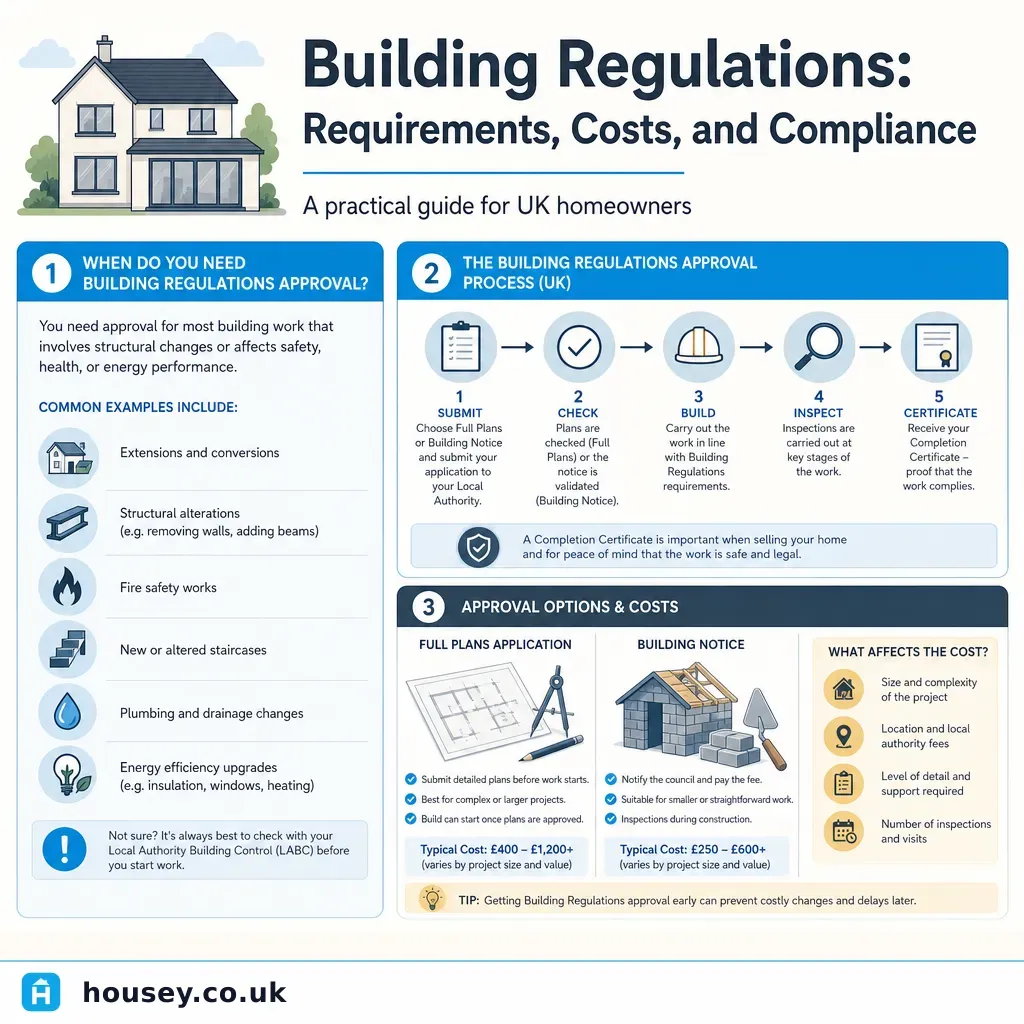
Building Regulations: Requirements, Costs, and Compliance
Building regulations set minimum standards for how construction work is carried out in the UK, covering structural stability, fire safety, energy efficiency, and ventilation.
 Planning & Pre-Build
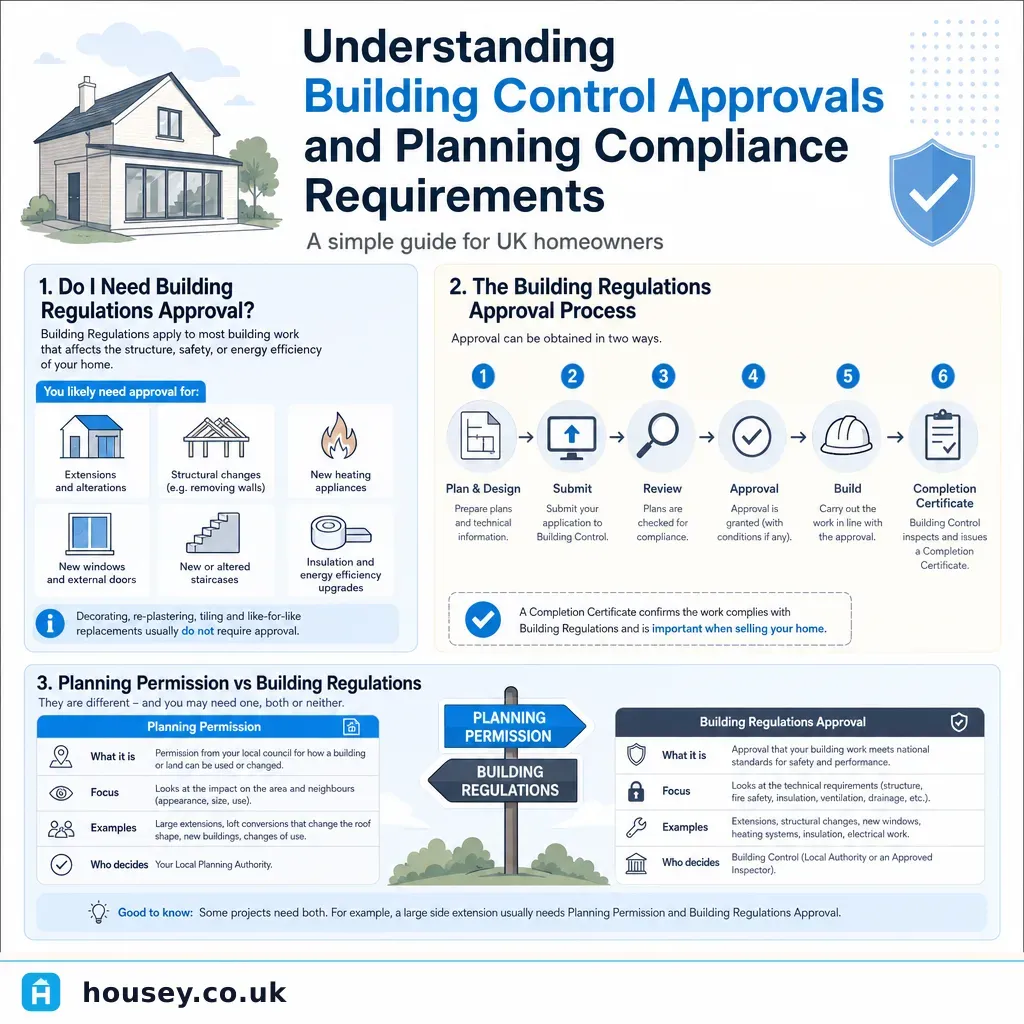
Understanding Building Control Approvals and Planning Compliance Requirements
Planning permission and building regulations are separate consents.
 Planning & Pre-Build
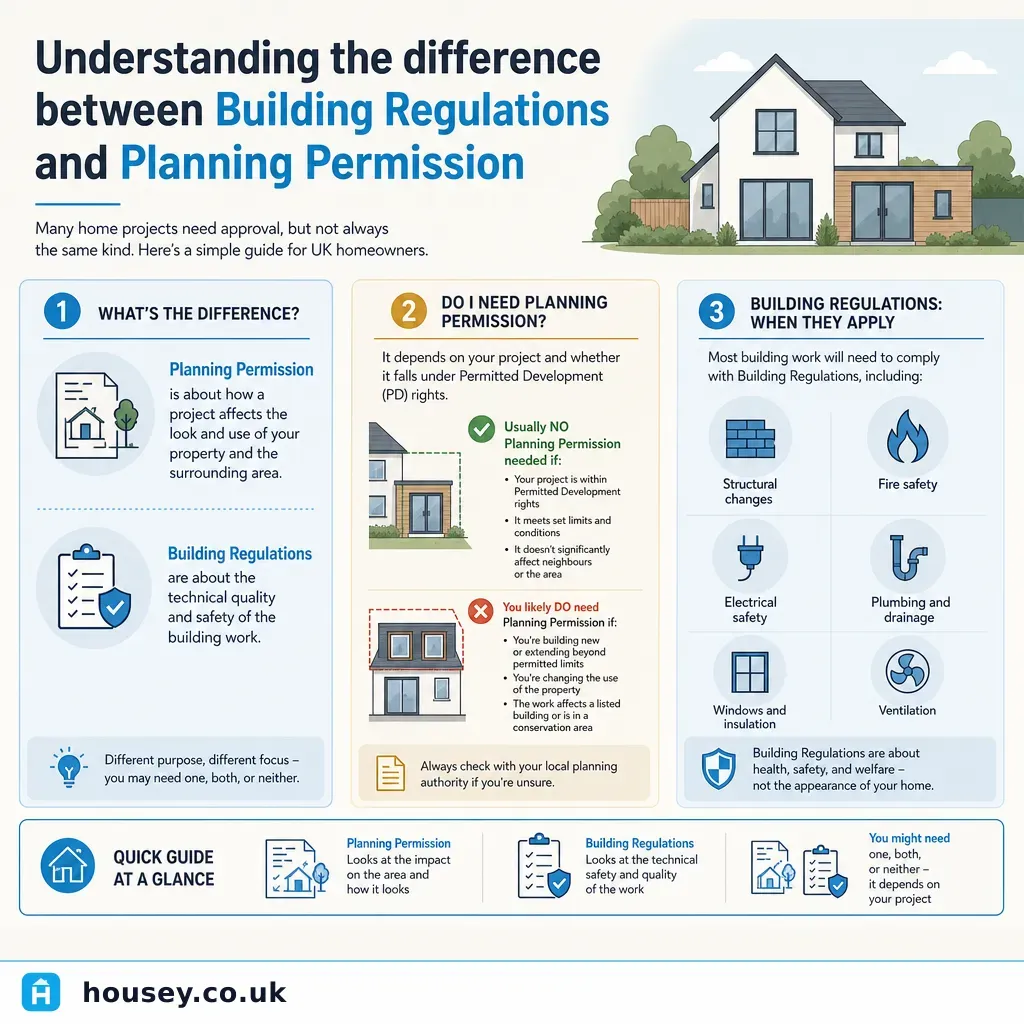
Understanding the difference between building regulations and planning permission
Planning permission is granted by your Local Planning Authority and controls whether a development is acceptable in principle — its appearance, use, and impact on the area.
 Planning & Pre-Build
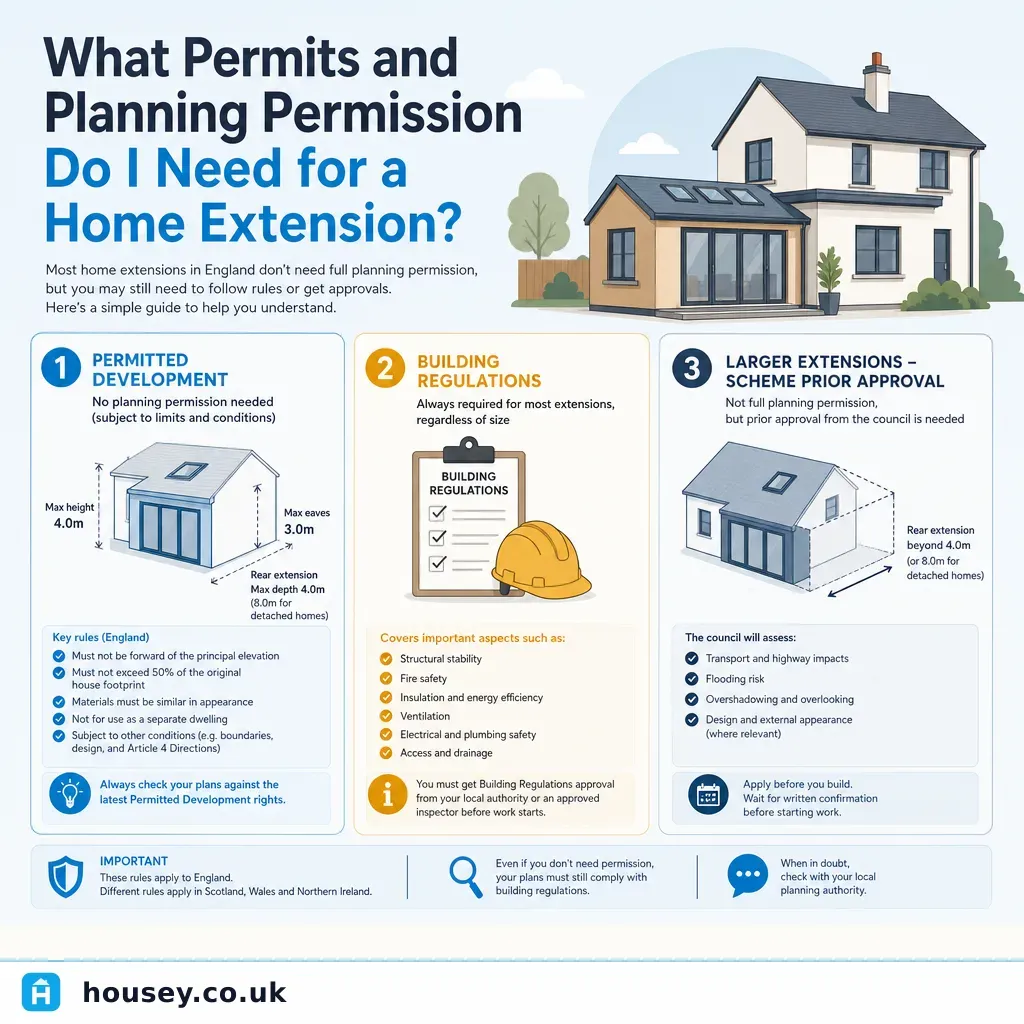
What Permits and Planning Permission Do I Need for a Home Extension?
Most single-storey rear extensions fall under permitted development and do not need a formal planning application, provided they stay within size limits set out in the Town and Country Planning (General Permitted Development) (England) Order 2015.
 Planning & Pre-Build
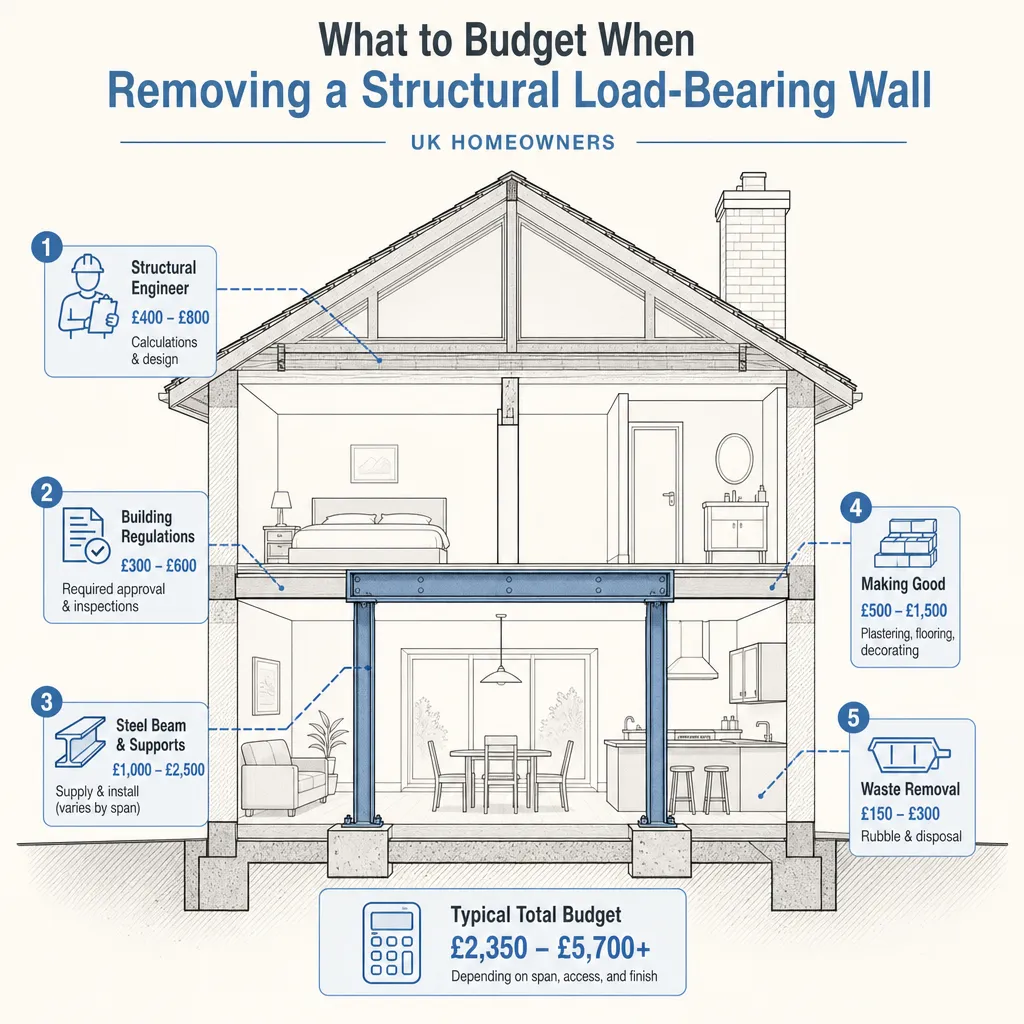
What to Budget When Removing a Structural Load-Bearing Wall
Removing a load-bearing wall in a typical UK home costs £2,500–£8,000 or more in total, covering a structural engineer's calculations, Building Regulations approval, the steel beam, builder's labour, and replastering.