Proximity to Boundary Lines: Building Distance Requirements and Planning Rules
By Housey · Last reviewed 4th of May 2026
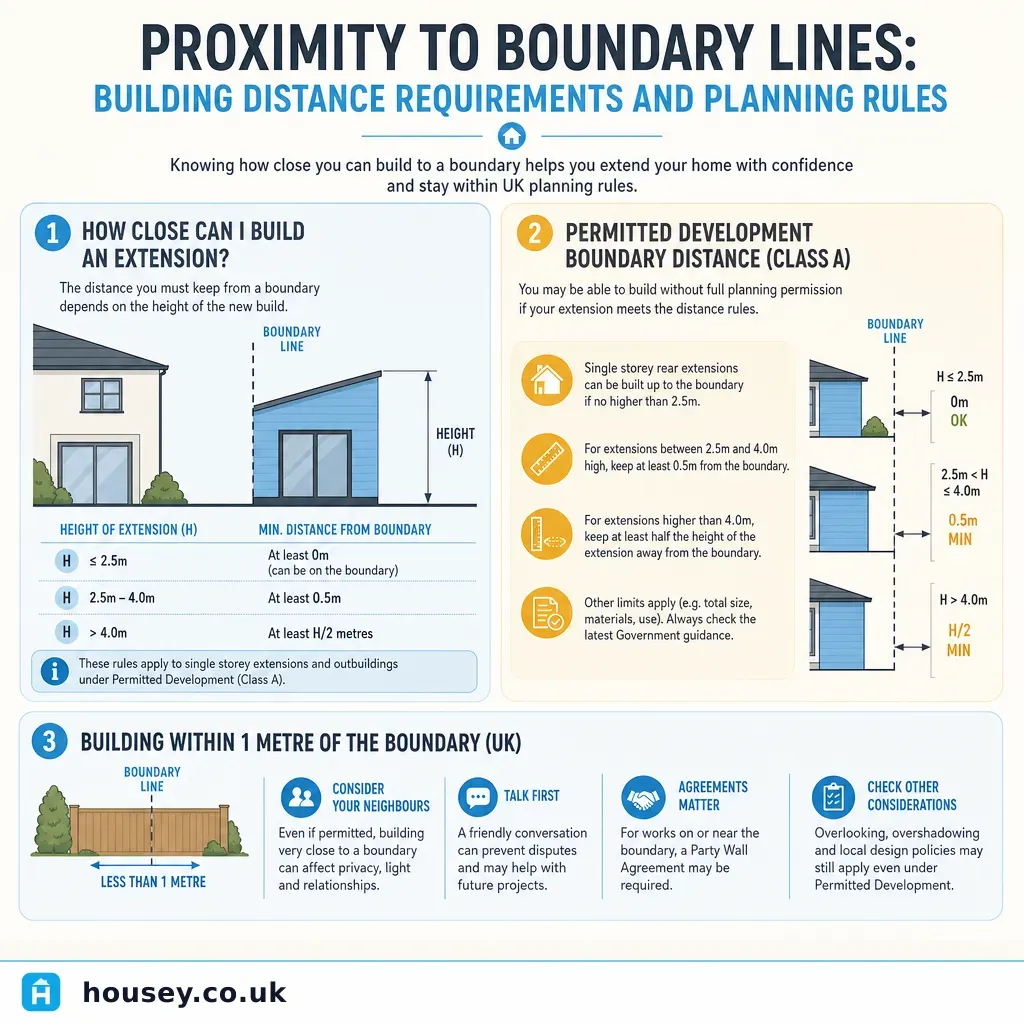
Proximity to Boundary Lines: Building Distance Requirements and Planning Rules
Boundary distance rules catch many UK homeowners off guard when planning an extension, outbuilding, or new structure. The question sits at the intersection of three overlapping regulatory regimes — permitted development rules, local planning policy, and Building Regulations — and a misunderstanding of any one of them can result in enforcement action, costly structural modifications, or a neighbour dispute that is difficult and expensive to resolve. These questions typically arise at the planning stage of a project, when a builder gives informal assurances, or when a neighbour raises concern about a proposed structure.
Key points
- Under Class A permitted development, a side extension within 2 m of a boundary must not exceed a single storey; any taller structure closer than 2 m requires a full planning application.
- Building Regulations Approved Document B (Fire Safety) requires external walls within 1 m of a boundary to achieve a minimum fire resistance of REI 60, with no unprotected openings (windows or doors) normally permitted in that zone.
- The Party Wall etc. Act 1996 requires formal notice to be served if you excavate within 3 m of a neighbouring structure to a depth below their foundations, or within 6 m where the 45-degree plane rule is triggered.
- Under Class E permitted development, outbuildings taller than 2.5 m must be at least 2 m from any boundary; shorter structures may be placed closer, subject to other conditions.
- The legal boundary is defined in the title deeds and title plan registered at HM Land Registry — it may not correspond to the fence, wall, or hedge on the ground.
What the legal boundary means in UK planning
A boundary in UK planning and property law is the legal line dividing one registered title of land from another, defined in the title deeds and shown on the HM Land Registry title plan. The physical features on the ground — fences, walls, hedges — are indicators, but they may have been moved or installed in the wrong position.
Where there is any ambiguity about where the legal boundary lies, a boundary surveyor should establish the precise position before any structure is built near it. Building on or encroaching over a legal boundary can expose you to a dispute, injunction, and potentially an order to demolish the encroaching structure.
The building line — sometimes confused with the boundary — is a separate planning concept that prevents buildings being erected in front of the prevailing street alignment, and is determined by the local planning authority.
Permitted development and boundary distance rules
The Town and Country Planning (General Permitted Development) (England) Order 2015 (as amended) governs when householder works can proceed without a planning application.
Class A — Extensions to a dwellinghouse
- A single-storey rear extension may project up to 4 m from the rear wall of a detached house, or 3 m from a semi-detached or terraced house, within permitted development.
- An extension must not exceed a single storey if it is within 2 m of any boundary — any taller structure within 2 m requires full planning permission.
- The larger home extension prior approval procedure (also within Class A) can permit extensions up to 8 m (detached) or 6 m (semi/terraced), subject to a neighbour consultation scheme.
Class E — Outbuildings within the curtilage
- An outbuilding, garden office, or detached garage must be at least 2 m from any boundary if its maximum overall height exceeds 2.5 m.
- If eaves height is no more than 2.5 m, the structure may be closer to the boundary, subject to overall height limits and coverage conditions.
- Outbuildings cannot be placed forward of the principal elevation of the house.
Conservation areas, National Parks, Areas of Outstanding Natural Beauty, listed buildings, Article 4 directions, and conditions attached to the original planning permission can all remove or restrict permitted development rights. If uncertain, a Lawful Development Certificate (LDC) application to the LPA is the most reliable way to confirm eligibility before starting work.
Building regulations: fire safety near boundaries
Building Regulations apply regardless of whether planning permission is required. Approved Document B (Fire Safety), Volume 1 sets out requirements for residential buildings in relation to boundary proximity.
Distance from boundary | Fire resistance requirement | Openings permitted? |
|---|---|---|
More than 1 m | Standard construction applies | Yes, subject to limits on total unprotected area |
Within 1 m | External wall must achieve REI 60 fire resistance | No unprotected openings (windows, doors) normally permitted |
On or very near the boundary | REI 60 or better; combustible cladding restrictions apply | No unprotected openings |
These requirements limit fire spread between adjacent properties. In practice, a wall within 1 m of a boundary will normally need to be solid non-combustible construction without glazed openings on that elevation — which directly affects designs incorporating side-facing windows or doors near a boundary.
The calculation of unprotected area in relation to boundary distance is set out in Approved Document B, Appendix C, and can be complex for non-standard situations. A building control body can advise on compliance for your specific proposal.
Planning policy and neighbour amenity
Even where a project qualifies as permitted development, local planning policies and the National Planning Policy Framework (NPPF) remain relevant where full planning permission is needed. The NPPF requires development to respect the amenity of neighbouring properties, including:
- Overshadowing: extensions close to boundaries can reduce daylight to adjacent gardens and windows.
- Privacy and overlooking: raised terraces or two-storey elevations facing a boundary can be refused where the privacy impact is significant.
- Overbearing effect: a tall wall or extension very close to a boundary can dominate a neighbouring garden in a way that LPAs may refuse on planning grounds.
Many LPAs publish supplementary planning documents (SPDs) on householder extensions that set out specific separation distance guidance. These are material considerations in planning decisions and are available on your council's planning website.
The Party Wall etc. Act 1996
The Party Wall etc. Act 1996 operates separately from planning and building regulations. Formal notice must be served on adjoining owners before:
- Party Wall Notice: work on, or cutting into, a shared (party) wall.
- Line of Junction Notice: building a new wall up to or astride the boundary line.
- Three/Six-Metre Notice: excavation within 3 m of a neighbouring building to a depth below their foundations, or within 6 m where the 45-degree plane rule is triggered.
Notice must be served at least one month before work begins (two months for major party structure works). If a neighbour dissents or fails to respond within 14 days, a party wall surveyor must be appointed. Failure to serve notice when required can lead to injunctions and liability for damage caused.
Decision guide: which route do you need?
- Proceed as permitted development if you have confirmed all Class A or Class E conditions are met — including boundary distances, height limits, and volume limits — and PD rights have not been removed.
- Apply for a Lawful Development Certificate if uncertain whether PD applies, or to obtain legal certainty before starting work near a boundary. Recommended for any boundary-sensitive project.
- Apply for full planning permission if the project does not meet PD conditions — for example, a two-storey side extension within 2 m of a boundary, or any external works in a conservation area where PD is restricted.
- Consult a planning consultant if the site is in a designated area, the project is complex, or pre-application discussions have raised concerns.
- Instruct a boundary surveyor if there is any uncertainty about the legal position of the boundary before starting work near it.
- Serve Party Wall notice if works involve a party wall, a new wall on or up to the boundary line, or excavation within 3–6 m of a neighbouring structure.
Important limitations
This article provides general guidance on building distance requirements and planning rules in England as of 2026-05-04. Rules differ in Wales, Scotland, and Northern Ireland, where separate planning legislation applies. Permitted development conditions are subject to amendment. Site-specific factors — including planning history, conditions attached to permissions, title covenants, and active boundary disputes — can all affect what is permissible on your specific property. This article is general information only and is not a substitute for professional planning, legal, or building control advice.
What to ask a qualified professional
Before starting any work near a boundary, ask your planning consultant, architect, or surveyor:
- Has any prior extension on this property reduced the permitted development allowances available?
- Does an Article 4 direction or a planning condition remove or restrict PD rights here?
- Where is the legal boundary, and is there any risk of a dispute with the neighbouring owner?
- Does the Party Wall etc. Act 1996 apply to this project?
- What fire resistance will be required under Approved Document B if I build within 1 m of the boundary?
- Is there a local SPD on residential extensions I should be aware of?
- Should I apply for a Lawful Development Certificate before starting, or is a pre-application enquiry a better first step?
When to get professional help
Professional advice is strongly recommended when:
- The legal position of the boundary is unclear or contested.
- The project involves a two-storey structure near a side or rear boundary.
- The property is listed, in a conservation area, AONB, or National Park.
- Permitted development rights may have been removed by a planning condition.
- A neighbour has indicated they may object to or dispute the works.
- Excavations near a shared or adjacent structure are proposed.
Red flags that indicate you should stop and take advice before proceeding:
- A builder assures you a structure can go right up to the fence without checking the title register or PD conditions.
- You are uncertain where the legal boundary lies.
- A neighbour has already objected in writing before any application has been made.
- Your title register shows a covenant or restriction relating to development on the site.
How Housey can help
If you are planning work near a boundary and need qualified guidance, Housey connects homeowners with experienced professionals across the UK. A planning consultant can advise on whether your project needs planning permission, prepare a Lawful Development Certificate application, or manage a full planning submission. If the exact boundary position is in doubt, a boundary surveyor can establish the legal line and produce a formal boundary report. For compliance with building regulations, a building control consultant can confirm what fire resistance and construction standards apply to any wall built near a boundary.
Frequently asked questions
How close to a boundary can I build a single-storey rear extension?
Under Class A permitted development, a single-storey rear extension can be built close to a side boundary as long as it meets depth and height conditions. However, any wall within 1 m of a boundary triggers Building Regulations Part B: REI 60 fire resistance and no unprotected openings on the boundary-facing elevation. Check with your LPA and building control body before starting.
Can I build an outbuilding right on the boundary line?
A low outbuilding with eaves no higher than 2.5 m may be placed up to the boundary under Class E permitted development, subject to other conditions. Any wall on or near the legal boundary triggers Part B fire safety requirements. No part of the structure — including gutters and overhangs — may encroach over the neighbouring title. A Line of Junction Notice under the Party Wall etc. Act may also be required.
What happens if I have built too close to a boundary without permission?
Your LPA can issue an enforcement notice requiring removal or alteration of the structure. There is generally a four-year time limit for enforcement action on operational development — but this should not be relied on as a strategy. Building regulations breaches are a separate matter with no equivalent time limit. Professional advice before starting is always more cost-effective than retrospective remediation.
Does the Party Wall Act apply when building a garden fence?
Usually not. A standard garden fence is not a party fence wall in the legal sense. The Party Wall etc. Act 1996 applies to shared structural walls, new walls built on or up to the boundary line, and excavation within 3 m or 6 m of a neighbouring structure. If you are replacing a boundary wall that provides structural support to both sides, a party wall surveyor can advise.
Do planning boundary distance rules differ across the UK?
Yes. Permitted development rules are set by separate legislation in Wales, Scotland, and Northern Ireland. This article covers England only. In Wales, refer to the Town and Country Planning (General Permitted Development) Order 1995 as amended; in Scotland, the Planning (General Permitted Development) (Scotland) Order 1992 as amended; and in Northern Ireland, the Planning (General Development) Order (Northern Ireland) 2015.
Sources and further reading
- Town and Country Planning (General Permitted Development) (England) Order 2015 — legislation.gov.uk
- Building Regulations Approved Document B: Fire Safety, Volume 1 — Ministry of Housing, Communities and Local Government
- Planning Practice Guidance: Permitted Development Rights for Householders — Technical Guidance — GOV.UK
- Party Wall etc. Act 1996 — legislation.gov.uk
- HM Land Registry: Search for property information — HM Land Registry
- Planning Portal: Outbuildings — Planning Portal
Useful next reads
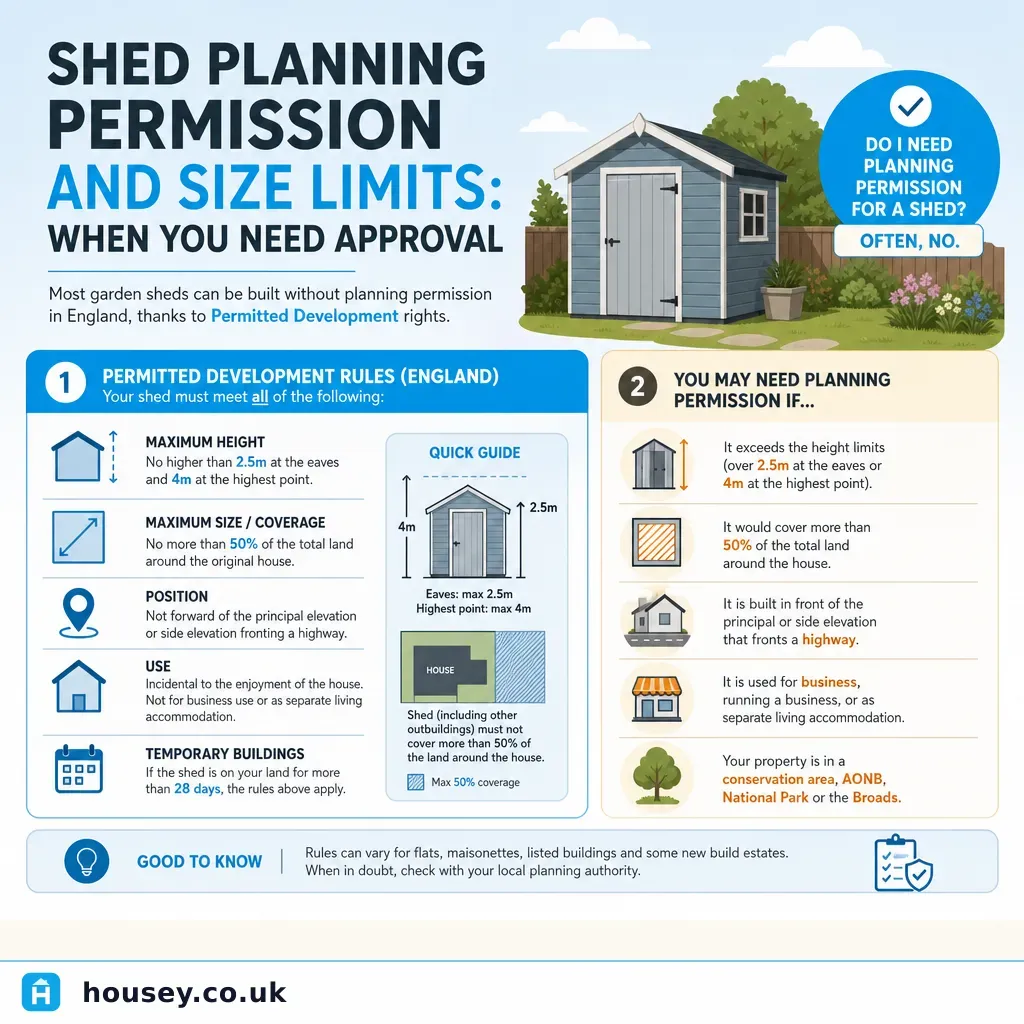 Planning & Pre-Build
Shed Planning Permission and Size Limits: When You Need Approval
Most garden sheds in England fall under Class E permitted development rights and do not need planning permission, provided they are single-storey, behind the principal elevation, within height limits for their boundary distance, and combined outbuilding coverage does not exceed 50% of the original curtilage.
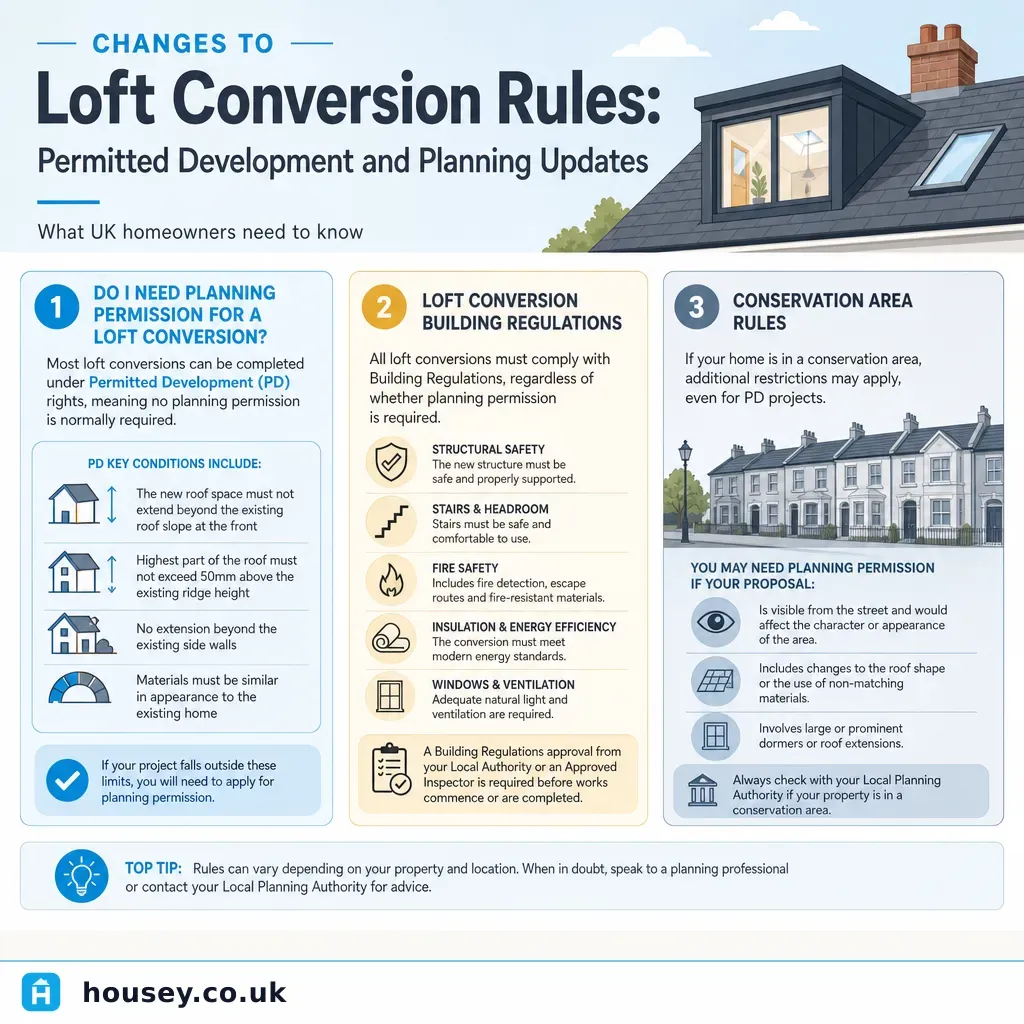 Planning & Pre-Build
Changes to Loft Conversion Rules: Permitted Development and Planning Updates
In England, most loft conversions on standard houses qualify as Permitted Development under Class B of the GPDO 2015, allowing up to 40 cubic metres (terraced) or 50 cubic metres (detached or semi-detached) without a planning application — if conditions are met.
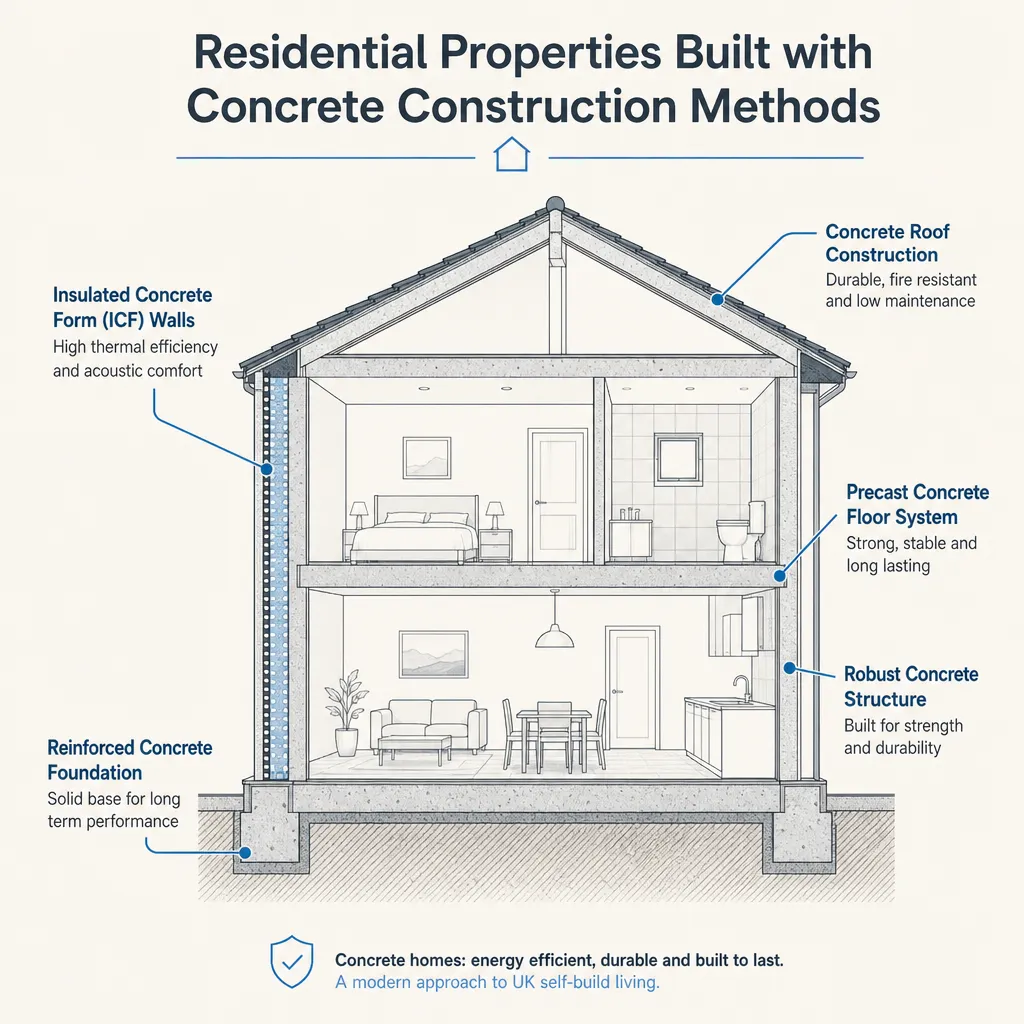 Planning & Pre-Build
Residential Properties Built with Concrete Construction Methods
UK homes are built using several concrete methods: in-situ cast concrete, precast panel systems, insulating concrete formwork (ICF), and older non-traditional types such as Wimpey No-Fines and Laing Easiform.
 Planning & Pre-Build
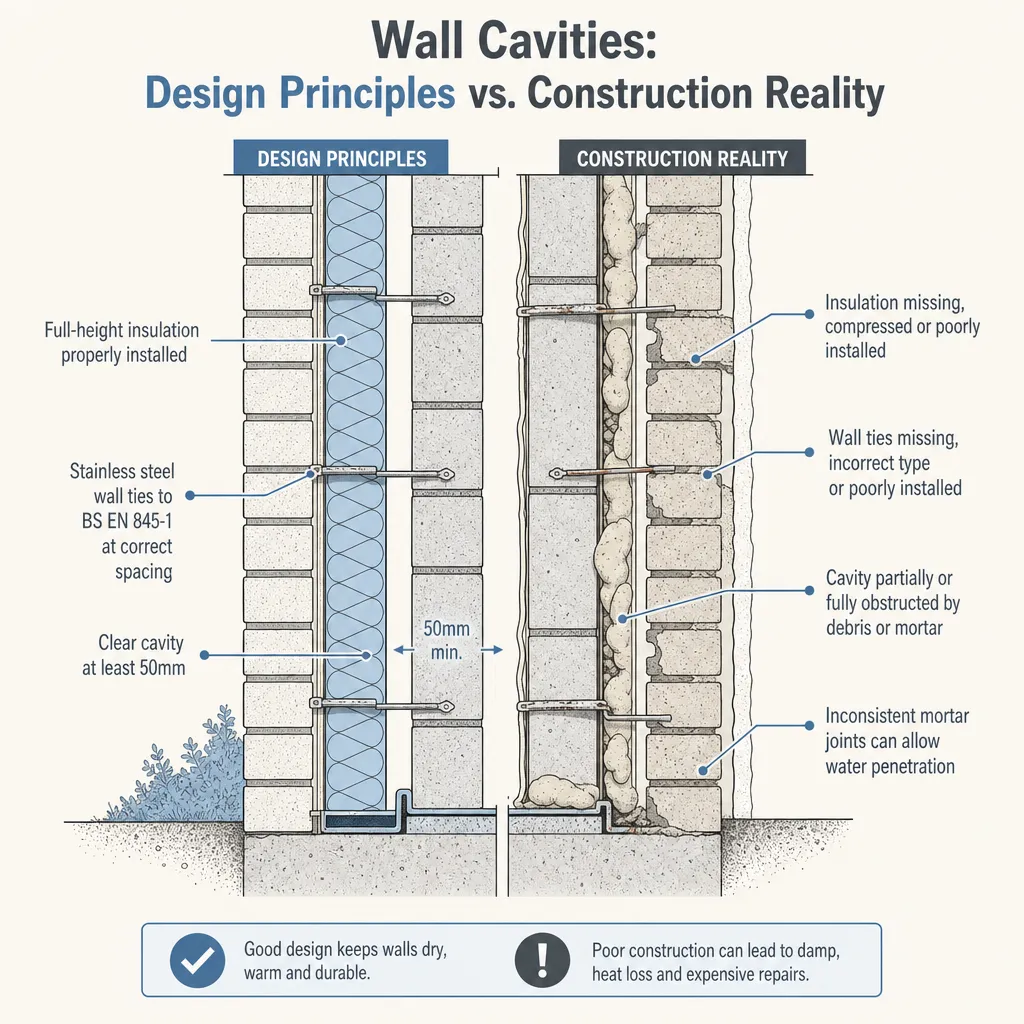
Wall Cavities: Design Principles vs. Construction Reality
A UK cavity wall is designed to resist weather, control heat loss, and structurally link two masonry leaves.
 Planning & Pre-Build
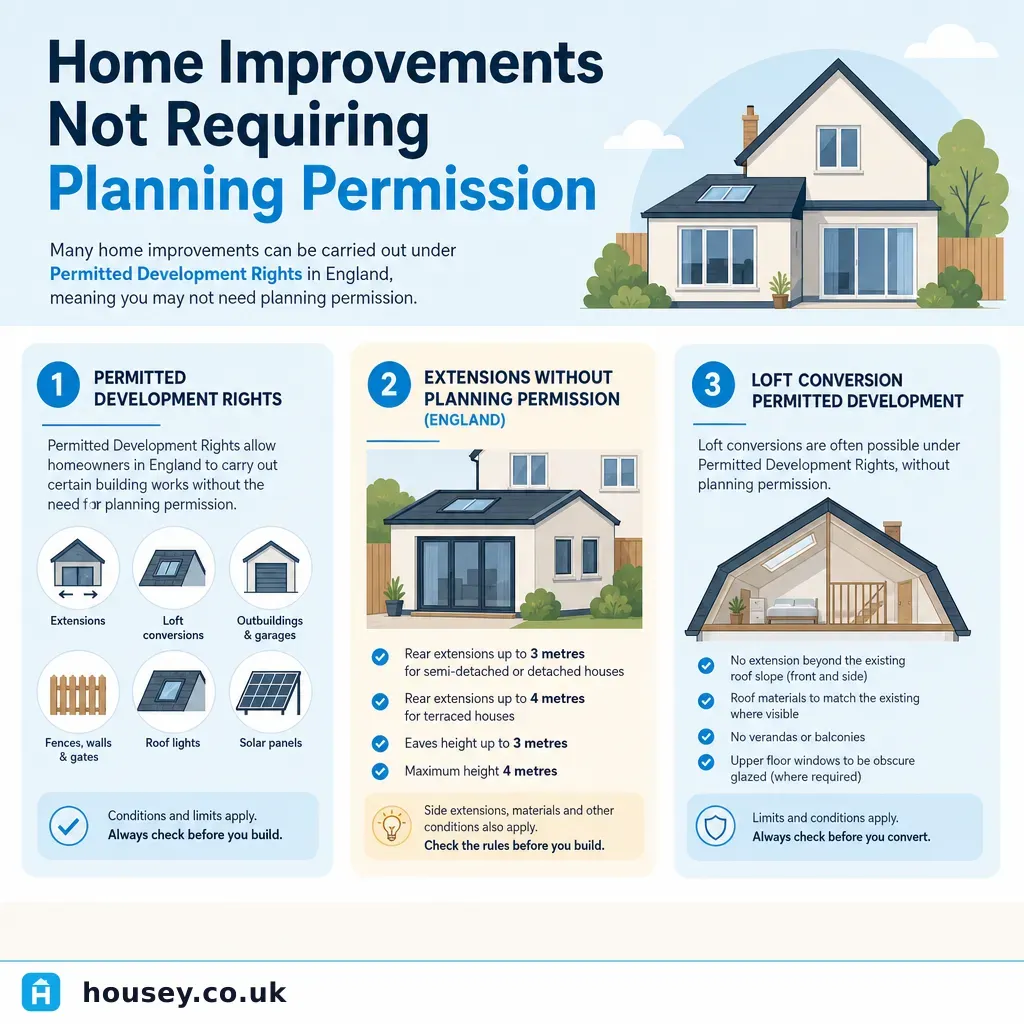
Home Improvements Not Requiring Planning Permission
Many common home improvements in England fall under Permitted Development Rights and do not require a planning application.