Building During Hot Weather: Challenges and Solutions
By Housey · Last reviewed 11th of May 2026
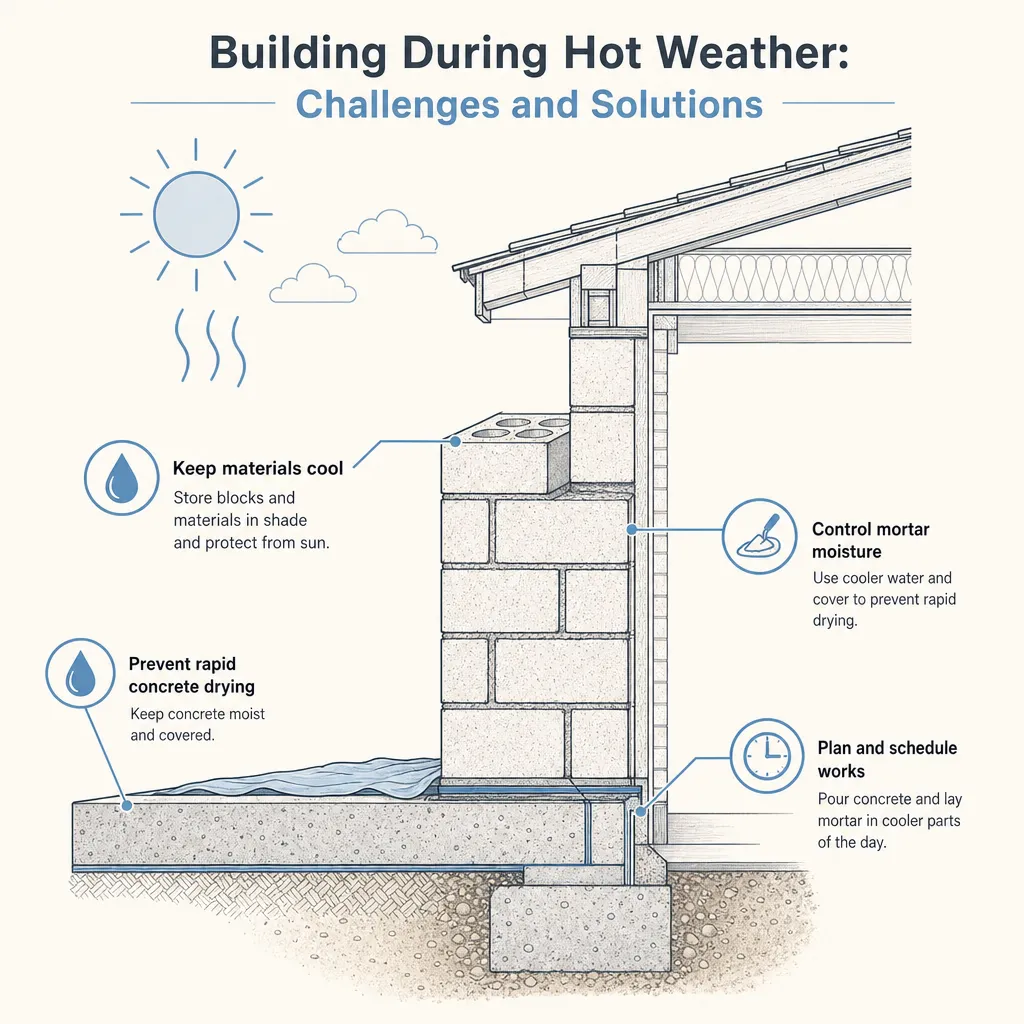
Building During Hot Weather: Challenges and Solutions
Hot weather is an increasingly common consideration for UK construction projects, particularly during the longer dry spells that have become more frequent in southern England. Whether you are extending a 1930s semi, pouring a foundation for a garden room, or managing a larger renovation, unusually warm conditions can affect the quality of concrete, masonry, and adhesives — as well as the welfare of everyone on site. Understanding these risks before a heatwave arrives is far more effective than reacting once problems emerge.
Key points
- Concrete delivered or mixed at ambient temperatures above 30°C can lose workability significantly faster — in some cases within 30–45 minutes rather than the 1–2 hours typical in mild UK conditions.
- BS EN 206 sets maximum temperature requirements for fresh concrete on delivery; most UK ready-mix suppliers will flag if temperatures risk non-compliance.
- Freshly laid concrete must be cured for at least 3 days (7 days for structural elements) under BS 8500 guidance to prevent premature surface drying and reduced strength.
- The Management of Health and Safety at Work Regulations 1999 require employers to assess and control thermal comfort risks; HSE guidance covers shade, water breaks, and task rotation for outdoor sites.
- Mortar in brickwork can skin over rapidly in dry, windy heat, preventing proper carbonation and reducing bond strength before the joint has cured.
How hot weather affects concrete quality
Concrete generates heat as cement hydrates; when ambient temperatures are already elevated, this internal heat can push fresh concrete temperatures well above safe limits. Above approximately 32°C, the water-cement ratio is disrupted as moisture evaporates faster, shrinkage cracks become more likely, and compressive strength can be reduced if curing is inadequate.
Practical measures used by experienced contractors include:
- Scheduling large pours for early morning when air temperature is at its lowest.
- Using chilled or iced water as part of the mix water.
- Requesting fly-ash or GGBS (ground granulated blast-furnace slag) cement blends from the supplier, which generate less heat during hydration.
- Covering freshly poured concrete with damp hessian or polythene sheeting immediately after finishing.
- Avoiding pours during peak sun hours (roughly 11:00–15:00 in summer).
CIRIA guidance on hot-weather concreting provides detailed technical parameters for site managers and engineers on temperature thresholds and curing regimes.
How hot weather affects brickwork and mortar
Mortar needs moisture to cure properly. In high temperatures with low humidity, mortar joints can dry out prematurely — a process sometimes called "flash set" — before full carbonation has occurred, leading to weak, friable joints. Bricks can also absorb water rapidly from the mortar in dry conditions if they have not been pre-wetted.
Good practice for hot-weather brickwork:
- Pre-wet dry, absorbent bricks several hours before laying — not immediately before, as surface water weakens the bond.
- Mix smaller mortar batches so none sit unused for more than 30 minutes in hot conditions.
- Protect finished courses with shade netting or dampened hessian at the end of each working period.
- Avoid laying mortar in direct sunlight where possible — work in shade or schedule around the hottest part of the day.
NHBC Standards and BS 8000-3 (Workmanship on building sites — masonry) set out expectations for mortar quality and protection during adverse weather conditions.
Heat stress and worker welfare on site
Under the Management of Health and Safety at Work Regulations 1999, employers must assess and control thermal comfort risks. HSE guidance notes that there is no single legal maximum workplace temperature in the UK, but employers must act when heat becomes a risk to health.
Practical steps site supervisors should take:
- Provide shaded rest areas with cool drinking water — HSE guidance suggests at least 0.5 litres per hour per worker in hot conditions.
- Rotate workers on physically demanding tasks and allow extra breaks.
- Schedule the heaviest work for early morning or late afternoon.
- Train workers to recognise signs of heat exhaustion: heavy sweating, weakness, cold or pale skin, weak pulse, and nausea.
- Consider lighter-coloured or vented PPE where this is safe and practical on site.
Decision tree: responding to hot weather on site
- Choose standard working practices if temperatures are below 25°C; monitor conditions and prepare contingency measures.
- Introduce shade, water breaks, and scheduled morning pours if temperatures reach 25–30°C; protect mortar and fresh concrete from direct sun and wind.
- Implement a heat-stress plan and contact your ready-mix supplier if temperatures exceed 30°C; consider delaying structural pours; brief all workers on heat-exhaustion symptoms.
- Consult your contractor and structural engineer before any structural concrete pour or critical masonry if temperatures exceed 35°C or UKHSA issues a heat-health alert.
- Treat strong wind alongside high heat as equivalent to a higher temperature for material risks — increase curing protection and shading measures accordingly.
Red flags: signs hot weather may have caused a problem
Catch issues early — some hot-weather defects are visible shortly after placement, others emerge weeks later:
- Plastic shrinkage cracks appearing in fresh concrete within hours of placement, typically parallel diagonal lines across flatwork.
- Surface scaling or crazing on concrete that looks powdery or flaky after curing — may indicate inadequate curing or too-high a water-cement ratio.
- Crumbly, soft mortar in finished brickwork that can be gouged with a fingernail — indicates flash set or premature dry-out during curing.
- Open vertical cracks in freshly constructed masonry panels appearing at regular intervals — may suggest thermal movement was not accommodated in the build.
- Efflorescence (white salt deposits) concentrated in mortar joints — can indicate moisture movement caused by rapid temperature cycling in newly built masonry.
If you notice any of these signs, discuss them with your contractor before covering the work or proceeding to the next build stage.
When to get professional help
Hot weather rarely causes catastrophic failure on its own, but it raises the risk of sub-standard materials and workmanship that may only become apparent months later. Seek professional input if:
- Your contractor proposes to continue structural concrete pours above 32°C without specific hot-weather controls in place.
- Cracks or surface defects appear in newly poured concrete slabs or foundations within the first week.
- Mortar joints in new brickwork appear loose, hollow-sounding, or crumbled on close inspection.
- A heatwave is forecast during a critical build phase such as a foundation slab pour, beam installation, or structural blockwork.
A structural engineer or clerk of works can advise on whether work should pause and whether completed elements need testing or remediation.
How Housey can help
Housey connects homeowners with vetted extension builders who understand seasonal site management, and with project managers who can help oversee build quality during challenging weather conditions. Submit a brief and receive quotes from local professionals.
Frequently asked questions
Can you lay concrete in hot weather in the UK?
Yes, but it requires careful management. Keep fresh concrete cool by scheduling pours for early morning, using chilled mix water, and covering the finished surface with damp hessian or polythene immediately after placement. Concrete temperatures above 32°C on delivery are generally considered a quality risk under BS EN 206 and should be discussed with your supplier before any hot-weather pour.
Does hot weather affect brick laying?
Hot, dry weather accelerates moisture loss from mortar before it has cured fully, which can reduce bond strength significantly. Pre-wet absorbent bricks several hours before use, mix smaller mortar batches, and protect laid courses from direct sun and wind with shade netting or damp hessian. Scheduling brickwork for earlier or later in the day during heat spells is good practice.
Is there a legal maximum temperature for UK construction sites?
There is no single statutory maximum temperature in UK workplace law, but employers must manage thermal comfort risks under the Management of Health and Safety at Work Regulations 1999. HSE guidance sets out practical measures including the provision of shade, cool drinking water, rotation of workers on demanding tasks, and scheduling the heaviest work for cooler parts of the day.
How long should you cure concrete in summer?
BS 8500 recommends a minimum of 3 days for non-structural elements and 7 days for structural concrete. In hot weather, these minimum periods are especially important — curing compounds, wet hessian, or polythene sheeting should be applied immediately after finishing and maintained throughout. Inadequate curing in hot conditions is a common cause of surface crazing and reduced compressive strength.
Sources and further reading
- HSE thermal comfort guidance — Health and Safety Executive
- Management of Health and Safety at Work Regulations 1999 — legislation.gov.uk
- CIRIA hot-weather concreting guidance — CIRIA
- NHBC Standards — NHBC
Useful next reads
 Improvement & Build
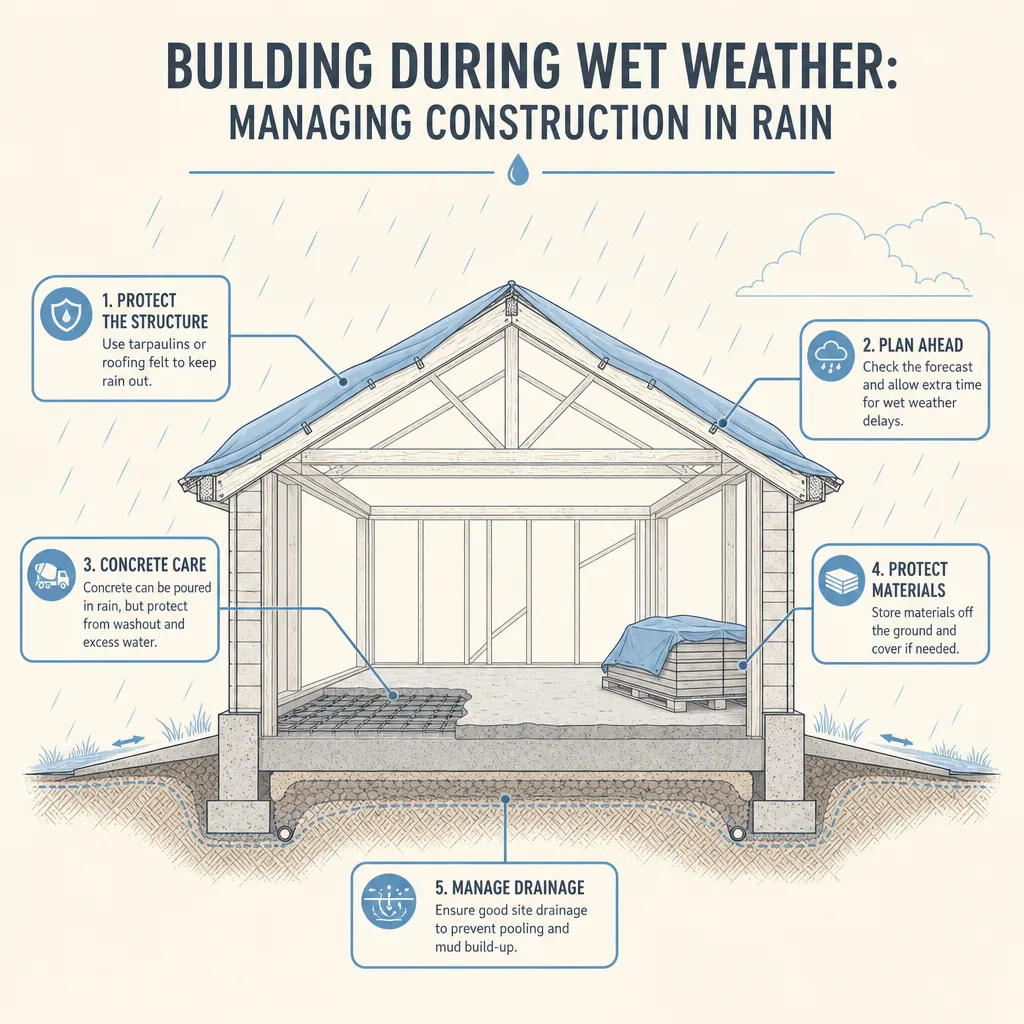
Building During Wet Weather: Managing Construction in Rain
Rain affects different construction stages differently.
 Improvement & Build
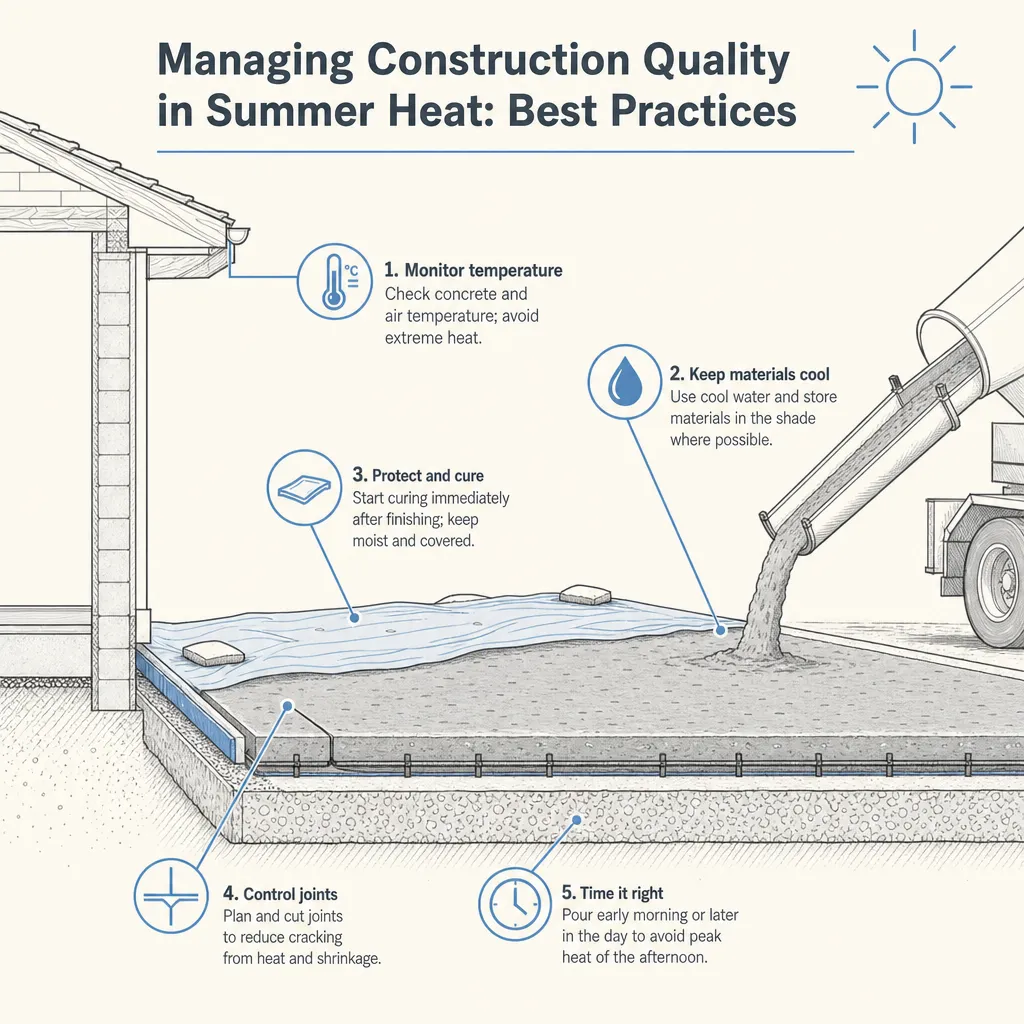
Managing Construction Quality in Summer Heat: Best Practices
Hot weather above 25°C can reduce concrete workability, increase shrinkage cracking, and cause mortar and render to dry before they have properly cured.
 Improvement & Build
Gardening in Hot Weather: Growing Successfully in Summer Conditions
In hot weather, UK gardens benefit most from deep watering in the early morning, a 5–7.
 Improvement & Build
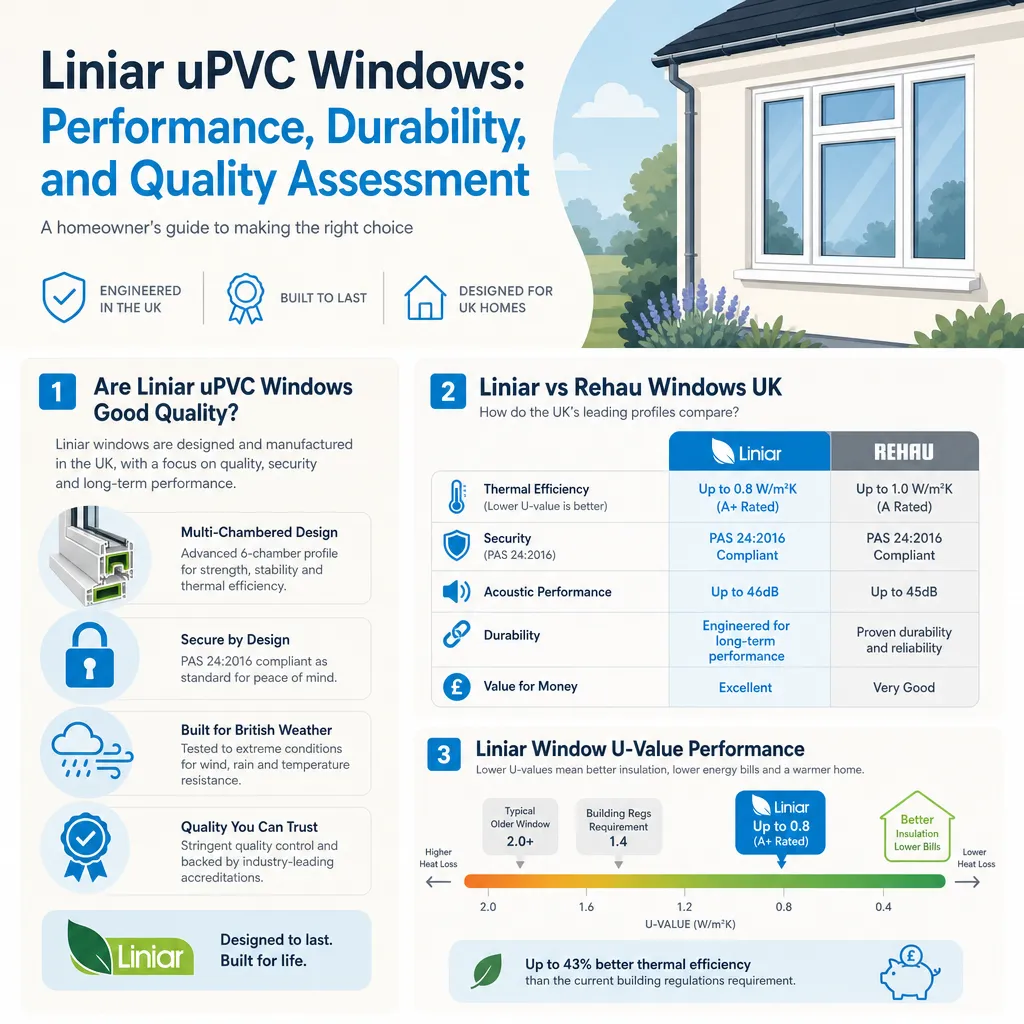
Liniar uPVC Windows: Performance, Durability, and Quality Assessment
Liniar uPVC window profiles are manufactured in the UK using multi-chambered, foamed frames.
 Improvement & Build
Garden Tap Installation with Hot and Cold Water: Plumbing Options
Adding a cold garden tap is a common DIY project, but routing hot water outdoors requires a plumber to connect to your domestic hot water system and comply with the Water Supply (Water Fittings) Regulations 1999.