Building During Wet Weather: Managing Construction in Rain
By Housey · Last reviewed 11th of May 2026
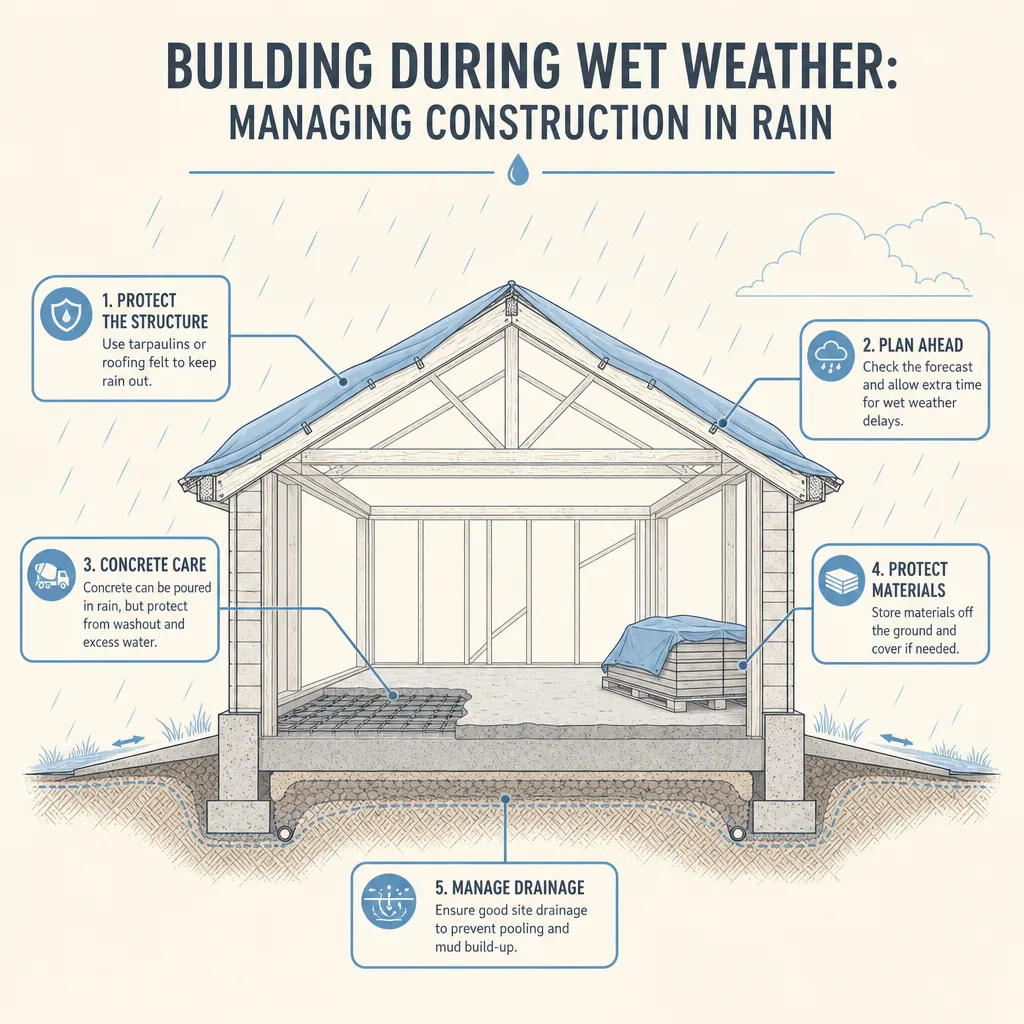
Building During Wet Weather: Managing Construction in Rain
The UK's climate means that most domestic building projects will encounter significant rainfall at some point. Whether you are extending a Victorian terrace, building a new garden room, or undertaking groundworks ahead of a loft conversion, knowing which tasks can safely continue in wet conditions — and which must pause — is essential for protecting your build quality and managing programme delays.
Key points
- Concrete poured in heavy rain can suffer surface dilution, reducing compressive strength below the values required by BS EN 206:2013, the UK standard governing concrete composition and performance.
- JCT building contracts typically allow a contractor to claim an extension of time for exceptionally adverse weather conditions under clause 2.29; what counts as exceptional is judged against long-term local meteorological averages.
- The Construction (Design and Management) Regulations 2015 (CDM 2015) require principal contractors to manage site conditions, including the risks of unstable, waterlogged excavations.
- Exposed brickwork left uncovered in rain is at risk of efflorescence — salt deposits drawn to the surface — and mortar washout in new joints.
- Air temperature matters as much as rainfall: BS EN 1996-2 (Eurocode 6) recommends mortar is not laid when temperatures are expected to drop below 3°C within 24 hours.
Which construction activities are affected by rain?
Different site operations carry very different sensitivity to wet weather. Understanding the distinction helps you and your contractor make informed decisions about sequencing and programme.
Activity | Rain sensitivity | Key risk | Can it continue in light rain? |
|---|---|---|---|
Concrete pours (slabs, foundations) | High | Surface dilution, strength loss | No — cover or reschedule |
Blockwork and brickwork | High | Mortar washout, efflorescence | No — cover completed work; halt new work in heavy rain |
Excavation and groundworks | High | Trench collapse, waterlogging, ground heave | Only with active pumping and CDM risk assessment |
Roofing (felt or membrane) | Moderate | Adhesion failure, trapped moisture | Light rain: possibly; heavy rain: no |
Timber frame erection | Low–Moderate | Swelling and warping of exposed joists | Light rain: generally yes, with cover for cut ends |
Internal fit-out (plastering, boarding) | Low | Structure must be watertight first | Yes, if building envelope is fully closed |
Drainage installation | Moderate | Trench silting, pipe joint failure | Assessment needed; active dewatering may allow it |
Always defer to your site manager or structural engineer if conditions are borderline.
How rain affects concrete
Concrete is among the most rain-sensitive materials used in domestic builds. The core risk is water-to-cement ratio dilution: if rainwater enters a fresh pour, the mix becomes weaker and more permeable, potentially falling below the C25/30 or C30/37 mix specification typically required for UK domestic foundations and slabs under BS 8500-1:2023.
Practical implications at each stage:
- Before pouring: check the 24-hour forecast. A dry window of at least 4–6 hours is usually needed after a standard domestic slab pour.
- During pouring: temporary polythene sheeting should be on hand to cover the pour immediately if rain begins.
- After pouring: fresh concrete needs protection for the first 24–48 hours while initial set occurs. Curing blankets or polythene retain moisture and protect against temperature fluctuations.
- Cold-weather risk: if air temperature is likely to drop below 2°C within 48 hours, cold-weather concreting protocols apply — including insulating blankets or heated enclosures.
Concrete that has been significantly rained on before it sets adequately may need to be broken out and replaced. This is a costly and time-consuming outcome that underscores the value of proper scheduling and on-site cover materials agreed before work starts.
What your contract should say about weather delays
Most domestic building contracts — whether a standard JCT Minor Works form or a bespoke agreement — include provisions for delays caused by weather. Key points for homeowners:
- Relevant Events: Under JCT contracts, exceptionally adverse weather conditions are a Relevant Event entitling the contractor to an extension of time but not to additional money. The contractor typically bears the cost of standing time unless the contract specifies otherwise.
- What counts as exceptional: this is assessed against meteorological records for the area and time of year. A week of heavy rain in November in the Lake District is unlikely to qualify; the same rainfall in July in Surrey may well do.
- Notification obligations: most JCT forms require the contractor to notify you within a specified period — often two weeks — of a delay becoming apparent. Check your contract wording carefully.
- Programme tracking: ask your contractor to maintain a programme showing weather-sensitive activities on the critical path, so delays remain transparent and auditable throughout the project.
If your project has no formal contract, the Consumer Rights Act 2015 and Citizens Advice guidance on service contracts may apply to disputes about delay and completion.
Decision tree: should work continue today?
Use this guide when your contractor or site manager needs to assess current conditions:
- Continue if the activity is internal fit-out, roofing with a fully closed envelope, or drainage with adequate dewatering and no trench stability concerns.
- Cover and pause concrete or mortar work if rainfall is above light drizzle, or if standing water is visible near the pour area.
- Halt groundworks if trenches show signs of slumping, water accumulation exceeds pump capacity, or adjacent ground is visibly saturated.
- Consult your structural engineer if excavation is within 1.5m of an existing foundation or boundary wall and ground conditions have changed materially due to prolonged rain.
- Review the contract programme if cumulative rain days have exceeded the normal annual average for the site's location — this is the trigger for a formal extension-of-time assessment under the contract.
Red flags: when wet-weather conditions need immediate attention
- Trench walls showing cracks, slumping, or water seepage — stop work immediately and contact a geotechnical or structural engineer.
- Fresh concrete that received significant rainfall during the pour — do not assume it will meet strength requirements without independent cube testing per BS EN 12390-3.
- Completed brickwork with visible white staining across wide areas — may indicate mortar washout; ask a competent builder to assess whether repointing is needed.
- Roof structure exposed to repeated wetting and drying cycles — warping and movement can affect tile fixing and weathertightness.
- Groundwater rising into a new subfloor void — may indicate inadequate drainage design and should be reviewed by a structural engineer before the slab is enclosed.
Homeowner wet-weather checklist
Before and during any construction project in the UK:
When to get professional help
Wet weather management is primarily a site management responsibility, but independent professional input adds genuine value in certain situations. A structural engineer should be involved if groundwater conditions are unexpectedly severe, or if ground movement near existing foundations is suspected. An independent project manager can provide neutral oversight of programme and delay assessments, particularly on larger domestic projects. If a dispute arises over weather-related delay costs or standing time, a construction solicitor or adjudicator may be needed.
How Housey can help
If you are planning a domestic build or extension and want professional site management from the outset, Housey can connect you with vetted extension builders experienced in UK weather conditions. Project managers can maintain programme oversight and wet-weather risk assessment throughout your project, while design-and-build firms can integrate weather contingency planning directly into your contract from day one.
Frequently asked questions
Can concrete be poured in light drizzle?
Light drizzle is less damaging than heavy rain, but most site managers prefer a dry window of at least 4–6 hours after a pour to allow initial set. If drizzle intensifies, covering the pour immediately is essential. Always defer to your contractor's assessment of current conditions and the specified concrete mix.
Who pays for construction delays caused by rain?
Under most JCT contracts, exceptionally adverse weather entitles the contractor to additional time but not additional money. The cost of standing time and weather protection materials is typically borne by the contractor, unless the contract explicitly allocates weather costs differently. Check your specific contract wording.
How can I check whether concrete that got wet during a pour is still structurally adequate?
Request cube tests in accordance with BS EN 12390-3. Samples taken during the pour are crushed after 28 days to verify compressive strength. If results fall below the specification, your structural engineer should advise on remedial options, which may include breaking out and recasting the affected area.
Does rain affect brickwork mortar?
Yes. Heavy rain can wash cement from fresh mortar joints before they set, weakening the bond and leaving a porous, friable finish. Completed brickwork should be covered with polythene or a tarpaulin during and immediately after rain until the mortar has achieved adequate strength, typically 24–48 hours at normal temperatures.
Sources and further reading
- BS EN 206:2013+A2:2021 – Concrete: Specification, performance, production and conformity — BSI Group
- Construction (Design and Management) Regulations 2015 — legislation.gov.uk
- JCT Minor Works Building Contract — Joint Contracts Tribunal
- BS EN 1996-2:2006 – Design of masonry structures — BSI Group
- UK climate normals and weather data — Met Office
Useful next reads
 Improvement & Build
How to Find and Hire an Extension Builder
To hire a reliable extension builder, get at least three detailed written quotes from contractors with documented experience of similar projects.
 Improvement & Build
Home Extensions and Additions: Planning Your Project
Most single-storey rear extensions can be built under permitted development without a full planning application, provided they stay within depth limits of 4 m for detached or 3 m for semi-detached and terraced properties.
 Improvement & Build
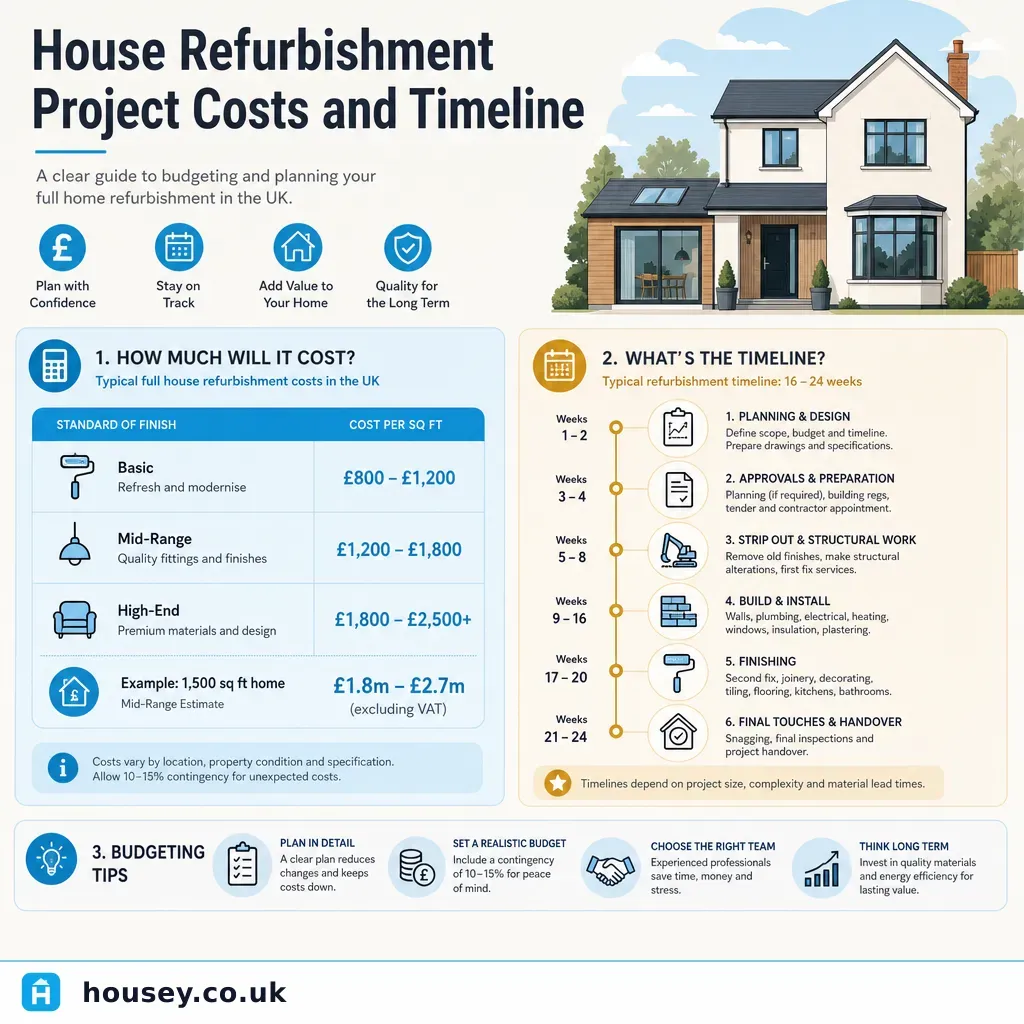
House Refurbishment Project Costs and Timeline
A full house refurbishment in the UK typically costs £30,000–£225,000+ depending on property size, scope, and location.
 Improvement & Build
Renovation Investment Strategy: Assessing Properties Before You Buy
Renovation investment properties require more due diligence than a standard home purchase.
 Improvement & Build
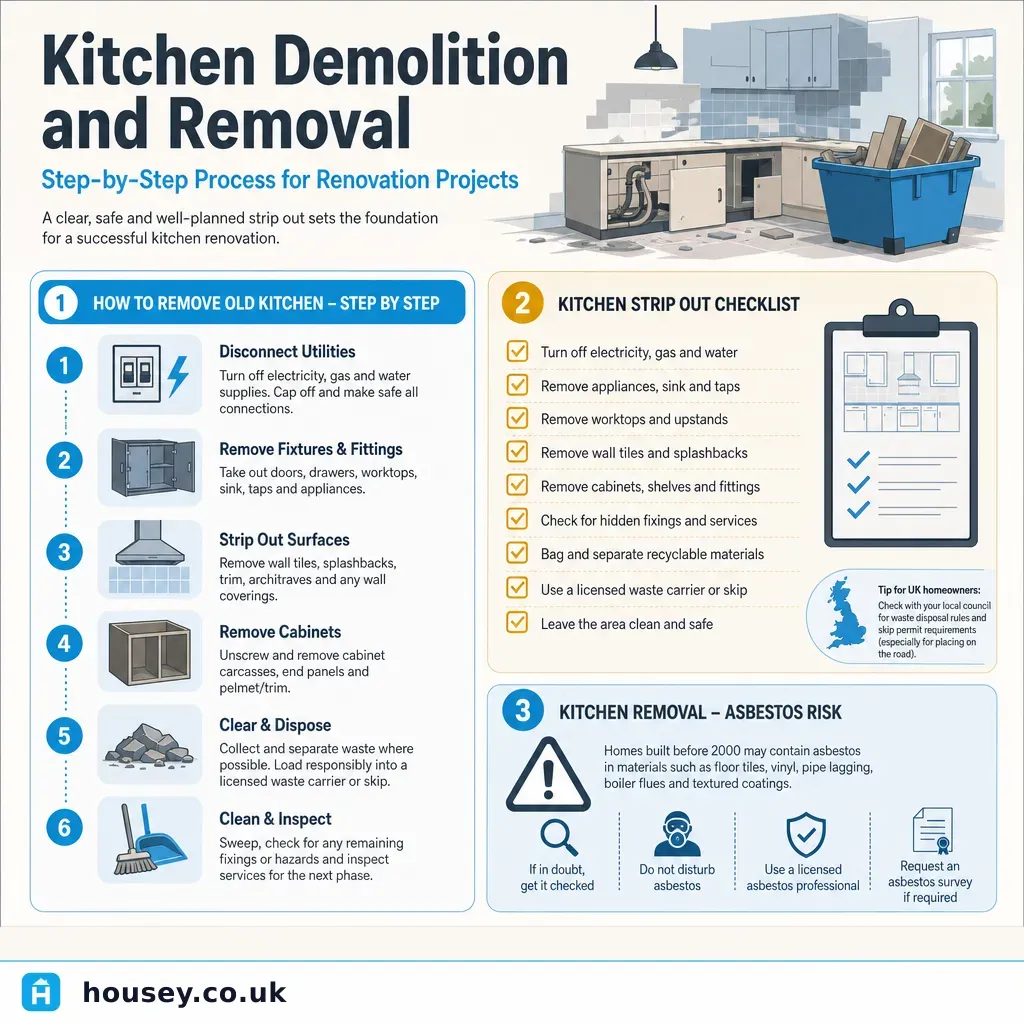
Kitchen Demolition and Removal: Step-by-Step Process for Renovation Projects
Kitchen demolition involves regulated services, potential asbestos in pre-2000 properties, and legal waste disposal obligations.