Building Material Safety Standards: Regulatory Framework for Modern Construction
By Housey · Last reviewed 31st of May 2026
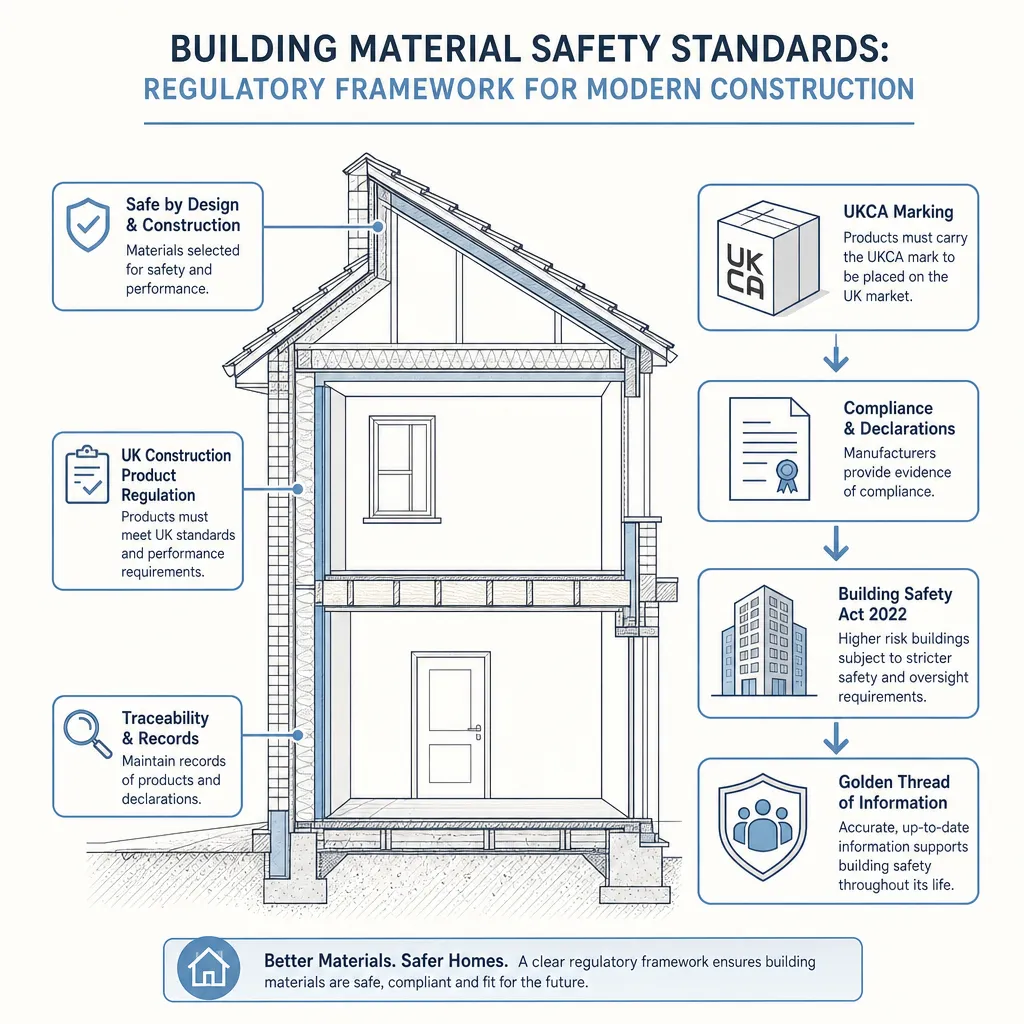
Building Material Safety Standards: Regulatory Framework for Modern Construction
When planning a construction project in the UK — whether a home extension, loft conversion, or new build — the materials used must meet strict regulatory requirements. These standards protect occupants from fire, structural failure, damp, and a range of other hazards. Knowing which certifications, product markings, and Approved Documents apply to your project helps you work effectively with your contractor and building control body, and avoid costly enforcement action or expensive retroactive remediation.
Key points
- The Building Regulations 2010 (as amended) set minimum performance requirements through Approved Documents covering structure (Part A), fire (Part B), damp (Part C), toxic substances (Part D), sound (Part E), ventilation (Part F), combustion appliances (Part J), energy efficiency (Part L), and electrical safety (Part P).
- From 1 January 2021, construction products placed on the Great Britain market must carry the UKCA mark (UK Conformity Assessed) rather than the EU CE mark; transition arrangements remain in flux — verify current guidance on GOV.UK before specifying products.
- The Building Safety Act 2022 created a Building Safety Regulator (hosted within HSE) and introduced a mandatory three-stage Gateway process for higher-risk buildings — residential buildings of at least 18 m or seven or more storeys with at least two units.
- Cladding and external wall insulation on higher-risk buildings must achieve at least Class A2-s1, d0 (limited combustibility) under the amended Approved Document B — combustible insulation in such wall systems is largely prohibited.
- Third-party certification from a UKAS-accredited testing body, a BBA (British Board of Agrément) certificate, or BSI Kitemark provides additional assurance that a product meets the relevant UK performance standard.
What are UK building material safety standards?
Building material safety standards in the UK are primarily defined by the Building Regulations 2010 and their Approved Documents, published by the Ministry of Housing, Communities and Local Government (MHCLG). These documents do not mandate specific product brands — instead, they define performance outcomes, and the designer or contractor must demonstrate that chosen materials achieve those outcomes.
The table below summarises the most material-relevant Approved Documents:
Approved Document | Subject | Key material relevance |
|---|---|---|
Part A | Structure | Loads, foundations, masonry, timber framing |
Part B | Fire safety | Fire resistance ratings, cladding, cavity barriers |
Part C | Site preparation and resistance to moisture | Vapour control, tanking, damp-proof course |
Part E | Resistance to sound | Acoustic performance of partitions and floors |
Part F | Ventilation | Breathability, air-tightness membranes |
Part L | Conservation of fuel and power | U-values, thermal bridging, insulation performance |
Part P | Electrical safety | Wiring systems, notifiable electrical works |
Products that comply with a relevant harmonised or UK-designated standard and carry the correct conformity mark are presumed to satisfy the associated regulatory performance requirement. Building control bodies retain discretion to request further evidence if they have concerns about a product's suitability.
How UK product marking works after Brexit
Before January 2021, construction products across the UK could carry the CE mark, indicating compliance with EU harmonised standards. Since then:
- UKCA marking is required for most construction products placed on the Great Britain (England, Scotland, Wales) market. It requires conformity assessment against a UK-designated standard and, for regulated products, third-party certification by a UK Approved Body.
- CE marking continues to apply in Northern Ireland under the Windsor Framework and, under certain transition provisions, may still be accepted on the GB market — check current GOV.UK construction products guidance before specifying imported products.
- If a contractor proposes a product that lacks the correct marking, request written confirmation of how it demonstrates compliance with the relevant Approved Document performance requirement.
The Building Safety Act 2022 and higher-risk buildings
The Building Safety Act 2022 fundamentally reformed building safety regulation in England for higher-risk residential buildings (HRBs), defined as residential buildings of at least 18 m or seven or more storeys with at least two residential units. Key changes include:
- A new Building Safety Regulator (within HSE) that must grant approval at three Gateway points before work can proceed or residents can occupy the building.
- A mandatory \"golden thread\" of building information — a digital record of materials specifications, as-built drawings, and safety decisions that must be maintained throughout the building's life.
- Mandatory registration of existing HRBs; principal accountable persons have ongoing legal duties for safety case reporting and resident engagement.
- Extended limitation periods for construction defect claims, increasing the window during which owners can seek remedies for non-compliant materials.
For most homeowners carrying out domestic extensions or loft conversions, the HRB regime will not apply directly. If you own a flat in a qualifying building, however, your principal accountable person's statutory obligations directly affect service charges and maintenance decisions.
Fire safety and cladding: what the rules now require
The most significant material safety changes since 2018 relate to external wall systems. Following the Grenfell Tower fire, Approved Document B was amended to require external wall systems on higher-risk buildings to achieve at least limited-combustibility performance (Class A2-s1, d0 or better). Combustible foam insulation as part of such wall systems is largely prohibited.
For flats in buildings with non-standard cladding, an EWS1 (External Wall System) form — a professional declaration on the fire safety of the wall system — is commonly requested by mortgage lenders and valuers. It is not a statutory document but is effectively required for sales and remortgaging in many cases.
Which professional do I need for materials compliance?
Situation | Professional to involve | Why |
|---|---|---|
Domestic extension or conversion | Building control body + architect or designer | Confirms Approved Document compliance throughout project |
New build or significant alteration | RIBA architect or CIAT architectural technologist + structural engineer | Specifies compliant materials at design stage |
Higher-risk building (≥18 m or 7+ storeys) | Building Safety Regulator + principal designer + principal contractor | Gateway process is mandatory before work can proceed |
Suspected non-compliant external cladding | Fire engineer or RICS-accredited façade specialist | EWS1 assessment and remediation advice |
Innovative or unlisted product | BBA or UKAS-accredited Technical Assessment body | Independent evidence of compliance as alternative route |
Important limitations
This article provides general information about the UK regulatory framework for building material safety in England. Regulations are updated periodically — verify requirements against the current Approved Documents on GOV.UK and confirm with your building control body or a qualified professional before specifying materials. Listed buildings, conservation areas, and the devolved nations (Scotland uses Technical Handbooks, Wales has its own Approved Documents, Northern Ireland uses Technical Booklets) have materially different frameworks. This guide does not constitute legal or building control advice.
When this becomes urgent
If work is already under way and you suspect non-compliant materials have been incorporated — cladding without the required fire classification, structural materials that differ from the approved specification, or products lacking UKCA marking — do not wait for the project to complete. Contact your building control body immediately. For higher-risk buildings where Gateway approvals have not been obtained, contact the Building Safety Regulator directly. Retroactive remediation is almost always more costly and disruptive than early intervention.
What to ask a qualified professional
- Which Approved Documents apply to my project, and what specific performance requirements must the materials meet?
- Has the proposed product been assessed by a UK Approved Body or third-party certifier, and can you provide the BBA Agrément certificate or equivalent documentation?
- Does this project fall within the scope of the Building Safety Act 2022 Gateway process?
- How will compliance with material requirements be documented for building control sign-off?
- If a material substitution is made on site during construction, how will you confirm the replacement meets the same Approved Document performance standard?
When to get professional help
Most construction projects require building control involvement before work starts. Involve a qualified professional immediately if:
- You are specifying materials for structural elements — a structural engineer should review load-bearing specifications.
- Your project involves external wall insulation, render, or cladding — engage an architect or fire engineer with current knowledge of Approved Document B.
- A product on site lacks the required UKCA or CE marking — raise this with your building control officer before the material is incorporated into the structure.
- Your building meets the definition of a higher-risk building — the Gateway process requires professional sign-off at each mandatory stage.
How Housey can help
Housey connects homeowners and developers with vetted professionals across the UK. Whether you need building control consultants to guide your project through approval, building regulations drawings to specify compliant materials from the outset, or structural engineering input for load-bearing elements, Housey can match you with the right specialist for your project and location.
Frequently asked questions
Do I need building regulations approval just to replace insulation?
In many cases, yes. Works that affect the thermal performance of the building envelope — including replacing insulation — may require a building regulations application to demonstrate compliance with Approved Document L (energy efficiency). Check with your local authority building control or an approved inspector before starting work.
What is the difference between the UKCA mark and the CE mark for building products?
The UKCA mark is the UK conformity marking introduced after Brexit for products placed on the Great Britain market. It indicates assessment against UK-designated standards by a UK Approved Body. CE-marked products remain accepted in Northern Ireland and under certain transition arrangements on the GB market — always verify current GOV.UK guidance before specifying products.
What is an EWS1 form and when is it required?
An EWS1 (External Wall System) form is a declaration by a qualified professional confirming the fire safety of a building's external wall system. Mortgage lenders and valuers commonly require it for flats in multi-storey buildings with non-standard cladding. It is not a statutory requirement but has become a standard transaction requirement since the Grenfell Tower fire.
What happens if materials used in my building do not comply with Building Regulations?
Building control bodies can issue enforcement notices requiring remediation of non-compliant work. Local authorities may apply to a magistrates' court for an order requiring alteration or demolition. Under the Building Safety Act 2022, extended limitation periods apply for defective-work claims in higher-risk buildings, significantly increasing long-term liability exposure.
Sources and further reading
- Approved Documents — Building Regulations — GOV.UK
- Building Safety Act 2022 — legislation.gov.uk
- UKCA marking for construction products — GOV.UK
- Building Safety Regulator — HSE
- Construction products regulation in Great Britain — GOV.UK
Useful next reads
 Planning & Pre-Build
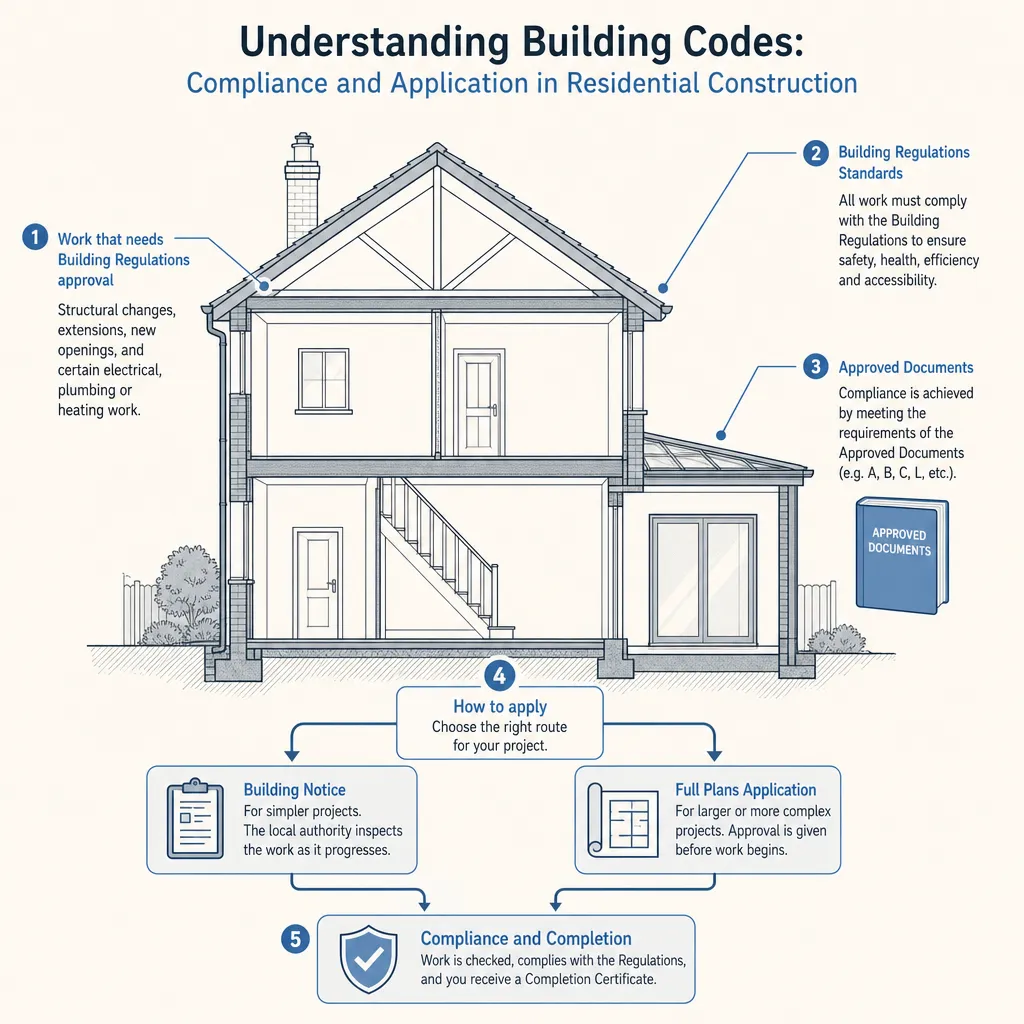
Understanding Building Codes: Compliance and Application in Residential Construction
Building Regulations in England and Wales set minimum technical standards for construction, covering structural stability, fire safety, ventilation, insulation, drainage, and electrical safety.
 Planning & Pre-Build
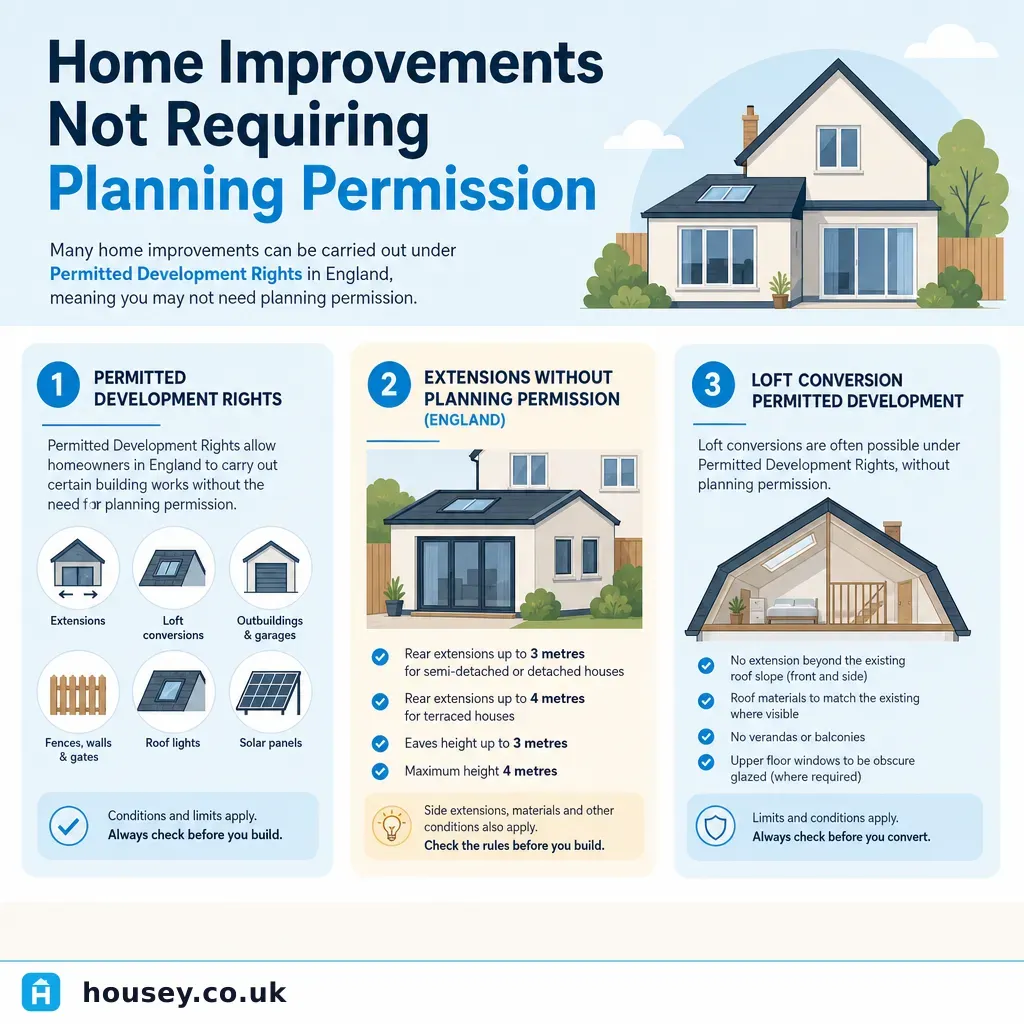
Home Improvements Not Requiring Planning Permission
Many common home improvements in England fall under Permitted Development Rights and do not require a planning application.
 Planning & Pre-Build
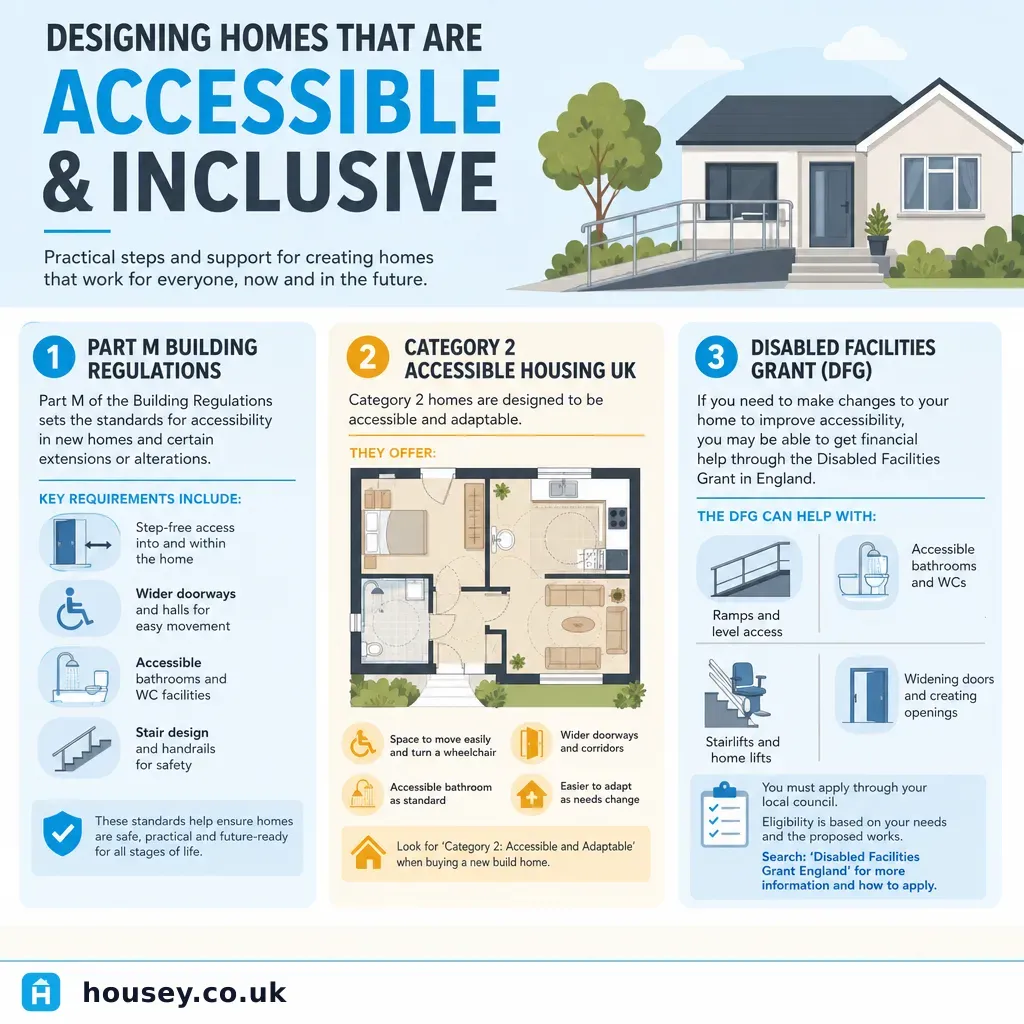
Designing Homes That Are Accessible and Inclusive
Accessible home design in the UK is guided by Building Regulations Approved Document M, which sets three standards for new dwellings: Category 1 (Visitable), Category 2 (Accessible and Adaptable), and Category 3 (Wheelchair User Dwelling).
 Planning & Pre-Build
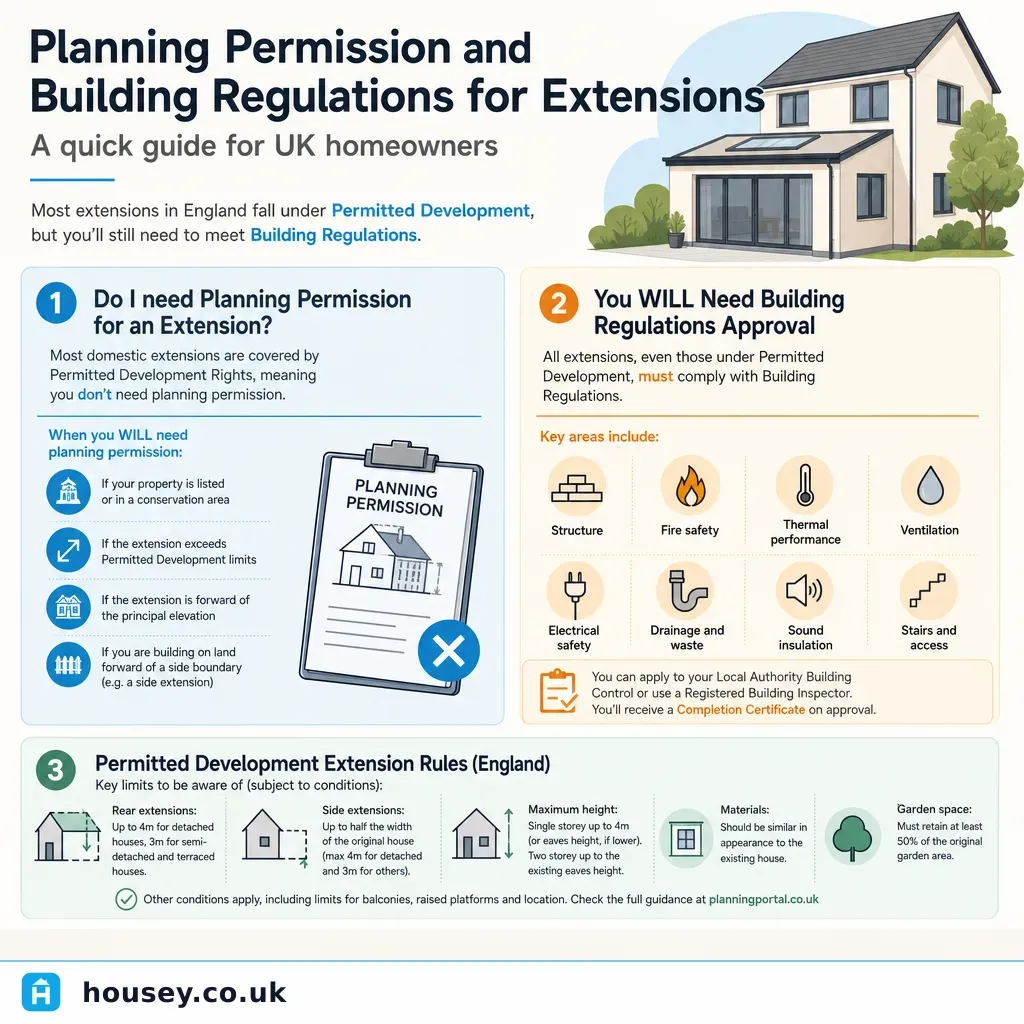
Planning Permission and Building Regulations for Extensions
UK home extensions usually require both planning permission and Building Regulations approval, though most smaller rear extensions qualify as Permitted Development under the GPDO 2015 and need no planning application.
 Planning & Pre-Build
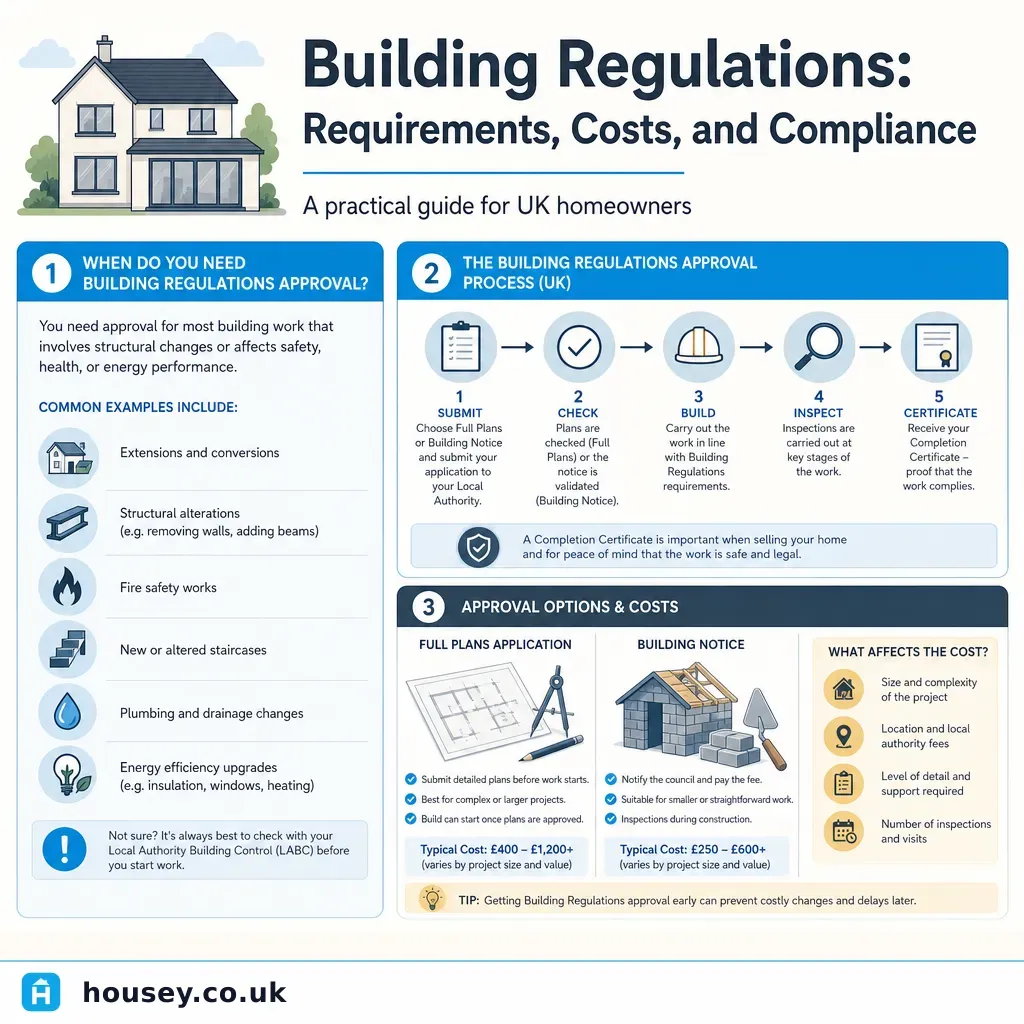
Building Regulations: Requirements, Costs, and Compliance
Building regulations set minimum standards for how construction work is carried out in the UK, covering structural stability, fire safety, energy efficiency, and ventilation.