Understanding Building Codes: Compliance and Application in Residential Construction
By Housey · Last reviewed 24th of May 2026
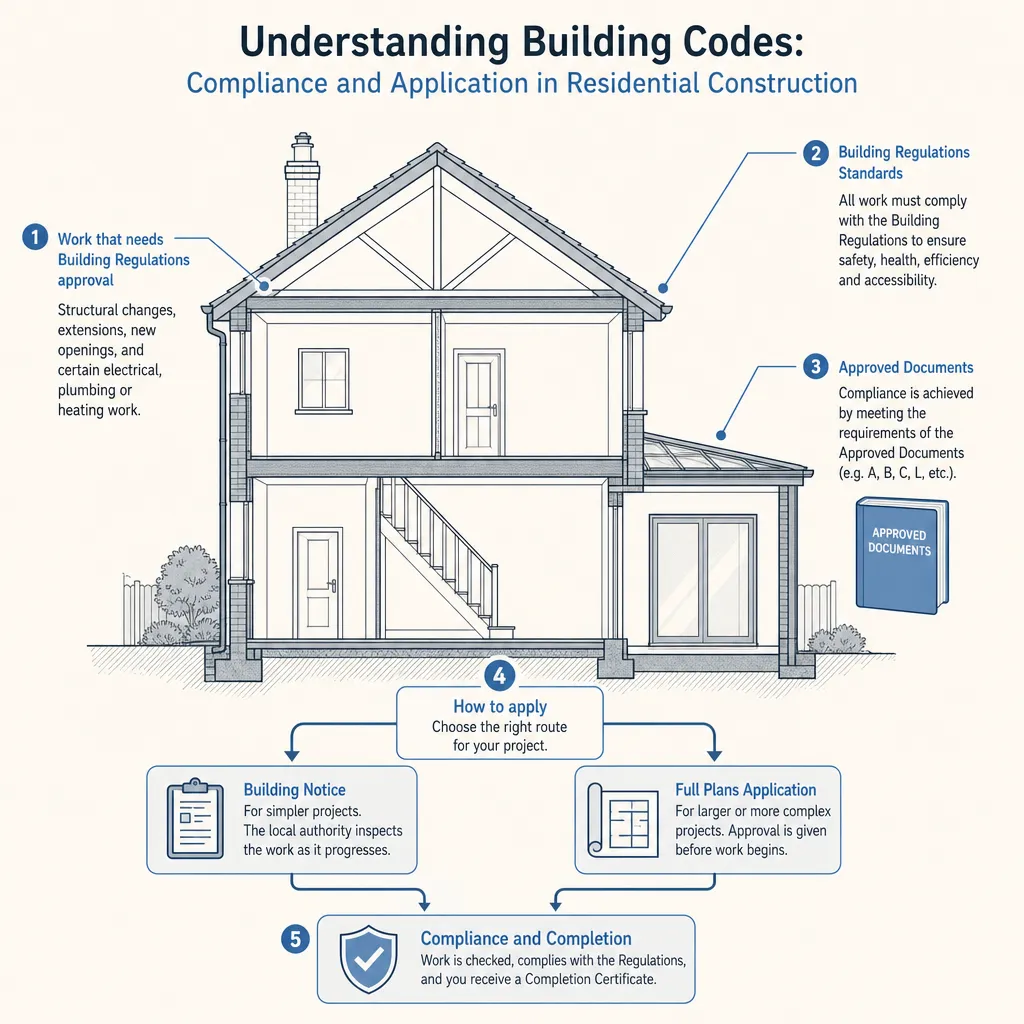
Understanding Building Codes: Compliance and Application in Residential Construction
Building Regulations sit at the heart of almost every residential construction project in the UK, yet the framework is one of the most widely misunderstood areas for homeowners. What is often called 'building codes' in international contexts is properly known in the UK as Building Regulations — a set of minimum technical standards made under the Building Act 1984, covering everything from structural stability and fire safety to energy efficiency and drainage. Getting compliance right matters: unpermitted works can affect a property sale, void an insurance policy, or — in the case of structural or fire safety failures — have serious consequences for occupants.
Key points
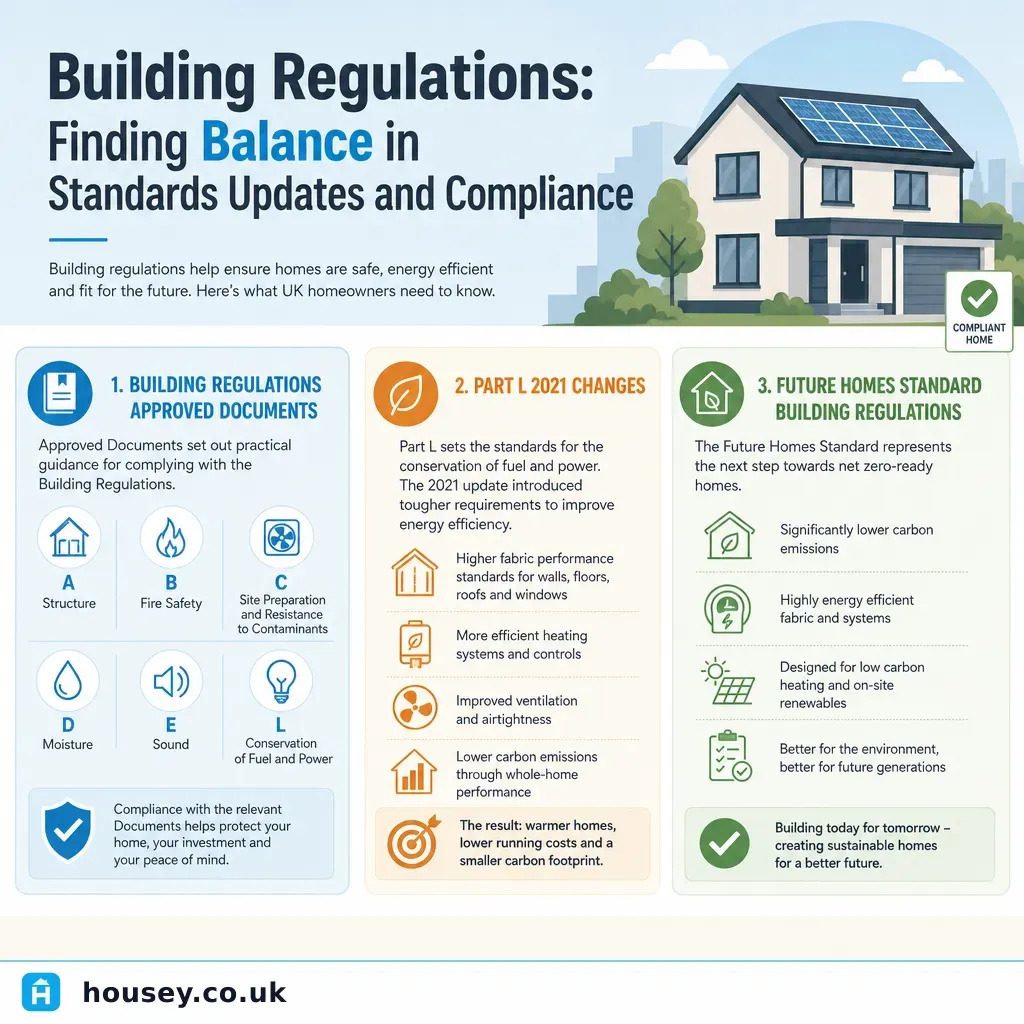
- Building Regulations in England and Wales are made under the Building Act 1984; the technical requirements are set out in Approved Documents A through S, each covering a specific aspect of construction.
- Building control approval is separate from planning permission — a project can have planning consent but still require building control approval, and vice versa.
- From October 2023, the Building Safety Act 2022 introduced the Building Safety Regulator (BSR) as the new building control authority for higher-risk buildings (those over 18 m or 7 storeys containing two or more dwellings).
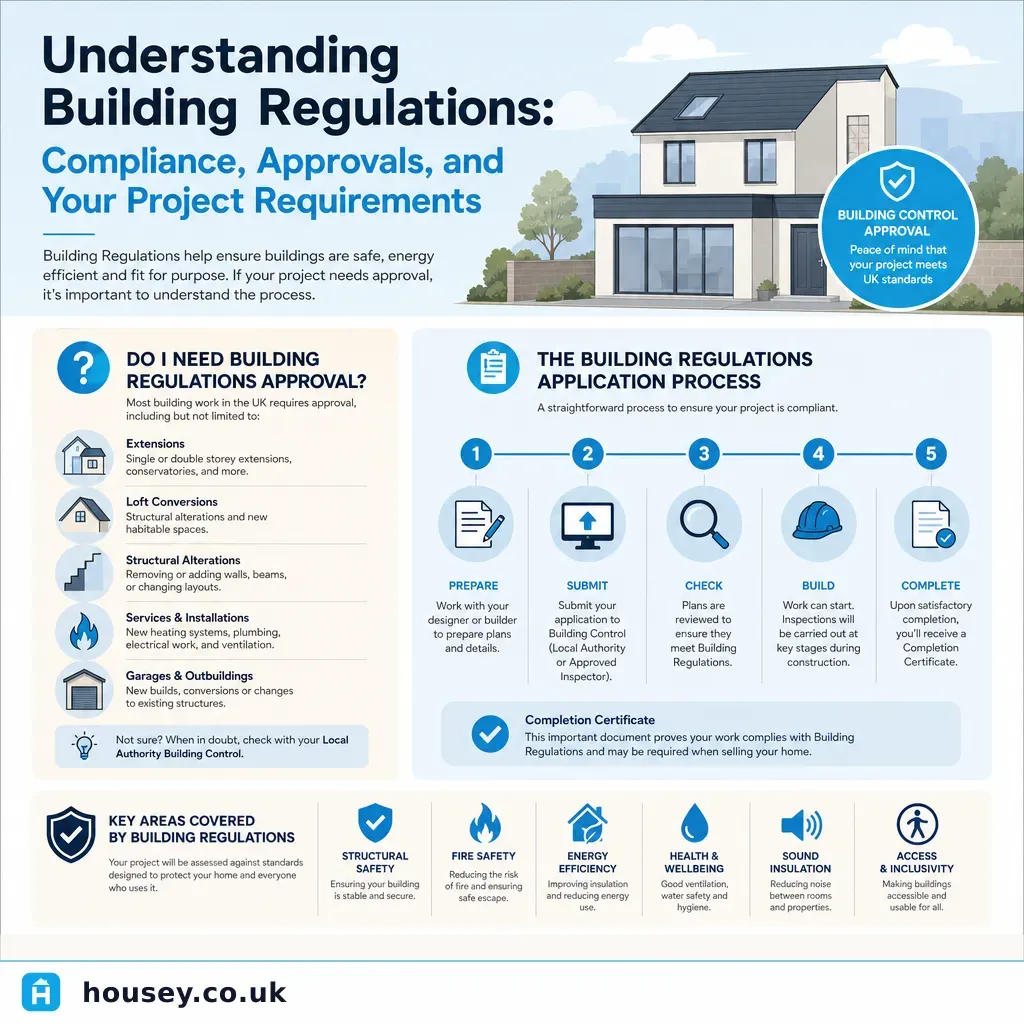
- Most domestic work — including extensions, loft conversions, garage conversions, structural alterations, and replacement windows — requires building regulations approval even when it does not require planning permission.
- A regularisation certificate can be obtained for notifiable work completed without approval after 11 November 1985, but the process is more complex and costly than applying in advance.
What are UK Building Regulations and why do they apply to homeowners
Building Regulations set minimum standards for the design and construction of buildings in Great Britain. They cover structural stability, fire safety, damp-proofing, insulation, ventilation, drainage, electrical safety, and more. Separate but broadly similar regulations apply in Scotland (Technical Handbooks) and Northern Ireland (Building Regulations Technical Booklets).
In England and Wales, the Approved Documents provide technical guidance on how to comply with each Part of the regulations. Following the relevant Approved Document is the most common and accepted route to compliance, though other approaches can be used where they can be shown to meet the required performance standard.
Homeowners interact with Building Regulations most often through:
- Extensions and conservatories (beyond permitted size thresholds).
- Loft conversions and garage conversions.
- Structural alterations, including removing or modifying load-bearing walls.
- New window or door openings in external walls.
- Replacement heating systems and electrical installation work.
- Installation or alteration of foul drainage or rainwater disposal.
- Cavity wall and external wall insulation on existing properties.
The Approved Documents: what they cover
Each Approved Document corresponds to a specific area of building performance:
Part | Topic | Common relevance to homeowners |
|---|---|---|
A | Structure | Extensions, loft conversions, removing load-bearing walls |
B | Fire safety | Escape routes, fire doors, smoke alarms in loft conversions |
C | Site preparation and moisture | Damp-proofing, radon protection, ground contamination |
E | Sound | Party wall separating dwellings in conversions |
F | Ventilation | Kitchen, bathroom, and whole-house ventilation |
J | Combustion appliances | Boilers, log burners, solid fuel installations |
L | Conservation of fuel and power | Insulation, windows, SAP rating, new and altered dwellings |
M | Access and facilities | Accessible design in new homes and some alterations |
O | Overheating | New homes in England from June 2022 |
P | Electrical safety | Domestic electrical installations |
Q | Security | Doors and windows in new dwellings |
S | EV charging infrastructure | New dwellings with associated parking |
For most domestic projects, Parts A, B, F, and L are the most frequently triggered.
Building notice vs full plans application: which route should you use?
Route | Best for | Not ideal for | Process | Key risk |
|---|---|---|---|---|
Full plans application | Complex projects, lenders' requirements, new builds, larger extensions | Small, straightforward alterations where speed is critical | Submit drawings before work begins; inspector checks and approves plans; inspections at key stages | Longer pre-work wait; plan amendments may be required |
Building notice | Simple alterations, small extensions, internal works | New dwellings, work near drains, projects where plan approval is needed by a lender | No drawings submitted in advance; inspector visits at key stages; no plan approval issued | No plan check before work starts; non-compliance found on site causes delay and cost |
Regularisation certificate | Works already completed without approval (post-1985) | Works where the owner refuses opening-up inspection | Submit application with details of completed works; inspector may require opening up | More costly; may require remedial work; no guarantee of certificate |
From April 2024, the Building Safety Act changes introduced a Registered Building Inspector system. For most domestic work, local authority building control (LABC) or Registered Building Control Approvers (formerly approved inspectors) remain the two main options.
Who does what: professionals involved in building control compliance
Professional | Role | When you need them |
|---|---|---|
Architect or designer | Produces drawings and specifications that comply with Approved Documents | Most extensions, conversions, and alterations requiring detailed design |
Structural engineer | Designs structural elements (beams, foundations, connections) to Part A | Removal of load-bearing walls, large openings, loft conversions |
Building control surveyor (LABC or RBCA) | Checks compliance, carries out inspections, issues completion certificate | All notifiable building regulations work |
SAP assessor | Calculates energy performance to demonstrate Part L compliance | Extensions, new builds, certain window replacements |
Party wall surveyor | Manages party wall notices and awards — separate from building control | Works on or near a party wall or boundary |
Approved electrician (Part P) | Self-certifies notifiable electrical work | Consumer unit replacement, new circuits in kitchens and bathrooms |
Document preparation checklist for a building regulations application
Before submitting a building notice or full plans application, prepare the following:
What happens without building regulations approval
Carrying out notifiable building work without approval is an offence under the Building Act 1984. More practically:
- A local authority can serve an enforcement notice requiring rectification or removal of unauthorised work.
- The work will not have a completion certificate, which solicitors require when a property is sold.
- Buyers' solicitors and mortgage lenders routinely ask for evidence of building regulations sign-off for past alterations.
- Indemnity insurance is available in some cases but does not confirm the work is safe and does not satisfy all lenders or insurers.
Important limitations
This article provides general information about Building Regulations in England and Wales. Rules and requirements differ in Scotland and Northern Ireland. Building Regulations and their Approved Documents are updated periodically — always check current versions on GOV.UK before relying on specific technical standards. For complex projects, listed buildings, or works in conservation areas, additional consents may apply. This article does not constitute legal or compliance advice; a qualified building control professional, architect, or solicitor should be consulted for your specific project.
When this becomes urgent
Seek professional advice promptly if:
- You have carried out notifiable work without building control approval and are preparing to sell the property.
- Building control has issued a notice or enforcement action is being considered.
- Work has been completed and you are uncertain whether a completion certificate was issued.
- You are buying a property and cannot locate completion certificates for extensions or conversions.
- Works involve fire safety elements — escape routes, fire doors — where non-compliance could have direct safety implications.
What to ask a qualified professional
Before instructing an architect, designer, or building control professional, ask:
- Which Approved Documents are relevant to my project, and how will compliance be demonstrated for each?
- Will you apply for building regulations on my behalf, and which route — building notice or full plans — do you recommend and why?
- What inspections will the building control surveyor carry out, and at which stages of the work?
- Who is responsible for structural engineer calculations, and will these be submitted to building control?
- When will I receive the completion certificate, and what happens if an inspection is failed?
- For work already done without approval — is regularisation the right route, or might opening-up be required?
- How do Building Regulations interact with any planning permission I have or need for this project?
When to get professional help
Building Regulations compliance is not optional, and errors are costly to correct once work has started. An architect or experienced designer will identify which Parts are triggered by your project, recommend the right application route, and coordinate the other professionals — structural engineer, SAP assessor — whose input is required. Building control professionals can advise on compliance at the pre-design stage, which is far less expensive than identifying non-compliance on site.
Red flags that mean you should seek help now:
- You are selling a property and cannot locate completion certificates for past works.
- A contractor has told you something does not need building regulations approval but you are not certain.
- The project involves structural alterations, fire safety elements, or drainage changes.
- You have received correspondence from your local authority about unauthorised works.
How Housey can help
Navigating Building Regulations is significantly easier with expert support from the outset. Housey can connect you with building control consultants who can advise on compliance requirements for your specific project, and planning consultants where planning permission and building regulations approvals need to be managed in parallel.
Frequently asked questions
Do all home improvements need building regulations approval in the UK?
No. Some work is exempt, including most repairs and like-for-like replacements, small detached outbuildings under 30 m² with no sleeping accommodation, and some conservatories meeting specific criteria. However, most structural alterations, extensions, loft conversions, and changes to heating, electrical, or drainage systems do require approval. Always check with your local authority or a building control professional before starting work.
What is the difference between building regulations and planning permission?
Planning permission controls whether a development is acceptable in land-use and appearance terms. Building regulations control the technical standards of construction — structural safety, fire safety, energy efficiency, and so on. Many projects need both; some need one but not the other. A loft conversion, for example, often does not need planning permission but almost always requires building regulations approval.
How long does a building regulations application take?
For a full plans application, the building control body has five weeks to approve the plans (or two months with agreement). Building notices produce no plan approval; work can begin after the notice is submitted, subject to site inspections at key stages. The completion certificate is issued after a satisfactory final inspection, which may be several months after work begins.
Can I sell my house without building regulations sign-off for past works?
A sale can technically proceed, but solicitors and mortgage lenders routinely ask for completion certificates for notifiable work. If certificates are missing, the seller typically obtains indemnity insurance — but this does not confirm the work is safe or compliant. Obtaining a regularisation certificate or providing completion documentation in advance is preferable and reduces risk for buyers.
Sources and further reading
- Building Regulations Approved Documents — GOV.UK
- Building Act 1984 — legislation.gov.uk
- Building Safety Act 2022 — legislation.gov.uk
- Building Safety Regulator — HSE
- Planning Portal: Building Regulations guidance — Planning Portal
Useful next reads
 Planning & Pre-Build
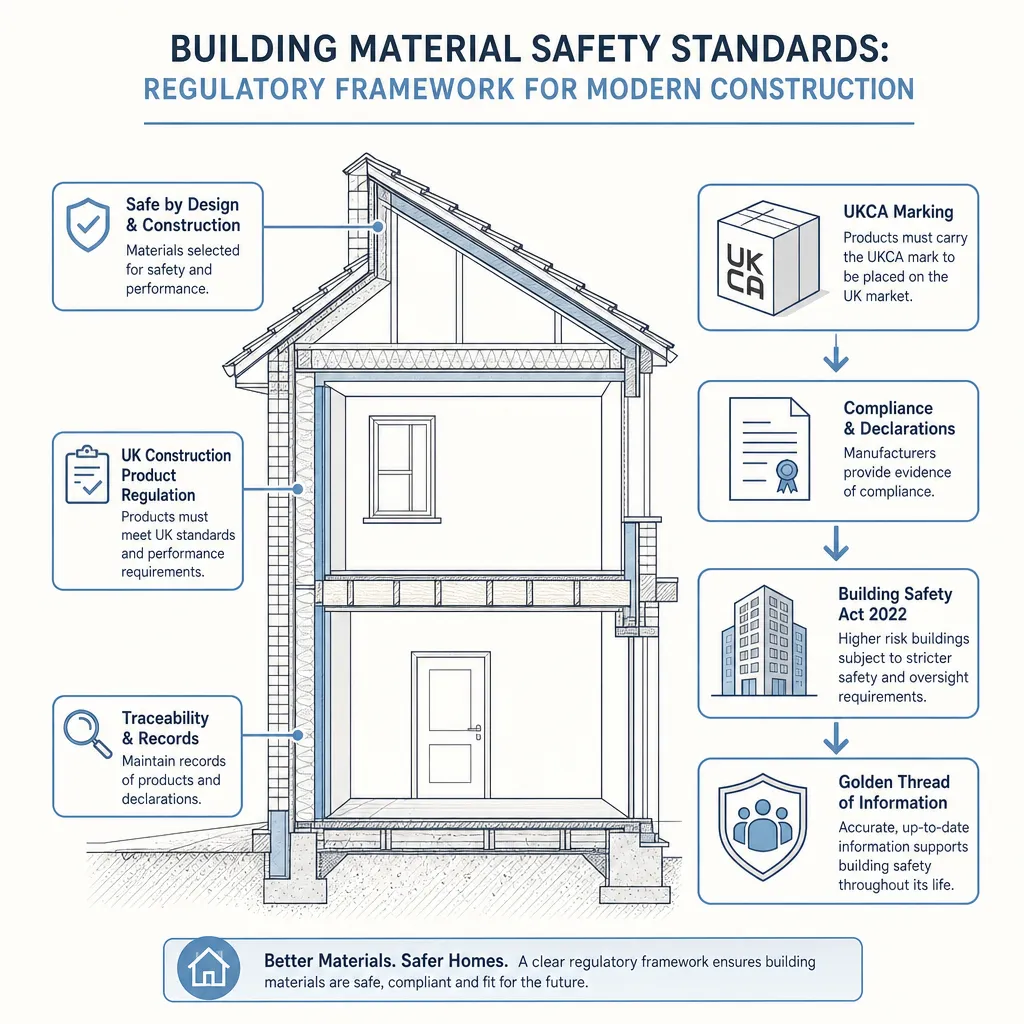
Building Material Safety Standards: Regulatory Framework for Modern Construction
UK building material safety standards are set through the Building Regulations 2010 and associated Approved Documents covering structure, fire, damp, energy, and ventilation.
 Planning & Pre-Build
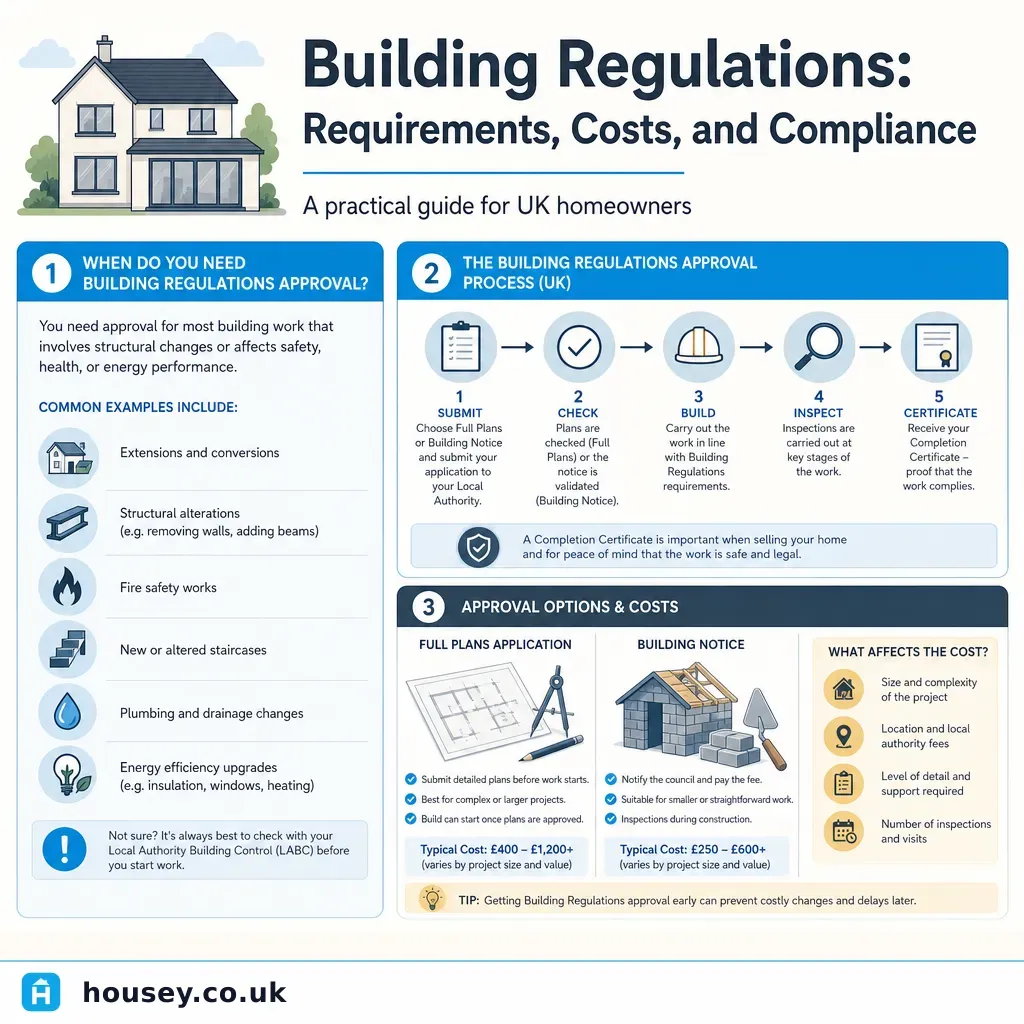
Building Regulations: Requirements, Costs, and Compliance
Building regulations set minimum standards for how construction work is carried out in the UK, covering structural stability, fire safety, energy efficiency, and ventilation.
 Planning & Pre-Build
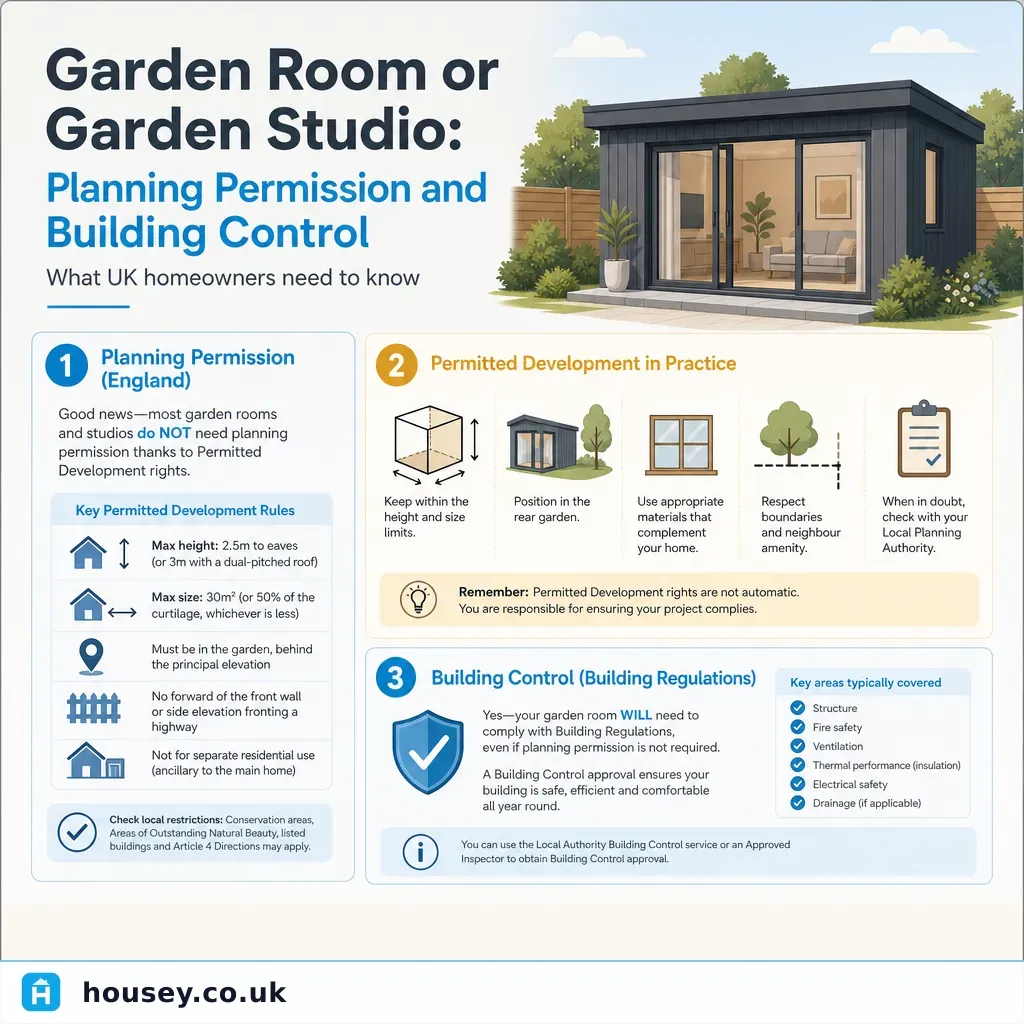
Garden Room or Garden Studio: Planning Permission and Building Control
A garden room or studio often qualifies as permitted development in England, meaning no planning application is needed — provided it occupies no more than 50% of the total curtilage, sits within height limits, and is not used as a separate dwelling.
 Planning & Pre-Build
Building Regulations: Finding Balance in Standards Updates and Compliance
Building regulations in England and Wales set minimum standards for construction, covering structure, fire safety, energy efficiency, and ventilation.
 Planning & Pre-Build
Understanding Building Regulations: Compliance, Approvals, and Your Project Requirements
Building regulations set minimum standards for design, construction, and alterations to buildings in England and Wales.